Manufacturing
October 15 2026
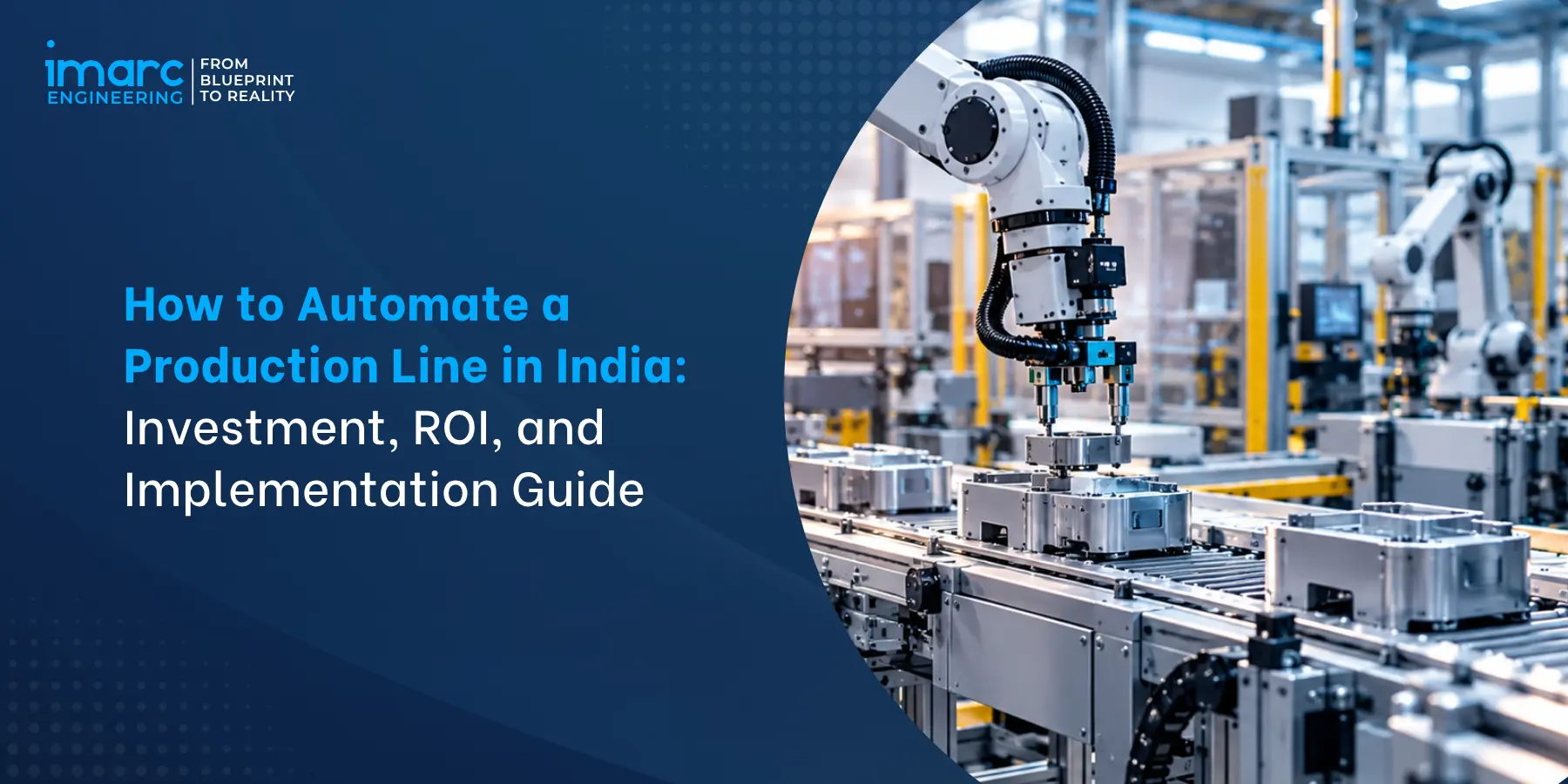
How to Automate a Production Line in India: Investment, ROI, and Implementation Guide
Introduction
For manufacturers, project sponsors and investors evaluating production line automation in India in 2026, disciplined planning separates a defensible capital project from an expensive experiment. Automation is rarely a single purchase; it is a programme spanning constraint analysis, technology selection, integration, commissioning and post-implementation validation.
India's manufacturing base is expanding across automotive components, electronics assembly, pharmaceuticals, food processing and engineering goods, and each segment presents a different automation economics. This guide is written for readers who must justify every rupee of investment to a board or a lender, not for readers seeking a general introduction to Industry 4.0.
Scope of this Guide
This guide answers the sponsor's guiding question directly: How can manufacturers in India evaluate production line automation opportunities, estimate investment costs and ROI, select suitable automation technologies, and implement automation projects without significantly disrupting existing manufacturing operations? It covers automation readiness assessment, process selection, technology alternatives, equipment compatibility, CAPEX and OPEX build-up, an assumption-based ROI calculation, vendor evaluation, integration, installation, commissioning and post-implementation performance validation. Coverage is deliberately narrow: automation investment and practical implementation for Indian plants, rather than a broad survey of Industry 4.0 or smart factory concepts.
Table of Contents
- Introduction
- Why Production Line Automation in India Matters for Manufacturers in 2026
- What Production Line Automation in India Means for a Manufacturing Plant
- Production Line Automation in India: Technology Selection and Capacity Planning
- Production Line Automation in India: Hardware, Software and Consumables
- Core Production Line Automation in India: Process
- Core Production Line Automation in India: Verification and Commissioning
- Production Line Automation in India: Machinery, Controls and Utilities
- Production Line Automation in India: Effluent, Licenses and Project Economics
- Conclusion
1. Why Production Line Automation in India Matters for Manufacturers in 2026
Four drivers make production line automation in India a board-level investment decision in 2026 rather than an upgrade of individual machines.
1.1 Import Dependence and Localization of Automation Hardware
Servo drives, safety controllers, machine vision cameras, high-payload robots and CNC controls are still predominantly imported from Europe, Japan, Korea and China, so landed automation cost moves with customs duty, freight, exchange rates and lead times that typically run 10–20 weeks (Figures are indicative in nature, may vary). Indian integrators increasingly build control panels, conveyors, guarding, fixtures and end effectors locally, which shortens delivery, simplifies spares and improves service response. Sourcing strategy therefore affects both capital cost and uptime across the asset's ten-year operating life.
1.2 Policy and Standards Framework
Government incentives for automation projects depend on the applicable scheme, industry, project location, investment category, and eligibility criteria. Relevant support may include sector-specific incentives, MSME programmes, credit facilities, and state industrial policies. SAMARTH Udyog Bharat 4.0 centers demonstrate Industry 4.0 adoption for Indian manufacturers. Technical compliance follows IEC 61131-3 programming practice, IEC 60204-1 electrical design and ISO 13849-1 machine safety.
1.3 Investment Ecosystem and Cost of Capital
Automation projects may be funded through internal accruals, term loans, equipment leasing, vendor finance or a combination of these. The financing structure depends on project cost, promoter contribution, projected cash flows, debt-servicing capacity, and lender requirements. Lenders appraise projects on demonstrated volume, contracted demand and realistic OEE assumptions rather than on equipment specification sheets. Sponsors should therefore prepare a benefit case built from their own measured cycle times, since lenders discount vendor-quoted productivity claims and require sensitivity analysis on volume and utilization.
1.4 The Cost of Poor Planning
Poorly sequenced automation creates stranded assets: a robot cell specified for volumes that never materialize, engineering change orders raised after factory acceptance testing, or a shutdown extended because legacy wiring was undocumented. Estimates that treat the equipment invoice as the project cost can understate controls, integration, safety systems, utilities, installation, training and production downtime. These costs should be estimated separately based on the project's scope, site conditions, and integration requirements. Measuring before buying is what separates a four-year payback from an abandoned project on the shop floor.
2. What Production Line Automation in India Means for a Manufacturing Plant
A production line automation project is defined by what is automated, at which level, and under what physical, volume and compatibility constraints.
2.1 Definition and Scope of an Automated Production Line
Production line automation is the replacement or augmentation of manual operations within a manufacturing sequence by controlled mechanical, electrical and software systems programmable logic controllers (PLC), variable-frequency drives, robots, conveyors, sensors, machine vision and supervisory software so that material flow, cycle time and quality become repeatable and measurable. Discrete assembly, machining, packaging, inspection and process control are all in scope. The unifying test is whether a defined, repeatable operation can be executed to a specified tolerance without continuous human intervention.
2.2 Automation Levels: Semi-Automated Versus Fully Automated Lines
Manufacturing systems can range from manual production to partial, semi-automated, and fully automated operations. Manual systems rely primarily on operator intervention. Partial automation automates selected tasks while retaining manual operations at other stations. Semi-automated lines combine automated equipment with defined manual activities such as loading, unloading, or inspection. Fully automated systems integrate production, material handling, controls and inspection with limited operator intervention.
2.3 Scale Determinants and Automation Readiness
Automation suitability depends on production volume, repetition, process stability, labour requirements, safety considerations, and expected financial returns. High-mix production may favour flexible automation, quick-change tooling or collaborative systems, while repetitive or hazardous operations may offer stronger automation potential. Readiness also depends on part presentation, process capability, drawing and tolerance clarity, equipment condition, and the plant's maintenance and integration capabilities.
2.4 Equipment Compatibility and Brownfield Constraints
Legacy equipment can often be integrated through suitable communication interfaces or gateways, but compatibility must be assessed case by case. The retrofit decision should consider equipment condition, controls architecture, communication capability, achievable cycle time and process tolerances, as well as available power, compressed air and other utilities. Where existing equipment cannot reliably meet process requirements, replacement may be more appropriate than automation retrofit.
2.5 Plant Sections
| Section | Function | Key Equipment |
|---|---|---|
| Raw material store | Incoming material staging | Bar feeders, hoppers, pallet racks |
| Machining and forming cell | Value-adding shaping operations | CNC turning centers, presses, robot tending |
| Assembly and joining station | Component consolidation | Robotic screwdriving, servo presses, weld cells |
| Automated material handling | Inter-station transfer | Conveyors, AMRs, gantry loaders |
| Inspection and test bay | In-line quality assurance | Vision systems, CMM, leak testers |
| Packaging and palletizing | Dispatch-ready packing | Case packers, palletizers, labellers |
| Controls and IT room | Real-time line control | PLC racks, SCADA servers, MES, switches |
| Utilities block | Power and motive media | Compressors, dryers, chillers, UPS |
| Tool room and maintenance | Tooling, spares, calibration | Tool cribs, calibration bench, spares |
| Effluent and waste handling | Treatment and disposal | Coolant treatment, oil separators, e-waste store |
3. Production Line Automation in India: Technology Selection and Capacity Planning
Technology selection follows volume, variety and process physics, while capacity planning converts demand into takt time, station cycle times and buffer sizes.
3.1 Fixed, Programmable, Flexible and Robotic Automation
Fixed or hard automation uses cam and linkage systems for very high volumes with minimal changeover, and is economical only where one product variant runs for years. Programmable automation built around PLC-controlled sequences and recipe management suits moderate variety. Flexible automation combines CNC machines, tool changers and robots to handle part families. Robotic cells and cobots dominate tending, assembly and palletizing. The volume-variety matrix, not vendor preference, should settle the choice.
3.2 Takt Time, Line Balancing and Capacity
Takt time is calculated by dividing available production time by customer demand. For example, a production line required to manufacture 1,200 units in 420 productive minutes must achieve a takt time of 21 seconds per unit. Station cycle times should be evaluated against this requirement to identify bottlenecks and balance workloads across the production line.
Buffer capacity should be determined based on process variability, equipment downtime, material flow and changeover requirements. Overall Equipment Effectiveness (OEE), calculated as availability, performance & quality, helps manufacturers assess production efficiency and establish realistic, project-specific capacity improvement targets.
3.3 Automation Readiness Assessment
Before investing in production line automation, manufacturers should assess the readiness of their existing processes, equipment and infrastructure. The assessment should examine process stability, production volumes, equipment condition, historical downtime, quality performance, machine compatibility, power and utility availability, and workforce capabilities.
Manufacturers should also evaluate whether existing machinery can support automation integration or requires modification or replacement. These findings help identify suitable automation opportunities, establish technical requirements, estimate investment needs and prioritize processes that offer measurable operational and financial benefits.
3.4 Cluster and Site Selection
Automation-heavy plants benefit from proximity to integrators, tooling suppliers and skilled automation technicians. Established clusters include Pune-Chakan and Ranjangaon for automotive components, Chennai-Sriperumbudur and Oragadam for automotive and electronics, Sanand and Halol in Gujarat, Manesar and Bawal in the National Capital Region, Bengaluru and Hosur for electronics and aerospace, Coimbatore for pumps and motors, and Rajkot for castings and machining. Site checks must confirm three-phase supply, floor loading capacity, headroom for gantries and cell guarding, and road access for heavy equipment.
4. Production Line Automation in India: Hardware, Software and Consumables
An automated line is a stack of controllers, drives, sensors, robots, software and safety hardware, and each layer carries specification ranges that directly determine cost and performance.
4.1 Controllers, Drives and Sensors
Line control typically uses Siemens S7-1500, Rockwell ControlLogix or Mitsubishi iQ-R class PLC CPUs handling 500–2,000 I/O points with scan times under 10 milliseconds, linked through Profinet, EtherNet/IP or EtherCAT (Figures are indicative in nature, may vary). Variable-frequency drives of 0.75–22 kW run conveyors and fans, while servo axes of 0.4–7.5 kW position tooling and gantries. Inductive, photoelectric and ultrasonic sensors rated IP67, preferably with IO-Link diagnostics, detect part presence, position, and throughput at each station.
4.2 Robots, Cobots and End Effectors
Six-axis articulated robots with 6–20 kg payload and repeatability near plus or minus 0.03 mm handle machine tending and palletizing; SCARA units at 3–6 kg suit high-speed assembly; delta robots reach 60–120 picks per minute. Collaborative robots can be suitable for applications where human-robot interaction is required, but the need for guarding, speed and separation measures, protective devices or other safeguards must be determined through a documented risk assessment and applicable safety standards.
4.3 Software Stack and Machine Connectivity
Supervisory control and data acquisition (SCADA) platforms managing 5,000–20,000 tags provide operator visibility; manufacturing execution systems aligned to ISA-95 and IEC 62264 handle work orders, genealogy and traceability; OEE dashboards, historians and recipe management sit above them. Connectivity uses OPC UA, MQTT, and industrial Ethernet, with network segmentation and IEC 62443 controls for cybersecurity. Software configuration, not license count, is where the majority of integration effort and cost actually sits.
4.4 Panels, Wiring, Safety Components and Spares
Control panels rated IP54 to IP65, built with IEC 60204-1 wiring practice, ferruled conductors, surge protection and segregated power and signal routing, form the backbone of reliable operation. Safety hardware includes safety PLCs or relays rated PL d, Category 3 under ISO 13849-1, emergency stops, light curtains, interlocked gates and two-hand controls. A spares holding of 3–5 percent of hardware value, with obsolescence tracking across a ten-year horizon, protects uptime (Figures are indicative in nature, may vary).
4.5 Vendor Evaluation, Technical Specifications and Support
Vendor selection should assess technical capability, relevant project experience, equipment compatibility, and long-term support rather than purchase price alone. The evaluation should consider comparable installations, system architecture, integration capability, technical documentation, service infrastructure, and availability of spare parts.
Technical and commercial bids should be evaluated against defined specifications covering equipment performance, controls, interfaces, safety requirements, utilities, installation and commissioning scope. Responsibilities for system integration should be clearly assigned between the automation vendor, equipment suppliers, plant team, and other contractors.
Factory Acceptance Testing (FAT) should verify agreed functions and performance before dispatch, while Site Acceptance Testing (SAT) confirms performance under actual plant conditions. Where appropriate, contracts should define performance guarantees, acceptance criteria, warranty terms, critical spares, software support and after-sales service requirements.
A clear vendor evaluation framework helps reduce compatibility risks and establishes accountability for integration, commissioning, and post-installation support.
5. Core Production Line Automation in India: Process Steps Part 1
The engineering sequence begins by measuring the existing line and ends with cells that are specified, integrated, tooled, and proven at station level.
5.1 Constraint Mapping and Cycle Time Study
The study opens with time and motion analysis, video-based cycle studies and value stream mapping across two to three weeks of production data (Figures are indicative in nature, may vary). Each station's cycle time is compared against takt, and downtime is classified through mean time between failures and mean time to repair. Scrap and rework are Pareto-ranked by station. The output is a ranked list of automation candidates where constraint relief, labor reduction or quality improvement is quantified rather than assumed.
5.2 Machine Tending and Gantry Loading
Robotic tending of CNC lathes, vertical machining centers and presses removes the most repetitive manual work in metalworking. Layout must reconcile robot reach of 1.4–1.8 m with machine door geometry, chip and coolant containment, and part turnover positions. Rail-mounted gantries serve several machines from one unit where cycle times permit. Tended part cycles typically run 45–90 seconds, with gripper change stations and double grippers allowing simultaneous load and unload (Figures are indicative in nature, may vary).
5.3 Conveyor Automation and Automated Material Handling
Modular belt, roller and indexing chain conveyors move parts at 5–30 m per minute with accumulation zones that decouple station stoppages, while escapements and orientation devices present parts consistently to robots. Automated guided vehicles and autonomous mobile robots with SLAM navigation handle 300–1,500 kg payloads between lines and stores, and mini-load automated storage buffers work-in-progress. Barcode or RFID tagging at every transfer point creates the traceability record the MES consumes (Figures are indicative in nature, may vary).
5.4 Robotic Assembly and Joining Cells
Assembly automation covers screwdriving with torque monitoring held within about plus or minus 5 percent of target, press-fit operations with force-displacement curve monitoring, adhesive dispensing with volumetric accuracy, and resistance or laser welding cells with fume extraction. Poka-yoke fixtures and vision-guided part location reduce the positional accuracy demanded from upstream processes. Tool changers and quick-release grippers let a single cell run several product variants without mechanical rework (Figures are indicative in nature, may vary).
6. Core Production Line Automation in India: Verification and Commissioning Part 2
Verification covers measurement, safety, installation sequencing and the performance run that ultimately proves the investment case to lenders and auditors.
6.1 Machine Vision and Automated Inspection
Area-scan GigE cameras of 2–5 megapixels running at 30–60 frames per second, combined with ring, bar or dome lighting and telecentric lenses, form the core of in-line inspection; reliable detection requires the smallest feature to span at least two to three pixels. Three-dimensional laser profilers verify gaps, heights and weld beads, while leak testers verify sealed assemblies at 0.5–2 bar. Gauge repeatability and reproducibility studies must show measurement error below 10 percent before vision limits are frozen (Figures are indicative in nature, may vary).
6.2 Safety Systems and Standards Validation
Machine safety begins with an ISO 12100 risk assessment. The required safety functions and performance levels should then be determined for each application based on the identified hazards, risk reduction requirements, and applicable standards. Industrial robot applications should be assessed against relevant robot safety standards, with collaborative applications subject to additional requirements where applicable. Safety distances are calculated from approach speed and total stopping time, then validated by physical measurement rather than simulation. Electrical design follows IEC 60204-1, with lockout and tagout procedures documented for every automated cell.
6.3 Installation, FAT/SAT and Production Continuity
Factory acceptance testing at the integrator's works covers cycle time, recipe handling, fault recovery and a four-to-eight hour endurance run before dispatch, and site acceptance repeats these tests under actual plant conditions. Brownfield installation should be planned around the plant's production schedule, equipment scope and required tie-ins. Shutdown duration should be established through detailed installation planning, pre-fabrication, pre-testing and identification of temporary production arrangements where required. FAT should verify the system before dispatch, while SAT should confirm installation and performance at the plant. Phased changeover can help limit production disruption.
6.4 Commissioning, Performance Validation and Training
Commissioning should progress from dry runs and functional checks to powered trials, production trials, and ramp-up. Acceptance criteria should be defined for each project based on agreed cycle time, quality, availability, safety, and other performance requirements. Operator and maintenance training should cover the installed controls, robotics, safety systems, troubleshooting and preventive maintenance, with the scope and duration determined by system complexity and project requirements. Performance validation should follow the agreed acceptance and warranty conditions.
7. Production Line Automation in India: Machinery, Controls and Utilities
Machinery selection, environmental control and utility capacity together determine whether an installed line ever reaches its design performance.
7.1 Automation Machinery and Cells
Core machinery includes CNC tending cells, robotic welding cells, pick-and-place and palletizing units, cobot assembly benches, vision inspection stations, laser marking systems, autonomous mobile robot fleets and mini-load automated storage. Specification should follow station duty cycle, payload, reach, repeatability and cleanliness requirement rather than price alone. Cells capable of running two or three product families materially reduce the risk of stranded capital when the product mix shifts during the asset's life.
7.2 Cleanroom, Temperature and Environmental Control
Environmental controls should be specified according to the manufacturing process, product sensitivity, equipment requirements, and applicable standards. Depending on the application, requirements may include temperature and humidity control, particulate management, ESD protection, ventilation or specialised cleanroom conditions. The required classification and operating parameters should be established through process and product requirements rather than applied as a standard automation requirement.
7.3 Utilities: Power, Compressed Air, Water and Gases
Utility requirements should be calculated from the selected equipment and production process. The assessment should cover electrical load and power quality, backup requirements, compressed air, water, cooling, gases, and other process utilities as applicable. Capacity should account for existing plant demand, new equipment requirements, future expansion, and required redundancy. Utility specifications should be confirmed during detailed engineering rather than based on generic automation benchmarks.
7.4 Layout, Material Handling and Machine Connectivity
Line layout follows product flow: straight-line for high volume, U-shaped for single-operator control, or a flexible manufacturing cell arrangement for high-mix work. Operator aisles of 1.2–1.6 m, AMR routes of 2.5–3m, and warehouse truck aisles of 4–6m are practical minimums (Figures are indicative in nature, may vary). Connectivity uses managed industrial Ethernet switches, Power over Ethernet for cameras and access points, and logical segmentation separating control, safety and enterprise traffic.
7.5 Key Machinery
| Category | Equipment | Illustrative Scale |
|---|---|---|
| Control and automation | PLC with remote I/O | 500–1,500 I/O points per line |
| Robotics | Six-axis articulated robot | 6–20 kg payload, 1.4–1.8 m reach |
| Robotics | SCARA or delta pick-place | 3–6 kg payload, 60–120 picks per minute |
| Material handling | Modular belt indexing conveyor | 5–30 m per minute, 100–500 kg per m |
| Machine vision | GigE area-scan inspection system | 2–5 megapixels, 30–60 frames per second |
| Automation software | SCADA with MES module | 5,000–20,000 tags, 6–10 week configuration |
| Safety systems | Safety PLC, light curtains | PL d, Category 3, SIL 2 |
| Utilities | Screw compressor with dryer | 6–7 bar, ISO 8573-1 Class 1.4.1 |
8. Production Line Automation in India: Effluent, Licenses and Project Economics
Environmental obligations, statutory approvals and a defensible cost model are the three parts of an automation project most consistently underestimated at concept stage.
8.1 Effluent, Hazardous Waste and E-Waste Management
Automation projects may generate limited additional environmental loads, but the impact depends on the manufacturing process and the equipment being installed. The DPR should assess any changes in wastewater, emissions, hazardous waste, used oil, coolants, batteries or electronic waste and compare them with existing consent conditions and applicable regulatory requirements.
Where modernization changes production capacity, process characteristics or waste generation, existing environmental consents and authorisations should be reviewed to determine whether amendments or additional approvals are required.
8.2 Licenses, Approvals and Compliance
Regulatory requirements depend on the nature of the automation project, manufacturing process, site, and changes to existing operations. Existing factory, environmental, electrical, fire-safety, hazardous-material, building and sector-specific approvals should be reviewed to determine whether the modernization requires amendments, additional permissions or no change.
Where applicable, projects may need to address pollution-control consents, electrical approvals, fire-safety requirements, PESO permissions for specified hazardous or petroleum products, and product or equipment certification under applicable standards. Sector-specific requirements may also apply to industries such as food, pharmaceuticals, and chemicals. The DPR should identify the approvals triggered by the proposed changes rather than treating them as universal requirements.
8.3 CAPEX and OPEX Composition
Total installed automation cost should be developed from the project scope rather than a standard percentage split. The estimate should separately identify equipment, controls and software, system integration, safety systems, engineering, installation, commissioning, civil and utility modifications, training, documentation, contingency and other project-specific costs. OPEX should similarly consider maintenance, spare parts, software support, energy, consumables, cybersecurity and specialist manpower. Equipment purchase price should be clearly distinguished from the total installed project cost.
8.4 ROI, Payback and Sensitivity Analysis
Net annual benefit should be calculated from project-specific assumptions, including labour redeployment, additional production contribution at the applicable contribution margin, quality improvements and energy savings, less incremental maintenance, software, consumables and other recurring costs. Payback is calculated by dividing the net installed project cost by the resulting annual net benefit.
For example, a brownfield machining and assembly retrofit with an installed cost of INR 2.8 crore may generate an illustrative net annual benefit of INR 72 lakh, comprising INR 25 lakh from labour redeployment, INR 40 lakh from additional production contribution, INR 15 lakh from quality improvements and energy savings, less INR 10 lakh in incremental maintenance and software costs. This produces a simple payback of approximately 3.9 years.
This is an illustrative project calculation, not an industry benchmark. Actual returns depend on plant-specific costs, production volumes, margins, quality performance and operating conditions. NPV and IRR should use a project-appropriate discount rate based on the financing structure, risk profile and applicable investment assumptions. Sensitivity analysis should test changes in volume, selling price, labour savings, project cost and operating costs.
8.5 Project Economics
Automation investment should be estimated from the defined process scope, equipment requirements and site conditions rather than a generic project-size range. The estimate should identify equipment purchase costs separately from controls, software, integration, engineering, safety systems, installation, commissioning, civil and utility modifications, training and contingency.
Equipment quotations, technical specifications, installation requirements, and vendor proposals should form the basis of the estimate wherever available. For early-stage feasibility, assumptions should be clearly identified and progressively replaced with supplier quotations and engineering estimates as the project develops.
Conclusion
Planning production line automation in India requires a project-specific assessment of the existing process, production requirements, technology options, equipment compatibility and total installed cost. Manufacturers should evaluate automation readiness using actual production data and select technologies based on volume, variety, process stability, safety, and financial feasibility.
Successful implementation also depends on detailed specifications, capable vendors, clear integration responsibilities, FAT and SAT, phased installation, appropriate safety measures, and project-specific commissioning criteria. A robust financial model should reflect measured benefits, recurring costs, implementation risks, and sensitivity to changes in production and investment assumptions.
By linking feasibility, engineering, vendor evaluation, implementation and commissioning, manufacturers can develop a more transparent and controlled automation investment case.
PURSUING A PRODUCTION LINE AUTOMATION PROJECT IN INDIA?
IMARC Engineering supports manufacturers, project sponsors and investors with automation readiness assessment, capacity and feasibility planning, plant layout and process flow design, equipment selection, utilities planning, vendor evaluation, integration and commissioning supervision, safety compliance, and capital investment planning. The advisory covers discrete assembly, machining, packaging, electronics and process lines, including constraint mapping, controls architecture, robotic cells, material handling, machine vision and MES integration, with project-specific infrastructure, training and performance validation planning.
→ Schedule a free production line automation scoping consultation with an IMARC specialist
Frequently Asked Questions
Production line automation is the use of PLCs, drives, robots, conveyors, sensors, machine vision and supervisory software to execute defined manufacturing operations repeatedly without continuous manual intervention. It covers machining, assembly, inspection, packaging and material handling, and its purpose is repeatable cycle time, consistent quality and documented throughput rather than merely replacing labor.
Repetitive, high-volume, hazardous or tolerance-critical operations give the strongest case: machine tending, welding, screwdriving, palletizing, pick-and-place, in-line inspection, packaging and material transfer. High-mix work suits collaborative robots and quick-change fixtures. Processes with unstable part presentation, undefined tolerances or very low annual volumes should first be stabilized and standardized before any automation is specified.
Production line automation costs are project-specific and depend on the number of stations, equipment, robots, controls, software, integration scope, safety systems, installation, utilities and site modifications. Equipment purchase price should be distinguished from total installed automation cost. A reliable estimate should be developed from defined technical specifications, supplier quotations, integration requirements, and project-specific engineering assumptions.
Robot payload and reach, number of stations, cycle time target, number of product variants, legacy machine compatibility, controls architecture, required safety performance level, cleanroom class, utility upgrades and integration engineering hours. Brownfield retrofits usually cost less than greenfield because civil and utility infrastructure already exists, but undocumented legacy wiring and missing logic often expand engineering scope.
Build the business case from measured production data, including cycle time, output, manpower, scrap, downtime and operating costs. Quantify labour redeployment, additional production contribution, quality improvements and energy savings, then deduct incremental maintenance, software, spares and consumables. Payback can be calculated by dividing total installed project cost by annual net benefit. NPV and IRR should use a project-appropriate discount rate, supported by sensitivity analysis for changes in volume, costs, investment, and operating performance.
A semi-automated line links automated cells but retains manual loading, unloading or inspection at defined stations, so labor content and cycle time still depend on operators. A fully automated line runs the complete sequence under operator supervision with automated transfer, inspection and fault recovery, delivering consistent takt and higher OEE potential, but requiring stronger technical maintenance capability.
PLC and safety PLC platforms, variable-frequency and servo drives, industrial robots and cobots, conveyors, autonomous mobile robots, 2D and 3D machine vision, sensors with IO-Link diagnostics, SCADA, MES aligned to ISA-95, historians, OEE dashboards, and OPC UA or industrial Ethernet connectivity, all protected by segmented networks under IEC 62443 cybersecurity controls.
Retrofit cell by cell where practical and align installation with the plant's production schedule. Use FAT, pre-assembly, pre-testing, temporary production arrangements, and buffer planning to reduce disruption. The required shutdown duration should be established from the installation scope, tie-ins, equipment configuration, and site conditions. Phased changeover can help contain production risk.
Inconsistent part presentation, undocumented legacy controls, unrealistic cycle time assumptions, under-specified safety systems, poor power quality and compressed air supply, shortage of technicians able to troubleshoot PLC and robot faults, interfaces between multiple vendors, and inadequate planning for spare parts and software obsolescence across a ten-year asset life.
Assess vendors on technical capability, relevant project experience, equipment compatibility, integration responsibility, engineering resources, safety competence, service infrastructure and after-sales support. Technical and commercial bids should be evaluated against defined specifications rather than price alone. FAT and SAT should verify agreed functions and performance, while contracts should define acceptance criteria, warranties, spare parts, performance guarantees and support obligations. Post-commissioning performance should be measured against the project-specific acceptance criteria.
Recent Post



Trusted by Industry Leaders
We partner with global enterprises and ambitious businesses across sectors to deliver operational excellence, strategic insights, and sustainable growth through integrated solutions.












Success in Their Words
Real feedback from clients across industries. Discover how our solutions delivered measurable impact and operational excellence.

I wanted to express my sincere appreciation for your efforts in handling this matter. Your dedication and commitment have been truly commendable, and it is evident that you have put in tremendous hard work and expertise into resolving the issues at hand. We are greatly interested in continuing our collaboration with you in the future, as your professionalism and reliability have made you a trusted partner. Thank you once again for your invaluable contribution. We look forward to strengthening our partnership ahead.

It has been a pleasure working with the IMARC team. The insights provided were structured, clear, and highly valuable, helping us strengthen both our technical and financial planning with confidence. We deeply appreciate the team’s professionalism, responsiveness, and attention to detail throughout the engagement. Every requirement was well understood and effectively incorporated, resulting in a comprehensive and actionable output. Overall, our experience has been excellent, and I would gladly recommend IMARC to organizations seeking a reliable research partner.

Your service is truly exceptional. Working with the IMARC team has been a seamless and professional experience. The clarity of communication, responsiveness to queries, and consistent support at every stage made the entire engagement highly efficient. The insights shared were well-structured, practical, and perfectly aligned with our requirements, helping us make informed decisions with confidence. Overall, the dedication and professionalism demonstrated by your team stand out, and I would be glad to recommend IMARC as a reliable and trustworthy research partner.

IMARC did an outstanding job in preparing our study. They were punctual, precise, and consistently responsive throughout the entire process. The team delivered all the data we required in a clear, well-organized, and highly professional format. Their strong attention to detail, combined with their ability to meet every deadline without compromising quality, truly set them apart. Overall, their reliability and commitment made them an exceptional partner for our project, and we would gladly work with them again in the future.

IMARC made the whole process incredibly easy from start to finish. Everyone I interacted with via email was polite, professional, and straightforward to deal with, always keeping their promises regarding delivery timelines and remaining consistently solutions-focused. From my very first contact, I appreciated the professionalism and support shown by the entire IMARC team. I highly recommend IMARC to anyone seeking timely, affordable, and reliable information or advice. My experience with IMARC was excellent, and I truly cannot fault any aspect of it.

I’d like to express my sincere gratitude for the excellent work you accomplished with the study. Your ability to quickly understand our requirements and deliver high-quality results under tight timelines truly reflects your expertise, exceptional work ethic, and unwavering commitment to your customer’s success. The professionalism and responsiveness you demonstrated throughout the process made a significant difference. Our entire team and company are incredibly thankful for your dedication, reliability, and support. Once again, thank you for your outstanding contribution.