Manufacturing
November 26 2026
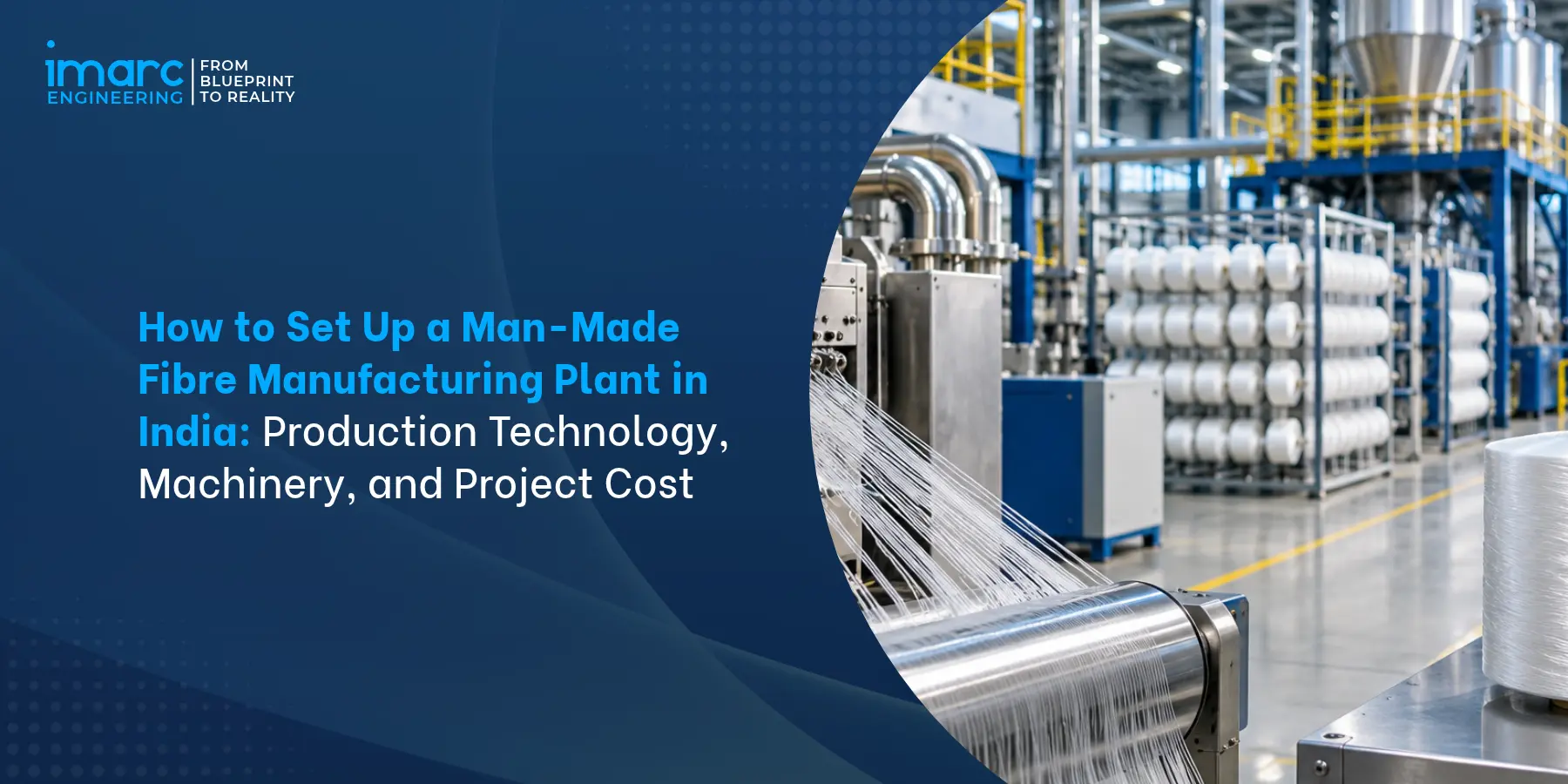
How to Set Up a Man-Made Fibre Manufacturing Plant in India: Production Technology, Machinery, and Project Cost (2026)
Introduction
For investors and manufacturers evaluating a man-made fibre manufacturing plant in India in 2026, the first decision is fibre category polyester, nylon, viscose, or lyocell because each has substantially different process technology, chemical handling, environmental footprint, and capital intensity. For synthetic fibres such as polyester and nylon, the next decision is whether to adopt chip-based melt spinning using purchased polymers or integrate polymerisation with fibre production.
Regenerated cellulosic fibres such as viscose and lyocell require separate cellulose preparation, dissolution, spinning and chemical or solvent recovery systems. These technology choices determine the plant's machinery, infrastructure, regulatory requirements and investment profile.
Scope of this Guide
This guide walks through man-made fibre plant setup from product selection through melt, wet, and dry spinning technology, machinery and raw materials, plant layout, utilities and environmental systems, regulatory compliance, quality control, CAPEX/OPEX, and DPR preparation calibrated to the Indian regulatory and policy framework in force in November 2026. Textile garment manufacturing and downstream weaving/knitting operations are distinct businesses covered elsewhere.
Table of Contents
-
Introduction
-
Why Man-Made Fibre Manufacturing Plant Setup in India Matters for Investors in 2026
-
Types of Man-Made Fibres and Product Selection for a Manufacturing Plant in India
-
Man-Made Fibre Manufacturing Process and Technology Routes for a Plant in India
-
Machinery, Equipment and Raw Materials for a Man-Made Fibre Manufacturing Plant in India
-
Land, Plant Layout, Utilities and Environmental Infrastructure for a Man-Made Fibre Plant in India
-
Regulatory Framework, Quality Control and Fibre Testing for Man-Made Fibre Manufacturing in India
-
CAPEX, OPEX, Working Capital and Financial Feasibility for a Man-Made Fibre Plant in India
-
DPR Preparation, Project Risks and EPCM Support for a Man-Made Fibre Plant in India
-
Conclusion
1. Why Man-Made Fibre Manufacturing Plant Setup in India Matters for Investors in 2026
Four drivers make disciplined MMF investment strategically important in India in 2026.
1.1 Demand Across Textiles, Technical Textiles and Industrial Applications
Man-made fibres serve apparel textiles, home furnishing, automotive interiors, industrial textiles (tyre cord, conveyor belts, geotextiles, filtration), medical textiles, and non-wovens. Growth in domestic consumption, exports, and technical textile applications supports disciplined investment in the man-made fibre industry in India, with a multi-segment customer base. Polyester dominates volume; nylon is speciality-driven; regenerated cellulosics are growing with sustainability positioning.
1.2 Policy Support Under PLI and PM MITRA
The Production Linked Incentive (PLI) Scheme for Textiles, notified by the Ministry of Textiles in September 2021, covers MMF apparel, MMF fabrics and notified technical textile products, including some speciality fibres. Conventional fibre and yarn plants are generally not eligible unless the project extends into notified products. Investment thresholds were halved from 1 August 2025 (Part-1 to INR 150 crore, Part-2 to INR 50 crore), and the latest application window closed on 31 March 2026, so check whether a new window is open.
The PM MITRA (PM Mega Integrated Textile Regions and Apparel Parks) scheme, approved in 2021, has seven park sites in Tamil Nadu, Telangana, Gujarat, Karnataka, Madhya Pradesh, Uttar Pradesh and Maharashtra offering plug-and-play infrastructure, and the National Technical Textiles Mission (NTTM) supports research and market development. State textile policies add capital subsidy, interest subvention and power-tariff support. Verify current eligibility before modelling any incentive, and treat incentives as upside rather than the basis of viability.
1.3 Chip-Based vs Integrated Economics
Chip-based melt spinning plants buy polymer and perform only spinning lower CAPEX, lower regulatory exposure, no polymerisation. Integrated plants perform polymerisation (PTA/MEG for polyester, caprolactam for nylon 6, HMDA/adipic acid for nylon 66) upstream of spinning substantially higher CAPEX, chemical-plant-grade safety, Environmental Clearance implications, but captures the full value chain and insulates against chip price volatility.
1.4 Environmental and Safety Discipline
Polyester melt spinning has a moderate environmental footprint. Viscose (regenerated cellulosic) uses carbon disulphide (CS2) under the Manufacture, Storage and Import of Hazardous Chemicals (MSIHC) Rules 1989 (as amended) and requires strict solvent recovery; viscose plants carry the highest environmental and safety discipline among the four fibre categories. Lyocell uses N-methylmorpholine-N-oxide (NMMO) in a closed-loop process and has a lower environmental footprint than viscose. Synthetic fibre manufacturing plant design must match the compliance envelope to the chosen fibre category.
2. Types of Man-Made Fibres and Product Selection for a Manufacturing Plant in India
Product selection is the first decision in MMF manufacturing plant planning. Synthetic fibres and regenerated cellulosic fibres have fundamentally different chemistry, process, and plant design.
2.1 Synthetic Fibres
Synthetic fibres are polymerised from petrochemical feedstocks. Polyester (polyethylene terephthalate, PET) is the largest-volume synthetic fibre, available as polyester staple fibre (PSF) for blending and spinning and polyester filament yarn (PFY/POY/DTY) for direct weaving. Nylon 6 is polymerised from caprolactam; nylon 66 from hexamethylenediamine and adipic acid. Nylon serves tyre cord, industrial filament, apparel, and carpet applications. Polypropylene (PP) is a third important synthetic for non-wovens, carpet, and industrial yarn.
2.2 Regenerated Cellulosic Fibres
Regenerated cellulosic fibres are produced from cellulose (wood-dissolving pulp). Viscose staple fibre (VSF) is the dominant commercial variant, produced via the viscose process using sodium hydroxide and carbon disulphide. Lyocell uses NMMO in a closed-loop dissolution process with lower environmental footprint. Modal is a modified viscose variant. These fibres are preferred for softness and moisture handling with growing sustainability demand.
2.3 Fibre Form Staple vs Filament
Staple fibres are short cut lengths (typically 32-100 mm) blended with other fibres and spun on textile ring frames. Filament yarns are continuous-length fibres wound onto bobbins directly from the spinning line and used in weaving, knitting, or industrial applications. Staple and filament lines use different downstream machinery tow stretchers and cutters for staple; take-up winders, texturising machines for filament.
2.4 Product Selection Logic
Product selection follows target customer (apparel, home, industrial, technical textile), feedstock access, environmental compliance appetite, available capital, and incentive eligibility. For first-time entrants, a polyester fibre manufacturing plant based on chip-fed spinning is the most common entry point moderate CAPEX, proven technology, strong domestic demand. Integrated polymerisation, nylon, and regenerated cellulosic plants carry higher CAPEX and specialised technology and are typically later-phase investments.
2.5 How to Set Up a Man-Made Fibre Manufacturing Plant in India: Step by Step
A man-made fibre plant is best developed in the sequence below, fixing product and capacity before technology and machinery.
| Activity | What to Decide or Deliver |
|---|---|
| Market assessment | Demand by segment, customer base, import competition, price trends |
| Product selection | Fibre category (polyester, nylon, viscose, lyocell) and form (staple or filament) |
| Production capacity | Tonnes per day, line count and product mix |
| Feedstock sourcing | Chips, monomers or dissolving pulp; supplier base and import exposure |
| Feasibility study and DPR | Project feasibility (technical, market and financial); bankable DPR |
| Technology licensing | Licensor or line supplier for polymerisation, spinning, viscose or lyocell |
| Site selection | Land, power, water, effluent discharge, logistics, textile clusters or PM MITRA parks |
| Approvals | Environmental Clearance where applicable, SPCB consents, factory licence, fire, MSIHC |
| Machinery procurement | Specifications, vendor evaluation, acceptance trials |
| Installation and commissioning | Erection, trial production, customer qualification, performance acceptance |
2.6 How to Select the Right MMF Production Technology
How investors can select the right MMF production technology: match the spinning route to the polymer chemistry first (melt spinning for polyester, nylon and polypropylene; wet spinning for viscose; dry-jet wet spinning for lyocell), then choose staple or filament by target customer, decide between chip-based and integrated operation by capital and feedstock access, and test licensor or vendor references at comparable scale. Compliance appetite matters as much as cost, because viscose and integrated polymerisation carry far heavier environmental and chemical-safety obligations than chip-based melt spinning.
3. Man-Made Fibre Manufacturing Process and Technology Routes for a Plant in India
The man-made fibre manufacturing process uses one of three principal spinning routes melt, wet, or dry chosen by polymer chemistry. Within each route, product-specific processes differ.
3.1 Three Spinning Routes
Melt spinning extrudes molten polymer through spinnerets, cooled by cross-flow air, drawn, and wound used for polyester, nylon, polypropylene (polymers that melt stably). Wet spinning extrudes polymer solution into a coagulating bath that regenerates the polymer into fibre form used for viscose and acrylic. Dry spinning extrudes polymer solution into a heated air column that evaporates the solvent, leaving the fibre used for cellulose acetate and some elastomeric yarns. Lyocell uses dry-jet wet spinning: cellulose dissolved in NMMO is extruded through an air gap into an aqueous bath, with very high solvent recovery in a closed loop.
Melt spinning in synthetic fibre production: polymer chips, or melt from continuous polymerisation, are melted, filtered and metered through spinnerets, cooled by cross-flow air, drawn to orient the molecules, and wound as filament or collected as tow for staple. Because it needs no solvent, it is the simplest synthetic fibre production process with the lightest environmental load of the three routes.
| Spinning Route | Principle | Typical Fibres | Key Plant Requirement |
|---|---|---|---|
| Melt spinning | Molten polymer extruded through spinnerets and cooled by air | Polyester, nylon, polypropylene | Chip drying, extruders, quench air, HVAC |
| Wet spinning | Polymer solution extruded into a coagulation bath | Viscose, acrylic | Chemical preparation, spin baths, solvent and effluent recovery |
| Dry spinning | Polymer solution extruded into heated air that evaporates the solvent | Cellulose acetate, spandex, some acrylic | Solvent recovery and flammable-solvent safety |
| Dry-jet wet spinning | Solution extruded through an air gap into a bath | Lyocell | Closed-loop NMMO recovery |
3.2 Polyester Fibre Process
Polyester chip-based spinning starts with PET chip receipt (purchased or produced in-house via PTA-MEG polymerisation), drying to remove residual moisture, melting in an extruder, filtration, extrusion through spinnerets, cross-flow air quenching, application of spin finish, drawing to orient molecules, and either winding to filament (POY, FDY) or collection as tow for subsequent crimping, heat setting, and cutting into staple fibre (PSF). Draw-texturising of POY produces DTY for apparel. Integrated plants perform PTA-MEG polymerisation in continuous or batch reactors upstream of spinning, and continuous plants often feed melt directly to the spinning line (direct spinning), avoiding chip solidification, drying and remelting.
- Chip-based filament production: PET Chips → Drying → Melt Extrusion → Filtration and Metering → Spinning → Quenching → Spin Finish → Product-Specific Drawing and Winding.
- Direct melt spinning: Polymer Melt from Continuous Polymerisation → Melt Transfer, Filtration and Metering → Spinning → Quenching → Spin Finish → Product-Specific Drawing and Winding.
- DTY production: POY → Draw-Texturising → Winding → Packaging.
3.3 Nylon Fibre Process
Nylon chip-based spinning follows a similar melt-spinning sequence chip drying, extrusion, filtration, spinneret, quench, drawing, and winding or cutting. Nylon 6 is polymerised from caprolactam via ring-opening; nylon 66 from hexamethylenediamine and adipic acid via condensation. Nylon 66 melts at about 260 °C against about 220 °C for nylon 6, and its higher thermal stability suits tyre cord and airbag yarn; nylon chips are hygroscopic, so drying and moisture control are critical.
A nylon fibre manufacturing plant making industrial yarn must deliver high tenacity, whereas apparel nylon is tuned for softness. Integrated nylon plants adding polymerisation have higher chemical-handling and safety requirements.
- Illustrative nylon filament flow: Nylon 6 or Nylon 66 Chips → Drying → Extrusion → Melt Filtration → Spinning → Quenching → Spin Finish → Drawing → Winding → Texturising or Twisting (as required).
3.4 Viscose and Regenerated Cellulosic Process
A viscose fibre manufacturing plant starts with cellulose preparation from dissolving pulp: steeping in sodium hydroxide, pressing, shredding, ageing, and xanthation with carbon disulphide (CS2) to form sodium cellulose xanthate. The xanthate is dissolved in dilute sodium hydroxide to form the viscose solution, which is ripened, filtered and deaerated before being wet-spun into a coagulation bath of sulphuric acid, sodium sulphate and zinc sulphate that regenerates cellulose as fibre.
Downstream steps cover washing, desulphurization, bleaching where required, finishing, drying and cutting. CS2 recovery, H2S scrubbing and effluent treatment are central to viscose plant engineering. Lyocell instead dissolves pulp directly in NMMO and recovers the solvent in a closed loop, with a lighter environmental footprint.
- Illustrative viscose staple fibre flow: Dissolving Pulp → Steeping → Pressing and Shredding → Ageing → Xanthation (CS2) → Dissolution → Ripening, Filtration and Deaeration → Wet Spinning in Acid Bath → Stretching → Cutting → Washing and Desulphurisation → Finishing → Drying → Baling.
Lyocell production uses direct dissolution of cellulose in N-methylmorpholine-N-oxide (NMMO), followed by dry-jet wet spinning and cellulose regeneration. The process requires controlled dissolution, solvent recovery, purification and recycling systems.
llustrative lyocell staple fibre process flow:
- Dissolving Pulp → Pulp Preparation → NMMO Dissolution → Filtration and Deaeration → Dry-Jet Wet Spinning → Coagulation and Regeneration → Washing → Finishing and Cutting → Drying → Baling.
- NMMO recovery, purification and recycling operate as an integrated solvent recovery loop.
4. Machinery, Equipment and Raw Materials for a Man-Made Fibre Manufacturing Plant in India
An integrated fibre spinning plant machinery suite varies by fibre and spinning route. Core machinery families recur across polyester and nylon (melt-spinning) with distinct equipment for regenerated cellulosic processes.
4.1 Core Melt-Spinning Equipment
Core melt-spinning equipment for polyester and nylon includes chip silos and dryers, extruder with heated screw and barrel, candle filters or continuous screen changers for polymer filtration, metering (spin) pumps, spinning beam with spinnerets, quench cabinet with cross-flow air, spin finish applicators, godet rolls for drawing, winders for filament take-up (POY, FDY, industrial yarn), tow stretch-crimp-cut lines for staple fibre, bale press, and HVAC with humidity control throughout the spinning area.
4.2 Equipment Requirements by Plant Configuration
For a chip-based polyester or nylon plant, essential equipment is the extruder, spinning beam with spinnerets, quench, godets, and winders or staple line. Chip-based plants use purchased polymer feedstock and therefore do not require in-house polymerisation reactors. For viscose plants, essential equipment includes steeping press, shredder, xanthator, dissolving tanks, viscose filtration, spinning machines with coagulation baths, washing and desulphurisation lines, CS2 recovery system, and effluent treatment most steps cannot be outsourced without changing the business model.
The table below summarises man-made fibre production machinery by application and by the plant configuration that needs it.
| Machinery / Equipment | Application | Required For |
|---|---|---|
| Polymer chip silos and drying systems | Polymer storage and moisture control; crystallisation where required | Chip-based polyester and nylon plants |
| Extruder, melt filter and spin pumps | Melting, filtering and metering polymer | Extruders for chip-based plants; filtration and metering systems for chip-based and direct melt spinning |
| Spinning beam with spinnerets | Forming filaments | All melt-spinning plants |
| Quench cabinets (cross-flow air) | Cooling and solidifying filaments | All melt-spinning plants |
| Godets and high-speed winders | Drawing and take-up of POY, FDY, industrial yarn | Filament plants |
| Draw-texturising machines | Converting POY into DTY | Filament plants (where in scope) |
| Tow draw line, crimper, heat-setter, cutter, baler | Staple fibre production | Staple plants |
| Polymerisation reactors (PTA-MEG, caprolactam or HMDA/adipic acid) | In-house polymer production | Integrated synthetic fibre plants |
| Steeping press, shredder, xanthator, dissolvers | Cellulose preparation and viscose solution | Viscose plants |
| Dry-jet wet spinning equipment and coagulation baths | Filament formation and cellulose regeneration | Lyocell plants |
| CS2 recovery and H2S scrubbing systems | Emission control and solvent recovery | Viscose plants |
| NMMO dissolution and solvent recovery systems | Cellulose dissolution, solvent purification and recycling | Lyocell plants |
| Heat transfer medium system, chillers, HVAC | Beam heating, cooling, humidity control | According to process technology and utility requirements |
| QC laboratory instruments | Linear density, tenacity, elongation, crimp, shrinkage tests | All plants |
4.3 Raw Materials
| Raw Material / Input | Primary Use |
|---|---|
| PET chips (bottle/fibre grade) | Chip-based polyester melt spinning |
| PTA and MEG | Integrated polyester polymerisation |
| Nylon 6 chips (or caprolactam) | Chip-based (or integrated) nylon 6 |
| Nylon 66 chips (or HMDA + adipic acid) | Chip-based (or integrated) nylon 66 |
| Wood-dissolving pulp | Viscose and lyocell cellulose source |
| Sodium hydroxide, CS2 | Viscose process chemicals |
| Sulphuric acid, sodium sulphate, zinc sulphate | Viscose coagulation bath |
| NMMO solvent | Lyocell closed-loop process |
| Spin finish oils, additives, delustrants | Fibre lubrication and matting |
| Masterbatch colourants | Dope-dyed coloured yarn |
Feedstock supply depends on the fibre chosen. PTA, MEG and caprolactam are available from domestic petrochemical producers and imports, and the Quality Control Orders on PTA and MEG were rescinded in November 2025, easing import access. Dissolving pulp is often imported, so viscose and lyocell projects should plan long-term supply contracts and price hedging.
4.4 Water, Steam and Energy
MMF plants are energy-intensive. Electrical load supports extruders, godets, winders and HVAC in spinning halls where humidity and temperature are closely controlled. Steam from a boiler (gas, biomass or coal-fired) heats polymerisation reactors, dryers and process vessels, while a heat transfer medium system typically heats spinning beams and polymer lines. Cooling water serves heat exchangers and quench systems. Process water quality is critical for viscose (demineralised) and less critical for chip-based melt spinning. Disciplined utility sizing for a fibre spinning plant matches polymer throughput, line speed and HVAC load.
5. Land, Plant Layout, Utilities and Environmental Infrastructure for a Man-Made Fibre Plant in India
Facility layout and environmental infrastructure for a polyester fibre manufacturing plant or other MMF production are shaped by fibre category, integration model (chip-based vs integrated), and the compliance envelope of chosen chemistry.
5.1 Plant Layout
Material flow proceeds from feedstock storage (chip silos, pulp warehouse, or PTA/MEG tanks) to polymerisation reactors (integrated only), spinning hall with multiple lines, drawing and winding, texturising or staple cutting, and packing and finished goods. Spinning halls are temperature and humidity controlled with filtered-air HVAC. For viscose, additional zones cover steeping, xanthation (CS2 area), spinning baths, and solvent recovery.
How an MMF plant layout should be designed: follow one-way flow from feedstock to dispatch, keep the controlled spinning hall at the core, segregate chemical and solvent areas, and reserve space for additional lines. Land requirement should be derived from this zone-wise layout and the planned number of lines, rather than from a generic benchmark.
| Zone | Contents | Design Requirement |
|---|---|---|
| Feedstock storage | Chip silos, pulp warehouse or PTA/MEG tanks | Dry storage; bunded tanks for liquids |
| Polymerisation (integrated only) | Reactors, monomer handling | Chemical-plant safety distances |
| Spinning hall | Extruders, spinning beams, quench | Temperature and humidity control; multi-level structure |
| Drawing and finishing | Winders, texturising or staple line | Clean, controlled environment |
| Viscose chemical area | Steeping, xanthation (CS2), spin baths, recovery | Segregated, ventilated, explosion-protected |
| Packing and warehouse | Bale press, bobbin packing, finished goods | Next to dispatch with truck access |
| Utilities and ETP | Substation, boiler, chillers, effluent treatment plant | Separate from the process core; expansion space |
5.2 Utilities
Utilities include three-phase electrical supply with dedicated substation sized for extruders, godets, winders and HVAC compressors, DG backup for critical spinning loads (power interruption causes yield loss), steam from boiler for polymerisation and process heating, chilled and cooling water, compressed air, demineralised water for viscose, nitrogen for inerting where applicable, and HVAC with humidity control in spinning halls.
5.3 Environmental Infrastructure
Environmental infrastructure scales with fibre chemistry. Chip-based polyester and nylon plants have modest effluent and air emissions. Integrated polymerisation adds process effluent and vent management. Viscose plants carry the heaviest environmental load CS2 and H2S requiring scrubbing and recovery, acidic effluent from spinning baths, zinc and sulphur recovery, and solid waste. Each plant needs an effluent treatment plant sized to its chemistry, and viscose units may face zero liquid discharge or industry-specific discharge conditions through SPCB consents, so verify site-specific conditions.
5.4 Production Capacity Planning
How MMF production capacity is calculated: capacity is set in tonnes per day by polymer throughput and line count, then converted to annual saleable output using operating days, line efficiency and waste. Product mix matters, because finer deniers and filament grades run at lower throughput than coarse staple, and quality requirements for industrial yarn can limit line speed. The illustrative calculation below uses assumptions only.
| Parameter | Formula / Assumption | Result |
|---|---|---|
| Polymer throughput | Assumption: one staple line | 2,000 kg/h |
| Daily capacity | 2,000 kg/h × 24 h | 48 t/day |
| Installed capacity | 48 t/day × 330 operating days | 15,840 t/yr |
| Actual output | 15,840 × 90% line efficiency | 14,256 t/yr |
| Saleable output | 14,256 × (1 − 2% waste) | About 13,970 t/yr |
This illustration assumes that the 90% operating efficiency accounts for production time and throughput losses but excludes the separately applied 2% material loss. Actual saleable output should be established using equipment performance data, product specifications and a validated process mass balance.
Downstream equipment should be sized according to the maximum expected material throughput at each processing stage, considering operating schedules, intermediate storage, process losses and equipment availability. Saleable annual output should be used for revenue projections, dispatch planning and finished-goods inventory assessment.
5.5 Fire, Chemical and Hazardous Waste Safety
Fire and chemical safety is critical. Polymer dusts, polymer melt at high temperature, and solvent systems require fire detection, suppression, and emergency ventilation per NBC 2016 Part 4. For viscose plants, CS2 is highly toxic and flammable and falls under the Manufacture, Storage and Import of Hazardous Chemicals (MSIHC) Rules 1989 (as amended) with detailed on-site emergency plan, off-site emergency plan where applicable, and hazard identification per chemical safety provisions. Hazardous waste is managed under the Hazardous and Other Wastes (Management and Transboundary Movement) Rules 2016 (HOWM Rules) with disposal at an authorised TSDF.
6. Regulatory Framework, Quality Control and Fibre Testing for Man-Made Fibre Manufacturing in India
The regulatory stack for a synthetic fibre manufacturing plant combines factory, environmental, chemical-safety, hazardous-waste, and for export-oriented production customer-specification compliance.
6.1 Factory, Environmental and Chemical Safety
Factory licensing and occupational safety requirements must be assessed under the Occupational Safety, Health and Working Conditions (OSH) Code, 2020, and applicable state rules and transitional provisions. Manufacturers must obtain Consent to Establish (CTE) and Consent to Operate (CTO) from the respective State Pollution Control Board (SPCB), where applicable, under the Water Act, 1974, and Air Act, 1981. Pollution classification should be confirmed based on the manufacturing process, chemical usage and applicable CPCB and SPCB guidelines.
Prior Environmental Clearance (EC) applicability must be assessed under the EIA Notification, 2006, and its subsequent amendments. Under Schedule Item 5(d), rayon manufacturing is classified as Category A, while other covered man-made fibre manufacturing projects are classified as Category B, subject to applicable exclusions, including units involving extrusion of granules or chips. Integrated polymerisation facilities may attract additional requirements under relevant petrochemical or chemical manufacturing entries. The applicable project classification should therefore be confirmed based on the proposed manufacturing configuration.
Chemical safety requirements under the Manufacture, Storage and Import of Hazardous Chemicals (MSIHC) Rules, 1989, must be assessed according to the chemicals handled, quantities stored and applicable regulatory thresholds. Particular attention is required for carbon disulphide (CS₂) in viscose manufacturing and hazardous chemicals used in integrated polymerisation facilities. Labour and social security compliance, including EPFO and ESIC registration, should be assessed under the applicable provisions of the Code on Social Security, 2020.
| Requirement | Authority / Basis | Applicability |
|---|---|---|
| Factory licence | OSH Code 2020 and state rules | All plants above the factory threshold |
| Pollution control consents | SPCB CTE/CTO, Water Act, 1974, and Air Act, 1981 | According to the manufacturing process and applicable regulatory requirements |
| Environmental Clearance | EIA Notification, 2006, Schedule Item 5(d), and subsequent amendments | Category A for rayon and Category B for other covered man-made fibre projects, subject to applicable exclusions. Integrated polymerisation may attract additional requirements |
| Chemical safety | MSIHC Rules, 1989, and Chemical Accidents Rules, 1996 | According to hazardous chemical classification, activities and applicable threshold quantities |
| Hazardous waste | HOWM Rules 2016 | Sludge, spent oils and solvents, zinc-bearing waste |
| Fire safety | NBC 2016 Part 4 and applicable state fire safety rules | According to facility classification, process hazards and state requirements |
| Petroleum storage | Petroleum Act, 1934, and Petroleum Rules, 2002 | Where regulated substances and storage quantities trigger licensing requirements |
| Boiler registration | Boilers Act 2025 | Where a steam boiler is installed |
| Labour and occupational safety | OSH Code 2020; Code on Social Security 2020 | Safety systems, EPFO and ESIC registration |
6.2 Fire, PESO and Hazardous Waste
A Fire NOC under NBC 2016 Part 4 and state fire services rules covers polymer dust, melt handling, solvent systems and, for viscose, CS2 explosion risk. PESO licensing under the Petroleum Act 1934 and Petroleum Rules 2002 applies to flammable liquid storage above threshold quantities. The HOWM Rules 2016 cover polymerisation sludge, spent solvents, zinc-containing wastes from viscose and other categorised waste streams. Electrical inspectorate approval for HT installations and registration under the Boilers Act 2025 where a steam boiler is installed complete the stack.
6.3 Product Standards
BIS product compliance is targeted, not universal. In November 2025 the government rescinded several Quality Control Orders in this value chain, including those on PTA, MEG, polyester spun yarn, polyester filament yarn (including POY) and polyester industrial yarn (12 November 2025) and on viscose staple fibre (18 November 2025); the filament yarn withdrawal was challenged in the Gujarat High Court in 2026.
Check the current status for the specific product, including polyester staple fibre and nylon yarns, before launch. Export customers routinely require ISO 9001, OEKO-TEX Standard 100, ZDHC compliance and, for recycled polyester, the Global Recycled Standard. MMF manufacturing plant sponsors should verify current applicability for the planned product scope.
6.4 Fibre Quality Testing
Quality testing covers linear density (denier or tex) per ISO 1973, tenacity and elongation per ISO 5079 or bundle tests, intrinsic viscosity for polyester, spin finish (oil pick-up) level, fibre length and distribution (for staple), crimp count and crimp stability, moisture regain, shrinkage at specified temperatures, dyeability, uniformity by evenness tester, defect inspection, and for export-oriented production restricted substance testing per Oeko-Tex and brand-specific lists. Routine in-house QC with a periodic third-party audit is standard practice.
7. CAPEX, OPEX, Working Capital and Financial Feasibility for a Man-Made Fibre Plant in India
Estimating man-made fibre plant cost in India needs discipline. A single per-tonne CAPEX figure does not apply across polyester, nylon, viscose, and lyocell process complexity, environmental systems, and capital intensity differ substantially.
7.1 CAPEX Drivers
Primary CAPEX drivers are fibre category and integration model (chip-based vs integrated polymerisation; melt vs wet vs dry vs lyocell spinning), production capacity in tonnes/day, line count and configuration (filament vs staple, number of spinning positions), machinery automation level, utility infrastructure (dedicated substation, boiler, chillers, HVAC), environmental systems (modest for chip-based polyester, heavy for viscose with CS2 recovery), civil work with controlled-environment spinning halls, chemical storage with bunded containment, land, technology licensing fees, EPC margin, and a contingency provision sized to technology and scope risk.
7.2 OPEX Components
Primary OPEX components are feedstock (PET chips, nylon chips, dissolving pulp typically the largest OPEX component), process chemicals (CS2 and sulphuric acid for viscose; additives and masterbatch for synthetics), electrical energy (energy-intensive), steam fuel, consumables (spinnerets, filters, spin finish, packaging), skilled labour, maintenance, environmental compliance, insurance, and technology royalty if applicable. Feedstock price volatility is the dominant OPEX-risk variable.
The CAPEX and OPEX components a DPR should estimate are summarised below. Each should come from vendor quotations, consumption norms and tariffs for the specific project.
| CAPEX Components | OPEX Components |
|---|---|
| Land and site development | Polymer chips, dissolving pulp or other feedstock |
| Factory buildings and production infrastructure | Energy and utilities |
| Polymer processing or chemical preparation systems | Processing chemicals and additives |
| Fibre spinning and downstream processing lines | Labour |
| Electrical, cooling and utility systems | Maintenance and spare parts |
| Storage and material handling equipment | Packaging and logistics |
| Environmental control and treatment systems | Waste treatment and environmental compliance |
| Quality testing laboratory | Quality testing and laboratory consumables |
| Installation, commissioning and contingency | Start-up and trial-run operating expenses |
7.3 Working Capital
MMF manufacturing is working-capital intensive. Feedstock inventory, work-in-progress, finished goods (filament bobbins or staple bales), and receivables from textile mill and export customers on customer-specific credit terms stretch cash. Export letters of credit help certain customers. Incentive disbursement, where eligible, affects cash-flow timing. DPR projections should model working-capital days by customer segment.
7.4 Financial Feasibility
Financial feasibility combines CAPEX amortised over equipment life, OPEX with feedstock price assumptions, revenue by product and customer segment, working capital, incentives where eligible, and standard investment metrics (NPV, IRR, payback, DSCR) in line with lender appraisal norms. Man-made fibre plant investment sensitivity spans feedstock price (PTA/MEG for polyester, caprolactam for nylon, pulp for viscose), energy cost (significant OPEX impact), capacity utilisation, incentive realisation timing, and export currency. Base-downside-upside banding is central.
7.5 How Investment Varies by Fibre Type and Integration
A single MMF plant cost does not apply across polyester, nylon, viscose and lyocell. The table compares relative capital intensity without figures; actual CAPEX must come from vendor quotations and site data in the project DPR.
| Plant Configuration | Main Investment Drivers | Relative Capital Intensity |
|---|---|---|
| Chip-based polyester (PSF or filament) | Spinning lines, draw or texturising machines, HVAC | Lowest |
| Chip-based nylon filament | Spinning, drawing, winding, chip drying | Low to moderate |
| Integrated polyester | Continuous polymerisation, direct spinning, monomer storage | High |
| Integrated nylon | Polymerisation, monomer handling, chemical safety | High |
| Viscose | Chemical preparation, spin baths, CS2 recovery, large ETP | Highest, with heavy environmental systems |
| Lyocell | Dissolution, dry-jet wet spinning, NMMO recovery | High; technology licensing usually required |
7.6 Operational Challenges and Profitability Factors
What affects the profitability of synthetic fibre manufacturing: feedstock price volatility (PTA, MEG, caprolactam and pulp), energy cost, equipment utilisation, product consistency across lots, waste and by-product management, and competition from large integrated producers and imports. Fixed costs are heavy, so utilisation and product mix usually decide returns.
Profitability can be tested with three relationships:
Contribution per tonne = Selling price − Variable cost per tonne (feedstock, chemicals, energy, packaging, variable labour)
Operating profit = (Contribution per tonne × Saleable tonnes) − Fixed manufacturing, administrative and selling costs
Break-even volume = Fixed costs ÷ Contribution per tonne
8. DPR Preparation, Project Risks and EPCM Support for a Man-Made Fibre Plant in India
A disciplined man-made fibre plant DPR integrates technical, market, environmental, and financial planning into a lender-ready document that also supports incentive applications where eligible.
8.1 DPR Component Framework
What a man-made fibre plant DPR should include: the DPR should evaluate production capacity, raw material availability, technology licensing, product mix, operating costs, market demand, pricing assumptions, cash flow, IRR, NPV and DSCR, as set out below.
| DPR Component | What to Cover |
|---|---|
| Executive summary | Fibre category, capacity, integration model, location, investment objective |
| Market demand and pricing | Demand by segment, competition and imports, pricing assumptions |
| Target customers and applications | Apparel, home, industrial, technical textile, export mix |
| Product mix and specifications | PSF/PFY/POY/DTY/industrial yarn; nylon; viscose; lyocell |
| Annual production capacity | Tonnes/day, lines, operating hours, product-mix split |
| Raw material availability | Chips or PTA/MEG; nylon chips or caprolactam; dissolving pulp |
| Technology and licensing | Chip-based vs integrated; spinning route; licensor and fees |
| Machinery and equipment | Extruders, spinning beams, winders, cutters, utilities |
| Plant layout and utilities | Spinning halls, HVAC, boiler, chillers, substation |
| Utility consumption | Power, steam, water and HTM norms per tonne |
| Environmental infrastructure | Scaled to fibre chemistry; CS2 recovery for viscose |
| Quality assurance and testing | Fibre testing laboratory, specifications, customer approvals |
| CAPEX, OPEX, working capital | Vendor-quote CAPEX, operating costs, feedstock buffer |
| Regulatory and compliance | EC, SPCB, factory, fire, MSIHC, PESO, hazardous waste |
| Financial projections | Revenue, cash flow, IRR, NPV, DSCR, break-even, sensitivity |
| Implementation and risk | Technology transfer, feedstock supply, market cycles |
8.2 Key Project Risks
Primary risks include feedstock price volatility (PTA/MEG, caprolactam, dissolving pulp dominant OPEX impact), energy cost (electricity and steam are significant), customer qualification cycles for export and industrial yarn (duration varies by customer and product), CS2 safety management for viscose plants, polymer specification compliance for premium customer segments, incentive terms and realisation timing, and currency exposure on imported feedstock. Mitigation includes diversified feedstock contracts, forward cover where feasible, robust process control, redundant safety-critical equipment, and conservative financial banding.
8.3 EPCM Support
EPCM support covers feasibility, DPR with vendor-quote CAPEX, FEED and detailed engineering for spinning halls, HVAC, environmental systems and for viscose CS2 recovery infrastructure, machinery vendor evaluation and technology licensing coordination, SPCB CTE and Factory Licence coordination, Fire NOC and PESO and MSIHC compliance for viscose and polymerisation plants, construction supervision, mechanical and electrical installation, line commissioning, trial production, product qualification, incentive application support where applicable, and performance acceptance. EPCM is particularly valuable for integrated and viscose configurations with higher technology and compliance complexity.
8.4 Setup Checklist
Use the checklist below before committing capital and again before commercial production.
| Stage | Checklist Item |
|---|---|
| Planning |
|
| Pre-construction approvals |
|
| Pre-operation approvals |
|
| Procurement |
|
| Commissioning |
|
8.5 How IMARC Engineering Supports MMF Plant Setup
IMARC Engineering supports man-made fibre projects from feasibility through commissioning. Its scope covers feasibility studies, technology evaluation, process flow planning, machinery sourcing, plant layout, CAPEX and OPEX estimation, regulatory advisory and project implementation, scoped to chip-based, integrated, viscose or lyocell configurations.
Conclusion
An effective man-made fibre manufacturing plant in India starts with two decisions: the fibre category and the integration model. Polyester, nylon, viscose and lyocell differ substantially in process, environmental systems and capital intensity, and chip-based melt spinning carries far lower CAPEX and compliance exposure than integrated polymerisation or viscose.
The plant then needs machinery sized to line count and product mix, HVAC-controlled spinning halls, environmental systems matched to the chemistry, and approvals planned in parallel with engineering. A DPR built on vendor-quote CAPEX, feedstock sensitivity and verified product-specific compliance, rather than universal cost or certification assumptions, is what makes the project bankable.
PLANNING A MAN-MADE FIBRE MANUFACTURING PLANT IN INDIA?
IMARC Engineering supports investors and manufacturers with fibre and product selection, process technology, machinery specification, plant layout, utilities, environmental systems, regulatory coordination, DPR preparation, financial feasibility, and EPCM services. From equipment sourcing and project planning to commissioning and product qualification, our team provides end-to-end engineering support for polyester, nylon, viscose, and lyocell manufacturing projects.
→ Schedule a free man-made fibre plant scoping consultation with an IMARC specialist
Frequently Asked Questions
Man-made fibre plant setup requires fibre category and integration model selection, a DPR with vendor-quote CAPEX, land, Environmental Clearance where applicable, SPCB CTE, a factory licence under the OSH Code 2020, Fire NOC, PESO licence where solvent storage requires it, MSIHC compliance where applicable, feedstock contracts, machinery procurement and trial production.
Man-made fibre manufacturing process uses melt spinning (polyester, nylon, polypropylene), wet spinning (viscose, acrylic), or dry spinning (cellulose acetate), with lyocell using closed-loop solvent spinning. Each route covers polymer or solution preparation, extrusion through spinnerets, cooling or regeneration, drawing, and winding or cutting.
Man-made fibre production machinery for melt spinning includes chip dryers, extruders, polymer filtration, spinning beams, spinnerets, quench, godets, winders, draw-stretch-cut staple lines, and texturising machines with viscose plants adding steeping, xanthation, dissolving, filtration, spinning baths, washing, and CS2 recovery.
Polyester fibre manufacturing plant CAPEX depends on chip-based or integrated configuration, product form (PSF, POY, FDY, DTY, industrial yarn), production capacity, line automation, environmental systems, and site location. Universal per-tonne figures mislead project-specific vendor-quote-based estimation in a DPR is essential.
Polyester is a synthetic fibre melt-spun from PET polymer with moderate environmental footprint. Viscose is a regenerated cellulosic fibre wet-spun from dissolving pulp using sodium hydroxide and carbon disulphide with significant environmental and chemical-safety requirements under MSIHC Rules 1989 and distinct effluent management.
Polyester staple fibre manufacturing covers PET chip drying, melt extrusion, filtration, spinning through spinnerets, cross-flow quenching, spin finish, tow collection, drawing in a stretch line, crimping, heat setting, and cutting to staple length (typically 32-100 mm) before baling for dispatch to spinning mills.
A nylon plant requires chip drying, melt extrusion, filtration, spinneret and quench, drawing, winding (filament) or cutting (staple), HVAC-controlled spinning halls, utilities, and compliance with integrated plants adding caprolactam (nylon 6) or HMDA/adipic acid (nylon 66) polymerisation and chemical safety compliance under the MSIHC Rules where scheduled chemicals exceed thresholds.
Chip-based spinning buys polymer chips (PET or nylon) and performs only melt spinning downstream lower CAPEX, no polymerisation risk, limited compliance. Integrated polymerisation produces polymer in-house from monomers (PTA/MEG or caprolactam) substantially higher CAPEX, chemical-plant compliance including MSIHC, but captures full value chain.
Utilities include three-phase electrical supply for extruders and godets, DG backup, steam from a boiler, cooling water and chilled water, compressed air, demineralised water for viscose, nitrogen for inerting where applicable, and HVAC with temperature and humidity control in spinning halls.
Environmental approvals for man-made fibre manufacturing in India may include Consent to Establish (CTE) and Consent to Operate (CTO) from the respective State Pollution Control Board, prior Environmental Clearance under the EIA Notification, 2006, where applicable, and hazardous waste authorisation. Environmental Clearance applicability depends on the manufacturing process, project configuration and applicable exclusions, including those relating to extrusion of granules or chips. Chemical safety, emission control, effluent treatment and discharge requirements must also be assessed according to the selected fibre technology and site-specific regulatory conditions.
Recent Post

Trusted by Industry Leaders
We partner with global enterprises and ambitious businesses across sectors to deliver operational excellence, strategic insights, and sustainable growth through integrated solutions.







Success in Their Words
Real feedback from clients across industries. Discover how our solutions delivered measurable impact and operational excellence.

I wanted to express my sincere appreciation for your efforts in handling this matter. Your dedication and commitment have been truly commendable, and it is evident that you have put in tremendous hard work and expertise into resolving the issues at hand. We are greatly interested in continuing our collaboration with you in the future, as your professionalism and reliability have made you a trusted partner. Thank you once again for your invaluable contribution. We look forward to strengthening our partnership ahead.

It has been a pleasure working with the IMARC team. The insights provided were structured, clear, and highly valuable, helping us strengthen both our technical and financial planning with confidence. We deeply appreciate the team’s professionalism, responsiveness, and attention to detail throughout the engagement. Every requirement was well understood and effectively incorporated, resulting in a comprehensive and actionable output. Overall, our experience has been excellent, and I would gladly recommend IMARC to organizations seeking a reliable research partner.
Your service is truly exceptional. Working with the IMARC team has been a seamless and professional experience. The clarity of communication, responsiveness to queries, and consistent support at every stage made the entire engagement highly efficient. The insights shared were well-structured, practical, and perfectly aligned with our requirements, helping us make informed decisions with confidence. Overall, the dedication and professionalism demonstrated by your team stand out, and I would be glad to recommend IMARC as a reliable and trustworthy research partner.

IMARC did an outstanding job in preparing our study. They were punctual, precise, and consistently responsive throughout the entire process. The team delivered all the data we required in a clear, well-organized, and highly professional format. Their strong attention to detail, combined with their ability to meet every deadline without compromising quality, truly set them apart. Overall, their reliability and commitment made them an exceptional partner for our project, and we would gladly work with them again in the future.

IMARC made the whole process incredibly easy from start to finish. Everyone I interacted with via email was polite, professional, and straightforward to deal with, always keeping their promises regarding delivery timelines and remaining consistently solutions-focused. From my very first contact, I appreciated the professionalism and support shown by the entire IMARC team. I highly recommend IMARC to anyone seeking timely, affordable, and reliable information or advice. My experience with IMARC was excellent, and I truly cannot fault any aspect of it.

I’d like to express my sincere gratitude for the excellent work you accomplished with the study. Your ability to quickly understand our requirements and deliver high-quality results under tight timelines truly reflects your expertise, exceptional work ethic, and unwavering commitment to your customer’s success. The professionalism and responsiveness you demonstrated throughout the process made a significant difference. Our entire team and company are incredibly thankful for your dedication, reliability, and support. Once again, thank you for your outstanding contribution.