Manufacturing
September 24 2026
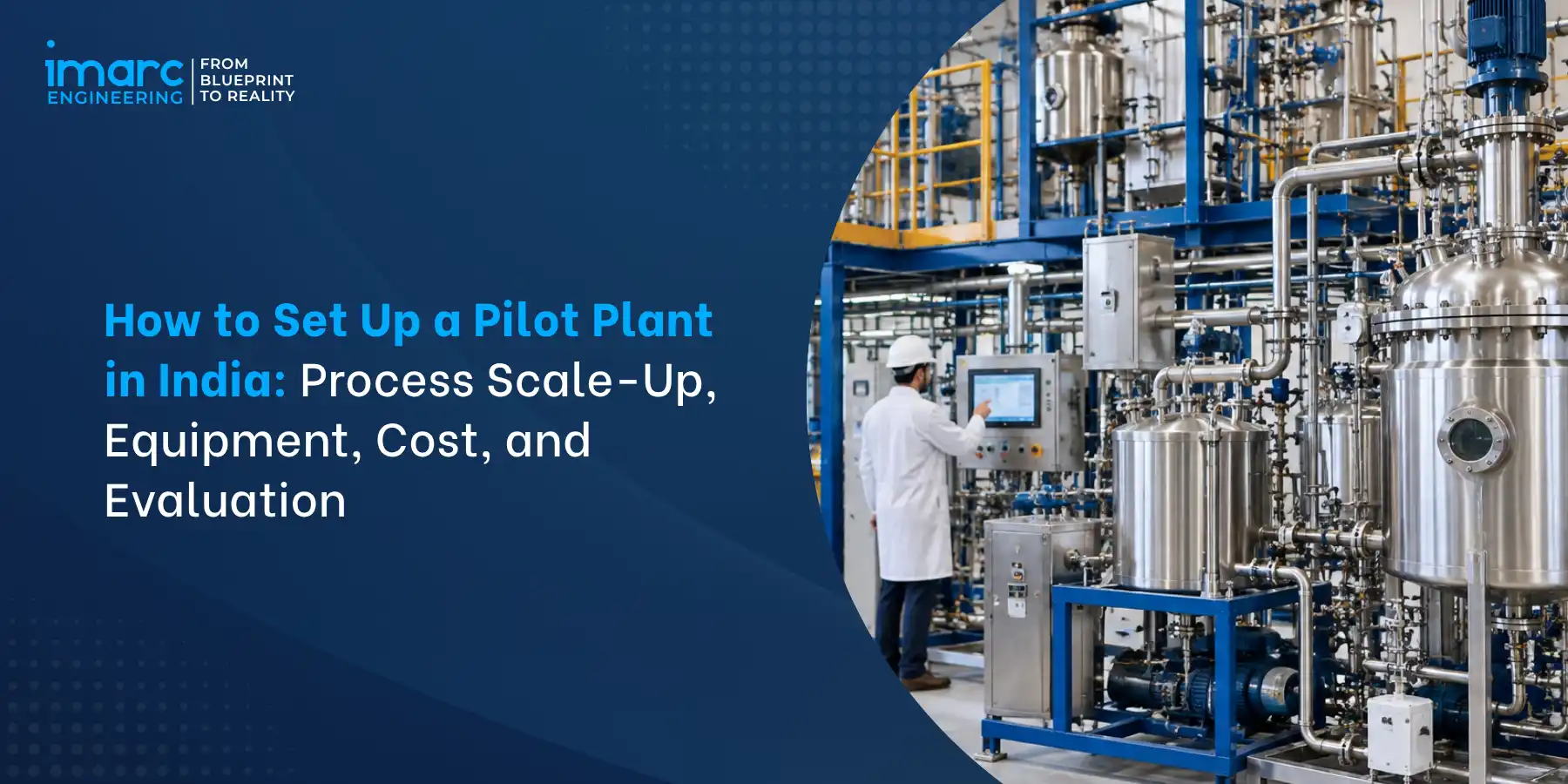
How to Set Up a Pilot Plant in India: Process Scale-Up, Equipment, Cost, and Evaluation
Introduction
For R&D teams, manufacturers, and project development teams planning pilot plant setup in India in 2026, the pilot plant serves as the critical engineering bridge between laboratory validation and commercial manufacturing. Well-designed pilot plants validate process technology, generate scale-up data, refine equipment specifications, verify safety controls, and support regulatory approvals - reducing commercial CAPEX risk and preventing costly retrofitting.
Regulatory framework depends on process, materials, and location (no universal pilot plant approval), typically involving OSH Code 2020 factory licence, SPCB consents, PESO/MSIHC where hazardous chemicals apply, and industry-specific approvals (CDSCO for pharma, FSSAI for food).
Scope of the Guide
This guide answers the sponsor's question directly. How can manufacturers use pilot plant in India to validate process technology, equipment, operating parameters, product quality, and project feasibility before scaling up to commercial manufacturing? It walks through scale-up objectives, process design translation, equipment sizing, utilities and instrumentation, trial campaigns, safety/regulatory considerations, CAPEX/OPEX drivers, and how pilot data supports commercial plant design - anchored to explicit project assumptions rather than universal ratios.
Table of Contents
- Introduction
- Why Pilot Plant Development Matters for Indian Manufacturers in 2026
- What a Pilot Plant is and Why It is Required in India
- Objectives and Role of a Pilot Plant in Laboratory to Commercial Scale-Up in India
- Scaling Up a Laboratory Process to Pilot Plant Equipment and Operations in India
- Equipment Sizing Utilities and Instrumentation for Pilot Plants in India
- Pilot Plant Trials Process Validation and Performance Evaluation in India
- Safety and Regulatory Considerations for Pilot Plants in India
- CAPEX OPEX and Using Pilot Plant Results for Commercial Manufacturing Plant Design in India
- Conclusion
1. Why Pilot Plant Development Matters for Indian Manufacturers in 2026
Four drivers make disciplined pilot plant development a strategic priority for Indian manufacturers and R&D teams in 2026.
1.1 Scale-Up Risk Reduction
Direct scale-up from lab to commercial without pilot-scale production carries substantial risk. Heat transfer, mass transfer, mixing, and reaction kinetics behave differently at scale. Lab conditions rarely reflect Indian operating realities - grid power fluctuations, groundwater chemistry variability, raw material inconsistency, and utility performance differences. Pilot plants validate process performance under India-representative conditions before commercial CAPEX commitment, revealing bottlenecks and issues that would surface expensively at full scale.
1.2 Regulatory and Business Case Validation
- Pilot plant testing serves multiple stakeholder needs
- Regulatory: pharma pilots generate Schedule M GMP validation data for CDSCO submission; food pilots support FSSAI licensing; agrochemical pilots support CIB&RC registration
- Business case: pilot data validates yields, cycle times, utility consumption, and OPEX assumptions for board-level investment decisions
- Engineering: pilot performance informs commercial equipment sizing, materials of construction, and utility specifications
- Technology transfer: pilot documentation supports handover from R&D to production teams with reproducible SOPs
1.3 Cost of Skipping Pilot Stage
- Commercial equipment retrofitting costs 3-10x new commissioning if scale-up issues surface post-commissioning
- Failed batches at commercial scale consume raw materials, utilities, and time with no revenue
- Safety incidents from unvalidated scale-up create regulatory shutdown risk
- Missed product specifications delay market entry and customer commitments
- Regulatory rejection of submissions without pilot validation extends approval timelines
1.4 India-Specific Considerations
Setting up a pilot production facility in India offers benefits and requires care. Benefits include lower CAPEX (INR terms), skilled engineering talent, access to Indian regulatory feedback for domestic products, and integration with existing manufacturing infrastructure. Care areas include India-representative raw material qualification (variable purity), utility reliability (power backup, water treatment), climate considerations (temperature, humidity for storage), and regulatory applicability assessment specific to process/materials/location - completed before design finalization rather than after.
2. What a Pilot Plant is and Why It is Required in India
Understanding what a pilot plant is and why it is required in India establishes the scope and role of pilot plants relative to laboratory and commercial operations.
2.1 Definition and Scale
- Industrial pilot plant: a small-scale replica of the intended commercial plant that produces representative product batches under engineering conditions
- Typical scale: reactor volume 100-2,000 L (illustrative), batch throughput 10-1,000 kg per batch
- Between kilo lab (10-100 L) and commercial plant (typically 5,000 L+) (illustrative)
- Runs the same unit operations as commercial in same sequence with same materials
- Instrumented for data collection - not just production but engineering measurement
2.2 Pilot Plant vs Lab vs Commercial
| Attribute | Laboratory (illustrative) | Pilot Plant (illustrative) | Commercial (illustrative) |
|---|---|---|---|
| Reactor size | 1-10 L | 100-2,000 L | 5,000-50,000+ L |
| Batch size | Grams-kg | 10-1,000 kg | Tonnes+ |
| Purpose | Chemistry discovery | Scale-up validation | Commercial output |
| Focus | Yield/selectivity | Engineering data | Production/OEE |
| Duration | Hours-days | Weeks-months | Continuous years |
| Instrumentation | Basic | Extensive | Production-optimized |
2.3 When Pilot Plant Is Required
- Pilot plant feasibility justified in these scenarios
- New chemistry or process technology without commercial reference
- Scale-up ratio 100x+ from lab to intended commercial
- Novel equipment/reactor type or unproven materials of construction
- Regulatory requirement (pharma CDSCO, food FSSAI, agrochemical CIB&RC)
- High commercial CAPEX (INR 100+ crore) requiring investor de-risking
- Product commercialization requiring customer validation batches
- Not required for well-established chemistry with proven scale-up from similar operations
3. Objectives and Role of a Pilot Plant in Laboratory to Commercial Scale-Up in India
Understanding the objectives and role of a pilot plant in laboratory to commercial scale-up in India frames what the pilot programme must deliver as a business and engineering asset.
3.1 Primary Objectives
- Process validation under scale-up conditions - verify chemistry holds at pilot scale
- Technology validation for reactor type, separation method, drying, and utility integration
- Product quality confirmation at pilot batches under commercial-representative conditions
- Yield, cycle time, and material balance verification under stable operation
- Utility consumption (steam, chilling, power, water) measurement per kg product
- Safety data - runaway reaction envelope, pressure/temperature excursions, emergency handling
- Equipment performance verification and materials of construction validation
- Operability - cleaning, changeover, startup/shutdown, and manning requirements
3.2 Role in Technology Transfer
- Technology transfer from R&D to commercial production is a common pilot plant deliverable
- Standard Operating Procedures (SOPs) developed and validated during pilot campaigns
- Batch records and analytical methods refined for production use
- Operator training on process operation, safety, and quality control
- Cleaning validation protocols established for multi-product operations
- Regulatory documentation package (validation reports, stability data, DMF for pharma)
3.3 Business Case Deliverables
Beyond technical validation, pilot programmes generate hard numbers supporting commercial investment decisions. Realistic yield/OPEX numbers replace lab estimates. Utility consumption per kg feeds into commercial utility design. Cycle time defines commercial batch schedule. Material consumption informs raw material sourcing and inventory strategy. Quality data supports commercial specification setting. Together these numbers enable board-level CAPEX/OPEX/NPV/IRR analysis with defensible assumptions - the kind that survive due diligence and financial audits.
3.4 What a Pilot Plant Does Not Do
- Does not automatically prove economic viability - trials measure inputs/outputs but do not set market price
- Does not eliminate all scale-up risk - final commercial scale still requires disciplined engineering
- Does not replace lab R&D - lab still needed for chemistry optimization and troubleshooting
- Does not substitute for market validation - customer trials and product qualification separate exercise
- Successful pilot batches without usable engineering data provide limited scale-up value
4. Scaling Up a Laboratory Process to Pilot Plant Equipment and Operations in India
Understanding scaling up a laboratory process to pilot plant equipment and operations in India covers the engineering discipline of dimensional analysis, parameter scaling, and staged validation.
4.1 Dimensional Analysis
- Process scale-up uses dimensionless numbers to maintain process similarity across scales
- Reynolds number (Re) - characterizes flow regime (laminar/transitional/turbulent) for mixing and heat transfer
- Froude number (Fr) - characterizes agitation intensity (impeller tip speed to gravitational effects)
- Power number (Np) - relates agitator power consumption to fluid properties
- Peclet number (Pe) - characterizes convective vs diffusive transport
- Damköhler number (Da) - reaction rate vs mass transfer/flow rate
- Complete geometric similarity not always possible - engineering judgement on which parameters preserve
4.2 Scale-Dependent Parameters
Some parameters preserve across scale (scale-independent) while others change (scale-dependent). Scale-independent: concentration, temperature, reaction time, pressure, pH, catalyst loading. Scale-dependent: mixing intensity, heat transfer coefficient, mass transfer coefficient, hold-up time, agitator power per unit volume. Scale-up engineering focuses on maintaining critical scale-dependent parameters within acceptable ranges. Heat transfer is often the binding constraint - surface-to-volume ratio decreases with scale, reducing heat removal capacity per unit reactor volume.
4.3 Staged Scale-Up
| Stage | Reactor Volume (Illustrative) | Purpose |
|---|---|---|
| Laboratory | 1-10 L | Chemistry, yield, selectivity |
| Kilo lab | 10-100 L | Process refinement, kinetics |
| Pilot plant | 100-2,000 L | Engineering scale-up, validation |
| Commercial | 5,000-50,000+ L | Commercial production |
4.4 Common Scale-Up Challenges
- Scale-up study typically encounters predictable challenges
- Heat removal - exothermic reactions become harder to cool at scale; need larger jackets/coils or slower addition
- Mixing efficiency - complete mixing time longer at scale; dead zones can form in large reactors
- Mass transfer - gas-liquid and solid-liquid interfaces less efficient at scale
- Reaction selectivity - poor mixing creates concentration gradients affecting yield/impurity profile
- Impurity accumulation - concentration effects change at scale; new impurities may appear
- Sampling limitations - representative sampling from large volumes harder than lab
- Cleaning validation - scaled-up cleaning may not achieve lab-equivalent verification
4.5 Scale-Up Ratios
Scale-up ratios vary by industry and process. Pharma API typically scales 10-100x from kilo lab to pilot, then 5-50x pilot to commercial. Fine chemicals may scale 50-100x per stage. Continuous processes can scale more aggressively per stage. Bio-processes often more conservative due to sensitivity. There is no universal scale-up ratio - each process determines its own based on chemistry, equipment geometry preservation, and risk tolerance. Aggressive scale-up compresses timeline but increases commercial risk; conservative scale-up adds time but reduces commercial retrofit likelihood.
5. Equipment Sizing Utilities and Instrumentation for Pilot Plants in India
Understanding equipment sizing utilities and instrumentation for pilot plants in India covers the technical infrastructure that determines pilot plant capability and data quality.
5.1 Reactor Selection
- Pilot plant equipment reactor selection follows commercial chemistry
- Glass-Lined Reactor (GLR) 100-2,000 L for corrosive/acidic chemistry - matches commercial GLR
- SS 316L reactor 100-2,000 L for neutral to mildly reactive chemistry
- Hastelloy reactor for aggressive/chloride environments - expensive but validates commercial choice
- Pressure vessels for hydrogenation, high-pressure reactions - IBR-compliant
- Jacket/coil configuration matching commercial heat transfer approach
- Agitator type (anchor/turbine/hydrofoil) matching intended commercial design
5.2 Ancillary Equipment
- Distillation column for solvent recovery/product purification
- Filtration for solid-liquid separation
- Drying matching commercial method
- Solvent recovery mini-system 50-500 L/hr rate
- Storage tanks for raw materials, intermediates, products
- Pumps for transfer (chemical-resistant metallurgy matching process)
5.3 Utilities
| Utility | Typical Specification | Application |
|---|---|---|
| Steam | 3.5-10.5 bar | Reactor heating, distillation |
| Chilled water | 7-12°C | Condenser cooling |
| Brine | -20 to -40°C | Low-temp reactions |
| Compressed air | 6-8 bar dry | Instrumentation, pneumatic |
| Nitrogen | 99.9+% | Blanketing, inerting |
| Electricity | 50-200 kVA | Motors, controls |
| DM water | Ultra-pure | Process, boiler |
| Vacuum | 10-50 mbar | Vacuum distillation, drying |
5.4 Instrumentation and Controls
- Instrumentation and controls for pilot plants prioritize data collection for engineering scale-up
- Temperature: RTDs/thermocouples at multiple reactor points for gradient monitoring
- Pressure: transmitters with alarm and shutdown interlocks
- Flow: Coriolis, magnetic, or ultrasonic flow meters on critical streams
- Level: radar/guided wave for reactor and storage tanks
- Analytical: pH, conductivity, dissolved oxygen, ORP as needed
- In-line/at-line analytics: FTIR, Raman, HPLC for real-time reaction monitoring
- DCS or PLC-based control system with historian for full data capture
- Data logging supports material/energy balance calculation, kinetics analysis, and validation reports
6. Pilot Plant Trials Process Validation and Performance Evaluation in India
Understanding pilot plant trials process validation and performance evaluation in India covers the discipline of running pilot campaigns that generate actionable engineering data.
6.1 Trial Design
- Pilot trials designed around clear objectives and Design of Experiments (DoE)
- Initial commissioning trials establish baseline operability and equipment function
- Process characterization trials map operating envelope (temperature, pressure, addition rate, catalyst loading)
- Optimization trials identify best operating point balancing yield/quality/cycle time/cost
- Reproducibility trials (Multiple batches where appropriate) validate consistency
- Stress trials test excursion tolerance and safety margins
6.2 Parameters to Evaluate
| Category | Key Parameters | Purpose |
|---|---|---|
| Process yield | Molar/mass yield, selectivity | Commercial viability |
| Product quality | Purity, impurity profile, form | Specification compliance |
| Material balance | Inputs vs outputs, losses | Raw material planning |
| Energy balance | Steam, chilling, electrical consumption | Utility sizing |
| Cycle time | Batch duration, changeover | Capacity planning |
| Safety data | Temperature/pressure excursions | Commercial safety design |
| Waste generation | Effluent, emissions, solids | Environmental design |
6.3 Data Collection Discipline
- Data collection during pilot trials is often more important than the batches themselves
- Time-stamped process data (temperature, pressure, flow) via DCS/PLC historian
- Sample analytical data at defined intervals with chain of custody
- Material inputs weighed and logged per batch (raw materials, solvents, additives)
- Utility consumption metered per batch (steam kg, chilling TR-hr, electricity kWh)
- Operator observations and deviations logged in batch records
- Cleaning validation samples for CIP effectiveness
- Waste samples for effluent characterization (BOD/COD/TDS)
6.4 Performance Evaluation
Performance evaluation converts pilot data into commercial design inputs. Statistical analysis of reproducibility batches establishes yield/quality confidence intervals for commercial specifications. Material/energy balance closure validates measurement discipline. Process kinetics extracted from time-resolved sampling supports reactor sizing. Failure mode analysis from stress trials informs commercial safety systems. Scale-up factors calculated from pilot performance guide commercial equipment sizing. Documentation package - trial reports, statistical analysis, process description - becomes the foundation for commercial engineering design and regulatory dossiers.
7. Safety and Regulatory Considerations for Pilot Plants in India
Understanding safety and regulatory considerations for pilot plants in India requires industry-specific applicability assessment - no universal pilot plant approval framework exists.
7.1 Safety Design
- Safety assessment for pilot plants covers process, equipment, and site hazards
- HAZOP (Hazard and Operability) study during pilot design; re-verify before commissioning
- Process Safety Information (PSI) - thermodynamic data, reaction kinetics, thermal stability, toxicity
- Runaway reaction assessment via calorimetry (DSC, adiabatic) before pilot scale-up
- Pressure relief system sizing per API standards
- Emergency shutdown (ESD) systems on critical parameters
- Fire/gas detection with alarm and interlock
- Personal Protective Equipment (PPE) per hazard analysis
- Emergency shower/eyewash near hazardous operations
- Ventilation/scrubbing for VOC or toxic release
7.2 Regulatory Applicability
- No universal pilot plant approval framework in India - depends on process, materials, location, capacity
- OSH Code 2020 factory licence if crossing worker/power thresholds; Section 6 Factory Plan Approval before construction
- SPCB CTE/CTO where effluent/emissions generated (Water Act 1974 / Air Act 1981)
- PESO approvals for petroleum storage, pressure vessels, gas cylinders where applicable
- MSIHC Rules 1989 if hazardous chemical inventories cross Schedule thresholds
- CAEPPR Rules 1996 emergency response planning where MSIHC applies
- Fire NOC
- Environmental Clearance under EIA Notification 2006 - typically only for larger operations crossing thresholds
7.3 Industry-Specific Approvals
| Industry | Additional Approvals | Notes |
|---|---|---|
| Pharma API | CDSCO manufacturing licence | Schedule M GMP applies |
| Pharma formulations | State FDA licence, CDSCO | GMP + facility approval |
| Food/beverage | FSSAI State/Central Licence | Schedule IV GMP |
| Agrochemical | CIB&RC + State Insecticide | Under Insecticides Act 1968 |
| Chemicals | SPCB, PESO, MSIHC as applicable | Depends on materials |
| Cosmetics | State cosmetic mfg licence | Cosmetics Rules 2020 |
7.4 Regulatory Assessment Approach
Regulatory strategy for pilot plants requires applicability assessment specific to process, materials, and location - done before design finalization, not after commissioning. Skipping this leads to design changes, delayed startup, and rework costs. Applicability assessment identifies applicable central approvals (CDSCO, FSSAI, EIA, MSIHC, PESO), state approvals (SPCB, factory licence, fire NOC as per applicability), and local approvals (municipal, building), maps sequencing dependencies (some approvals require others as prerequisites), and estimates timelines. Larger pilots handling hazardous chemicals or requiring GMP compliance often need 6-12 months (indicative) for full approvals - this parallels or extends design/procurement timeline.
8. CAPEX OPEX and Using Pilot Plant Results for Commercial Manufacturing Plant Design in India
Understanding CAPEX OPEX and project economics for pilot plant setup in India alongside using pilot plant results for commercial manufacturing plant design in India closes the framework loop.
8.1 CAPEX Composition (Indicative in Nature, may vary)
| Configuration | Scale Assumption | Investment (INR) |
|---|---|---|
| Simple lab-scale | 10-100 L reactor, basic utilities | 25 lakh - 1 crore |
| Medium pilot | 100-1,000 L reactor, standard utilities | 1-5 crore |
| Complex/hazardous | 1,000-2,000 L, DCS, PESO/MSIHC | 5-15 crore |
| GMP-compliant pharma | GMP suites, clean rooms, QC lab | 10-25+ crore |
- Pilot plant cost in India composition typically breaks down as
- Process equipment (reactors, columns, filters, dryers): 30-45 percent
- Utilities (steam, chilling, air, nitrogen, DM, vacuum): 15-25 percent
- Instrumentation, DCS/PLC, analytical: 10-20 percent
- Safety systems (scrubbers, ESD, fire): 5-10 percent
- Civil/building/clean rooms (if GMP): 10-25 percent
- Engineering, commissioning, validation: 8-15 percent
8.2 OPEX Drivers
- Raw materials for pilot campaigns typically 40-60 percent of trial OPEX
- Utilities (steam, power, chilling): 10-20 percent
- Manpower (operators, engineers, analysts): 15-25 percent
- Analytical/QC: 10-15 percent
- Waste disposal and consumables: 5-10 percent
- Regulatory/documentation: 3-8 percent
8.3 Commercial Plant Design from Pilot Data
- Commercial-scale manufacturing design uses pilot data across multiple engineering deliverables
- Equipment sizing - scaled from validated pilot equipment using dimensionless numbers
- Utility sizing - scaled from pilot consumption per kg with commercial batch size
- Materials of construction - pilot-validated MOC applied at commercial scale
- Safety systems - scaled ESD, relief, and detection based on pilot risk data
- Process control strategy - DCS logic developed from pilot control experience
- Commercial batch records - refined from pilot batch records
- Operator training - pilot campaign creates training documentation and experienced trainers
8.4 Timelines (Indicative in Nature, may vary)
- Pilot plant commissioning typical timelines by complexity
- Simple lab-scale pilots: 6-12 months from decision to first batch
- Medium pilots with standard utilities: 12-18 months
- Complex/GMP-compliant/hazardous pilots: 18-30 months
- Regulatory approvals often on critical path - initiate early in project
Conclusion
Setting up a pilot plant in India requires structured scale-up from laboratory development to pilot and commercial stages, with equipment sizing, utilities, instrumentation, process data collection, safety engineering, and applicable regulatory compliance integrated into the design. Project costs and commissioning timelines vary based on process complexity, industry requirements, technology, and facility scale.
Three priorities are important for pilot plant sponsors. First, design instrumentation and data collection to generate useful engineering inputs for commercial scale-up. Second, assess regulatory requirements based on the process, materials, location, and industry before finalising the design. Third, use appropriate staged scale-up to reduce the risk of unvalidated commercial-scale assumptions and costly modifications later.
PURSUING PILOT PLANT SETUP AND EVALUATION?
IMARC Engineering’s pilot plant setup and evaluation advisory supports R&D teams, manufacturers, and project sponsors with process scale-up, pilot equipment selection, utilities planning, instrumentation, trial campaigns, data collection, process optimisation, safety engineering, and applicable regulatory assessments. The service also covers scale-up analysis, process validation, material and energy balances, and capital investment planning for pilot and commercial-scale facilities.
→ Schedule a free pilot plant setup and evaluation scoping consultation with an IMARC specialist
Frequently Asked Questions
A pilot plant is a small-scale replica between lab and commercial scale (typically 100-2,000 L reactor volume) that validates process technology, equipment, safety, yield, and product quality. It reduces commercial scale-up risks by revealing behaviour differences from lab and generating engineering data for full-scale design.
Pilot plant setup in India involves clear scale-up objectives definition, capacity/batch size selection, equipment sizing based on lab process, utilities/instrumentation design, safety/regulatory assessment (SPCB, OSH Code, PESO, MSIHC where applicable), procurement/fabrication, installation, commissioning, and disciplined trial campaigns generating scale-up data for full-scale commercial plant design.
Laboratory to pilot scale-up requires dimensional analysis (Reynolds/Froude numbers), maintaining critical parameters (mixing intensity, heat transfer, mass transfer), equipment geometry preservation where possible, and staged validation. Scale-up ratios typically 10-100x from lab to pilot; scale-independent parameters (concentration, temperature, time) preserved while scale-dependent (heat/mass transfer) engineered.
Pilot plant equipment typically includes reactor (100-2,000 L), distillation column, filter/dryer, tanks, pumps, and analytical instruments matched to lab process chemistry. Utilities: steam, chilling, compressed air, nitrogen, DM water, and electricity. Instrumentation and controls with DCS/PLC for temperature/pressure/flow monitoring supporting data collection and process validation.
Pilot plant trials evaluate process yield, product quality/purity, energy consumption, material balance, mass/heat transfer coefficients, cycle time, mixing efficiency, safety parameters, equipment performance, reproducibility across batches, operability, cleaning validation, and scale-up factors. Trials generate the engineering data required for commercial equipment sizing and CAPEX/OPEX estimation.
Pilot plant cost in India varies with capacity, industry, and complexity. Simple lab-scale pilots INR 25 lakh to 1 crore; medium pilots INR 1-5 crore; complex hazardous chemistry or GMP-compliant pilots INR 5-25+ crore. Cost depends on reactor size, materials, utilities, instrumentation, and regulatory compliance.
Pilot plant evaluation reduces commercial scale-up risks by identifying process bottlenecks, heat/mass transfer limitations, yield/purity gaps, safety concerns, and equipment issues before committing to full commercial CAPEX. It validates engineering assumptions, refines commercial equipment specifications, generates operator training data, and provides regulatory evidence for approvals.
Pilot plant results translate into commercial plant design through validated scale-up factors, refined equipment specifications, verified yield/energy/material balances for CAPEX/OPEX estimation, proven safety controls, product quality assurance, and regulatory dossier evidence. Commercial equipment sized using pilot data with appropriate scale-up ratios and engineering safety margins.
Recent Post




Trusted by Industry Leaders
We partner with global enterprises and ambitious businesses across sectors to deliver operational excellence, strategic insights, and sustainable growth through integrated solutions.












Success in Their Words
Real feedback from clients across industries. Discover how our solutions delivered measurable impact and operational excellence.

I wanted to express my sincere appreciation for your efforts in handling this matter. Your dedication and commitment have been truly commendable, and it is evident that you have put in tremendous hard work and expertise into resolving the issues at hand. We are greatly interested in continuing our collaboration with you in the future, as your professionalism and reliability have made you a trusted partner. Thank you once again for your invaluable contribution. We look forward to strengthening our partnership ahead.

It has been a pleasure working with the IMARC team. The insights provided were structured, clear, and highly valuable, helping us strengthen both our technical and financial planning with confidence. We deeply appreciate the team’s professionalism, responsiveness, and attention to detail throughout the engagement. Every requirement was well understood and effectively incorporated, resulting in a comprehensive and actionable output. Overall, our experience has been excellent, and I would gladly recommend IMARC to organizations seeking a reliable research partner.

Your service is truly exceptional. Working with the IMARC team has been a seamless and professional experience. The clarity of communication, responsiveness to queries, and consistent support at every stage made the entire engagement highly efficient. The insights shared were well-structured, practical, and perfectly aligned with our requirements, helping us make informed decisions with confidence. Overall, the dedication and professionalism demonstrated by your team stand out, and I would be glad to recommend IMARC as a reliable and trustworthy research partner.

IMARC did an outstanding job in preparing our study. They were punctual, precise, and consistently responsive throughout the entire process. The team delivered all the data we required in a clear, well-organized, and highly professional format. Their strong attention to detail, combined with their ability to meet every deadline without compromising quality, truly set them apart. Overall, their reliability and commitment made them an exceptional partner for our project, and we would gladly work with them again in the future.

IMARC made the whole process incredibly easy from start to finish. Everyone I interacted with via email was polite, professional, and straightforward to deal with, always keeping their promises regarding delivery timelines and remaining consistently solutions-focused. From my very first contact, I appreciated the professionalism and support shown by the entire IMARC team. I highly recommend IMARC to anyone seeking timely, affordable, and reliable information or advice. My experience with IMARC was excellent, and I truly cannot fault any aspect of it.

I’d like to express my sincere gratitude for the excellent work you accomplished with the study. Your ability to quickly understand our requirements and deliver high-quality results under tight timelines truly reflects your expertise, exceptional work ethic, and unwavering commitment to your customer’s success. The professionalism and responsiveness you demonstrated throughout the process made a significant difference. Our entire team and company are incredibly thankful for your dedication, reliability, and support. Once again, thank you for your outstanding contribution.