Manufacturing
September 25 2026
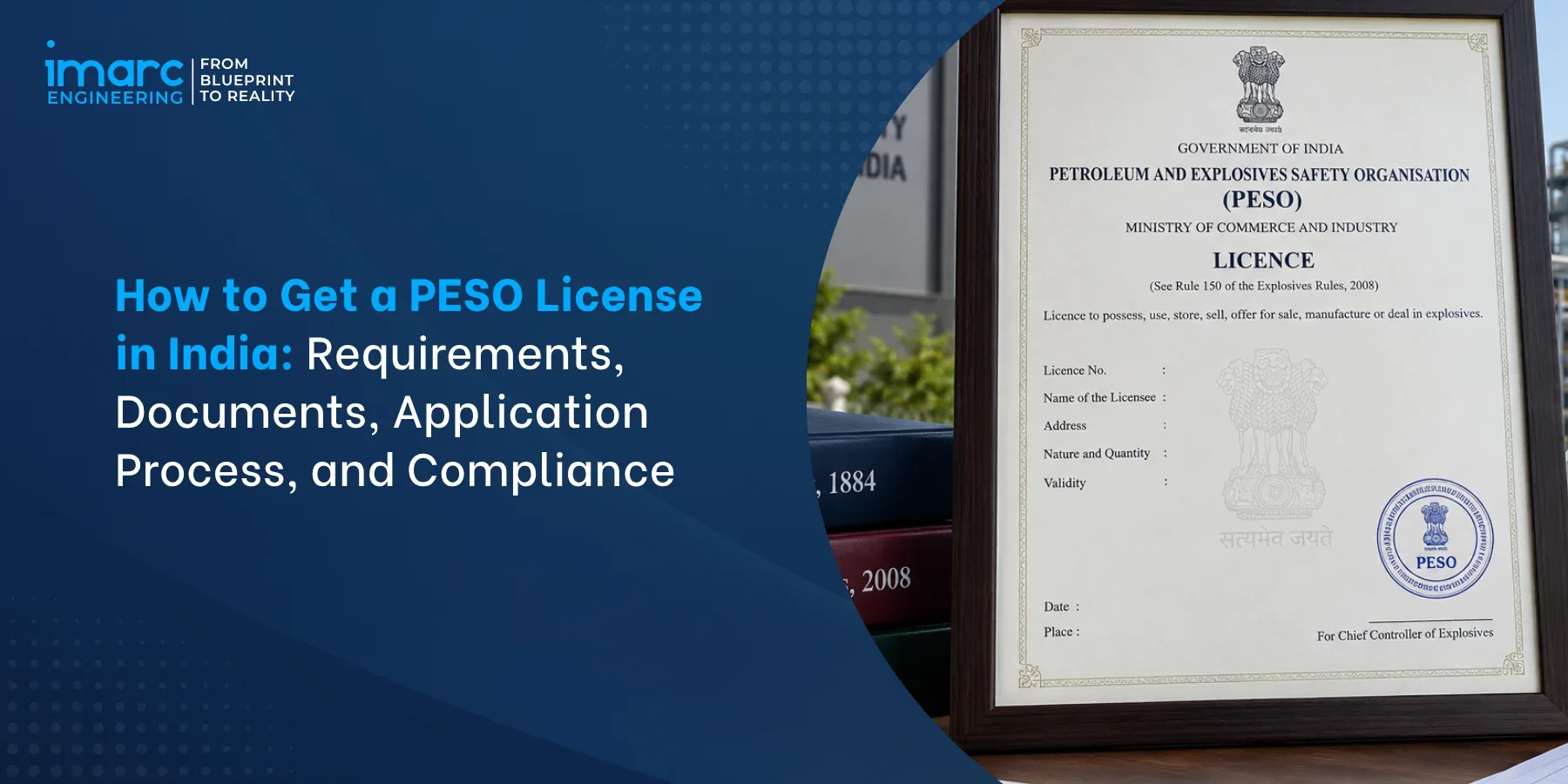
How to Get a PESO License in India: Requirements, Documents, Application Process, and Compliance
Introduction
For manufacturers, industrial project developers, and storage facility operators pursuing PESO license in India in 2026, disciplined understanding of the applicable rule, documentation, and compliance path is essential. "PESO licence" is an umbrella term - the actual approval, licence form, documents, safety requirements, NOC, fees, validity, and application process all depend on the regulated material (petroleum, compressed gas, pressure vessel, explosives), activity (storage, filling, manufacturing, import), quantity/storage configuration, and applicable rules. Recent Gas Cylinders (Amendment) Rules 2026 further reinforce the need to verify current requirements against the latest PESO notifications rather than older summaries.
Scope of this Guide
This guide answers the sponsor's question directly. How can manufacturers determine which PESO licence India they require and complete documentation, site-safety, application, inspection, and ongoing compliance? It walks through the rule identification framework (Petroleum Rules 2002, Gas Cylinders Rules 2016 with 2026 amendments, SMPV(U) Rules 2016, Explosives Rules 2008), documents and drawings required, NOC framework, online application via peso.gov.in, Chief Controller of Explosives scrutiny, and post-issuance compliance - anchored to rule-specific examples rather than universal claims.
Table of Contents
- Introduction
- Why PESO License Understanding Matters for Indian Manufacturers in 2026
- What a PESO License is and Who Needs It in India
- Industries and Activities That Require PESO Approval or Licensing in India
- Different Types of PESO Licences and Rule-Specific Approvals in India
- PESO License Requirements for Petroleum Storage Compressed Gas and Pressure Vessels in India
- Documents and Technical Drawings for PESO License Application in India
- PESO Online License Application Process and Chief Controller of Explosives Scrutiny in India
- PESO License Validity Renewal Amendment and Ongoing Compliance in India
- Conclusion
1. Why PESO License Understanding Matters for Indian Manufacturers in 2026
Four drivers make disciplined PESO licence understanding a strategic priority for industrial project sponsors and manufacturers in 2026.
1.1 PESO Cover Is Wider Than Assumed
Many industrial projects assume PESO compliance India applies only to petroleum retail or explosives manufacturers. In practice, PESO regulates petroleum storage (fuel depots, refinery installations), gas cylinder filling/storage (LPG bottling plants, industrial gas suppliers), pressure vessels for gases (LPG bullets, CNG cascades, ammonia storage), explosives (manufacture, storage, transport), calcium carbide, acetylene generators, fireworks, and cinematograph film. Any manufacturing plant storing petroleum products above threshold, compressed gases, LPG for utility use, or handling flammable/hazardous materials at scale likely needs some form of PESO approval.
1.2 Recent 2026 Regulatory Updates
PESO's regulatory framework continued to evolve in 2026. The Gas Cylinders (Amendment) Rules, 2026 and Second Amendment Rules, 2026 were notified, while PESO also invited stakeholder input for a broader review of the Acts and Rules it administers. In March 2026, PESO conducted a demonstration on online applications under the Explosives Rules, 2008. It also opened stakeholder consultation on draft SOPs and TORs under the SMPV(U) Rules, 2016 and continued processes for recognising competent persons.
1.3 Rule-Specific vs Generic Compliance
PESO requirements depend on the regulated material and activity, so there is no single generic "PESO licence." Petroleum, gas cylinders, pressure vessels, and explosives are governed by separate rules with different licensing, storage, testing, and approval requirements. Applicants should therefore identify the applicable rules and thresholds before selecting the licence or approval route.
1.4 Cost of Poor PESO Planning
Poor PESO planning can result in incorrect applications, additional documentation, site modifications, procurement delays, and interruptions when licences expire. Changes to storage capacity, site layout, equipment, or ownership may also require amendments or fresh approvals, depending on the applicable rules. Early review of regulatory requirements and site conditions can reduce the risk of rework and delays.
2. What a PESO License is and Who Needs It in India
Understanding what a PESO license is and who needs it in India establishes the scope and applicability of PESO regulatory framework.
2.1 PESO as Regulatory Authority
- Petroleum and Explosives Safety Organisation - apex regulatory authority for petroleum, explosives, gases, and related hazardous materials
- Under Department for Promotion of Industry and Internal Trade (DPIIT), Ministry of Commerce & Industry, Government of India
- Headquartered at Nagpur; headed by Chief Controller of Explosives (CCE)
- Network of regional and sub-circle offices across India for local licensing/inspections
- Unified online portal at peso.gov.in for applications, forms, notifications
- Advisory role to Ports, Railways, Defence, and other government bodies on hazardous material safety
2.2 PESO Under Multiple Acts
| Parent Act | Coverage | Key Rules Framed |
|---|---|---|
| Petroleum Act 1934 | Petroleum products | Petroleum Rules 2002 |
| Explosives Act 1884 | Explosives, gases, vessels | Explosives Rules 2008, Gas Cylinders Rules 2016, SMPV(U) Rules 2016 |
| Inflammable Substances Act 1952 | Inflammable substances | Related notifications |
2.3 Type of Approvals
PESO approvals in India can broadly be classified into two categories: Site/Activity Licences, which apply to the storage, filling, manufacturing, or use of regulated materials at a specific premises, such as petroleum storage, LPG bottling, explosives magazine, and pressure vessel licences; and Type/Design Approvals, which apply to products or equipment such as cylinders, valves, regulators, pressure vessels, Ex-electric apparatus, and dispensers.
Both types of approval may be required for a single facility. For example, an LPG plant may require a site-specific licence along with type-approved cylinders and valves. However, the transferability and validity of approvals vary by the applicable rule and approval category, so site licences and type approvals should not be treated as universally subject to the same conditions.
3. Industries and Activities That Require PESO Approval or Licensing in India
Understanding industries and activities that require PESO approval or licensing in India helps sponsors identify applicability early rather than post-facto.
3.1 Petroleum-Handling Industries
PESO licensing for petroleum storage and handling may apply to petroleum refineries, oil marketing company depots and terminals, retail petrol pumps and service stations, and manufacturing plants that use petroleum products such as solvents, thinners, or fuels above applicable thresholds. It may also cover underground petroleum storage installations, tank-truck operations, and the import or export of petroleum products, subject to the applicable Petroleum Rules and licensing requirements.
3.2 Compressed Gas and Cylinder Industries
Compressed gas and cylinder operations may require approvals under the Gas Cylinders Rules, 2016, including LPG bottling and distribution plants, industrial gas manufacturers, and suppliers of speciality gases such as medical, welding, and electronic gases. The framework may also apply to CNG dispensing stations, CBG facilities, recognised cylinder testing stations, cylinder manufacturers, and cylinder importers, depending on the activity.
3.3 Pressure Vessel Operations
PESO approvals under the SMPV(U) Rules, 2016 may apply to installations involving pressure vessels and certain liquefied gases. Examples include Auto LPG and Auto LNG dispensing stations, cryogenic liquefied-gas storage vessels operating above atmospheric pressure, bulk ammonia and chlorine storage vessels, CNG cascade installations, and bulk hydrogen storage systems.
3.4 Explosives and Related Industries
Explosives-related operations are regulated under the Explosives Rules, 2008 and may include explosives manufacturing, storage magazines, import and export, and transportation by licensed carriers. The regulatory framework also covers fireworks and pyrotechnics operations, while ammonium nitrate and calcium carbide are subject to their respective rules. Certain acetylene generator operations are also covered by applicable regulatory provisions.
3.5 Cross-Industry Applicability
Beyond dedicated petroleum/gas/explosives businesses, many manufacturing industries require PESO approvals as ancillary compliance. Chemical plants storing solvents in bulk (Class A/B/C petroleum) need PESO storage licence. Steel plants using industrial gases (oxygen, argon, acetylene) via cylinders or bulk vessels need Gas Cylinders/SMPV(U) approvals. Food/beverage plants using CO2 or nitrogen in bulk need PESO gas storage licence. Pharma plants with solvent storage or nitrogen blanketing systems need applicable PESO approvals. Data centres with bulk diesel storage need Petroleum Rules approvals. Applicability assessment should be part of any industrial project regulatory scoping.
4. Different Types of PESO Licences and Rule-Specific Approvals in India
Understanding different types of PESO licences and rule-specific approvals in India helps applicants identify the correct application form and framework.
4.1 Licences Under Petroleum Rules 2002
| Licence Type | Purpose | Rule Reference |
|---|---|---|
| Form XII | Import and storage of Petroleum Class A up to 300 litres in a storage shed or approved bin | Petroleum Rules 2002 |
| Form XIII | Import and storage of Petroleum Class B otherwise than in bulk, up to 25,000 litres | Petroleum Rules 2002 |
| Form XIV | Storage of petroleum in tanks connected with a pump outfit for fuelling motor conveyances | Petroleum Rules 2002 |
| Form XV | Import and storage of petroleum in an installation | Petroleum Rules 2002 |
| Form XVI | Import and storage otherwise than in bulk above specified quantities of Class A, B or C petroleum | Petroleum Rules 2002 |
| Form XI | Transport of petroleum by land on mechanically propelled vehicles | Petroleum Rules 2002 |
| Tank Testing Certificate | Certificate of tank testing | Rule 126 |
| Safety Certificate | Safety certificate for storage | Rule 130 |
| Refinery Approval | Petroleum refinery approval | Rule 162 |
4.2 Licences Under Gas Cylinders Rules 2016 (Amended 2026)
- Form G: Dispensing Compressed Natural Gas (CNG) as automotive fuel
- Form F: Filling and/or storing compressed gas in cylinders
- Type approval for cylinder designs, valves, regulators, pressure release devices
- Test Station recognition for cylinder testing/certification (CNG, hydrogen, nitrogen, CO2, ammonia, etc.)
- Rule 22: mandates CCE-approved Ex-Electric Apparatus in cylinder filling/storage premises
- Gas Cylinders (Amendment) Rules 2026 introduce updated provisions - verify current version
4.3 Licences Under SMPV(U) Rules 2016
- Petroleum and Explosives Safety Organisation license under Static and Mobile Pressure Vessels (Unfired) Rules 2016
- Licence for pressure vessel storage of compressed gases
- Rule 29: Auto LPG and Auto LNG dispenser type approval
- Rule 31: CCE-approved Ex-Electric Apparatus in premises
- Rule 46(a): NOC from District Authority for compressed gas storage (other than non-flammable, non-toxic)
- Recognition of Competent Persons for design/inspection under SMPV(U) Rules
- Licence validity maximum 3 years ending 31 March
4.4 Type/Design Approvals
- PESO certification India for type/design approvals (product-level)
- Cylinder designs and configurations
- Valves and regulators for gas cylinders
- Pressure release devices
- Pressure vessel designs (LPG bullets, CNG cascades)
- Ex-Electric Apparatus for hazardous areas (IECEx test reports)
- Auto LPG/LNG dispensers
- Composite CNG dispensing units
- Type approvals typically valid pan-India for 5-year cycle
5. PESO License Requirements for Petroleum Storage Compressed Gas and Pressure Vessels in India
Understanding PESO license requirements for petroleum storage compressed gas and pressure vessels in India covers site, safety, and technical requirements common across major rule categories.
5.1 Site and Layout Requirements
- Site layout requirements per applicable rule
- Land ownership or lease documents
- Land use certificate from local authority
- Approved site plan showing storage locations, dispatch/receiving areas, and adjacent land use
- Safety distances per rule-specific tables (Fourth Schedule of Petroleum Rules 2002 for petroleum installations)
- Buffer zones from residential/institutional areas
- Access roads for emergency response and fuel/gas transport
- Adequate space for expansion where operations may scale
5.2 Safety Distances
Safety distances vary by rule, licence class, and quantity/storage capacity. Petroleum Rules 2002 specify distances from tanks to boundary, public places, sources of ignition, and between tanks - varying by Class A/B/C and quantity. Gas Cylinders Rules 2016 specify separation distances for cylinder storage/filling from public places and boundary. SMPV(U) Rules 2016 specify distances for pressure vessels by gas type and capacity. Explosives Rules 2008 specify quantity distances for magazines. Universal safety distance claims should be avoided - always identify the applicable rule and licence category before determining requirements.
5.3 Approved Drawings
- Approved drawings form the technical backbone of PESO applications
- Site plan showing plot boundary, storage locations, distances, buildings, roads
- Storage tank/vessel drawings with dimensions, materials, capacities
- Piping and instrumentation diagrams (P&IDs) for critical systems
- Electrical layout showing Ex-hazardous area classifications and Ex-equipment locations
- Fire safety layout with hydrants, extinguishers, alarms, foam systems
- Drainage and containment (dyked areas for petroleum)
- Drawings signed by Chartered Engineer/qualified professional
5.4 Ex-Electric Apparatus
- Rule 22 Gas Cylinders Rules 2016: mandates CCE-approved Ex-Electric Apparatus in premises
- Rule 31 SMPV(U) Rules 2016: same Ex-Electric requirement for pressure vessel premises
- Fourth Schedule Petroleum Rules 2002: hazardous area classification for petroleum installations
- Selection per Equipment Protection Level (EPL) as defined in relevant IS standards
- Approval from CCE Nagpur for Ex-electric equipment (indigenous manufacture or imported)
- Documentation: IECEx test report, general assembly drawing, technical specifications
6. Documents and Technical Drawings for PESO License Application in India
Understanding documents and technical drawings for PESO license application in India covers the documentation package required for successful application processing.
6.1 Common Documents Across Rules
- PESO license documents typically required regardless of rule (subject to rule-specific additions)
- Application form
- Applicant identity documents (PAN, Aadhaar for individuals; incorporation documents for entities)
- Land ownership deed or long-term lease agreement
- Land use certificate from local planning authority (industrial/commercial zoning)
- Site plan/layout drawing to scale with all storage locations marked
- Storage tank/vessel drawings with material specifications
- Electrical layout showing hazardous area classification
- Fire safety plan and equipment layout
- Statutory fees payment proof
- Financial capability proof (for larger installations)
6.2 Rule-Specific Documents
| Rule | Additional Documents |
|---|---|
| Petroleum Rules 2002 | Tank calibration cert, Fire NOC, District NOC |
| Gas Cylinders Rules 2016 | Type approval for cylinders, valves, dispensers |
| SMPV(U) Rules 2016 | District Authority NOC (Rule 46(a)), vessel design |
| Explosives Rules 2008 | DM NOC, Police clearance, security plan |
| Type Approval | Design specifications, IECEx report, test data |
6.3 Technical Drawings
- Technical documentation requirements
- Site plan showing plot with dimensions, boundary, and adjacent land use
- General arrangement drawing showing all storage/process locations
- Storage tank/vessel drawings with dimensions, capacity, material of construction, design code (IS 803, IS 2825, ASME Section VIII)
- Piping and instrumentation diagrams (P&ID) for storage/dispensing systems
- Electrical single-line diagram and hazardous area classification map
- Fire safety and emergency response layout
- All drawings signed by Chartered Engineer (Mechanical/Chemical) with valid registration
6.4 NOC Requirements
Understanding NOC requirements and safety distances for PESO license approval in India covers a critical dependency that often delays approvals when overlooked. NOC (No Objection Certificate) requirements vary by rule and locality. Depending on the installation and location, applicants may need a District Authority NOC under Rule 46(a) of the SMPV(U) Rules, 2016 for applicable compressed-gas installations, a District Magistrate NOC for explosives licences, and a Fire NOC from the competent State Fire Services authority.
Other approvals may include local-body or municipal land-use clearance, SPCB Consent to Establish where applicable, and NOCs from airport, Coast Guard, or port authorities for installations near restricted zones. The format and documentation requirements for these NOCs may vary by the issuing authority.
7. PESO Online License Application Process and Chief Controller of Explosives Scrutiny in India
Understanding PESO online license application process and Chief Controller of Explosives scrutiny in India covers the application submission and regulatory review workflow.
7.1 peso.gov.in Portal
- PESO license online workflow through unified peso.gov.in portal
- Unified single portal for all rules (Petroleum, Gas Cylinders, SMPV(U), Explosives)
- User registration with mobile/email verification
- Applicable rule and form selection
- Digital document upload (PDF format typically; drawings in specified format)
- Statutory fee payment via integrated payment gateway
- Application tracking with real-time status
- Digital licence issuance and download post-approval
7.2 Application Process Steps
- Step 1: Determine applicable rule and licence category via preliminary assessment
- Step 2: Prepare site drawings, technical documents, and obtain applicable NOCs
- Step 3: Register user on peso.gov.in and select correct application form
- Step 4: Fill application details and upload documents/drawings
- Step 5: Pay statutory fees (varies by rule and licence category)
- Step 6: Submit for scrutiny by respective office
- Step 7: Respond to queries raised during scrutiny within stipulated time
- Step 8: Undergo site inspection by PESO officer
- Step 9: Address inspection observations and provide compliance documentation
- Step 10: Receive digital licence for download; commence licensed operations
7.3 CCE Scrutiny
- Chief Controller of Explosives office at Nagpur handles
- Type/design approvals (cylinders, valves, dispensers, Ex-electrical apparatus)
- Approval of Competent Persons and Test Stations
- Central-level licences (major installations, refinery approvals)
- Regional/sub-circle offices handle location-specific licences
- Scrutiny checks completeness, technical adequacy, safety compliance, NOC validity
- Query resolution typically requires responses within 15-30 days
7.4 Site Inspection
After document scrutiny is completed, PESO schedules the site inspection. The inspecting officer verifies that the facility matches the approved drawings, including safety distances and Ex-electric equipment. Fire-safety systems, drainage, and containment arrangements are also inspected. The officer may review on-site documentation such as approved drawings, calibration certificates, and test reports. Minor observations may require a compliance response, while major deficiencies may lead to re-inspection.
8. PESO License Validity Renewal Amendment and Ongoing Compliance in India
Understanding PESO license validity renewal amendment and ongoing compliance in India covers post-issuance obligations often missed at licence application stage.
8.1 Validity Periods
| Rule/Licence | Typical Validity | Renewal Notes |
|---|---|---|
| SMPV(U) Rules 2016 | Max 3 years, ending 31 March | Apply by 2 March of expiry year |
| Petroleum Rules 2002 | 1–3 years typical | Renew before expiry |
| Gas Cylinders Rules 2016 | Varies by licence type | Verify current amendments |
| Explosives Rules 2008 | Varies by category | LE-specific renewal cycle |
| Type Approvals | 5-year cycle typical | Renewal with updated tests |
8.2 Renewal Process
PESO licence renewal requires timely application and continued compliance. Renewal applications are submitted through the PESO portal before expiry, with applicable fees and updated safety documentation, test certificates, and calibration records. For SMPV(U) licences, the renewal application must reach the renewing office by 2 March of the licence expiry year. Depending on the licence category, a site inspection may also be required. Late renewal can attract penalties, while prolonged lapse may require a fresh licence.
8.3 Amendments
A PESO licence may need to be amended when there are changes to the licensed operations, such as increased storage capacity, changes to site layout, expansion, or the addition of new products or gases. Changes in the constitution of the licensee may also require regulatory action, subject to applicable transferability provisions. Changes involving petroleum refineries may also require fresh approval under the applicable provisions.
8.4 Ongoing Compliance
Ongoing PESO compliance includes periodic testing of tanks and pressure vessels, maintenance of statutory registers, safety audits, emergency drills, and training for personnel handling hazardous materials. Applicable incidents and accidents must be reported to PESO within the prescribed timelines. Where MSIHC and CAEPPR requirements apply, operators should also coordinate with relevant district authorities for emergency planning. Facilities must maintain required safety records and cooperate with periodic PESO inspections and audits.
Conclusion
Obtaining and maintaining a PESO licence in India requires identifying the applicable rules based on the regulated material and activity. Petroleum, gas cylinders, pressure vessels, explosives, and other regulated materials are governed by different rules, which determine the applicable licence, documents, safety requirements, NOCs, and validity.
PESO approvals may include site or activity licences and separate type or design approvals. Depending on the activity, applications may involve Fire, SPCB, District Authority, or District Magistrate clearances, followed by scrutiny, inspection, and licence issuance. Ongoing compliance includes applicable testing, safety audits, statutory records, and timely amendments when ownership, layout, or capacity changes.
PURSUING A PESO LICENSE IN INDIA?
IMARC Engineering’s PESO licensing and compliance advisory supports manufacturers, industrial developers, and storage operators with rule-specific applicability assessment, licence identification, site and layout requirements, technical documentation, NOC coordination, and online applications. The service covers petroleum, gas cylinders, pressure vessels, explosives, and other regulated installations, along with site inspection preparation and licence issuance. Post-licensing support includes compliance with applicable testing and certification requirements, statutory records, safety audits, emergency drills, personnel training, and incident reporting.
→ Schedule a free PESO licensing scoping consultation with an IMARC specialist
Frequently Asked Questions
A PESO license in India is a regulatory approval from the Petroleum and Explosives Safety Organisation under DPIIT required for handling petroleum, compressed gases, gas cylinders, pressure vessels, and explosives. Businesses storing, manufacturing, importing, or transporting these hazardous materials need PESO approval to operate legally.
Industries requiring PESO approval include petroleum refineries, petrol pumps, oil depots, LPG bottling plants, CNG/LNG stations, industrial gas manufacturers, cylinder testing stations, pressure vessel manufacturers/operators, explosives manufacturing/storage, fireworks, calcium carbide, cinematograph film, and any manufacturing plants storing hazardous quantities of petroleum, gases, or explosives on-site.
PESO licences fall into two categories: Site/Activity licences (petroleum storage under Petroleum Rules 2002, gas cylinder filling under Gas Cylinders Rules 2016, pressure vessel storage under SMPV(U) Rules 2016, explosives under Explosives Rules 2008) and Type/Design approvals (cylinder design, valve, regulator, and pressure vessel drawing).
Petroleum Rules 2002 apply to petroleum storage/import (Class A, B, C by flash point). Gas Cylinders Rules 2016 (amended 2026) govern compressed gas filling/import/testing. SMPV(U) Rules 2016 apply to stationary and mobile pressure vessels for gases. Explosives Rules 2008 govern explosives under Explosives Act 1884.
PESO license documents include application form (rule-specific), site plan/layout drawing, storage tank/vessel drawings, safety distances layout, ownership/lease documents, land use certificate, District Authority NOC (where required), Fire NOC, SPCB consent, calibration certificates, test certificates (Rule 126 Petroleum Rules), and technical drawings signed by Chartered Engineer.
NOC from District Authority is required under Rule 46(a) of SMPV(U) Rules 2016 for compressed gas storage (other than non-flammable, non-toxic gases). Petroleum storage above threshold needs NOC. Explosives licences require District Magistrate NOC. Local authorities issue land-use NOCs; no prescribed proforma exists for NOC.
PESO license application uses the unified peso.gov.in portal. Applicants register, select rule-specific form, upload documents (site plan, drawings, NOCs, ownership/lease), pay statutory fees, submit for scrutiny by Chief Controller of Explosives Nagpur or regional office, respond to queries, undergo site inspection, and receive digital licence.
Validity varies by rule: SMPV(U) licences max 3 years ending 31 March; Petroleum licences typically 1-3 years. Renewal application by 2 March of expiry year (SMPV). Amendments needed for changes in capacity/layout/ownership. Ongoing compliance: periodic inspections, test certificates, statutory registers, safety audits.
Recent Post



Trusted by Industry Leaders
We partner with global enterprises and ambitious businesses across sectors to deliver operational excellence, strategic insights, and sustainable growth through integrated solutions.










Success in Their Words
Real feedback from clients across industries. Discover how our solutions delivered measurable impact and operational excellence.

I wanted to express my sincere appreciation for your efforts in handling this matter. Your dedication and commitment have been truly commendable, and it is evident that you have put in tremendous hard work and expertise into resolving the issues at hand. We are greatly interested in continuing our collaboration with you in the future, as your professionalism and reliability have made you a trusted partner. Thank you once again for your invaluable contribution. We look forward to strengthening our partnership ahead.

It has been a pleasure working with the IMARC team. The insights provided were structured, clear, and highly valuable, helping us strengthen both our technical and financial planning with confidence. We deeply appreciate the team’s professionalism, responsiveness, and attention to detail throughout the engagement. Every requirement was well understood and effectively incorporated, resulting in a comprehensive and actionable output. Overall, our experience has been excellent, and I would gladly recommend IMARC to organizations seeking a reliable research partner.

Your service is truly exceptional. Working with the IMARC team has been a seamless and professional experience. The clarity of communication, responsiveness to queries, and consistent support at every stage made the entire engagement highly efficient. The insights shared were well-structured, practical, and perfectly aligned with our requirements, helping us make informed decisions with confidence. Overall, the dedication and professionalism demonstrated by your team stand out, and I would be glad to recommend IMARC as a reliable and trustworthy research partner.

IMARC did an outstanding job in preparing our study. They were punctual, precise, and consistently responsive throughout the entire process. The team delivered all the data we required in a clear, well-organized, and highly professional format. Their strong attention to detail, combined with their ability to meet every deadline without compromising quality, truly set them apart. Overall, their reliability and commitment made them an exceptional partner for our project, and we would gladly work with them again in the future.

IMARC made the whole process incredibly easy from start to finish. Everyone I interacted with via email was polite, professional, and straightforward to deal with, always keeping their promises regarding delivery timelines and remaining consistently solutions-focused. From my very first contact, I appreciated the professionalism and support shown by the entire IMARC team. I highly recommend IMARC to anyone seeking timely, affordable, and reliable information or advice. My experience with IMARC was excellent, and I truly cannot fault any aspect of it.

I’d like to express my sincere gratitude for the excellent work you accomplished with the study. Your ability to quickly understand our requirements and deliver high-quality results under tight timelines truly reflects your expertise, exceptional work ethic, and unwavering commitment to your customer’s success. The professionalism and responsiveness you demonstrated throughout the process made a significant difference. Our entire team and company are incredibly thankful for your dedication, reliability, and support. Once again, thank you for your outstanding contribution.