Manufacturing
September 24 2026
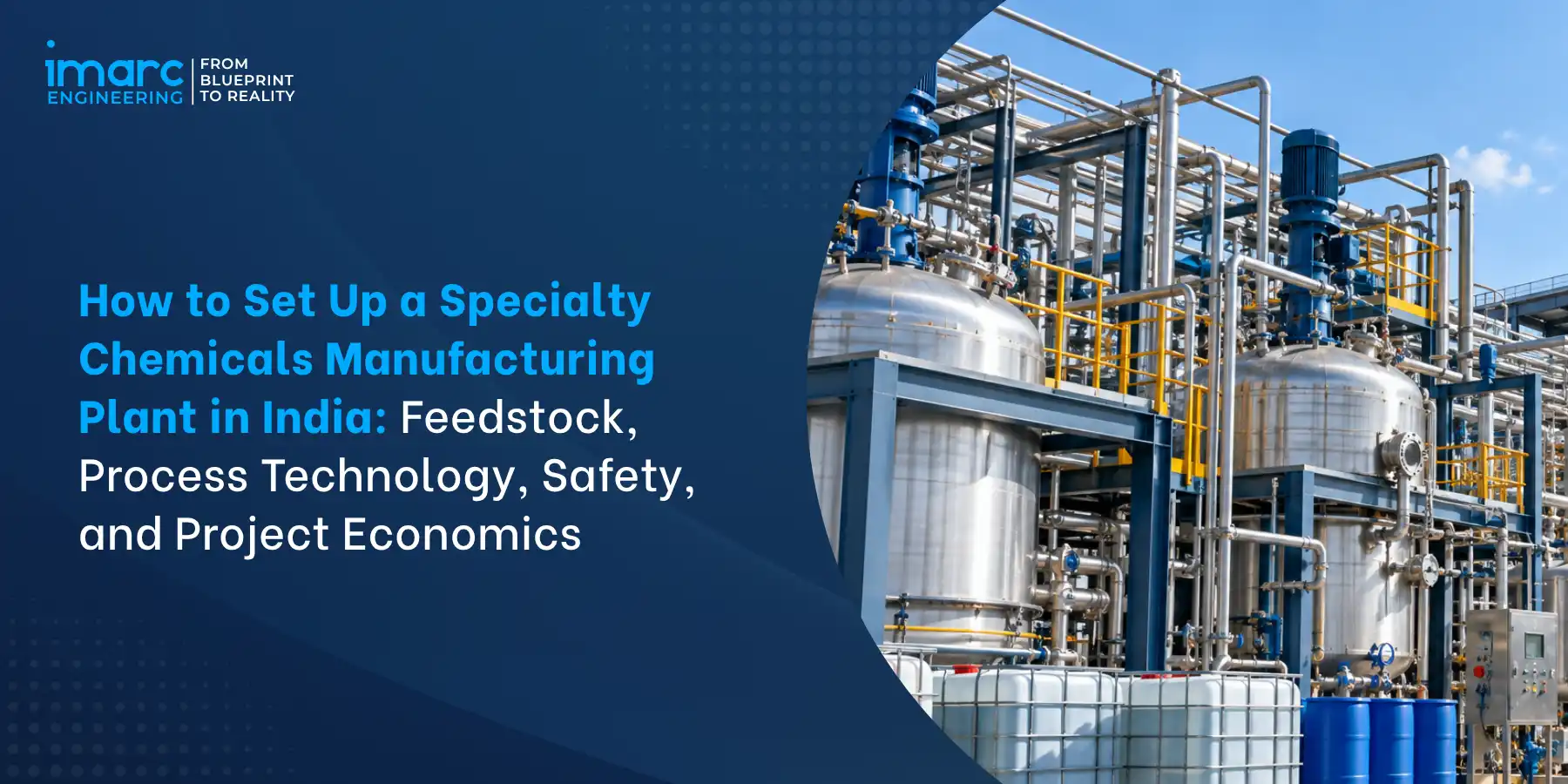
How to Set Up a Specialty Chemicals Manufacturing Plant in India: Feedstock, Process Technology, Safety, and Project Economics
Introduction
For investors, manufacturers, and project development teams planning a specialty chemicals manufacturing plant in India in 2026, disciplined integration across product/feedstock selection, process chemistry, equipment engineering, safety design, environmental systems, regulatory compliance, and project economics determines commercial viability.
Planning a specialty chemicals manufacturing plant in India requires coordinated decisions across product specifications, feedstock availability, process chemistry, production capacity, equipment selection, utilities, process safety, environmental systems, regulatory requirements, and project economics. These factors should be assessed together because a change in product chemistry or production route can materially alter plant configuration, CAPEX, OPEX, safety requirements, and commissioning strategy.
Scope of this Guide
This guide answers the sponsor's question directly. How should investors plan a specialty chemical plant in India covering product/feedstock selection, process technology, equipment configuration, utilities, safety engineering, environmental systems, regulatory compliance, and integrated project execution? It walks through raw material security, batch vs continuous decision, reactor/separation/filtration/drying selection, hazardous chemical handling, ETP/emission control, CAPEX/OPEX drivers, and commissioning timelines - anchored to explicit product, capacity, and technology assumptions.
Table of Contents
- Introduction
- Why Specialty Chemicals Manufacturing Plant Investment Matters for India in 2026
- What a Specialty Chemicals Manufacturing Plant is and Why It Matters in India
- How to Set Up a Specialty Chemicals Manufacturing Plant in India
- Site Selection for a Specialty Chemicals Manufacturing Plant in India
- Product Feedstock Selection and Raw Material Security for Specialty Chemicals Manufacturing Plants in India
- Process Technology and Batch vs Continuous Chemical Manufacturing for Specialty Chemicals Plants in India
- Reactors Distillation Filtration and Drying Equipment for Specialty Chemical Manufacturing in India
- Hazardous Chemical Storage Solvent Handling and Process Safety for Specialty Chemical Plants in India
- Utilities Environmental Systems and Effluent Treatment for Specialty Chemicals Manufacturing Plants in India
- Regulatory Framework Licensing and Project Economics for Specialty Chemicals Manufacturing Plants in India
- Conclusion
1. Why Specialty Chemicals Manufacturing Plant Investment Matters for India in 2026
Four drivers make disciplined specialty chemicals plant investment a strategic priority for manufacturers and investors in 2026.
1.1 Sustained Sector Growth
India's specialty chemicals industry in India continues to grow driven by domestic demand (pharma APIs, agrochemicals, dyes/pigments, personal care, flavours/fragrances, adhesives, coatings), export opportunities (China+1 supply diversification benefiting Indian manufacturers), and government policy support. FDI in chemicals sector reached INR 1,49,001.81 crore (USD 23.97 billion) between January 2000 to December 2025, indicating sustained investor confidence.
1.2 Policy and Infrastructure Support
- PCPIRs (Petroleum, Chemicals and Petrochemical Investment Regions) at Vizag, Dahej, Paradeep
- PCPIR Paradeep with cumulative investments around INR 73,518 crore
- PLI Scheme for Bulk Drug Parks
- Union Budget 2026-27 announced Chemical Parks scheme covering 3 states
- Department of Chemicals & Petrochemicals (DCPC) under Ministry of Chemicals & Fertilizers as nodal ministry
1.3 Regulatory Landscape
- MSIHC Rules 1989 under Environment Protection Act 1986 - hazardous chemicals handling (CMSR/India REACH remains draft, not yet in force)
- CAEPPR Rules 1996 - chemical accidents emergency planning, preparedness, and response
- OSH Code 2020 - factory licence (in force from 21 November 2025)
- PESO framework - Petroleum Rules 2002, Pressure Vessels Rules 2016, Gas Cylinder Rules 2016
- SPCB CTE/CTO under Water Act 1974 and Air Act 1981
- Hazardous Waste Rules 2016 (amended 2022) for hazardous waste management
1.4 Cost of Poor Planning
Poor project planning carries meaningful cost in specialty chemicals manufacturing in India. Wrong process technology forces expensive retrofitting. Under-specified safety engineering causes accidents with regulatory shutdowns. Feedstock over-dependence on single source or import creates supply disruption risk. Inadequate ETP capacity delays SPCB CTO. Universal CAPEX assumptions without product-specific engineering create budget over-runs of 30-50 percent. Integrated project discipline across feedstock, process, safety, and regulatory reduces delivery risk and improves outcomes.
2. What a Specialty Chemicals Manufacturing Plant is and Why It Matters in India
Understanding what a specialty chemicals manufacturing plant is and why it matters in India begins with placing it as an integrated process-engineering and manufacturing project rather than a commodity chemical facility.
2.1 Definition and Distinction
-
Specialty chemicals: performance-based, low-volume high-value products for specific applications (dyes, adhesives, catalysts, surfactants, specialty polymers, cosmetic ingredients, electronic chemicals, agrochemicals intermediates)
-
Commodity chemicals: high-volume standardized products (basic petrochemicals, chlor-alkali, ammonia)
-
Specialty plants typically batch or campaign mode with multi-product flexibility; commodity plants continuous with dedicated lines
-
Specialty chemistry involves shorter product life cycles, R&D-driven differentiation, and application-specific customer collaboration
2.2 Plant Components
| Component | Function | Illustrative Elements |
|---|---|---|
| Raw material storage | Feedstock inventory | Solvent tanks, powder silos, drums |
| Reaction section | Chemistry execution | Reactors, condensers, receivers |
| Separation section | Product isolation | Distillation, extraction, crystallization |
| Filtration/drying | Solid product finishing | Filters, dryers, packaging |
| Utilities | Process services | Steam, chilling, air, nitrogen, DM |
| Safety systems | Hazard mitigation | Scrubbers, flare, foam systems |
| Environmental | Emission/effluent control | ETP, VOC scrubbers, incinerator |
| QC laboratory | Product/process testing | Analytical instruments |
2.3 Plant Scale Determinants
Plant scale depends on target product, market, and business model. Small multi-product plants (MPP) with INR 25-100 crore CAPEX serve niche specialty chemistry with product mix flexibility. Medium MPP (INR 100-400 crore) balance scale and flexibility. Large dedicated plants (INR 400-1,500 crore) target single or few products at commercial scale. Very large integrated complexes (INR 1,500+ crore) combine multiple products with shared utilities and infrastructure. Decisions on capacity, product mix, batch vs continuous, and dedicated vs multi-product should follow product portfolio strategy - not standard assumptions.
3. How to Set Up a Specialty Chemicals Manufacturing Plant in India
Setting up a specialty chemicals manufacturing plant requires a structured project-development approach. The process begins with defining the target products, specifications, production capacity, customer requirements, and expected market demand. This is followed by a feasibility assessment covering market potential, feedstock availability, process technology, capital investment, operating costs, and commercial viability.
Once the project is considered feasible, feedstock sources and supply risks should be assessed. The appropriate manufacturing route should then be selected based on product chemistry, capacity, product mix, safety requirements, and flexibility. The project can proceed to process design, equipment selection, utility planning, plant layout, and preliminary engineering.
Regulatory requirements should be identified alongside the engineering design rather than after the plant is configured. Depending on the project, this may include environmental approvals, SPCB consents, hazardous chemical requirements, PESO approvals, factory and occupational-safety requirements, and other product- or location-specific permissions.
The next stages cover detailed engineering, procurement, construction, installation, and commissioning. Equipment and utilities are installed and tested before production trials begin. The plant is then progressively scaled up, with process performance, product quality, safety systems, and production capacity evaluated before moving towards stable commercial operations. The exact sequence and duration vary according to product chemistry, plant scale, technology, site conditions, and regulatory requirements.
4. Site Selection for a Specialty Chemicals Manufacturing Plant in India
Site selection is an important early decision because location affects feedstock logistics, utilities, regulatory requirements, operating costs, and future expansion. Potential sites should be assessed for proximity to key suppliers, ports, transport networks, and major customer markets. For import-dependent raw materials, access to ports and reliable logistics can reduce supply-chain risks.
The availability and reliability of water, power, steam, waste-treatment infrastructure, and other industrial utilities should also be evaluated. Sites within established industrial or chemical clusters may offer access to common infrastructure, specialised services, skilled manpower, and established supply chains. However, the site's suitability should still be assessed against the specific process and chemical inventory.
Environmental and safety considerations are particularly important for specialty chemical projects. Site assessment should consider land-use compatibility, environmental sensitivities, hazardous-material storage and transportation requirements, wastewater and waste-disposal options, emissions management, emergency response infrastructure, and applicable regulatory restrictions.
Workforce availability, local infrastructure, transportation access, and scope for future expansion should also form part of the evaluation. A structured site-selection study can compare candidate locations against technical, logistical, environmental, regulatory, and commercial criteria before land acquisition and detailed engineering are undertaken.
5. Product Feedstock Selection and Raw Material Security for Specialty Chemicals Manufacturing Plants in India
Understanding product feedstock selection and raw material security for specialty chemicals manufacturing plants in India is a critical early-stage decision. Feedstock choices influence process design, cost structure, and supply risk.
5.1 Feedstock Categories
- Specialty chemical feedstock typically falls into these categories
- Base petrochemicals (benzene, toluene, xylene, ethylene derivatives) - typically imported or from Indian refineries
- Chlor-alkali products (chlorine, caustic soda, HCl) - domestically produced, price volatility
- Key intermediates - can be domestic manufactured, imported, or captive
- Solvents (methanol, ethanol, acetone, toluene, IPA, MDC, THF, DMF, DMSO) - mix of domestic and imported
- Catalysts (noble metal, transition metal, homogeneous) - largely imported
- Specialty raw materials (chiral building blocks, phosphorus compounds, silicon precursors) - often import-dependent
5.2 Raw Material Assessment
- Raw material sourcing assessment considers multiple factors
- Chemistry compatibility with intended process route and yield targets
- Purity specifications (99+ percent typical for specialty applications) and impurity profile
- Availability - production volume, number of suppliers, geographic concentration
- Pricing history - 3–5-year volatility, correlation with crude/base petrochemical prices
- Import dependence - percentage from imports, supplier country concentration
- Logistics - transport class (hazardous, refrigerated), lead time, minimum order quantities
- Environmental/regulatory constraints on specific feedstocks
5.3 Feedstock Security Strategies
- Feedstock security for specialty chemical plants relies on multiple risk mitigation strategies
- Supplier diversification - qualify 2-3 alternate suppliers per critical raw material
- Dual sourcing - combine domestic and import supply to hedge disruption risk
- Long-term contracts with price formula (indexed to crude/base petrochemical) for critical inputs
- Strategic inventory - 30-90 days buffer stock for critical import-dependent materials
- Backward integration - captive production for high-consumption critical intermediates
- Geopolitical/policy risk monitoring - track export restrictions, tariffs, disruption in supplier countries
- Substitute chemistry evaluation - identify alternative feedstocks/routes for critical materials
5.4 Import Dependence
India's specialty chemicals sector has meaningful import dependence for select intermediates, catalysts, and specialty raw materials - particularly from China, EU, and specific Asian suppliers. China+1 diversification opportunities are driving import substitution investment. Feedstock strategy should explicitly evaluate import exposure by material, monitor policy/tariff/geopolitical developments, and build diversified sourcing. Backward integration into critical intermediates offers cost stability but requires additional CAPEX and operational complexity - evaluate against import cost/volatility.
6. Process Technology and Batch vs Continuous Chemical Manufacturing for Specialty Chemicals Plants in India
Understanding process technology and batch vs continuous chemical manufacturing for specialty chemicals plants in India covers the core configuration decision for specialty chemical plant design.
6.1 Batch Manufacturing
- Batch chemical manufacturing runs discrete production batches through shared equipment sequentially
- Suits small-to-medium volume, high-value specialty products (typically less than 5,000 TPA per product)
- High product mix flexibility - same equipment produces multiple products with cleaning between
- Lower CAPEX per product; higher OPEX per kg due to labour and changeovers
- Suitable for pharma intermediates, specialty dyes, catalysts, fine chemicals, some agrochemicals
- Product changeover involves cleaning, verification, and sometimes campaign planning to minimize downtime
6.2 Continuous Manufacturing
- Continuous chemical manufacturing runs steady-state production with continuous feed and product streams
- Suits large-volume single-product operations (typically 20,000+ TPA)
- Higher yield/selectivity, lower per-kg OPEX, better safety through smaller inventory
- Higher CAPEX due to dedicated equipment; longer commissioning; less flexibility
- Suitable for commodity intermediates, high-volume specialty polymers, established chemistries
- Flow chemistry/microreactor technology enables continuous processing for smaller volumes
6.3 Campaign Manufacturing
- Campaign manufacturing runs multiple products sequentially in a multiproduct chemical plant - middle ground between batch and continuous
- Each product runs for defined campaign period (days to weeks) before changeover
- Balances flexibility with efficiency; suits mid-volume specialty portfolios
- Requires disciplined production planning and cleaning validation between campaigns
- Common in pharma intermediates, specialty additives, custom chemistry contract manufacturing
6.4 Selection Framework
| Factor | Batch | Continuous | Campaign |
|---|---|---|---|
| Volume/product | Small | Large | Medium |
| Product mix | High flexibility | Single product | Sequential mix |
| CAPEX intensity | Lower | Higher | Medium |
| OPEX per kg | Higher | Lower | Medium |
| Changeover | Frequent | Rare | Periodic |
| Best suits | Fine chemicals | Commodities | Multi-product specialty |
6.5 Process Scale-up
- Process scale-up from lab to plant requires disciplined stages
- Lab (1-10 L) - chemistry development, yield/selectivity, impurity profile
- Kilo lab (10-100 L) - process refinement, safety data, reaction kinetics
- Pilot plant (100-2,000 L) - engineering scale-up, unit operations validation
- Commercial plant - full scale with instrumentation, control, and continuous QC
- Each scale addresses different risks - do not shortcut scale-up stages for critical products
7. Reactors Distillation Filtration and Drying Equipment for Specialty Chemical Manufacturing in India
Understanding reactors distillation filtration and drying equipment for specialty chemical manufacturing in India covers the core unit operations that determine plant capability, capacity, and product quality.
7.1 Reactors
Reactors are selected based on process chemistry, corrosion requirements, operating conditions, and production scale. Glass-lined, stainless steel 316L, and Hastelloy reactors are commonly considered for different chemical environments. Reactor configuration may include suitable agitators, baffles, heating or cooling systems, dip pipes, and reflux condensers.
7.2 Separation Equipment
Separation systems are selected according to the properties of the process mixture and the required product purity. Distillation may be used for solvent recovery and purification, while extraction and crystallization can support selective separation and product isolation. Vacuum or fractional distillation may be used where process conditions require it.
7.3 Filtration Equipment
Filtration equipment is used for solid-liquid separation and is selected based on solids loading, throughput, and product requirements. Nutsche filters, ANFDs, centrifuges, filter presses, and micron filters can be used for different filtration and washing applications.
7.4 Drying Equipment
Drying equipment should match the product's heat sensitivity, throughput, moisture requirements, and physical properties. Vacuum tray dryers, rotary vacuum dryers, spray dryers, fluid bed dryers, and freeze dryers are suitable for different process and product requirements.
7.5 Solvent Recovery
Solvent recovery systems can reduce solvent consumption, waste generation, and operating costs. Distillation is commonly used for solvent recovery, while azeotropic distillation or membrane separation may be suitable for specific solvent mixtures. Recovered solvents should be tested for quality before reuse to avoid contamination and cross-product carryover.
8. Hazardous Chemical Storage Solvent Handling and Process Safety for Specialty Chemical Plants in India
Understanding hazardous chemical storage solvent handling and process safety for specialty chemical plants in India covers the safety engineering discipline that determines plant licence viability and operational continuity.
8.1 Hazardous Chemical Storage
- Hazardous chemical storage under MSIHC Rules 1989 and PESO framework
- Threshold quantities per MSIHC Schedule triggering additional compliance
- Petroleum storage: Class A (flash below 23°C), Class B (23-65°C), Class C (65-93°C) per Petroleum Rules 2002
- PESO licence for petroleum storage above threshold; annual renewal
- Above-ground tanks with dyked containment
- Segregation of incompatible chemicals (acids/bases, oxidisers/reducers, water-reactives)
- Adequate spacing per Oil Industry Safety Directorate (OISD) guidelines
8.2 Solvent Handling
- Solvent storage requires specific engineering controls
- Bulk solvent tanks with nitrogen blanketing to prevent flammable vapour formation
- Vapour recovery/scrubbing to control VOC emissions during transfer
- Grounded/bonded transfer piping to prevent static discharge ignition
- Solvent drum storage in ventilated area with spill containment
- Solvent handling per OSHA-equivalent HAZOP recommendations
8.3 Process Safety
Process safety engineering should be integrated across the plant life cycle, from design through operation and major modifications. A HAZOP (Hazard and Operability) study can be conducted during the design stage and repeated before major modifications to identify process hazards and operational risks.
Process Safety Information (PSI) should cover relevant process chemistry, thermodynamics, reaction kinetics, and thermal stability. For processes involving potentially hazardous reactions, runaway reaction assessments can use techniques such as adiabatic calorimetry and Time to Maximum Rate (TMR) analysis. Pressure relief systems should be appropriately designed and sized in accordance with applicable engineering standards, including API standards where relevant.
Critical processes should incorporate suitable emergency shutdown (ESD) systems, while fire and gas detection systems can provide alarms and automated interlocks where required. Emergency preparedness should include applicable on-site and off-site emergency response plans under the relevant provisions of the CAEPPR Rules, 1996. Periodic occupational safety and health audits may also be conducted using applicable standards, including IS 14489:2018.
8.4 Safety Systems
Fire and personal safety systems should be selected based on the hazards present in the process and storage areas. Scrubbers can be used for neutralising acid or alkali vapour emissions, while flares or thermal oxidisers may be used to control combustible vent gases where applicable. Foam-based systems can provide fire suppression for certain flammable-liquid hazards, and fixed water-spray systems can be used for cooling hazardous chemical storage where required.
Personal Protective Equipment (PPE) should be specified based on the hazard assessment and the nature of the operations. Safety showers and eyewash stations should also be provided at suitable locations near hazardous operations, based on the applicable safety requirements and risk assessment.
9. Utilities Environmental Systems and Effluent Treatment for Specialty Chemicals Manufacturing Plants in India
Understanding utilities environmental systems and effluent treatment for specialty chemicals manufacturing plants in India covers the supporting infrastructure critical to operational reliability and regulatory compliance.
9.1 Process Utilities
| Utility | Illustrative Requirement | Application |
|---|---|---|
| Steam LP | 3.5 bar | General heating, jackets |
| Steam MP | 10.5 bar | Distillation reboilers |
| Thermic fluid | Up to 300°C | High-temperature reactions |
| Chilled water | 7-12°C | Condenser cooling |
| Brine | -20 to -40°C | Low-temp reactions/crystallization |
| DM water | Ultra-pure | Process, boiler feed |
| Compressed air | 6-8 bar dry | Instrumentation, pneumatic |
| Nitrogen | 99.9+% | Blanketing, inerting |
9.2 Effluent Treatment
- Effluent treatment plant designed to meet SPCB discharge norms
- Primary treatment - equalization, neutralization, oil/water separation
- Secondary biological treatment - activated sludge, MBBR, MBR for BOD/COD reduction
- Tertiary treatment - filtration, activated carbon, UV/ozone for polishing
- Zero Liquid Discharge (ZLD) where SPCB mandates or in water-scarce regions
- Reject water evaporation with MEE (Multiple Effect Evaporator) for concentrating brines
- Sludge management under Hazardous Waste Rules 2016 if hazardous
9.3 Emission Control
- Emission control and VOC control systems for specialty chemical plants
- Point-source scrubbers for acid vent gas (HCl, SO2) with alkali absorption
- Activated carbon adsorption for VOC recovery/emission control
- Regenerative Thermal Oxidizer (RTO) for combustible VOC destruction
- Bag filters and cyclones for particulate matter
- Continuous emission monitoring (CEMS) as SPCB requires
- Fugitive emission control through LDAR (Leak Detection and Repair) programs
9.4 Plant Layout
Plant layout should balance safety, operational efficiency, and future expansion. The process block typically includes reactors, separation, and filtration systems, with equipment arranged to support efficient material movement and, where practical, gravity flow. Utilities can be positioned centrally to enable efficient distribution to the process areas.
Raw material storage may be positioned upwind of the process area, while finished-product warehouses can be located downwind or to the side, subject to site-specific safety and environmental considerations. Tank farms should provide adequate spacing and appropriate dyked containment in line with applicable requirements. Effluent treatment facilities should be located based on process drainage, environmental controls, and site layout, while incinerators or RTOs should consider prevailing wind conditions where relevant.
The layout should also include clearly defined emergency assembly points, escape routes, and fire hydrant networks. Quality-control laboratories should be located close enough to production for efficient sample handling while remaining suitably separated from hazardous areas. Administrative facilities should likewise be separated from hazardous process zones where appropriate.
10. Regulatory Framework Licensing and Project Economics for Specialty Chemicals Manufacturing Plants in India
Understanding regulatory framework licensing and compliance for specialty chemicals manufacturing plants in India alongside CAPEX OPEX and project economics for specialty chemicals manufacturing plants in India completes the framework.
10.1 Potential Regulatory Approvals and Compliance Requirements
Regulatory requirements vary by product chemistry, raw materials, hazardous-material inventory, manufacturing process, plant capacity, emissions/effluent profile, location and state. The following requirements may apply and should be confirmed for the specific project with the relevant authorities.
- Environmental Clearance under EIA Notification 2006 (amended 2020)
- SPCB CTE (Consent to Establish) before construction; CTO (Consent to Operate) before production
- MSIHC Rules 1989 - Notification, Safety Report, On-site Emergency Plan under EPA 1986
- CAEPPR Rules 1996 - Off-site Emergency Plan with district collector
- PESO licences - petroleum, compressed gas cylinders, pressure vessels per applicable Rules
- OSH Code 2020 factory licence from Chief Inspector of Factories
- Hazardous Waste Authorization from SPCB under Hazardous Waste Rules 2016
- Public Liability Insurance under PLI Act 1991 for hazardous chemical handlers
- Fire NOC per NBC 2016; Building Plan approval; Trade Licence
10.2 CAPEX Composition (Indicative Figures, may vary as per project)
| Configuration | Scale Assumption | Investment (INR) |
|---|---|---|
| Small MPP | Multi-product batch plant | 25-100 crore |
| Medium MPP | Multi-product with utilities | 100-400 crore |
| Large dedicated | Single or few products at scale | 400-1,500 crore |
| Very Large integrated | Multi-product with shared infra | 1,500+ crore |
- Process equipment (reactors, columns, dryers, filters): 30-45 percent CAPEX
- Utilities (steam, chilling, air, nitrogen, DM): 15-25 percent
- Environmental systems (ETP, RTO, scrubbers): 8-15 percent
- Civil/structural/building: 15-25 percent
- Instrumentation, control, electrical: 8-15 percent
- Engineering, project management, commissioning: 8-12 percent
10.3 OPEX Drivers
- Raw materials/feedstock: typically, 50-70 percent OPEX for specialty chemicals
- Utilities (steam, power, chilling): 8-15 percent
- Labour (skilled operators, chemists, QC, engineers): 8-15 percent
- Consumables (catalysts, filter cloths, packaging): 3-8 percent
- Environmental compliance (ETP operation, sludge disposal): 2-5 percent
- Repairs, maintenance, spares: 3-5 percent
10.4 Commissioning
- Specialty chemical plant commissioning typically takes 24-36 months from investment decision
- Feasibility and DFR (Detailed Feasibility Report): 3-6 months
- Basic engineering + procurement of critical long-lead items: 6-9 months
- Civil construction: 8-12 months (parallel with equipment fabrication)
- Equipment installation and piping: 6-9 months
- Pre-commissioning, HAZOP re-verification, safety systems test: 2-3 months
- Commissioning and scale-up to nameplate capacity: 3-6 months
- Complex/large plants and first-of-kind chemistry can extend timelines
Conclusion
Setting up a specialty chemicals manufacturing plant in India requires careful product and feedstock selection, process technology suited to production volume and product mix, appropriate equipment, utilities, environmental systems, and regulatory compliance. Feedstock diversification, dual sourcing, and strategic inventory can help reduce supply risks for import-dependent materials. Batch, continuous, or campaign processing should be selected based on the product portfolio and manufacturing requirements rather than a standard configuration.
Safety and compliance should be integrated into the project from the design stage. This includes hazardous chemical storage, process safety studies such as HAZOP, appropriate emergency and environmental systems, and compliance with applicable MSIHC, PESO, SPCB, environmental, and occupational-safety requirements. Capital investment and commissioning timelines vary significantly based on product chemistry, production capacity, technology, equipment configuration, site conditions, and overall project scope.
PURSUING A SPECIALTY CHEMICALS MANUFACTURING PLANT?
IMARC Engineering’s specialty chemicals manufacturing plant advisory supports investors and manufacturers with product and feedstock selection, sourcing strategies, process technology and scale-up, equipment and utility planning, process safety, hazardous chemical handling, effluent and emission control, regulatory compliance, and capital investment planning. The service also covers plant configuration and integrated commissioning for specialty chemical projects.
→ Schedule a free specialty chemical plant project set up consultation with an IMARC specialist
Frequently Asked Questions
Setting up a specialty chemicals manufacturing plant in India involves product/feedstock selection, process route design (batch/continuous/campaign), site selection, equipment/reactor selection, safety engineering (HAZOP, MSIHC compliance), environmental systems (ETP, VOC), regulatory approvals (SPCB CTE/CTO, PESO, EIA where applicable), and integrated project execution typically over 24-36 months.
Raw materials and specialty chemical feedstock selection considers chemistry compatibility, purity, availability, price stability, import dependence, and supplier concentration. Feedstock security strategies include supplier diversification, long-term contracts, dual sourcing, strategic inventory, backward integration for critical intermediates, and continuous monitoring of geopolitical risks affecting supply chains.
Process technology selection depends on product chemistry, capacity, hazard profile, and product mix. Batch chemical manufacturing suits small-volume high-value products and multi-product plants. Continuous manufacturing suits large-volume single-product operations. Campaign manufacturing runs products in shared equipment. Reactor type, separation method, and yield determine equipment configuration.
Specialty chemical manufacturing equipment includes reactors (glass-lined 500-25,000 L, SS 316L, Hastelloy), distillation columns, filtration systems (Nutsche/ANFD/centrifuges), dryers (VTD/RVD/spray/fluid bed), solvent recovery, and storage tanks. Utilities: steam LP 3.5-MP 10.5 bar, thermic fluid to 300°C, brine -20 to -40°C, DM water, compressed air, nitrogen blanketing.
Specialty chemical plant cost in India varies significantly with capacity, product mix, and process complexity. Small multi-product plant (MPP): INR 25-100 crore; medium MPP: INR 100-400 crore; large dedicated plant: INR 400-1,500 crore; very large integrated: INR 1,500+ crore excluding land. Commissioning typically 24-36 months.
Manufacturers manage feedstock supply risks through supplier diversification, dual sourcing (domestic and import), long-term contracts with price formula, strategic inventory buffers, backward integration for critical intermediates, geopolitical risk monitoring, and identifying substitute chemistries where technically feasible. Import dependence for critical intermediates is a key risk.
Safety and environmental requirements include MSIHC Rules 1989 (hazardous chemicals), CAEPPR Rules 1996 (emergency response), OSH Code 2020 factory licence, PESO approvals, HAZOP studies, SPCB CTE/CTO under Water/Air Acts, Hazardous Waste Rules 2016, EIA Notification 2006 for large plants, effluent treatment plant, and VOC control.
Commercial viability depends on product margins (premium specialty vs commodity), feedstock cost/availability, plant capacity utilization, yield/conversion efficiency, energy cost, labour productivity, capital cost per unit output, product mix flexibility, regulatory compliance cost, market access, and integrated execution across feasibility, engineering, procurement, construction, commissioning, and scale-up.
Recent Post
Trusted by Industry Leaders
We partner with global enterprises and ambitious businesses across sectors to deliver operational excellence, strategic insights, and sustainable growth through integrated solutions.










Success in Their Words
Real feedback from clients across industries. Discover how our solutions delivered measurable impact and operational excellence.

I wanted to express my sincere appreciation for your efforts in handling this matter. Your dedication and commitment have been truly commendable, and it is evident that you have put in tremendous hard work and expertise into resolving the issues at hand. We are greatly interested in continuing our collaboration with you in the future, as your professionalism and reliability have made you a trusted partner. Thank you once again for your invaluable contribution. We look forward to strengthening our partnership ahead.

It has been a pleasure working with the IMARC team. The insights provided were structured, clear, and highly valuable, helping us strengthen both our technical and financial planning with confidence. We deeply appreciate the team’s professionalism, responsiveness, and attention to detail throughout the engagement. Every requirement was well understood and effectively incorporated, resulting in a comprehensive and actionable output. Overall, our experience has been excellent, and I would gladly recommend IMARC to organizations seeking a reliable research partner.

Your service is truly exceptional. Working with the IMARC team has been a seamless and professional experience. The clarity of communication, responsiveness to queries, and consistent support at every stage made the entire engagement highly efficient. The insights shared were well-structured, practical, and perfectly aligned with our requirements, helping us make informed decisions with confidence. Overall, the dedication and professionalism demonstrated by your team stand out, and I would be glad to recommend IMARC as a reliable and trustworthy research partner.

IMARC did an outstanding job in preparing our study. They were punctual, precise, and consistently responsive throughout the entire process. The team delivered all the data we required in a clear, well-organized, and highly professional format. Their strong attention to detail, combined with their ability to meet every deadline without compromising quality, truly set them apart. Overall, their reliability and commitment made them an exceptional partner for our project, and we would gladly work with them again in the future.

IMARC made the whole process incredibly easy from start to finish. Everyone I interacted with via email was polite, professional, and straightforward to deal with, always keeping their promises regarding delivery timelines and remaining consistently solutions-focused. From my very first contact, I appreciated the professionalism and support shown by the entire IMARC team. I highly recommend IMARC to anyone seeking timely, affordable, and reliable information or advice. My experience with IMARC was excellent, and I truly cannot fault any aspect of it.

I’d like to express my sincere gratitude for the excellent work you accomplished with the study. Your ability to quickly understand our requirements and deliver high-quality results under tight timelines truly reflects your expertise, exceptional work ethic, and unwavering commitment to your customer’s success. The professionalism and responsiveness you demonstrated throughout the process made a significant difference. Our entire team and company are incredibly thankful for your dedication, reliability, and support. Once again, thank you for your outstanding contribution.