Manufacturing
August 17 2026
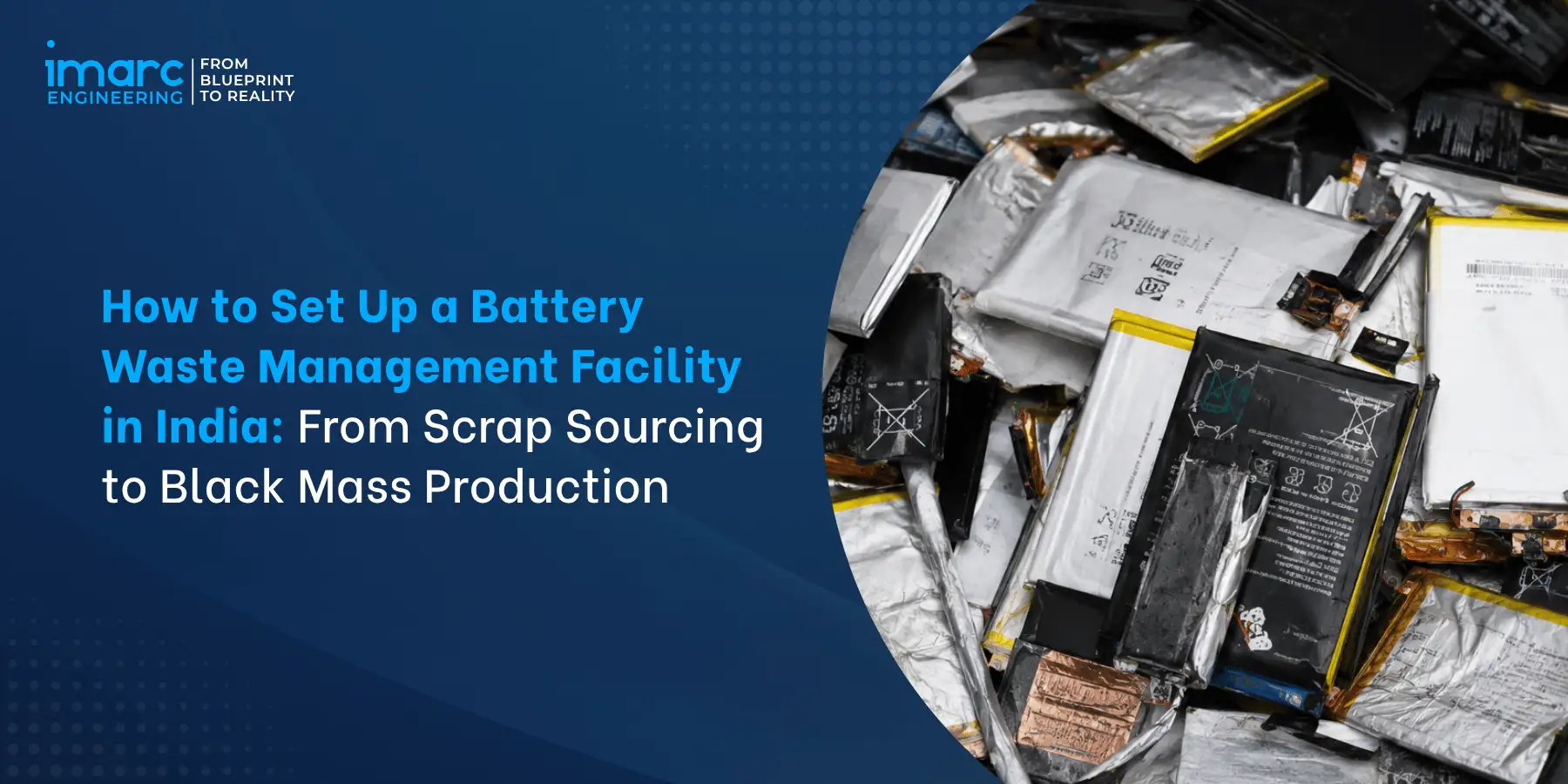
How to Set Up a Battery Waste Management Facility in India: From Scrap Sourcing to Black Mass Production
Introduction
For any investor or recycling entrepreneur pursuing India's rapidly expanding battery circular economy in 2026, battery waste management facility in India development addresses the essential preprocessing stage between end-of-life batteries and downstream metal recovery.
A preprocessing facility differs from a full-scale battery recycling plant by focusing on scrap sourcing, collection, storage, sorting, discharge, dismantling, mechanical preprocessing, material separation, and black mass production, while leaving downstream metal refining to specialised recycling operators.
Scope of this Guide
This guide answers the sponsor's facility question directly. How can investors set up a facility that secures reliable scrap feedstock, safely preprocesses end-of-life batteries, produces consistent-quality black mass, and operates in compliance with applicable regulations? It walks through a well-defined setup roadmap, scrap sourcing and feedstock security, collection and storage operations, discharge and dismantling discipline, mechanical preprocessing and separation producing preprocessing outputs, regulatory framework, and the practices distinguishing preprocessing facilities from ad-hoc operations that consistently fail commercial and safety expectations.
Table of Contents
- Introduction
- Why Battery Waste Management Facilities Matter in India
- How to Set Up a Battery Waste Management Facility in India
- Battery Scrap Sourcing and Feedstock Security in India
- Battery Collection Storage and Sorting Operations in India
- Battery Discharge Dismantling and Preprocessing in India
- Black Mass Production and Material Separation in India
- Regulatory and EPR Compliance for Battery Waste Management in India
- Common Mistakes and Best Practices
- Conclusion
1. Why Battery Waste Management Facilities Matter in India
Four structural drivers make preprocessing facilities strategically important in India's battery circular economy in 2026.
1.1 Electric Vehicle Market Growth and Feedstock Availability
India's growing electric vehicle market is expected to increase the volume of batteries reaching end of life over the coming years. At the same time, the expansion of domestic battery and cell manufacturing is creating another important feedstock source through production scrap.
The Production Linked Incentive (PLI) Scheme for Advanced Chemistry Cell Battery Storage, with an outlay of INR 18,100 crore and a target of 50 GWh of domestic manufacturing capacity, is supporting the growth of India's battery manufacturing ecosystem.
Beyond EVs, used batteries from consumer electronics, industrial energy storage, and grid-scale storage systems add to the available feedstock. As these volumes grow, adequate collection, reverse logistics, and preprocessing capacity will be essential to handle battery waste safely and support material recovery.
1.2 Regulatory Push Through Battery Waste Rules 2022
Battery Waste Management Rules 2022 notified by Ministry of Environment Forest and Climate Change (MoEFCC) on 22 August 2022 establish Extended Producer Responsibility for batteries framework replacing earlier Batteries (Management and Handling) Rules 2001. Producers, importers, and brand owners face defined recycling obligations across portable, automotive (motive), industrial, and electric vehicle battery categories.
Registration through CPCB EPR Portal required for producers, recyclers, and refurbishers. Progressive EPR targets from 2024-25 supporting recycling ecosystem development materially outperform earlier voluntary frameworks.
1.3 Preprocessing Economics and Value Chain Position
Preprocessing facilities occupy a distinct value chain position between generators and downstream refiners. Preprocessing-only facilities typically require 20-40 percent of equivalent full recycling plant capex enabling faster scaling and lower entry barriers. Specialisation supports operational excellence in feedstock aggregation, safe processing, and black mass quality that vertically integrated operators struggle to match.
Downstream refiners in domestic and international markets provide offtake pathways. Preprocessing specialisation aligned with emerging India recycling ecosystem outperforms attempted vertical integration for new entrants.
1.4 Environmental and Resource Recovery
End-of-life batteries improperly managed pose fire hazards, environmental contamination, and material loss. Preprocessing enables safe handling of hazardous chemistries and recovery of critical materials including cobalt, nickel, lithium, and manganese progressively concentrated in black mass.
Resource recovery supporting circular economy objectives materially reduces dependency on primary mining and imports. Environmental benefits combined with material value recovery support both regulatory compliance and commercial economics.
2. How to Set Up a Battery Waste Management Facility in India
Understanding how to set up a battery waste management facility in India helps sponsors sequence programme decisions correctly. Well-planned setup integrates feasibility, engineering, regulatory approvals, construction, and commissioning across preprocessing-focused scope avoiding overreach into downstream metal refining.
2.1 The Structured Setup Roadmap
| Stage | Activities | Typical Duration |
|---|---|---|
| Feasibility and Business Case | Market analysis, capacity sizing, DPR | 3-6 months |
| Site Selection and Approvals | Land, environmental clearance, PESO | 6-12 months |
| Detailed Engineering | Process design, layout, equipment specs | 4-8 months |
| EPR Registration and Compliance | CPCB portal, agreements, licences | 3-6 months (parallel) |
| Procurement and Construction | Equipment sourcing, civil works, installation | 9-18 months |
| Commissioning and Ramp-Up | Testing, feedstock qualification, black mass validation | 3-6 months |
2.2 Capex Opex and Financial Modelling for Battery Waste Facilities in India
Capex Opex and financial modelling for battery waste facilities in India scale with target capacity and processing sophistication. Small preprocessing facilities (500-2,000 tonnes per annum) typically require INR 15-50 crore capex. Medium facilities (2,000-10,000 TPA) typically require INR 50-200 crore. Large integrated preprocessing (10,000-30,000 TPA) typically requires INR 200-600 crore.
Preprocessing-only facilities typically require 20-40 percent of equivalent full recycling plant capex given absence of hydrometallurgical or pyrometallurgical unit operations. Well-curated financial modelling incorporating feedstock cost, black mass pricing, and capacity utilisation supports informed investment decisions.
2.3 Preprocessing Versus Full Recycling Plant
Preprocessing facility differs materially from full-scale battery recycling plant. Preprocessing covers collection through battery dismantling, mechanical size reduction, physical separation, and black mass production ending at intermediate output.
Full recycling plants extend beyond preprocessing through downstream metal refining producing battery-grade compounds. Preprocessing specialisation supports faster capacity development, lower capital requirements, and focused operational excellence while establishing offtake to downstream refiners.
3. Battery Scrap Sourcing and Feedstock Security in India
Battery scrap sourcing and feedstock security in India determine facility commercial viability more than any other factor. Preprocessing facilities without secured feedstock face persistent capacity underutilisation regardless of process excellence. Battery scrap sourcing combining multiple channels materially outperforms single-source dependency.
3.1 Feedstock Categories and Sources
- Production scrap from OEM cell and battery pack manufacturing
- End-of-life electric vehicle batteries from OEMs and fleet operators
- Consumer electronics batteries via aggregators and take-back programmes
- Industrial and grid storage batteries from utilities and industrial users
- Aftermarket repair and warranty returns
- Imported battery feedstock, where permitted under applicable waste, customs, and environmental regulations
- EPR aggregator networks emerging under regulatory framework
- Off-specification cells and packs from testing operations
3.2 Battery Recycling Feedstock Contract Structures
Battery recycling feedstock sourcing typically combines contract structures. Long-term take-or-pay agreements with OEMs and large generators supporting capacity utilisation certainty. Spot market purchasing supplementing baseline volumes.
EPR service agreements with producers using facility for compliance obligations. Aggregator partnerships accessing distributed generator networks. Import arrangements where permitted by regulation. Multi-channel sourcing materially reduces feedstock volatility affecting facility economics.
3.3 Feedstock Quality Assessment
Feedstock quality assessment supports both processing safety and black mass yield. Chemistry identification through visual inspection, labelling, and testing distinguishing lithium-ion variants including LCO (Lithium Cobalt Oxide), NMC (Nickel Manganese Cobalt), NCA (Nickel Cobalt Aluminium), LFP (Lithium Iron Phosphate), and LMO (Lithium Manganese Oxide).
Format identification covering cylindrical, prismatic, and pouch cells. State of charge assessment supporting discharge planning. Damage assessment supporting safe handling classification. Incoming quality assessment significantly prevents downstream processing surprises.
3.4 Reverse Logistics and Transportation
End-of-life batteries classified as hazardous goods under UN 3480 (lithium-ion batteries) or UN 3090 (lithium metal batteries) requiring transportation. UN 38.3 test compliance for cell shipment. Damaged, defective, or recalled (DDR) batteries requiring specialised packaging. Manifest system compliance under Hazardous and Other Wastes Rules 2016 where applicable. Reverse logistics network development typically extends 12-24 months producing reliable feedstock supply supporting facility ramp-up.
4. Battery Collection Storage and Sorting Operations in India
Battery collection storage and sorting operations in India address the pre-processing operational discipline that determines both safety outcomes and downstream throughput. Uncontrolled storage of lithium-ion batteries produces material fire risk that operations prevent.
4.1 Receiving and Inspection
Structured receiving covers documentation verification against transport manifests, dimensional and weight verification, chemistry and format identification, visual damage assessment, state of charge assessment through thermal imaging where warranted, and well-defined classification for downstream handling.
Receiving area designed with segregation of pre-inspection and post-inspection zones, aisles supporting fork lift access, and fire protection matched to lithium-ion hazards. Receiving typically consumes 5-10 percent of facility footprint supporting throughput sustainment.
4.2 Storage Infrastructure
- Segregated storage bunkers by chemistry, format, and damage state
- Fire-resistant construction and storage design based on applicable Indian fire-safety requirements and battery-specific hazard assessment
- Damaged, Defective, and Recalled (DDR) battery containment
- Environmental controls managing temperature and humidity
- Thermal imaging cameras for continuous hot spot monitoring
- Fire detection and specialised suppression for lithium fires
- Ventilation supporting off-gas dispersal
- Stacking and racking respecting weight and stability limits
4.3 Sorting Discipline
Sorting operations progressively separate feedstock by chemistry, format, and downstream processing route. Chemistry-specific sorting supports both discharge protocol selection and downstream metallurgical routing. Format-specific sorting (cylindrical, prismatic, pouch) affects dismantling approach. Manual sorting with operator training for smaller volumes.
Semi-automated sorting incorporating machine vision, X-ray fluorescence (XRF), and induction sensors for larger throughput. Sorting improves downstream black mass quality and processing efficiency versus mixed-feedstock operations.
4.4 Fire Safety and Emergency Response
Fire safety infrastructure specifically designed for lithium-ion hazards. Fire detection and suppression systems designed for lithium-ion battery thermal-runaway hazards, including water-based cooling/suppression where supported by the applicable fire-safety design and testing. Water-based systems supporting cooling application. Foam systems for hydrocarbon component fires.
Structured emergency response protocols including workforce training, evacuation procedures, and coordination with local fire services. Insurance coverage typically requires documented lithium-specific fire safety infrastructure. Safety investment reduces both incident risk and insurance costs.
5. Battery Discharge Dismantling and Preprocessing in India
Battery discharge dismantling and preprocessing in India transform raw feedstock into processing-ready material. Structured battery preprocessing combines electrical safety, mechanical processing, and material handling into coherent operations.
5.1 Discharge Methods
Battery discharge should be completed before dismantling to reduce electrical and thermal risks. Controlled electrical discharge using suitable equipment can safely reduce stored energy, while energy-recovery systems may recover usable power where technically feasible. The selected method should suit the battery chemistry, format, condition, and recycling process.
Batteries should be discharged to an appropriately safe state before mechanical processing. Discharge procedures should be defined through facility-specific safety protocols and environmentally sound waste-management practices. This reduces the risk of short circuits, thermal events, and fire during dismantling and downstream recycling.
5.2 Battery Dismantling Approach
Structured battery dismantling progresses from pack to module to cell. Pack-level dismantling removes battery management systems, thermal management components, and structural elements. Module-level dismantling separates cell groups within packs. Cell-level processing prepares for mechanical size reduction. Manual dismantling with trained operators typically suits low-to-medium volumes.
Semi-automated dismantling with robotic assistance emerging for larger throughput. Dismantling documentation supporting downstream traceability and safety records. Component-level recovery for high-value items including copper busbars, aluminium cases, and BMS components supplementing black mass revenue.
5.3 Equipment and Infrastructure for Battery Preprocessing in India
Equipment and infrastructure for battery preprocessing in India typically includes controlled electrical discharge systems appropriate to the battery chemistry, format, condition, and facility safety protocol, manual dismantling stations with ergonomic design, semi-automated dismantling assistance where volume justifies, cryogenic pre-cooling for some processes, mechanical shredders, inert atmosphere shredding with nitrogen blanket preventing thermal events, rotary screens and vibrating screens for size classification, magnetic separators recovering ferrous materials, eddy current separators recovering non-ferrous metals, air classifiers separating by density and shape, and dust collection with HEPA filtration. Equipment selection should reflect facility capacity, feedstock chemistry mix, safety requirements, and target black mass specifications.
5.4 Mechanical Size Reduction
Mechanical size reduction after discharge and initial dismantling breaks cells into fragments enabling downstream separation across the battery scrap processing sequence. Single-shaft shredders provide controlled reduction. Twin-shaft shredders handle higher throughput with variable output size. Hammermill shredding produces finer output supporting downstream separation.
Inert atmosphere operation using nitrogen blanket typically preferred for lithium-ion preventing thermal events during shredding. Structured size reduction directly determines downstream separation effectiveness and final black mass characteristics.
6. Black Mass Production and Material Separation in India
Black mass production and material separation in India constitute the commercial output of preprocessing facilities. Separation determines both black mass quality commanding downstream premium and recovery of secondary material streams. This section covers physical separation ending at black mass output, downstream metal refining sits outside preprocessing scope.
6.1 Physical Separation Sequence
| Separation Stage | Target Output |
|---|---|
| Magnetic separation | Ferrous materials (steel casings, current collectors) |
| Eddy current separation | Non-ferrous metals (aluminium, copper) |
| Air classification | Separator films, plastics, lightweight fractions |
| Screen sizing | Fine fraction (black mass) versus coarse fraction |
| Density separation | Further refinement of copper and aluminium |
| Optical sorting | Contamination removal from black mass |
| Dust collection | Fugitive dust capture with HEPA filtration |
6.2 Black Mass Composition and Yield
Black-mass yield varies substantially with battery chemistry, cell format, and processing design, with published mechanical-recycling studies reporting roughly 30–60% of feedstock mass. Composition typically includes lithium, nickel, cobalt, manganese, graphite, and residual aluminium, copper, electrolyte, binder, and other impurities, with concentrations varying significantly by chemistry.
NMC and NCA chemistries produce higher-cobalt and higher-nickel black mass supporting premium pricing. Chemistry-specific segregation supporting higher-value single-chemistry black mass materially outperforms mixed-chemistry output.
6.3 Quality Parameters and Downstream Value
Black mass quality parameters affecting downstream value include metal content (higher metal concentration commanding premium), moisture content (typically below 5 percent for optimal handling), particle size distribution supporting downstream metallurgy, impurity content particularly organic residues and fluorine compounds, and chemistry consistency batch-to-batch.
Structured process control including inert atmosphere shredding, effective drying, controlled separation, and quality monitoring supports consistent premium-quality output. Testing typically includes X-ray fluorescence (XRF) for composition, moisture determination, and screening for size distribution.
6.4 Offtake and Downstream Relationships
Downstream offtake to metal refiners provides commercial pathway for black mass. Domestic refiners including emerging Indian operators supplement traditionally dominant international refiners in Europe, Korea, and China.
Offtake agreements typically as long-term supply contracts with pricing linked to metal content and quality specifications. Offtake relationships developed during feasibility stage outperform post-production offtake development.
7. Regulatory and EPR Compliance for Battery Waste Management in India
Regulatory and EPR compliance for battery waste management in India provide the framework within which preprocessing facilities must operate. Non-compliance produces both operational disruption and regulatory penalties that compliance from inception prevents.
7.1 Battery Waste Management Rules 2022
Battery Waste Management Rules 2022 notified 22 August 2022 with subsequent 2023 amendments provide the primary regulatory framework replacing earlier Batteries (Management and Handling) Rules 2001. Rules cover four battery categories including portable, automotive (motive), industrial, and electric vehicle batteries.
Extended Producer Responsibility framework assigns recycling obligations to producers, importers, and brand owners. Registration through Central Pollution Control Board (CPCB) EPR Portal required for producers, recyclers, and refurbishers. Progressive EPR targets from 2024-25 onwards drive recycling ecosystem development.
7.2 Approvals Required
| Approval | Authority | Trigger |
|---|---|---|
| Environmental Clearance | MoEFCC or SEIAA per EIA 2006 | Applicability must be determined against the EIA Notification, 2006 and the specific process/project configuration. |
| Consent to Establish | State Pollution Control Board | Pre-construction |
| Consent to Operate | State Pollution Control Board | Pre-commissioning |
| EPR Registration | CPCB Battery EPR Portal | Recycler and refurbisher categories |
| Factory Licence | Relevant state authority | Applicable where the establishment meets the Code's factory/establishment criteria |
| Fire NOC | State Fire Services | Per NBC 2016 Part 4 |
| PESO Licence | PESO under Explosives Act 1884 | Only where the facility handles substances or installations regulated by PESO |
| Hazardous Waste Authorisation | State PCB | Where applicable under the Hazardous and Other Wastes (Management and Transboundary Movement) Rules, 2016, |
7.3 Transportation and Handling Compliance
Battery transportation subject to hazardous goods framework. Lithium-ion batteries classified as UN 3480 for standalone shipment. UN 3090 for lithium metal batteries. UN 38.3 test compliance required for cell shipment. Motor Vehicles Act 1988 governing road transportation with State Regional Transport Office (RTO) permits where applicable.
Damaged, Defective, and Recalled (DDR) batteries requiring specialised UN 3480/DDR packaging. Manifest system compliance during transportation. Compliance during transportation prevents both regulatory issues and safety incidents affecting feedstock supply chain.
7.4 International Standards Alignment
International standards alignment supports both operational excellence and international market engagement. NFPA 855 principles for stationary energy storage system safety. UN Recommendations on Transport of Dangerous Goods for hazardous transportation.
ISO 45001 Occupational Health and Safety Management Systems for worker safety. ISO 14001 Environmental Management Systems for environmental discipline. ISO 9001 Quality Management Systems supporting consistent black mass output. Alignment with international standards supports both domestic operational excellence and international downstream engagement.
8. Common Mistakes and Best Practices
8.1 Under-Investment in Feedstock Security
Facilities constructed without secured feedstock face persistent capacity underutilisation regardless of process excellence.
Best practice: feedstock sourcing agreements developed during feasibility stage; multi-channel sourcing across OEM production scrap, EV batteries, consumer electronics, and industrial storage; long-term contracts with take-or-pay elements supporting utilisation certainty; EPR service agreements with producers; reverse logistics network development; import arrangements where regulatory framework permits.
8.2 Weak Chemistry Sorting Discipline
Facilities processing mixed lithium-ion chemistries produce lower-value blended black mass instead of premium chemistry-specific outputs.
Best practice: chemistry identification during receiving; segregated storage bunkers by chemistry; chemistry-specific discharge and dismantling protocols where warranted; chemistry-specific processing streams producing premium single-chemistry black mass; automated sorting deployment as volumes support; documented chain of custody maintaining chemistry segregation.
8.3 Inadequate Fire Safety Infrastructure
Standard fire safety inadequate for lithium-ion battery hazards produces material incident exposure and insurance costs.
Best practice: provide fire-safety infrastructure specifically engineered for the battery chemistries and storage conditions involved, including early detection, thermal monitoring, appropriate cooling or suppression systems, ventilation for off-gas management, storage segregation, DDR battery containment, emergency-response procedures, and coordination with fire authorities and insurers.
8.4 Skipping Downstream Offtake Development
Facilities producing black mass without secured offtake face commercial vulnerability and quality feedback disconnect.
Best practice: offtake relationship development during feasibility stage; long-term supply agreements with pricing linked to metal content and quality specifications; multiple offtake relationships preventing single-buyer dependency; prepayment or advance financing arrangements supporting working capital; downstream refiner engagement in black mass quality specification; regular quality feedback integration.
8.5 Scope Creep into Metal Refining
Preprocessing operators attempting integration into downstream metal refining face 3-5 times capex increase and different operational competencies.
Best practice: preprocessing specialisation focus supporting operational excellence within defined scope; offtake partnerships accessing refining capabilities; capital efficiency through focused scope; future integration decisions supported by proven preprocessing track record rather than initial ambition.
Note: The Figures mentioned in the blog are indicative estimates.
Conclusion
Structured battery waste management facility in India development in 2026 combines feedstock security, collection and storage operations, chemistry-sensitive sorting, safe discharge and dismantling, mechanical preprocessing with inert atmosphere shredding, material separation producing black mass and secondary streams, regulatory compliance under Battery Waste Management Rules 2022 and Extended Producer Responsibility framework, and downstream offtake relationships into coherent preprocessing-focused programmes.
Successful battery waste facilities depend on securing feedstock early, adopting chemistry-specific preprocessing to maximise black mass value, and maintaining a focused preprocessing strategy before expanding into downstream metal refining.
PLANNING YOUR BATTERY WASTE MANAGEMENT FACILITY?
IMARC Engineering supports battery waste management and preprocessing projects across feasibility assessment, feedstock strategy, site selection, process and plant engineering, equipment evaluation, regulatory planning, CAPEX/OPEX assessment, black mass quality planning, and project execution. Our engineering-led approach helps investors develop safe, scalable preprocessing facilities aligned with feedstock availability, downstream offtake requirements, and applicable battery waste regulations.
→ Schedule a free battery waste facility scoping consultation with an IMARC specialist
Frequently Asked Questions
A battery waste management facility in India collects, stores, sorts, discharges, dismantles, and mechanically processes waste batteries. Preprocessing may produce black mass and other material streams, while downstream recycling further recovers metals. The Battery Waste Management Rules, 2022 govern environmentally sound management.
A preprocessing facility typically handles collection, discharge, dismantling, shredding, and mechanical separation, producing black mass and other fractions. A full recycling plant adds downstream processes such as hydrometallurgical or pyrometallurgical recovery. Preprocessing generally requires lower capital investment, although costs vary by configuration.
Setup typically involves feasibility assessment, feedstock planning, site selection, approvals, detailed engineering, equipment procurement, construction, and commissioning. CPCB registration and compliance under the Battery Waste Management Rules, 2022 should be incorporated into project planning alongside applicable pollution-control and factory requirements.
Reliable sourcing can combine OEM and manufacturer agreements, EPR-related arrangements, aggregators, authorised collection channels, spot purchases, and permitted imports. Feedstock strategy should consider chemistry, battery format, volumes, quality, and regulatory requirements. Multi-channel sourcing developed during feasibility can reduce utilisation risks.
Equipment may include controlled discharge systems, dismantling stations, shredders, screens, magnetic and eddy-current separators, air classifiers, dust-control systems, and fire detection and suppression infrastructure. Shredding may use controlled atmospheres where required. Equipment selection depends on battery chemistry, format, throughput, and target material quality.
Black mass production generally involves inspection, controlled discharge, dismantling, shredding, screening, and separation of ferrous, non-ferrous, plastic, and other fractions. Fine electrode material forms the black-mass stream. Yield varies substantially with chemistry, cell format, and process design, rather than following one fixed percentage.
Black-mass value depends on lithium, nickel, cobalt, manganese, and graphite content, along with moisture, particle size, chemistry consistency, and impurities such as aluminium, copper, fluorine, and organic residues. Chemistry-specific segregation can improve downstream processing and commercial value compared with mixed-feedstock material.
Key requirements can include SPCB Consent to Establish and Operate, CPCB registration under the Battery Waste Management Rules, 2022, factory and fire approvals, and hazardous-waste authorisation where applicable. Environmental Clearance, PESO approvals, and transport requirements depend on project activities and materials handled.
Viability depends on secured feedstock, chemistry mix, processing scale, black-mass quality, operating costs, fire and safety systems, regulatory compliance, downstream offtake, and capital discipline. Feedstock security is particularly important because insufficient volumes can reduce capacity utilisation and undermine project economics.
Engineering consultants can support feasibility studies, feedstock and site assessment, process design, equipment selection, plant layout, regulatory planning, fire-safety design, CAPEX/OPEX modelling, black-mass specifications, and project execution. They can also coordinate applicable CPCB, SPCB, factory, fire, and other statutory requirements.
Recent Post
Trusted by Industry Leaders
We partner with global enterprises and ambitious businesses across sectors to deliver operational excellence, strategic insights, and sustainable growth through integrated solutions.












Success in Their Words
Real feedback from clients across industries. Discover how our solutions delivered measurable impact and operational excellence.

I wanted to express my sincere appreciation for your efforts in handling this matter. Your dedication and commitment have been truly commendable, and it is evident that you have put in tremendous hard work and expertise into resolving the issues at hand. We are greatly interested in continuing our collaboration with you in the future, as your professionalism and reliability have made you a trusted partner. Thank you once again for your invaluable contribution. We look forward to strengthening our partnership ahead.

It has been a pleasure working with the IMARC team. The insights provided were structured, clear, and highly valuable, helping us strengthen both our technical and financial planning with confidence. We deeply appreciate the team’s professionalism, responsiveness, and attention to detail throughout the engagement. Every requirement was well understood and effectively incorporated, resulting in a comprehensive and actionable output. Overall, our experience has been excellent, and I would gladly recommend IMARC to organizations seeking a reliable research partner.

Your service is truly exceptional. Working with the IMARC team has been a seamless and professional experience. The clarity of communication, responsiveness to queries, and consistent support at every stage made the entire engagement highly efficient. The insights shared were well-structured, practical, and perfectly aligned with our requirements, helping us make informed decisions with confidence. Overall, the dedication and professionalism demonstrated by your team stand out, and I would be glad to recommend IMARC as a reliable and trustworthy research partner.

IMARC did an outstanding job in preparing our study. They were punctual, precise, and consistently responsive throughout the entire process. The team delivered all the data we required in a clear, well-organized, and highly professional format. Their strong attention to detail, combined with their ability to meet every deadline without compromising quality, truly set them apart. Overall, their reliability and commitment made them an exceptional partner for our project, and we would gladly work with them again in the future.

IMARC made the whole process incredibly easy from start to finish. Everyone I interacted with via email was polite, professional, and straightforward to deal with, always keeping their promises regarding delivery timelines and remaining consistently solutions-focused. From my very first contact, I appreciated the professionalism and support shown by the entire IMARC team. I highly recommend IMARC to anyone seeking timely, affordable, and reliable information or advice. My experience with IMARC was excellent, and I truly cannot fault any aspect of it.

I’d like to express my sincere gratitude for the excellent work you accomplished with the study. Your ability to quickly understand our requirements and deliver high-quality results under tight timelines truly reflects your expertise, exceptional work ethic, and unwavering commitment to your customer’s success. The professionalism and responsiveness you demonstrated throughout the process made a significant difference. Our entire team and company are incredibly thankful for your dedication, reliability, and support. Once again, thank you for your outstanding contribution.