Uttar Pradesh Approves INR 200+ Crore Ethanol Plant at Chhata Sugar Mill in Mathura
September 23, 2026
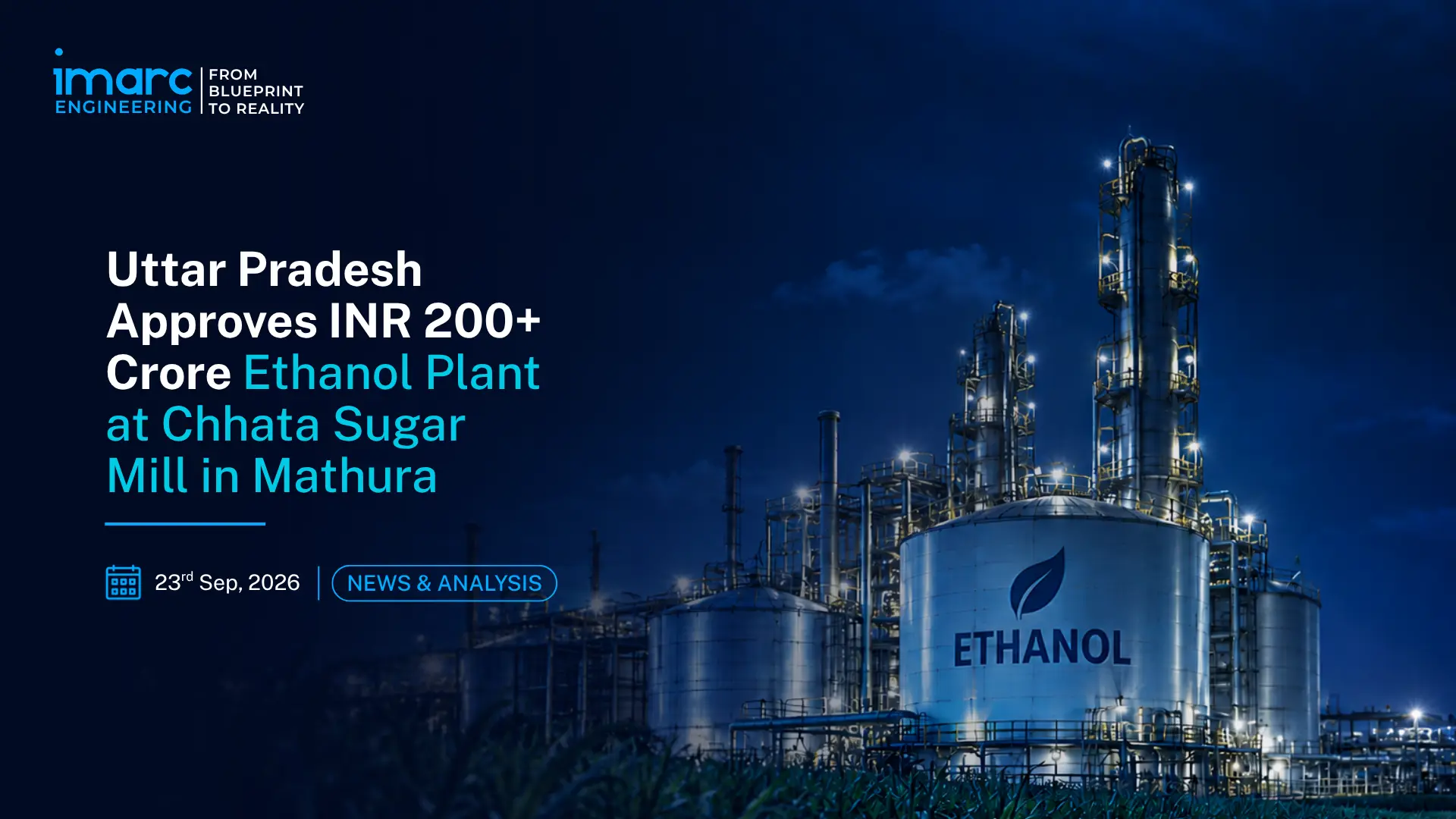
The Uttar Pradesh Cabinet, meeting under Chief Minister Yogi Adityanath in September 2026 approved a proposal to establish an ethanol plant at the closed Chhata Sugar Mill in Mathura district, one of 23 proposals cleared at the same meeting. Sugarcane Minister Chaudhary Laxmi Narayan, who represents the Chhata constituency in the state assembly, announced the decision, describing it as an important step toward providing relief to sugarcane farmers and making productive use of an industrial unit that has stood closed for nearly 19 years.
This is a Cabinet approval for a proposed project, not a confirmation that construction has started. The state government has approved the plan and outlined its broad parameters, but there is no confirmation that site work, detailed engineering, or construction is currently underway.
What Ethanol Plant Has the Uttar Pradesh Government Approved in Mathura?
The approved project would establish an ethanol manufacturing facility at the Chhata Sugar Mill, located in Chhata tehsil of Mathura district. The mill itself dates back to 1975 and had operated as the only sugar mill in the wider Agra region before its closure roughly 19 years ago. Rather than reviving the site purely as a sugar mill, the state government's approved plan directs it first toward ethanol production, reflecting current constraints on sugarcane supply in the area rather than a permanent shift away from sugar manufacturing.
How Much Investment is Planned, and What Will the Production Capacity Be?
The project is estimated to cost INR 200 crore, according to the state government's announcement. The plant is expected to produce 3.96 crore litres (39.6 million litres) of ethanol annually, operating for around 11 months of the year. These figures reflect the government's own stated project parameters at the approval stage; detailed engineering and project planning, which typically follow a Cabinet-level approval of this kind, would refine the specific design basis the facility is ultimately built around.
Which Feedstocks Are Expected to Be Used at the Chhata Ethanol Plant?
Minister Laxmi Narayan said the plant would initially produce ethanol using sugarcane and paddy as feedstock. He separately indicated that corn (maize) and rice would serve as alternative feedstocks once sugarcane supplies in the area are exhausted during a given operating season, describing a multi-feed approach rather than a facility designed around a single crop input.
This feedstock strategy is a direct response to the same supply constraint that is keeping the site out of full sugar production: rather than depending on a single feedstock whose local availability is limited, the project as announced is intended to draw on whichever of sugarcane, maize, or paddy is available at a given point in the operating year.
Why is the Closed Chhata Sugar Mill Site Being Revived for Ethanol Production?
According to Minister Laxmi Narayan, sugarcane availability in the Chhata area currently falls short of what the mill would need to operate as a sugar production facility. He noted that a sugar mill typically requires roughly 45-50 lakh quintals of sugarcane annually to run smoothly, a volume the region cannot presently supply.
Rather than leaving the site idle while cane cultivation in the area potentially expands, the government's approved plan repurposes it for ethanol production in the near term, using feedstocks more readily available locally. The minister indicated that sugar production could be taken up at the mill once adequate sugarcane supply becomes available, a stated future possibility rather than a committed timeline.
How Can Feedstock Availability Influence the Design and Utilization of a Multi-Feed Ethanol Plant?
A plant designed to run on more than one feedstock generally needs to account for the fact that sugarcane, paddy, rice, and maize each require different pre-processing, storage, and material-handling approaches before they can enter the ethanol production process. Sugarcane-based ethanol production typically follows a different process pathway from grain-based ethanol production using paddy, rice, or maize, and a facility intended to handle multiple feedstocks, whether sequentially across a season or through a more flexible processing configuration, needs storage capacity, material handling systems, and utilities sized to accommodate that variability rather than a single, fixed feedstock stream.
Seasonal availability also affects plant utilisation directly: a facility that can only run at full capacity when its primary feedstock is in season and must switch feedstocks or reduce output at other times, has a different utilisation profile than a single-feedstock plant with a steady year-round supply. The project as announced has not yet disclosed the specific process configuration or technology that will handle this multi-feed approach, and that design basis would need to be established through the plant's detailed engineering rather than assumed from the Cabinet announcement alone.
What Infrastructure and Project-Planning Requirements Need to Be Assessed at a Long-Idle Industrial Site?
Reviving a site that has been closed for close to two decades requires assessing what of the original sugar mill's infrastructure including buildings, utilities, storage, and any retained equipment, remains usable, what needs modification, and what would need to be replaced entirely before an ethanol production process could be installed. the site has around 96 acres of land, with warehouses and other supporting facilities identified as potential development opportunities, but it has not detailed the condition of the existing sugar mill structures or the extent to which they will be incorporated into the ethanol facility versus rebuilt from scratch.
This distinction matters materially for project planning: a facility that can reuse existing civil structures, power connections, and water infrastructure faces a different scope of work than one that effectively requires greenfield-level construction on an already-owned parcel of land. Until the project's engineering assessment of the existing site is complete, the degree to which this qualifies as a straightforward brownfield conversion, as opposed to substantial new construction on a previously industrial site, remains to be established.
What Are the Next Stages Between Cabinet Approval and Construction and Commissioning?
Following Cabinet approval, a project of this kind typically moves through detailed project reporting, site-specific engineering assessment, technology and process selection suited to the confirmed feedstock mix, and the applicable regulatory approvals and clearances required before construction and commissioning.
Separate reporting has indicated that Chief Minister Adityanath is expected to lay the foundation stone for the project later in the year, though this remains a reported expectation rather than a confirmed date, and it would mark the start of formal groundwork rather than the completion of construction. Actual construction, commissioning, and the timeline for the plant to begin ethanol production have not been detailed in the government's announcement and should not be assumed until confirmed through subsequent, authoritative updates.
Uttar Pradesh has approved a plan to bring a sugar mill that closed 19 years ago back into industrial use, not as a sugar producer, at least initially, but as a multi-feed ethanol plant designed around whatever crop feedstock the Chhata region can actually supply. Whether that plan delivers a reliable 3.96 crore-litre-a-year facility will depend on the engineering, site assessment, and feedstock-planning work that now needs to follow this Cabinet approval, not on the approval itself.
IMARC Engineering’s Perspective
The Chhata Sugar Mill ethanol project is a clear example of a state government using an existing, long-idle industrial asset to address a specific supply-chain constraint, insufficient local sugarcane for full sugar production, rather than leaving a 96-acre site with established infrastructure unused.
At IMARC Engineering, we see the project's multi-feed feedstock strategy, spanning sugarcane, paddy, maize, and rice, as exactly the kind of design decision that needs careful engineering resolution before construction: a facility intended to run on more than one feedstock has to be engineered for the storage, material handling, and process flexibility each input requires, rather than defaulting to a single-feedstock design that later struggles to accommodate feedstock switching. Equally, the extent to which the mill's existing structures and utilities can be reused, rather than rebuilt, needs a rigorous site and asset assessment before project cost and schedule commitments can be finalised with confidence.
As this project moves from Cabinet approval toward detailed engineering and, eventually, construction, the developers responsible for it will need to resolve these feedstock-design and existing-site questions early, since decisions made at this stage will shape the facility's utilisation and reliability for years after commissioning.
Latest News
-
Uttar Pradesh Approves INR 200+ Crore Ethanol Plant at Chhata Sugar Mill in Mathura
September 23, 2026
-
Escorts Kubota Breaks Ground on INR 2,000 Crore Greenfield Manufacturing Plant in Uttar Pradesh
September 22, 2026
-
SEMICON India 2026 Highlights Expansion of India’s Semiconductor Manufacturing Ecosystem
September 21, 2026
-
Wood Wins USD 200 Million ExxonMobil Construction Services Contract for PNG LNG Brownfield Projects
September 18, 2026
-
IHCL Signs 125-Key Greenfield Gateway Hotel in Sambalpur, Expanding Odisha Portfolio
September 18, 2026
Trusted by Industry Leaders
We partner with global enterprises and ambitious businesses across sectors to deliver operational excellence, strategic insights, and sustainable growth through integrated solutions.












Success in Their Words
Real feedback from clients across industries. Discover how our solutions delivered measurable impact and operational excellence.

I wanted to express my sincere appreciation for your efforts in handling this matter. Your dedication and commitment have been truly commendable, and it is evident that you have put in tremendous hard work and expertise into resolving the issues at hand. We are greatly interested in continuing our collaboration with you in the future, as your professionalism and reliability have made you a trusted partner. Thank you once again for your invaluable contribution. We look forward to strengthening our partnership ahead.

It has been a pleasure working with the IMARC team. The insights provided were structured, clear, and highly valuable, helping us strengthen both our technical and financial planning with confidence. We deeply appreciate the team’s professionalism, responsiveness, and attention to detail throughout the engagement. Every requirement was well understood and effectively incorporated, resulting in a comprehensive and actionable output. Overall, our experience has been excellent, and I would gladly recommend IMARC to organizations seeking a reliable research partner.

Your service is truly exceptional. Working with the IMARC team has been a seamless and professional experience. The clarity of communication, responsiveness to queries, and consistent support at every stage made the entire engagement highly efficient. The insights shared were well-structured, practical, and perfectly aligned with our requirements, helping us make informed decisions with confidence. Overall, the dedication and professionalism demonstrated by your team stand out, and I would be glad to recommend IMARC as a reliable and trustworthy research partner.

IMARC did an outstanding job in preparing our study. They were punctual, precise, and consistently responsive throughout the entire process. The team delivered all the data we required in a clear, well-organized, and highly professional format. Their strong attention to detail, combined with their ability to meet every deadline without compromising quality, truly set them apart. Overall, their reliability and commitment made them an exceptional partner for our project, and we would gladly work with them again in the future.

IMARC made the whole process incredibly easy from start to finish. Everyone I interacted with via email was polite, professional, and straightforward to deal with, always keeping their promises regarding delivery timelines and remaining consistently solutions-focused. From my very first contact, I appreciated the professionalism and support shown by the entire IMARC team. I highly recommend IMARC to anyone seeking timely, affordable, and reliable information or advice. My experience with IMARC was excellent, and I truly cannot fault any aspect of it.

I’d like to express my sincere gratitude for the excellent work you accomplished with the study. Your ability to quickly understand our requirements and deliver high-quality results under tight timelines truly reflects your expertise, exceptional work ethic, and unwavering commitment to your customer’s success. The professionalism and responsiveness you demonstrated throughout the process made a significant difference. Our entire team and company are incredibly thankful for your dedication, reliability, and support. Once again, thank you for your outstanding contribution.
Ready to Experience the IMARC Advantage?
Whether you're planning a new facility, expanding operations, optimizing performance, or facing complex challenges—IMARC Engineering brings the expertise, experience, and commitment needed for success.