India's Solar Manufacturing Expansion Highlights Growing Need for Integrated Cell and Wafer Production
October 30, 2026
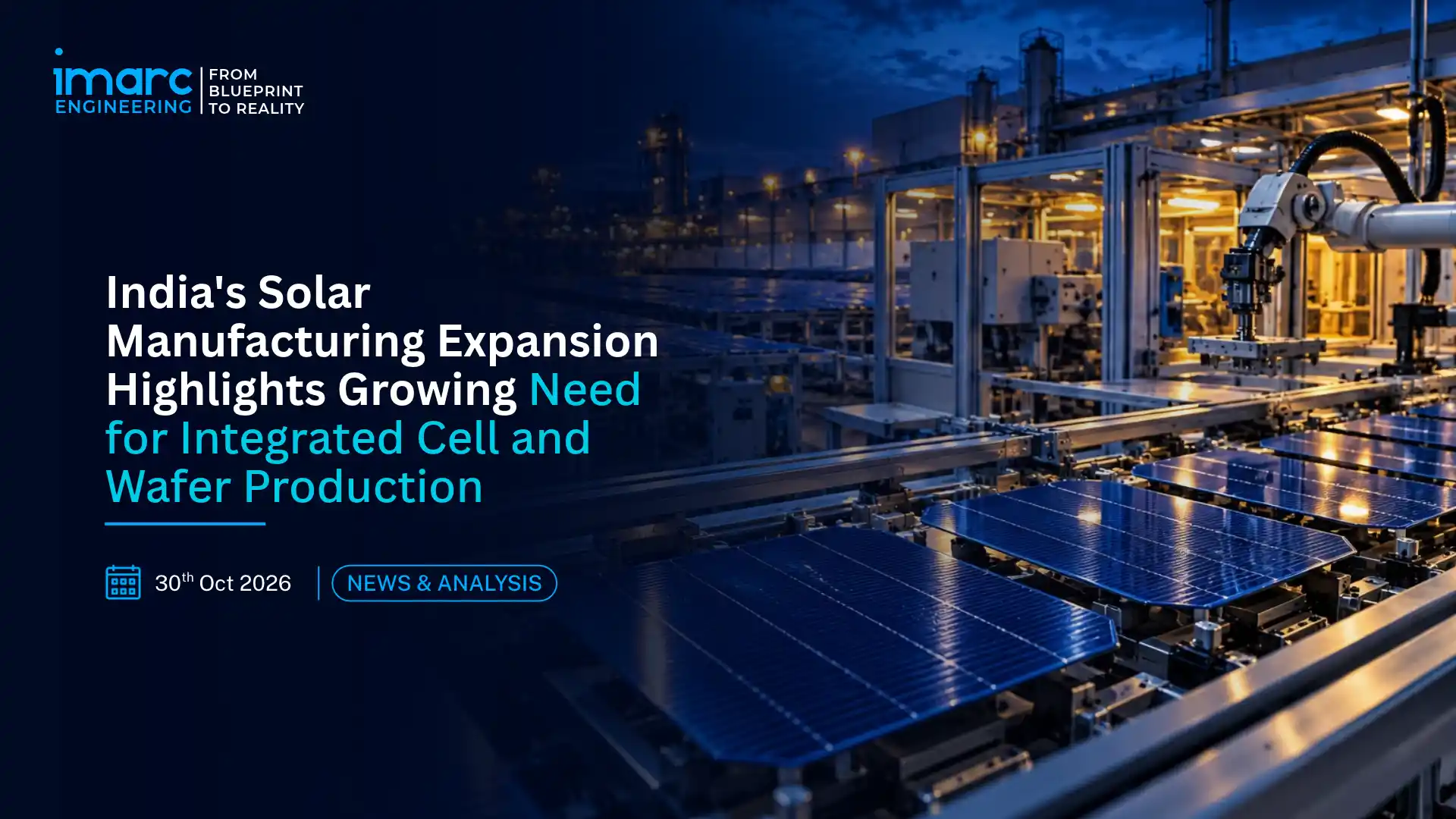
Solar manufacturing expansion in India has produced a lot of module capacity and much less cell, wafer and ingot capacity. According to Mercom India's September 2026 report, India added 50.6 GW of annual solar module manufacturing capacity and 9.7 GW of annual solar cell manufacturing capacity during the first half of 2026. Separately, IEEFA and JMK Research estimated module factory utilisation at 35–40%, highlighting a gap between installed manufacturing capacity and actual production. These figures represent different measures and should not be directly compared.
What Is Gigawatt-Scale Solar Manufacturing, and How Do the Stages Differ?
Gigawatt-scale solar manufacturing means factories with annual output measured in GW of modules, cells, wafers or ingots, and not in MW. The solar value chain has stages:
- Polysilicon is refined silicon, the base material.
- Ingots are crystalline silicon blocks grown from polysilicon.
- Wafers are thin slices cut from ingots.
- Solar cells are wafers processed into devices that generate electricity. Technologies such as TOPCon sit at this stage.
- Photovoltaic modules are cells assembled into panels.
Module assembly is the least capital-intensive stage, while ingot, wafer and cell production need more specialised equipment, utilities and process control. This is why capacity is uneven across the chain.
How Much Solar Module and Cell Capacity Did India Add in 2026?
Mercom India reported that India added 50.6 GW of solar module capacity and 9.7 GW of cell capacity in the first half of 2026. Mercom India reported that India's cumulative annual manufacturing capacity reached 261.7 GW for solar modules and 36.6 GW for solar cells by the end of June 2026. Separately, IEEFA and JMK Research estimated solar module manufacturing capacity at 233 GW for the same period. The estimates differ, and readers should refer to each report's methodology and coverage before comparing them. Neither figure represents actual annual production.
In October 2026, MNRE's ALMM List-II for solar cells reached approximately 37.39 GW of listed capacity after Premier Energies Photovoltaic added 529 MW of Mono-PERC capacity. This is enlisted capacity, not a measure of actual cell production.
Why Does India's Cell Capacity Lag Module Capacity?
According to IEEFA and JMK Research, India's solar module manufacturing capacity is nearly seven times its cell manufacturing capacity and approximately 116 times its ingot-wafer manufacturing capacity. This highlights the significant gap between downstream module assembly and upstream manufacturing capabilities. The development of domestic ingot and wafer production remains an important consideration for manufacturers evaluating supply-chain integration.
Mercom reports that cells made up 81% of cell and module imports in the first half of 2026, and that total imports rose 18% year on year. Mercom Capital's Raj Prabhu said, "Domestic cell shortages have become the biggest near-term challenge for India's solar market." He added that installed cell capacity overstates available supply, because new lines take months to reach stable commercial output.
Why Is India Expanding Integrated Solar Manufacturing Facilities?
India's Approved List of Models and Manufacturers (ALMM) framework is influencing investment decisions across the solar manufacturing value chain. Cell sourcing requirements under ALMM List-II apply to projects covered by the relevant government orders, subject to specified exemptions and transitional provisions.
In March 2026, the Ministry of New and Renewable Energy announced the extension of the ALMM framework to ingots and wafers through List-III, with implementation scheduled from June 1, 2028. Manufacturers should assess the applicable notifications, procurement requirements and project-specific exemptions before finalising investment decisions.
The initial list is to be issued only after at least three independent manufacturers with 15 GW of combined capacity are operational, and wafer makers must have equivalent ingot capacity. From June 2028, List-I is to include only modules made with ALMM-listed cells and wafers, with grandfathering for projects under implementation. These are policy notifications, and actual compliance depends on capacity coming online.
What Are the Risks of Module Overcapacity?
IEEFA and JMK Research estimated that India's solar module factories were operating at approximately 35–40% utilisation, while around 135 GW of additional manufacturing capacity was planned or under construction. The study highlighted concerns about whether existing and proposed capacity can achieve commercially sustainable utilisation levels. For investors, the implications include potential pricing pressure, underutilised assets, higher fixed costs per unit and greater uncertainty around project returns.
The export market is concentrated: The IEEFA and JMK Research study also highlighted a decline in Indian solar module exports to the United States from their FY2024 peak. The report identified trade-policy uncertainty and exposure to US import duties as significant risks for Indian manufacturers. These developments underline the importance of evaluating export-market concentration, trade restrictions and alternative sales markets before committing to additional manufacturing capacity.
Which Integrated Projects Are Announced, and What Is Their Status?
Announced projects are not operating plants. Waaree Energies announced the groundbreaking of an integrated ingot and wafer manufacturing facility at Butibori, Nagpur, in March 2025. The announced project scope includes 10 GW of ingot manufacturing capacity and 10 GW of wafer manufacturing capacity, with a proposed investment of approximately INR 6,200 crore.
These figures represent the company's announced project plans and should not be interpreted as commissioned or operational manufacturing capacity. The project's latest implementation and commissioning status should be confirmed through subsequent company disclosures.
In subsequent company materials, Waaree outlined FY2027 targets of 28.4 GW of module capacity and 15.4 GW of cell capacity. These are expansion targets, not confirmation that all the capacity is operational. The commissioning schedule for the Nagpur facility should be confirmed through the company's latest disclosures.
What Infrastructure and Costs Shape an Integrated Plant?
A GW-scale integrated plant needs reliable high-voltage power, ultrapure water, process gases, chemical storage and handling, effluent treatment, cleanroom or controlled areas and waste management. Ingot and wafer stages add heavy power and thermal loads, and cell lines need tight process control. Capital cost drivers include equipment, technology choice, utilities and civil works, and operating costs depend on power tariffs, silicon input prices, yield and utilisation. Specific CAPEX per GW varies by technology and site and is not given here.
India has built the module end of the solar chain faster than the cell, wafer and ingot end. The next phase of investment is likely to be judged on integration, utilisation and policy compliance, not announced gigawatts.
IMARC Engineering’s Perspective
India's rapid expansion in solar module manufacturing is making upstream integration an increasingly important investment consideration. However, establishing integrated cell, wafer or ingot manufacturing capacity is not necessarily commercially viable for every project.
At IMARC Engineering, we emphasise the importance of evaluating market demand, capacity utilisation, technology selection, raw material availability, site suitability, industrial utilities, CAPEX, OPEX and regulatory requirements before committing to new manufacturing investments.
A detailed feasibility study can help investors compare standalone module manufacturing with integrated production models, assess project risks and establish an appropriate development strategy. EPCM planning can further support equipment integration, infrastructure development, construction coordination and commissioning.
Latest News
-
India's Solar Manufacturing Expansion Highlights Growing Need for Integrated Cell and Wafer Production
October 30, 2026
-
Ministry of Power Releases Draft National Electricity Data Sharing Framework 2026 for Public Consultation
October 28, 2026
-
India's Electronics Imports from Vietnam Rise 9.5% in FY26 Amid Review of ASEAN Rules of Origin
October 27, 2026
-
China's Tunnel Boring Machine Export Controls Put Focus on India's Proposed USD 1.2 Billion Manufacturing Incentive Scheme
October 22, 2026
-
NTPC Plans Nuclear Power Project Feasibility Studies in More Indian States, Including Uttar Pradesh
October 21, 2026
Trusted by Industry Leaders
We partner with global enterprises and ambitious businesses across sectors to deliver operational excellence, strategic insights, and sustainable growth through integrated solutions.












Success in Their Words
Real feedback from clients across industries. Discover how our solutions delivered measurable impact and operational excellence.

I wanted to express my sincere appreciation for your efforts in handling this matter. Your dedication and commitment have been truly commendable, and it is evident that you have put in tremendous hard work and expertise into resolving the issues at hand. We are greatly interested in continuing our collaboration with you in the future, as your professionalism and reliability have made you a trusted partner. Thank you once again for your invaluable contribution. We look forward to strengthening our partnership ahead.

It has been a pleasure working with the IMARC team. The insights provided were structured, clear, and highly valuable, helping us strengthen both our technical and financial planning with confidence. We deeply appreciate the team’s professionalism, responsiveness, and attention to detail throughout the engagement. Every requirement was well understood and effectively incorporated, resulting in a comprehensive and actionable output. Overall, our experience has been excellent, and I would gladly recommend IMARC to organizations seeking a reliable research partner.

Your service is truly exceptional. Working with the IMARC team has been a seamless and professional experience. The clarity of communication, responsiveness to queries, and consistent support at every stage made the entire engagement highly efficient. The insights shared were well-structured, practical, and perfectly aligned with our requirements, helping us make informed decisions with confidence. Overall, the dedication and professionalism demonstrated by your team stand out, and I would be glad to recommend IMARC as a reliable and trustworthy research partner.

IMARC did an outstanding job in preparing our study. They were punctual, precise, and consistently responsive throughout the entire process. The team delivered all the data we required in a clear, well-organized, and highly professional format. Their strong attention to detail, combined with their ability to meet every deadline without compromising quality, truly set them apart. Overall, their reliability and commitment made them an exceptional partner for our project, and we would gladly work with them again in the future.

IMARC made the whole process incredibly easy from start to finish. Everyone I interacted with via email was polite, professional, and straightforward to deal with, always keeping their promises regarding delivery timelines and remaining consistently solutions-focused. From my very first contact, I appreciated the professionalism and support shown by the entire IMARC team. I highly recommend IMARC to anyone seeking timely, affordable, and reliable information or advice. My experience with IMARC was excellent, and I truly cannot fault any aspect of it.

I’d like to express my sincere gratitude for the excellent work you accomplished with the study. Your ability to quickly understand our requirements and deliver high-quality results under tight timelines truly reflects your expertise, exceptional work ethic, and unwavering commitment to your customer’s success. The professionalism and responsiveness you demonstrated throughout the process made a significant difference. Our entire team and company are incredibly thankful for your dedication, reliability, and support. Once again, thank you for your outstanding contribution.
Ready to Experience the IMARC Advantage?
Whether you're planning a new facility, expanding operations, optimizing performance, or facing complex challenges—IMARC Engineering brings the expertise, experience, and commitment needed for success.