India Clears 58 Companies Under INR 1,500 Crore Critical Mineral Recycling Scheme, with INR 5,000 Crore in Proposed Investments
November 02, 2026
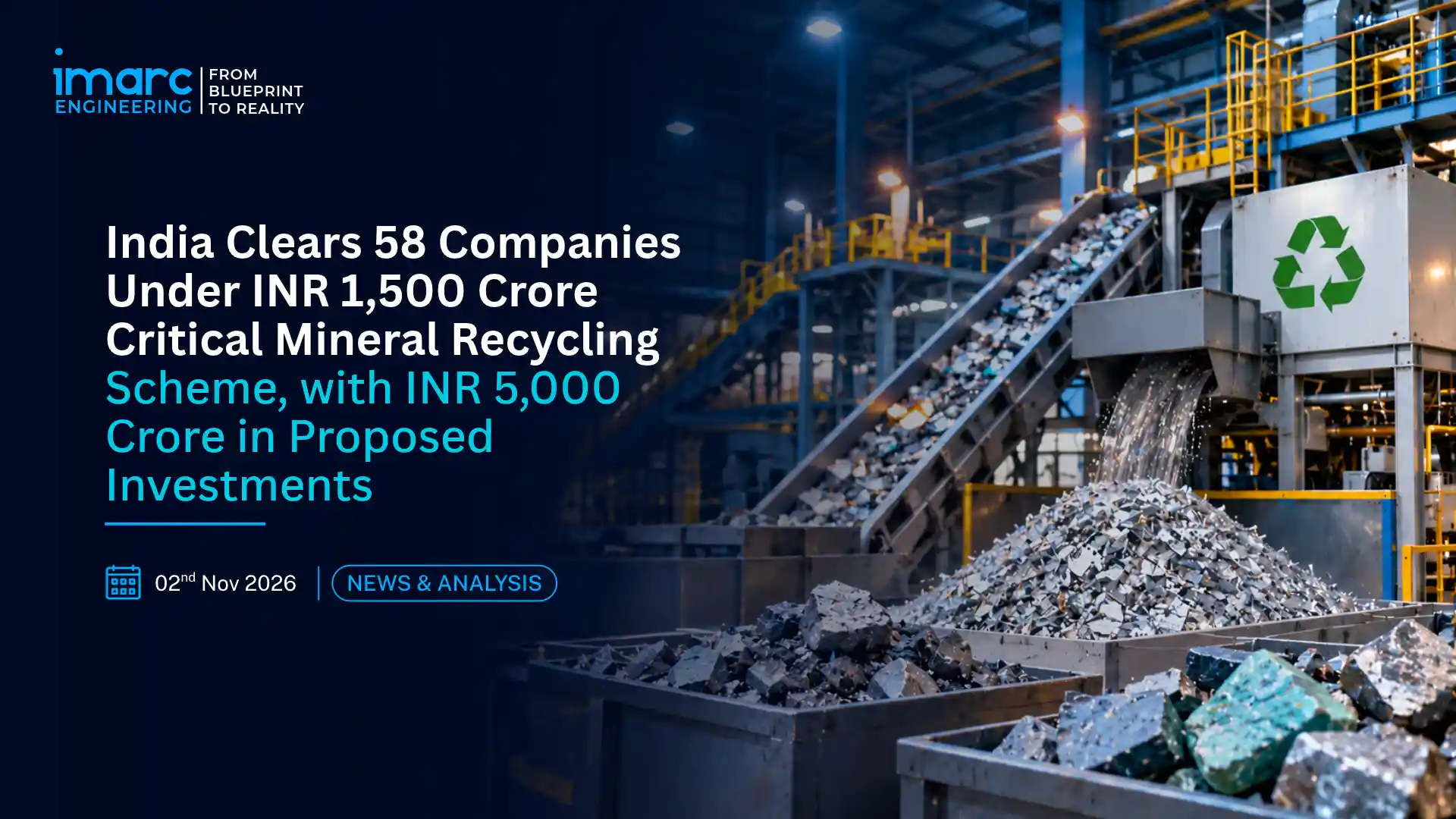
On April 30, 2026, the Ministry of Mines announced that 58 entities had been approved as eligible to participate in India's INR1,500 crore Incentive Scheme for Promotion of Critical Mineral Recycling. The entities have pledged approximately INR5,000 crore in investment and around 850 kilo tonnes per annum (KTPA) in recycling capacity. These are proposed figures, not verified installed or operating capacity. Eligibility does not mean that incentives have been disbursed; financial support remains subject to the scheme's conditions and claim-verification process.
What Did the April 30 Announcement Say?
The Ministry of Mines announced approval of 58 entities under the Incentive Scheme for Promotion of Critical Mineral Recycling, part of the National Critical Mineral Mission. Twenty entities were cleared on March 30, 2026, and 38 at the Executive Committee meeting on April 29, 2026. The pledged capacity is about 850 kilo tonnes per annum (KTPA).
Key Scheme Developments
The scheme was notified on October 2, 2025. Applications were open from October 2, 2025, to April 1, 2026. The Jawaharlal Nehru Aluminium Research Development and Design Centre, acting as Project Management Agency, evaluated the proposals.
The Ministry's April 30 announcement confirms eligibility approval for 58 entities. These entities must now meet the applicable project implementation, commercial production and incentive-claim requirements. The announcement does not establish that all proposed projects have commenced construction or production.
What Is the Incentive Structure?
The Union Cabinet approved the scheme in September 2025 for six years, from FY 2025-26 to FY 2030-31. As reported, it offers:
The scheme provides capital expenditure support for eligible recycling facilities, subject to the prescribed investment, commissioning and claim conditions. The applicable subsidy percentage, eligible expenditure and production-start deadlines should be confirmed against the Ministry of Mines' official scheme guidelines.
An OPEX incentive linked to incremental sales over the FY 2025-26 base year, paid 40% in year two and 60% in year five, subject to sales thresholds. Caps of INR 50 crore for large entities and INR 25 crore for small entities, including both CAPEX and OPEX support. The OPEX portion is capped at INR 10 crore and INR 5 crore.
One-third of the outlay is earmarked for small, new recyclers, including start-ups.
These terms are from Cabinet-approval coverage and secondary reports on the guidelines. IMARC Engineering has not reviewed the Ministry of Mines guidelines document, so applicants should confirm the exact rates, timelines and conditions in that document.
Is Eligibility the Same as Receiving Incentives?
No. Approval as an eligible participant is not the same as receiving an incentive. Under the scheme, financial support is linked to eligible investment, commencement of commercial production and the applicable performance requirements. Claims must be supported by prescribed documents and verified through the Project Management Agency and the scheme's Executive Committee.
The Ministry's April 30 announcement did not disclose company-wise incentive disbursements. The INR 5,000 crore figure represents pledged investment by the selected entities, not subsidy paid by the government. Actual support will depend on each project's compliance with the scheme conditions and successful claims.
Which Recycling Projects Are Covered?
The scheme covers spent lithium-ion batteries, e-waste and other eligible waste streams containing critical minerals, including specified catalysts, magnets and alloy scrap. Subject to the official guidelines, support may extend to new recycling facilities and the expansion, modernisation or diversification of existing units.
Does Black Mass Production Alone Qualify?
No. The scheme excludes activities limited to collection, dismantling, shredding, crushing, sorting or producing black mass without further extraction of critical minerals. Eligible projects must undertake actual recovery and separation of critical minerals through the prescribed processing route and meet the scheme's applicable performance and yield requirements. Applicants should check the official guidelines for the full eligibility criteria.
What Are the Implications for Recycling Plant Development?
A recycling plant is a chemical process facility, and its design depends on the feedstock. Lithium recovery, cobalt recovery and nickel recovery from batteries need collection and sorting, pre-treatment, a refining stage and effluent handling. Utilities include power, process water, reagent storage and waste treatment. E-waste lines need different equipment, so technology selection and recycling plant machinery should follow the feedstock mix.
Environmental approvals and project scheduling can influence the time required to establish and commission a recycling facility. Applicants should verify the scheme's applicable commissioning deadlines, incentive conditions and treatment of environmental-clearance requirements before finalising their implementation schedule. Delays can affect the applicable rate if the prescribed production-start window is missed. Site selection, environmental approvals, process design, utilities and commissioning should therefore be planned as an integrated project schedule.
What Happens Next?
At the Cabinet-approval stage, the scheme targeted at least 270 KTPA of recycling capacity and around 40 KTPA of annual critical-mineral production. The 850 KTPA announced on April 30 represents pledged capacity from eligible entities, not verified operating capacity. Although the pledged figure is higher than the scheme's original recycling-capacity target, the two figures should not be treated as evidence of capacity already commissioned or critical minerals already recovered.
The 58 approvals show strong interest. The scheme's real test will be how much of the pledged capacity is built, operated and able to recover critical minerals.
Industrial Project Perspective: IMARC Engineering's View
For eligible companies, the next challenge is translating approval into an executable project. A feasibility study should validate feedstock availability, recovery yields and product markets. CAPEX planning should distinguish eligible expenditure from excluded costs and account for the scheme's investment thresholds and incentive limits. Engineering should establish the process route, utilities, environmental controls and commissioning sequence early. Project scheduling should also account for the production-start deadlines that determine the applicable CAPEX incentive rate.
We support recyclers and investors with feasibility studies, DPR preparation, CAPEX planning, engineering and project management. We are not part of the Ministry's process, and companies should rely on the official guidelines for eligibility.
Latest News
-
India Clears 58 Companies Under INR 1,500 Crore Critical Mineral Recycling Scheme, with INR 5,000 Crore in Proposed Investments
November 02, 2026
-
India's Solar Manufacturing Expansion Highlights Growing Need for Integrated Cell and Wafer Production
October 30, 2026
-
Ministry of Power Releases Draft National Electricity Data Sharing Framework 2026 for Public Consultation
October 28, 2026
-
India's Electronics Imports from Vietnam Rise 9.5% in FY26 Amid Review of ASEAN Rules of Origin
October 27, 2026
-
China's Tunnel Boring Machine Export Controls Put Focus on India's Proposed USD 1.2 Billion Manufacturing Incentive Scheme
October 22, 2026
Trusted by Industry Leaders
We partner with global enterprises and ambitious businesses across sectors to deliver operational excellence, strategic insights, and sustainable growth through integrated solutions.








Success in Their Words
Real feedback from clients across industries. Discover how our solutions delivered measurable impact and operational excellence.

I wanted to express my sincere appreciation for your efforts in handling this matter. Your dedication and commitment have been truly commendable, and it is evident that you have put in tremendous hard work and expertise into resolving the issues at hand. We are greatly interested in continuing our collaboration with you in the future, as your professionalism and reliability have made you a trusted partner. Thank you once again for your invaluable contribution. We look forward to strengthening our partnership ahead.

It has been a pleasure working with the IMARC team. The insights provided were structured, clear, and highly valuable, helping us strengthen both our technical and financial planning with confidence. We deeply appreciate the team’s professionalism, responsiveness, and attention to detail throughout the engagement. Every requirement was well understood and effectively incorporated, resulting in a comprehensive and actionable output. Overall, our experience has been excellent, and I would gladly recommend IMARC to organizations seeking a reliable research partner.

Your service is truly exceptional. Working with the IMARC team has been a seamless and professional experience. The clarity of communication, responsiveness to queries, and consistent support at every stage made the entire engagement highly efficient. The insights shared were well-structured, practical, and perfectly aligned with our requirements, helping us make informed decisions with confidence. Overall, the dedication and professionalism demonstrated by your team stand out, and I would be glad to recommend IMARC as a reliable and trustworthy research partner.

IMARC did an outstanding job in preparing our study. They were punctual, precise, and consistently responsive throughout the entire process. The team delivered all the data we required in a clear, well-organized, and highly professional format. Their strong attention to detail, combined with their ability to meet every deadline without compromising quality, truly set them apart. Overall, their reliability and commitment made them an exceptional partner for our project, and we would gladly work with them again in the future.
IMARC made the whole process incredibly easy from start to finish. Everyone I interacted with via email was polite, professional, and straightforward to deal with, always keeping their promises regarding delivery timelines and remaining consistently solutions-focused. From my very first contact, I appreciated the professionalism and support shown by the entire IMARC team. I highly recommend IMARC to anyone seeking timely, affordable, and reliable information or advice. My experience with IMARC was excellent, and I truly cannot fault any aspect of it.

I’d like to express my sincere gratitude for the excellent work you accomplished with the study. Your ability to quickly understand our requirements and deliver high-quality results under tight timelines truly reflects your expertise, exceptional work ethic, and unwavering commitment to your customer’s success. The professionalism and responsiveness you demonstrated throughout the process made a significant difference. Our entire team and company are incredibly thankful for your dedication, reliability, and support. Once again, thank you for your outstanding contribution.
Ready to Experience the IMARC Advantage?
Whether you're planning a new facility, expanding operations, optimizing performance, or facing complex challenges—IMARC Engineering brings the expertise, experience, and commitment needed for success.