Chemical
July 07 2026
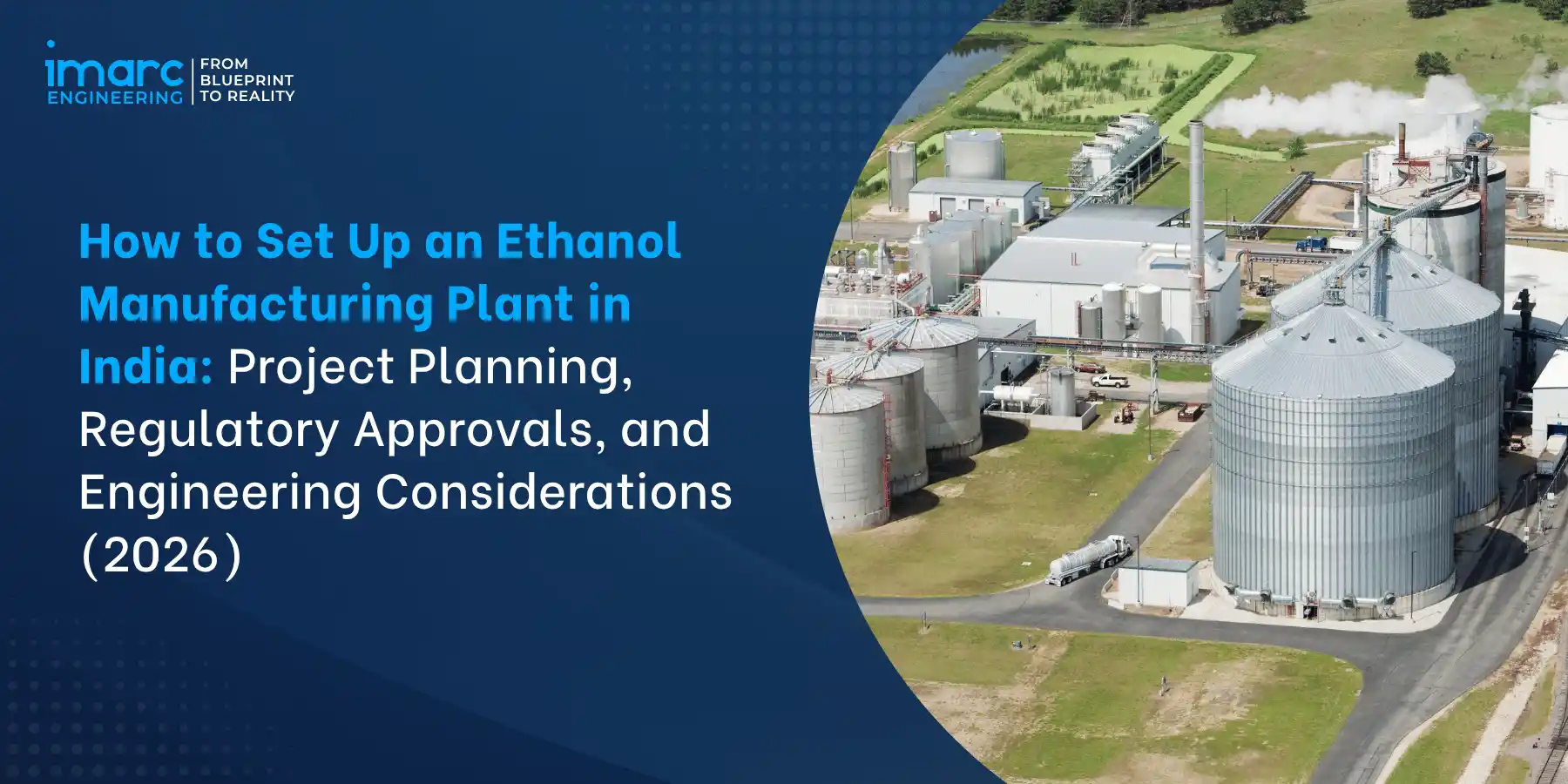
How to Set Up an Ethanol Manufacturing Plant in India: Project Planning, Regulatory Approvals, and Engineering Considerations (2026)
Introduction
India's biofuel sector is entering a new phase of industrial expansion, driven by the Ethanol Blended Petrol (EBP) Programme, increasing investments in renewable energy, and rising demand for domestically produced ethanol. As ethanol production capacity continues to grow, developers, sugar mills, grain processors, and investors are actively evaluating opportunities to establish new ethanol manufacturing plants in India.
However, setting up an ethanol manufacturing plant involves far more than selecting a technology provider or arranging project finance. A successful ethanol manufacturing project requires detailed feasibility studies, feedstock planning, engineering design, regulatory approvals, environmental compliance, utility infrastructure, and disciplined project execution. Decisions made during the planning stage directly influence project costs, approval timelines, operational efficiency, and long-term commercial viability.
Scope of this Guide
This guide explains what investors need to know before setting up an ethanol manufacturing plant in India. It covers project planning, regulatory approvals, engineering considerations, infrastructure requirements, execution strategy, and key challenges, helping manufacturers reduce project risks and build a commercially viable, future-ready biofuel manufacturing facility.
Table of Contents
- Introduction
- Why Ethanol Manufacturing in India Matters in 2026
- Feedstock Selection and Plant Configuration
- How to Set Up an Ethanol Manufacturing Plant in India
- Ethanol Manufacturing Plant Feasibility Study India
- Regulatory Approvals for Ethanol Distillery in India
- Ethanol Plant Engineering and Design Services in India
- Ethanol Plant Setup Cost in India
- Common Mistakes and Best Practices
- Conclusion
1. Why Ethanol Manufacturing in India Matters in 2026
Four structural drivers make ethanol manufacturing a strategically compelling opportunity for Indian investors in 2026.
1.1 Ethanol Blended Petrol Programme Acceleration
Ethanol capacity expansion has emerged as one of the most policy-supported categories of industrial plant setup in India. India achieved E10 (10 percent ethanol blending in petrol) in June 2022. Government of India advanced the E20 target from 2030 to 2025-26, creating structural demand growth for ethanol capacity.
The Ministry of Petroleum and Natural Gas along with Oil Marketing Companies (IOCL, BPCL, HPCL) has published progressive procurement plans supporting the E20 target. India's petrol consumption base creates ethanol demand at scale that current capacity is progressively meeting through capacity additions.
1.2 National Biofuels Policy Framework
The National Biofuels Policy 2018 provides the policy foundation. Amendments in 2022 expanded permitted feedstocks to include damaged foodgrains, surplus foodgrains from Food Corporation of India, sugarcane derivatives including juice and syrup (previously restricted), and additional biomass sources. The policy encourages Second Generation (2G) cellulosic ethanol as long-term alternative. Interest subvention schemes, priority sector lending, and off-take pricing mechanisms provide financial support to new capacity additions.
1.3 State-Level Support
State Governments particularly in Uttar Pradesh, Maharashtra, Karnataka, Tamil Nadu, Bihar, and Madhya Pradesh have introduced structured incentive packages including capital subsidies, interest subvention, land at concessional rates, and expedited approvals. Uttar Pradesh has emerged as a particularly active state with a large sugar sector supporting molasses-based capacity. State-level policy support materially affects project economics and should be evaluated during location decisions.
1.4 Off-Take Certainty and Revenue Predictability
Unlike many industrial products facing market price volatility, ethanol for blending has structured off-take through OMC procurement mechanisms. Long-term agreements at published prices provide revenue predictability that supports debt financing structures and lender confidence. This off-take certainty distinguishes ethanol investments from many other industrial opportunities and materially improves financing terms.
2. Feedstock Selection and Plant Configuration
The single most consequential decision in ethanol plant project planning is feedstock selection. Feedstock choice determines plant configuration, capital cost, operating economics, byproduct streams, and effluent management approach. Feedstock selection for ethanol manufacturing plants requires structured analysis of availability, cost, seasonal variation, and regulatory permissions.
2.1 Feedstock Options Under NBP
| Feedstock Category | Examples | Typical Position |
|---|---|---|
| Sugarcane Derivatives | C-Heavy Molasses, B-Heavy Molasses, Sugarcane Juice, Syrup | Traditional; regional availability |
| Grain-Based | Damaged foodgrains, maize, broken rice, FCI surplus rice | Expanding; enables non-sugar geography |
| Dual Feed | Combination of molasses and grain | Flexibility across seasons |
| Second Generation (2G) | Rice/wheat straw, bagasse, cellulosic biomass | Emerging; higher capital cost |
| Other | Sweet sorghum, damaged/surplus horticultural produce | Niche; regional pilots |
2.2 Molasses-Based Configuration
Molasses-based distilleries operate downstream of sugar mills or independently sourcing molasses. Advantages include lower capital cost, mature technology, established equipment supplier base, and shorter mash preparation time.
Disadvantages include feedstock geography constraints (sugar-growing regions), seasonal availability, and significant spent wash volumes requiring intensive effluent management. Typical capital cost for a 60-100 KLPD (Kilo Litres Per Day) molasses-based plant is INR 50-150 crore; 200-500 KLPD plants range INR 150-500 crore depending on utilities scope and integration.
2.3 Grain-Based Configuration
Grain-based distilleries process damaged foodgrains, maize, broken rice, or FCI-supplied surplus rice. Advantages include feedstock availability across broader geography, ability to blend feedstocks, and valuable Distillers Dried Grains with Solubles (DDGS) or Distillers Wet Grains (DWG) byproducts that support animal feed markets.
Disadvantages include higher capital cost due to grain handling and cooking systems, and grain price volatility affecting operating margins. Typical capital cost for a 60-100 KLPD grain-based plant is INR 100-200 crore; larger 200-500 KLPD plants range INR 200-600 crore. Investors should evaluate biofuel manufacturing plant in India opportunities against local feedstock availability and DDGS market access.
2.4 Dual Feed Configurations
Dual feed ethanol plant configuration has emerged as increasingly popular for new projects. The configuration allows switching between molasses and grain feedstocks based on seasonal availability, price differentials, and off-take contracts. Capital cost is 15-25 percent higher than single-feedstock plants but operational flexibility provides material risk mitigation across feedstock price cycles. Dual feed plants are particularly common in geographies with both sugar sector activity and grain availability.
3. How to Set Up an Ethanol Manufacturing Plant in India
The end-to-end pathway from concept to commissioning typically runs 30-48 months. Understanding how to set up an ethanol manufacturing plant in India helps promoters plan realistic timelines and sequenced investment commitments.
3.1 The Six-Stage Project Roadmap
| Stage | Activities | Typical Duration |
|---|---|---|
| 1. Feasibility & Concept | Feedstock, location, capacity, off-take | 3-6 months |
| 2. Approvals Initiation | Land, EC, distillery licence, boiler, PESO | 12-18 months |
| 3. Financing | Term loan, equity, interest subvention | 6-12 months |
| 4. Detailed Engineering | Process, utilities, effluent, civil, electrical | 6-12 months |
| 5. Construction | Civil, mechanical, piping, instrumentation, utilities | 12-18 months |
| 6. Commissioning & COD | Cold and hot commissioning, OMC first-fill | 3-6 months |
3.2 Concept and Feasibility
Concept-stage activities include feedstock availability assessment (crop patterns, sugar mill proximity, FCI district-level surplus, logistics economics), off-take mapping (OMC procurement zones, ethanol pricing scenarios, transportation logistics), location screening (state incentives, land availability, water access, road/rail connectivity, industrial classification), and preliminary technical configuration. Concept documents form the basis for pre-feasibility studies and internal go/no-go decisions before feasibility investment.
3.3 Approvals and Financing in Parallel
Approvals initiation and financing arrangement operate in parallel to compress timeline. Environmental Clearance under EIA Notification 2006 typically takes 12-18 months from application including public consultation. State Pollution Control Board Consent to Establish (CTE) is prerequisite for construction.
Distillery licence from State Excise Department is typically the most sector-specific approval requiring detailed state-by-state understanding. Term loan financing at typical 70:30 or 75:25 debt-equity ratio is negotiated during approvals period.
3.4 Engineering, Construction, and Commissioning
Detailed engineering covers process package (fermentation, distillation, dehydration), utilities (boiler, cooling, DM water), effluent management (Zero Liquid Discharge design), civil works (foundations, tank farm, warehouses, roads), electrical and instrumentation, and safety systems (fire, gas detection, emergency response). Construction follows engineering release with typical 12-18 month duration. Commissioning covers cold commissioning of utilities, hot commissioning of process, performance guarantee testing, and OMC first-fill leading to Commercial Operations Date.
4. Ethanol Manufacturing Plant Feasibility Study India
A rigorous ethanol manufacturing plant feasibility study is the foundation of investment-grade decision-making. Weak feasibility work produces subsequent project difficulties that dwarf the cost of thorough upfront analysis. Structured ethanol plant feasibility study work covers technical, commercial, regulatory, financial, and environmental dimensions.
4.1 Technical Feasibility
Technical feasibility covers process technology selection, feedstock availability quantification, water availability from surface or ground sources, power availability, boiler fuel supply, and site suitability (soil, seismic zone, flood risk, connectivity). Process technology choice among molecular sieve dehydration, azeotropic distillation, or hybrid configurations affects capital cost and utility consumption. Water balance verification is particularly critical given intensive water requirements of distilleries. Site suitability failures at feasibility stage cost fractions of failures discovered during construction.
4.2 Commercial and Market Assessment
Commercial feasibility covers OMC off-take arrangements (procurement zone, tender participation, price mechanism), byproduct market development (DDGS/DWG for grain plants, CO2 capture for beverages/industrial, biogas for power), feedstock procurement structures (sugar mill agreements, FCI supply, direct farmer sourcing where permitted), and financial closure prerequisites. Market assessment considers both current and projected demand-supply balance under different E20 rollout scenarios.
4.3 Financial Modelling
Financial modelling integrates capital cost estimates, operating cost projections, revenue projections at published OMC prices, working capital requirements, financing structure, tax provisions, and sensitivity analysis. Well-designed models test outcomes under feedstock price scenarios, OMC price scenarios, capacity utilisation scenarios, and financing cost scenarios. Monte Carlo simulation supports contingency provisioning. Bank-quality models are essential for term loan approval. Sensitivity to feedstock cost is typically the largest single variable driving project IRR.
4.4 Environmental and Social Assessment
Environmental assessment covers water sourcing sustainability, effluent management strategy (Zero Liquid Discharge is mandatory for distilleries per CPCB directives), air emission controls, hazardous waste management, and social impact including local employment expectations. Baseline environmental studies begin early to support subsequent Environmental Clearance application. Community engagement through structured social impact assessment reduces downstream community relations risk.
5. Regulatory Approvals for Ethanol Distillery in India
Regulatory approvals for ethanol distillery in India span Central and State levels with several sector-specific approvals unique to alcohol manufacturing. Structured approval planning avoids the sequential-approval trap where each approval waits for its predecessor.
5.1 The Approvals Map
| Approval | Issuing Authority | Timing |
|---|---|---|
| Environmental Clearance | MoEFCC / State EIAA | Pre-construction |
| Consent to Establish (CTE) | State Pollution Control Board | Pre-construction |
| Consent to Operate (CTO) | State Pollution Control Board | Pre-COD |
| Distillery Licence | State Excise Department | Pre-construction |
| Factory Licence | State Directorate of Factories | Pre-COD |
| Boiler Registration (IBR) | State Boiler Inspectorate | Pre-commissioning |
| PESO Licence | PESO under Explosives Act | Pre-commissioning |
| Fire NOC | State Fire Services | Pre-COD |
5.2 Environmental Clearance
Ethanol plant environmental clearance is granted under EIA Notification 2006. Distilleries typically fall under Category B classification (though large capacities may attract Category A). Process includes application submission with Form 1, ToR (Terms of Reference) from State Expert Appraisal Committee (SEAC), baseline environmental studies, Environmental Impact Assessment (EIA) report preparation, public consultation including public hearing, EAC/SEAC appraisal, and clearance letter with binding conditions. Timelines typically span 12-18 months from application to clearance. Environmental Management Plan (EMP) commitments become binding operational obligations.
5.3 Distillery Licence and State Excise Framework
The Distillery Licence from State Excise Department is the most sector-specific approval. State Excise Acts vary materially across states - some states such as Uttar Pradesh, Maharashtra, and Karnataka have well-developed frameworks with published policies; others require case-by-case navigation. Licence covers distillation, storage, bottling (where applicable), and movement of ethanol. Bond arrangements for excise-duty-free ethanol movement to OMCs require separate approval. State-specific expertise materially affects licensing timelines and outcomes.
5.4 PESO, IBR, and Safety Approvals
Petroleum and Explosives Safety Organisation (PESO) under the Explosives Act 1884 governs ethanol storage and handling given its flammability. Storage tank design, dyke construction, fire protection, and layout require PESO approval.
Static and Mobile Pressure Vessels (Unfired) Rules 2016 govern pressure vessels. Indian Boilers Act 1923 through State Boiler Inspectorates governs boiler registration and periodic inspection. Fire NOC from State Fire Services governs fire protection systems. These approvals cannot be compressed and should be initiated in parallel with primary approvals.
6. Ethanol Plant Engineering and Design Services in India
Ethanol plant engineering and design services integrate process, mechanical, civil, electrical, instrumentation, and utility engineering across the distillery boundary. Structured ethanol plant engineering reduces field rework, protects schedule, and delivers the operating asset that project economics depend upon.
6.1 Process Engineering Scope
Process engineering covers feedstock preparation (grinding, cooking, liquefaction, saccharification for grain; dilution for molasses), fermentation systems with yeast propagation, multi-column distillation (rectifier, stripper, purifier), dehydration through molecular sieve to 99.5 percent-plus anhydrous ethanol per IS 15464 specification, product storage, and DDGS/DWG recovery for grain plants.
Vendor selection typically involves Praj Industries, Vogelbusch, Katzen International, ThyssenKrupp, and others with proven Indian references. Technology licence, engineering, and equipment supply packages define the process backbone.
6.2 Utility Systems
Utilities represent 25-40 percent of ethanol plant capital cost. Steam boilers (30-100 TPH capacity typical) support cooking, distillation, and evaporation. Boiler fuel selection between bagasse (integrated sugar mills), rice husk, coal, or biomass affects operating cost and Environmental Clearance conditions.
Cooling water systems provide condensation and process cooling. Demineralised water plants prepare boiler feed. Instrument and plant air compressors serve controls and process needs. Captive cogeneration is common - producing both steam and power from single fuel source with attractive economics.
6.3 Effluent Management and Zero Liquid Discharge
Distillery zero liquid discharge design is mandatory for ethanol plants per Central Pollution Control Board directives. Spent wash from molasses fermentation carries high BOD, COD, and total dissolved solids. Treatment train typically includes bio-methanation (recovering biogas as fuel), multi-effect evaporators concentrating spent wash from ~10 percent to ~55-60 percent solids, followed by incineration in boiler or composting for potash-rich ash. Grain plants produce lower spent wash volume with different composition. ZLD design integrates with utility strategy since biogas recovery and evaporator steam demand tie to overall energy balance.
6.4 Safety, Fire, and Electrical Classification
Safety engineering covers hazardous area classification per IS 5572 and IEC 60079, explosion-proof electrical equipment in classified zones, fire protection with foam-water systems for tank farm, gas detection for combustible mixtures, emergency shutdown systems, and structured management of change protocols.
Ethanol storage requires PESO-approved tank design with dyke walls, drain traps, and fire protection. Electrical distribution must accommodate motor loads (agitators, pumps, compressors), instrumentation power, lighting, and emergency backup. Safety-integrated engineering costs materially less than post-construction retrofits.
7. Ethanol Plant Setup Cost in India
Ethanol plant setup cost in India varies significantly by capacity, feedstock, technology, and location. Understanding the cost structure supports informed investment planning and effective bank engagement.
7.1 Capital Cost Ranges
| Configuration | Capacity | Indicative Capital Cost |
|---|---|---|
| Molasses-Based | 60-100 KLPD | INR 50-150 crore |
| Molasses-Based | 200-500 KLPD | INR 150-500 crore |
| Grain-Based | 60-100 KLPD | INR 100-200 crore |
| Grain-Based | 200-500 KLPD | INR 200-600 crore |
| Dual Feed | 100-300 KLPD | INR 150-400 crore |
| 2G Cellulosic (Emerging) | 60-100 KLPD | INR 200-500 crore |
7.2 Cost Component Breakdown
- Process package (technology licence + equipment): 30-40 percent
- Utilities (boiler, cooling, DM water, cogeneration): 15-25 percent
- Effluent treatment and ZLD system: 10-20 percent
- Civil works, buildings, tank farm, roads: 10-15 percent
- Electrical, instrumentation, and controls: 8-12 percent
- Erection, commissioning, and project management: 8-12 percent
- Contingency and pre-operative expenses: 5-8 percent
7.3 Financing Structures
Term loan financing typically at 70:30 or 75:25 debt-equity ratio. State Bank of India, Punjab National Bank, Union Bank, and Bank of Baroda are common consortium leaders for ethanol projects. Interest subvention under NBP-linked schemes reduces effective borrowing cost. Some projects use structured lender syndicates for larger investments. Working capital arrangements cover feedstock inventory, work-in-progress, and OMC receivables cycle. Financial closure discipline requires bank-quality technical and commercial documentation.
7.4 Payback and Return Considerations
Well-designed ethanol projects at appropriate scale typically target project IRR of 15-20 percent and payback periods of 6-9 years. Feedstock cost is the single largest operating variable - typically 55-70 percent of variable operating cost. OMC price movements and feedstock price movements together determine actual margin. Byproduct revenue (DDGS for grain plants, biogas for utilities offset) materially affects returns. State incentives and interest subvention improve effective returns. Poor feedstock strategy, weak location choice, or under-scaled utilities can erode returns materially.
8. Common Mistakes and Best Practices
8.1 Under-Scoped Feedstock Strategy
Feedstock plans based on ambient market prices without structured sourcing arrangements face material operating stress during shortage periods. Best practice: multi-year supply arrangements with sugar mills, farmer producer organisations, or FCI channel; buffer inventory positioning; dual-feed capability where feasible; scenario analysis of feedstock cost variation.
8.2 Weak Environmental and ZLD Design
Effluent management retrofits after construction cost far more than upfront ZLD design integration. Best practice: integrated design from concept stage; distillery zero liquid discharge design embedded in overall energy and mass balance; biogas recovery integrated with boiler fuel strategy; contingency for effluent variability across feedstock changes.
8.3 Sequential Rather Than Parallel Approvals
Waiting for one approval before initiating the next extends approvals stage from typical 12-18 months to 24-36 months. Best practice: parallel initiation of Environmental Clearance, Distillery Licence, State Pollution Control Board CTE, land acquisition, and financing; dedicated approvals coordinator; structured escalation for delays.
8.4 Inadequate Utilities Sizing
Under-sized utilities (steam, power, water, cooling) constrain plant capacity below designed rating. Best practice: utility sizing at 110-115 percent of process design to accommodate peak and future debottlenecking; integrated cogeneration where fuel supply supports; standby capacity for critical utilities; utility optimisation studies at engineering stage.
8.5 Weak Contractor and PMC Engagement
Under-resourced project management and contractor selection on lowest-price basis produce cost, quality, and schedule outcomes that exceed direct savings. Best practice: qualification-based contractor selection; experienced project management consultant (PMC); structured contract framework with FIDIC or comparable discipline; clear risk allocation and change control.
Conclusion
For any investor considering INR 100-500 crore or higher deployment in an ethanol manufacturing plant in India in 2026, the opportunity is materially attractive, but execution complexity is substantial. Ethanol Blended Petrol Programme acceleration to E20, National Biofuels Policy 2018 feedstock expansion, State Government incentives across sugar and grain geographies, and OMC-backed off-take certainty collectively define one of the most structurally supported industrial investment opportunities available.
Sponsors that combine structured feasibility, disciplined approvals sequencing, rigorous engineering, and experienced execution management consistently deliver projects that achieve commissioning on schedule and meet Internal Rate of Return targets across the project lifecycle.
Three closing reminders for ethanol project sponsors. First, invest in structured feasibility discipline before financial closure - feedstock sourcing arrangements, off-take agreements, location suitability, and financial modelling that survives bank scrutiny materially determine downstream outcomes.
Second, sequence approvals in parallel rather than serially - Environmental Clearance, Distillery Licence, State Pollution Control Board consents, boiler registration, PESO approvals, and Fire NOC can and should progress in parallel through structured coordination.
Third, engineer for integrated performance from inception - process, utilities, effluent management (including mandatory Zero Liquid Discharge), safety systems, and civil works must be designed as a coherent whole rather than sequential silos to deliver the operating asset that ethanol economics depend upon.
PLANNING YOUR ETHANOL MANUFACTURING PROJECT?
IMARC Engineering's ethanol project advisory team supports promoters, investors, and project development teams across feedstock strategy, feasibility studies, approvals coordination, technology selection, detailed engineering, financing support, construction management, commissioning, and post-COD operations optimisation for greenfield and expansion ethanol projects across molasses, grain, dual-feed, and 2G cellulosic configurations.
→ Schedule a free ethanol project scoping consultation with an IMARC specialist
Frequently Asked Questions
Costs vary by capacity and feedstock. Ethanol plant setup cost in India typically ranges INR 50-150 crore for 60-100 KLPD molasses plants; INR 100-200 crore for equivalent grain plants; INR 150-500 crore for 200-500 KLPD molasses plants; INR 200-600 crore for larger grain plants.
There is no universal best - choice depends on geographic feedstock availability, price stability, byproduct market access, and effluent handling capability. Molasses is traditional in sugar-growing regions; grain-based is expanding across broader geography; dual-feed configurations provide flexibility.
End-to-end timeline from concept to Commercial Operations Date is typically 30-48 months. Ethanol manufacturing project timelines can be compressed through parallel approvals and engineering-construction overlap, but structural steps like Environmental Clearance and Distillery Licence require inherent processing time.
Key approvals include Environmental Clearance under EIA Notification 2006, State Pollution Control Board Consent to Establish and Consent to Operate, Distillery Licence from State Excise Department, Factory Licence, Boiler registration under IBR, PESO approval for ethanol storage, and Fire NOC. Approvals should progress in parallel rather than sequentially.
Yes. Central Pollution Control Board directives require ZLD for distilleries. Ethanol plant engineering must integrate ZLD from concept stage, typically through bio-methanation, multi-effect evaporators, and incineration or composting of concentrated solids.
OMCs (IOCL, BPCL, HPCL) procure ethanol through structured tender processes with published prices linked to feedstock source (C-Heavy Molasses, B-Heavy Molasses, Sugarcane Juice, Damaged Foodgrains, Surplus FCI Rice). Long-term supply agreements provide off-take certainty for planned capacity.
Term loan financing typically at 70:30 or 75:25 debt-equity from banks including State Bank of India, Punjab National Bank, Union Bank, and Bank of Baroda. Interest subvention schemes reduce borrowing cost. Ethanol plant regulatory approvals and structured feasibility support bank engagement.
Yes. Smaller greenfield ethanol plant capacities in the 30-60 KLPD range are viable in appropriate geographies with structured feedstock arrangements. Capital deployment of INR 50-100 crore is achievable for right-sized projects.
Byproducts include Distillers Dried Grains with Solubles (DDGS) or Distillers Wet Grains (DWG) from grain plants supporting animal feed markets; CO2 capture for beverage or industrial applications; biogas from spent wash bio-methanation supporting boiler fuel or power generation; potash-rich ash from spent wash incineration. Byproduct revenue materially affects project returns.
Recent Post
Trusted by Industry Leaders
We partner with global enterprises and ambitious businesses across sectors to deliver operational excellence, strategic insights, and sustainable growth through integrated solutions.










Success in Their Words
Real feedback from clients across industries. Discover how our solutions delivered measurable impact and operational excellence.

I wanted to express my sincere appreciation for your efforts in handling this matter. Your dedication and commitment have been truly commendable, and it is evident that you have put in tremendous hard work and expertise into resolving the issues at hand. We are greatly interested in continuing our collaboration with you in the future, as your professionalism and reliability have made you a trusted partner. Thank you once again for your invaluable contribution. We look forward to strengthening our partnership ahead.

It has been a pleasure working with the IMARC team. The insights provided were structured, clear, and highly valuable, helping us strengthen both our technical and financial planning with confidence. We deeply appreciate the team’s professionalism, responsiveness, and attention to detail throughout the engagement. Every requirement was well understood and effectively incorporated, resulting in a comprehensive and actionable output. Overall, our experience has been excellent, and I would gladly recommend IMARC to organizations seeking a reliable research partner.

Your service is truly exceptional. Working with the IMARC team has been a seamless and professional experience. The clarity of communication, responsiveness to queries, and consistent support at every stage made the entire engagement highly efficient. The insights shared were well-structured, practical, and perfectly aligned with our requirements, helping us make informed decisions with confidence. Overall, the dedication and professionalism demonstrated by your team stand out, and I would be glad to recommend IMARC as a reliable and trustworthy research partner.

IMARC did an outstanding job in preparing our study. They were punctual, precise, and consistently responsive throughout the entire process. The team delivered all the data we required in a clear, well-organized, and highly professional format. Their strong attention to detail, combined with their ability to meet every deadline without compromising quality, truly set them apart. Overall, their reliability and commitment made them an exceptional partner for our project, and we would gladly work with them again in the future.

IMARC made the whole process incredibly easy from start to finish. Everyone I interacted with via email was polite, professional, and straightforward to deal with, always keeping their promises regarding delivery timelines and remaining consistently solutions-focused. From my very first contact, I appreciated the professionalism and support shown by the entire IMARC team. I highly recommend IMARC to anyone seeking timely, affordable, and reliable information or advice. My experience with IMARC was excellent, and I truly cannot fault any aspect of it.

I’d like to express my sincere gratitude for the excellent work you accomplished with the study. Your ability to quickly understand our requirements and deliver high-quality results under tight timelines truly reflects your expertise, exceptional work ethic, and unwavering commitment to your customer’s success. The professionalism and responsiveness you demonstrated throughout the process made a significant difference. Our entire team and company are incredibly thankful for your dedication, reliability, and support. Once again, thank you for your outstanding contribution.