Thoothukudi Mega Shipyard Moves Forward with INR 6.78 Crore Geotechnical and Seabed Investigation Tender
September 17, 2026
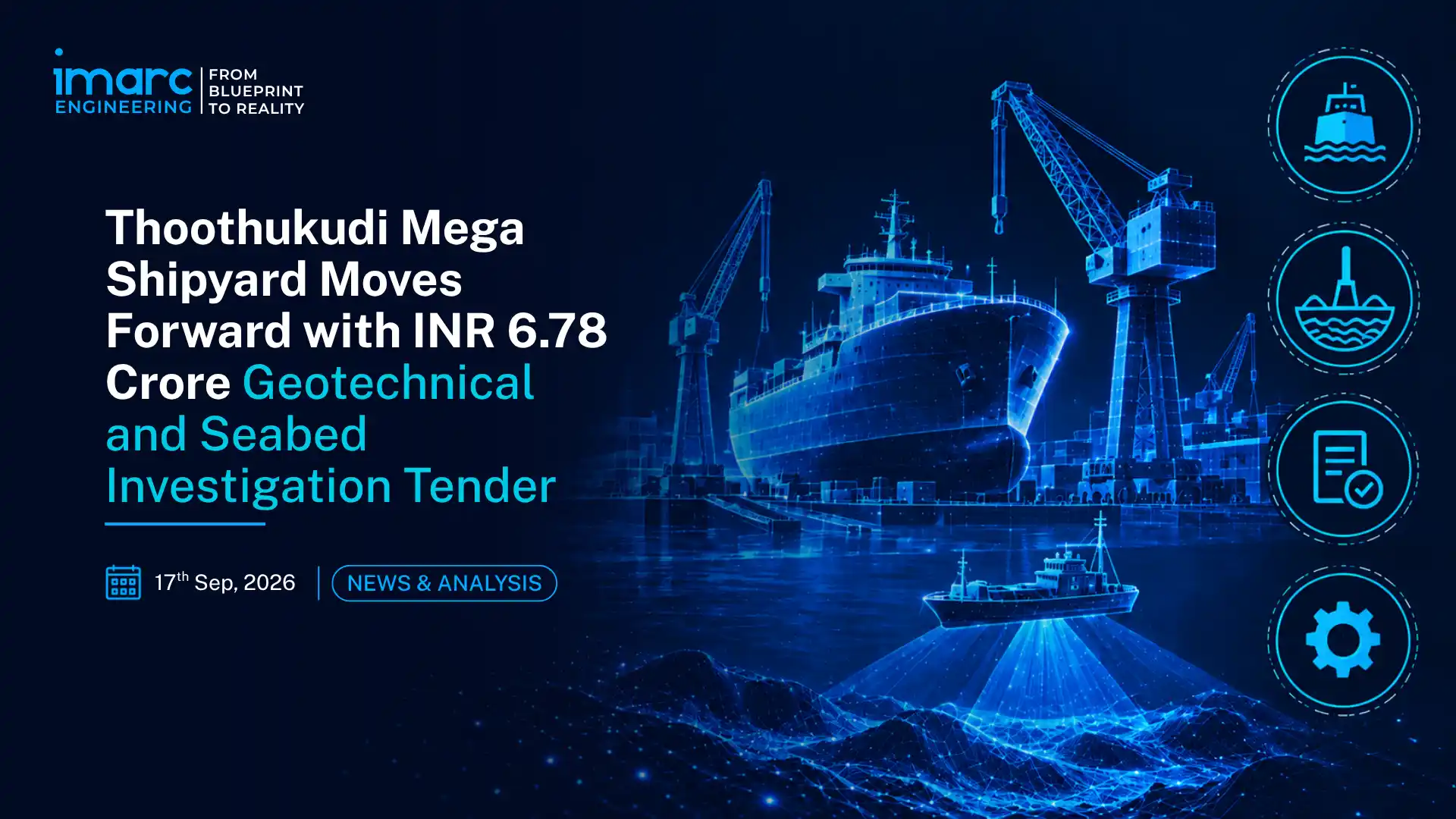
As a critical step in the development of the Thoothukudi mega greenfield shipyard, an INR 6.78 crore tender has been issued for geotechnical and seabed investigations. This tender is a significant milestone for the shipyard project, which is intended to be a major player in India's shipbuilding industry. The tender was announced in Thoothukudi in the presence of key stakeholders and representatives of the project consortium.
It is worth being precise about what this announcement entails: the tender represents an initial but essential stage of the project. It is not yet a signal that construction has commenced. These pre-construction investigations are designed to inform the Detailed Project Report (DPR) and guide subsequent engineering decisions. The INR 6.78 crore tender covers investigations intended to characterize soil, rock and seabed conditions and provide technical inputs for the DPR and subsequent engineering decisions.
The geotechnical and seabed investigations are foundational activities for assessing soil, rock and seabed conditions at the proposed shipyard site. The findings will provide important inputs for the DPR and subsequent engineering decisions, helping engineers evaluate ground conditions, foundation requirements and waterfront infrastructure considerations. This site-specific data can reduce design uncertainty, identify potential construction challenges and support more informed project planning before the shipyard advances to subsequent development stages.
What is the Thoothukudi Mega Greenfield Shipyard Project?
The Thoothukudi mega greenfield shipyard project is a strategically envisioned infrastructure development aimed at establishing a world-class shipbuilding facility in Tamil Nadu, India. Planned at the VO Chidambaranar Port, the project intends to leverage the region's strategic location and its connectivity to international shipping routes.
The proposed shipyard is designed to have an annual capacity of 2.5 million Gross Tonnage (GT), making it one of the largest in India. The project aims to enhance India's shipbuilding capabilities by reducing reliance on international shipyards and promoting indigenous manufacturing.
This initiative is envisioned as a catalyst for regional economic development and an enhancer of local employment opportunities. By spurring indirect jobs in supply chains, mariner services, and logistics, the project is expected to play a significant role in the socio-economic upliftment of the region. The enrichment of local human resources through skill development programs tied to shipbuilding is another crucial aspect of the project.
The development of Thoothukudi shipyard is part of a broader government initiative to boost the maritime sector, create jobs, and bring technological advancements. It aligns with the national mandate of 'Make in India' by encouraging domestic manufacturing and technology transfer. Additionally, the project proposes a partnership with Korean shipbuilders to facilitate knowledge exchange and technical collaboration, further strengthening the project’s potential for success.
What Studies Are Being Conducted for the Thoothukudi Shipbuilding Yard?
The current scope of investigations for the Thoothukudi shipbuilding yard involves conducting comprehensive geotechnical studies, including both onshore and offshore boreholes, as well as seabed and geophysical surveys. The evaluation aims to comprehensively assess the ground and seabed conditions. The plan encompasses drilling approximately 127 boreholes both onshore and offshore to gather data on the subsurface soil and rock characteristics, analyzing their load-bearing capacities and other critical geotechnical variables.
These examinations factor into determining the soil stratification, groundwater table levels, rock depths, and marine sediment compositions, all of which affect the design and construction of large-scale facilities like dry docks, berths, and supporting infrastructure.
Understanding the precise geological conditions will provide crucial insights into the potential risks and design challenges specific to this coastal area. Such data ensures that shipyard facilities are not only durable but also in harmony with natural hydrogeological features. The studies also play a critical role in mitigating environmental impact, as they help engineers design infrastructure that minimizes potential harm to delicate marine ecosystems.
Why Are 127 Boreholes Planned for the Proposed Shipyard?
The planned 127 boreholes will provide detailed subsurface data across the proposed shipyard investigation area. The boreholes will help characterize variations in soil and rock conditions and provide samples for laboratory testing. The resulting geotechnical data can support engineering assessments for foundations, waterfront structures and other major shipyard infrastructure.
The borehole data aims to offer insights into the diversity and characteristics of soil and rock layers beneath the proposed site, highlighting any potential challenges such as weak soil zones or problematic groundwater levels. This data will inform the design parameters for critical structural elements of the shipyard, such as launchways and marine works, underpinning risk mitigation strategies and ensuring the long-term stability and safety of shipbuilding operations.
The scope and scale of the investigation are indicative of the complex geotechnical conditions expected at this coastal location. Detecting potential seismic activity, rockslides, or erosion patterns is crucial for risk management and executing informed construction practices. Furthermore, these findings aid in evaluating future maintenance requirements, reducing delays and unexpected costs associated with structural repairs.
Why Are Seabed and Offshore Geophysical Surveys Required Before Shipyard Construction?
The seabed and offshore geophysical surveys are crucial for evaluating underwater conditions that significantly influence the design and construction of marine facilities. These surveys are intended to map the ocean floor and its characteristics, identifying any anomalies such as debris, cavities, or variations in sediment composition that may affect shipyard and port installations.
These surveys employ advanced technologies to perform detailed analyses of the seabed. Techniques like acoustic profiling and seismic reflection are used to achieve a clear understanding of sub-surface materials' distribution and mechanical properties. Given the complexity and cost of marine construction, these surveys are indispensable in ensuring decisions are based on data that minimize risk, manage costs, and optimize construction processes.
Identifying the composition and health of the marine environment allows project planners to prevent harmful impacts on local biodiversity, promoting conservation alongside development. It also facilitates the creation of emergency response strategies for potential spills or hazardous incidents during construction and operation, safeguarding both the environment and human health in the region.
How Will the Investigations Support Shipyard Engineering and the DPR?
Geotechnical and seabed investigation data can provide critical inputs for the DPR and subsequent engineering of the proposed shipyard. Information on soil stratification, rock levels, groundwater conditions, engineering properties and seabed characteristics can influence foundation concepts, ground-improvement requirements, waterfront and marine structures, dredging assumptions and construction methodology.
These findings can also help engineers refine preliminary quantities, equipment and construction requirements, project risks and cost assumptions. Integrating site-specific investigation data into the DPR reduces reliance on preliminary assumptions and provides a stronger technical basis for subsequent design and project-development decisions.
What is the Planned Capacity of the Thoothukudi Mega Shipyard?
The proposed Thoothukudi mega shipyard is designed to achieve a substantial capacity of 2.5 million GT per annum. This ambitious capacity is meant to meet the increasing demands for ship construction, repair, and maintenance within India and globally. It reflects the strategic vision of situating Thoothukudi as a central hub for maritime commerce and shipbuilding excellence.
This capacity aims to reinforce India's maritime capabilities by manufacturing various vessels domestically, thereby reducing dependency on foreign shipyards. The shipyard's ability to handle such volumes is intended to attract both commercial and naval contracts, contributing to regional economic growth and positioning India competitively in the global shipping industry.
Furthermore, achieving such capacity will necessitate a skilled workforce, attracting talent and offering training pathways in various maritime professions. This development of human capital should yield sustained economic benefits both regionally and nationally. As a result, the shipyard is expected to stimulate associated sectors, including supply chain logistics, transportation, and technical services, embedding itself as an integral component of India's maritime future.
What is the Current Development Stage of the Thoothukudi Shipbuilding Project?
The Thoothukudi shipbuilding project is currently in the project development and DPR stage, with detailed site investigations being undertaken to support further engineering and planning. The INR 6.78 crore investigation tender marks progression from strategic planning toward detailed site characterization and data-driven project development.
The current investigations are intended to provide geotechnical and seabed data needed to assess site conditions and refine engineering assumptions for the proposed shipyard. The findings can inform the DPR and subsequent decisions related to foundations, waterfront infrastructure, ground improvement, marine works and other major project components.
These investigations do not indicate that shipyard construction has commenced. Progression toward detailed engineering and subsequent development stages will depend on the investigation findings, completion of project-development activities, applicable approvals and further decisions by the project authorities.
IMARC Engineering's Perspective
The initiation of the geotechnical and seabed investigations for the Thoothukudi shipyard project reflects a vital step in positioning India's maritime infrastructure towards global competitiveness. This comprehensive site assessment is notable for its breadth and detail, capturing critical data for robust and informed engineering designs. By laying this groundwork, the project is incorporating strategic planning with practical engineering insight, a vital approach for such large-scale shipyard developments.
At IMARC Engineering, we see the gap between the issuance of a tender and the successful completion of geotechnical assessments as a focal point where the project’s future viability is examined. These extensive investigations will demand rigorous geological and environmental analysis, meticulous engineering design suited to the findings, and a thoughtful integration into the local ecosystem.
From an engineering perspective, the value of the current investigation programme lies in converting site uncertainty into design data. Borehole, geotechnical and offshore survey results can influence foundation concepts, ground-improvement requirements, waterfront engineering, dredging assumptions, construction methodology and preliminary project costs. Integrating these findings into the DPR will be critical before the proposed shipyard advances toward detailed engineering and subsequent development stages.
Latest News
-
Thoothukudi Mega Shipyard Moves Forward with INR 6.78 Crore Geotechnical and Seabed Investigation Tender
September 17, 2026
-
Nagpur–Warangal Greenfield Highway Targets December 2027 Completion as Land Acquisition Bottlenecks Ease
September 16, 2026
-
BRICS New Delhi Declaration 2026 Focuses on Resilient Supply Chains, Critical Minerals and Energy Cooperation
September 15, 2026
-
NTPC Invites EOI for Grid-Connected Sodium-Ion Battery Storage Pilot in India
September 14, 2026
-
Tamil Nadu Shortlists Cheyyur and Manellore for Chennai’s Second Airport, AAI to Assess Feasibility
September 10, 2026
Trusted by Industry Leaders
We partner with global enterprises and ambitious businesses across sectors to deliver operational excellence, strategic insights, and sustainable growth through integrated solutions.











Success in Their Words
Real feedback from clients across industries. Discover how our solutions delivered measurable impact and operational excellence.

I wanted to express my sincere appreciation for your efforts in handling this matter. Your dedication and commitment have been truly commendable, and it is evident that you have put in tremendous hard work and expertise into resolving the issues at hand. We are greatly interested in continuing our collaboration with you in the future, as your professionalism and reliability have made you a trusted partner. Thank you once again for your invaluable contribution. We look forward to strengthening our partnership ahead.

It has been a pleasure working with the IMARC team. The insights provided were structured, clear, and highly valuable, helping us strengthen both our technical and financial planning with confidence. We deeply appreciate the team’s professionalism, responsiveness, and attention to detail throughout the engagement. Every requirement was well understood and effectively incorporated, resulting in a comprehensive and actionable output. Overall, our experience has been excellent, and I would gladly recommend IMARC to organizations seeking a reliable research partner.

Your service is truly exceptional. Working with the IMARC team has been a seamless and professional experience. The clarity of communication, responsiveness to queries, and consistent support at every stage made the entire engagement highly efficient. The insights shared were well-structured, practical, and perfectly aligned with our requirements, helping us make informed decisions with confidence. Overall, the dedication and professionalism demonstrated by your team stand out, and I would be glad to recommend IMARC as a reliable and trustworthy research partner.

IMARC did an outstanding job in preparing our study. They were punctual, precise, and consistently responsive throughout the entire process. The team delivered all the data we required in a clear, well-organized, and highly professional format. Their strong attention to detail, combined with their ability to meet every deadline without compromising quality, truly set them apart. Overall, their reliability and commitment made them an exceptional partner for our project, and we would gladly work with them again in the future.

IMARC made the whole process incredibly easy from start to finish. Everyone I interacted with via email was polite, professional, and straightforward to deal with, always keeping their promises regarding delivery timelines and remaining consistently solutions-focused. From my very first contact, I appreciated the professionalism and support shown by the entire IMARC team. I highly recommend IMARC to anyone seeking timely, affordable, and reliable information or advice. My experience with IMARC was excellent, and I truly cannot fault any aspect of it.

I’d like to express my sincere gratitude for the excellent work you accomplished with the study. Your ability to quickly understand our requirements and deliver high-quality results under tight timelines truly reflects your expertise, exceptional work ethic, and unwavering commitment to your customer’s success. The professionalism and responsiveness you demonstrated throughout the process made a significant difference. Our entire team and company are incredibly thankful for your dedication, reliability, and support. Once again, thank you for your outstanding contribution.
Ready to Experience the IMARC Advantage?
Whether you're planning a new facility, expanding operations, optimizing performance, or facing complex challenges—IMARC Engineering brings the expertise, experience, and commitment needed for success.