China's Tunnel Boring Machine Export Controls Put Focus on India's Proposed USD 1.2 Billion Manufacturing Incentive Scheme
October 22, 2026
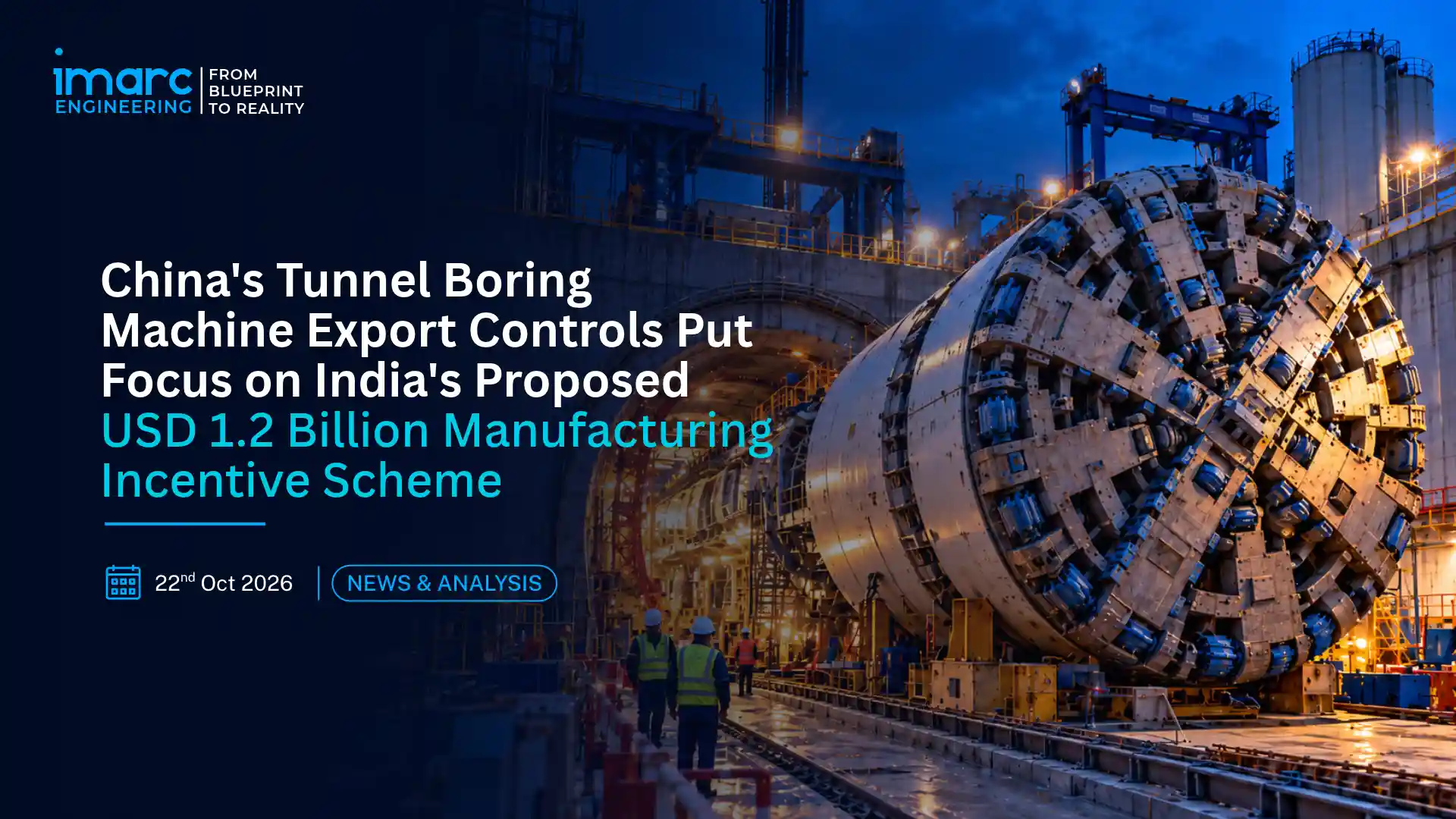
China announced new export controls covering tunnel boring machines and specified related equipment on October 19, 2026, with implementation scheduled for November 18. The move has renewed attention on India's proposed USD 1.2 billion incentive scheme for domestic construction and infrastructure equipment manufacturing.
Reuters reported in August 2026 that the proposed scheme could attract approximately USD 1.8 billion in investment over seven years. The figure is a projection, not committed investment, and the scheme's final approval and operating guidelines have not been established by the public sources reviewed.
For Indian project developers, the two developments sit on different timelines: one is an immediate procurement question about specialised machinery already on order, and the other is a medium-term industrial policy question about where future machinery will be built. The overlap matters because India's metro, hydropower, road and mining pipelines draw heavily on imported high-end equipment, and tunnel boring machines sit at the most specialised end of that dependence.
What are China's New Export Restrictions on Tunnel Boring Machines?
On October 19, 2026, China's Ministry of Commerce and General Administration of Customs issued Announcement No. 50 introducing export controls on specified tunnel boring machines and related items. The controls cover categories of shield tunnelling machines and rock tunnel boring machines, alongside other equipment and technologies listed in the notification.
The announcement establishes licensing requirements for exports to designated sensitive countries and regions, while exports to other destinations are subject to specified registration and documentation requirements. These controls do not amount to a universal export ban. Indian buyers should assess the classification of their equipment, destination-specific requirements and supplier compliance obligations before drawing conclusions about shipment risks.
When will China's Tunnel Boring Machine Export Controls Take Effect?
China's tunnel boring machine export controls are scheduled to take effect on November 18, 2026, approximately one month after the October 19 announcement. The implementation date is particularly relevant for Indian infrastructure developers procuring specialised tunnelling equipment with long manufacturing and delivery timelines.
For machines already ordered but not yet shipped, the implications will depend on the equipment's classification, destination-specific export requirements and applicable documentation procedures. Buyers should not assume that contracts signed before the implementation date are automatically exempt. Equipment undergoing manufacturing, factory acceptance testing or pre-shipment inspection may require additional compliance checks before dispatch.
Project owners should confirm shipment status, export documentation requirements and expected delivery schedules directly with their equipment suppliers. They should also review contractual provisions covering export approvals, delivery extensions and potential cost implications. These measures can help manage procurement uncertainty without assuming that the new controls will necessarily delay ongoing infrastructure projects.
What is India's Proposed USD 1.2 Billion Construction Equipment Manufacturing Incentive Scheme?
India's proposed USD 1.2 billion incentive scheme aims to strengthen domestic production of high-value construction and infrastructure equipment. Reuters reported in August 2026 that the proposal could attract approximately USD 1.8 billion in investment over seven years.
Equipment categories under discussion include tunnel boring machines, fire-fighting equipment and lifts used in multi-storey buildings. The government has also highlighted local value addition as an objective. However, detailed eligibility conditions, incentive rates, application timelines and implementation guidelines should not be treated as final until officially notified.
Has the Construction Equipment Incentive Scheme Received Final Approval?
Based on publicly available reporting reviewed as of October 21, 2026, India's proposed construction equipment manufacturing incentive scheme has not been confirmed as receiving final government approval. The reported USD 1.2 billion outlay and projected USD 1.8 billion investment remain proposal-stage estimates rather than approved funding or committed investment.
The scheme's final scope, eligibility criteria, incentive structure and implementation timeline will depend on government approval and the publication of official guidelines. These details may change during the approval process, particularly the equipment categories covered, investment thresholds and conditions for receiving incentives.
Manufacturers and investors should therefore avoid treating the proposed incentives as guaranteed financial support when preparing feasibility studies or detailed project reports (DPRs). Project financial models should assess viability independently of the scheme, with potential incentives evaluated separately once official eligibility conditions and implementation guidelines are available.
Why does India Depend on Imported Specialised Construction Equipment?
India relies on imports for specialised construction equipment because advanced engineering, manufacturing scale and proven performance remain concentrated among suppliers in China, Germany, Japan and South Korea. Tunnel boring machines (TBMs) are custom engineered for specific geology, diameter and alignment. Their complex systems require large-scale fabrication, precision machining, control software and proven project experience.
Manufacturing lead times can exceed a year. One TBM built for a 12.5-km Indian tunnelling project took more than a year to manufacture, illustrating the complexity of these machines. India has domestic capacity in several equipment categories, mainly mid-range segments. However, critical components such as high-capacity hydraulics, large-diameter bearings and control electronics often remain imported, even when machines are assembled locally.
What Opportunities could the Scheme Create for Domestic Equipment Manufacturers?
The proposed scheme could create opportunities in precision fabrication, hydraulic systems, cutter tools, wear parts, electrical assemblies, equipment refurbishment and aftermarket services. Some component categories may offer more accessible entry routes than complete tunnel boring machine manufacturing, although supplier qualification and technical requirements will vary.
Technology partnerships, licensing arrangements, and joint ventures could support more advanced manufacturing. However, local production of critical assemblies requires engineering capability, quality validation, specialised machinery, and reliable customer demand.
How could Equipment Localisation Affect Infrastructure Project Procurement?
Equipment localisation could affect procurement lead times, qualification requirements, contract structures and whole-life costs, mainly over the medium term. Domestic sourcing may reduce delivery times and foreign exchange exposure, but new suppliers may need prototype testing, factory acceptance trials and performance guarantees. Performance-based procurement specifications can help project owners qualify alternative suppliers without relying on specific brands or countries of origin. Export control changes do not automatically delay Indian infrastructure projects. Actual impacts depend on order books, contract terms and alternative suppliers.
Implications for Industrial Project Planning
For companies evaluating construction equipment manufacturing in India, the proposed incentive scheme should be treated as a potential opportunity rather than an approved funding source. Investment decisions require feasibility studies covering market demand, technology sourcing, component localisation, production capacity, machinery requirements and supplier qualification.
A detailed project report should also assess capital expenditure, operating costs, technology-transfer arrangements, workforce capabilities and project implementation timelines. For infrastructure developers procuring imported equipment, contract reviews and alternative sourcing assessments can help identify exposure to export-control requirements and delivery uncertainty.
China’s new TBM export controls highlight India’s reliance on imported specialised construction equipment, while the proposed USD 1.2 billion incentive scheme could support domestic manufacturing and component localisation. Future progress will depend on government approval, final incentive guidelines, technology partnerships, and investment in critical components.
IMARC Engineering's Perspective
China's TBM export controls highlight India's infrastructure equipment import risks, while the proposed USD 1.2 billion incentive scheme aims to strengthen domestic manufacturing. However, the scheme remains unapproved, and the projected USD 1.8 billion investment is only an estimate.
Genuine localisation requires domestic capabilities in critical components, including cutter heads, main drives, bearings, hydraulics, and control electronics. Building and qualifying these capabilities will take time. Investors should assess the scheme's eligible equipment, technology transfer terms and procurement contracts' allocation of licensing and delivery risks. IMARC Engineering supports these decisions through manufacturing feasibility, technology sourcing assessment, and industrial project planning.
Latest News
-
China's Tunnel Boring Machine Export Controls Put Focus on India's Proposed USD 1.2 Billion Manufacturing Incentive Scheme
October 22, 2026
-
NTPC Plans Nuclear Power Project Feasibility Studies in More Indian States, Including Uttar Pradesh
October 21, 2026
-
NITI Aayog Releases Data Centre Evaluation Framework, Highlights Power and Water Planning Risks
October 20, 2026
-
Tamil Nadu Allocates INR 98 Lakh for DPR Preparation of Five Infrastructure Projects in Chennai
October 16, 2026
-
SunBridge BioEnergy Starts Commercial Production at INR 350 Crore, 300 KLD Ethanol Plant in Madhya Pradesh
October 15, 2026
Trusted by Industry Leaders
We partner with global enterprises and ambitious businesses across sectors to deliver operational excellence, strategic insights, and sustainable growth through integrated solutions.










Success in Their Words
Real feedback from clients across industries. Discover how our solutions delivered measurable impact and operational excellence.

I wanted to express my sincere appreciation for your efforts in handling this matter. Your dedication and commitment have been truly commendable, and it is evident that you have put in tremendous hard work and expertise into resolving the issues at hand. We are greatly interested in continuing our collaboration with you in the future, as your professionalism and reliability have made you a trusted partner. Thank you once again for your invaluable contribution. We look forward to strengthening our partnership ahead.

It has been a pleasure working with the IMARC team. The insights provided were structured, clear, and highly valuable, helping us strengthen both our technical and financial planning with confidence. We deeply appreciate the team’s professionalism, responsiveness, and attention to detail throughout the engagement. Every requirement was well understood and effectively incorporated, resulting in a comprehensive and actionable output. Overall, our experience has been excellent, and I would gladly recommend IMARC to organizations seeking a reliable research partner.

Your service is truly exceptional. Working with the IMARC team has been a seamless and professional experience. The clarity of communication, responsiveness to queries, and consistent support at every stage made the entire engagement highly efficient. The insights shared were well-structured, practical, and perfectly aligned with our requirements, helping us make informed decisions with confidence. Overall, the dedication and professionalism demonstrated by your team stand out, and I would be glad to recommend IMARC as a reliable and trustworthy research partner.

IMARC did an outstanding job in preparing our study. They were punctual, precise, and consistently responsive throughout the entire process. The team delivered all the data we required in a clear, well-organized, and highly professional format. Their strong attention to detail, combined with their ability to meet every deadline without compromising quality, truly set them apart. Overall, their reliability and commitment made them an exceptional partner for our project, and we would gladly work with them again in the future.

IMARC made the whole process incredibly easy from start to finish. Everyone I interacted with via email was polite, professional, and straightforward to deal with, always keeping their promises regarding delivery timelines and remaining consistently solutions-focused. From my very first contact, I appreciated the professionalism and support shown by the entire IMARC team. I highly recommend IMARC to anyone seeking timely, affordable, and reliable information or advice. My experience with IMARC was excellent, and I truly cannot fault any aspect of it.

I’d like to express my sincere gratitude for the excellent work you accomplished with the study. Your ability to quickly understand our requirements and deliver high-quality results under tight timelines truly reflects your expertise, exceptional work ethic, and unwavering commitment to your customer’s success. The professionalism and responsiveness you demonstrated throughout the process made a significant difference. Our entire team and company are incredibly thankful for your dedication, reliability, and support. Once again, thank you for your outstanding contribution.
Ready to Experience the IMARC Advantage?
Whether you're planning a new facility, expanding operations, optimizing performance, or facing complex challenges—IMARC Engineering brings the expertise, experience, and commitment needed for success.