Iran War Sends Petrol Prices Soaring: EV Two-Wheeler Makers Accelerate Expansion
May 19, 2026
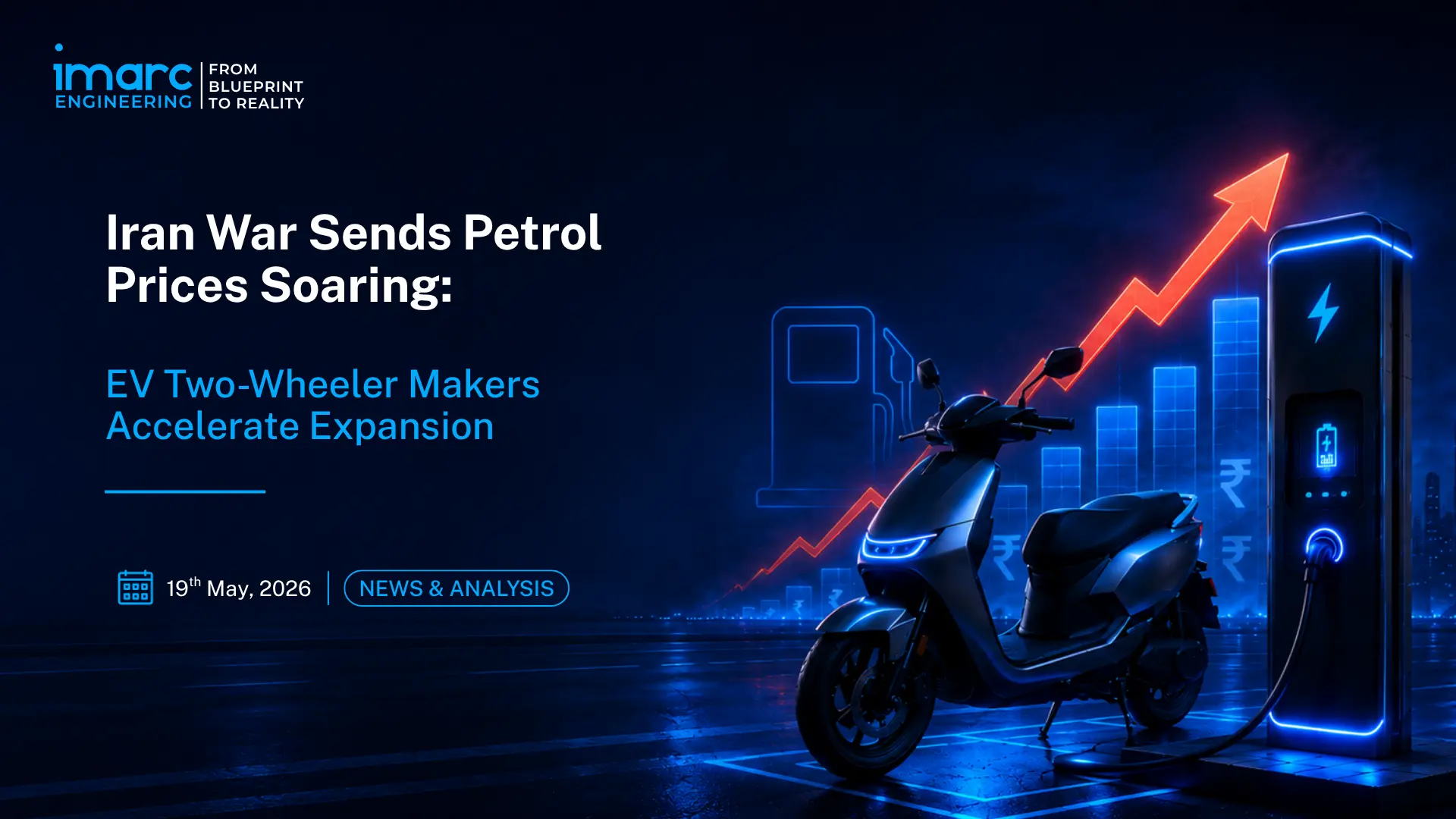
On May 15, 2026, Indian Oil Corporation, Bharat Petroleum, and Hindustan Petroleum raised petrol prices by INR 3.14/litre and diesel by INR 3.11/litre, ending a four-year freeze. This petrol price hike India EV demand shift is directly linked to the Iran war impact on oil prices, which pushed Brent crude from USD 69 to over USD 113 per barrel due to Strait of Hormuz disruptions. The resulting crude oil price rise impact on India has significantly increased fuel costs, reshaping mobility economics.
For EV manufacturing in India, this has become a structural demand trigger, especially for EV two-wheeler manufacturers in India, where cost advantages over petrol vehicles are now stark. Rising fuel prices are accelerating investment in EV manufacturing plant setup and expanding capacity for every major electric vehicle factory in India, positioning the sector for rapid scale-up driven by sustained cost arbitrage.
From USD 69 to USD 114: How the Iran War Rewrote India's Fuel Economics
India's crude oil import dependency stood at 89.44% in FY 2024-25, per Energy Statistics India 2026. The country imports crude from approximately 40 countries, with about 70% of routes now outside the Strait of Hormuz following supplier diversification. But route diversification does not insulate India from global crude price benchmarks, oil is priced globally in dollars, and when Brent surges massively in three months, India's import bill, forex demand, and fuel pricing pressure all move in lockstep.
The Iran war impact on oil prices has been felt globally. Brent crude surged to multi-year highs above USD 100 per barrel in late April and early May 2026 on fears of prolonged Hormuz disruptions. The crude oil price rise impact on India has been direct: the Rs 3 per litre hike is only a partial pass-through, oil marketing companies had been absorbing input cost pressure for 11 weeks before the hike became financially unsustainable. With crude averaging USD 113-114 per barrel, further revisions are possible.
For two-wheeler commuters filling up an 8-litre tank, INR 3 hike adds INR 25 per fil, approximately Rs 600-700 per month at typical riding frequency. The running cost of a petrol scooter at Rs 2 per km has never looked more unfavourable against the INR 0.30 per km cost of an electric equivalent.
The Demand Surge That Was Already Happening and Has Now Accelerated
The Iran war has not just increased fuel prices, it has become a structural trigger for EV manufacturing plant setup demand in India, especially in the two-wheeler segment where cost sensitivity is highest. This shift is now translating into accelerated investments across battery assembly & gigafactory engineering and factory capacity expansion projects, as manufacturers prepare for sustained demand.
The electric two-wheeler market was already on a strong growth trajectory before the disruption. FY2026 recorded 1.40 million e-2W sales, up 22% YoY, with a 57% share of total EV volumes. March 2026 saw a record 190,941 units, supported by policy timelines and early geopolitical signals, while April sustained momentum with 148,740 units (+61% YoY), confirming demand is structural, not cyclical.
The competitive landscape within EV manufacturing in India has been reshuffled in the same period. TVS Motor Company became the new e-2W market leader for FY2026 with 341,647 units, 44% YoY growth, dethroning Ola Electric for the first time in three years. Bajaj Auto held second with 289,325 units, driven by the Chetak's sub-INR 1 lakh variants that have systematically converted Honda Activa and Jupiter users.
Additionally, Ather Energy was the standout growth story: 239,124 units, 82% YoY growth, 17% market share, powered by the Rizta family scooter, which accounts for 76% of its sales and has significantly increased its market share in Gujarat and Maharashtra. Hero MotoCorp's Vida brand grew 196% to 144,313 units, from a low FY2025 base, leveraging Hero's 6,000-outlet network and the Vida VX2's removable battery, the only swappable-battery product in the top five. Ola Electric, by contrast, experienced a 52% sales decline to 164,294 units, a cautionary tale about service network gaps in a market where after-sales trust now determines purchase decisions as much as product spec.
How EV Manufacturers Are Responding: Factory Capacity Expansion Across the Board
The demand surge and the petrol price hike India EV demand dynamic have converted EV manufacturing plant setup from a medium-term strategic exercise into an immediate capital deployment priority. Every major EV two-wheeler manufacturer is executing factory capacity expansion, and the manufacturing infrastructure decisions being made now will define the supply ceiling of India's e-2W market through 2028-29.
TVS Motor Company is expanding its Hosur manufacturing complex in Tamil Nadu, already the most productive EV facility in the country, with dedicated production lines for the iQube family and the newly launched Orbiter e-scooter. The company introduced Battery-as-a-Service across its EV lineup in FY2026, directly addressing the upfront cost barrier and converting the purchase decision from a capital comparison into a monthly operating cost comparison, one where the petrol price hike India’s EV demand calculation now favours EVs decisively.
Bajaj Auto's Chetak manufacturing in Pune is scaling rapidly, with the Akurdi and Waluj facilities supporting battery assembly and vehicle integration for both the domestic market and export programmes targeting Southeast Asia and Africa. Ather Energy has doubled its retail footprint to 700 Experience Centres, offers over 6,000 charging points, and achieved 66% growth in total income to Rs 3,823 crore in FY2026, significantly narrowing its path to profitability with EBITDA margins improving approximately 2,080 basis points in Q4.
Ola Electric, despite its sales decline, has the most significant battery manufacturing investment of any domestic EV player. Its gigafactory in Krishnagiri, Tamil Nadu, the first facility in India to produce and commercialise in-house 4680-format lithium-ion cells, branded Bharat Cell, received the first PLI-ACC disbursement of INR 73.7 crore in March 2025. The Roadster X+, powered by a 9.1 kWh Bharat Cell pack offering 500 km IDC range, has begun gaining ground in Tier 2 markets like Uttar Pradesh and Bihar. Ola's recovery trajectory through April 2026, 12,166 units, up 20% month-on-month, suggests the battery technology investment is beginning to translate into product differentiation.
The Manufacturing Plant Setup Imperative: Supply Must Match the Demand Wave
The Iran war has created something that years of government incentive policy could not fully produce: an undeniable, consumer-driven, cost-economics case for electric two-wheelers that transcends subsidy dependence. At INR 97.77 per litre petrol in Delhi, and with further hikes probable, the payback period on an electric two-wheeler has compressed sharply. For a daily commuter covering 40 km, the fuel cost saving alone exceeds INR 1,000 per month compared to a petrol equivalent. The total cost of ownership advantage of an electric two-wheeler over a five-year holding period now exceeds INR 60,000 in most urban markets, independent of any government subsidy.
This demand permanence is what is driving EV manufacturing plant setup activity at a scale that 2024 investment plans did not anticipate. EV manufacturing in India now requires urgent attention to battery assembly capacity, motor and controller production lines, and the ancillary supply chain of wiring harnesses, BMS systems, and charger hardware, all of which were calibrated for a market of 1.15 million units, not the 1.4 million already sold and the projected trajectory that could exceed 2 million by FY2028.
The electric vehicle factory in India that was a medium-term investment two years ago is now a near-term competitive necessity. Manufacturers that do not expand manufacturing capacity through 2026-27 will face supply constraints precisely when consumer conversion from petrol to electric is at its most rapid.
For plant setup consultants, EPCM firms, and turnkey project managers serving the EV manufacturing sector, the post-Iran-war environment has materially shortened client decision timelines. Brownfield capacity expansion at existing EV facilities, adding production lines to operating plants in Tamil Nadu, Maharashtra, Gujarat, and Rajasthan, is being evaluated on 6-to-12 month delivery schedules rather than the 18-to-24 month greenfield timelines that were standard a year ago.
Gigafactory engineering for battery assembly, the most capital-intensive and technically complex layer of EV manufacturing plant setup demand, is being accelerated by both domestic players and the global battery manufacturers now evaluating India as a supply chain partner in the wake of the China+1 restructuring that the Iran war has further reinforced.
India's 89% crude import dependency is not changing in the next decade. What is changing, at pace, and structurally, is how many of India's two-wheeler commuters are insulating themselves from that dependency by switching to electric. The Iran war has not created this trend; it has compressed its timeline. The EV two-wheeler manufacturers, factory engineers, and plant setup consultants who move fastest to expand production capacity in 2026 will capture the largest share of a market transition that is now, unmistakably, underway.
The Iran war did not start India's EV revolution. It accelerated the timetable by which petrol becomes unaffordable for the commuter who has an electric alternative waiting.
Planning EV manufacturing or charging infrastructure expansion? Connect with IMARC Engineering experts
Latest News
-
IEX Subsidiary Applies for Coal Exchange Registration Under India’s New Coal Exchange Rules 2026
September 30, 2026
-
India Pushes Domestic Shipping Container Manufacturing with INR 10,000 Crore Assistance Scheme
September 25, 2026
-
India’s Growing GCC Sector Brings Greenfield Setup and Regulatory Compliance into Focus
September 24, 2026
-
Uttar Pradesh Approves INR 200+ Crore Ethanol Plant at Chhata Sugar Mill in Mathura
September 23, 2026
-
Escorts Kubota Breaks Ground on INR 2,000 Crore Greenfield Manufacturing Plant in Uttar Pradesh
September 22, 2026
Trusted by Industry Leaders
We partner with global enterprises and ambitious businesses across sectors to deliver operational excellence, strategic insights, and sustainable growth through integrated solutions.










Success in Their Words
Real feedback from clients across industries. Discover how our solutions delivered measurable impact and operational excellence.

I wanted to express my sincere appreciation for your efforts in handling this matter. Your dedication and commitment have been truly commendable, and it is evident that you have put in tremendous hard work and expertise into resolving the issues at hand. We are greatly interested in continuing our collaboration with you in the future, as your professionalism and reliability have made you a trusted partner. Thank you once again for your invaluable contribution. We look forward to strengthening our partnership ahead.

It has been a pleasure working with the IMARC team. The insights provided were structured, clear, and highly valuable, helping us strengthen both our technical and financial planning with confidence. We deeply appreciate the team’s professionalism, responsiveness, and attention to detail throughout the engagement. Every requirement was well understood and effectively incorporated, resulting in a comprehensive and actionable output. Overall, our experience has been excellent, and I would gladly recommend IMARC to organizations seeking a reliable research partner.

Your service is truly exceptional. Working with the IMARC team has been a seamless and professional experience. The clarity of communication, responsiveness to queries, and consistent support at every stage made the entire engagement highly efficient. The insights shared were well-structured, practical, and perfectly aligned with our requirements, helping us make informed decisions with confidence. Overall, the dedication and professionalism demonstrated by your team stand out, and I would be glad to recommend IMARC as a reliable and trustworthy research partner.

IMARC did an outstanding job in preparing our study. They were punctual, precise, and consistently responsive throughout the entire process. The team delivered all the data we required in a clear, well-organized, and highly professional format. Their strong attention to detail, combined with their ability to meet every deadline without compromising quality, truly set them apart. Overall, their reliability and commitment made them an exceptional partner for our project, and we would gladly work with them again in the future.

IMARC made the whole process incredibly easy from start to finish. Everyone I interacted with via email was polite, professional, and straightforward to deal with, always keeping their promises regarding delivery timelines and remaining consistently solutions-focused. From my very first contact, I appreciated the professionalism and support shown by the entire IMARC team. I highly recommend IMARC to anyone seeking timely, affordable, and reliable information or advice. My experience with IMARC was excellent, and I truly cannot fault any aspect of it.

I’d like to express my sincere gratitude for the excellent work you accomplished with the study. Your ability to quickly understand our requirements and deliver high-quality results under tight timelines truly reflects your expertise, exceptional work ethic, and unwavering commitment to your customer’s success. The professionalism and responsiveness you demonstrated throughout the process made a significant difference. Our entire team and company are incredibly thankful for your dedication, reliability, and support. Once again, thank you for your outstanding contribution.
Ready to Experience the IMARC Advantage?
Whether you're planning a new facility, expanding operations, optimizing performance, or facing complex challenges—IMARC Engineering brings the expertise, experience, and commitment needed for success.