India's Nuclear Energy Expansion in 2026: NTPC's Feasibility Study and the Rise of Large-Scale Infrastructure Planning
May 21, 2026
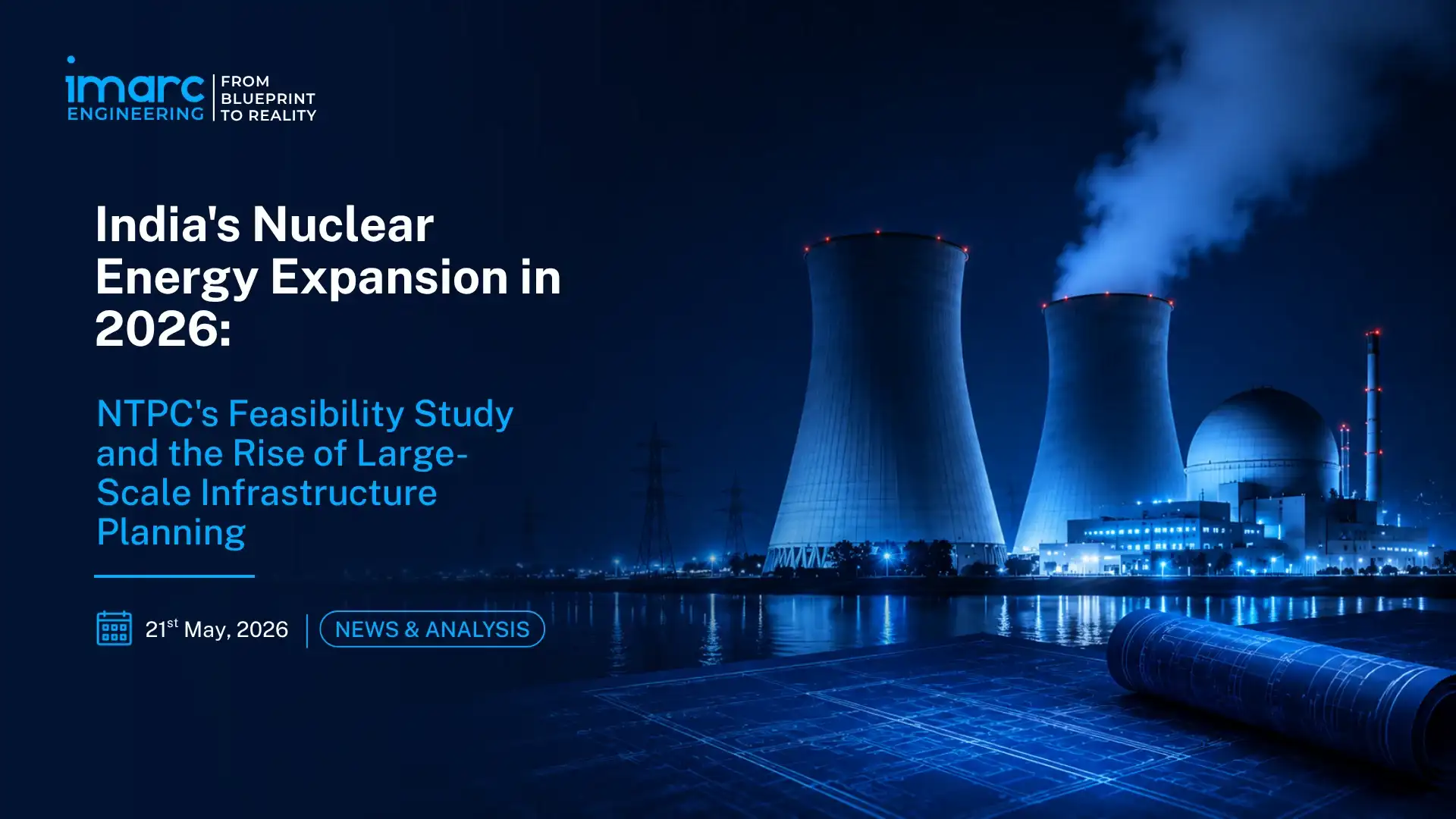
On May 10, 2026, it was reported that NTPC Limited, India's largest power generator, is preparing to submit its first nuclear power plant feasibility study to the Department of Atomic Energy for approval, paving the way for the company's first standalone nuclear project. In the same week, the Energy and Resources Institute (TERI) released a landmark report, India's Nuclear Energy Vision: Strategic Pathways for SMR Deployment that placed the total investment requirement to reach 100 GW of nuclear capacity by 2047 at INR 23-25 lakh crore, with an average annual investment requirement of INR 1.0-1.2 lakh crore.
Published within the same week, these two developments capture the full scope of India's nuclear energy expansion in 2026: institutional momentum at the project level, and a newly clarified financial framework for nuclear energy expansion at the national level. Together, they define the most consequential infrastructure planning cycle for nuclear power plant in India's energy history.
NTPC's Nuclear Feasibility Study: What Has Been Completed and What Comes Next
NTPC has completed a nuclear power plant feasibility study in one of 14 states identified for future nuclear projects, with studies in at least two additional states in progress. The Bihar government has formally approved NTPC to conduct a feasibility study in Banka district, approximately 250 km from Patna, where two 700 MW units are planned at a combined investment of approximately INR 25,000 crore.
Each 700 MW unit carries an estimated cost of Rs 20,000 crore, with the possibility of expanding to four units at a single site depending on feasibility outcomes. NTPC is additionally exploring states including Gujarat, Andhra Pradesh, Maharashtra, Madhya Pradesh, Chhattisgarh, and Odisha for its nuclear infrastructure planning.
The regulatory pathway from completed feasibility study to construction approval is defined and sequential. The Standing Site Selection Committee of the Department of Atomic Energy reviews all proposals. Technically viable proposals are forwarded to the Atomic Energy Commission for further processing. After AEC clearance, NTPC approaches the concerned state government for land acquisition. Only then can detailed project report preparation begin.
This process, from feasibility submission to DPR approval, typically spans several years and is the most time-critical bottleneck in NTPC's target of achieving at least 2 GW of nuclear capacity by 2032. Recent reports related to the feasibility studies signals that NTPC is now formally entering this process for the first time as an independent nuclear project developer.
In parallel, NTPC is already executing a nuclear project in joint venture with Nuclear Power Corporation of India Ltd (NPCIL) through ASHVINI (Anushakti Vidhyut Nigam Ltd), in which NTPC holds a 49% stake. The 4x700 MW Mahi Banswara Rajasthan Atomic Power Project (MBRAPP), with an investment of approximately INR 42,000 crore, had its foundation stone laid by Prime Minister Modi in September 2025.
First concrete was poured for both initial units in March 2026. This JV project is progressing in parallel with NTPC's independent nuclear feasibility work, reflecting the company's dual-track strategy of partnered execution with NPCIL alongside the development of its own standalone nuclear portfolio targeting 30 GW across 14 states by 2047.
The 100 GW Nuclear Target: Investment Scale and the Policy Architecture Supporting It
India's current nuclear capacity stands at 8.8 GW. NPCIL achieved record generation of 56,681 Million Units in FY 2024-25, preventing approximately 49 million tonnes of CO2 emissions. Projects under construction are expected to raise total capacity to approximately 22 GW by FY32. The remaining gap of 78 GW requires an average annual addition of approximately 4.5 GW from the early 2030s through 2047.
At an assumed capital intensity of Rs 22-25 crore per MW, the total investment requirement is Rs 23-25 lakh crore, the figure the TERI report published in May 2026 confirmed. This is not a theoretical projection: it is the investment planning number that every infrastructure fund, engineering consultancy, and project developer operating in India's energy sector must now treat as the baseline for nuclear capacity modelling.
The policy architecture to support this scale of nuclear power investment in India is being constructed simultaneously. The Union Budget 2025-26 launched the Nuclear Energy Mission for Viksit Bharat with a Rs 20,000 crore outlay, committed to five Indian-designed small modular reactors operational by 2033, and proposed amendments to the Atomic Energy Act and Civil Liability for Nuclear Damage Act (CLND Act), with the goal of unlocking an estimated USD 26 billion in private investment. The amendments, pending parliamentary passage, are the enabling legislation for private sector nuclear participation in India.
The SHANTI Act, already passed, opened the nuclear sector to private participation through public-private partnerships, a structural reform that has prompted Adani Power to incorporate two dedicated nuclear entities (Adani Atomic Energy Ltd and two project-level subsidiaries) in what nuclear sector analysts have described as preparation for execution rather than exploration.
Small Modular Reactors: India's Second-Track Nuclear Strategy
Alongside the large PHWR-based fleet programme, India is developing three indigenous small modular reactor designs through the Bhabha Atomic Research Centre (BARC): the 200 MWe Bharat Small Modular Reactor (BSMR), a 55 MWe SMR, and a 5 MWt high-temperature gas-cooled reactor.
The Prototype Fast Breeder Reactor at Kalpakkam, part of the second stage of India's three-stage nuclear programme, achieved criticality in April 2026, marking the first operational proof of India's closed fuel cycle ambitions. The second stage is foundational to the thorium-based third stage, which will eventually reduce India's dependence on imported uranium.
The TERI report provides the most detailed SMR deployment roadmap yet published in India. It outlines three phases: Phase 1 through 2030 covering standardisation of PHWR fleet construction, pilot SMR deployment, and demonstration projects; Phase 2 from 2030 to 2040 covering serial PHWR and Fast Breeder Reactor deployment, initial SMR commercialisation, and thorium fuel cycle development; and Phase 3 from 2040 to 2047 covering large-scale capacity addition, SMRs for green hydrogen and hard-to-abate industrial sectors, and Advanced Heavy Water Reactor deployment.
Globally, the SMR deployment in India seeks to replicate is most advanced in Russia, the US, Canada, China, and France. France's EDF has signed an MoU with BHEL to explore collaboration on the NUWARD SMR, a 400 MWe pressurised water reactor design with commercialisation planned for the 2030s. Larsen & Toubro, Tata Consulting Engineers, and Holtec Asia have been identified as entities eligible to receive technical information for SMR development under the India-US civil nuclear framework.
Infrastructure Planning at Scale: What This Means for Project Developers and Consultants
The scale of India's nuclear energy expansion creates a nuclear project infrastructure planning requirement that extends well beyond reactor engineering. Site identification and acquisition for nuclear power plant typically requiring more than four years per location, is the first critical bottleneck.
Land acquisition for 30 GW of NTPC nuclear capacity across 14 states, each requiring appropriate geology, seismicity, hydrology, and proximity to grid infrastructure, is itself a multi-year, multi-agency exercise. Water availability, approximately five litres per unit of nuclear electricity generated, creates site selection constraints that overlap with agricultural, industrial, and municipal demand. For each proposed site, feasibility studies must assess all of these parameters before the Department of Atomic Energy Standing Site Selection Committee will advance a proposal.
The construction supply chain for large PHWRs and SMRs requires components and engineering disciplines that India is simultaneously developing. Reactor pressure vessel forgings for the IPWR (Indian Pressurized Water Reactor) will come from the L&T-NPCIL heavy forge joint venture at Hazira, Gujarat. Turbines will be supplied by BHEL.
The India Nuclear Business Platform 2026, scheduled for June 16-17 in Mumbai, described as the first major global convening following the SHANTI Act reforms, will serve as the forum where international technology providers, Indian industrial groups, and government agencies align on the emerging architecture of private sector participation and global technology collaboration.
For infrastructure investors, engineering consultancies, and project management firms, the nuclear energy expansion in India 2026 represents the opening of a capital cycle measured in lakhs of crores, executing over two decades, across 14 states, in a sector that has historically been exclusively public.
The TERI report explicitly notes that the binding constraint in achieving India’s nuclear ambitions is no longer engineering feasibility, but how projects are structured, financed, licensed, and executed. This is why the upcoming NTPC nuclear power plant feasibility study DPR in India is strategically important, it marks the beginning of a much broader ecosystem involving nuclear project investment and infrastructure planning India 2026, standardized reactor deployment, and long-term fuel security planning. The roadmap will also shape the Bharat Small Modular Reactor deployment timeline in India, particularly around regulatory readiness, manufacturing localization, and grid integration.
As India moves toward its 100 GW nuclear target by 2047, demand is expected to rise for specialized greenfield nuclear power plant setup consultantscapabilities and experienced nuclear energy project management consultants in India that can navigate execution complexity.
Equally important will be defining how to set up nuclear power plant India regulatory process frameworks covering siting, licensing, environmental approvals, financing structures, and operational governance. The feasibility study NTPC is preparing is therefore not just a technical exercise, it is the first formal step in opening India’s next-generation nuclear infrastructure ecosystem for investment and execution.
India's nuclear expansion is no longer a vision document. With NTPC's feasibility submission imminent, private sector entry open, and Rs 25 lakh crore of investment required, the project planning era has begun.
Talk to our experts for project feasibility and business planning support through our Feasibility Study & Business Planning consultation.
Latest News
-
IEX Subsidiary Applies for Coal Exchange Registration Under India’s New Coal Exchange Rules 2026
September 30, 2026
-
India Pushes Domestic Shipping Container Manufacturing with INR 10,000 Crore Assistance Scheme
September 25, 2026
-
India’s Growing GCC Sector Brings Greenfield Setup and Regulatory Compliance into Focus
September 24, 2026
-
Uttar Pradesh Approves INR 200+ Crore Ethanol Plant at Chhata Sugar Mill in Mathura
September 23, 2026
-
Escorts Kubota Breaks Ground on INR 2,000 Crore Greenfield Manufacturing Plant in Uttar Pradesh
September 22, 2026
Trusted by Industry Leaders
We partner with global enterprises and ambitious businesses across sectors to deliver operational excellence, strategic insights, and sustainable growth through integrated solutions.











Success in Their Words
Real feedback from clients across industries. Discover how our solutions delivered measurable impact and operational excellence.

I wanted to express my sincere appreciation for your efforts in handling this matter. Your dedication and commitment have been truly commendable, and it is evident that you have put in tremendous hard work and expertise into resolving the issues at hand. We are greatly interested in continuing our collaboration with you in the future, as your professionalism and reliability have made you a trusted partner. Thank you once again for your invaluable contribution. We look forward to strengthening our partnership ahead.

It has been a pleasure working with the IMARC team. The insights provided were structured, clear, and highly valuable, helping us strengthen both our technical and financial planning with confidence. We deeply appreciate the team’s professionalism, responsiveness, and attention to detail throughout the engagement. Every requirement was well understood and effectively incorporated, resulting in a comprehensive and actionable output. Overall, our experience has been excellent, and I would gladly recommend IMARC to organizations seeking a reliable research partner.

Your service is truly exceptional. Working with the IMARC team has been a seamless and professional experience. The clarity of communication, responsiveness to queries, and consistent support at every stage made the entire engagement highly efficient. The insights shared were well-structured, practical, and perfectly aligned with our requirements, helping us make informed decisions with confidence. Overall, the dedication and professionalism demonstrated by your team stand out, and I would be glad to recommend IMARC as a reliable and trustworthy research partner.

IMARC did an outstanding job in preparing our study. They were punctual, precise, and consistently responsive throughout the entire process. The team delivered all the data we required in a clear, well-organized, and highly professional format. Their strong attention to detail, combined with their ability to meet every deadline without compromising quality, truly set them apart. Overall, their reliability and commitment made them an exceptional partner for our project, and we would gladly work with them again in the future.

IMARC made the whole process incredibly easy from start to finish. Everyone I interacted with via email was polite, professional, and straightforward to deal with, always keeping their promises regarding delivery timelines and remaining consistently solutions-focused. From my very first contact, I appreciated the professionalism and support shown by the entire IMARC team. I highly recommend IMARC to anyone seeking timely, affordable, and reliable information or advice. My experience with IMARC was excellent, and I truly cannot fault any aspect of it.

I’d like to express my sincere gratitude for the excellent work you accomplished with the study. Your ability to quickly understand our requirements and deliver high-quality results under tight timelines truly reflects your expertise, exceptional work ethic, and unwavering commitment to your customer’s success. The professionalism and responsiveness you demonstrated throughout the process made a significant difference. Our entire team and company are incredibly thankful for your dedication, reliability, and support. Once again, thank you for your outstanding contribution.
Ready to Experience the IMARC Advantage?
Whether you're planning a new facility, expanding operations, optimizing performance, or facing complex challenges—IMARC Engineering brings the expertise, experience, and commitment needed for success.