India's Pharma Compliance Overhaul 2026: Revised Schedule M, CDSCO Reforms & What Manufacturers Must Do Now
May 18, 2026
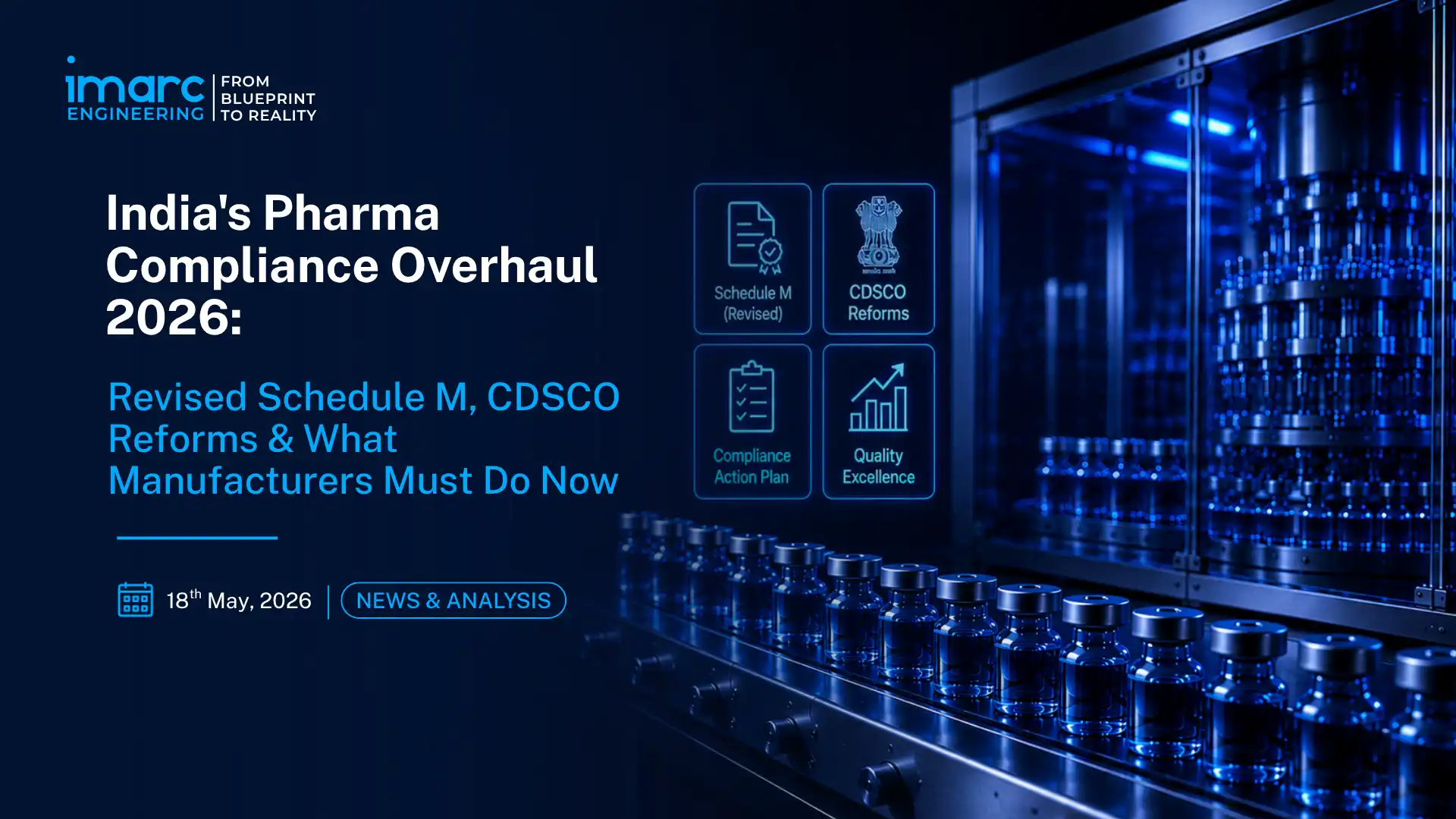
India’s pharmaceutical manufacturers are navigating the most sweeping regulatory reset in decades. The government has revised Schedule M GMP requirements, amended the NDCT Rules, restructured CDSCO’s approval framework, tightened pharmacovigilance obligations, and intensified inspections targeting non-compliant units. This has sharply increased demand for pharma regulatory consulting in India, particularly from companies undertaking a Schedule M gap assessment to align with the updated standards.
For manufacturers that have already upgraded, with support from experienced Schedule M consultants or revised Schedule M consultants, this shift creates a clear competitive advantage. For those still delaying compliance, it represents a material operational and regulatory risk. This article outlines the key regulatory changes through May 2026 and the immediate actions required from pharmaceutical companies.
Revised Schedule M: What Changed, Who Is Affected, and What the Deadline Actually Means
Schedule M under the Drugs and Cosmetics Act, 1940, is India's statutory Good Manufacturing Practices framework in pharma, the baseline quality standard every licensed pharmaceutical manufacturer must meet. The revised Schedule M, notified in December 2023, upgraded its scope to 'Good Manufacturing Practices and Requirements of Premises, Plant, and Equipment for Pharmaceutical Products', a title change that signals a substantive expansion of requirements.
The revised framework introduces mandatory Pharmaceutical Quality Systems (PQS), Quality Risk Management (QRM), lifecycle validation, computerised system qualification, Product Quality Review (PQR), and change control procedures, aligning India's GMP framework with WHO-GMP, PIC/S, and ICH Q10 standards for the first time.
Implementation was phased by company size. Large manufacturers with turnover exceeding Rs 250 crore were required to comply by June 28, 2024. The approximately 8,500 pharma MSMEs received an extension to December 31st, 2025, for units that formally applied under G.S.R. 127(E) dated February 11, 2025. The compliance picture is deeply uneven: only an estimated 11% of manufacturing firms applied for the extension in Himachal. The PAN India picture also looks similar. The remaining 88-90%, who did not apply, are subject to immediate and comprehensive inspections under the revised requirements, with no grace period available.
In the directive issued on November 7, the DCGI, Rajeev Raghuvanshi, has directed the drug controllers of all states and UTs to furnish a monthly report regarding the observations made by them while conducting inspections and actions taken thereupon. State drug controllers are now required to submit monthly reports to CDSCO detailing inspections, observations, and actions taken. CDSCO has confirmed publicly that no further extensions will be granted, units failing inspection face mandatory manufacturing licence suspension.
The technical requirements driving the most significant investment are infrastructure and validation upgrades. Cleanroom qualification, HVAC validation, water system qualification (purified water and water for injection), computerised system validation (CSV), equipment qualification (IQ/OQ/PQ), stability storage upgrades, and documentation system overhauls are universally required.
For a mid-scale pharma MSME, full Schedule M compliance typically requires significant capital investment depending on existing infrastructure. Of India's approximately 10,500 pharmaceutical manufacturing units, only around 2,000 currently hold WHO GMP certification, leaving over 8,000 units at varying stages of compliance gap.
CDSCO Drug Approval Reforms 2026: A Regulatory System Being Rebuilt in Real Time
The Schedule M enforcement story is one layer of a broader institutional transformation at CDSCO. In August 2025, following a WHO regulatory review that called for stronger transparency and data integrity, CDSCO released India's first formal guidelines defining how Subject Expert Committees (SECs) must be constituted, how experts must be selected, and how applications must be reviewed.
SECs are the advisory bodies that recommend approval decisions to the DCGI, and their previously informal operation created the inconsistency and unpredictability that the pharmaceutical industry had long complained about. Formal, published procedures represent a structural shift toward a more auditable, internationally credible approval system.
In January 2026, the Ministry of Health and Family Welfare published sweeping amendments to the NDCT Rules, 2019, now in effect. The centerpiece is the replacement of test licence requirements with an online prior-intimation mechanism for most low-risk drug development activities. Under the previous system, CDSCO processed approximately 30,000-35,000 test licence applications annually, creating systemic delays.
Under the amended rules, companies manufacturing small quantities for research, nonclinical testing, or analysis simply notify CDSCO through the SUGAM portal and proceed. For categories where test licences remain mandatory, cytotoxic drugs, narcotics, psychotropics, sex hormones, and beta-lactam antibiotics, the statutory processing timeline has been cut from 90 working days to 45 working days. The Ministry estimates the combined effect saves a minimum of 90 days across the drug development lifecycle.
The NDCT amendments additionally waive prior CDSCO permission for specified low-risk bioavailability and bioequivalence (BA/BE) studies. CDSCO processes approximately 4,000-4,500 BA/BE study applications annually, faster study commencement directly accelerates generic drug launches.
A further reform effective June 1, 2026 revises drug testing norms for import and manufacturing approvals, streamlining NOC issuance at designated testing laboratories and standardising testing protocols against current pharmacopoeial specifications. India also recorded its highest-ever annual approval of recombinant DNA-origin new drugs in 2025, 28 approved for manufacture and marketing versus 20 in 2024, including insulin formulations and Nimotuzumab for Head and Neck Cancer.
On pharmacovigilance, CDSCO has introduced updated rules requiring pharmaceutical companies to submit Periodic Safety Update Reports (PSURs) from the actual market launch date, not the approval date, closing a loophole that had allowed post-launch safety data gaps. All dosage forms and indications of a single drug must now be covered in one unified safety report, reducing duplication and providing regulators a holistic risk profile.
What Pharmaceutical Manufacturers Must Do Now: A Compliance Action Framework
For manufacturers whose revised Schedule M deadline has passed, the regulatory posture is binary: demonstrate compliance through inspection or suspend production pending upgrade. The monthly reporting mandate imposed on state drug controllers means that uninspected units are not invisible, they are flagged.
For manufacturers that are non-compliant and have not applied for an extension, immediate engagement of a qualified pharmaceutical GMP consultants’ firm to conduct a formal gap assessment and remediation roadmap is the single most urgent action. Gap assessments typically take 2-4 weeks; remediation timelines range from 6 to 18 months depending on infrastructure deficit.
For manufacturers planning greenfield pharmaceutical plant setup or brownfield capacity expansion, the revised Schedule M requirements must be embedded in the project design from the outset, not treated as a post-construction compliance exercise. Cleanroom classification, HVAC design parameters, water system specification, utilities segregation, material and personnel flow layouts, and documentation systems must all be specified against the revised Schedule M at the Detailed Project Report (DPR) stage.
A techno-economic feasibility study for a new pharmaceutical manufacturing facility that does not model revised Schedule M infrastructure costs against the target product portfolio is not a bankable document in 2026. Any pharmaceutical plant setup consultants or EPCM consultancy engaged in 2026 must demonstrate direct familiarity with revised Schedule M design requirements, CDSCO inspection readiness protocols, and state-level drug controller licensing procedures.
The exact investment priorities introduced by new Schedule M for each manufacturer would be the following: qualification and validation plans for all equipment, utilities, and computerized systems; shift from manual (paper-based) batch manufacturing records (eBMR) to electronic batch manufacturing records along with CSV; quality risk management plan at both product and process levels; Product Quality Review (PQR) system for all marketed products; and change control, deviation management, and CAPA systems.
New Schedule M compliance for those Indian companies that export their products to other regulated countries such as the USA, Europe, United Kingdom, and Australia would become the lowest standard to meet in order to prove to overseas regulatory authorities that there are sound manufacturing processes in place.
India's pharmaceutical compliance overhaul is not a one-event reset, it is a structural reconfiguration of the regulatory architecture designed to make Indian-made medicines credible in nearly 200 countries they reach. Manufacturers that treat this moment as a compliance burden to be minimised will be managing licence risk for the next several years. Those that treat it as a platform to build WHO-GMP-grade infrastructure, validated systems, and CDSCO inspection readiness culture will find themselves in a structurally stronger competitive position in a global generic pharmaceutical market actively seeking credible, scalable, inspection-ready manufacturing partners outside China.
The reforms at the approval level, faster BA/BE study initiation, 45-day test licence processing, streamlined drug testing NOCs, mean that a compliant facility can now also move faster through India's commercial pipeline than ever before. Compliance and commercial speed are, for the first time, pointing in the same direction.
India's pharma compliance overhaul has removed the option of deferral. The manufacturers who upgrade now will define the quality map of the world's generic medicine supply.
Connect with IMARC Engineering Team to discuss pharmaceutical compliance, facility upgrades, and manufacturing project requirements.
Latest News
-
IEX Subsidiary Applies for Coal Exchange Registration Under India’s New Coal Exchange Rules 2026
September 30, 2026
-
India Pushes Domestic Shipping Container Manufacturing with INR 10,000 Crore Assistance Scheme
September 25, 2026
-
India’s Growing GCC Sector Brings Greenfield Setup and Regulatory Compliance into Focus
September 24, 2026
-
Uttar Pradesh Approves INR 200+ Crore Ethanol Plant at Chhata Sugar Mill in Mathura
September 23, 2026
-
Escorts Kubota Breaks Ground on INR 2,000 Crore Greenfield Manufacturing Plant in Uttar Pradesh
September 22, 2026
Trusted by Industry Leaders
We partner with global enterprises and ambitious businesses across sectors to deliver operational excellence, strategic insights, and sustainable growth through integrated solutions.









Success in Their Words
Real feedback from clients across industries. Discover how our solutions delivered measurable impact and operational excellence.

I wanted to express my sincere appreciation for your efforts in handling this matter. Your dedication and commitment have been truly commendable, and it is evident that you have put in tremendous hard work and expertise into resolving the issues at hand. We are greatly interested in continuing our collaboration with you in the future, as your professionalism and reliability have made you a trusted partner. Thank you once again for your invaluable contribution. We look forward to strengthening our partnership ahead.

It has been a pleasure working with the IMARC team. The insights provided were structured, clear, and highly valuable, helping us strengthen both our technical and financial planning with confidence. We deeply appreciate the team’s professionalism, responsiveness, and attention to detail throughout the engagement. Every requirement was well understood and effectively incorporated, resulting in a comprehensive and actionable output. Overall, our experience has been excellent, and I would gladly recommend IMARC to organizations seeking a reliable research partner.
Your service is truly exceptional. Working with the IMARC team has been a seamless and professional experience. The clarity of communication, responsiveness to queries, and consistent support at every stage made the entire engagement highly efficient. The insights shared were well-structured, practical, and perfectly aligned with our requirements, helping us make informed decisions with confidence. Overall, the dedication and professionalism demonstrated by your team stand out, and I would be glad to recommend IMARC as a reliable and trustworthy research partner.

IMARC did an outstanding job in preparing our study. They were punctual, precise, and consistently responsive throughout the entire process. The team delivered all the data we required in a clear, well-organized, and highly professional format. Their strong attention to detail, combined with their ability to meet every deadline without compromising quality, truly set them apart. Overall, their reliability and commitment made them an exceptional partner for our project, and we would gladly work with them again in the future.

IMARC made the whole process incredibly easy from start to finish. Everyone I interacted with via email was polite, professional, and straightforward to deal with, always keeping their promises regarding delivery timelines and remaining consistently solutions-focused. From my very first contact, I appreciated the professionalism and support shown by the entire IMARC team. I highly recommend IMARC to anyone seeking timely, affordable, and reliable information or advice. My experience with IMARC was excellent, and I truly cannot fault any aspect of it.

I’d like to express my sincere gratitude for the excellent work you accomplished with the study. Your ability to quickly understand our requirements and deliver high-quality results under tight timelines truly reflects your expertise, exceptional work ethic, and unwavering commitment to your customer’s success. The professionalism and responsiveness you demonstrated throughout the process made a significant difference. Our entire team and company are incredibly thankful for your dedication, reliability, and support. Once again, thank you for your outstanding contribution.
Ready to Experience the IMARC Advantage?
Whether you're planning a new facility, expanding operations, optimizing performance, or facing complex challenges—IMARC Engineering brings the expertise, experience, and commitment needed for success.