India Records Nearly 3,000 Acres of Land Deals in FY2026: Why Legal Due Diligence is Now Non-Negotiable for Industrial Projects
May 22, 2026
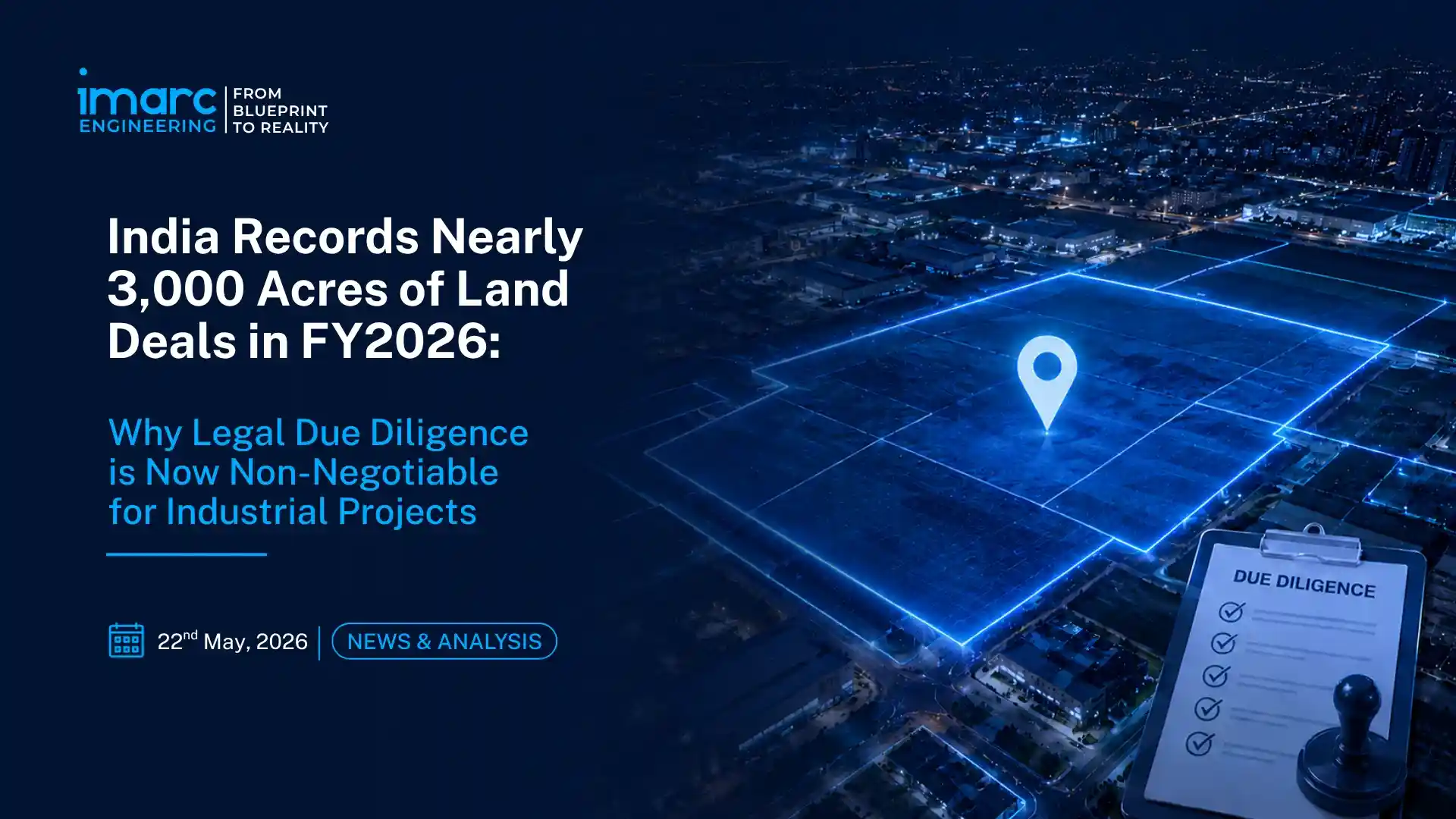
India recorded 111 land deals covering over 2,994 acres in FY2026, as per the data published by a real estate consultancy firm in late April 2026, a market that, in the same year, saw Invest India facilitate USD 6.1 billion in grounded foreign investment, Rajasthan launch its Industrial Park Promotion Policy-2026 opening private and PPP-led industrial parks, Jammu and Kashmir earmark 6,037 additional acres for 42 new industrial estates, and PM MITRA parks allot hundreds of acres to manufacturing investors in a single board meeting.
The volume and velocity of industrial land acquisition in India has never been higher. And yet, the legal infrastructure surrounding these transactions like title verification, encumbrance clearance, land conversion, zoning compliance, and environmental clearance remains the single most common source of project delays, lender objections, and stranded capital. In 2026, legal due diligence in India is not a precautionary step. It is the foundation on which every industrial project's investment thesis stands or falls.
Experts across industrial real estate, infrastructure advisory, and manufacturing consulting firms indicate that demand for industrial land legal due diligence services in India is rising as investors and manufacturers face more stringent regulatory scrutiny, fragmented land records, and multi-agency approval requirements.
Companies pursuing due diligence for manufacturing plant land in India are increasingly engaging specialised land acquisition legal consultant for industrial project in India providers to assess title clarity, historical ownership, encumbrances, litigation exposure, land-use conversion status, and infrastructure access before capital deployment.
A comprehensive land due diligence report for manufacturing plant setup now typically includes industrial land title search and legal opinion, environmental clearance and zoning compliance, and assessment of utility connectivity and statutory approvals.
Industry participants also emphasise that legal due diligence for acquiring land for greenfield projects in India differs materially from legal due diligence for brownfield projects, as brownfield acquisitions often involve legacy liabilities, operational compliance risks, labour-related obligations, and environmental remediation exposure in addition to conventional title verification.
The Land Deal Surge: Industrial Projects Are Driving a New Acquisition Wave
The data of 111 deals covering 2,994 acres captures primarily the organised and formal segment of the market and remains relatively skewed toward residential development transactions. As a result, the broader industrial land transaction landscape in India is materially larger and more geographically distributed than the dataset alone suggests. Evidence from early 2026 indicates continued momentum in industrial parks, logistics assets, and manufacturing-linked land allocation across multiple states and asset classes.
Between January and May 2026, several large industrial land and infrastructure developments were announced or advanced. In Tamil Nadu, the PM MITRA Park allocated 190.44 acres to 23 investors with committed investments of INR 2,192 crore during a single board meeting held in February 2026. Rajasthan introduced the Industrial Park Promotion Policy-2026, establishing four new private and PPP development models requiring industrial parks of at least 50 acres with a minimum of 10 industrial units.
In Jammu and Kashmir, the government earmarked an additional 6,037 acres for 42 new industrial estates linked to proposed investments worth INR 34,292 crore. Private-sector activity also remained strong: IndoSpace Core acquired six industrial and logistics parks spanning 380 acres across Bengaluru, Chennai, Delhi, Mumbai, and Pune for INR 3,000 crore, while Blackstone Inc. partnered with Casagrand to develop 154 acres of industrial and logistics parks in Sriperumbudur.
The broader FDI context amplifies the scale. DPIIT's total FDI grew 15% year-on-year, reaching USD18.6 billion in Q1 FY2025-26 alone. Invest India's USD 6.1 billion in grounded investments in FY2025-26 came from sectors, semiconductor manufacturing, EV batteries, data centres, defence, chemicals, food processing, that each require large, strategically located industrial land parcels with verified legal title and clear regulatory status.
The convergence of PLI-scheme-driven greenfield investment, China+1 supply chain migration, semiconductor fab buildouts, and data centre expansion has created a volume of factory land purchase in India that the legal due diligence ecosystem was not previously designed to process at this speed. That mismatch is where project risk is being created.
As industrial land transactions become larger and more complex, manufacturers and investors are increasingly conducting detailed industrial feasibility assessments before committing capital to greenfield and brownfield projects in India.
Why Industrial Land Due Diligence in India Is Structurally Different and More Complex
Industrial land acquisition in India involves a legal complexity that is materially different from residential or commercial property purchases, and the stakes of failure are correspondingly higher. A defective title on a residential property affects one family. A defective title on a 200-acre semiconductor fab site affects INR 20,000 crore of committed capital, a PLI incentive clock that is already running, and the employment of thousands of workers.
A Bar and Bench analysis published in August 2025 described industrial land due diligence as an exercise that must go beyond title flow and encumbrance checks for a look-back period of 30 years, examining how the land was acquired, under what conditions it is held, whether those conditions are fulfilled, and what risks continue to persist- legal, regulatory, or community-driven.
The first and most foundational element of any land due diligence checklist in India is the title chain, establishing unbroken, documented ownership for at least 30 years. In India's fragmented land records environment, title chains are frequently incomplete, particularly for land that has passed through inheritance, partition, or informal transfers.
The second is encumbrance certificate verification, confirming that the land carries no outstanding mortgage, lien, court stay, or third-party claim. The encumbrance certificate from the sub-registrar's office, covering at least the last 13-30 years, is the baseline instrument, but it does not capture unregistered claims, which require separate verification through revenue courts and district court litigation searches.
For industrial land, the land conversion status is a third critical dimension. The majority of potentially viable industrial sites in India's growth corridors are, or were recently, agricultural land. Converting agricultural land to industrial use requires state-specific permissions, non-Agricultural Land use conversion orders, without which the facility cannot be legally operated regardless of what the project has built on the site.
Land conversion timelines vary from three months in efficient states to over 18 months in more complex jurisdictions, and the conversion permission must be obtained before construction commences for lenders to treat the asset as bankable security.
SIDC-Allotted Land: The Due Diligence Category That Most Investors Underestimate
A significant proportion of India's industrial land acquisition, through MIDC in Maharashtra, GIDC in Gujarat, SIPCOT in Tamil Nadu, RIICO in Rajasthan, HSIIDC in Haryana, and TSIIC in Telangana, involves land allotted by State Industrial Development Corporations on lease or freehold basis with use-specific conditions. This category of industrial land requires a distinctly different due diligence framework, and its complexity is consistently underestimated by investors and their advisors.
SIDC-allotted land carries conditions tied to the specific industrial activity for which it was granted, conditions that restrict the ability to change product mix, transfer the allotment to a new entity, or use the land as collateral without explicit SIDC consent.
A factory land purchase in India from an existing SIDC lessee must verify whether the original allotment conditions have been fulfilled, whether the SIDC has issued a no-objection for transfer, whether any ongoing instalments or lease rentals remain outstanding, and whether the acquiring entity's proposed industrial activity matches the allotment's use classification.
Failure to obtain SIDC consent before transaction close can render the transfer void, resulting in loss of land rights and, in some cases, regulatory penalties. This risk is not theoretical: it has materialised in multiple high-value industrial acquisitions over the past three years, including in Maharashtra and Gujarat, the two most active states for industrial land acquisition in India.
The Land Due Diligence Checklist India Industrial Investors Must Follow in 2026
A comprehensive land due diligence checklist in India for industrial projects in 2026 must cover seven distinct layers. First, the 30-year title chain: original title deeds, sale deeds, gift deeds, partition deeds, court decrees, and mutation records establishing unbroken ownership.
Second, encumbrance certificate verification covering the full look-back period, supplemented by litigation searches in district courts, high courts, revenue courts, and Debt Recovery Tribunals. Third, land conversion and zoning status: NA order verification, industrial zoning confirmation in the relevant development authority's master plan, and FSI/FAR entitlement applicable to the site.
Fourth, SIDC conditions compliance, where applicable, including allotment order review, lease deed examination, outstanding dues verification, and transfer/sub-lease NOC requirements. Fifth, environmental clearance status, projects above prescribed thresholds require Environmental Impact Assessment clearance from the Ministry of Environment, Forest and Climate Change, and proximity to eco-sensitive zones, water bodies, and forest land must be evaluated before transaction completion.
Sixth, mutation records and property tax: current mutation in the seller's name confirms administrative ownership recognition, and all outstanding dues, property tax, water charges, electricity dues, must be cleared before transfer to avoid statutory liability passing to the acquirer. Seventh, public notice: publication in English and vernacular dailies is mandatory to surface undisclosed encumbrances or third-party claims before title is transferred.
For industrial projects involving lender financing, project finance, term loans, or external commercial borrowing, lenders require a formal legal due diligence report prepared by independent legal counsel, covering all seven dimensions above. A legal opinion from a qualified advocate confirming clear and marketable title is a standard condition precedent to financial closure for any manufacturing plant, industrial park, or infrastructure project. Financial institutions also increasingly evaluate industrial project feasibility studies to assess execution risk, infrastructure readiness, regulatory exposure, and long-term operational viability before approving project financing.
In 2026, with the volume of industrial project due diligence in India at record levels and with lenders including multilateral development banks and foreign institutional lenders, applying increasingly rigorous documentation standards, the scope and depth of the legal due diligence report has become a transaction-enabling document rather than a procedural formality.
The Cost of Skipping: What Inadequate Due Diligence Has Cost Industrial Projects
The case for rigorous legal due diligence in India is ultimately demonstrated by the consequences of inadequate verification. An analysis of industrial project disputes before the National Company Law Tribunal and various High Courts over the last three years reveals recurring issues such as land title defects discovered after construction had already begun, violations of SIDC allotment conditions identified during financing reviews, and agricultural land being used for industrial purposes without valid conversion approvals.
A second category of disputes has emerged from incomplete record verification during acquisition. In several cases, encumbrances did not appear in encumbrance certificates but later surfaced through revenue court records, mutation disputes, or pending administrative proceedings.
Industrial projects have also encountered community ownership claims and tribal land-right disputes that were not identified during the initial title-verification process, highlighting the growing importance of comprehensive industrial land legal due diligence in India. These failures have resulted in multi-year project delays, significant capital losses, stalled financing, and, in severe instances, demolition orders or forced re-acquisition.
As industrial land acquisition accelerates across India and companies face pressure to move quickly from MoU signing to project execution, attempts to abbreviate the due diligence process have proven consistently expensive. The 2,994 acres transacted in FY2026 represent committed capital, but the legal framework surrounding those transactions ultimately determines whether investments perform or fail.
India's industrial land boom is creating wealth and infrastructure at an unprecedented pace. Legal due diligence is the mechanism that ensures that capital lands on ground that is legally, regulatorily, and commercially sound.
Manufacturers and investors can connect with IMARC Engineering for industrial land assessment, project planning, and factory setup advisory services.
Latest News
-
IEX Subsidiary Applies for Coal Exchange Registration Under India’s New Coal Exchange Rules 2026
September 30, 2026
-
India Pushes Domestic Shipping Container Manufacturing with INR 10,000 Crore Assistance Scheme
September 25, 2026
-
India’s Growing GCC Sector Brings Greenfield Setup and Regulatory Compliance into Focus
September 24, 2026
-
Uttar Pradesh Approves INR 200+ Crore Ethanol Plant at Chhata Sugar Mill in Mathura
September 23, 2026
-
Escorts Kubota Breaks Ground on INR 2,000 Crore Greenfield Manufacturing Plant in Uttar Pradesh
September 22, 2026
Trusted by Industry Leaders
We partner with global enterprises and ambitious businesses across sectors to deliver operational excellence, strategic insights, and sustainable growth through integrated solutions.










Success in Their Words
Real feedback from clients across industries. Discover how our solutions delivered measurable impact and operational excellence.

I wanted to express my sincere appreciation for your efforts in handling this matter. Your dedication and commitment have been truly commendable, and it is evident that you have put in tremendous hard work and expertise into resolving the issues at hand. We are greatly interested in continuing our collaboration with you in the future, as your professionalism and reliability have made you a trusted partner. Thank you once again for your invaluable contribution. We look forward to strengthening our partnership ahead.

It has been a pleasure working with the IMARC team. The insights provided were structured, clear, and highly valuable, helping us strengthen both our technical and financial planning with confidence. We deeply appreciate the team’s professionalism, responsiveness, and attention to detail throughout the engagement. Every requirement was well understood and effectively incorporated, resulting in a comprehensive and actionable output. Overall, our experience has been excellent, and I would gladly recommend IMARC to organizations seeking a reliable research partner.

Your service is truly exceptional. Working with the IMARC team has been a seamless and professional experience. The clarity of communication, responsiveness to queries, and consistent support at every stage made the entire engagement highly efficient. The insights shared were well-structured, practical, and perfectly aligned with our requirements, helping us make informed decisions with confidence. Overall, the dedication and professionalism demonstrated by your team stand out, and I would be glad to recommend IMARC as a reliable and trustworthy research partner.

IMARC did an outstanding job in preparing our study. They were punctual, precise, and consistently responsive throughout the entire process. The team delivered all the data we required in a clear, well-organized, and highly professional format. Their strong attention to detail, combined with their ability to meet every deadline without compromising quality, truly set them apart. Overall, their reliability and commitment made them an exceptional partner for our project, and we would gladly work with them again in the future.

IMARC made the whole process incredibly easy from start to finish. Everyone I interacted with via email was polite, professional, and straightforward to deal with, always keeping their promises regarding delivery timelines and remaining consistently solutions-focused. From my very first contact, I appreciated the professionalism and support shown by the entire IMARC team. I highly recommend IMARC to anyone seeking timely, affordable, and reliable information or advice. My experience with IMARC was excellent, and I truly cannot fault any aspect of it.

I’d like to express my sincere gratitude for the excellent work you accomplished with the study. Your ability to quickly understand our requirements and deliver high-quality results under tight timelines truly reflects your expertise, exceptional work ethic, and unwavering commitment to your customer’s success. The professionalism and responsiveness you demonstrated throughout the process made a significant difference. Our entire team and company are incredibly thankful for your dedication, reliability, and support. Once again, thank you for your outstanding contribution.
Ready to Experience the IMARC Advantage?
Whether you're planning a new facility, expanding operations, optimizing performance, or facing complex challenges—IMARC Engineering brings the expertise, experience, and commitment needed for success.