India Pushes Domestic Shipping Container Manufacturing with INR 10,000 Crore Assistance Scheme
September 25, 2026
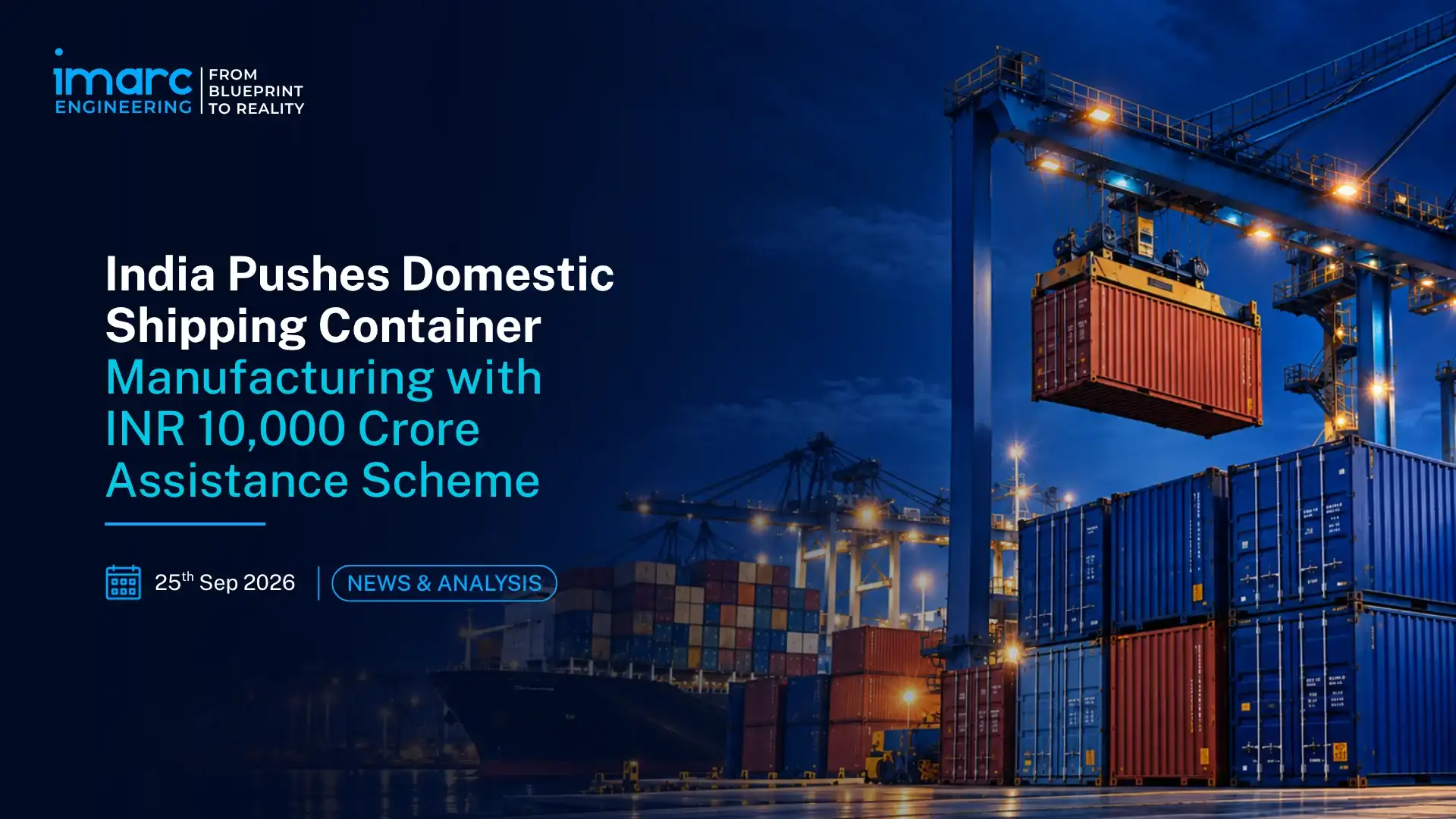
India's push to build a domestic shipping container manufacturing industry has moved from policy announcement to commercial proof point within a matter of months. The Union Budget 2026-27 proposed the Container Manufacturing Assistance Scheme (CMAS), backed by an outlay of INR 10,000 crore over five years, aimed at building a globally competitive domestic container manufacturing ecosystem.
On July 3, 2026, that policy push found its first concrete commercial validation: Union Minister for Ports, Shipping and Waterways Sarbananda Sonowal unveiled India's first export-import (EXIM) grade shipping container, manufactured by DCM Shriram Group for global shipping line A.P. Moller-Maersk, at the Maersk-CONCOR Inland Container Depot in Dadri, Uttar Pradesh, and Maersk used the occasion to place an order for 1,000 additional India-manufactured containers.
What is the Container Manufacturing Assistance Scheme (CMAS)?
CMAS is a targeted government initiative announced in the Union Budget 2026-27 to establish a competitive domestic container manufacturing industry through financial and institutional support. The scheme responds to a stark import-dependence gap: more than 95% of the world's dry shipping containers are manufactured in China, and India, despite being one of the world's fastest-growing export economies, had produced next to no containers domestically before this policy push.
That dependence carried real commercial cost, during periods of global freight market disruption, Indian exporters have had to pay several times the usual freight charges and faced extended shipping delays tied to container scarcity. CMAS is designed to complement broader government initiatives including Make in India, the Maritime Amrit Kaal Vision 2047, PM Gati Shakti, and the Sagarmala Programme.
How Much Has India Allocated for CMAS, and What is the Capacity Target?
The scheme carries a proposed outlay of INR 10,000 crore over five years. Its central capacity target is to raise India's annual domestic container manufacturing capacity to around 7.5 lakh Twenty-foot Equivalent Units (TEUs), roughly ten times the country's existing production level.
The government has projected this could generate a market opportunity of nearly INR 80,000 crore, a roughly eight-times leverage over the scheme's own outlay, while creating an estimated 3,000 direct jobs and more than 50,000 indirect jobs across container manufacturing and allied sectors. These figures represent the scheme's proposed and targeted outcomes rather than results already achieved; CMAS remains at an early implementation stage.
How Will CMAS Support Greenfield and Brownfield Container Manufacturing?
The scheme's support structure is built around four components: capital assistance for setting up new greenfield container manufacturing facilities; support for expanding existing brownfield units; operational assistance intended to help bridge the cost gap per container and improve the competitiveness of domestic manufacturers against established international producers; and research and development support covering testing, skilling, and capacity-building activity across the sector.
This structure is designed to address both ends of the capacity problem simultaneously, enabling entirely new manufacturing sites while also making it commercially viable to expand production at facilities that already exist, such as DCM Shriram Group's own container manufacturing operations.
Why is India Expanding Domestic Shipping Container Manufacturing?
Beyond the immediate cost and delay exposure of import dependence, India's broader trade and manufacturing ambitions have increased the strategic case for a domestic container base. According to the UN Conference on Trade and Development, around 80% of global merchandise trade by volume moves by sea, and containerised cargo accounts for nearly two-thirds of the value of international trade, meaning a country's access to reliable, competitively priced container capacity has direct bearing on its export competitiveness.
The government has also signalled parallel investment in the broader maritime ecosystem CMAS-manufactured containers would eventually serve: in February 2026, the Ministry of Ports, Shipping and Waterways signed an MoU to establish the Bharat Container Shipping Line, bringing together the Shipping Corporation of India, Container Corporation of India, and several port authorities in an initiative involving around INR 99,149 crore to develop a fleet of 51 container vessels and procure domestically manufactured containers, a plan the government has explicitly said aligns with CMAS's objectives.
What do the July 2026 EXIM Container Milestone and 1,000-Container Order Indicate?
The Dadri unveiling gives CMAS's stated ambitions a concrete commercial reference point rather than leaving them as policy targets alone. DCM Shriram Group, whose container manufacturing operations trace back to a 1993 joint venture with Hyundai Mobis, built the EXIM container to comply with International Organisation for Standardisation (ISO) structural and dimensional specifications and the International Convention for Safe Containers (CSC), the international treaty governing container safety in global transport.
Structural prototype testing throughout the manufacturing process followed ISO 1496 guidelines, including stacking, lifting, racking, and floor strength tests alongside weatherproofing validation, the technical bar an India-made container has to clear before a global shipping line will accept it into international service. The milestone itself traces back to a February 2025 meeting between Maersk's Chairman of the Supervisory Board, Robert Maersk Uggla, and Prime Minister Narendra Modi, culminating in a 16-month development process during which Maersk shared global technical knowledge with its Indian manufacturing partner.
Maersk becoming the first international shipping line to procure an India-manufactured EXIM container and then placing a follow-on order for 1,000 more units at the same event, signals that the commercial case for Indian-made containers is starting to translate into real, repeatable purchase orders rather than a single demonstration unit.
What Could This Mean for Greenfield Plants, Brownfield Expansion, and Ancillary Manufacturing?
If CMAS's capital and operational assistance materialises as designed, the scheme could support new greenfield container manufacturing plants in locations with strong steel supply chains and port or rail connectivity, alongside brownfield expansion at established players such as DCM Shriram.
A scaled-up container industry would also require growth across the ancillary component base since a container manufacturer's ability to source these inputs domestically, rather than importing them, directly affects the cost competitiveness CMAS's operational assistance is designed to improve. Readers seeking a detailed walkthrough of container plant setup, machinery selection, and CAPEX planning can refer to IMARC Engineering's dedicated guide on shipping container manufacturing plant setup, which this article does not repeat.
India went from producing almost no shipping containers domestically to landing a 1,000-unit order from one of the world's largest shipping lines within months of announcing a INR 10,000 crore assistance scheme. Whether that early momentum scales into the 7.5 lakh TEU capacity CMAS is targeting will depend on how quickly greenfield and brownfield manufacturing investment follows the policy and this first commercial order.
IMARC Engineering’s Perspective
CMAS's INR 10,000 crore outlay and its 7.5 lakh TEU capacity target represent genuine policy ambition, but the Maersk-DCM Shriram milestone at Dadri is what gives that ambition commercial credibility this early in the scheme's rollout, a global shipping line placing a follow-on order for 1,000 India-made containers is a materially different signal than a policy target alone.
At IMARC Engineering, we see the proposed assistance framework and emergence of commercial orders as important signals for investors evaluating greenfield and brownfield container manufacturing opportunities. However, project viability will still depend on site selection, production scale, equipment and process configuration, raw-material sourcing, ISO/CSC compliance, project economics and execution planning.
As more manufacturers look to enter or expand within India's container industry, the developers who combine CMAS's capital and operational assistance with sound engineering execution will be best positioned to convert this early commercial validation into sustained production capacity.
Latest News
-
India Pushes Domestic Shipping Container Manufacturing with INR 10,000 Crore Assistance Scheme
September 25, 2026
-
India’s Growing GCC Sector Brings Greenfield Setup and Regulatory Compliance into Focus
September 24, 2026
-
Uttar Pradesh Approves INR 200+ Crore Ethanol Plant at Chhata Sugar Mill in Mathura
September 23, 2026
-
Escorts Kubota Breaks Ground on INR 2,000 Crore Greenfield Manufacturing Plant in Uttar Pradesh
September 22, 2026
-
SEMICON India 2026 Highlights Expansion of India’s Semiconductor Manufacturing Ecosystem
September 21, 2026
Trusted by Industry Leaders
We partner with global enterprises and ambitious businesses across sectors to deliver operational excellence, strategic insights, and sustainable growth through integrated solutions.










Success in Their Words
Real feedback from clients across industries. Discover how our solutions delivered measurable impact and operational excellence.

I wanted to express my sincere appreciation for your efforts in handling this matter. Your dedication and commitment have been truly commendable, and it is evident that you have put in tremendous hard work and expertise into resolving the issues at hand. We are greatly interested in continuing our collaboration with you in the future, as your professionalism and reliability have made you a trusted partner. Thank you once again for your invaluable contribution. We look forward to strengthening our partnership ahead.

It has been a pleasure working with the IMARC team. The insights provided were structured, clear, and highly valuable, helping us strengthen both our technical and financial planning with confidence. We deeply appreciate the team’s professionalism, responsiveness, and attention to detail throughout the engagement. Every requirement was well understood and effectively incorporated, resulting in a comprehensive and actionable output. Overall, our experience has been excellent, and I would gladly recommend IMARC to organizations seeking a reliable research partner.

Your service is truly exceptional. Working with the IMARC team has been a seamless and professional experience. The clarity of communication, responsiveness to queries, and consistent support at every stage made the entire engagement highly efficient. The insights shared were well-structured, practical, and perfectly aligned with our requirements, helping us make informed decisions with confidence. Overall, the dedication and professionalism demonstrated by your team stand out, and I would be glad to recommend IMARC as a reliable and trustworthy research partner.

IMARC did an outstanding job in preparing our study. They were punctual, precise, and consistently responsive throughout the entire process. The team delivered all the data we required in a clear, well-organized, and highly professional format. Their strong attention to detail, combined with their ability to meet every deadline without compromising quality, truly set them apart. Overall, their reliability and commitment made them an exceptional partner for our project, and we would gladly work with them again in the future.

IMARC made the whole process incredibly easy from start to finish. Everyone I interacted with via email was polite, professional, and straightforward to deal with, always keeping their promises regarding delivery timelines and remaining consistently solutions-focused. From my very first contact, I appreciated the professionalism and support shown by the entire IMARC team. I highly recommend IMARC to anyone seeking timely, affordable, and reliable information or advice. My experience with IMARC was excellent, and I truly cannot fault any aspect of it.

I’d like to express my sincere gratitude for the excellent work you accomplished with the study. Your ability to quickly understand our requirements and deliver high-quality results under tight timelines truly reflects your expertise, exceptional work ethic, and unwavering commitment to your customer’s success. The professionalism and responsiveness you demonstrated throughout the process made a significant difference. Our entire team and company are incredibly thankful for your dedication, reliability, and support. Once again, thank you for your outstanding contribution.
Ready to Experience the IMARC Advantage?
Whether you're planning a new facility, expanding operations, optimizing performance, or facing complex challenges—IMARC Engineering brings the expertise, experience, and commitment needed for success.