Battery Recycling Gains Importance for India's EV Supply Chain and Critical Mineral Security
November 17, 2026
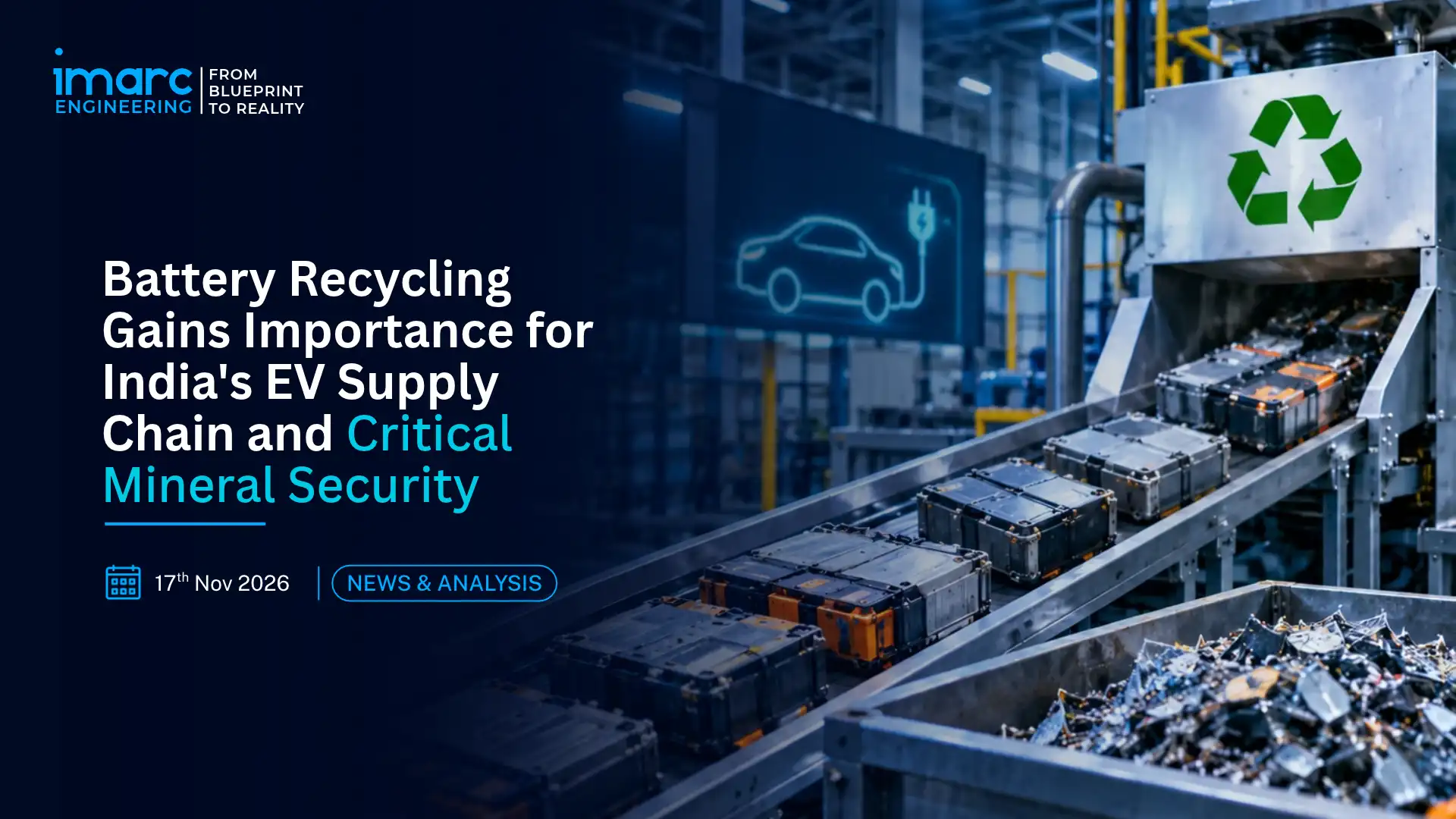
EV battery recycling in India is drawing policy attention as an industrial and supply-chain question. An opinion column in Autocar Professional, published on November 14, 2026, and written by Manikumar Uppala of Metastable Materials, argues that recycling is central to the country's EV battery supply chain. The column is the author's view. Two government actions in November give it context: a Cabinet-approved processing scheme on November 4 and a DGFT export prohibition on battery waste reported on November 11.
What Did the Government Announce in November 2026?
On November 11, 2026, the Press Information Bureau reported that the Directorate General of Foreign Trade (DGFT), through Notification No. 49/2026-27 dated November 10, 2026, prohibited exports of material covered under ITC (HS) Code 85491400. The restriction applies to the products specified in the notification and should not be interpreted as a blanket prohibition on all battery waste or all processed black-mass products.
The notification covers the specified category of unsorted waste and scrap of primary cells, primary batteries and electric accumulators, including spent cells, batteries and accumulators, that do not contain lead, cadmium or mercury. The prohibition should therefore be described by reference to the notified ITC (HS) code and product description, rather than as a blanket ban on all battery waste or all processed black-mass products.
The restriction could increase the availability of covered battery waste for domestic processing. However, its contribution to critical mineral recovery will depend on the availability of suitable recycling and refining infrastructure.
On November 4, 2026, the Union Cabinet approved the Capex Support Scheme to Promote Critical Mineral Processing, with a total outlay of INR 2,814 crore for FY 2026–27 to FY 2030–31. The Cabinet-approved Capex Support Scheme to Promote Critical Mineral Processing aims to strengthen domestic lithium and nickel processing capacity. The scheme provides capital investment support for eligible processing projects, subject to prescribed capacity thresholds, beneficiary limits and selection conditions.
It is distinct from the separate Incentive Scheme for Promotion of Critical Mineral Recycling and should not be presented as direct financial support for battery recycling or black-mass processing facilities. Beneficiaries will be selected through a two-stage process involving technical qualification and financial bidding. Incentives will be released in three tranches linked to specified project milestones.
Cobalt is expected to be recovered as a by-product of nickel processing. The scheme focuses on establishing domestic lithium and nickel processing facilities. It should not be presented as a recycling incentive or as confirmed support for black-mass processing. This is distinct from the separate Incentive Scheme for Promotion of Critical Mineral Recycling.
Why Does Battery Recycling Matter for India's EV Industry?
The Autocar Professional column argues that growing EV sales will create a stream of retired packs, and that recycling can turn this into a domestic source of materials. These are the author's arguments and unsourced statistics, and they should not be read as established industry data.
Battery recycling has two important roles in India's EV ecosystem. It provides a regulated route for collecting and processing end-of-life batteries, including damaged packs that require specialised handling, and creates a potential secondary source of materials for battery manufacturing. The extent to which recycled materials can reduce import dependence will depend on battery returns, collection efficiency, processing capacity, recovery rates and the quality of recovered materials.
How Can Recycling Support Critical Mineral Security?
India depends on imports for refined lithium, nickel and cobalt intermediates, as the IANS report notes. Recovery from used batteries can add a secondary source of these materials, alongside ore-based processing. The scale of that contribution is not established in the coverage reviewed.
India has also introduced the INR 1,500-crore Incentive Scheme for Promotion of Critical Mineral Recycling under the National Critical Mineral Mission. The Ministry of Mines has reported participation and proposed investment commitments under the Incentive Scheme for Promotion of Critical Mineral Recycling. These announcements indicate planned industry participation, but proposed investments and recycling capacities should not be treated as completed projects or operational facilities. Actual capacity development will depend on project execution, regulatory approvals and commissioning.
These figures represent announced commitments and proposed capacity, not completed investment, installed capacity or operational recycling facilities. The Ministry identified project execution and capacity development as the next stage, with production commencement to be considered for financial support under the scheme.
The scheme covers recycling of spent lithium-ion batteries, e-waste and other eligible scrap to recover critical minerals. Incentives are intended for activities involving the actual extraction of critical minerals, rather than facilities that only produce black mass. Black mass may be used as feedstock for further mineral recovery, subject to the scheme's eligibility, sourcing and traceability requirements.
What Materials Can Be Recovered from Lithium-Ion Batteries?
Recoverable materials depend on battery chemistry. Nickel manganese cobalt (NMC) batteries contain lithium, nickel, manganese and cobalt, while lithium iron phosphate (LFP) batteries contain lithium, iron and phosphate but no nickel or cobalt. LFP recycling economics therefore differ from those of NMC batteries. Other recoverable materials include copper, aluminium and graphite. Actual recovery rates and commercial value depend on cell composition, battery condition, process efficiency and the quality requirements of downstream buyers.
The source of material also matters. Manufacturing scrap from cell production is relatively uniform and arrives early, while end-of-life EV batteries vary in chemistry, condition and age. Capacity plans that rely on one stream should not be read as covering the other.
What Technologies Are Used for EV Battery Recycling?
EV battery recycling typically involves safe collection and dismantling, followed by mechanical processing to separate materials and recover black mass. Further processing through hydrometallurgical or pyrometallurgical technologies can recover valuable metals, depending on battery chemistry. Black mass production is an intermediate processing stage and does not itself represent the recovery of battery-grade materials.
Depending on battery chemistry and pre-treatment efficiency, it may also contain residual copper, aluminium, electrolyte, binders and other impurities. Its composition is therefore not uniform. Further processing, commonly through hydrometallurgical or pyrometallurgical routes, is required to recover individual metals and other usable materials.
Technology selection depends on battery chemistry, feedstock characteristics, target materials, recovery efficiency, product purity, operating costs, environmental controls and the required level of material separation. Producing black mass is an intermediate recycling step and does not, by itself, constitute the recovery of battery-grade materials.
What Regulations Apply to Battery Recycling in India?
Battery recycling in India is governed by the Battery Waste Management Rules, 2022, which establish an Extended Producer Responsibility (EPR) framework covering portable, automotive, industrial and electric vehicle batteries. Producers, including manufacturers and importers, are responsible for meeting applicable waste battery collection, recycling or refurbishment and recycled-content obligations through registered entities.
The Battery Waste Management Rules, 2022, and subsequent amendments prescribe minimum material recovery requirements for registered recyclers, with applicable targets varying by battery category and implementation period. Recycling facilities should verify the current recovery targets and reporting obligations under the relevant schedules and CPCB requirements.
The regulatory framework also provides for minimum recycled-material content requirements in new batteries, with implementation timelines and percentages depending on the applicable battery category and amendments. Battery manufacturers and producers should assess these obligations against the current regulatory schedule and applicable CPCB guidance.
The Battery Waste Management (Amendment) Rules, 2025, introduced additional labelling provisions, allowing producers to use a barcode or QR code containing their EPR registration number as an alternative method, subject to the prescribed CPCB intimation requirements.
CPCB guidance on battery recycling and the collection, handling, storage and transportation of waste batteries provides additional direction on operational safety and environmental management. Recycling facilities should evaluate the applicable guidelines alongside registration, pollution-control and reporting requirements under the Battery Waste Management Rules. Recycling facilities should assess their registration, pollution-control, record-keeping and safety requirements against the current rules and CPCB guidelines.
What Challenges Affect Battery Recycling Infrastructure in India?
Challenges named in the coverage and visible in the policy include sourcing enough end-of-life batteries, the need for organised battery collection, varied chemistries, and compliance with environmental and safety conditions. The export ban retains black mass in India but does not by itself create refining capacity. The Cabinet scheme, in turn, targets ore-based processing, so recycling-linked refining capacity relies on other support. Whether domestic refiners can absorb the retained black mass has not been reported.
How Can Recycling Companies Evaluate New Battery Recycling Projects?
Project evaluation should begin with an assessment of feedstock availability, including the expected mix of manufacturing scrap and end-of-life batteries, battery chemistry, condition and procurement costs. Developers should then evaluate technology selection, material recovery, product purity, environmental controls, CPCB registration and EPR requirements, and downstream offtake arrangements.
Eligibility under applicable incentive schemes should also be assessed. A detailed feasibility study and project report should test CAPEX, OPEX, working capital, recovery yields and revenue assumptions before investment decisions are finalised.
What Role Can Recycling Play in India's Domestic EV Supply Chain?
Recycling could link used batteries back to sustainable battery manufacturing by supplying recovered materials, if refining reaches battery-grade quality. Today that remains a possibility. The column's forward-looking recommendations are opinion, and the policy steps are recent.
India's battery recycling ecosystem could play an important role in strengthening domestic EV supply chains and critical mineral recovery. However, future growth will depend on reliable feedstock collection, suitable recycling technologies, downstream refining capacity, regulatory compliance and commercially viable project development.
IMARC Engineering’s Perspective
The November policy developments highlight the growing importance of battery recycling in India's critical mineral and EV supply chains. From an engineering and project development perspective, key considerations include feedstock availability, process technology, material recovery, regulatory compliance and downstream integration.
IMARC Engineering supports investors and project developers through feasibility studies, Detailed Project Reports (DPRs), technology evaluation, plant planning and investment assessments for battery recycling and materials processing projects. Its role is advisory, focusing on technical feasibility, regulatory requirements and project development.
Latest News
-
Battery Recycling Gains Importance for India's EV Supply Chain and Critical Mineral Security
November 17, 2026
-
Indian Public Sector Banks Integrate ESG Factors into Corporate Credit Risk Assessments
November 16, 2026
-
India EV Conclave 2026 Highlights Next-Generation Materials for Electric Vehicle Manufacturing
November 13, 2026
-
NTPC Green Energy Invites Bids for Battery Containers and PCS for 40 GWh BESS Projects in India
November 12, 2026
-
India Approves INR 1,856 Crore Khelo India Scheme to Boost Sports Goods Manufacturing
November 06, 2026
Trusted by Industry Leaders
We partner with global enterprises and ambitious businesses across sectors to deliver operational excellence, strategic insights, and sustainable growth through integrated solutions.











Success in Their Words
Real feedback from clients across industries. Discover how our solutions delivered measurable impact and operational excellence.

I wanted to express my sincere appreciation for your efforts in handling this matter. Your dedication and commitment have been truly commendable, and it is evident that you have put in tremendous hard work and expertise into resolving the issues at hand. We are greatly interested in continuing our collaboration with you in the future, as your professionalism and reliability have made you a trusted partner. Thank you once again for your invaluable contribution. We look forward to strengthening our partnership ahead.

It has been a pleasure working with the IMARC team. The insights provided were structured, clear, and highly valuable, helping us strengthen both our technical and financial planning with confidence. We deeply appreciate the team’s professionalism, responsiveness, and attention to detail throughout the engagement. Every requirement was well understood and effectively incorporated, resulting in a comprehensive and actionable output. Overall, our experience has been excellent, and I would gladly recommend IMARC to organizations seeking a reliable research partner.

Your service is truly exceptional. Working with the IMARC team has been a seamless and professional experience. The clarity of communication, responsiveness to queries, and consistent support at every stage made the entire engagement highly efficient. The insights shared were well-structured, practical, and perfectly aligned with our requirements, helping us make informed decisions with confidence. Overall, the dedication and professionalism demonstrated by your team stand out, and I would be glad to recommend IMARC as a reliable and trustworthy research partner.

IMARC did an outstanding job in preparing our study. They were punctual, precise, and consistently responsive throughout the entire process. The team delivered all the data we required in a clear, well-organized, and highly professional format. Their strong attention to detail, combined with their ability to meet every deadline without compromising quality, truly set them apart. Overall, their reliability and commitment made them an exceptional partner for our project, and we would gladly work with them again in the future.

IMARC made the whole process incredibly easy from start to finish. Everyone I interacted with via email was polite, professional, and straightforward to deal with, always keeping their promises regarding delivery timelines and remaining consistently solutions-focused. From my very first contact, I appreciated the professionalism and support shown by the entire IMARC team. I highly recommend IMARC to anyone seeking timely, affordable, and reliable information or advice. My experience with IMARC was excellent, and I truly cannot fault any aspect of it.

I’d like to express my sincere gratitude for the excellent work you accomplished with the study. Your ability to quickly understand our requirements and deliver high-quality results under tight timelines truly reflects your expertise, exceptional work ethic, and unwavering commitment to your customer’s success. The professionalism and responsiveness you demonstrated throughout the process made a significant difference. Our entire team and company are incredibly thankful for your dedication, reliability, and support. Once again, thank you for your outstanding contribution.
Ready to Experience the IMARC Advantage?
Whether you're planning a new facility, expanding operations, optimizing performance, or facing complex challenges—IMARC Engineering brings the expertise, experience, and commitment needed for success.