ESG & Sustainability
May 15 2026
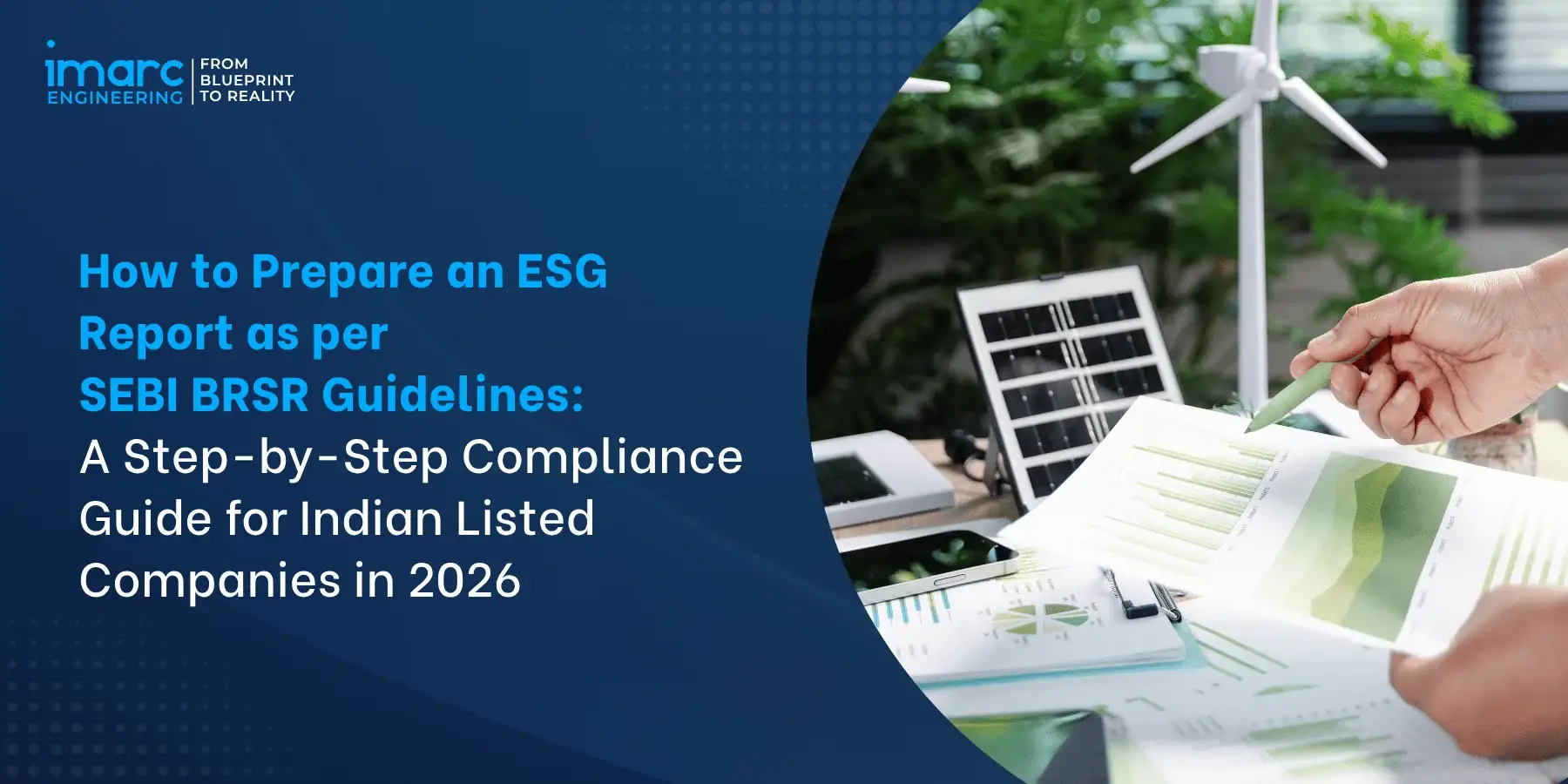
How to Prepare an ESG Report as per SEBI BRSR Guidelines: A Step-by-Step Compliance Guide for Indian Listed Companies in 2026
Introduction
For any Indian listed company in the top 1,000 by market capitalisation, SEBI BRSR reporting in India has become one of the most consequential annual compliance exercises on the corporate calendar. Introduced by the Securities and Exchange Board of India (SEBI) through its circular dated 10 May 2021, and made mandatory from FY 2022-23, the Business Responsibility and Sustainability Report (BRSR) replaced the older Business Responsibility Report (BRR) with a substantially more rigorous, quantitative, and globally comparable framework.
The top 1,000 listed entities, representing over 70% of India's market capitalisation, are now required to disclose against 140 ESG indicators each year, with progressively mandatory third-party assurance on a core subset under the BRSR Core regime.
The trajectory is clear. BRSR compliance for listed companies has moved from a documentation exercise to an audited disclosure regime that materially affects investor relations, lender appetite, and the broader cost of capital. Reasonable assurance on the nine BRSR Core attributes was applicable to the top 150 listed entities from FY 2023-24, expanded to the top 250 from FY 2024-25, the top 500 from FY 2025-26, and is scheduled to cover all top 1,000 from FY 2026-27.
Value chain disclosures, covering suppliers and customers individually contributing 2% or more of purchases or sales, are following a similar phased glide path. The compliance burden, in short, is rising every year.
Drawing on IMARC Engineering's experience supporting ESG diagnostics, sustainability reporting engagements in India, data-systems setup, materiality assessments, and assurance readiness for Indian listed companies and their value-chain partners, this guide lays out a structured, step-by-step approach to preparing a BRSR report in 2026.
You will find an overview of the framework, a deep-dive on BRSR Core and assurance, a step-by-step preparation process, value-chain disclosure guidance, data and materiality methodology, common-pitfall warnings, a checklist for compliance teams, guidance on choosing consultants, and a frequently-asked-questions section. The objective is to make the ESG disclosure framework in India practical and predictable for your compliance and sustainability teams.
Table of Contents
- Introduction
- Why BRSR Reporting Matters in 2026
- The BRSR Framework - 9 Principles, 3 Sections, 140 Indicators
- BRSR Core - 9 KPI Attributes and Assurance Requirements
- Step-by-Step BRSR Preparation Process
- Value Chain ESG Disclosures and Phased Timeline
- Data Collection, Materiality, and Stakeholder Engagement
- Common Mistakes and How to Avoid Them
- BRSR Preparation Checklist
- How to Choose an ESG Reporting Consultant
- Conclusion
1. Why BRSR Reporting Matters in 2026
Understanding why ESG reporting requirements in India under the SEBI BRSR regime have become so material in 2026 starts with five structural factors that are reshaping the cost of capital, market access, and stakeholder expectations for Indian listed companies.
1.1 The Regulatory Net Is Tightening Annually
BRSR reporting became mandatory for the top 1,000 listed entities from FY 2022-23. From FY 2023-24, the BRSR Core sub-framework added mandatory reasonable assurance on nine ESG attributes, starting with the top 150 companies and expanding annually. From FY 2024-25, the top 250 companies began reporting value chain ESG data on a 'comply or explain' basis.
From FY 2025-26, BRSR Core assurance extends to the top 500 listed entities. From FY 2026-27, assurance and value-chain disclosures cover the full top 1,000. Each year's expansion brings new entrants into the assurance regime; companies near the cut-off should track the market-cap rank annually, since entry can happen with a single year's price movement.
1.2 The Cost of Capital Is Increasingly ESG-Linked
Indian and international institutional investors, mutual funds, insurance companies, sovereign wealth funds, pension funds, ESG-mandated funds, now reference BRSR data directly in their investment decisions. ESG-linked debt instruments (sustainability-linked loans, green bonds) embed BRSR-disclosed metrics into pricing covenants. Companies with weak or unassured ESG data face wider credit spreads, smaller pools of eligible investors, and harder conversations with international JV partners and lenders. The economics of robust BRSR reporting have moved from compliance cost to balance-sheet implication.
1.3 Global Reporting Frameworks Are Converging
BRSR is explicitly aligned with global frameworks, Global Reporting Initiative (GRI) Standards, the Task Force on Climate-related Financial Disclosures (TCFD), the UN Global Compact, the UN Sustainable Development Goals (SDGs), and the IFRS Sustainability Disclosure Standards developed by the International Sustainability Standards Board (ISSB).
For Indian listed companies with export, JV, or capital-markets exposure, a well-constructed BRSR feeds directly into international ESG questionnaires (CDP, MSCI, Sustainalytics, ISS, S&P Global CSA) with substantially less duplicated effort. Companies that build their data systems to BRSR Core standard typically find that 60-80% of the same data answers the major international frameworks.
1.4 Value Chain Disclosures Will Push Compliance Into the Supplier Base
Value chain disclosures, currently on a 'comply or explain' basis for top 250 companies and scheduled to become mandatory with assurance for the full top 1,000 by FY 2026-27, extend BRSR data requirements to suppliers and customers individually contributing 2% or more of purchases or sales, or covering 75% of aggregate purchases and sales value cumulatively. This means even mid-size unlisted suppliers to listed companies will increasingly need to report ESG data in BRSR-compatible formats. The compliance perimeter is expanding well beyond the directly-regulated 1,000 entities.
1.5 The Reputational and Greenwashing Risk Is Real
BRSR Core assurance is reasonable assurance, a higher standard than the limited assurance used in most other jurisdictions, including the EU CSRD in its initial phase. Misstatements that survive into a public BRSR filing carry reputational risk that compounds over years and can trigger regulatory inquiries. Greenwashing accusations, the gap between disclosed claims and underlying reality, have become a material legal and reputational exposure for Indian listed companies, particularly those marketing to international customers. Robust, evidence-backed BRSR data, by specialist ESG compliance services in India is the most cost-effective insurance against this risk.
2. The BRSR Framework - 9 Principles, 3 Sections, 140 Indicators
The BRSR framework is anchored in the National Guidelines on Responsible Business Conduct (NGRBC) issued by the Ministry of Corporate Affairs, Government of India. NGRBC defines nine principles of responsible business conduct, and BRSR operationalises these into a structured disclosure architecture. Understanding the framework structure is the foundation of any disciplined preparation effort.
2.1 The Nine NGRBC Principles
| Principle | Theme |
|---|---|
| Principle 1 | Businesses should conduct and govern themselves with integrity, ethics, transparency, and accountability |
| Principle 2 | Businesses should provide goods and services in a manner that is sustainable and safe |
| Principle 3 | Businesses should respect and promote the well-being of all employees, including those in their value chain |
| Principle 4 | Businesses should respect the interests of and be responsive to all stakeholders |
| Principle 5 | Businesses should respect and promote human rights |
| Principle 6 | Businesses should respect and make efforts to protect and restore the environment |
| Principle 7 | Businesses, when engaging in influencing public and regulatory policy, should do so in a responsible and transparent manner |
| Principle 8 | Businesses should promote inclusive growth and equitable development |
| Principle 9 | Businesses should engage with and provide value to consumers in a responsible manner |
2.2 The Three BRSR Sections
Every BRSR report is organised into three sections. Section A captures general disclosures - corporate identity, products and services, employees, capital structure, geographic spread, transparency and complaint mechanisms. Section B documents management and process disclosures - the company's policies, governance, oversight, and processes for each of the nine NGRBC principles, including details of the policies themselves, the senior executives responsible, and how performance is reviewed. Section C is the substantive section - principle-wise performance disclosures, broken into essential indicators (mandatory quantitative and qualitative data points) and leadership indicators (additional disclosures that demonstrate ESG maturity). Section C is where the bulk of the data collection, analysis, and assurance effort concentrates.
2.3 The 140 Indicators - Essential and Leadership
BRSR requires disclosures across approximately 140 ESG indicators, split into 98 BRSR essential indicators (mandatory) and 42 leadership indicators (recommended but not mandatory under the standard BRSR; certain leadership indicators become essential under the BRSR Core sub-framework for the cohort within the assurance perimeter).
Essential indicators capture quantitative and comparable data points: greenhouse gas emissions, energy and water consumption, waste generation, workforce composition and diversity, training hours, complaint and grievance data, CSR spend, board independence, and many more. Leadership indicators capture practices that go beyond compliance, supply chain audits, sustainability-linked R&D, biodiversity programmes, employee well-being initiatives, customer satisfaction surveys, and similar. Companies preparing for capital-markets visibility increasingly disclose leadership indicators voluntarily even where not mandatory.
2.4 Filing Format and Public Availability
BRSR disclosures are included in the company's annual report (filed alongside Form MGT-7) and submitted to the stock exchanges (BSE and NSE) in machine-readable XBRL format. The reports are publicly accessible on the exchange portals and on company websites under the investor-relations or sustainability sections. The public-availability dimension is important, BRSR data is read not only by SEBI and stock exchanges but by analysts, lenders, customers, NGOs, journalists, and competitors. The standard of preparation must reflect that public-document reality.
3. BRSR Core - 9 KPI Attributes and Assurance Requirements
BRSR Core is the assurance-bearing sub-framework that defines BRSR Core assurance requirements for cohorts of listed companies, expanding annually until it covers the full top 1,000 by FY 2026-27. The Core comprises nine ESG attributes that require BRSR Core 9 attributes assurance from an independent assurance provider, either the statutory auditor or a SEBI-recognised assessment provider.
3.1 The Nine BRSR Core Attributes
| S.No. | Attribute | Category |
|---|---|---|
| 1 | Greenhouse Gas (GHG) Emissions- Scope 1, Scope 2, Scope 3 (absolute and intensity) | Environmental |
| 2 | Water Management- withdrawal, consumption, discharge | Environmental |
| 3 | Energy Consumption- from renewable and non-renewable sources | Environmental |
| 4 | Waste Management- generation, recycling, disposal | Environmental |
| 5 | Gender Diversity- representation across workforce, including senior management and board | Social |
| 6 | Wages and Compensation- minimum wages, gender pay gap, fair remuneration | Social |
| 7 | Inclusive Development- community engagement, social impact, CSR effectiveness | Social |
| 8 | Fairness in Engaging with Customer- complaints, redressal, product responsibility | Governance |
| 9 | Openness of Business- transparency, anti-corruption, ethics | Governance |
3.2 The Phased Assurance Glide Path
| Financial Year | Mandatory BRSR Reporting | Mandatory BRSR Core Reasonable Assurance | Value Chain ESG Disclosures |
|---|---|---|---|
| FY 2022-23 | Top 1,000 by market cap | Not applicable | Not applicable |
| FY 2023-24 | Top 1,000 | Top 150 listed entities | Not applicable |
| FY 2024-25 | Top 1,000 | Top 250 listed entities | Top 250 (comply or explain) |
| FY 2025-26 | Top 1,000 | Top 500 listed entities | Top 250 (continues) |
| FY 2026-27 | Top 1,000 | All top 1,000 listed entities | Top 1,000 (mandatory with assurance) |
Market-capitalisation rank is determined as of 31 March of the relevant financial year. Companies near a cohort cut-off should monitor their rank prospectively, entering the assurance perimeter for the first time typically requires 6-12 months of preparation, which means initial data systems and governance work needs to start well before the financial year in question.
3.3 Reasonable Assurance- What It Actually Means
BRSR Core is a reasonable assurance regime, not the limited assurance standard used in many other jurisdictions. Reasonable assurance involves a substantially deeper level of evidence-gathering, sample-testing, and audit procedure than limited assurance, closer in rigour to a statutory financial audit than to a typical sustainability review.
Practical implications: every Core KPI must be supported by source data (utility bills, payroll registers, HR records, complaint registers, training records, board minutes, environmental monitoring logs); data systems must produce audit trails that demonstrate completeness and accuracy; methodology for calculations (especially Scope 1, 2, 3 emissions) must be documented and consistent year-on-year; and remediation of any control gaps identified during early-stage assurance must be evidenced before the final report.
3.4 Choosing an Assurance Provider
BRSR Core assurance can be provided by the statutory auditor or by a SEBI-recognised assessment provider with appropriate accreditation. The choice has practical implications for timeline, cost, and coordination with the statutory audit.
Many large, listed entities engage their statutory auditor to leverage existing audit-engagement coordination; others engage specialist sustainability-assurance firms for independence and depth. Either way, the assurance provider should be engaged well before the financial year-end, typically 6-9 months ahead, to give the company time to address any control or data gaps identified in the readiness review.
4. Step-by-Step BRSR Preparation Process
A disciplined step-by-step BRSR reporting process India unfolds across eight sequential stages, ideally spread over 8-12 months from kickoff to filed report. The right way to address how to prepare ESG report India is to treat it as a year-round programme with named accountabilities, not as a March-April scramble. The framework below works for first-time filers, subsequent-year filers, and companies entering the BRSR Core assurance perimeter for the first time.
| Stage | Activity | Owner |
|---|---|---|
| 1. Governance setup | ESG steering committee, sustainability officer, principle-owners assigned | CEO / Board |
| 2. Gap analysis | Diagnostic against BRSR essential indicators and Core attributes | Sustainability head + advisor |
| 3. Materiality assessment | Stakeholder engagement, materiality matrix, priority topics | Sustainability head + advisor |
| 4. Data systems design | Source systems mapping, data-owner assignment, audit trail design | Sustainability + IT + Finance |
| 5. Data collection and validation | Monthly / quarterly data gathering, reconciliation, exception management | Function owners |
| 6. Report drafting | Section A / B / C drafting, narrative development, board review | Sustainability head + IR |
| 7. Assurance and remediation | Assurance provider walkthrough, evidence binders, gap remediation | Sustainability head + audit |
| 8. Filing and disclosure | XBRL filing, annual report inclusion, exchange and website publication | Company Secretary |
4.1 Stage 1 - Governance Setup
Set up an ESG steering committee chaired by the CEO or a board-level director, with the Chief Sustainability Officer (or equivalent), Chief Financial Officer, Chief Human Resources Officer, Company Secretary, and Chief Operating Officer as members. Assign principle-owners, one named senior executive accountable for the data, narrative, and disclosures under each of the nine NGRBC principles. Issue a board-approved BRSR governance charter. This sounds bureaucratic but is the single highest-leverage step, BRSR data quality lives or dies on whether someone senior owns each line.
4.2 Stage 2 - Gap Analysis
Conduct a structured diagnostic against all 98 essential indicators (and 42 leadership indicators for companies aspiring to leadership disclosures) and the nine BRSR Core attributes (for companies in or entering the assurance perimeter). The diagnostic identifies: which indicators already have data sources and controls; which need new data collection; which have data but lack documentation or audit trail; and which carry methodology questions that need resolution. The output is a prioritised remediation plan with named owners and timelines. For first-time BRSR filers, expect 40-60% of indicators to need new or enhanced data infrastructure.
4.3 Stage 3 - Materiality Assessment
A credible ESG materiality assessment identifies the ESG topics that are most material to the business and its stakeholders, and informs the narrative emphasis in Sections B and C of the BRSR. The assessment should involve structured stakeholder engagement, employees, customers, investors, regulators, suppliers, communities, through surveys, interviews, or workshops; analysis against industry-specific frameworks (SASB Standards, GRI Sector Standards, ISSB IFRS S1/S2); and a materiality matrix that prioritises topics by impact and influence.
The output is a documented list of material topics that drives the report's focus areas. SEBI does not currently mandate a specific materiality methodology, but companies in the assurance perimeter should expect questions on it during assurance walkthroughs.
4.4 Stage 4 - Data Systems Design
For each essential indicator and Core attribute, define: the source system (utility billing system, payroll, HR information system, environmental monitoring, complaint register, board secretariat system, etc.); the data owner (named individual responsible for accuracy and completeness); the calculation methodology (especially for Scope 1, 2, 3 GHG emissions, water consumption, waste intensity, energy intensity); the collection frequency (monthly is generally better than annual); and the audit trail (the documentation that links source records to the disclosed number).
For BRSR Core attributes under assurance, the data-systems design must support reasonable-assurance evidence requirements, sample testing, recalculation, source-document verification.
4.5 Stage 5 - Data Collection and Validation
Begin monthly or quarterly data collection from each source system. Reconcile reported numbers against source records. Investigate and document any exceptions. Maintain a running file of supporting evidence (utility bills, invoices, HR registers, training records, complaint logs, environmental monitoring reports, board minutes, audit findings). Conduct quarterly reviews against the prior year and against the materiality-driven narrative. Quarterly reviews surface methodology and data issues 6-9 months ahead of the filing deadline, when there is still time to fix them.
4.6 Stage 6 - Report Drafting
Begin Section A and Section B drafting around Month 9, these are largely policy and process narratives that are stable year-on-year. Section C drafting commences once year-end data is finalised (typically by Month 10-11).
The narrative should be evidence-led, not aspirational, each performance claim referenced to source data, each year-on-year change explained, each underperformance addressed honestly with corrective action. Board review of the draft BRSR before publication is now standard practice and should be calendared 4-6 weeks before the filing deadline.
4.7 Stage 7 - Assurance and Remediation
For companies within the BRSR Core assurance perimeter, the assurance provider's walkthrough typically begins 8-12 weeks before the filing deadline. The assurance team reviews the Core data, sample-tests source records, recalculates KPIs, and identifies any observations. Companies use this window to remediate gaps, strengthen documentation, correct calculations, address control weaknesses. The objective is to walk into final assurance with all observations closed and clean evidence binders ready.
4.8 Stage 8 - Filing and Disclosure
Final BRSR is included in the annual report (filed with the Registrar of Companies in Form MGT-7) and submitted to the stock exchanges in XBRL format. The annual report is published to shareholders and made available on the company website.
The how to file BRSR with SEBI workflow is in practice handled through the BSE and NSE filing portals, which prescribe XBRL templates and disclosure formats. For the BRSR Core perimeter, the independent assurance report accompanies the disclosure. Coordinate the BRSR filing with the company's broader annual-report timeline; the BRSR is now a board-approved governance document, not a standalone sustainability brochure.
5. Value Chain ESG Disclosures and Phased Timeline
The value chain ESG disclosures BRSR requirement is one of the most consequential expansions of BRSR scope in the 2024-27 window. From FY 2024-25, the top 250 listed entities began reporting ESG data for their material suppliers and customers; from FY 2026-27, this is scheduled to become mandatory with assurance for all top 1,000 listed entities. The scope and the assurance overlay will push BRSR-compatible reporting deep into India's unlisted supplier base.
5.1 The 2% and 75% Thresholds
Under the SEBI value-chain framework, listed companies must report ESG disclosures for suppliers and customers that individually contribute 2% or more of total purchases or sales, or that together cover 75% of aggregate purchases and sales by value (whichever set is broader). For most large listed entities, this translates into 20-50 material suppliers and 10-30 material customers each year. The list changes annually with business volume, so the perimeter calculation needs to be refreshed every reporting cycle.
5.2 What Listed Companies Must Disclose
Value-chain disclosures cover the same essential indicators and Core attributes that apply to the listed entity itself, GHG emissions, energy and water consumption, waste, workforce composition and diversity, complaint and grievance data, and so on, but for the material supplier and customer perimeter.
This typically requires the listed company to either collect the data directly from value-chain partners or to use estimation methodologies (with documented assumptions) for non-cooperating partners. The 'comply or explain' framework allows companies to explain where they cannot disclose, but each year the bar for what counts as a reasonable explanation will rise.
5.3 What Suppliers and Customers Need to Prepare
For unlisted suppliers and customers of top-1,000 listed entities, value-chain disclosures effectively pull them into the BRSR-compatible reporting orbit. Many will need to: set up basic ESG data systems (energy and water consumption tracking, GHG emissions calculation, workforce diversity reporting); respond to ESG questionnaires from multiple listed customers; provide source data for the listed customer's assurance process; and increasingly, obtain their own ESG attestation. Indian MSMEs in the supply chain of regulated listed entities face a particularly steep adjustment, one that is best addressed proactively before the listed customer's request arrives.
5.4 Strategic Implications
The value-chain regime will reshape supplier and customer relationships for the top 1,000 listed entities. Buyers will increasingly favour suppliers that can deliver clean ESG data; suppliers that cannot will face commercial friction, exclusion from preferred-supplier lists, or pricing penalties. Customer ESG data needs will affect contract structure and term sheets. The companies that recognise this 12-24 months ahead and invest in their supplier-engagement, supplier-development, and customer-onboarding capability typically capture disproportionate value as the regime tightens.
6. Data Collection, Materiality, and Stakeholder Engagement
The substance of a strong BRSR report sits in three operational disciplines, data quality, materiality discipline, and stakeholder engagement. Companies that build capability in these three areas typically clear assurance with minimal observations and produce reports that earn the confidence of capital-markets readers. Companies that compress these into a March-April sprint typically struggle.
6.1 Building BRSR-Grade Data Systems
BRSR Core assurance is reasonable assurance, which means the underlying data must satisfy the same evidence and audit-trail expectations as financial-statement audit. Practical disciplines include: define each indicator at sub-line-item level with formula, source, owner, and frequency; integrate ESG data capture into existing finance, HR, and operations systems wherever possible (a separate sustainability data lake is acceptable but riskier than embedded capture); maintain monthly or quarterly reconciliation between source records and reported numbers; document calculation methodology (especially Scope 1, 2, 3 GHG emissions with emission factors and boundary definitions) in a methodology note that is updated annually; and retain supporting records for at least two financial years (longer is recommended for trend analysis).
6.2 Materiality - From Compliance to Strategy
Materiality assessment is where compliance reporting becomes strategic communication. A weak exercise treats all ESG topics equally, diluting focus. A strong one identifies the 5–10 issues that truly matter to the business and its stakeholders, shaping a clear and credible BRSR narrative.
The methodology should include reviewing frameworks (SASB, GRI, ISSB), gathering structured stakeholder input, analysing peer disclosures, and mapping topics to business risks and opportunities, culminating in a board-approved materiality matrix. This matrix should be refreshed every 2–3 years, as material priorities typically remain stable in the short term.
6.3 Stakeholder Engagement
BRSR explicitly requires disclosure of stakeholder engagement mechanisms under Principle 4 (responsiveness to stakeholders) and Principle 5 (human rights). This involves identifying key stakeholder groups, employees, customers, investors, regulators, suppliers, communities, and NGOs, and engaging them through a mix of structured channels such as surveys, investor calls, supplier audits, and community consultations, along with ad-hoc mechanisms like grievance systems, helplines, and social media monitoring.
These channels must be clearly documented in the BRSR, including their frequency, response processes, and escalation pathways. Companies should also track outcomes, issues raised, actions taken, and follow-ups, and report them transparently. Organizations that build stakeholder engagement as a two-way capability typically benefit from faster issue resolution, fewer disruptions, and stronger employee retention.
6.4 BRSR vs. Other Frameworks - The Convergence Path
Indian listed companies often face a question on BRSR vs GRI reporting in India, whether to maintain separate disclosures against the two frameworks or to streamline. The pragmatic answer is convergence: build the data systems to BRSR Core standard (which is the most rigorous of the frameworks applicable to Indian listed entities), then map the same data to GRI Standards, TCFD, CDP, ISSB IFRS S1/S2, and other frameworks.
The 60-80% data overlap means that one strong BRSR-anchored data programme answers most international questionnaires with modest additional effort. The discipline is in framework mapping, maintaining a central data dictionary that links each BRSR data point to its equivalent in every other framework the company reports under.
7. Common Mistakes and How to Avoid Them
The mistakes below are the recurring patterns we see across BRSR engagements in India, and the ones most likely to surface as assurance observations, regulatory queries, or capital-markets reputational risk. Each is paired with the discipline that prevents it.
7.1 Treating BRSR as a Year-End Disclosure Rather Than a Year-Long Programme
The single most common failure mode is starting BRSR preparation in February-March for a March year-end filing. The pattern: data is reconstructed retrospectively, evidence binders are thin, methodology is inconsistent year-on-year, and assurance teams raise observations on data integrity. Discipline: start the next year's preparation immediately after the current year's filing, governance, data systems, materiality, and stakeholder engagement run as a year-round programme.
7.2 Weak Governance Ownership
BRSR data quality lives or dies on whether named senior executives own each line. The pattern: sustainability function is asked to deliver BRSR without authority over finance, HR, operations, or environmental data; data is begged for in March; the narrative becomes aspirational rather than evidence-led. Discipline: board-approved BRSR governance charter, ESG steering committee chaired by CEO or director, named principle-owners with accountability built into KRA.
7.3 Methodology Drift Year-on-Year
Calculations that change methodology from year to year- emission factors, boundary definitions, intensity denominators, workforce-counting rules, destroy the comparability that BRSR is designed to enable. Each methodology change without clear disclosure looks like number-management. Discipline: document methodology in a versioned methodology note; flag any necessary changes transparently with both the new and the restated prior-year number; convene a board-level review before changing material methodology.
7.4 Cherry-Picking Disclosures
Reporting against essential indicators where the data is favourable and finding reasons not to report (or providing thin disclosure) on indicators where the data is weaker is a pattern that assurance teams and analysts catch quickly. The reputational cost typically exceeds the perceived benefit. Discipline: report every essential indicator fully; explain underperformance honestly with corrective action; let the narrative show direction of travel rather than hide unflattering snapshots.
7.5 Aspirational Narrative Without Evidence
BRSR is an audited disclosure framework, not a marketing brochure. Aspirational statements ("we are committed to net zero by 2050", "diversity is in our DNA") without underlying metrics and credible roadmaps invite greenwashing accusations and assurance qualifications.
7.6 Underestimating Value Chain Complexity
Companies entering the value-chain disclosure regime often underestimate the time required to engage suppliers, design questionnaires, collect data, and validate it. The pattern: a list of 30-40 material suppliers, of whom 60-70% have no existing ESG data systems and limited bandwidth to respond.
7.7 Skipping the Pre-Assurance Readiness Review
Walking into BRSR Core assurance without a structured pre-assurance readiness review is the most reliable predictor of qualified opinions and last-minute remediation. Discipline: engage the assurance provider for an early-stage readiness review 6-9 months ahead of year-end; conduct an independent dry-run of the core attributes; remediate observations during the financial year, not after.
8. BRSR Preparation Checklist
The checklist below consolidates the operational decision points discussed across this guide into a structured set that compliance and sustainability teams can apply directly to their next BRSR cycle.
8.1 Governance and Setup
-
Board-approved BRSR governance charter in place
-
ESG steering committee chaired by CEO / board-level director established
-
Principle-owners (one per NGRBC principle) assigned with KRA accountability
-
Sustainability head / Chief Sustainability Officer designated
-
Materiality matrix board-approved and current (refreshed within 2-3 years)
8.2 Data Systems
-
Every essential indicator mapped to source system, data owner, methodology, frequency
-
BRSR Core nine attributes integrated into monthly / quarterly MIS
-
Scope 1, 2, 3 GHG emissions methodology documented with emission factors and boundaries
-
Audit trail and evidence binders maintained per indicator
-
Quarterly reconciliation between source records and reported numbers
8.3 Materiality and Stakeholder Engagement
-
Structured stakeholder engagement across employees, customers, investors, suppliers, communities
-
Industry-specific framework review (SASB, GRI Sector Standards, ISSB IFRS S1/S2)
-
Materiality matrix with 5-10 priority topics documented
-
Material topics inform BRSR narrative emphasis in Sections B and C
8.4 Drafting and Review
-
Section A general disclosures drafted (typically stable year-on-year)
-
Section B management and process disclosures drafted with principle-owner sign-off
-
Section C essential indicators populated with reconciled data
-
Leadership indicators populated where company chooses to disclose
-
Year-on-year changes explained; underperformance addressed with corrective action
-
Draft BRSR reviewed and approved by ESG steering committee and board
8.5 Assurance and Filing
-
Assurance provider engaged 6-9 months ahead of year-end (for companies in Core perimeter)
-
Pre-assurance readiness review completed; observations remediated
-
Reasonable assurance walkthrough and final report completed
-
BRSR included in annual report (Form MGT-7) and filed with Registrar of Companies
-
XBRL submission to BSE and NSE completed within statutory timelines
- Annual report and BRSR published on company website (investor relations / sustainability section)
9. How to Choose an ESG Reporting Consultant
For most listed companies, particularly those preparing for BRSR Core assurance or value-chain reporting for the first time, engaging specialist ESG reporting consultants is a sensible investment. The right consultant accelerates the learning curve, reduces assurance risk, and frees the in-house team to focus on substance rather than methodology debugging. The selection framework below summarises what mature compliance teams test for.
9.1 The Six Selection Criteria
-
BRSR-specific experience- documented project credentials with Indian listed entities, not just generic ESG consulting
-
BRSR Core assurance experience- ability to prepare clients for reasonable-assurance walkthroughs
-
Multi-disciplinary capability- sustainability, finance, audit, IT, and industry knowledge under one project lead
-
Sector depth- understanding of sector-specific material topics, regulatory overlays, and peer benchmarks
-
Independence- distinct from the assurance provider to avoid conflict and preserve audit independence
-
Engagement model- fixed scope, fixed fee where possible, with clear deliverables and timeline
9.2 Red Flags to Watch
Consultants that propose generic templated BRSR reports without sector-specific tailoring are likely to deliver reports that look the same as every other listed entity's, missing the strategic communication opportunity. Consultants that promise specific outcomes (assurance pass-through, ESG rating improvements) before doing the work are signalling a willingness to retrofit numbers to the answer rather than to the underlying reality. Consultants that lack Indian listed-entity credentials are likely to deliver internationally-styled reports that miss the specific NGRBC principle structure and SEBI reporting templates.
Conclusion
Preparing a robust BRSR is now a regulatory and governance mandate for India’s top listed companies. Under SEBI BRSR guidelines 2026, requirements are tightening with BRSR Core assurance and expanded value-chain disclosures, raising both compliance scope and scrutiny from investors and regulators. Companies that treat BRSR as a year-round data and controls programme, not a year-end exercise, consistently deliver stronger, more credible outcomes.
Three essentials: establish clear governance ownership, treat BRSR Core like an audited process with strong data systems, and approach materiality and stakeholder engagement strategically.
IMARC Engineering provides end-to-end BRSR and ESG advisory support, from first-time filings to assurance readiness.
Need support with BRSR reporting, ESG compliance, assurance readiness, or value-chain disclosures? IMARC Engineering helps listed companies build structured, audit-ready ESG reporting frameworks aligned with SEBI BRSR guidelines.
→ Contact us to learn more about our ESG Compliance Consulting & Advisory Services
Frequently Asked Questions
The top 1,000 listed entities by market capitalisation (as of 31 March of the relevant financial year) must file BRSR. Mandatory ESG reporting for top 1000 listed companies India began from FY 2022-23. Companies moving into the top 1,000 must commence BRSR reporting from the financial year in which they enter the perimeter. SEBI has encouraged voluntary BRSR adoption by listed entities outside the top 1,000 as well.
No, BRSR is a mandatory regulatory framework specific to Indian listed entities. Many companies continue to report against GRI Standards, TCFD, CDP, ISSB IFRS S1/S2, and other voluntary frameworks for international stakeholder communication. BRSR is explicitly aligned with these frameworks, so the same data systems typically support 60-80% of the international reporting need.
Costs vary substantially by company size, scope (with or without BRSR Core), and whether value-chain disclosures are in scope. Internal effort (sustainability team, finance, HR, IT) often exceeds external consultant fees. The right framing is cost-to-risk, weak preparation can result in assurance qualifications, regulatory queries, and capital-markets reputational damage that far exceed the cost of doing it properly the first time.
No, independence requirements separate preparation from assurance. The preparation consultant and the BRSR Core assurance provider must be distinct entities (the assurance provider is typically the statutory auditor or a SEBI-recognised assessment provider; the preparation consultant is an independent third party). Coordination between the two teams is essential to a clean assurance walkthrough.
BRSR Core requires GHG emissions disclosure following recognised methodologies (typically the GHG Protocol Corporate Standard). Scope 1 covers direct emissions from owned or controlled sources (fuel combustion, process emissions, fleet fuel use); Scope 2 covers indirect emissions from purchased energy (electricity, steam, heating, cooling); Scope 3 covers other indirect emissions across the value chain (purchased goods, business travel, employee commuting, transportation, end-of-life of sold products). Methodology, boundary, and emission factors must be documented and consistent year-on-year. Scope 3 reporting depth varies, the BRSR Core requirements have progressively expanded Scope 3 coverage over the implementation glide path.
SEBI does not currently prescribe a specific materiality methodology, but companies in the assurance perimeter should document their materiality approach, stakeholder engagement, peer review, industry-specific frameworks, and the resulting materiality matrix. Material topics should drive the narrative emphasis in Sections B and C, even though all essential indicators must still be reported.
IMARC Engineering provides end-to-end BRSR and ESG advisory including governance setup, gap analysis, materiality assessment, data-systems design, drafting support across all three BRSR sections, BRSR Core assurance readiness, value-chain supplier engagement, framework mapping (GRI, TCFD, ISSB), and ongoing programme governance. Our teams combine sustainability expertise, sector engineering, finance, and assurance experience to deliver BRSR programmes that meet regulatory, capital-markets, and operational expectations.
IMARC supports BRSR and ESG advisory across pharmaceuticals, automotive and auto components, specialty chemicals, food and FMCG, electronics, engineering and capital goods, energy, infrastructure, and other listed-entity sectors. Sector-specific case credentials, materiality benchmarks, and data-system templates can be shared during project scoping.
Recent Post



Trusted by Industry Leaders
We partner with global enterprises and ambitious businesses across sectors to deliver operational excellence, strategic insights, and sustainable growth through integrated solutions.












Success in Their Words
Real feedback from clients across industries. Discover how our solutions delivered measurable impact and operational excellence.

I wanted to express my sincere appreciation for your efforts in handling this matter. Your dedication and commitment have been truly commendable, and it is evident that you have put in tremendous hard work and expertise into resolving the issues at hand. We are greatly interested in continuing our collaboration with you in the future, as your professionalism and reliability have made you a trusted partner. Thank you once again for your invaluable contribution. We look forward to strengthening our partnership ahead.

It has been a pleasure working with the IMARC team. The insights provided were structured, clear, and highly valuable, helping us strengthen both our technical and financial planning with confidence. We deeply appreciate the team’s professionalism, responsiveness, and attention to detail throughout the engagement. Every requirement was well understood and effectively incorporated, resulting in a comprehensive and actionable output. Overall, our experience has been excellent, and I would gladly recommend IMARC to organizations seeking a reliable research partner.

Your service is truly exceptional. Working with the IMARC team has been a seamless and professional experience. The clarity of communication, responsiveness to queries, and consistent support at every stage made the entire engagement highly efficient. The insights shared were well-structured, practical, and perfectly aligned with our requirements, helping us make informed decisions with confidence. Overall, the dedication and professionalism demonstrated by your team stand out, and I would be glad to recommend IMARC as a reliable and trustworthy research partner.

IMARC did an outstanding job in preparing our study. They were punctual, precise, and consistently responsive throughout the entire process. The team delivered all the data we required in a clear, well-organized, and highly professional format. Their strong attention to detail, combined with their ability to meet every deadline without compromising quality, truly set them apart. Overall, their reliability and commitment made them an exceptional partner for our project, and we would gladly work with them again in the future.

IMARC made the whole process incredibly easy from start to finish. Everyone I interacted with via email was polite, professional, and straightforward to deal with, always keeping their promises regarding delivery timelines and remaining consistently solutions-focused. From my very first contact, I appreciated the professionalism and support shown by the entire IMARC team. I highly recommend IMARC to anyone seeking timely, affordable, and reliable information or advice. My experience with IMARC was excellent, and I truly cannot fault any aspect of it.

I’d like to express my sincere gratitude for the excellent work you accomplished with the study. Your ability to quickly understand our requirements and deliver high-quality results under tight timelines truly reflects your expertise, exceptional work ethic, and unwavering commitment to your customer’s success. The professionalism and responsiveness you demonstrated throughout the process made a significant difference. Our entire team and company are incredibly thankful for your dedication, reliability, and support. Once again, thank you for your outstanding contribution.