Manufacturing
May 18 2026
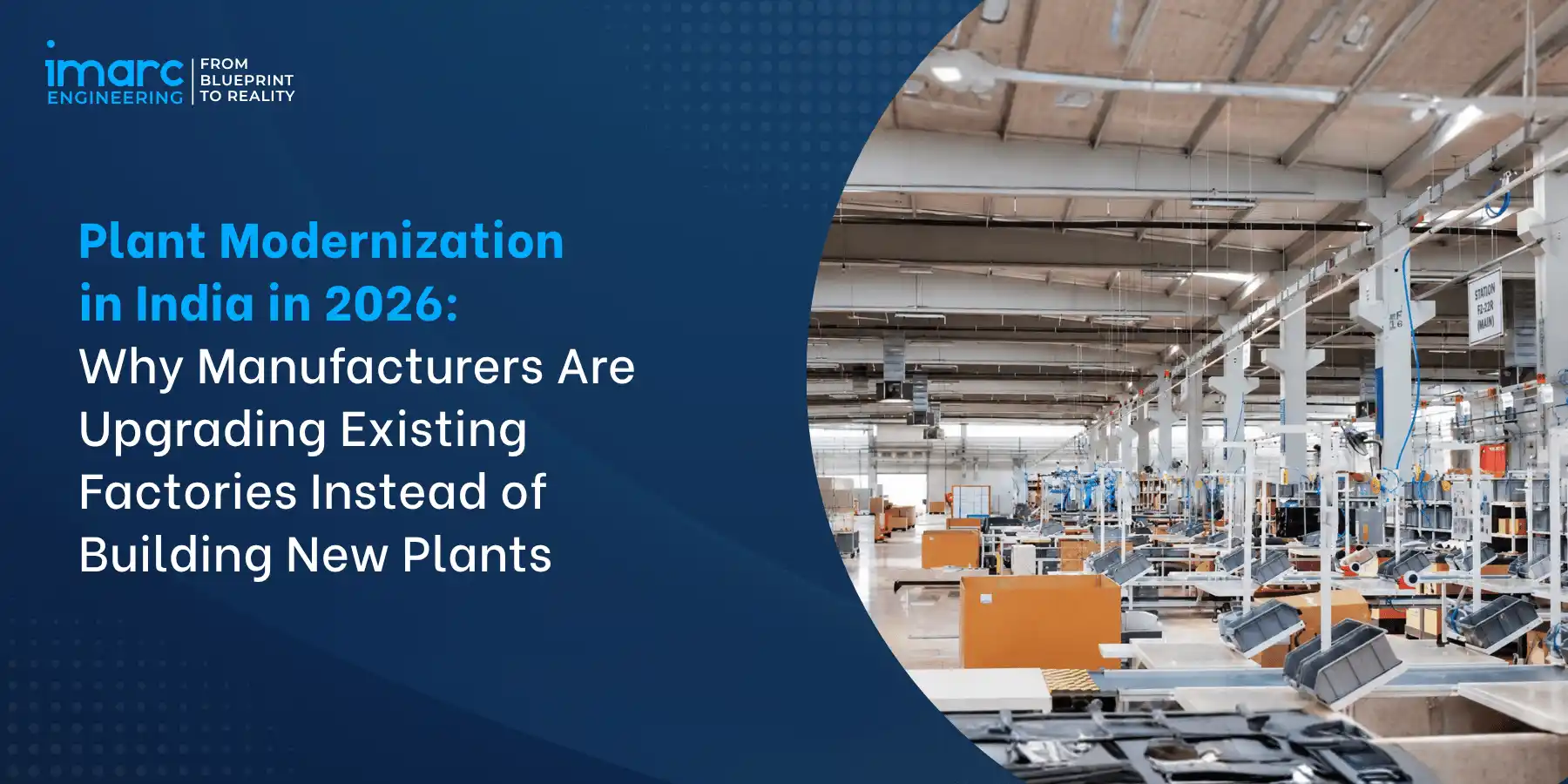
Plant Modernization in India (2026): Why Manufacturers Are Upgrading Existing Factories Instead of Building New Plants
Introduction
Across India's manufacturing belt, the auto cluster in Chakan, the chemical corridor along the Gujarat coastline, the textile hubs of Tamil Nadu, the steel and aluminium plants of Odisha and Jharkhand, a structural shift is underway. The capex narrative of the previous decade was dominated by greenfield ambition.
The capex narrative of 2026 is more discriminating: capital is flowing increasingly into upgrading what already exists rather than building from scratch. Plant modernization in India has emerged as the dominant industrial capex strategy across multiple sectors, driven by four converging pressures. Capital decisions are now increasingly supported by structured capex planning and feasibility assessment frameworks.
First, the Production Linked Incentive (PLI) schemes, with a combined announced outlay of approximately INR 1.97 lakh crore across 14 sectors, reward incremental output more than greenfield investment. Second, the EU's Carbon Border Adjustment Mechanism (CBAM), now in its definitive enforcement period from January 2026, has placed measurable carbon intensity at the centre of export competitiveness.
Third, greenfield approval timelines under the LARR Act 2013, the EIA Notification 2006, and parallel utility sanctions have lengthened materially. Fourth, the maturity of retrofit-ready technologies has made the manufacturing plant upgrade path technically and commercially attractive at scale.
Drawing on IMARC Engineering's experience supporting factory modernization services, brownfield capacity expansion engineering, smart factory retrofit, and industrial modernization consulting integrated with structured capex decision frameworks, this guide lays out a structured framework for plant modernization in 2026 India, the brownfield-versus-greenfield decision, the structural forces driving the modernization wave, an eight-stage modernization process, the smart factory retrofit sequence, CBAM-readiness implications, cost and timeline benchmarks, common pitfalls, and a frequently-asked-questions section. The objective is to make the brownfield plant expansion path practical, predictable, and economically defensible for your project team.
Table of Contents
- Introduction
- Why Plant Modernization Has Become India's Default Capex Play in 2026
- Brownfield vs Greenfield- The Capital Allocation Math
- Five Forces Driving the Modernization Wave
- Step-by-Step Plant Modernization Process
- The Smart Factory Stack- Automation, MES, and Industry 4.0 Retrofit
- Energy, Emissions, and CBAM-Readiness Through Retrofit
- Plant Modernization Cost, Timeline, and Financing Pathways
- Common Mistakes and How to Avoid Them
- Plant Modernization Checklist
- Conclusion
1. Why Plant Modernization Has Become India's Default Capex Play in 2026
Understanding why plant modernization in India has overtaken greenfield expansion as the dominant industrial capex strategy starts with four structural shifts that have reshaped the build-versus-upgrade calculus over the last five years.
1.1 Greenfield Approval Timelines Have Lengthened Materially
The clearance stack required to build a new manufacturing plant in India has not become easier. Land acquisition under the LARR Act 2013, environmental clearance under the EIA Notification 2006, Consent to Establish and Consent to Operate from State Pollution Control Boards, water and power sanctions, fire safety clearances, factory licence under the Factories Act 1948, and BIS certification (where applicable) collectively stretch greenfield project timelines well past what most product roadmaps can absorb.
While the National Single Window System launched on 22 September 2021 has consolidated application interfaces, the underlying clearance regime and the parallel land-acquisition process continue to make greenfield commissioning a multi-year exercise. Brownfield upgrades at existing sites, where most clearances are already secured and where capacity expansion can typically proceed under simplified amendment routes, sidestep most of this complexity. This is why many manufacturers are shifting toward brownfield plant modernization strategies instead of new plant development.
1.2 The PLI Schemes Reward Output, Not Where It Comes From
The 14-sector Production Linked Incentive regime, with a combined announced outlay of around INR 1.97 lakh crore, structures incentives around incremental sales above a base year, not around whether the additional output comes from a new plant or expanded capacity at an existing one. For most participating sectors (specialty steel, automobiles and auto components, advanced chemistry cell batteries, white goods, electronics, telecom equipment, pharmaceuticals, food processing, textiles, drones, and others), this design tilts the rational capex strategy toward the faster-to-output path. Manufacturing plant upgrade projects typically reach incremental output ahead of greenfield equivalents, capturing more years of PLI benefit within the scheme window. For most operators, plant modernization for PLI scheme compliance is now central to the capex roadmap.
1.3 CBAM and Domestic Carbon Pricing Have Made Carbon Intensity Strategic
The EU's Carbon Border Adjustment Mechanism entered its definitive enforcement period in January 2026, covering imports of cement, iron and steel, aluminium, fertilisers, hydrogen, and electricity. Indian exporters in these sectors now face certificate purchase obligations linked to embedded carbon emissions.
Parallel domestic regulation, the Energy Conservation (Amendment) Act 2022, the Carbon Credit Trading Scheme notified by the Ministry of Power in June 2023, and the ongoing PAT cycles administered by the Bureau of Energy Efficiency, has begun to put a price on emissions intensity inside India as well. Plant modernization is the most direct lever for improving carbon intensity at existing plants without disrupting production volume, and factory modernization for CBAM readiness is now a recurring scope item across perimeter sectors.
1.4 Industry 4.0 Retrofit Is Now Technically Mature
The technology stack for retrofitting existing plants, programmable logic controllers, SCADA, manufacturing execution systems, edge analytics, industrial IoT sensors, digital twins, and predictive maintenance platforms, has reached commercial maturity at scale across Indian industry.
The Department of Heavy Industry's SAMARTH Udyog Bharat 4.0 initiative has built awareness and demonstration capacity for smart manufacturing, and smart factory upgrade in India projects today regularly deliver measurable improvements in overall equipment effectiveness, scrap reduction, energy intensity, and unplanned downtime. Industrial Industry 4.0 implementation in India has shifted from pilot projects to mainstream capex.
2. Brownfield vs Greenfield- The Capital Allocation Math
The brownfield expansion vs greenfield manufacturing in India decision is one of the most consequential capex choices a manufacturing operator makes. Getting it right materially affects time-to-output, capex per unit of incremental capacity, and the carbon and compliance profile of the resulting asset.
| Decision Lens | Greenfield (New Plant) | Brownfield (Modernization / Expansion) |
|---|---|---|
| Land acquisition | LARR Act 2013; public consultation; multi-year | Existing site; no acquisition required |
| Environmental clearance | EIA Notification 2006; full EC pathway | Existing CTE/CTO; amendment route in most cases |
| Power and water sanctions | Fresh applications; sub-station works | Existing connections; capacity augmentation only |
| Pre-commissioning timeline | Multi-year for most sectors | Materially faster- typically a fraction of greenfield |
| Capex per unit of incremental capacity | Higher (greenfield baseline) | Typically lower; existing utilities leveraged |
| Workforce and supply chain | Recruit, train, build vendor base | Existing skilled workforce and ecosystem |
| Risk profile | Higher- multiple new variables | Lower- incremental change on a known base |
| Industry 4.0 maturity | Designed-in from day one | Retrofit; phased implementation |
| Construction-phase carbon footprint | Significant embedded emissions | Lower embedded emissions footprint |
2.1 Where Brownfield Beats Greenfield
For most sectors and most situations, brownfield expansion wins on time-to-output, capex efficiency, and execution risk. Operators looking to capture PLI benefit, respond to a near-term demand uptick, or fund capacity expansion from cash flows typically find the brownfield plant expansion path more attractive. The single largest source of value in brownfield projects is the avoided cost and time of re-creating the utility, logistics, workforce, and clearance base that the existing site already has, value that compounds across every phase of the project but rarely shows up cleanly on a capex template.
2.2 Where Greenfield Still Makes Sense
Greenfield is the right answer where the existing site cannot physically accommodate the planned capacity; where a step change in technology requires a clean-sheet plant design (for instance, integrated continuous-process plants replacing batch operations); where strategic geography drives the decision (proximity to a new customer cluster, port access, feedstock); or where the existing site carries legacy environmental liability that makes incremental capex commercially unattractive. The decision framework should test each of these conditions explicitly before defaulting to either path.
2.3 The Hybrid Path- Brownfield-First, Greenfield-Next
For operators with strong near-term demand but uncertain longer-term volume trajectory, a brownfield-first strategy followed by a greenfield decision at a later capex cycle is often the most capital-efficient sequence. Brownfield modernization captures the near-term opportunity at lower capital risk; the data and operational learning from the modernized plant then informs whether and where greenfield expansion is justified.
3. Five Forces Driving the Modernization Wave
Beyond the high-level capex math, five specific forces are converging to make 2026 a structural inflection point for manufacturing plant upgrade activity in India. Each is operating across multiple sectors, and each is durable enough that the modernization cycle is unlikely to peak within this capex window.
3.1 PLI-Linked Incremental Output Targets
The PLI design, incentive payments based on incremental sales above a base year, with sector-specific eligibility windows, has created a clear commercial reason to push existing plants to higher throughput within the scheme period. Across specialty steel, advanced chemistry cell batteries, automobiles and auto components, pharmaceuticals, electronics, telecom equipment, white goods, food processing, textiles, and drones, the operators best positioned to capture PLI benefit are typically those who can debottleneck and modernize existing plants faster than competitors can build new ones.
3.2 CBAM and Export-Market Carbon Pricing
For exporters of cement, steel, aluminium, fertilisers, hydrogen, and electricity to the EU, CBAM has become a direct line item in cost-to-export from January 2026 onwards. Embedded emissions per tonne of product translate into certificate purchase obligations; the gap between Indian and EU benchmark intensity is the gap that has to be closed, either through emissions reduction at source or through carbon-credit-linked pricing in the destination market. Plant-level emissions reduction through modernization (efficient furnaces, electrified process heating, waste-heat recovery, renewable sourcing, process digitalisation) is the most cost-effective path for most operators.
3.3 The Energy Conservation Framework Is Tightening
The Energy Conservation Act 2001, amended in 2022, brought industrial energy efficiency into a more enforceable regime. The Carbon Credit Trading Scheme notified by the Ministry of Power in June 2023, the ongoing PAT cycles administered by BEE, and the Designated Consumers framework collectively put energy and emissions performance at existing plants under increasing scrutiny. Modernization investments in high-efficiency motors, variable-frequency drives, compressed-air optimisation, heat recovery, and process controls deliver carbon-credit and PAT-credit value in addition to direct energy savings, making energy efficiency retrofit in India an increasingly important workstream within the broader modernization scope.
3.4 Supply Chain Resilience and Workforce Economics
The China-plus-one positioning India has captured has driven both greenfield and brownfield investment, but for existing Indian manufacturers serving global customers, the most credible response is brownfield capacity expansion, leveraging existing certifications, audit history, quality systems, and customer relationships rather than asking customers to qualify a new site. Brownfield manufacturing investment in India from global parents, joint-venture partners, and private-equity holding companies has grown in parallel. At the same time, the economics of manufacturing automation in India have shifted decisively, automation business cases that paid back over five-to-seven years a decade ago now pay back in two-to-four years on typical project economics, making plant modernization the natural vehicle for implementing automation at scale.
3.5 Customer and Regulatory Audit Standards Are Rising
Customer audits, particularly from large global OEMs, retailers, and pharmaceutical buyers, increasingly include traceability, digital documentation, environmental performance, and worker-welfare metrics that legacy plants struggle to meet without targeted upgrades. Regulatory audit standards under BIS, FSSAI, CDSCO, CPCB, and DGFASLI are also tightening. Operators who modernize proactively typically clear audits with less remediation and capture preferred-supplier status; operators who treat audits reactively face emergency capex cycles at higher unit cost and with worse timing.
4. Step-by-Step Plant Modernization Process
A disciplined manufacturing plant upgrade programme unfolds across eight sequential stages, ideally spread over 9-15 months. The framework below addresses the practical question of how to modernize existing manufacturing plant in India across capacity-led, automation-led, and emissions-led modernization.
| Stage | Activity | Owner |
|---|---|---|
| 1. Strategy and objective setting | Brownfield-vs-greenfield decision, capex envelope, target outcomes | CEO / COO + advisor |
| 2. Plant diagnostic and baselining | Capacity, OEE, energy, emissions, automation, compliance | Plant head + advisor |
| 3. Modernization master plan | Sequenced interventions, capex sequencing, shutdown windows | Engineering head + advisor |
| 4. Detailed engineering and vendor selection | Equipment specs, MES architecture, EPC packaging | Engineering + procurement |
| 5. Approvals and clearances | EC amendment, CTE/CTO revision, safety clearances | Compliance + advisor |
| 6. Execution and integration | Civil/mechanical/electrical works, automation deployment, SIT/FAT | Project execution team |
| 7. Commissioning and trial run | Hot trials, performance testing, OEE ramp-up | Plant team + EPC |
| 8. Stabilisation and benefit realisation | Sustained operation, post-implementation review | Plant head |
4.1 Stage 1- Strategy and Objective Setting
Set out the modernization objective in measurable terms, incremental capacity, OEE improvement, energy intensity reduction, emissions intensity reduction, automation maturity targets, audit-readiness targets, and define the capex envelope and shutdown tolerance the business can absorb. Without quantified objectives at this stage, modernization scope drifts during engineering and the realised benefit becomes hard to measure against intent.
4.2 Stage 2- Plant Diagnostic and Baselining
Conduct a structured plant diagnostic across six dimensions: production capacity and bottleneck analysis; OEE breakdown (availability, performance, quality); energy and emissions intensity benchmarked against sector reference values; automation and digital maturity; compliance status; and asset condition. The diagnostic establishes the quantified baseline against which modernization gains will be measured and identifies the highest-leverage intervention areas.
4.3 Stage 3- Modernization Master Plan
Translate the diagnostic into a sequenced master plan. Group interventions into work packages executable during planned shutdowns to minimise production disruption. Sequence high-dependency upgrades early (utility upgrades, control-system replacements, production line modernization of the constraint line) before downstream packages. Document the plan with capex envelope, shutdown calendar, vendor packaging strategy, and key risk areas.
4.4 Stage 4- Detailed Engineering and Vendor Selection
Move from concept master plan to detailed engineering, equipment specifications, P&IDs, electrical and instrumentation drawings, MES and SCADA architecture. Package scope into EPC or multi-vendor execution units depending on capex size. Run a structured vendor selection process focused on execution capability, after-sales support, and life-cycle cost rather than lowest initial price. For complex multi-vendor packages, end-to-end EPC services for plant modernization typically deliver tighter integration than disaggregated awards.
4.5 Stage 5- Approvals and Clearances
Most brownfield modernization projects need environmental clearance amendments, revisions to Consent to Establish and Consent to Operate, factory plan approval revisions, electrical inspector approvals, fire safety re-approvals, and BIS scheme amendments where the product specification changes. The approvals workstream runs in parallel with detailed engineering, treating it as a post-engineering activity is one of the most common timeline-busters.
4.6 Stage 6- Execution and Integration
Execute work packages within planned shutdown windows. The single highest-risk activity in most modernization projects is integration between new equipment and existing legacy systems, different vintages of PLCs and SCADA, mixed-vendor instrumentation, legacy MES interfaces, brownfield utility connections. Allocate sufficient time and skilled engineering for system integration testing (SIT) and factory acceptance testing (FAT) before site installation.
4.7 Stage 7- Commissioning and Trial Run
Move from cold commissioning through hot trials to performance guarantee testing. Validate against the modernization objectives set in Stage 1, incremental capacity, OEE, energy intensity, scrap, emissions intensity, and close gaps before signing off the EPC contract. Performance testing should be supervised by the plant team alongside the EPC contractor and witnessed by an independent advisor where the contract requires it.
4.8 Stage 8- Stabilisation and Benefit Realisation
Modernization gains ramp up over 6-12 months after commissioning as operators become familiar with the new equipment, control loops are tuned, MES dashboards embed in the operating rhythm, and predictive maintenance routines stabilise. Conduct structured post-implementation reviews at 6 months and 12 months against the original objectives, and feed lessons learnt into the next modernization cycle.
5. The Smart Factory Stack- Automation, MES, and Industry 4.0 Retrofit
The smart factory upgrade in India category sits at the heart of most modernization programmes in 2026. The technology stack has matured to the point where retrofitting existing plants, rather than designing greenfield digital plants, is now the dominant Industry 4.0 implementation route in Indian manufacturing.
| Layer | Function | Typical Components |
|---|---|---|
| Layer 1- Sensors and field instrumentation | Real-time data capture from equipment, processes, and utilities | Smart sensors, energy meters, vibration monitors, vision systems |
| Layer 2- Control and edge | Process control, local data aggregation, edge analytics | PLCs, SCADA, DCS, edge gateways, historian |
| Layer 3- Manufacturing Execution System (MES) | Production scheduling, OEE, quality, traceability, dispatch | MES platforms, electronic batch records, e-logs |
| Layer 4- Enterprise integration | Linking shop floor to ERP, supply chain, planning systems | ERP middleware, advanced planning systems |
| Layer 5- Analytics, AI/ML, digital twin | Predictive maintenance, advanced process control, scenario planning | Cloud analytics, ML models, digital-twin platforms |
5.1 The Bottom-Up Retrofit Sequence
Most successful brownfield Industry 4.0 retrofits follow a bottom-up sequence, instrument the plant first, upgrade and harmonise control systems next, implement MES, integrate with enterprise systems, and layer on advanced analytics and digital twins last. Starting top-down with analytics before instrumentation is mature is the most common failure mode in Industry 4.0 retrofits. Predictive maintenance implementation in India is only as reliable as the sensor and historian layers feeding it.
5.2 The MES Decision
For most Indian manufacturers with ten-year-old or older plants, the MES decision is the single highest-leverage choice in the modernization programme. A well-implemented MES improves OEE measurement and accountability, tightens quality and traceability documentation (critical for audits, exports, and recalls), reduces production-planning latency, and provides the data backbone for predictive maintenance. MES and SCADA upgrade services in India engagements typically run 6-12 months for a single-site MES and should be sequenced into the modernization plan from the diagnostic stage.
5.3 OT-IT Convergence and Cybersecurity
As shop-floor equipment becomes increasingly networked and connected to enterprise IT systems, the OT and IT cybersecurity perimeters converge. Plant modernization projects in 2026 routinely include OT cybersecurity assessment, network segmentation, secure remote-access architecture, and incident-response procedures. Both CERT-In directions and customer audit requirements now expect documented OT cybersecurity controls at modernized plants; retrofitting cybersecurity after the fact is materially more expensive than designing it into the modernization scope.
6. Energy, Emissions, and CBAM-Readiness Through Retrofit
For CBAM-perimeter exporters and for any manufacturer operating under the Energy Conservation framework, modernization is the most direct lever for improving carbon intensity at existing sites. The intervention map below covers the practical retrofit options for the typical Indian manufacturing plant.
6.1 Energy Efficiency Interventions
The high-leverage energy efficiency interventions in most Indian plants are well-known: replacement of older induction motors with IE3 or IE4 efficiency-class equivalents; variable-frequency drives on pumps, fans, and compressors; centralised compressed-air system optimisation; waste-heat recovery from furnace flue gas, compressor cooling water, and process streams; LED lighting with daylight harvesting; and steam-trap audits with steam-system optimisation. The BEE PAT scheme has documented and benchmarked these interventions across multiple cycles, and payback periods in industrial settings are well-established.
6.2 Process Electrification and Fuel Switching
For process heating, a major emissions source in cement, steel, chemicals, and ceramics, the electrification and fuel-switching options have expanded materially. Electric arc and induction heating, hydrogen-blended fuel mixes, biomass and biogas substitution, and solar-thermal integration are increasingly available at industrial scale. The economics are sector-specific, but the broad trajectory is toward partial electrification of legacy fuel-based processes, accelerated by the National Green Hydrogen Mission and the parallel build-out of renewable generation.
6.3 Renewable Electricity Sourcing
Captive solar, rooftop solar, wind-solar hybrid PPAs, open-access electricity from renewable generators, and emerging green-hydrogen offtake structures collectively offer Indian manufacturers a path to substantially decarbonise their purchased electricity. India's updated NDC targets 50% cumulative installed power capacity from non-fossil sources by 2030. Modernization is the natural moment to upgrade plant electrical infrastructure to accommodate renewable integration, switchgear ratings, harmonics filtering, energy storage, and power-quality controls.
6.4 CBAM-Readiness Roadmap
For CBAM-perimeter exporters, the modernization programme should explicitly include a verified embedded-emissions accounting framework aligned with the CBAM methodology, a roadmap to reduce embedded emissions toward the EU benchmark, documentation of emission-factor sources and process boundaries, and customer-facing emissions disclosure capability that meets EU importer reporting requirements. CBAM is a structural cost line in the export business model from January 2026 onwards, not a one-time event.
7. Plant Modernization Cost, Timeline, and Financing Pathways
Understanding cost structure, realistic timelines, and financing options is essential for project-team planning and board-level capex approval. The framework below provides a working basis for cost of plant modernization in India conversations; precise figures vary materially by sector, plant size, scope, and the condition of the existing asset.
7.1 Cost Structure
The cost of a manufacturing plant upgrade comprises four primary buckets: equipment and instrumentation (typically the largest, covering process equipment, utility equipment, automation hardware, and MES software licences); civil, structural, mechanical, and electrical installation work; advisory, engineering, and project management; and indirect costs. A robust capex template tracks all four buckets explicitly rather than collapsing them into equipment-and-other.
7.2 Realistic Timelines
Timelines assume robust diagnostic and master planning, secured approvals, defined shutdown windows, and disciplined EPC execution. Approval delays, vendor non-performance, scope creep, and inadequate shutdown planning each add weeks to months. Add a 20-30% contingency to published timelines when committing to commercial milestones.
7.3 Financing Pathways
Plant modernization is typically financed through a combination of internal accruals, term loans from commercial banks and NBFCs, equipment financing, and (where eligible) PLI-linked working-capital structures. For energy and emissions-focused interventions, dedicated finance lines are available through SIDBI, financial institutions running green-finance and energy-efficiency lending programmes, and multilateral development banks operating in India. External commercial borrowings remain an option for larger programmes within the RBI framework.
8. Common Mistakes and How to Avoid Them
The mistakes below are the recurring patterns we see across plant modernization programmes, and the ones most likely to compromise project economics, extend timelines, or force a second capex cycle within 24-36 months. Each is paired with the discipline that prevents it.
8.1 Treating Modernization as Equipment Replacement Rather Than Programme Design
The most common failure mode is scoping modernization as 'replace this one bottleneck' without integrating capacity, automation, energy, emissions, and compliance objectives. The pattern: a series of disconnected upgrades that individually solve narrow problems but collectively underdeliver on plant-level economics. Discipline: scope modernization as a programme with a defined plant-level outcome, multiple integrated work packages, and a shared engineering and execution structure.
8.2 Skipping the Plant Diagnostic Stage
Operators frequently move from broad modernization intent straight into detailed engineering, skipping the structured diagnostic that establishes the quantified baseline. The pattern: capex is committed against assumed bottlenecks that turn out to be secondary; the actual constraints surface only during commissioning. Discipline: invest 6-10 weeks in a rigorous diagnostic, capacity, OEE, energy, emissions, automation maturity, compliance, before finalising scope.
8.3 Underestimating Integration Risk Between Legacy and New Systems
System integration between new equipment and legacy plant systems, different PLC vintages, mixed instrumentation vendors, legacy SCADA, brownfield utilities, is the single highest-risk activity in most modernization projects. The pattern: integration issues surface late, commissioning slips, and the EPC contractor and plant team end up in dispute over scope boundaries. Discipline: define integration scope explicitly in the EPC contract, allocate sufficient SIT and FAT time, and engage an independent advisor on integration interfaces for complex multi-vendor programmes.
8.4 Inadequate Shutdown Planning
Modernization at operating plants requires planned shutdowns that minimise revenue impact while permitting the work to be completed safely and on schedule. The pattern: shutdown windows are set arbitrarily; critical-path work overruns; production restart is delayed. Discipline: build a detailed shutdown plan during the master-plan stage, sequence work packages so critical paths fit within agreed windows, and build contingency into both the shutdown calendar and the EPC contract.
8.5 Implementing Industry 4.0 Top-Down Rather Than Bottom-Up
A common Industry 4.0 retrofit error is starting with analytics and dashboards before instrumentation and control systems are mature. The pattern: dashboards display unreliable data; users lose confidence; the digital programme stalls. Discipline: implement the five-layer smart factory stack bottom-up, sensors and instrumentation first, control and edge next, MES, enterprise integration, and finally advanced analytics and digital twin.
8.6 Treating Compliance and Approvals as a Post-Engineering Activity
Approvals, environmental clearance amendments, CTE/CTO revisions, factory plan approvals, electrical inspector clearances, BIS amendments, are routinely treated as an after-engineering workstream. The pattern: detailed engineering is completed before approvals are confirmed; changes are then forced during the approvals process, triggering rework. Discipline: run the approvals workstream in parallel with detailed engineering from Stage 3 onwards, with named ownership and a tracked timeline.
9. Plant Modernization Checklist
The checklist below consolidates the operational decision points discussed across this guide into a structured set that capex teams and plant leadership can apply directly to their next modernization cycle.
9.1 Strategy and Diagnostic Phase
- Brownfield-versus-greenfield decision documented with explicit comparison
- Modernization objectives quantified- capacity, OEE, energy, emissions, automation
- Plant diagnostic completed across capacity, OEE, energy, emissions, automation, compliance, asset condition
- Sector benchmarks referenced for baselining
- Capex envelope and shutdown tolerance defined
- PLI, CBAM, PAT, and CCTS implications assessed
9.2 Master Plan and Engineering Phase
- Sequenced modernization master plan with work-package definition
- Shutdown calendar aligned with master plan
- Integrated design across capacity, automation, energy, and emissions interventions
- Detailed engineering completed for each work package
- Vendor selection completed with life-cycle cost analysis
- EPC contract structure aligned with execution sequencing
9.3 Approvals and Compliance Phase
- Environmental clearance amendment applied for
- CTE/CTO revision applied for
- Factory plan approval revision filed
- BIS scheme amendments filed where product specification changes
- Electrical inspector and fire safety re-approvals scheduled
- Sectoral approvals (FSSAI, CDSCO, others) addressed where applicable
9.4 Execution and Commissioning Phase
- Shutdown plan locked in with critical-path tracking
- System integration testing (SIT) and factory acceptance testing (FAT) completed
- OT cybersecurity controls validated
- Performance guarantee testing completed
- Trial run and hot commissioning supervised by plant team and advisor
- Independent verification of modernization objectives versus baseline
9.5 Stabilisation and Benefit Realisation Phase
- OEE, energy intensity, emissions intensity, and capacity tracked monthly
- Six-month and twelve-month post-implementation reviews conducted
- Predictive maintenance routines stabilised
- MES dashboards embedded in operating cadence
- Lessons learnt documented for next modernization cycle
- Customer audit walkthrough scheduled where applicable
Conclusion
The case for plant modernization in India (2026) is stronger than ever. PLI incentives, CBAM-related emissions pressures, longer greenfield approval timelines, and advances in smart factory retrofits are pushing manufacturers toward upgrading existing facilities instead of building new ones. While the previous decade focused on greenfield expansion, this decade is increasingly defined by integrated modernization.
Three priorities matter most: treat modernization as a unified programme covering capacity, automation, energy, and compliance; invest early in a strong diagnostic and master plan; and execute approvals, engineering, and implementation in parallel to avoid costly delays.
PLANNING A PLANT MODERNIZATION PROGRAMME?
IMARC Engineering's industrial modernization specialists are ready to help. Whether you are scoping a targeted plant debottlenecking, a smart factory retrofit, a comprehensive multi-objective modernization, or a multi-site programme, our team can support you with diagnostic, master planning, and end-to-end execution.
Frequently Asked Questions
Plant modernization in India refers to the structured upgrade of an existing manufacturing facility, covering some combination of production capacity, equipment replacement, automation and digital systems, energy and emissions performance, and regulatory compliance, without relocating the plant. The category spans targeted debottlenecking, energy efficiency retrofit, smart factory upgrade, and comprehensive multi-objective programmes.
Brownfield modernization typically wins on time-to-output, capex per unit of incremental capacity, and risk. Greenfield is the right choice where the existing site cannot accommodate planned capacity, where a step technology change requires clean-sheet design, where strategic geography drives the decision, or where legacy environmental liability makes incremental investment unattractive. Most operators should test the brownfield case explicitly before defaulting to greenfield.
Activity is widely distributed, PLI-sector operators in specialty steel, automobiles and auto components, advanced chemistry cell batteries, electronics, pharmaceuticals, and white goods; CBAM-perimeter exporters in steel, aluminium, cement, and fertilisers; FMCG, food processing, and packaging operators upgrading for capacity and traceability; textile manufacturers upgrading for export-market quality and ESG audit; and specialty chemicals operators responding to capacity, automation, and emissions drivers together.
Costs vary materially by sector, plant size, scope, and asset condition. The four primary cost buckets are equipment and instrumentation, civil-mechanical-electrical installation, advisory and engineering, and indirect costs. For brownfield modernization, total capex per unit of incremental capacity is typically materially lower than greenfield, and the cost-benefit case improves further when energy and emissions interventions are bundled into the same programme.
Modernization is typically financed through internal accruals, term loans from commercial banks and NBFCs, equipment financing, PLI-linked structures (for eligible sectors), green-finance lending from SIDBI and other financial institutions, and external commercial borrowings within the RBI framework. For energy and emissions-focused interventions, concessional finance through multilateral development banks operating in India is often available.
The five-layer smart factory stack should be implemented bottom-up: instrumentation and sensors first, control and edge systems next, MES, enterprise integration, and advanced analytics and digital twin last. Starting top-down with dashboards before instrumentation is mature is the most common Industry 4.0 retrofit failure mode.
For Indian exporters of cement, iron and steel, aluminium, fertilisers, hydrogen, and electricity to the EU, CBAM has placed measurable embedded emissions at the centre of export competitiveness from January 2026 onwards. Plant modernization is the most direct lever for reducing embedded emissions at source. CBAM-perimeter operators should bundle CBAM-readiness into their broader modernization programme rather than treat it as a standalone reporting exercise.
Most projects require environmental clearance amendments under the EIA Notification framework, revisions to Consent to Establish and Consent to Operate, factory plan approval revisions, electrical inspector approvals, fire safety re-approvals, and BIS scheme amendments where product specification changes. Sectoral approvals from FSSAI, CDSCO, and others apply where the product is governed by such authorities.
IMARC Engineering provides end-to-end plant modernization advisory and execution — brownfield-versus-greenfield decision support, plant diagnostic and baselining, modernization master planning, detailed engineering, vendor selection, EPC management, smart factory and MES retrofit, energy and CBAM-readiness consulting, approvals and compliance support, commissioning supervision, and post-implementation review. Our teams combine engineering depth, sector expertise, automation experience, and energy and emissions advisory under a single project lead.
IMARC Engineering supports modernization across automobiles and auto components, specialty chemicals, pharmaceuticals, food processing, FMCG, packaging, textiles, electronics, steel and metals, cement, building materials, and a wide range of engineered-goods sectors. Sector-specific case credentials, benchmarking data, and modernization playbooks can be shared during project scoping.
Recent Post

Trusted by Industry Leaders
We partner with global enterprises and ambitious businesses across sectors to deliver operational excellence, strategic insights, and sustainable growth through integrated solutions.











Success in Their Words
Real feedback from clients across industries. Discover how our solutions delivered measurable impact and operational excellence.

I wanted to express my sincere appreciation for your efforts in handling this matter. Your dedication and commitment have been truly commendable, and it is evident that you have put in tremendous hard work and expertise into resolving the issues at hand. We are greatly interested in continuing our collaboration with you in the future, as your professionalism and reliability have made you a trusted partner. Thank you once again for your invaluable contribution. We look forward to strengthening our partnership ahead.

It has been a pleasure working with the IMARC team. The insights provided were structured, clear, and highly valuable, helping us strengthen both our technical and financial planning with confidence. We deeply appreciate the team’s professionalism, responsiveness, and attention to detail throughout the engagement. Every requirement was well understood and effectively incorporated, resulting in a comprehensive and actionable output. Overall, our experience has been excellent, and I would gladly recommend IMARC to organizations seeking a reliable research partner.

Your service is truly exceptional. Working with the IMARC team has been a seamless and professional experience. The clarity of communication, responsiveness to queries, and consistent support at every stage made the entire engagement highly efficient. The insights shared were well-structured, practical, and perfectly aligned with our requirements, helping us make informed decisions with confidence. Overall, the dedication and professionalism demonstrated by your team stand out, and I would be glad to recommend IMARC as a reliable and trustworthy research partner.

IMARC did an outstanding job in preparing our study. They were punctual, precise, and consistently responsive throughout the entire process. The team delivered all the data we required in a clear, well-organized, and highly professional format. Their strong attention to detail, combined with their ability to meet every deadline without compromising quality, truly set them apart. Overall, their reliability and commitment made them an exceptional partner for our project, and we would gladly work with them again in the future.

IMARC made the whole process incredibly easy from start to finish. Everyone I interacted with via email was polite, professional, and straightforward to deal with, always keeping their promises regarding delivery timelines and remaining consistently solutions-focused. From my very first contact, I appreciated the professionalism and support shown by the entire IMARC team. I highly recommend IMARC to anyone seeking timely, affordable, and reliable information or advice. My experience with IMARC was excellent, and I truly cannot fault any aspect of it.

I’d like to express my sincere gratitude for the excellent work you accomplished with the study. Your ability to quickly understand our requirements and deliver high-quality results under tight timelines truly reflects your expertise, exceptional work ethic, and unwavering commitment to your customer’s success. The professionalism and responsiveness you demonstrated throughout the process made a significant difference. Our entire team and company are incredibly thankful for your dedication, reliability, and support. Once again, thank you for your outstanding contribution.