Automotive
May 20 2026
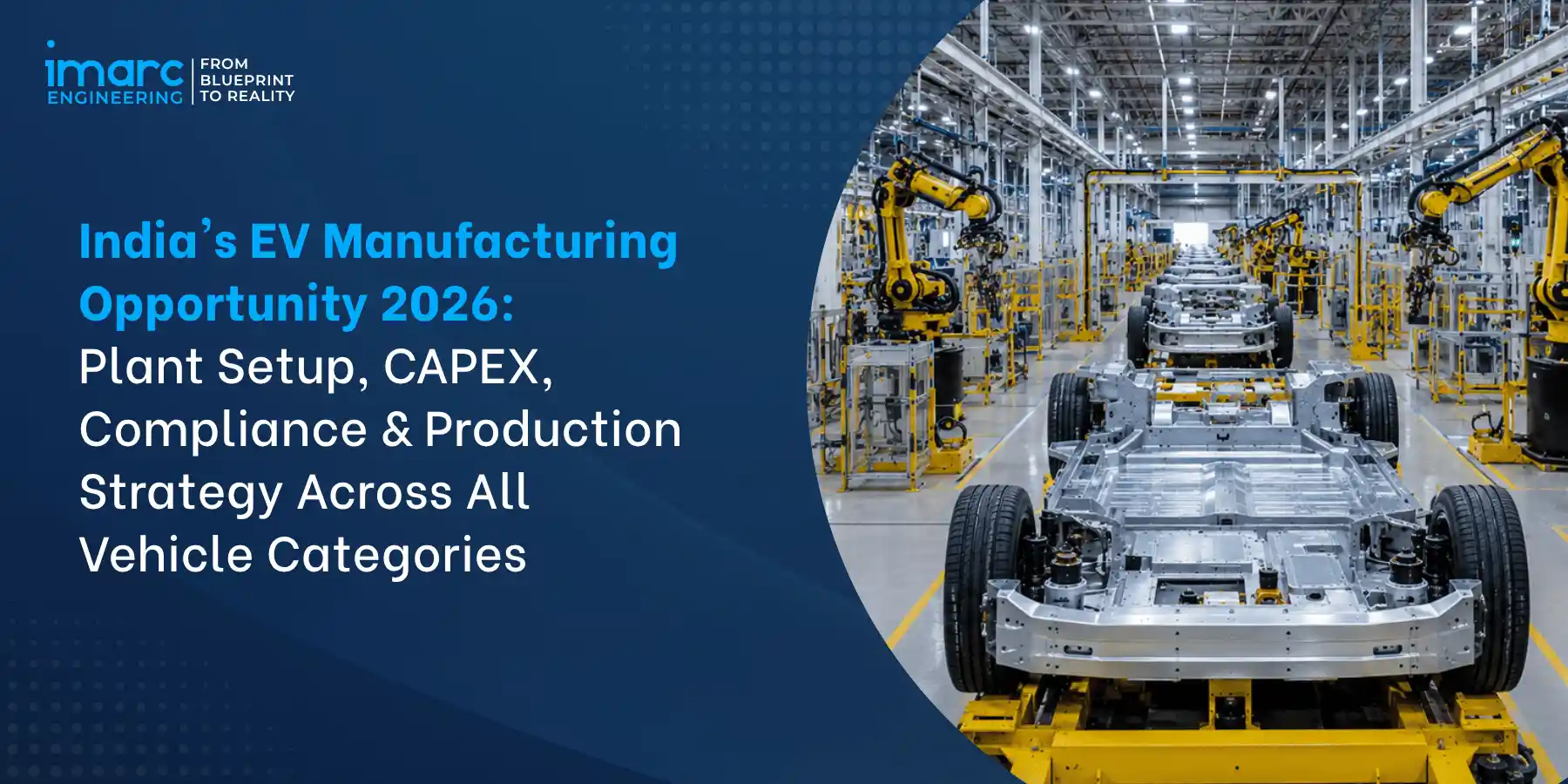
India's EV Manufacturing Opportunity 2026: Plant Setup, CAPEX, Compliance & Production Strategy Across All Vehicle Categories
Introduction
India's electric vehicle ecosystem has moved from policy ambition to industrial reality. What began as fragmented pilot programmes is now a structured, capex-backed manufacturing opportunity spanning two-wheelers, three-wheelers, passenger cars, commercial vehicles, buses, and specialty EV categories. EV manufacturing in India is increasingly being driven by rising demand, localization goals, and large-scale industrial investment.
This transformation has been enabled by a strong policy framework, including NEMMP 2020, FAME II (INR 10,000 crore), the PM E-DRIVE scheme (INR 10,900 crore), the Auto & Auto Components PLI scheme (INR 25,938 crore), and the ACC Battery Storage PLI scheme (INR 18,100 crore for 50 GWh capacity). Together, these initiatives have aligned EV demand incentives with domestic manufacturing expansion, making EV manufacturing in India structurally attractive across segments, despite varying capex and execution requirements.
NITI Aayog’s 2030 EV penetration targets, 30% for private cars, 40% for buses, 70% for commercial vehicles, and 80% for two- and three-wheelers, imply a massive manufacturing capacity build-out over the next five years. As a result, the focus for manufacturers has shifted from whether to invest in EV manufacturing in India to how to structure plant design, CAPEX, supply chains, and certification strategy.
Drawing on IMARC Engineering’s experience in electric vehicle plant setup projects in India, including feasibility studies, plant design, CAPEX modelling, vendor selection, and EPC project management, this guide outlines a structured framework for EV manufacturing plant setup across major vehicle segments.
Table of Contents
- Introduction
- The 2026 EV Manufacturing Moment in India
- EV Vehicle Segments- Profiles, Demand, and Major OEMs
- Plant Setup Essentials- Land, Location, Utilities, and Plant Size by Segment
- CAPEX, OPEX, and Financial Feasibility by Vehicle Category
- EV Manufacturing Process Flow- Assembly, Paint, Battery Integration, Testing
- Battery and Component Supply Chain- Cells, BMS, Motors, Power Electronics
- Policy and Regulatory Framework- FAME, PM E-DRIVE, PLI, State Policies, Certifications
- Technology, Automation, and Manpower
- Risks, Mitigation, and Future Outlook to 2030
- Conclusion
1. The 2026 EV Manufacturing Moment in India
The case for entering or expanding EV manufacturing in India in 2026 rests on four structural shifts that have collectively transformed the operating environment for electric vehicle manufacturers over the past three years.
1.1 Demand-Side Incentives Are Now Mature and Sustained
The progression from FAME I (2015) to FAME II (April 2019, INR 10,000 crore outlay, multiple extensions) to the interim EMPS scheme (April-July 2024) and now to the PM E-DRIVE scheme demonstrates policy continuity at the demand level. PM E-DRIVE supports electric two-wheelers, three-wheelers, ambulances, trucks, e-buses for state transport undertakings, charging infrastructure, and the testing infrastructure ecosystem, covering the full range of segments most relevant to industrial manufacturers.
1.2 Supply-Side PLI Capital Is Flowing
The PLI Scheme for Automobile and Auto Components (INR 25,938 crore approved by the Union Cabinet in September 2021) targets advanced automotive technology products including electric vehicles, fuel-cell vehicles, and EV components. The PLI ACC Battery Storage scheme (INR 18,100 crore, targeting 50 GWh of lithium-ion cell manufacturing in India capacity) directly addresses the cell-import dependency that has historically constrained Indian EV battery plant economics. Together these two schemes are unlocking material domestic investment across the EV value chain through the second half of the decade.
1.3 Stated 2030 Penetration Ambitions Imply a Capacity Build-Out
NITI Aayog's stated EV penetration ambitions for 2030, broadly 30% for private cars, 40% for buses, 70% for commercial vehicles, and 80% for two- and three-wheelers, set the implicit scale of the manufacturing build-out. Even partial achievement of these targets implies a multi-million-vehicle annual capacity addition across segments by the end of the decade. The corresponding battery, motor, power-electronics, and charging-infrastructure capacity additions are correspondingly large.
1.4 State EV Policies Add a Second Incentive Layer
Most major industrial states have notified dedicated EV policies, Delhi (2020), Maharashtra (2021), Tamil Nadu (2023), Karnataka (2017), and others. These policies typically include manufacturer-side incentives (capital subsidy on plant investment, electricity duty waiver, stamp duty exemption, interest subvention) on top of the central PLI and PM E-DRIVE schemes, making the effective subsidy stack at the right location materially competitive with comparable manufacturing geographies.
2. EV Vehicle Segments- Profiles, Demand, and Major OEMs
The Indian EV market is structurally segmented in ways that have direct implications for plant design, CAPEX, and operating model. The summary below profiles the seven principal categories- electric two-wheeler manufacturing in India, electric three-wheeler manufacturing in India, electric passenger cars, electric LCVs and HCVs, electric bus manufacturing in India, and specialty electric vehicles, and the strategic considerations that differentiate them.
| Segment | Typical Powertrain | Major OEMs (Indicative) | Strategic Profile |
|---|---|---|---|
| E2W (Electric Two-Wheelers) | BLDC/PMSM motor, 2-4 kWh battery | Ola Electric, Ather Energy, TVS Motor, Bajaj Auto, Hero MotoCorp (Vida), Ampere | Highest-volume segment; lowest CAPEX per unit; fastest scale-up |
| E3W (Electric Three-Wheelers) | BLDC motor, 5-12 kWh battery | Mahindra Last Mile Mobility, Bajaj Auto, Piaggio, Atul Auto, TVS, YC Electric | Strong commercial demand; lower CAPEX; cargo and passenger variants |
| E-Cars (Passenger) | PMSM motor, 25-90 kWh battery | Tata Motors, Mahindra, MG Motor (JSW MG), Hyundai, Kia, Mercedes-Benz, BMW | Highest CAPEX per unit; full paint shop; brand and dealer ecosystem critical |
| E-LCV (Light Commercial) | PMSM motor, 25-60 kWh battery | Tata Motors (Ace EV), Mahindra, Switch Mobility, Eicher | Fleet-led demand; logistics and last-mile operators; lower marketing burden |
| E-HCV (Heavy Commercial) | Multiple motors, 200-500+ kWh battery | Tata Motors, Ashok Leyland (Switch), Volvo Eicher, BharatBenz | Highest battery capex per unit; emerging segment; long sales cycles |
| E-Buses | Multiple motors, 200-400 kWh battery | Tata Motors, Switch Mobility, Olectra Greentech, JBM Auto, PMI Electro, Pinnacle | Tender-driven demand (STUs); strong PM E-DRIVE support; integrated body building |
| Specialty EVs | Varies- BLDC/PMSM, 3-30 kWh battery | Multiple regional and category-specific manufacturers | Forklifts, golf carts, last-mile delivery vehicles, ag-EVs, off-road; niche but rising |
2.1 E2W and E3W- The Volume Anchor
The two-wheeler and three-wheeler segments together account for the bulk of EV registrations in India. The structural logic is straightforward, the unit economics of electrification work earliest and most powerfully where the total cost of ownership against the ICE alternative is most favourable, and that is in high-utilisation, urban-use commuter and last-mile categories. For new manufacturing entrants, E2W and E3W plants offer the fastest path to operational scale, the lowest CAPEX per unit of installed capacity, and the broadest base of demand-side incentives under PM E-DRIVE.
2.2 E-Cars- The Brand and Capital Game
The electric passenger car segment requires the deepest CAPEX commitment, the most sophisticated paint shop and body shop integration, the longest certification cycle, and the most developed dealer and service network. The Indian e-car field is led by domestic incumbents (Tata Motors, Mahindra) alongside global players (Hyundai, Kia, Mercedes-Benz, BMW, MG Motor, now operating as JSW MG). New entrants in the e-car category are typically global or joint-venture parents with multi-thousand-crore commitment horizons.
2.3 E-LCV and E-HCV- Fleet-Led Demand
Electric light and heavy commercial vehicles serve fleet customers, e-commerce logistics, intra-city delivery, state and municipal operators, and increasingly long-haul logistics on dedicated freight corridors. The commercial case rests on total cost of ownership against diesel ICE benchmarks under high utilisation. E-LCV is a faster-maturing sub-segment; E-HCV is earlier in the adoption curve and currently concentrated in defined freight corridors and city-pair operations.
2.4 E-Buses- Tender-Driven and PM E-DRIVE-Supported
Electric bus demand in India is structurally tender-led, state transport undertakings (STUs) and city operators procure under PM E-DRIVE and earlier FAME II contracts. The manufacturing profile combines automotive chassis and electrification with integrated body building (or coordination with body builders). PM E-DRIVE has earmarked specific outlays for procurement of e-buses by STUs, providing direct demand visibility to manufacturers.
3. Plant Setup Essentials- Land, Location, Utilities, and Plant Size by Segment
The physical setup parameters for an EV manufacturing plant, land requirement, location choice, utility profile, and plant size, vary materially by segment. The table below provides typical industry ranges as a planning starting point; precise sizing depends on production volume, vertical integration depth (in-house pack assembly versus bought-in packs), and automation level. EV plant land requirement in India considerations should always be tested against the specific product and volume profile.
| Segment | Typical Land (acres) | Indicative Annual Capacity | Critical Utility Profile |
|---|---|---|---|
| E2W | 10-30 | 100,000-500,000+ units | Moderate power demand; compressed air; light paint shop |
| E3W | 15-40 | 30,000-150,000 units | Moderate power; cargo body integration space |
| E-Car | 100-300+ | 50,000-300,000 units | High power; full paint shop with ED/topcoat; large utility yard |
| E-LCV | 50-150 | 20,000-80,000 units | Moderate-to-high power; chassis assembly footprint |
| E-HCV | 100-300+ | 5,000-30,000 units | High power; heavy chassis line; battery pack assembly area |
| E-Bus | 50-200 | 1,000-10,000 units | High power; integrated body building; long bay structure |
3.1 Location Strategy
The dominant EV plant location strategy considerations are state EV policy benefits (capital subsidy, electricity duty waiver, stamp duty exemption), proximity to component clusters, logistics access (ports for components and exports; highway access for domestic dispatch), workforce availability (skilled automotive labour pools in Pune-Chakan, Sanand, Chennai-Sriperumbudur, Hosur, Pithampur, Manesar-Bawal), and proximity to battery cell or pack-assembly capacity. The right location optimises across all five, not just one.
3.2 Infrastructure and Utilities
EV plant utility profiles differ from ICE-equivalent plants in three respects. Power demand is higher per assembled unit, particularly when in-house battery pack assembly and motor testing are included, with significant connected-load requirements that drive sub-station and switchyard sizing. Water demand is lower for pure EV plants (no engine block testing or coolant systems on the same scale) but remains material for paint shop and cooling tower applications. Compressed air and dry compressed air systems are critical, particularly for battery cell and pack handling environments where controlled humidity is required.
3.3 Plant Sizing- A Starting Point, Not a Conclusion
Plant size is a function of target annual capacity, vertical integration depth (whether the operator assembles its own battery packs and motors versus sourcing them), automation level, and shift pattern. A common error in early-stage feasibility work is to fix plant size before settling segment, capacity, and vertical integration. A structured feasibility study sequences these choices in the right order.
4. CAPEX, OPEX, and Financial Feasibility by Vehicle Category
Understanding electric vehicle manufacturing CAPEX India and operating economics by segment is central to investment decisions. The framework below sets out the cost structure and the principal variables that drive total project economics; precise figures vary materially by capacity, automation level, vertical integration, and incentive stack.
4.1 CAPEX Buckets
An EV plant CAPEX template typically tracks six buckets. First, land and site development. Second, civil and structural construction, assembly bay, paint shop (for cars/LCVs/HCVs/buses), battery pack assembly area, utilities. Third, plant and machinery, assembly lines, conveyors, robotic stations, paint shop equipment, battery pack assembly equipment, motor testing rigs, end-of-line testing.
Fourth, instrumentation, controls, and IT, PLCs, MES, ERP integration, traceability systems. Fifth, working capital, inventory of cells, BMS, motors, controllers, and finished goods through the cash-conversion cycle. Sixth, project development and pre-operative, design fees, regulatory approvals, certification, project management, commissioning.
4.2 CAPEX Profile by Segment (Indicative Ranges)
| Segment | Indicative Total CAPEX Range | Largest CAPEX Bucket | Notes |
|---|---|---|---|
| E2W | Lower end of the EV CAPEX spectrum | Plant and machinery | Modest paint shop; battery pack assembly often in-house |
| E3W | Lower end of the spectrum | Plant and machinery + chassis line | Cargo and passenger body variations |
| E-Car | Highest in the EV spectrum | Paint shop + body shop + battery line | Full ED, primer, basecoat, clearcoat paint shop |
| E-LCV | Mid spectrum | Plant and machinery + chassis | Lower paint complexity vs e-cars |
| E-HCV | Mid-to-high spectrum | Battery pack assembly + chassis | Very large pack assembly area |
| E-Bus | Mid spectrum (per unit higher) | Body building + battery integration | Tender-driven volume; long bay structure |
Ranges above are indicative for greenfield EV plants in India. Brownfield expansion at an existing ICE-vehicle facility, or capacity addition at an existing EV plant, materially compresses CAPEX through utility, workforce, and approval leverage.
4.3 OPEX Structure
Operating cost on an EV plant is dominated by bill of materials, cells and battery packs (typically the single largest OPEX line), motor and power-electronics components, body and chassis materials, and consumables. Direct labour is a smaller proportion than in ICE-equivalent operations because of higher automation and lower mechanical complexity. Energy and utilities are material but optimisable through plant design choices. Maintenance and tooling are dependent on the automation profile and the cycle life of robotic and conveyor assets.
4.4 Financial Feasibility and Payback
Payback periods on electric vehicle plant ROI in India analyses vary materially by segment, scale, financing structure, and the realised stack of central and state incentives. As a generalisation, lower-CAPEX, higher-volume segments (E2W, E3W) reach operational break-even faster than higher-CAPEX, lower-volume segments (E-Car, E-Bus), but absolute economic value generated also varies in the opposite direction. The right feasibility study models multiple scenarios, base case, upside (full incentive realisation, faster ramp-up), downside (delayed certification, slower demand ramp), and stress-tests segment selection against each.
5. EV Manufacturing Process Flow- Assembly, Paint, Battery Integration, Testing
The electric vehicle assembly plant in India process flow shares broad outlines with conventional automotive manufacturing but differs in three critical areas: the absence of the engine assembly and engine test line, the addition of high-voltage battery pack assembly and integration, and the more stringent electrical and thermal testing protocols at end-of-line. Process flow also varies by segment in important ways.
5.1 Common Process Backbone
Most EV assembly plants share a common backbone: incoming material inspection and warehousing; sub-assembly of chassis, body, and major modules (for cars, LCVs, HCVs, and buses) or frame and structural components (for two-wheelers and three-wheelers); paint shop (where applicable to the segment); main assembly line where battery pack, motor, power electronics, wiring harness, and finishing are installed; end-of-line testing including high-voltage safety testing, charging-circuit verification, range/performance validation, and quality audits; and dispatch.
5.2 Segment-Specific Variations
E2W and E3W plants use shorter assembly lines, often without a full automotive paint shop (frame and panel painting is typically batch or smaller-scale). E-Car plants require a complete automotive paint shop, pre-treatment, electrodeposition, primer, basecoat, clearcoat, with associated curing and quality stations, and a body shop for body-in-white welding (in-house or sub-assembled). E-LCV and E-HCV plants integrate heavy chassis assembly with battery pack mounting and high-voltage routing. E-Bus plants integrate chassis fabrication, body building (in-house or coordinated), and battery pack integration in long-bay layouts.
5.3 Battery Pack Assembly and Integration
The single most distinctive process area in any EV plant is EV battery pack assembly in India, cell sorting and matching, module assembly, pack assembly with BMS integration, thermal management integration, and end-of-line testing. This area requires controlled humidity, dust and particulate control, electrostatic discharge management, and high-voltage safety protocols. The decision on whether to assemble packs in-house, source from a partner, or operate a joint-venture pack facility is one of the highest-leverage strategic decisions in the plant design phase.
5.4 End-of-Line Testing and Certification
EV end-of-line testing covers electrical insulation, dielectric strength, charging-circuit verification, battery state-of-charge calibration, motor performance, range and energy-consumption certification testing, and safety verification. Vehicles must be certified against the applicable Automotive Industry Standards (notably AIS-038 for general EV requirements, AIS-039 for range and energy consumption measurement, AIS-156 for safety requirements including battery safety as amended after fire-incident reviews) before commercial dispatch.
6. Battery and Component Supply Chain- Cells, BMS, Motors, Power Electronics
The competitive economics of any EV plant in India is shaped first and foremost by its battery and component supply chain. Cell sourcing, pack-assembly integration, BMS and electronics localisation, and motor procurement collectively determine the bill of materials, the working-capital cycle, and the resilience of the operation to global supply disruptions.
6.1 Cell Sourcing- The Largest Variable
Indian EV manufacturers have historically sourced lithium-ion cells primarily from established Asian producers (China, South Korea, Japan), with some volumes from European suppliers. The PLI ACC Battery Storage scheme (INR 18,100 crore outlay targeting 50 GWh of cell manufacturing capacity) is designed specifically to localise this dependency over the second half of the decade. Lithium-ion cell manufacturing in India capacity is being built by domestic players (Ola Electric, Reliance, Exide, Amara Raja, and others) under the scheme. For new EV manufacturers, the cell-sourcing decision, long-term offtake contract with a domestic ACC PLI awardee, multi-source import portfolio, or eventual captive cell capacity, is one of the foundational supply-chain choices.
6.2 Battery Pack Assembly- In-House Versus Bought-In
Pack assembly is the natural entry point for vertical integration. In-house pack assembly captures the value-add and quality-control benefits of integrating cells, BMS, thermal management, and structural housing under the manufacturer's own roof; bought-in packs simplify the operating model but cede margin to the pack supplier. Most volume EV manufacturers in India have moved toward in-house pack assembly while sourcing cells; smaller and emerging manufacturers often start with bought-in packs and migrate to in-house assembly as volumes scale.
6.3 BMS, Motors, and Power Electronics
Battery management systems (BMS), the firmware-and-hardware combination that monitors cell health, manages charge/discharge, balances cell voltages, and triggers safety responses, is a mix of domestic design and imported semiconductors. Motors (PMSM, BLDC, and induction motors depending on segment and application) and power electronics (motor controllers, DC-DC converters, on-board chargers) are increasingly produced in India by Tier-1 component suppliers under the broader PLI Auto and Auto Components scheme, with semiconductor content still largely imported. Localisation has progressed materially but is uneven across components.
6.4 Localisation Status
As a general profile, body and chassis components, frame and panel parts, low-voltage wiring harnesses, motor bodies, and many sub-assemblies are largely localised in India. Cells, advanced semiconductors, and certain specialised power electronics components remain partially or substantially imported. The localisation trajectory is structural and policy-supported, but the practical bill of materials for any specific plant will include a measured proportion of imported content for several years.
7. Policy and Regulatory Framework- FAME, PM E-DRIVE, PLI, State Policies, Certifications
Navigating the policy and regulatory framework is non-negotiable for any Indian EV manufacturer. The framework has multiple layers, demand-side schemes that incentivise consumers and fleet operators, supply-side schemes that incentivise manufacturers, state policies that add a second tier of incentives, and the certification regime that governs market access. Each layer needs to be addressed explicitly in the feasibility and plant-design phase.
7.1 Demand-Side Schemes- FAME II and PM E-DRIVE
FAME II (Faster Adoption and Manufacturing of Electric Vehicles, Phase II) was notified in April 2019 with a total outlay of INR 10,000 crore and was extended through March 2024. The interim Electric Mobility Promotion Scheme (EMPS) operated for the April-July 2024 transition window.
PM E-DRIVE scheme benefits for manufacturers, the PM Electric Drive Revolution in Innovative Vehicle Enhancement scheme, notified in September 2024 with a INR 10,900 crore outlay over two financial years, now provides demand-side incentives across electric two-wheelers, three-wheelers, ambulances, trucks, e-buses for state transport undertakings, and supports charging infrastructure and testing infrastructure development. Manufacturers serving the supported categories must register their models with the scheme and meet the eligibility conditions to access the incentive flow at the point of sale.
7.2 Supply-Side Schemes- PLI Auto and PLI ACC
The PLI scheme for EV manufacturing operates through two complementary schemes. The PLI Scheme for the Automobile and Auto Components Industry (outlay INR 25,938 crore over five years) supports advanced automotive technology vehicles and components, including electric vehicles, fuel-cell vehicles, and high-value EV components, with selected approved applicants eligible for incentive payments on incremental sales.
The PLI ACC Battery Storage scheme (outlay INR 18,100 crore targeting 50 GWh of advanced chemistry cell manufacturing) is the supply-side anchor for domestic EV battery manufacturing investment in India. Together these two schemes are the primary central-government supply-side levers for EV manufacturing.
7.3 State EV Policies
Most major industrial states have notified dedicated EV policies- Delhi (2020), Maharashtra (2021), Tamil Nadu (2023), Karnataka (2017), Gujarat (2021), Telangana (2020), Andhra Pradesh (2018), Madhya Pradesh (2019), Uttar Pradesh (2022), Rajasthan (2022), among others. State subsidies for EV manufacturing in India typically include capital subsidy on plant investment, electricity duty waiver or rebate, stamp duty exemption on land transactions, interest subvention on term loans, and reimbursement of state GST on EV sales within the state. Location decisions should systematically compare the effective stack of central and state benefits across candidate states.
7.4 Certification Regime- ARAI, ICAT, BIS, and AIS Standards
EV manufacturers must navigate vehicle type approval under the Central Motor Vehicles Rules (CMVR), administered through testing agencies notified by the Government of India, primarily the Automotive Research Association of India (ARAI), the International Centre for Automotive Technology (ICAT), and others.
ARAI certification process for EV manufacturers covers compliance against the relevant Automotive Industry Standards (AIS) series, including AIS-038 (electric power-train vehicles - general construction and functional safety requirements, with Rev 2 updates), AIS-039 (electric vehicle range and energy consumption measurement), and AIS-156 (electric power-train vehicles - safety requirements, particularly the battery safety provisions amended after fire-incident reviews).
BIS certification for electric vehicles applies separately for batteries and related components under the IS standards series. The certification timeline is non-trivial and must be sequenced into the plant commissioning plan from the design stage.
8. Technology, Automation, and Manpower
EV manufacturing in India in 2026 is being built with materially higher automation, deeper digital integration, and a different skill profile than the ICE-vehicle plants that preceded it. The technology and workforce architecture is an integral part of the plant design.
8.1 Industry 4.0 and the Smart Factory Stack
New EV plants in India are typically designed with the five-layer smart factory stack from the outset: sensors and field instrumentation across major equipment and utilities; control and edge systems (PLCs, SCADA, edge gateways); a manufacturing execution system (MES) handling production scheduling, OEE, quality, and traceability; enterprise integration with ERP, supply-chain, and planning systems; and advanced analytics, digital-twin, and predictive-maintenance platforms. The greenfield advantage in EV plant design is that all five layers can be engineered together rather than retrofitted in stages.
8.2 Robotics and Automation
Robotic automation is heavily used in EV plants for body welding (where applicable), paint application, battery pack assembly, sealing and dispensing operations, screw-driving and torque-controlled fastening, and material handling. The automation intensity is typically higher than in equivalent-volume ICE plants, both because EV processes lend themselves more naturally to automation (high-voltage battery handling, for instance, benefits from automated rather than manual handling for safety reasons) and because the labour-cost differential against automation has narrowed.
8.3 Sustainability and Energy
New EV plants in India are routinely designed with substantial captive renewable electricity (rooftop and ground-mount solar), renewable PPAs, water recycling and zero-liquid-discharge systems, energy-efficient utility design, and waste-heat recovery from process and utility systems. Sustainability design is no longer a niche choice, it is a default expectation from customers, financial institutions, and global parent companies.
8.4 Manpower and Skill Requirements
EV plant manpower profiles differ from ICE plants in three respects. The proportion of high-voltage and battery technicians, power-electronics and BMS specialists, and software/firmware engineers is materially higher. Conventional engine and powertrain assembly roles are absent. End-of-line testing and quality engineering roles are more technically demanding given the safety implications of EV systems. Training infrastructure, captive academies, partnerships with NSDC and ITI ecosystems, and OEM-led skilling programmes is increasingly part of the plant setup investment.
9. Risks, Mitigation, and Future Outlook to 2030
Investing in EV manufacturing in India in 2026 carries a defined and addressable set of risks. The framework below summarises the principal categories, the typical mitigations applied by established operators, and the structural outlook to 2030.
9.1 Supply-Chain Risk- Particularly Cells and Semiconductors
Lithium-ion cell supply is currently concentrated in a handful of global suppliers; advanced semiconductors for BMS and power electronics likewise. Mitigations include long-term offtake contracts with PLI ACC awardees, multi-source supplier portfolios, strategic inventory buffers at critical points, and progressive vertical integration into pack assembly and (for larger operators) cell manufacturing.
9.2 Policy Risk
Demand-side incentive schemes are time-bound and may not be extended in their current form. Mitigations include sizing the business case to break even without sustained subsidy support, locking PM E-DRIVE-eligible model registrations early in the scheme window, and designing the product cost structure for post-subsidy parity with ICE alternatives.
9.3 Technology Obsolescence Risk
Battery chemistry evolution (LFP currently dominant in mid-tier vehicles; LMFP, sodium-ion, and solid-state batteries on horizons of varying timelines), motor and power-electronics evolution, and software-defined vehicle architectures all imply that today's optimal design will not be tomorrow's. Mitigations include modular and upgradeable plant design, supplier agreements with technology-roadmap visibility, and explicit budget for mid-life plant upgrades.
9.4 Charging Infrastructure and Demand Realisation
Customer adoption depends not only on vehicle price but on the maturity of charging infrastructure. Mitigations include manufacturer participation in charging-network partnerships, alignment with battery-swapping ecosystems for relevant segments (notably E2W and E3W), and product design choices that minimise range-anxiety friction (faster charging, higher energy density, robust thermal management).
9.5 Future Outlook to 2030
The structural outlook to 2030 is one of substantial capacity addition across segments. Stated NITI Aayog penetration ambitions imply multi-million-unit annual production targets across two-wheelers, three-wheelers, cars, commercial vehicles, and buses. Capacity gap analysis suggests material under-build relative to these stated ambitions in most segments today, particularly in domestic cell manufacturing, advanced power electronics, and high-volume e-bus production.
Export potential to South Asian, African, and South-East Asian markets is emerging as an additional volume driver for Indian E2W, E3W, and E-Bus manufacturers in particular. Emerging sub-segments like electric trucks, agricultural EVs, off-road EVs, and integrated battery-swapping infrastructure, represent the next layer of opportunity.
Conclusion
India's EV manufacturing opportunity in 2026 is structural, capex-backed, and segment-diverse. The convergence of mature demand-side policy (PM E-DRIVE), substantial supply-side capital (PLI Auto INR 25,938 crore, PLI ACC INR 18,100 crore), state-level incentive layers, a stated 2030 penetration ambition that implies multi-million-unit capacity addition, and a maturing certification and standards regime under ARAI, ICAT, and the AIS series has created an operating environment in which EV manufacturing in India is no longer a speculative bet, it is a structured industrial investment category.
The strategic questions for new entrants and incumbents are no longer about whether to invest, but about which segment, at what scale, with what supply-chain architecture, and under which combination of central and state incentives.
Three closing reminders. First, treat segment selection, CAPEX envelope, supply-chain architecture, and incentive optimisation as a single integrated decision rather than four sequential ones. The interdependencies between these variables materially affect project IRR. Second, the certification timeline under ARAI, ICAT, and the AIS standards series is non-trivial and should be sequenced into the plant programme from the design stage, not approached as a post-construction activity.
Third, scale economics in EV manufacturing reward investors who design for the next decade, not the current quarter, vertical integration on pack assembly, captive renewable power, smart factory architecture, and workforce skilling all pay back across the second half of the decade.
Whether you are an automotive incumbent planning EV capacity addition, a global EV manufacturer entering the Indian market, a battery or component manufacturer scaling under the PLI framework, or a strategic investor evaluating EV manufacturing as an industrial entry, IMARC Engineering provides end-to-end feasibility, plant design, and EPC execution support across all EV segments.
STILL HAVE ANY DOUBTS?
IMARC Engineering's industrial and EV specialists are ready to help. Whether you are an OEM planning a greenfield EV plant, a component manufacturer expanding into electric drivetrains, a fleet operator building charging infrastructure, or an investor evaluating India's EV manufacturing landscape, our team can support you with end-to-end feasibility, engineering, and project execution advisory.
Frequently Asked Questions
Segment selection should be a structured decision based on five inputs: target market and customer profile; available capital and risk appetite; technology and capability fit (existing automotive experience, battery and electronics expertise); incentive realisation (PM E-DRIVE coverage, PLI eligibility, state-policy alignment); and time-to-revenue tolerance. E2W and E3W offer the fastest scale-up at the lowest CAPEX; E-Car requires the deepest commitment; E-Bus is tender-led with strong PM E-DRIVE support; E-LCV and E-HCV serve fleet customers with TCO-driven adoption. A feasibility study that models all five segments against a defined entry strategy is the most reliable basis for the decision.
The question of how to set up EV manufacturing plant in India has answers that vary by segment and scale. Indicative timelines: feasibility and planning (3-6 months), detailed engineering and approvals (6-9 months in parallel), construction and equipment installation (9-18 months depending on segment and complexity), commissioning and certification (3-6 months), commercial launch. Total greenfield timelines typically range from approximately 2 years for a tightly-scoped E2W/E3W plant to 3-4 years for a full-scale E-Car or E-Bus facility. Brownfield conversion of an existing ICE plant compresses this materially.
Total cost to set up electric vehicle factory in India ranges materially by segment, capacity, vertical integration depth, and automation level. E2W and E3W plants sit at the lower end of the EV CAPEX spectrum; E-Car and E-HCV plants at the higher end; E-Bus, E-LCV, and specialty EV plants in between. The right basis for any specific decision is a segment-and-capacity-specific CAPEX model that explicitly accounts for the planned incentive stack, central PLI, PM E-DRIVE eligibility, and state-policy benefits.
Bill of materials, particularly battery cells and packs, typically dominates OPEX in any EV plant, with motor and power-electronics components as the second-largest line. Direct labour is a smaller share than in comparable ICE operations because of higher automation. Energy, maintenance, logistics, and certification testing complete the OPEX picture. The right OPEX strategy is built around cell-sourcing cost optimisation, vertical-integration choice on packs and key components, and progressive localisation.
Vehicle type approval under the Central Motor Vehicles Rules (CMVR) is mandatory and is administered through ARAI, ICAT, and other notified testing agencies. The vehicle must demonstrate compliance against the applicable Automotive Industry Standards (AIS) series, AIS-038 for general EV requirements, AIS-039 for range and energy consumption, AIS-156 for safety including battery safety, among others. BIS certification under the relevant IS standards applies to batteries and certain components. PM E-DRIVE eligibility requires model registration with the scheme. State-level certifications and No-Objection Certificates apply for plant operation.
PM E-DRIVE, notified in September 2024 with a INR 10,900 crore outlay over two financial years, continues the demand-side incentive logic of FAME II but with a refined scope. PM E-DRIVE covers electric two-wheelers, three-wheelers, ambulances, trucks, e-buses for state transport undertakings, charging infrastructure, and testing infrastructure. The scheme operates with model-by-model registration and incentive flow at the point of sale or procurement, subject to eligibility and localisation conditions.
IMARC Engineering provides end-to-end advisory and execution for EV plant setup across all major segments, feasibility study and segment-fit analysis, location and incentive optimisation, plant design and layout, CAPEX and OPEX modelling, supply-chain architecture (cell sourcing, pack assembly, BMS, motors, power electronics), detailed engineering, EPC project management, vendor selection, certification support (ARAI, ICAT, BIS, AIS standards), commissioning, and post-implementation operational support.
Our team combines deep automotive engineering expertise with battery and power-electronics specialism, policy and incentive optimisation capability, and EPC execution depth under a single project lead.
IMARC Engineering supports plant setup and operational advisory across electric two-wheelers, electric three-wheelers, electric passenger cars, electric LCVs and HCVs, electric buses, and specialty EVs (forklifts, last-mile delivery vehicles, off-road EVs, and others). We also support battery pack assembly facilities, lithium-ion cell manufacturing plants under the PLI ACC framework, and EV component plants (motors, power electronics, BMS). Sector-specific case credentials and segment-level benchmarking data can be shared during project scoping.
Recent Post
Trusted by Industry Leaders
We partner with global enterprises and ambitious businesses across sectors to deliver operational excellence, strategic insights, and sustainable growth through integrated solutions.












Success in Their Words
Real feedback from clients across industries. Discover how our solutions delivered measurable impact and operational excellence.

I wanted to express my sincere appreciation for your efforts in handling this matter. Your dedication and commitment have been truly commendable, and it is evident that you have put in tremendous hard work and expertise into resolving the issues at hand. We are greatly interested in continuing our collaboration with you in the future, as your professionalism and reliability have made you a trusted partner. Thank you once again for your invaluable contribution. We look forward to strengthening our partnership ahead.

It has been a pleasure working with the IMARC team. The insights provided were structured, clear, and highly valuable, helping us strengthen both our technical and financial planning with confidence. We deeply appreciate the team’s professionalism, responsiveness, and attention to detail throughout the engagement. Every requirement was well understood and effectively incorporated, resulting in a comprehensive and actionable output. Overall, our experience has been excellent, and I would gladly recommend IMARC to organizations seeking a reliable research partner.

Your service is truly exceptional. Working with the IMARC team has been a seamless and professional experience. The clarity of communication, responsiveness to queries, and consistent support at every stage made the entire engagement highly efficient. The insights shared were well-structured, practical, and perfectly aligned with our requirements, helping us make informed decisions with confidence. Overall, the dedication and professionalism demonstrated by your team stand out, and I would be glad to recommend IMARC as a reliable and trustworthy research partner.

IMARC did an outstanding job in preparing our study. They were punctual, precise, and consistently responsive throughout the entire process. The team delivered all the data we required in a clear, well-organized, and highly professional format. Their strong attention to detail, combined with their ability to meet every deadline without compromising quality, truly set them apart. Overall, their reliability and commitment made them an exceptional partner for our project, and we would gladly work with them again in the future.

IMARC made the whole process incredibly easy from start to finish. Everyone I interacted with via email was polite, professional, and straightforward to deal with, always keeping their promises regarding delivery timelines and remaining consistently solutions-focused. From my very first contact, I appreciated the professionalism and support shown by the entire IMARC team. I highly recommend IMARC to anyone seeking timely, affordable, and reliable information or advice. My experience with IMARC was excellent, and I truly cannot fault any aspect of it.

I’d like to express my sincere gratitude for the excellent work you accomplished with the study. Your ability to quickly understand our requirements and deliver high-quality results under tight timelines truly reflects your expertise, exceptional work ethic, and unwavering commitment to your customer’s success. The professionalism and responsiveness you demonstrated throughout the process made a significant difference. Our entire team and company are incredibly thankful for your dedication, reliability, and support. Once again, thank you for your outstanding contribution.