Manufacturing
May 13 2026
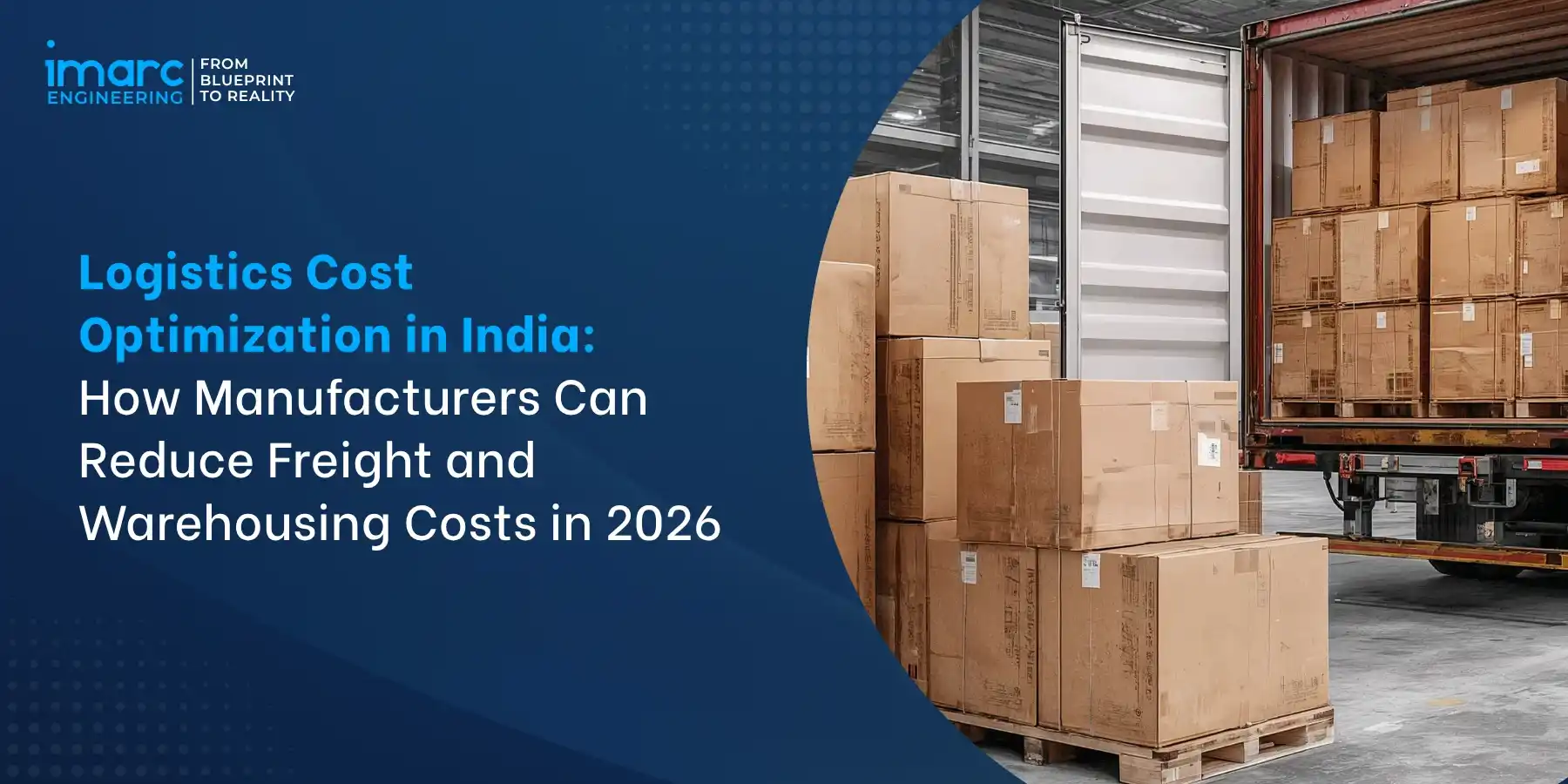
Logistics Cost Optimization in India: How Manufacturers Can Reduce Freight and Warehousing Costs in 2026
Introduction
Logistics is one of the largest controllable cost categories on an Indian manufacturer's P&L, and one of the most neglected. According to the National Council of Applied Economic Research (NCAER) study released by DPIIT, India's total logistics cost in 2023-24 was approximately INR 24.01 lakh crore, equivalent to 7.97% of GDP. The Government of India's stated objective under the National Logistics Policy (2022) is to bring this down further toward 8% of GDP by 2030, aligning with developed-economy benchmarks.
For an individual manufacturer, the same range typically translates into a logistics cost percentage of revenue India of anywhere between 5% and 15%, depending on sector, product weight, distance to market, and channel mix. Disciplined logistics cost optimization India can realistically deliver 10-25% reduction in this number over a 12–24 month engagement, directly improving operating margin, working capital, and cash conversion.
The 2026 context makes the opportunity sharper than at any point in the last decade. The Dedicated Freight Corridors have lifted rail freight speeds to ~60 km/h versus ~25 km/h on legacy lines, and the DFC network is now handling 400+ trains per day with new records of 892 interchange trains on a single day.
PM Gati Shakti has integrated planning across 44 ministries and accelerated infrastructure approvals. GST has structurally changed where manufacturers should warehouse their inventory, most have not yet fully re-optimised their networks. And rising diesel costs, driver shortages, and shifting customer expectations on lead times are pushing freight economics in new directions. The companies that act on these shifts deliberately, with a structured supply chain optimization India manufacturing methodology, are pulling material cost and service-level advantage away from peers that treat logistics as overhead.
Drawing on IMARC Engineering's experience supporting logistics cost diagnostics, network design, freight benchmarking, and 3PL evaluations for manufacturers across FMCG, pharmaceuticals, chemicals, food, electronics, and engineering goods, this guide lays out a structured, step-by-step approach to reduce logistics cost manufacturing India operations face today. You will find a six-stage cost-optimisation framework, freight and warehouse cost-reduction tactics, a 3PL-vs-in-house decision framework, a view on the policy environment, sector-specific recommendations for FMCG and SME manufacturers, a benchmarking primer, common-mistake warnings, and a frequently-asked-questions section addressing the operational realities Indian manufacturers are navigating in 2026.
Table of Contents
- Introduction
- Why Logistics Cost Optimization Is a Strategic Lever in 2026
- The Six-Stage Logistics Cost Optimization Framework
- Reducing Freight Costs - Multimodal, Route, and Carrier Strategies
- Warehousing Cost Reduction and Network Optimization
- 3PL vs In-House Logistics - The Decision Framework
- PM Gati Shakti and the National Logistics Policy
- Sector-Specific Strategies - FMCG and SME Manufacturers
- Logistics Cost Benchmarking and KPIs
- Common Mistakes and How to Avoid Them
- Conclusion
1. Why Logistics Cost Optimization is a Strategic Lever in 2026
For Indian manufacturers, logistics is a more material cost line than most boardrooms recognise. Logistics cost reduction for manufacturers typically delivers larger and faster bottom-line impact than equivalent effort spent on raw-material negotiation or labour productivity, yet it gets less senior attention. Five structural shifts make 2026 a particularly high-leverage year to address it.
1.1 The Cost Base Is Larger Than It Looks
Most manufacturers track only outbound freight and warehouse rent. The fuller logistics cost stack, inbound freight, outbound freight, primary and secondary distribution, warehousing (rent + manpower + utilities + losses), inventory carrying cost, packaging, handling, and reverse logistics, typically totals 5-15% of revenue depending on sector. FMCG and consumer durables tend to sit at the higher end; high-value low-volume goods (electronics, pharma formulations) at the lower end. The question "how to reduce logistics cost in manufacturing company India" is therefore not a peripheral cost-control exercise, it is a margin-shaping one.
1.2 The Macro Environment Has Shifted
India's logistics cost as a share of GDP has been on a structural downtrend, from the often-cited 13-14% range estimated by industry bodies a decade ago, to 7.97% in 2023-24 per the DPIIT-commissioned NCAER framework. The drivers are concrete: National Logistics Policy (2022), PM Gati Shakti (2021), the Eastern and Western Dedicated Freight Corridors, Bharatmala, Sagarmala, and the digital backbone of the Logistics Data Bank. But the macro improvement only reaches individual manufacturers if they actively re-design their flows to use the new infrastructure. Many have not.
1.3 GST Removed the Tax Driver for Warehouse Sprawl
Before GST (pre-2017), manufacturers needed a warehouse in every state to avoid CST on inter-state transfers. Post-GST, the tax driver for state-level warehousing is gone, but most networks have not been redesigned. The opportunity for warehouse consolidation after GST India is real, typical engagements show that a national network of 20-30 small warehouses can be consolidated to 6-10 larger, mechanised regional hubs with 15-30% lower total warehousing cost, better service levels, and improved inventory accuracy.
1.4 Rail Freight Has Become Competitive Again
Rail's modal share in Indian freight has slipped from ~86% in 1951 to ~30% in 2022 , with the National Rail Plan targeting 45% by 2050. The Dedicated Freight Corridors are starting to make rail genuinely competitive on transit time. For manufacturers with long-haul flows (Delhi-Mumbai, Punjab-JNPT, NCR-Kolkata), rail or rail-road multimodal is now often cheaper and faster than all-road, a flip from where the economics stood five years ago.
1.5 Capital Discipline Is Tighter
Indian cost of capital remains structurally above developed-market benchmarks. Inventory tied up in finished goods, in-transit stock, and excess warehouse stock therefore has a higher financial carrying cost than the depreciation-and-rent view suggests. A 20-day reduction in finished-goods days of inventory at a mid-size manufacturer can free up working capital equivalent to several months of operating cash flow, making inventory-side levers far more valuable than they appear on the static P&L.
Talk to Our Logistics Optimization Experts
2. The Six-Stage Logistics Cost Optimization Framework
Disciplined logistics cost optimization India unfolds across six sequential stages. Treat them as gates, completing each before moving to the next consistently produces stronger outcomes than a parallel-track or "start everything at once" approach.
| Stage | Objective | Key Deliverable |
|---|---|---|
| 1. Cost diagnostic and baselining | Map full logistics cost stack, segment by lane / mode / SKU / customer | Total logistics cost as % of revenue, broken down by category and lane |
| 2. Network design and warehouse footprint | Re-optimise warehouse locations and number, post-GST and post-DFC | Recommended warehouse network with capacity, location, and role for each node |
| 3. Mode-mix and routing optimisation | Shift to multimodal where viable; optimise routes within each mode | Mode-shift roadmap, route plan, expected freight savings |
| 4. Freight rate audit and carrier consolidation | Benchmark current rates, re-tender, consolidate carriers | Renegotiated rate cards, carrier shortlist, freight audit report |
| 5. 3PL vs in-house decision and contracting | Decide own / 3PL / hybrid for each function and execute | 3PL contracts with KPIs, transition plan, governance framework |
| 6. Continuous tracking and KPI governance | Embed monthly KPI tracking, exception management, and quarterly reviews | KPI dashboard, monthly review forum, annual benchmarking refresh |
3. Reducing Freight Costs - Multimodal, Route, and Carrier Strategies
Freight typically accounts for at least half of total logistics cost for Indian manufacturers, so it is usually the largest single line to attack. The practical question of how to reduce freight cost India manufacturing operations face today comes down to four families of transportation cost reduction strategies: mode-shift, routing, carrier rate, and fuel/operating efficiency. The right answer for any specific manufacturer is usually a combination, sequenced over 6-18 months.
3.1 Mode-Shift - Road vs. Rail vs. Coastal vs. Air
The classic road vs rail freight cost comparison India starts with the fundamentals: rail is structurally cheaper per tonne-km for long-haul bulk and containerised flows, road is more flexible for short and medium-haul and time-sensitive deliveries. The 2026 update is that DFC-enabled rail container services are now competitive on transit time for major industrial corridors, Delhi-Mumbai container transit has halved on the Western DFC, with average rail freight speeds of ~60 km/h versus ~25 km/h on the legacy network. For long-haul flows above ~800-1,000 km, rail or rail-road multimodal often beats all-road on both cost and reliability. Coastal shipping is a third option for east-west and west-east flows along the coast. Air remains expensive but justified for high-value time-critical SKUs (electronics, pharma). The right mode mix is sector-specific, lane-specific, and SKU-specific.
3.2 Multimodal Logistics and DFC Utilisation
The case for multimodal logistics India has strengthened materially with the operational maturity of the Eastern and Western Dedicated Freight Corridors. The Indian Railways Trucks-on-Trains (ToT) service on the WDFC, for example, allows loaded trucks to be carried on flat wagons between New Palanpur and New Rewari, combining the flexibility of road for first/last-mile with the cost and time efficiency of electrified rail for the long-haul. ToT operations handled 545 rakes and over 3 lakh tonnes of freight. Manufacturers in Gujarat, Maharashtra, NCR, and Punjab with regular long-haul flows should evaluate DFC-enabled rail or ToT against current all-road economics, the answer is increasingly favourable to rail.
3.3 Route Optimisation
Even within road, route optimization for manufacturers India typically delivers 5-12% freight saving without changing carriers or modes. Levers include: load consolidation across multiple destinations, dynamic routing software, hub-and-spoke designs for secondary distribution, backhaul utilisation to reduce empty-running, and timing of dispatches to avoid peak-toll periods. For fleets with 50+ vehicles, route-optimisation software (RouteIQ, LogiNext, Locus, FarEye, and similar) typically pays back within 6-9 months on fuel and time savings alone.
3.4 Freight Audit and Carrier Rate Discipline
A formal freight audit India, third-party verification of invoiced freight against agreed rate cards, lane data, and contracted accessorials, typically recovers 1-4% of total freight spend in the first audit cycle, with continued 0.5-1.5% recovery in subsequent cycles. For manufacturers spending more than INR 50-100 crore a year on freight, the ROI on a freight audit and rate-management capability (in-house or outsourced) is among the most reliable in the cost-optimisation playbook. Combine audit with carrier consolidation, most manufacturers use too many carriers, diluting volume leverage.
3.5 Fuel and Operating Efficiency
Fuel typically accounts for 35-55% of total road-freight cost. Practical fuel cost saving strategies for fleet India include: telematics-enabled driver behaviour management (idle-time, harsh braking, over-speeding) which alone delivers 5-10% fuel saving in 6-12 months; right-sizing vehicles to load (avoiding under-utilised LCVs and over-sized HCVs); tyre pressure and tyre-life management; aerodynamic kits for long-haul trucks; CNG/LNG conversion where infrastructure permits; and progressive trials of electric LCVs for urban distribution (where India's EV ecosystem is maturing fastest).
4. Warehousing Cost Reduction and Network Optimization
Warehousing typically accounts for 15-25% of total logistics cost for Indian manufacturers. Warehousing cost reduction India engagements consistently find that the largest opportunity is not within any individual warehouse, it is in the network structure itself. Most networks were designed before GST and have not been re-optimised since.
4.1 Network Redesign - The Post-GST Reset
Before GST, manufacturers maintained a warehouse in nearly every state to avoid CST on inter-state transfers. Post-GST, this rationale disappeared. Warehouse network optimization India for a typical mid-to-large FMCG or consumer durables manufacturer now points to 6-10 larger, mechanised regional hubs (typically one per zone, with a few high-density states warranting two) replacing 20-30 small state warehouses. The savings come from three directions: rent (larger warehouses in non-metro locations are cheaper per sq ft), manpower (mechanisation lowers headcount-per-throughput), and inventory (consolidated stock-keeping enables lower aggregate safety stock at the same service level).
4.2 How to Reduce Warehousing Cost in India
Within a given footprint, the practical levers for how to reduce warehousing cost in India are well-established and typically yield 8-15% saving on warehouse OpEx without any network change:
- Mechanisation - pallet racking, forklifts, conveyors, sortation; raises throughput per sq ft and per person
- WMS (Warehouse Management System) - reduces picking errors, improves stock accuracy, enables wave picking and put-away optimisation
- Slotting optimisation - fast-movers near dispatch, slow-movers in deep storage; cuts picker travel time by 20-40%
- Cross-docking for high-velocity SKUs - bypasses storage entirely for products with predictable demand
- Shared warehousing or warehouse-as-a-service for non-core categories- converts CapEx to OpEx, useful for seasonal or fast-growing categories
- Energy efficiency - LED lighting, solar rooftop, natural ventilation; typically 15-25% energy-cost reduction with 2-3 year payback
4.3 Inventory Carrying Cost - The Hidden Lever
Inventory carrying cost, typically estimated at 15-25% of inventory value per annum in India (cost of capital plus shrinkage, obsolescence, storage, and insurance), is often the largest hidden line in logistics economics. Effective inventory carrying cost reduction runs along three tracks: SKU rationalisation (remove tail SKUs that consume disproportionate stock), demand-driven replenishment (statistical safety stock instead of static norms), and S&OP discipline (better forecast accuracy reduces both safety stock and excess inventory). A 20% reduction in finished-goods inventory at a mid-size manufacturer can free working capital equivalent to several months of operating cash flow, a balance-sheet benefit that does not always show up as a P&L saving but materially improves return on capital employed.
4.4 Modern Warehousing Standards - Grade A Push
The Indian warehousing market has shifted decisively toward Grade A facilities, 8m+ clear height, FM2 floors, fire safety per NBC, dock levellers, sprinkler systems, and structured truck movement. For manufacturers in fast-moving categories, the productivity gain from a Grade A facility (typically 30-50% higher throughput per sq ft than Grade B/C) more than offsets the higher rent. The right framing is throughput-per-rupee, not rent-per-sq-ft. Industrial and logistics REITs and developers (ESR, Welspun One, Indospace, Embassy, NDR, LOGOS) have built large-format Grade A capacity around major consumption centres, NCR, Mumbai-Pune, Bengaluru, Chennai, Hyderabad, Ahmedabad, making the network-consolidation play more executable than it was 5-7 years ago.
5. 3PL vs In-House Logistics - The Decision Framework
The 3PL vs in-house logistics India question is rarely binary. The right answer for most manufacturers is a hybrid, own the strategic, regulated, or IP-sensitive parts of the operation, and outsource the standardised, scalable, capital-intensive parts to specialist 3PLs. The decision framework below summarises the practical trade-offs.
5.1 How to Choose Between 3PL and In-House Logistics in India
The question of how to choose between 3PL and in-house logistics India comes down to four tests: strategic importance, scale economics, capability gap, and capital intensity. The matrix below summarises the typical answer for each major logistics function.
| Function | Typical Best Choice | Rationale |
|---|---|---|
| Primary freight (factory to RDC) | 3PL (contracted carriers) | Standardised, scale-driven, fuel-cost intensive- 3PL economics usually beat captive fleet |
| Secondary distribution (RDC to retailer) | 3PL or hybrid | Density-driven; 3PL works well where 3PL has dense network in the region |
| Last mile (urban / e-commerce) | 3PL specialists | Specialist 3PLs / aggregators have density advantage; captive last-mile rarely scales |
| Warehousing - regional hubs | 3PL or warehouse-as-a-service | Real estate and WMS capability are non-core for most manufacturers |
| Warehousing - factory-attached | In-house (typically) | Tight integration with production, IP and quality-sensitive |
| Cold chain (pharma, food, dairy) | Specialist 3PL | Compliance, equipment, and route density beyond most manufacturers' core capability |
| Hazardous / specialty chemicals | Specialist 3PL | Regulatory licences, equipment, and trained crews are specialist domain |
| High-value / time-critical (electronics) | 3PL with SLA discipline | Speed and security drive choice; specialist 3PLs have the network and tracking |
| Inbound from key suppliers | 3PL or supplier-managed | Often best run through supplier-managed inbound (VMI) or a designated 3PL |
5.2 What Makes a 3PL Engagement Work
Most failed 3PL engagements fail for the same reasons: unclear scope, mismatched KPIs, weak governance, and inadequate transition planning. The disciplines that consistently make 3PL relationships work include: clear scope and SLA definition (volumes, lanes, service levels, exceptions); KPI alignment that ties 3PL incentives to manufacturer outcomes (on-time delivery, damage rate, cost-per-unit); a structured governance forum (monthly operational review, quarterly business review, annual strategic review); investment in transition (3-6 months parallel running, knowledge transfer, IT integration); and a credible exit clause that protects the manufacturer if performance fails. Lowest-bid 3PL selection, like lowest-bid equipment selection, is the single most reliable predictor of subsequent disappointment.
6. PM Gati Shakti and the National Logistics Policy
The impact of PM Gati Shakti on logistics cost India is one of the most consequential structural shifts in Indian logistics in the last two decades. PM Gati Shakti National Master Plan, launched in October 2021, integrates the infrastructure planning of 44 ministries on a common GIS-based digital platform, eliminating siloed project planning and aligning road, rail, port, airport, and utility development. Combined with the National Logistics Policy (2022), it has materially reduced project approval cycles, accelerated multimodal infrastructure, and given private operators visibility into long-horizon connectivity plans.
6.1 What Has Actually Changed
The visible deliverables are concrete: the Logistics Data Bank (LDB 2.0) for container tracking; the LEADS (Logistics Ease Across Different States) and LEAPS reporting frameworks that rank state logistics performance; the IPRS (Industrial Park Rating System) 3.0 developed with the Asian Development Bank to rate industrial parks on sustainability, connectivity, digital readiness, and skills; the SMILE programme launching city-level logistics plans in eight pilot cities; and the operational maturity of the Eastern DFC (since 2023) and near-completion of the Western DFC. Indian Railways freight tonnage rose from approximately 1,055 million tonnes in 2013-14 to 1,617 million tonnes in 2024-25 . LPI ranking improved from 44 in 2018 to 38 in 2023 (World Bank Logistics Performance Index), with DPIIT targeting a sub-25 rank in the next iteration.
6.2 What It Means for the Individual Manufacturer
For any specific manufacturer, three practical questions follow from the policy backdrop. First, are existing long-haul lanes still optimally allocated to road, or has the DFC made rail or rail-road multimodal cheaper and faster? Second, are warehouse locations still in the right places given the new highway / DFC / port connectivity, or is the network due for a redesign? Third, are there state-level incentives, industrial-park benefits, or LEADS-ranked-state advantages that should influence where the next greenfield or expansion happens? Manufacturers that ask these questions deliberately, typically with external benchmarking support, capture the macro improvement at the firm level. Those that wait for cost to fall through ambient infrastructure improvement alone capture only a fraction of the available benefit.
7. Sector-Specific Strategies - FMCG and SME Manufacturers
Logistics-cost optimisation is genuinely sector-specific. The framework is constant, but the dominant levers shift substantially. Below we summarise the practical logistics cost reduction strategies for FMCG companies India and logistics cost reduction strategies for SME manufacturers India, the two segments where IMARC sees the most engagement traction.
7.1 FMCG and Consumer Durables
FMCG manufacturers typically run logistics at 8-14% of revenue, with secondary distribution and last-mile dominating the cost stack. The highest-leverage moves are: warehouse network consolidation post-GST; secondary-distribution route optimisation and consolidation; structured 3PL contracts with density-rich partners for secondary and last-mile; SKU rationalisation and demand-driven replenishment to cut inventory carrying cost; cold-chain partnerships for temperature-sensitive categories; and progressive trial of EV LCVs for urban last-mile. Combined, these typically deliver 10-20% logistics-cost reduction over 12-18 months at FMCG scale.
7.2 SME Manufacturers
SME manufacturers typically run logistics at 5-15% of revenue, often without a dedicated logistics function. The opportunity profile is different from FMCG: less network redesign (smaller footprints), more freight-rate discipline (rate transparency is the biggest gap), more 3PL leverage (sub-scale captive operations are rarely economic), and stronger inventory-side levers (SMEs often run higher safety stock than they need).
Practical priorities for SME manufacturers: build basic freight cost visibility (lane-wise, carrier-wise, monthly); benchmark current rates against market; consolidate carriers (most SMEs use too many); evaluate 3PL for warehousing and primary freight; tighten inventory norms with a simple statistical safety-stock model. SME engagements typically deliver 8-15% logistics-cost reduction over 6-12 months with modest investment in capability.
7.3 Pharma, Chemicals, Food Processing
Regulated sectors face overlay constraints that shape the optimisation playbook. Pharma demands GDP-compliant (Good Distribution Practice) cold chain, serialised traceability, and tight temperature control, favouring specialist 3PLs over captive operations for distribution. Speciality chemicals and hazardous materials require licensed transporters, route restrictions, and emergency-response capability, again favouring specialist 3PLs with established compliance. Food processing combines hygienic-design warehousing, cold chain for frozen and chilled segments, FSSAI compliance, and high seasonal volatility, favouring shared cold-chain infrastructure and flexible 3PL contracts. In all three sectors, compliance is the constraint that shapes the cost structure, not the other way around.
7.4 Engineering, Auto Components, Electronics
Engineering and auto-component manufacturers typically have B2B-heavy flows with fewer destinations than FMCG but higher consignment value and tighter time-windows. The optimisation playbook centres on: JIT (Just-in-Time) and milk-run inbound from key suppliers; sequencing inbound to factory dock to reduce inventory at the manufacturer; export consolidation for international flows; rail or rail-road multimodal for long-haul finished-goods movement; and structured 3PL contracts for last-mile to OEM customers. Electronics adds high-value security requirements and faster cycle times, often justifying premium 3PL services with SLA-anchored contracts.
8. Logistics Cost Benchmarking and KPIs
Disciplined logistics cost benchmarking India manufacturing is the foundation of any serious optimisation programme, without it, you cannot tell whether the operation is well-run, the rate cards are competitive, or the network design is fit for purpose. The objective is not academic comparison but actionable visibility: where am I relative to my sector peers, on each cost line, and what is the practical opportunity?
8.1 The Core Logistics KPIs Every Manufacturer Should Track
The KPI list below is what we use as a baseline scorecard in cost-diagnostic engagements. Tracked monthly with quarterly trend review, it provides the granularity needed to identify and prioritise interventions.
| KPI | Definition |
|---|---|
| Total logistics cost as % of revenue | All-in logistics spend / net revenue |
| Freight cost per tonne-km (primary) | Primary freight spend / tonne-km moved |
| Freight cost per case (secondary) | Secondary freight spend / cases delivered |
| Warehouse cost per case throughput | Warehouse spend / cases handled |
| Inventory carrying cost % of inventory | Carrying cost / average inventory value |
| Finished-goods days of inventory | Avg FG inventory / daily COGS |
| On-time delivery (OTD) % | On-time deliveries / total deliveries |
| Damage / loss rate % | Damage value / total movement value |
| Order fill rate % | Lines fully shipped / lines ordered |
| Empty-running % | Empty kms / total kms (for captive fleet) |
8.2 How to Use Benchmarks Without Misusing Them
Benchmarks are useful, but they are not destiny. A manufacturer that runs at 12% logistics cost-to-revenue is not necessarily underperforming one at 8%, the answer depends on product weight, distance to market, channel mix, value density, and service expectations. The right framing is two-step. First, internal trend: is your cost-to-revenue moving in the right direction year-on-year, and what is explaining the change? Second, peer-segment comparison: how do you compare to manufacturers of similar product weight, distance profile, and channel mix? Avoid headline cross-industry comparisons; they are typically misleading and frequently demoralising. Specialist consulting partners, sector associations, and industry-data providers can support segment-specific benchmarking that is genuinely actionable.
9. Common Mistakes and How to Avoid Them
The mistakes below are the recurring patterns we see across logistics-optimisation engagements with Indian manufacturers, and the ones most likely to leave material savings on the table. Each is paired with the discipline that prevents it.
9.1 Optimising Freight Without Redesigning the Network
Re-tendering carriers without first asking whether the warehouse footprint is right is the most common shortcut, and the most expensive. A manufacturer with 25 sub-scale state warehouses and badly-located primary lanes can negotiate aggressive rates and still leave 60-70% of the available saving on the table.
9.2 Treating 3PL Selection as a Procurement Bid
Lowest-bid 3PL selection is the single most reliable predictor of subsequent disappointment. Hidden cost emerges in damage, delay, dispute, transition friction, and the eventual cost of switching. Discipline: evaluate 3PLs on a structured scorecard (capability, network density, IT, financial stability, references, cultural fit) with commercial as one factor among several; involve operations leadership in the decision; structure SLAs with measurable triggers and remedies.
9.3 Buying WMS / Route-Optimisation Software Before Fixing the Basics
Technology is a multiplier on existing process discipline, it does not create discipline where none exists. Manufacturers that implement WMS before fixing slotting, master-data quality, and SOP discipline routinely find that the system surfaces problems rather than solving them. Discipline: fix master data, SOPs, and basic process discipline first; layer technology on a foundation that is ready to use it.
9.4 Ignoring Inventory in the Logistics-Cost Conversation
Inventory carrying cost is often the largest hidden line in logistics economics, yet it usually sits with the finance or production team rather than with logistics. Manufacturers that exclude inventory from the logistics-cost conversation typically under-invest in the most valuable cost-reduction lever they have. Discipline: include inventory carrying cost in the total logistics-cost scope from Day 1, and treat S&OP, demand planning, and SKU rationalisation as integral parts of the optimisation programme.
9.5 Compressing the Transition Window
Network redesigns, 3PL transitions, and WMS implementations all require disciplined parallel-running periods, typically 3-6 months for major changes. Manufacturers that compress the transition to save calendar time routinely see service-level dips, customer complaints, and a temporary spike in costs that erodes the business case for the change. Discipline: plan for 3-6 months of parallel running on major transitions; treat transition as a project with its own budget, leadership, and risk register.
9.6 Treating It as a One-Off Project
Logistics cost optimisation is not a project, it is a continuous capability. Manufacturers that run a one-time diagnostic, capture the gains, and disband the team typically see the savings erode within 18-24 months as carriers drift on rates, SKUs proliferate, and networks stretch. Discipline: embed monthly KPI tracking, quarterly cost review, and annual benchmarking refresh as a permanent governance routine.
Conclusion
Logistics remains one of the largest yet under-managed cost heads for Indian manufacturers. Effective logistics cost optimization India can reduce total spend by 10–25% within 12–24 months, while improving service levels and freeing working capital. In 2026, this is especially critical due to incomplete post-GST network redesigns, evolving multimodal economics driven by infrastructure upgrades, and the growing viability of 3PL models over captive logistics.
Three final things to remember. First, order of action is key, network design precedes carrier re-tendering, master data cleanup precedes WMS implementation, and the 3PL evaluation should be a proper selection process and not a procurement exercise. Second, build carrying cost of inventory into the logistics cost structure right from day one; it is usually the biggest invisible line item and leverage point. Third, approach logistics cost optimization as a competency that requires ongoing metrics tracking, quarterly costing analysis, and annual benchmarking updates.
Whether it’s cost diagnostics, network redesign, freight re-tendering, or 3PL evaluation, a structured approach can turn logistics into a sustained competitive advantage.
ABOUT IMARC ENGINEERING
IMARC Engineering is a leading EPC and advisory company delivering end-to-end project solutions for industrial and infrastructure development, including supply chain and logistics consulting. With a presence across five continents and deep expertise in logistics cost diagnostics, network design, freight optimisation, warehousing, and 3PL evaluation, we combine international best practices with local market knowledge to help Indian manufacturers reduce logistics cost, improve service levels, and build resilient supply chains.
Frequently Asked Questions
Long-list of 6-10 3PLs with relevant capability, shortlist of 3-4 against a structured scorecard (capability, network density, IT, financial stability, references, sector experience), RFP with clear scope and SLA, site visits and reference checks, commercial negotiation against benchmark data, and a transition plan with 3-6 month parallel running. Avoid lowest-bid defaults, evaluate on total value, not on quoted price.
It depends on scale and complexity. A large, integrated 3PL provides simpler governance and aggregated pricing leverage; specialist 3PLs provide deeper sector capability and network density in specific functions (last-mile, cold chain, hazardous, e-commerce). Many large manufacturers run a hybrid, one anchor 3PL for core flows, specialists for niche functions, with structured governance across the panel.
Usually yes, but the right number depends on service-level expectations, customer geography, and product profile. For most FMCG and consumer-durable manufacturers, 6-10 regional hubs is typically right; for sectors with tight delivery windows (last-mile B2C, perishables), more nodes may be needed. The right answer comes from a network-optimisation study using actual demand and lane data, not from a generic rule of thumb.
Compare on throughput-per-rupee and total-cost-per-case-handled rather than rent-per-sq-ft. Grade A facilities typically deliver significantly higher throughput, lower damage rates, better stock accuracy, and faster picking. For high-velocity SKUs and time-sensitive flows, the productivity gain almost always outweighs the rent premium. For slow-moving deep-storage SKUs, Grade B/C can remain economical.
IMARC Engineering provides end-to-end logistics-cost advisory, baseline diagnostic, network design, freight rate benchmarking and audit, mode-shift and routing analysis, warehouse design and WMS evaluation, 3PL evaluation and contracting, KPI governance setup, and continuous-improvement support. Our teams combine supply chain expertise, sector knowledge, freight-rate data, and on-ground execution support to translate strategy into measurable cost reduction and service-level improvement.
IMARC supports logistics-cost optimisation across FMCG, consumer durables, pharmaceuticals, specialty chemicals, food processing, electronics, auto components, engineering goods, and other manufacturing sectors. Sector-specific case credentials and capability statements can be shared under NDA during project scoping.
Recent Post



Trusted by Industry Leaders
We partner with global enterprises and ambitious businesses across sectors to deliver operational excellence, strategic insights, and sustainable growth through integrated solutions.










Success in Their Words
Real feedback from clients across industries. Discover how our solutions delivered measurable impact and operational excellence.

I wanted to express my sincere appreciation for your efforts in handling this matter. Your dedication and commitment have been truly commendable, and it is evident that you have put in tremendous hard work and expertise into resolving the issues at hand. We are greatly interested in continuing our collaboration with you in the future, as your professionalism and reliability have made you a trusted partner. Thank you once again for your invaluable contribution. We look forward to strengthening our partnership ahead.

It has been a pleasure working with the IMARC team. The insights provided were structured, clear, and highly valuable, helping us strengthen both our technical and financial planning with confidence. We deeply appreciate the team’s professionalism, responsiveness, and attention to detail throughout the engagement. Every requirement was well understood and effectively incorporated, resulting in a comprehensive and actionable output. Overall, our experience has been excellent, and I would gladly recommend IMARC to organizations seeking a reliable research partner.

Your service is truly exceptional. Working with the IMARC team has been a seamless and professional experience. The clarity of communication, responsiveness to queries, and consistent support at every stage made the entire engagement highly efficient. The insights shared were well-structured, practical, and perfectly aligned with our requirements, helping us make informed decisions with confidence. Overall, the dedication and professionalism demonstrated by your team stand out, and I would be glad to recommend IMARC as a reliable and trustworthy research partner.

IMARC did an outstanding job in preparing our study. They were punctual, precise, and consistently responsive throughout the entire process. The team delivered all the data we required in a clear, well-organized, and highly professional format. Their strong attention to detail, combined with their ability to meet every deadline without compromising quality, truly set them apart. Overall, their reliability and commitment made them an exceptional partner for our project, and we would gladly work with them again in the future.

IMARC made the whole process incredibly easy from start to finish. Everyone I interacted with via email was polite, professional, and straightforward to deal with, always keeping their promises regarding delivery timelines and remaining consistently solutions-focused. From my very first contact, I appreciated the professionalism and support shown by the entire IMARC team. I highly recommend IMARC to anyone seeking timely, affordable, and reliable information or advice. My experience with IMARC was excellent, and I truly cannot fault any aspect of it.

I’d like to express my sincere gratitude for the excellent work you accomplished with the study. Your ability to quickly understand our requirements and deliver high-quality results under tight timelines truly reflects your expertise, exceptional work ethic, and unwavering commitment to your customer’s success. The professionalism and responsiveness you demonstrated throughout the process made a significant difference. Our entire team and company are incredibly thankful for your dedication, reliability, and support. Once again, thank you for your outstanding contribution.