Manufacturing
August 18 2026
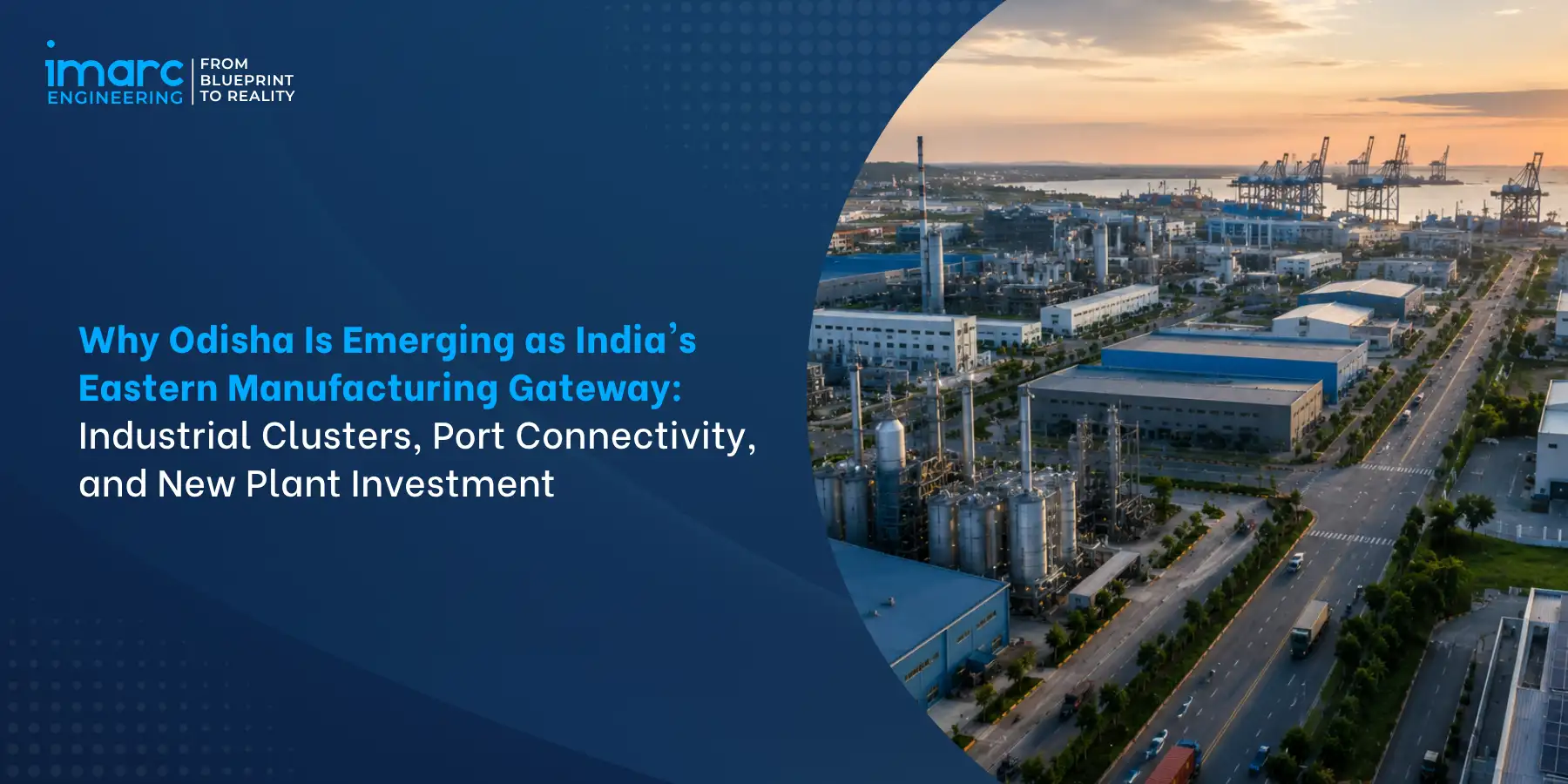
Why Odisha Is Emerging as India's Eastern Manufacturing Gateway: Industrial Clusters, Port Connectivity, and New Plant Investment
Introduction
For investors and manufacturing companies evaluating eastern India entry or expansion in 2026, manufacturing investment in Odisha draws serious consideration across metals, minerals-linked manufacturing, chemicals and petrochemicals, aluminium and steel downstream, and emerging sectors including electronics and green energy.
The state combines India's richest mineral endowment covering iron ore, chromite, bauxite, and coal with a 480-kilometre coastline hosting three operational ports at Paradip, Dhamra, and Gopalpur, giving Odisha structural advantages that few other Indian states match for raw-material-linked and export-oriented manufacturing.
Scope of this Guide
This guide explains why Odisha is strengthening its position as a manufacturing hub in eastern India, covering sectoral momentum, industrial cluster geography, port connectivity and logistics, raw material and supplier ecosystem, policy incentives under the Odisha Industrial Policy Resolution 2022, and the site selection and feasibility considerations that separate location-appropriate projects from those choosing a state without evaluating plant-specific fit. Strong state-level investment momentum does not automatically make every location suitable for every project.
Table of Contents
- Introduction
- Why Manufacturing Investment is Growing in Odisha
- Key Manufacturing Industries and Sectors Driving Investment in Odisha
- Major Industrial Clusters and Manufacturing Regions in Odisha
- Port Connectivity and Logistics Infrastructure for Manufacturing in Odisha
- Raw Material Availability and Supplier Ecosystem for Manufacturing in Odisha
- Odisha Industrial Policy and Manufacturing Incentives Framework
- Manufacturing Site Selection and Location Evaluation in Odisha
- Feasibility Assessment for Greenfield Manufacturing Projects in Odisha
- Conclusion
1. Why Manufacturing Investment is Growing in Odisha
Four drivers underpin Odisha's positioning as India's eastern manufacturing gateway in 2026.
1.1 Mineral Wealth and Raw Material Base
Odisha hosts among India's largest mineral reserves including iron ore, chromite, bauxite, coal, and manganese. The state produces a leading share of India's chromite output plus substantial iron ore, bauxite, and coal production supporting extensive downstream Odisha manufacturing sector development.
Mahanadi Coalfields Limited (MCL) operations across Talcher-Angul-Ib Valley coalfields anchor thermal power and metallurgical coal availability. Mineral wealth supports metals-linked and energy-intensive manufacturing with cost advantages that mineral-import-dependent states cannot match.
1.2 Port-Based Coastal Positioning
Odisha's 480-kilometre coastline hosts three operational ports along with additional greenfield ports at planning or development stage. Paradip Port under Paradip Port Authority (PPA) serves as a major port handling coal, iron ore, petroleum, and general cargo. Dhamra Port operated by Adani Ports and Special Economic Zone Limited serves as private port handling bulk cargo and containers.
Gopalpur Port operated by Adani Ports and Special Economic Zone Limited (APSEZ) serves as commercial private port. Coastal positioning can provide a significant logistics advantage for bulk raw-material movement, imported inputs, and export-oriented manufacturing, particularly for industries where maritime freight represents a material share of delivered cost.
1.3 Industrial Policy Continuity
Odisha has sustained industrial policy continuity anchored on Industrial Policy Resolution (IPR) 2022 supplementing earlier IPR 2015 provisions. Odisha Startup Policy, Odisha Electronics Policy 2021, and sector-specific policies supplement the general framework. Government of Odisha Single Window for Investor Facilitation and Tracking (GO-SWIFT) portal supports approvals coordination.
Make in Odisha Conclave biennial investor summits provide platforms for investor engagement. Continuity across industrial policies and sector-specific initiatives provides manufacturers with an established framework for evaluating incentives, approvals, and investment support.
In June 2026, the state government layered a further initiative, GO-EAST (Government of Odisha – Eastern Investment Accelerator and Special Task Force), onto this framework, alongside amendments to IPR 2022 extending Thrust Sector incentive status to non-mineral-based industries in 15 economically backward districts. The move signals continued policy activism rather than a static framework, reinforcing rather than undermining investor confidence in policy continuity.
1.4 Industrial Corridor and Infrastructure Investment
East Coast Economic Corridor (ECEC) supported by Asian Development Bank covers the eastern seaboard including Odisha nodes progressively developing integrated infrastructure. Amritsar-Kolkata Industrial Corridor Odisha node planned. Coastal Economic Zone (CEZ) development.
Bharatmala Pariyojana highway improvements supporting connectivity. Dedicated Freight Corridor extensions supporting bulk cargo movement. Corridor investment brings integrated infrastructure, connectivity, and industrial development supporting greenfield manufacturing at scales that ad-hoc industrial estates cannot match.
2. Key Manufacturing Industries and Sectors Driving Investment in Odisha
Key manufacturing industries and sectors driving investment in Odisha reflect both mature metals-and-minerals base and emerging diversification. Sectoral concentration around raw material availability supports competitive positioning while emerging sectors expand the addressable manufacturing base.
2.1 Steel and Metals Manufacturing
Steel manufacturing is one of Odisha's largest and most established industrial sectors with Tata Steel operations at Kalinganagar, Steel Authority of India Limited (SAIL) Rourkela Steel Plant, Jindal Steel and Power Limited (JSPL) Angul, Tata Steel BSL (formerly Bhushan Steel) at Meramandali, Jindal Stainless at Jajpur, and Neelachal Ispat Nigam Limited (acquired by Tata Steel).
Kalinganagar-Duburi cluster in Jajpur district represents one of India's densest steel manufacturing zones. Downstream steel processing and finishing including cold rolling, galvanising, and colour coating supplements primary steelmaking supporting extensive value chain participation.
2.2 Aluminium and Non-Ferrous Manufacturing
Aluminium manufacturing in Odisha anchors on National Aluminium Company Limited (NALCO) covering bauxite mining at Panchpatmali, alumina refinery at Damanjodi, and aluminium smelter and captive power at Angul. Vedanta Aluminium Jharsuguda operations represent private sector aluminium smelter capacity. Hindalco Industries operations complement the aluminium ecosystem.
Downstream aluminium processing including sheets, extrusions, and specialty products supports value-added manufacturing. India's substantial share of bauxite reserves supports competitive aluminium manufacturing positioning.
2.3 Chemicals and Petrochemicals
Chemicals and petrochemicals in Odisha concentrate around Paradip anchored by Indian Oil Corporation Limited (IOCL) Paradip Refinery, one of IOCL's newer major refineries. IFFCO Paradip fertiliser complex and Paradip Phosphates Limited (PPL) support fertiliser value chain.
Downstream petrochemical development including Paradip Petrochemical Complex in planning stage would expand value chain participation. Chemical park development around Paradip supports specialty chemical manufacturing benefiting from refinery feedstock proximity that isolated locations cannot match.
2.4 Emerging Sectors
Emerging sectors expanding the Odisha manufacturing ecosystem include electronics manufacturing supported by Odisha Electronics Policy 2021, textile and apparel manufacturing in identified clusters, food processing leveraging agricultural base, defence manufacturing supported by MSME defence supplier development, renewable energy manufacturing including solar photovoltaic and green hydrogen, and information technology hardware. Sectoral diversification via greenfield projects in Odisha supports both risk distribution beyond mining-linked manufacturing and workforce development across skill categories that concentrated mining and metals economies typically cannot achieve alone.
3. Major Industrial Clusters and Manufacturing Regions in Odisha
Major industrial clusters and manufacturing regions in Odisha concentrate around raw material availability, port access, and infrastructure corridors. Industrial cluster selection in Odisha during site evaluation influences access to suppliers, workforce, raw materials, customers, and logistics infrastructure.
3.1 Odisha Industrial Cluster Map
| Region | Primary Focus |
|---|---|
| Kalinganagar-Duburi (Jajpur) | Steel manufacturing cluster, ferro-alloys |
| Angul-Talcher | Coal, aluminium, thermal power, steel |
| Damanjodi-Koraput | Alumina refinery, bauxite mining |
| Jharsuguda | Aluminium smelter, coal-based industry |
| Rourkela (Sundargarh) | Steel manufacturing, engineering, cement |
| Paradip (Jagatsinghpur) | Petrochemicals, fertilisers, port-linked industry |
| Dhamra (Bhadrak) | Port-linked bulk manufacturing |
| Gopalpur (Ganjam) | SEZ, port-linked industry |
| Cuttack-Bhubaneswar-Khordha | IT, general manufacturing, food processing |
| Berhampur (Ganjam) | Industrial area, MSME |
3.2 Kalinganagar Steel Cluster
The Kalinganagar-Duburi cluster in Jajpur district represents one of India's most concentrated steel manufacturing zones. Tata Steel Kalinganagar operations, Jindal Stainless Jajpur, Neelachal Ispat Nigam Limited (Tata Steel), VISA Steel, and other producers form a dense steel ecosystem.
Ferro-alloys production including ferro-chrome benefits from proximity to Odisha's chromite reserves representing India's leading chromite-producing state. Kalinganagar Industrial Complex under Odisha Industrial Infrastructure Development Corporation (IDCO) provides developed industrial land with infrastructure supporting the cluster.
3.3 Angul-Talcher Coal and Aluminium Zone
Angul-Talcher is supported by major coalmining and power-generation activity associated with Mahanadi Coalfields Limited (MCL), alongside established aluminium and steel manufacturing operations. NALCO aluminium smelter and captive power plant at Angul supports non-ferrous manufacturing.
Jindal Steel and Power Angul steelworks represent integrated steel manufacturing. Bhushan Steel (Tata Steel BSL) Meramandali operations complete the zone's industrial profile. Coal availability supports thermal power and metallurgical coal-dependent manufacturing at competitive costs.
3.4 Paradip Petrochemical and Port Complex
Paradip complex anchors on Indian Oil Corporation Limited (IOCL) Paradip Refinery, one of IOCL's newer greenfield refineries. IFFCO Paradip fertiliser complex and Paradip Phosphates Limited (PPL) support fertiliser value chain.
Paradip Port under Paradip Port Authority provides maritime access supporting both raw material imports and product exports. Chemical Park development supports downstream specialty chemical and petrochemical investment. Paradip cluster represents India's emerging petrochemical and chemical hub on the eastern seaboard.
4. Port Connectivity and Logistics Infrastructure for Manufacturing in Odisha
Port connectivity and logistics infrastructure for manufacturing in Odisha represents the state's distinguishing competitive advantage on the eastern seaboard. Odisha port infrastructure across major and private ports supports both raw material exports and imported-input-intensive manufacturing.
4.1 Operational Ports in Odisha
| Port | Operator | Primary Cargo |
|---|---|---|
| Paradip Port | Paradip Port Authority (PPA) | Coal, iron ore, petroleum, containers |
| Dhamra Port | Adani Ports and SEZ Ltd | Coal, iron ore, bulk cargo, containers |
| Gopalpur Port | Adani Ports and SEZ Ltd | Bulk cargo, minerals, general |
4.2 Paradip Port
Paradip Port under Paradip Port Authority (PPA) ranks among India's major ports handling substantial coal, iron ore, petroleum products, and general cargo throughput. Multi-berth infrastructure supports bulk carriers, tankers, and container operations. Dedicated cargo terminals for coal, iron ore, and petroleum.
Rail and road connectivity through National Highway network supports hinterland cargo movement. Iron ore export operations serve global steel industry demand. Paradip Port's positioning supports both domestic and export-oriented manufacturing across steel, aluminium, chemicals, and petroleum products.
4.3 Dhamra and Gopalpur Private Ports
Dhamra Port operated by Adani Ports and Special Economic Zone Limited serves as private port handling bulk cargo including coal, iron ore, and containers. Deep-water berthing supports Capesize and larger vessels. Rail connectivity to hinterland supports bulk cargo movement.
Additionally, Gopalpur Port operated by Adani Ports and Special Economic Zone Limited serves southern Odisha industry. Private port operations supplement Paradip Port capacity supporting Odisha's overall throughput handling capability for growing manufacturing sector requirements.
4.4 Multi-Modal Connectivity
Multi-modal connectivity supplementing ports includes National Highway network with NH-16 (Golden Quadrilateral) traversing coastal Odisha connecting Chennai to Kolkata, NH-49, NH-53, and NH-55 supporting interior connectivity. East Coast Railway headquartered at Bhubaneswar supports both passenger and freight movement.
Biju Patnaik International Airport at Bhubaneswar supports passenger and air cargo. Jharsuguda (Veer Surendra Sai Airport), Rourkela, and other airports supplement air connectivity. Multi-modal infrastructure supports both raw material imports and finished goods movement to domestic markets and export gateways.
The value of port proximity varies by manufacturing model. Bulk-material industries such as metals, minerals, chemicals, and energy-intensive processing can derive substantial advantages from maritime access, while container-dependent manufacturers should separately evaluate container connectivity, service frequency, inland transport costs, and the most suitable gateway for their supply chain.
5. Raw Material Availability and Supplier Ecosystem for Manufacturing in Odisha
Raw material availability and supplier ecosystem for manufacturing in Odisha provide competitive advantages that raw-material-import-dependent regions cannot match. Mineral-linked and downstream manufacturing benefits from proximity economics that reduce logistics costs and support integrated operations.
5.1 Mineral Reserves and Availability
- Iron ore: substantial reserves in Keonjhar-Sundargarh belt supporting steel manufacturing
- Chromite: Odisha represents India's leading chromite-producing state (Sukinda Valley)
- Bauxite: Panchpatmali reserves supporting NALCO alumina and aluminium operations
- Coal: Talcher-Angul-Ib Valley coalfields under Mahanadi Coalfields Limited (MCL)
- Manganese: reserves supporting ferro-manganese and battery manufacturing
- Nickel: reserves supporting stainless steel and battery applications
- Limestone: reserves supporting cement and steel flux applications
- Dolomite: reserves supporting steel flux and refractory applications
5.2 Supplier Ecosystem Maturity
Established supplier ecosystems particularly around Kalinganagar steel cluster and Paradip petrochemical complex reduce localisation development time versus greenfield regions. Steel and metals sector Tier-2 supplier networks across castings, forgings, machining, and refractories support downstream sourcing. Paradip's refinery, fertiliser, chemical, and port-linked industrial base also support the development of downstream supplier and service ecosystems.
Engineering and fabrication services across established industrial regions. Established supplier ecosystems can reduce localisation risks during project ramp-up, although the depth of downstream supplier networks varies by industry and location within the state.
5.3 Workforce Availability
Odisha's workforce supports manufacturing across skill categories. Engineering education institutions including Indian Institute of Technology (IIT) Bhubaneswar, National Institute of Technology (NIT) Rourkela, and multiple state engineering colleges supply engineering graduates. Industrial Training Institutes (ITIs) across the state supply operator-level skilled workforce.
Odisha Skill Development Authority (OSDA) supports ongoing skill development. Labour availability and cost competitiveness should be evaluated at the cluster and site level, particularly for projects requiring specialised manufacturing, engineering, or technical skills. Workforce development remains progressive with capability continuing to build across advanced manufacturing skill categories.
5.4 Power and Utility Availability
Odisha has a substantial power-generation base supported by thermal, hydro, and growing renewable energy capacity. Electricity distribution across the state is served by TPCODL, TPWODL, TPSODL, and TPNODL, while GRIDCO Limited plays a key role in bulk power procurement and supply within the state.
For manufacturing projects, power availability, connection capacity, tariff structure, supply reliability, and backup requirements should be evaluated at the shortlisted site level. Water availability and allocation should similarly be assessed against process, cooling, utility, and future expansion requirements.
Site-specific utility assessment helps manufacturers determine whether available power, water, and supporting infrastructure can meet both initial plant requirements and planned capacity expansion.
6. Odisha Industrial Policy and Manufacturing Incentives Framework
Odisha industrial policy and manufacturing incentives framework combines a general industrial policy with sector-specific provisions. Policy navigation during feasibility supports optimal incentive positioning that post-award engagement typically cannot recover.
6.1 Industrial Policy Resolution 2022
Odisha Industrial Policy Resolution (IPR) 2022 represents the current principal industrial policy administered by the Department of Industries, Government of Odisha. IPR 2022 supplements earlier IPR 2015 provisions with expanded sector coverage and revised incentive structures. Eligibility spans micro, small, medium, large, mega, and ultra-mega project categories with graduated incentives.
Depending on project category, location, eligibility, and applicable policy provisions, incentives may include capital investment support, employment-related incentives, interest subsidy, State Goods and Services Tax (SGST)-linked benefits, stamp duty exemption, electricity duty exemption, and other forms of industrial support. Incentive structures for large, mega, and ultra-mega projects should be evaluated against the provisions applicable to the specific investment proposal.
In June 2026, the Odisha government announced amendments to IPR 2022 introducing a new "Thrust Sector" incentive category for non-mineral-based industrial units locating in 15 economically backward districts, including Balangir, Kalahandi, Nuapada, Kandhamal, Boudh, and Gajapati. The amendment is intended to extend industrial investment beyond the state's traditional mineral-linked corridor and support balanced regional development.
Investors evaluating locations in these districts should confirm current eligibility and incentive quantum with IPICOL, as Thrust Sector classification carries materially different incentive terms than standard IPR 2022 categories.
6.2 Sector-Specific Policies
- Odisha Electronics Policy 2021 supporting electronics manufacturing
- Odisha Startup Policy supporting technology startups and manufacturing incubation
- Odisha Mineral Policy governing mining and mineral-linked manufacturing
- Odisha Employment Policy supporting workforce development
- Odisha Textile Policy for textile and apparel manufacturing
- Odisha Food Processing Policy for agricultural value chain
- Sector-specific incentives supplementing IPR 2022 general framework
6.3 IDCO Framework and Industrial Land
Odisha Industrial Infrastructure Development Corporation (IDCO) established under the Orissa Industrial Infrastructure Development Corporation Act 1980 develops and manages industrial estates across the state. IDCO industrial areas provide developed plots with infrastructure covering internal roads, water supply, drainage, and power distribution.
Land allotment through IDCO application process with defined premium and annual rent structure. Land bank across strategic locations supporting new plant investment. Auto Cluster at Sector 1 Angul, Chemical Park at Paradip, Kalinganagar Industrial Complex, and various IDCO industrial parks provide developed land options. Private industrial parks and Special Economic Zones supplement IDCO areas.
6.4 GO-SWIFT and Investment Facilitation
Government of Odisha Single Window for Investor Facilitation and Tracking (GO-SWIFT) portal supports approvals coordination across departments providing structured investor engagement. Industrial Promotion and Investment Corporation of Odisha Limited (IPICOL) serves as nodal investment promotion agency supporting investor engagement.
Team Odisha initiative supports new plant investment in Odisha through dedicated project engagement. Make in Odisha Conclave biennial investor summits provide platforms for investor showcase and MoU execution supporting project pipeline development.
Alongside GO-SWIFT, the state launched GO-EAST (Government of Odisha- Eastern Investment Accelerator and Special Task Force) in June 2026, establishing a high-level Special Task Force and a dedicated "Go East Cell" within IPICOL to fast-track approvals and coordinate investment facilitation, with particular focus on attracting manufacturers from other eastern and north-eastern states.
State officials have cited reductions in project approval timelines, from roughly 400 days to under 160 days under successive "Deregulation" rounds, with a stated target of under 100 days, though investors should validate current approval timelines for their specific project category rather than relying on aggregate figures.
7. Manufacturing Site Selection and Location Evaluation in Odisha
Manufacturing site selection and location evaluation in Odisha transforms state-level advantages into project-specific decisions. Strong state momentum does not automatically make every location suitable for every project; disciplined site evaluation prevents costly location mistakes.
7.1 Site Selection Criteria
- Cluster proximity aligned with target customers, suppliers, and raw materials
- Industrial park type (IDCO, private, SEZ, ECEC node) matched to project requirements
- Land availability with expansion potential for future capacity addition
- Power infrastructure and tariff evaluation across discom territories
- Water availability for process requirements and utilities
- Port proximity for import-dependent or export-oriented operations
- Road and rail connectivity supporting inbound and outbound logistics
- Environmental clearance feasibility given siting characteristics
- Workforce availability across required skill categories
- Incentive optimisation under IPR 2022 zone classification
7.2 Coastal Versus Interior Location Trade-Offs
Coastal locations near Paradip, Dhamra, or Gopalpur suit port-dependent industries including petrochemicals, chemicals, and bulk commodity export-oriented manufacturing. Interior locations across Kalinganagar, Angul, Rourkela, and Jharsuguda suit raw-material-linked manufacturing with lower land costs versus coastal premium.
Trade-off evaluation considers logistics cost economics, land cost, workforce availability, and infrastructure maturity. Port-oriented industries typically justify coastal premium through logistics savings while raw-material-linked industries prioritise mineral proximity that interior locations provide.
7.3 IDCO Versus Private Park Versus SEZ
Location option evaluation should consider the trade-offs across different industrial park models. IDCO industrial areas provide state-developed industrial land and supporting infrastructure, while private industrial parks and specialised facilities such as the Chemical Park at Paradip may offer infrastructure tailored to specific industry requirements.
Special Economic Zones (SEZs), including Gopalpur SEZ, may provide specialised infrastructure and an export-oriented operating environment. However, investors should evaluate the current fiscal, customs, regulatory, and operational provisions applicable to their specific project rather than relying on general or legacy SEZ benefits.
The appropriate location model depends on the project category, infrastructure requirements, land availability, logistics needs, implementation timeline, and expansion plans. IDCO areas can support greenfield land access, while established industrial clusters may provide stronger access to suppliers, utilities, workforce, and supporting services.
7.4 Regulatory Timeline Considerations
Regulatory timeline planning during site selection helps prevent post-selection delays. Depending on the project category and location, requirements may include Environmental Clearance under the Environment (Protection) Act, 1986 and EIA Notification, 2006, along with Consent to Establish (CTE) and Consent to Operate (CTO) from the Odisha State Pollution Control Board (OSPCB).
Manufacturers should also evaluate applicable factory registration, licensing, and occupational safety requirements, fire and life-safety approvals from the competent authority, and Petroleum and Explosives Safety Organisation (PESO) licensing where hazardous materials or regulated storage are involved. Mineral-linked projects may require additional mining-related approvals depending on the project scope.
Approval requirements and timelines vary by industry, project scale, location, and process characteristics. Planning applicable approvals alongside site selection, engineering, procurement, and construction helps improve project execution predictability.
8. Feasibility Assessment for Greenfield Manufacturing Projects in Odisha
Feasibility assessment for greenfield manufacturing projects in Odisha translates location shortlist into investment decision. Strong state investment momentum does not substitute for project-specific feasibility discipline; disciplined assessment protects both commercial success and capital preservation.
8.1 Feasibility Assessment Components
| Component | Assessment Focus |
|---|---|
| Market and demand | Customer proximity, demand quantification, competitive positioning |
| Raw material and supply chain | Availability, cost, logistics, sourcing strategy |
| Location and site | Cluster fit, land, infrastructure, port proximity |
| Technology and process | Technology fit, equipment selection, capacity sizing |
| Capex and financial modelling | Investment sizing, project economics, return analysis |
| Opex and operational economics | Utilities, workforce, logistics cost |
| Regulatory and approvals | Timeline, requirements, feasibility risks |
| Incentives assessment | IPR 2022 classification, sector policies, Central schemes |
8.2 Detailed Project Report Development
Detailed Project Report (DPR) captures feasibility assessment supporting investment decision, banking, and regulatory engagement. DPR typically covers executive summary, project rationale and market analysis, technical proposal, location analysis, raw material and supply chain strategy, capex and opex projections, financial modelling, incentives assessment, regulatory framework, implementation plan, and risk assessment. The time required to prepare a bankable DPR depends on project complexity, availability of technical and commercial inputs, site-selection status, technology definition, vendor data, and the level of financial and regulatory assessment required.
8.3 Investment Decision Framework
Investment decision framework combines quantitative financial analysis with qualitative strategic considerations. Financial metrics including Internal Rate of Return (IRR), Net Present Value (NPV), payback period, and Return on Capital Employed (ROCE) support quantitative evaluation. Strategic considerations including market access, competitive positioning, raw material security, port access benefits, and long-term expansion potential supplement financial analysis.
Sensitivity analysis testing feasibility under adverse commodity price and demand scenarios supports risk-adjusted decision making. Documented governance around investment decision supports both stakeholder alignment and audit compliance.
Conclusion
Odisha is strengthening its position as an eastern manufacturing gateway through its mineral and raw-material base, established metals and process-industry clusters, strategic coastline, port connectivity, industrial infrastructure, and investment-support framework. These advantages create opportunities across established sectors such as steel, aluminium, chemicals, and petrochemicals, while emerging sectors are broadening the state's manufacturing base.
However, Odisha's state-level advantages do not make every location equally suitable for every manufacturing project. Successful investments depend on matching the plant's raw-material requirements, customer markets, logistics model, utility needs, workforce requirements, regulatory profile, and expansion strategy with the right industrial cluster and site. A project-specific feasibility study and location assessment therefore remain critical before committing capital to a greenfield or expansion project.
EVALUATING ODISHA MANUFACTURING INVESTMENT?
IMARC Engineering's manufacturing investment advisory and feasibility team supports investors, project sponsors, and manufacturing business leaders across market opportunity assessment covering steel, aluminium, chemicals and petrochemicals, electronics, renewable energy, and other manufacturing segments, cluster fit analysis, capex and opex financial modelling, bankable investment case development, and disciplined project governance for manufacturing investment across Odisha.
→ Schedule a free Odisha manufacturing investment scoping consultation with an IMARC specialist
Frequently Asked Questions
Odisha attracts manufacturing investment through its rich mineral resources, strategic coastline, major ports, established industrial clusters, supportive industrial policies, and GO-SWIFT single-window system. These advantages make the state particularly attractive for resource-based, export-oriented, and heavy manufacturing industries.
Key growth sectors include steel, aluminium, chemicals and petrochemicals, electronics, renewable energy, defence, and food processing. Strong mineral resources, large industrial investments, supportive policies, and expanding export infrastructure continue to drive manufacturing growth across these industries.
Major clusters include Kalinganagar for steel, Angul-Talcher for coal and aluminium, Damanjodi-Koraput and Jharsuguda for aluminium, Rourkela for steel and engineering, Paradip for petrochemicals, Dhamra for port-based industries, Gopalpur SEZ, and the Cuttack-Bhubaneswar manufacturing corridor.
Odisha's ports at Paradip, Dhamra, and Gopalpur support efficient import and export logistics for raw materials and finished products. This multi-port network can improve supply chain flexibility and potentially reduce logistics costs for export-oriented, import-dependent, and bulk-material industries, depending on plant location, cargo type, shipment volumes, and inland connectivity.
Odisha offers manufacturing infrastructure through operational ports, national highways, railway connectivity, airports, IDCO industrial estates, and established power-generation and distribution infrastructure. These assets can support industrial logistics and project development, although infrastructure and utility availability should be assessed at the specific site level.
Eligible manufacturing projects may access incentives under the Industrial Policy Resolution (IPR) 2022 and applicable sector-specific policies. The nature and quantum of support depend on factors such as project category, investment size, location, sector, and prevailing policy provisions. GO-SWIFT also supports coordination of applicable approvals and investor facilitation.
Companies should evaluate industrial cluster suitability, raw material availability, industrial parks, infrastructure, utilities, workforce, environmental approvals, logistics, and applicable incentives. The choice between coastal and inland locations should align with project requirements, supply chains, and logistics economics.
A feasibility assessment should evaluate market demand, raw material availability, technology selection, site suitability, financial modelling, regulatory approvals, incentives, and project risks. A bankable DPR provides the technical and commercial foundation for investment decisions, financing, and project implementation.
Recent Post

Trusted by Industry Leaders
We partner with global enterprises and ambitious businesses across sectors to deliver operational excellence, strategic insights, and sustainable growth through integrated solutions.







Success in Their Words
Real feedback from clients across industries. Discover how our solutions delivered measurable impact and operational excellence.
I wanted to express my sincere appreciation for your efforts in handling this matter. Your dedication and commitment have been truly commendable, and it is evident that you have put in tremendous hard work and expertise into resolving the issues at hand. We are greatly interested in continuing our collaboration with you in the future, as your professionalism and reliability have made you a trusted partner. Thank you once again for your invaluable contribution. We look forward to strengthening our partnership ahead.

It has been a pleasure working with the IMARC team. The insights provided were structured, clear, and highly valuable, helping us strengthen both our technical and financial planning with confidence. We deeply appreciate the team’s professionalism, responsiveness, and attention to detail throughout the engagement. Every requirement was well understood and effectively incorporated, resulting in a comprehensive and actionable output. Overall, our experience has been excellent, and I would gladly recommend IMARC to organizations seeking a reliable research partner.

Your service is truly exceptional. Working with the IMARC team has been a seamless and professional experience. The clarity of communication, responsiveness to queries, and consistent support at every stage made the entire engagement highly efficient. The insights shared were well-structured, practical, and perfectly aligned with our requirements, helping us make informed decisions with confidence. Overall, the dedication and professionalism demonstrated by your team stand out, and I would be glad to recommend IMARC as a reliable and trustworthy research partner.

IMARC did an outstanding job in preparing our study. They were punctual, precise, and consistently responsive throughout the entire process. The team delivered all the data we required in a clear, well-organized, and highly professional format. Their strong attention to detail, combined with their ability to meet every deadline without compromising quality, truly set them apart. Overall, their reliability and commitment made them an exceptional partner for our project, and we would gladly work with them again in the future.

IMARC made the whole process incredibly easy from start to finish. Everyone I interacted with via email was polite, professional, and straightforward to deal with, always keeping their promises regarding delivery timelines and remaining consistently solutions-focused. From my very first contact, I appreciated the professionalism and support shown by the entire IMARC team. I highly recommend IMARC to anyone seeking timely, affordable, and reliable information or advice. My experience with IMARC was excellent, and I truly cannot fault any aspect of it.

I’d like to express my sincere gratitude for the excellent work you accomplished with the study. Your ability to quickly understand our requirements and deliver high-quality results under tight timelines truly reflects your expertise, exceptional work ethic, and unwavering commitment to your customer’s success. The professionalism and responsiveness you demonstrated throughout the process made a significant difference. Our entire team and company are incredibly thankful for your dedication, reliability, and support. Once again, thank you for your outstanding contribution.