Manufacturing
July 20 2026
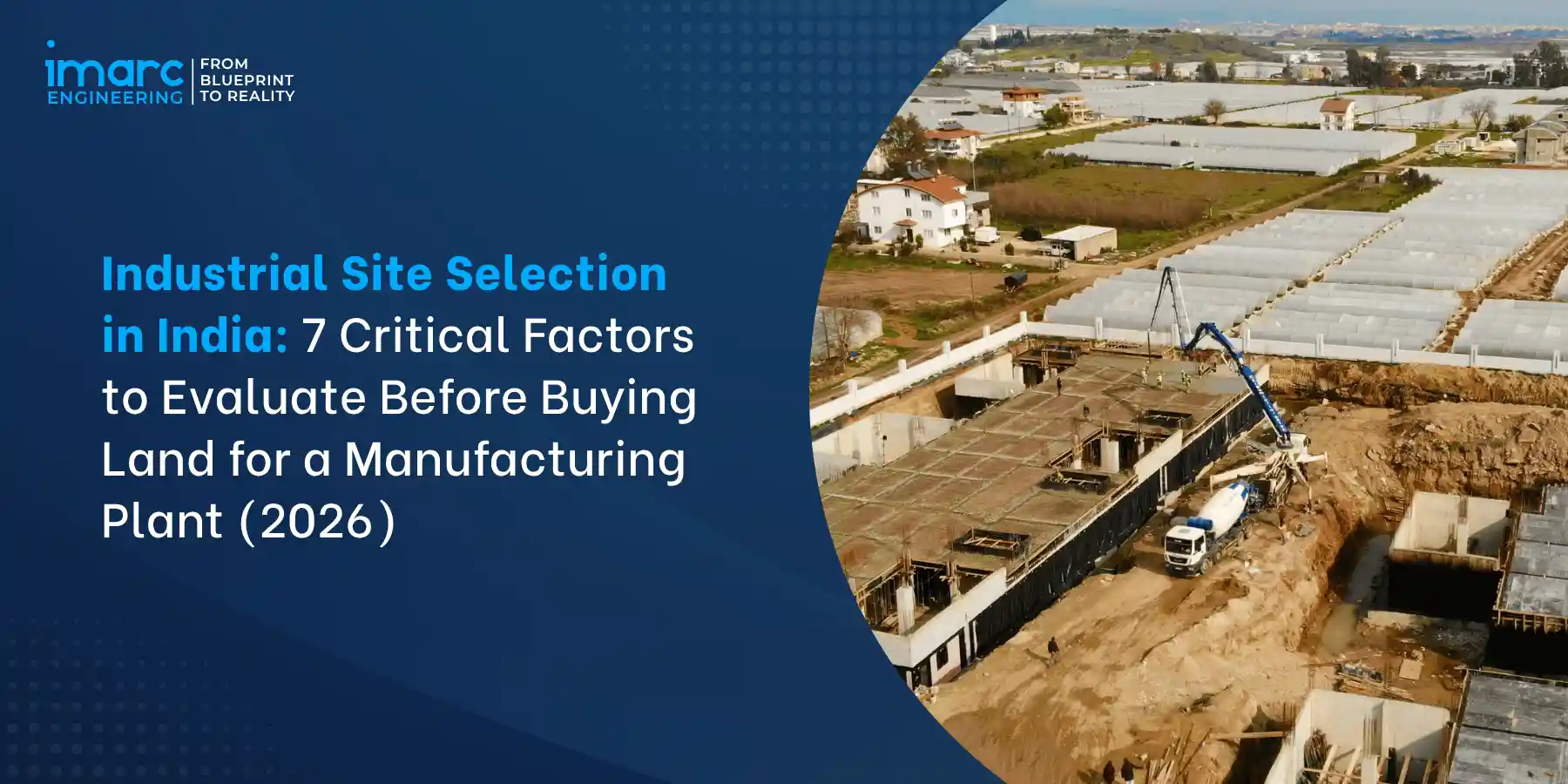
Industrial Site Selection in India: 7 Critical Factors to Evaluate Before Buying Land for a Manufacturing Plant (2026)
Introduction
For any promoter or investor planning a new manufacturing facility in India in 2026, land selection is among the most consequential and irreversible decisions in the project lifecycle. A well-chosen site accelerates approvals, reduces utility infrastructure cost, protects against environmental and legal risks, and supports future expansion.
A poorly chosen site produces years of compliance friction, expensive utility retrofits, restricted growth options, and, in extreme cases, manufacturing assets that become commercially unviable due to regulatory, infrastructure, or operational constraints. Structured industrial site selection in India helps manufacturers reduce project risk, accelerate approvals, optimise infrastructure investment, and improve long-term operational efficiency.
Scope of this Guide
This guide answers a critical question for manufacturers and investors: what factors should be evaluated before purchasing industrial land to ensure long-term operational efficiency, regulatory compliance, and project success? It walks through seven critical dimensions of manufacturing site selection — location and market accessibility, land title and legal due diligence, zoning and regulatory approvals, utilities availability, transportation and logistics, environmental and geotechnical risk, and future expansion and lifecycle cost — with the practices that distinguish disciplined selection from expensive lessons learned.
Table of Contents
- Introduction
- Why Industrial Site Selection in India Matters in 2026
- Factor 1 - Location and Market Accessibility
- Factor 2 - Land Title and Legal Due Diligence
- Factor 3 - Zoning, Land Use, and Regulatory Approvals
- Factor 4 - Utilities Availability for Industrial Sites in India
- Factor 5 - Transportation and Logistics Connectivity for Factories in India
- Factor 6 - Environmental, Geotechnical, and Climate Risk Assessment
- Factor 7 - Future Expansion Potential and Total Lifecycle Cost
- Common Mistakes to Avoid When Buying Industrial Land in India
- Conclusion
1. Why Industrial Site Selection in India Matters in 2026
Four structural drivers make disciplined site selection a strategic capability for Indian manufacturing sponsors in 2026.
1.1 Site Decisions Are Effectively Irreversible
Once land is purchased, construction has commenced, and utility connections are established, the site decision is effectively locked in for the plant's operational lifecycle (typically 20-40 years). Relocation costs, environmental remediation obligations, and operational disruption make correction expensive. Structured industrial land purchase diligence is materially cheaper than downstream corrections. The economics of site selection weigh diligence investment (typically INR 5-25 lakh for structured evaluation) against project capex exposure (typically INR 25 crore - 500 crore) — the leverage ratio is extreme.
1.2 Regulatory Framework Has Tightened
Environmental Clearance requirements under EIA Notification 2006, tightening Central Pollution Control Board effluent standards, CGWA groundwater restrictions in over-exploited and critical zones, and evolving Coastal Regulation Zone rules progressively raise site-selection complexity.
Zoning misclassification, buffer zone violations, or environmentally sensitive location choices produce approval failures that no downstream engineering can overcome. Regulatory diligence at site selection stage is prerequisite for project bankability.
1.3 Utility Infrastructure Costs Have Escalated
Bringing HT power connectivity, industrial water supply, natural gas, and drainage infrastructure to poorly-located sites has become materially expensive. Utility bringing costs range from a modest 2-5 percent of project capex for well-served industrial estates to 15-25 percent for isolated greenfield sites. Structured location analysis quantifies this trade-off and identifies sites where utility economics support the manufacturing business case rather than eroding it.
1.4 Infrastructure Corridor and Investment Region Support
India's industrial infrastructure ecosystem has matured significantly with the development of dedicated industrial corridors, investment regions, and organised industrial estates. Initiatives such as the Delhi-Mumbai Industrial Corridor (DMIC), Chennai-Bengaluru Industrial Corridor (CBIC), and other regional industrial corridors provide manufacturing projects with planned infrastructure, improved connectivity, and better access to utilities.
State industrial development agencies such as MIDC, GIDC, KIADB, and SIPCOT offer serviced industrial land with supporting infrastructure and regulatory support. Selecting sites within established industrial zones can reduce infrastructure development requirements, improve approval timelines, and support faster greenfield project execution compared with standalone land development.
2. Factor 1 - Location and Market Accessibility
Location and market accessibility form the strategic foundation of factory location selection. Proximity to raw material sources, customer markets, workforce availability, and support ecosystem materially shapes long-term operational competitiveness.
2.1 Market Proximity Analysis
Structured market proximity analysis evaluates distance to primary customer clusters, raw material sources, and export gateways. Manufacturing facilities serving domestic Tier 1 metropolitan markets often benefit from peripheral locations providing land cost advantage without excessive logistics cost.
Export-focused manufacturing benefits from proximity to major ports (JNPT, Mundra, Chennai, Kolkata, Kandla, Cochin, Visakhapatnam) or dedicated freight corridors. Raw material-intensive operations may benefit from source-proximity even at higher distribution cost. Analytical assessment across scenarios prevents defaulting to comfortable but sub-optimal locations.
2.2 Workforce and Skill Availability
Workforce availability and skill mix directly affect operational readiness. Manufacturing hubs including NCR, Pune, Chennai-Sriperumbudur, Bengaluru periphery, Ahmedabad, and Hyderabad provide deep manufacturing workforce pools.
Emerging clusters in Tier 2 cities including Coimbatore, Rajkot, Vadodara, Nashik, Aurangabad, and Indore combine reasonable workforce availability with lower cost structures. Isolated locations may require workforce migration incentives or extended commuting infrastructure. Structured workforce assessment includes availability, wage levels, unionisation patterns, and skill-development infrastructure.
2.3 Support Ecosystem
Support ecosystems including component supplier proximity, ancillary services, tool room and calibration providers, testing laboratories, and maintenance service providers materially affect operational efficiency. Established manufacturing clusters provide dense supplier networks reducing inbound logistics and inventory.
Automotive clusters around Pune-Chakan, Chennai, and Manesar-Gurgaon exemplify this pattern. Isolated locations require in-house capability development for services that clusters provide externally. Cluster benefits often justify moderate land cost premiums.
2.4 Corridor and Investment Region Alignment
Alignment with structured industrial corridors, investment regions, and organised industrial estates provides material advantages for greenfield project development. DMIC, CBIC, VCIC, AKIC, and BMIC corridors offer pre-planned infrastructure, dedicated freight corridor connectivity, and coordinated approvals.
State industrial estates administered by MIDC, GIDC, KIADB, SIPCOT, TSIIC, APIIC, and equivalents provide serviced land with utilities, roads, and drainage in place. These options materially reduce development time and cost versus standalone site development.
3. Factor 2 - Land Title and Legal Due Diligence
Land title and legal due diligence protect against title defects, encumbrances, and litigation exposure that can derail projects years into operations. Structured industrial land due diligence is prerequisite for any material land commitment.
3.1 Title Verification
Structured title verification typically traces ownership history covering 30 years or as required under applicable state practice. Documents examined include current sale deed and prior chain of title documents, land revenue records (7/12 extract in Maharashtra, Khasra/Khatauni in northern states, Patta/Chitta in Tamil Nadu, RTC in Karnataka, and equivalent state-specific records), Encumbrance Certificate (EC) from the Sub-Registrar Office covering 30-year search, mutation entries confirming ownership transfers, and property tax receipts. An industrial land due diligence checklist typically comprises 40-60 specific items across title, encumbrance, litigation, and physical possession dimensions.
3.2 Encumbrance and Litigation Check
Encumbrance Certificate identifies mortgages, liens, court attachments, and other charges registered against the property. Litigation searches at applicable civil courts, High Court, District Court, revenue courts, and consumer forums identify pending disputes.
Public notice in local newspapers before registration provides opportunity for third-party claim assertion. Structured encumbrance and litigation clearance materially reduces post-purchase surprise. Skipping this diligence stage to save 4-6 weeks routinely produces years of downstream disputes.
3.3 Statutory Compliance and Payments
| Compliance Item | Verification | Typical Consequence of Gap |
|---|---|---|
| Stamp Duty | Historical registration records | Legal challenges to transfer validity |
| Registration Charges | Sub-Registrar receipts | Title uncertainty |
| Property Tax | Municipal records | Attachment risk, sale challenges |
| Development Charges | Local authority records | Building permission complications |
| Betterment / Improvement Charges | State-specific ULB records | Additional payment demands |
| Land Ceiling Compliance | Revenue records | State acquisition risk |
3.4 Registration and Stamp Duty
Registration of sale deed under the Registration Act 1908 provides legal recognition of ownership transfer. Stamp duty rates vary by state, typically ranging 5-8 percent of transaction value with additional registration charges typically 1 percent. Concessions may apply for women purchasers in some states, and for industrial land in specific corridors.
Registration must occur at the Sub-Registrar office within jurisdictional territory of the property. Structured registration with complete documentation prevents technical challenges to transfer validity in future disputes.
4. Factor 3 - Zoning, Land Use, and Regulatory Approvals
Zoning and regulatory approvals for industrial land define what can be legally built and operated on the site. Zoning misalignment often produces the largest post-purchase surprises for insufficiently diligenced sponsors.
4.1 Development Plan and Zoning
Development Plans and Regional Plans notified by state Town Planning Departments define permissible land use for every parcel. Industrial zones (typically classified as Industrial-I for light and medium; Industrial-II for heavy) permit manufacturing operations. Agricultural zones require Change of Land Use (CLU) or Non-Agricultural (NA) permission before industrial development.
Residential and commercial zones typically prohibit manufacturing. Ground coverage, Floor Space Index (FSI) or Floor Area Ratio (FAR), setback requirements, and height restrictions further constrain the buildable envelope on approved industrial land.
4.2 Change of Land Use (CLU) and NA Conversion
Agricultural land purchased for industrial development requires Change of Land Use conversion typically through State Revenue Department or Town Planning Department. Process includes application with land documents, land use compatibility assessment, payment of CLU/conversion charges (varying by state and land value), site inspection, and issuance of order.
Timelines typically run 3-12 months. Land purchased without prior CLU verification produces indefinite delays or cost escalation. Structured pre-purchase zoning verification prevents this scenario.
4.3 Environmental and Statutory Approvals
- Environmental Clearance under EIA Notification 2006 (Category A/B based on capacity and sector)
- Consent to Establish (CTE) from State Pollution Control Board pre-construction
- Consent to Operate (CTO) from State Pollution Control Board pre-commissioning
- Central Ground Water Authority (CGWA) NOC in notified areas
- Factory Licence requirements under applicable state factory regulations and occupational safety legislation
- Fire NOC from State Fire Services
- Building Permission from local municipal authority
4.4 Sector-Specific Approvals
Sector-specific approvals overlay standard requirements. Pharmaceutical facilities require CDSCO manufacturing licence. Food processing requires FSSAI licence. Chemical facilities require additional approvals under Manufacture, Storage and Import of Hazardous Chemical Rules.
Petroleum and gas facilities require PESO approvals. AYUSH manufacturing requires State AYUSH Directorate licence. Sector-specific requirements must be evaluated at site selection stage as they may restrict specific location choices.
5. Factor 4 - Utilities Availability for Industrial Sites in India
Utilities availability for industrial sites in India directly affects both project capex (utility bringing costs) and long-term opex (utility tariffs and reliability). Structured utility assessment during site evaluation prevents post-purchase surprises.
5.1 Power Supply and Grid Connectivity
Power supply evaluation covers DISCOM connectivity, voltage availability (HT at 11kV, 22kV, 33kV, 66kV, or 132kV depending on connected load), substation proximity, feeder loading, and outage frequency. Grid connectivity charges vary significantly by distance to nearest suitable substation and required transmission infrastructure.
Industrial estates typically have dedicated substations reducing connectivity cost. Renewable energy access through rooftop solar, open access renewable procurement, or group captive arrangements is increasingly a site-selection consideration. Backup power planning through diesel generators or gas engines requires fuel supply availability assessment.
5.2 Water Supply and Wastewater
Water supply availability covers municipal supply access, groundwater status (CGWA categorisation as safe, semi-critical, critical, or over-exploited), surface water withdrawal rights, and treated wastewater availability where relevant. Coastal sites offer desalination options.
Wastewater discharge routes include municipal sewer connectivity, Common Effluent Treatment Plant (CETP) access in organised clusters, or standalone effluent treatment with authorised discharge. Zero Liquid Discharge is mandatory for CPCB-notified sectors. Water and wastewater constraints have become leading causes of project delays and should be validated at feasibility stage.
5.3 Gas, Fuel, and Other Utilities
- Natural gas: GAIL, IGL, or state gas company pipeline connectivity for PNG
- Alternative fuel: LPG cylinder delivery, LNG bulk supply where pipeline unavailable
- Compressed air: on-site generation typical, requires quality-grade planning
- Steam: boilers requiring IBR compliance, fuel supply matching
- HVAC infrastructure: chiller water, refrigeration for classified environments
- Drainage: storm water management, road runoff, monsoon capacity
- Fibre optic connectivity: for Industry 4.0 and cloud-linked operations
5.4 Utility Bringing Costs
Utility bringing costs vary dramatically by site. Well-served industrial estates typically require utility connection investment of 2-5 percent of project capex. Isolated greenfield sites may require 15-25 percent for equivalent utility infrastructure.
Costs include HT power line extension (typically INR 30 lakh - 5 crore per kilometre), water pipeline extension (INR 20 lakh - 2 crore per kilometre), gas pipeline connection where available, and internal utility infrastructure. Structured utility cost estimation is essential for site cost-benefit analysis.
6. Factor 5 - Transportation and Logistics Connectivity for Factories in India
Transportation and logistics connectivity for factories affects inbound raw material cost, outbound distribution cost, and delivery reliability. Structured logistics assessment quantifies the multi-year impact of connectivity choices.
6.1 Road Connectivity
Road connectivity is the workhorse of Indian manufacturing logistics. National Highway (NH) and State Highway (SH) proximity, expressway access where available, and last-mile road quality collectively shape truck-based logistics economics.
Bharatmala Pariyojana continues expanding the highway network. PM Gati Shakti National Master Plan coordinates multi-modal infrastructure. Sites within 5-10 kilometres of major highways typically enjoy strong logistics economics; distant sites require dedicated approach road investment.
6.2 Rail Connectivity and Dedicated Freight Corridors
Rail connectivity through Indian Railways siding access materially reduces bulk transportation cost for heavy manufacturing. The Dedicated Freight Corridors (DFC) — Eastern DFC and Western DFC — provide time-guaranteed freight movement for corridor-aligned facilities.
Container Corporation of India (CONCOR) inland container operations and Container Freight Stations support containerised freight movement. Sites within rail-served industrial areas gain material logistics cost advantages for bulk operations that road-only sites cannot match.
6.3 Port and Air Freight Access
Export-oriented manufacturing benefits from proximity to major ports. Jawaharlal Nehru Port Trust (JNPT / Nhava Sheva), Mundra, Chennai, Kolkata, Kandla (Deendayal), Cochin, Visakhapatnam, and other major ports provide primary gateway access. Sagarmala Programme continues expanding port capacity and connectivity. Inland Container Depots (ICD) provide upstream container handling.
Air freight access from major airports supports high-value, time-sensitive products including pharmaceuticals, electronics, and precision components. Sea-air corridor operations increasingly integrate these modes.
6.4 Warehousing and Distribution Ecosystem
Effective site selection for manufacturing plants considers the warehousing and distribution ecosystem beyond the immediate plant boundary. Third-party logistics (3PL) provider presence, multi-modal logistics parks, cold chain infrastructure for temperature-sensitive products, and Free Trade Warehousing Zones (FTWZ) for import-export operations collectively affect distribution capability. Structured logistics ecosystem assessment often reveals sites where third-party infrastructure substitutes for in-house investment that competing sites would require.
7. Factor 6 - Environmental, Geotechnical, and Climate Risk Assessment
Environmental and geotechnical risk assessment for industrial land protects against site-specific risks that shape both construction cost and operational continuity. Structured pre-purchase assessment prevents expensive foundation surprises, environmental compliance failures, and climate-driven operational disruption.
7.1 Environmental Sensitivity Screening
Environmental sensitivity screening identifies constraints that specific sites may face. Wildlife sanctuaries, national parks, and eco-sensitive zones require setback buffers. Coastal Regulation Zone (CRZ) provisions restrict development within specified distance from high tide line. Wetland conservation rules apply to notified wetlands.
Forest area proximity may trigger Forest Conservation Act provisions. Groundwater over-exploited or critical zones face CGWA withdrawal restrictions. Structured sensitivity screening at site selection stage prevents purchase of land that cannot be developed as intended.
7.2 Geotechnical Assessment
Geotechnical assessment through boreholes, standard penetration tests (SPT), and soil sample analysis per IS 2720 characterises subsurface conditions. Soil bearing capacity testing, generally performed according to applicable Indian Standards such as IS 6403, helps determine foundation requirements and construction costs. Groundwater level affects excavation, dewatering, and permanent works. Soil chemistry may reveal contamination requiring remediation.
Slope stability matters for hilly terrain. Rocky substrate may reduce foundation cost but complicate excavation. Structured geotechnical assessment typically costs INR 3-15 lakh but prevents foundation cost surprises that can exceed INR 1 crore.
7.3 Seismic and Flood Risk
Seismic zone classification per IS 1893 (Zone II low risk through Zone V highest risk) affects structural design. Zone IV and V require enhanced seismic detailing that increases civil cost. Flood risk assessment covers riverine flooding, urban flooding from stormwater accumulation, and historical monsoon flooding patterns. Sites in identified flood plains face both operational disruption and insurance premium impacts. Historical satellite imagery and local hydrological records support structured flood risk assessment.
7.4 Climate Risk Considerations
Climate risk considerations increasingly matter for long-term operational planning. Cyclone-prone coastal locations require enhanced structural design and business continuity planning. Extreme heat zones affect worker productivity, cooling costs, and equipment reliability. Water stress mapping identifies locations where water availability may deteriorate over the project lifecycle.
BEE Energy Conservation Building Code climate zones (hot-dry, warm-humid, temperate, composite, cold) inform building envelope and HVAC design. Structured climate risk assessment supports both design decisions and long-term operational planning.
8. Factor 7 - Future Expansion Potential and Total Lifecycle Cost
Future expansion potential and total lifecycle cost represent the seventh critical factor in industrial land selection. Sites optimised only for initial phase often constrain valuable future growth and produce higher lifecycle costs than sites planned with expansion in mind.
8.1 Expansion Land Provisioning
Structured planning for manufacturing plant location typically provisions expansion land equal to 50-100 percent of initial requirement. Adjacent land availability, contiguous parcel options, and vertical expansion possibilities within FSI limits provide flexibility.
Modular plant design supports staged capacity additions. Utility infrastructure sizing at 110-125 percent of initial demand accommodates expansion without utility retrofit. Structured provisioning at initial site selection is materially cheaper than land acquisition and infrastructure retrofit years later.
8.2 Total Lifecycle Cost Framework
| Cost Component | Typical Range as % of Lifecycle Cost | Notes |
|---|---|---|
| Land Acquisition | 5-15 percent | One-time; larger share for premium locations |
| Site Development | 3-8 percent | Boundary, roads, drainage, levelling |
| Utility Bringing | 2-25 percent | Highly variable by site quality |
| Plant Capex (buildings, equipment) | 40-60 percent | Sector-specific |
| Operating Utilities | 10-25 percent | Power, water, gas over lifecycle |
| Logistics and Distribution | 5-15 percent | Inbound and outbound over lifecycle |
| Compliance and Approvals | 1-3 percent | Recurring approvals, monitoring |
8.3 Industrial Land Purchase Cost Benchmarks
Industrial land purchase cost benchmarks vary significantly by tier and corridor. Tier 1 metropolitan periphery (NCR, MMR, Bengaluru periphery, Chennai periphery) typically ranges INR 5,000-25,000 per square metre. Tier 2 city clusters (Pune, Ahmedabad, Hyderabad, Coimbatore, Vadodara) typically range INR 2,000-10,000 per square metre.
Tier 3 city and remote industrial areas typically range INR 500-3,000 per square metre. State industrial estate rates within corridors are typically discounted 20-40 percent versus open-market equivalents. Long-term lease options (typically 99-year) often price at 20-40 percent of freehold equivalent.
8.4 Total Cost of Ownership Analysis
Structured Total Cost of Ownership (TCO) analysis integrates land cost, site development, utility bringing, approval costs, ongoing utility tariffs, logistics, and compliance across a 20-30 year operational horizon. TCO analysis frequently reveals that lower-land-cost sites carry higher total cost due to utility bringing, logistics, and compliance premiums.
Higher-cost industrial estate sites often deliver lower TCO through infrastructure availability and administrative efficiency. Structured TCO analysis is essential for informed site decisions rather than land-cost-only comparisons.
9. Common Mistakes to Avoid When Buying Industrial Land in India
- Purchasing land without complete title and encumbrance verification
- Selecting sites without confirming zoning and industrial use permissions
- Underestimating power, water, wastewater, and utility infrastructure requirements
- Ignoring soil conditions, flood risks, and environmental constraints
- Choosing locations without evaluating logistics connectivity and workforce availability
- Failing to consider future expansion requirements and lifecycle costs
A structured industrial site evaluation approach helps manufacturers identify these risks before committing capital and ensures that the selected location supports long-term operational and business objectives.
Conclusion
Structured industrial site selection in India in 2026 requires disciplined evaluation across seven critical factors, location and market accessibility, land title and legal due diligence, zoning and regulatory approvals, utilities availability, transportation and logistics, environmental and geotechnical risk, and future expansion and lifecycle cost. Site decisions taken with structured diligence deliver approvals faster, utility infrastructure at lower cost, and long-term operational efficiency that shortcut decisions cannot match.
Professional industrial site selection and due diligence services materially reduce project delays, compliance risks, infrastructure costs, and long-term operational challenges. Structured advisory covers pre-purchase feasibility including market accessibility analysis, land title and encumbrance verification, zoning and CLU validation, utility availability assessment with cost estimates, logistics and connectivity scoring, environmental sensitivity screening, geotechnical investigation coordination, seismic and flood risk assessment, expansion land provisioning, and total lifecycle cost analysis.
Structured 6-12-week evaluation cycles combining desk research, site visits, statutory verification, and independent assessment typically cost INR 5-25 lakh but protect INR 25 crore - 500 crore project capex from the site-related risks that unstructured selection routinely produces.
PLANNING INDUSTRIAL LAND PURCHASE?
IMARC Engineering's industrial site selection and due diligence advisory team supports manufacturing sponsors, real estate teams, and project development leaders across market accessibility analysis, land title and encumbrance verification, zoning and CLU validation, environmental sensitivity screening, utility availability assessment, logistics and connectivity evaluation, geotechnical investigation coordination, seismic and flood risk assessment, expansion land provisioning, and total lifecycle cost analysis for greenfield industrial developments, industrial estate acquisitions, corridor-aligned facilities, and SEZ or EOU projects across sectors.
→ Schedule a free industrial site selection scoping consultation with an IMARC specialist
Frequently Asked Questions
Seven critical factors merit structured evaluation: location and market accessibility, land title and legal due diligence, zoning and regulatory approvals, utilities availability, transportation and logistics connectivity, environmental and geotechnical risk, and future expansion potential with total lifecycle cost. Sites optimised across all seven consistently outperform sites optimised on land cost alone.
Land requirement depends on manufacturing scale, dosage forms or product types, utility infrastructure, storage, and expansion provisioning. Small units typically require 2,000-5,000 square metres. Medium units require 5,000-20,000 square metres. Large integrated units require 20,000-100,000 square metres or more. Structured manufacturing site selection typically provisions expansion land equal to 50-100 percent of initial requirement.
Change of Land Use (CLU) is the statutory conversion of agricultural land to non-agricultural or industrial use required before industrial development. Process operates through state Revenue or Town Planning Departments with typical timelines of 3-12 months and CLU/conversion charges. Land purchased without prior CLU verification produces indefinite delays or cost escalation. Structured pre-purchase zoning verification prevents this scenario.
Stamp duty rates vary by state, typically ranging 5-8 percent of transaction value with additional registration charges typically 1 percent. Concessions may apply for women purchasers in some states and for industrial land in specific corridors. Stamp duty is calculated on higher of transaction value or state-notified circle rate.
Structured industrial land due diligence covers 30-year title chain verification through sale deeds and mutation entries, Encumbrance Certificate from Sub-Registrar Office, land revenue records (7/12, Khasra/Khatauni, Patta, RTC per state), litigation searches across relevant courts, property tax verification, and physical possession confirmation. Independent legal counsel review is standard practice.
Environmental Clearance under EIA Notification 2006 (Category A or B based on capacity and sector), State Pollution Control Board Consent to Establish and Consent to Operate under the Water Act 1974 and Air Act 1981, CGWA NOC for groundwater withdrawal in notified areas, and sector-specific approvals collectively form the environmental approval stack.
Structured 6-12-week site selection and due diligence engagements typically cost INR 5-25 lakh depending on site count, sector complexity, and depth of technical assessment. This investment typically protects INR 25 crore - 500 crore project capex from site-related risks. The leverage ratio makes professional advisory materially cost-effective versus unstructured selection.
Corridor-aligned sites (DMIC, CBIC, VCIC, AKIC, BMIC) and state industrial estates (MIDC, GIDC, KIADB, SIPCOT, TSIIC, APIIC, and equivalents) provide pre-approved industrial zoning, dedicated infrastructure, utility connectivity, expedited approvals, and often financial incentives. Structured greenfield project development site selection that aligns with corridors and organised industrial estates typically completes 20-40 percent faster than equivalent standalone development.
Systematic evaluation of how to evaluate industrial land in India before buying covers market accessibility, title verification, zoning validation, utility assessment, logistics evaluation, environmental screening, geotechnical assessment, and lifecycle cost analysis. Professional advisory typically completes structured evaluation within 6-12 weeks including desk research, site visits, statutory verification, and independent assessment.
Recent Post



Trusted by Industry Leaders
We partner with global enterprises and ambitious businesses across sectors to deliver operational excellence, strategic insights, and sustainable growth through integrated solutions.










Success in Their Words
Real feedback from clients across industries. Discover how our solutions delivered measurable impact and operational excellence.

I wanted to express my sincere appreciation for your efforts in handling this matter. Your dedication and commitment have been truly commendable, and it is evident that you have put in tremendous hard work and expertise into resolving the issues at hand. We are greatly interested in continuing our collaboration with you in the future, as your professionalism and reliability have made you a trusted partner. Thank you once again for your invaluable contribution. We look forward to strengthening our partnership ahead.

It has been a pleasure working with the IMARC team. The insights provided were structured, clear, and highly valuable, helping us strengthen both our technical and financial planning with confidence. We deeply appreciate the team’s professionalism, responsiveness, and attention to detail throughout the engagement. Every requirement was well understood and effectively incorporated, resulting in a comprehensive and actionable output. Overall, our experience has been excellent, and I would gladly recommend IMARC to organizations seeking a reliable research partner.

Your service is truly exceptional. Working with the IMARC team has been a seamless and professional experience. The clarity of communication, responsiveness to queries, and consistent support at every stage made the entire engagement highly efficient. The insights shared were well-structured, practical, and perfectly aligned with our requirements, helping us make informed decisions with confidence. Overall, the dedication and professionalism demonstrated by your team stand out, and I would be glad to recommend IMARC as a reliable and trustworthy research partner.

IMARC did an outstanding job in preparing our study. They were punctual, precise, and consistently responsive throughout the entire process. The team delivered all the data we required in a clear, well-organized, and highly professional format. Their strong attention to detail, combined with their ability to meet every deadline without compromising quality, truly set them apart. Overall, their reliability and commitment made them an exceptional partner for our project, and we would gladly work with them again in the future.

IMARC made the whole process incredibly easy from start to finish. Everyone I interacted with via email was polite, professional, and straightforward to deal with, always keeping their promises regarding delivery timelines and remaining consistently solutions-focused. From my very first contact, I appreciated the professionalism and support shown by the entire IMARC team. I highly recommend IMARC to anyone seeking timely, affordable, and reliable information or advice. My experience with IMARC was excellent, and I truly cannot fault any aspect of it.

I’d like to express my sincere gratitude for the excellent work you accomplished with the study. Your ability to quickly understand our requirements and deliver high-quality results under tight timelines truly reflects your expertise, exceptional work ethic, and unwavering commitment to your customer’s success. The professionalism and responsiveness you demonstrated throughout the process made a significant difference. Our entire team and company are incredibly thankful for your dedication, reliability, and support. Once again, thank you for your outstanding contribution.