Manufacturing
September 03 2026
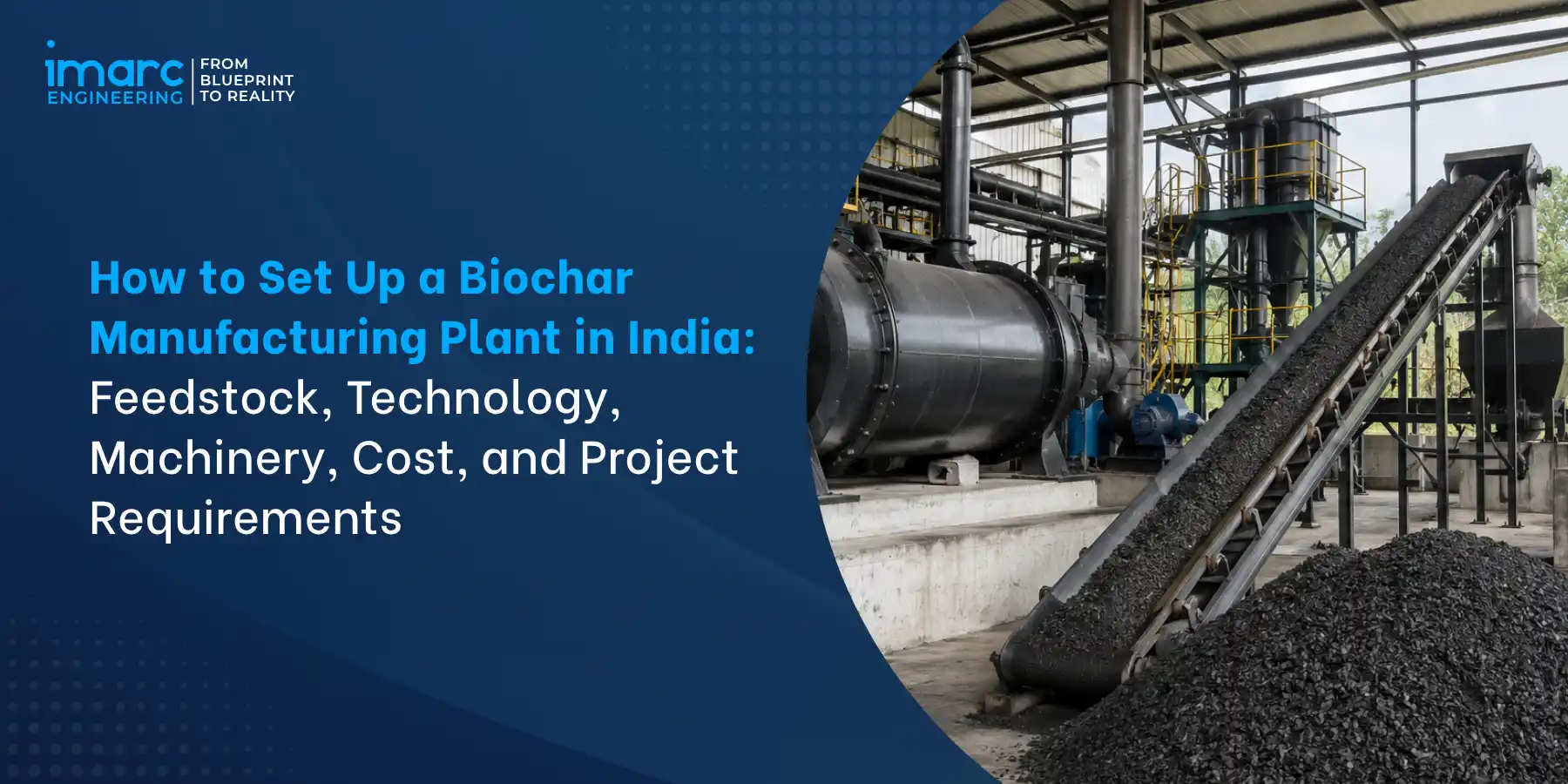
How to Set Up a Biochar Manufacturing Plant in India: Feedstock, Technology, Machinery, Cost, and Project Requirements
Introduction
For project developers, investors, and manufacturers evaluating a biochar manufacturing plant in India in 2026, disciplined planning across feedstock, pyrolysis technology, machinery, plant capacity, regulatory compliance, and target markets determines project viability. India's agricultural residue availability estimated at 500-600 million tonnes annually, combined with growing sustainability and carbon markets, creates commercial biochar production opportunity requiring careful project engineering rather than opportunistic entry.
Scope of this Guide
This guide answers the sponsor's question directly. How can project developers evaluate and set up a commercially viable biochar plant in India based on feedstock availability, plant capacity, pyrolysis technology, machinery, project cost, regulatory requirements, and target markets?
It walks through feedstock selection, pre-processing, pyrolysis technology, machinery configuration, capacity brackets anchored to explicit assumptions, plant infrastructure, investment planning, and applicable regulatory requirements, including SPCB CTE/CTO, factory licensing, product-specific requirements for agricultural applications where applicable, and potential carbon-credit pathways through the CCTS Offset Mechanism or international standards.
Table of Contents
- Introduction
- Why Biochar Manufacturing Matters for India in 2026
- What a Biochar Manufacturing Plant Is and Why It Matters in India
- Biomass Feedstock Selection and Pre-Processing for Biochar Production in India
- Pyrolysis Technology and Manufacturing Process for Biochar in India
- Machinery and Equipment for a Biochar Production Plant in India
- Plant Capacity Utilities and Infrastructure for Biochar Manufacturing in India
- Investment Capital Cost and Operating Economics for Biochar Production in India
- Environmental Approvals and Regulatory Requirements for Biochar Plants in India
- Conclusion
1. Why Biochar Manufacturing Matters for India in 2026
Four drivers make disciplined biochar plant setup a strategic priority for Indian project developers in 2026.
1.1 Agricultural Residue Availability
India generates 500-600 million tonnes of agricultural residues annually including rice husk, wheat straw, sugarcane bagasse, cotton stalks, groundnut shells, corn cobs, and mustard stalks. A significant portion is burned in-field creating air quality issues (particularly in northern states during October-November).
Biochar manufacturing in India provides productive utilisation of agricultural residues supporting rural income, reduced open burning, and value creation. Feedstock cost advantage and abundant supply support commercially viable biochar production compared to virgin biomass sourcing in regions with limited agricultural residue availability.
1.2 Carbon Market Development
India's Carbon Credit Trading Scheme (CCTS) established through Ministry of Environment, Forest and Climate Change (MoEFCC) notification with Greenhouse Gases Emission Intensity Target Rules 2025 creates evolving carbon market framework. CCTS Offset Mechanism specifically allows non-obligated entities including farmers and Farmer Producer Organisations (FPOs) to register projects for GHG emission reduction, removal, or avoidance.
Biochar carbon-removal projects could potentially participate in India's carbon market if an applicable methodology and eligibility pathway are available under the CCTS Offset Mechanism. As of 2026, a biochar-specific methodology does not appear on BEE's published list of approved offset methodologies. International voluntary carbon standards may provide separate biochar carbon-removal pathways where projects satisfy the applicable methodology, monitoring, verification, permanence, feedstock, and chain-of-custody requirements. Carbon-credit revenue should therefore remain conditional rather than guaranteed.
1.3 Market Diversification
Biochar has diversified end-use markets supporting revenue stability. Agricultural markets include soil amendment, fertilizer carrier, livestock feed additive, and composting accelerator. Industrial markets include metallurgical reductant, activated carbon precursor, filtration media, and construction material additive. Environmental markets include water treatment, soil remediation, and stormwater filtration.
Market diversification reduces single-customer dependency and supports differentiated pricing based on specifications. Product specifications significantly affect target market alignment with agricultural-grade biochar typically simpler than industrial or activated-carbon-grade products.
1.4 Policy and Sustainability Alignment
Biochar projects can align with broader Indian priorities around agricultural-residue utilisation, circular economy, biomass valorisation, emissions reduction, soil management and carbon removal. However, the applicability of individual government schemes, incentives or agricultural-product regulations should be assessed against the specific feedstock, technology, product classification and end use of each project.
State pollution control boards increasingly support biomass-to-value projects reducing open burning. Biochar production in India aligns with ESG frameworks, sustainability commitments of consumer brands, and rural livelihood development priorities creating supportive operating environment.
2. What a Biochar Manufacturing Plant Is and Why It Matters in India
Understanding what a biochar manufacturing plant is and why it matters in India begins with defining commercial-scale biochar production. Biochar plants are integrated biomass-processing facilities rather than simple pyrolysis units.
2.1 Definition and Scope
A commercial biochar production plant is an integrated biomass-processing facility converting agricultural residues, woody biomass, or other organic feedstocks into biochar (a stable carbon-rich solid) through pyrolysis in oxygen-limited conditions. Commercial plants combine feedstock reception and storage, pre-processing (size reduction, drying), pyrolysis reactor, char cooling and finishing, packaging, syngas handling, and emission control.
Commercial biochar plants differ from laboratory or demonstration units primarily through production scale, controlled feedstock handling, repeatable process conditions, product-quality management, emissions management, material handling and economically sustainable operation. Depending on capacity and technology, commercial facilities may use batch, semi-continuous or continuous production systems.
2.2 Plant Components
| Component | Function | Illustrative Elements |
|---|---|---|
| Feedstock Handling | Reception, storage, pre-processing | Weighbridge, storage yard, chipper, shredder |
| Drying System | Moisture reduction to 10-20% | Rotary dryer or belt dryer |
| Pyrolysis Reactor | Thermochemical conversion | Rotary kiln, screw reactor, batch retort |
| Char Handling | Cooling, screening, crushing | Char cooler, screens, hammer mill |
| Syngas System | Recovery and utilisation | Combustion chamber, heat exchanger |
| Emission Control | Air quality compliance | Cyclone, scrubber, bag filter, ESP |
| Packaging | Product finishing and dispatch | Bagging line, palletiser, warehouse |
| Utilities | Power, water, air, drainage | Substation, water storage, compressor |
2.3 Product End-Use Applications
- Agricultural soil amendment for improving soil water retention, cation exchange, and microbial activity
- Agricultural soil-conditioning or formulated agricultural applications, subject to applicable product classification, specifications and regulatory requirements
- Livestock feed additive supporting animal health and reduced methane emissions
- Composting accelerator and odour control
- Activated carbon precursor for filtration applications
- Metallurgical reductant replacing coke in specific applications
- Water treatment and environmental remediation media
- Construction material additive for cement and concrete formulations
2.4 End-Use Application Impact on Plant Design
End-use application significantly affects biochar plant design including feedstock selection, pyrolysis conditions, post-processing, and packaging. Agricultural-grade biochar typically tolerates broader feedstock and specification ranges compared to industrial applications. Activated carbon precursor grade requires specific feedstock and controlled pyrolysis conditions. Metallurgical grade requires low ash and specific volatile content.
Specialised applications may require additional contaminant limits, handling controls, testing, certification or regulatory compliance depending on the target market. Defining the intended end use and required product specification during plant design helps avoid costly retrofits or market limitations after commissioning.
3. Biomass Feedstock Selection and Pre-Processing for Biochar Production in India
Understanding biomass feedstock selection and pre-processing for biochar production in India determines plant economics and product quality. Feedstock decisions establish the baseline for all subsequent plant design decisions.
3.1 Feedstock Categories
- Biomass feedstock for biochar covers multiple categories with distinct characteristics
- Agricultural residue to biochar including rice husk, wheat straw, sugarcane bagasse, cotton stalks, groundnut shells, corn cobs
- Woody biomass including coconut shell, coconut fibre, wood chips, sawdust, prosopis juliflora
- Bamboo and bamboo processing residues
- Poultry litter (with appropriate handling)
- Sewage sludge (with special treatment and product-use restrictions)
- Municipal green waste (managed sources only)
- Industrial biomass by-products from processing industries
Waste-derived feedstocks such as sewage sludge, poultry litter and municipal green waste require additional assessment of contamination, heavy metals, ash, emissions, regulatory classification, product safety and permissible end uses. They should not be treated as interchangeable with clean agricultural residues or woody biomass when designing the process or defining target markets.
3.2 Feedstock Properties Affecting Plant Economics
Feedstock properties significantly affect plant economics and product characteristics. Moisture content determines drying energy requirement and pre-processing effort. Particle size determines size reduction requirement. Bulk density affects storage volume and material handling. Ash content affects carbon concentration, mineral composition, biochar yield and suitability for different end uses. Acceptable ash levels therefore depend on the target product specification rather than a single universal quality threshold. Volatile matter content affects syngas yield and pyrolysis heat balance.
Fixed carbon content affects biochar yield potential. Lignin content affects biochar stability and quality. Contamination levels including plastics, stones, and hazardous materials affect processing and product safety. Feedstock consistency significantly impacts plant operational reliability.
3.3 Feedstock Availability and Sourcing
| Feedstock Category | Typical Availability Regions | Sourcing Considerations |
|---|---|---|
| Rice husk | Punjab, Haryana, UP, Andhra, Odisha, WB | Seasonal harvest, rice mill tie-ups |
| Sugarcane bagasse | UP, Maharashtra, Karnataka, Tamil Nadu | Sugar mill tie-ups, seasonal peak |
| Cotton stalks | Maharashtra, Gujarat, Telangana | Post-harvest collection required |
| Coconut shell | Kerala, Tamil Nadu, Karnataka, Andhra | Coconut processor tie-ups |
| Wheat straw | Punjab, Haryana, UP | Post-harvest window, storage needed |
| Wood chips | Multiple states | Sawmill/timber industry tie-ups |
3.4 Feedstock Pre-Processing
- Biomass preprocessing requirements depend on feedstock characteristics and pyrolysis reactor type
- Feedstock size reduction through chippers, shredders, or hammer mills targeting 10-50 mm particles typical
- Feedstock drying reducing moisture from as received (20-50%) to 10-20% for efficient pyrolysis
- Contaminant removal including stones, metals, and plastics through magnetic separators and screens
- Storage in covered facilities preventing moisture pickup and quality degradation
- Feedstock blending for consistent characteristics if multiple sources
- Pre-processing typically consumes 5-10 percent of energy balance
4. Pyrolysis Technology and Manufacturing Process for Biochar in India
Understanding pyrolysis technology and manufacturing process for biochar in India covers the core thermochemical conversion step. Technology selection affects biochar yield, product quality, energy balance, and plant economics.
4.1 Pyrolysis Process Fundamentals
The biochar manufacturing process uses pyrolysis, a thermochemical decomposition of biomass in oxygen-limited or oxygen-free conditions at elevated temperatures. Biomass converts into three primary products: biochar (solid carbon-rich residue), syngas (non-condensable gases), and bio-oil (condensable liquid). Product distribution depends on temperature, heating rate, and residence time. Biomass carbonization through pyrolysis captures fixed carbon while releasing volatile matter as syngas and bio-oil. Syngas typically combusted for process heat while bio-oil recovery is optional depending on plant design.
4.2 Pyrolysis Technology Categories
| Technology | Temperature | Biochar Yield |
|---|---|---|
| Slow Pyrolysis | 300-500°C, long residence | 25-35% typical |
| Intermediate Pyrolysis | 400-550°C, medium residence | 20-30% typical |
| Fast Pyrolysis | 500-700°C, short residence | 15-25% typical (bio-oil focus) |
| Gasification | 700-900°C, high air/steam | 10-15% typical (syngas focus) |
4.3 Reactor Configurations
- Batch pyrolysis system: simpler batch retort or kiln operation suited to small-scale and modular installations
- Continuous pyrolysis system: rotary kiln, screw/auger reactor, or moving bed for continuous commercial operation
- Rotary kiln: robust for varied feedstock, moderate control precision
- Screw/auger reactor: continuous feed with good heat transfer, suited to fine feedstock
- Fluidized bed: strong heat and mass transfer with relatively uniform temperature control, but potentially greater feedstock-preparation and process-control complexity
- Moving bed/updraft: simple design, gravity-driven feed movement
- Vertical retort: batch or semi-batch operation for premium biochar grades
4.4 Process Steps
The biochar production process follows sequential steps. Feedstock reception and quality check at weighbridge and inspection. Pre-processing through size reduction and drying to target specifications. Feedstock feeding to pyrolysis reactor with controlled rate. Pyrolysis at target temperature and residence time per selected technology. Syngas separation and routing to combustion for process heat with excess handled per emission standards.
Biochar discharge and cooling through water-cooled or dry-cooled systems preventing spontaneous combustion. Biochar screening for particle size distribution. Crushing to target particle size if required by end-use. Packaging in bags or bulk containers with quality documentation. Process control through instrumentation monitoring temperature, pressure, feed rate, and product quality parameters supporting consistent operation.
5. Machinery and Equipment for a Biochar Production Plant in India
Understanding machinery and equipment for a biochar production plant in India covers the largest single capital investment category. Machinery selection should match feedstock characteristics, capacity, product specifications, and automation preferences.
5.1 Feedstock Handling and Pre-Processing
- Weighbridge for feedstock reception and inventory tracking
- Storage yard or silos with covered/open areas per feedstock characteristics
- Chippers for woody biomass reducing to 10-50 mm particles
- Shredders for agricultural residues and mixed biomass
- Hammer mills for fine particle production if required
- Screens and separators for particle sizing and contaminant removal
- Magnetic separators removing tramp iron
- Rotary or belt dryers reducing moisture to 10-20 percent
5.2 Pyrolysis Reactor and Char Handling
- Pyrolysis reactor selected per capacity and feedstock (rotary kiln, screw/auger, fluidized bed, batch retort)
- Biochar cooling system through water-cooled or dry-cooled screw conveyors preventing spontaneous combustion
- Biochar screening for particle size distribution meeting product specifications
- Biochar crushing if required for target particle size range
- Biochar packaging through bagging line (25-50 kg bags typical) or bulk container filling
5.3 Syngas and Emission Control
- Syngas recovery through insulated ducting to combustion chamber or gas engine
- Pyrolysis gas treatment including tar removal and condensate handling
- Combustion chamber for syngas providing process heat with heat exchangers
- Emission control system including cyclone separator, wet scrubber, bag filter, or electrostatic precipitator per SPCB standards
- Stack with continuous emission monitoring system (CEMS) for regulatory compliance
5.4 Supporting Equipment
Supporting equipment covers utilities and quality infrastructure. Electrical substation and distribution (typical 50-500 kVA depending on capacity). Water treatment for process and cooling. Compressed air for pneumatic instrumentation. Cooling water tower for heat rejection. Fire protection system with hydrants and extinguishers. Material handling including conveyors, forklifts, and loaders.
Laboratory for feedstock and biochar quality analysis (proximate, ultimate, ash, calorific value). Control room with SCADA or DCS system. Supporting equipment typically represents 15-25 percent of primary machinery cost.
6. Plant Capacity Utilities and Infrastructure for Biochar Manufacturing in India
Understanding plant capacity utilities and infrastructure for biochar manufacturing in India affects both operational efficiency and project economics. Capacity and infrastructure planning should be integrated rather than sequential decisions.
6.1 Plant Capacity Categories
| Category | Biochar Output | Land Area (Indicative) |
|---|---|---|
| Micro / Community | 0.5-2 TPD (150-600 TPA) | 0.5-1 acre |
| Small Commercial | 2-10 TPD (600-3,000 TPA) | 1-3 acres |
| Medium Industrial | 10-30 TPD (3,000-9,000 TPA) | 3-8 acres |
| Large Industrial | 30-100 TPD (9,000-30,000 TPA) | 8-20 acres |
6.2 Land and Layout Requirements
- Raw material storage zones for feedstock covering typically 15-30 days consumption
- Finished product storage zones for biochar warehousing and dispatch preparation
- Plant layout with segregated zones for feedstock, processing, char handling, packaging, utilities, and offices
- Pyrolysis area with adequate clearances for reactor operation and maintenance access
- Emission control equipment area near stack with maintenance access
- Truck movement zones supporting inbound feedstock and outbound biochar dispatch
- Fire tender access per NBC 2016 Part 4 requirements
- Future expansion allowance in initial site planning
6.3 Utilities Requirement
Utilities requirement covers power (typical 50-500 kVA depending on capacity), water for process cooling and utility, compressed air for pneumatic instrumentation, cooling water for char cooling, and fuel (self-sufficient through syngas combustion after startup). Effluent generation is limited to cooling water blowdown requiring basic treatment. Backup power through DG set recommended for operational continuity. Utility integration with syngas heat recovery reduces external fuel dependency during operation.
6.4 Mass and Energy Balance
Mass balance for typical slow pyrolysis: 100 units feedstock (dry basis) yields 25-35 units biochar, 30-40 units syngas, 15-25 units bio-oil. Energy balance typically achieves self-sufficiency post-startup through syngas combustion. External fuel required primarily for startup. Mass and energy balance calculations during design support both capacity sizing and utility planning.
7. Investment Capital Cost and Operating Economics for Biochar Production in India
Understanding investment capital cost and operating economics for biochar production in India requires capacity-specific analysis rather than universal figures. The brackets below reflect indicative ranges anchored to explicit capacity and technology assumptions.
7.1 Capital Investment by Category
| Plant Category | Capacity Assumption | Machinery + Setup (INR) |
|---|---|---|
| Micro / Community | 0.5-2 TPD, batch/simple technology | 25-75 lakh |
| Small Commercial | 2-10 TPD, semi-continuous | 75 lakh to 3 crore |
| Medium Industrial | 10-30 TPD, continuous rotary kiln | 3-8 crore |
| Large Industrial | 30-100 TPD, continuous with heat integration | 8-25 crore |
7.2 Investment Composition
Plant investment typically distributes across pyrolysis reactor (25-35 percent), feedstock handling and pre-processing (15-20 percent), emission control system (10-15 percent), char handling and packaging (10-15 percent), utilities (8-12 percent), civil works excluding land (10-15 percent), pre-operative expenses (3-5 percent), and contingency (5-8 percent). Land cost varies significantly by location. Working capital typically 15-25 percent of annual turnover. Total project cost estimation should include all components rather than machinery alone.
7.3 Operating Cost Structure
- Feedstock cost: 30-50 percent of variable cost depending on sourcing
- Labour cost: 10-15 percent depending on plant capacity and automation
- Power and utilities: 5-10 percent (lower with syngas self-sufficiency)
- Consumables and maintenance: 5-8 percent
- Packaging materials: 3-5 percent
- Freight and dispatch: 5-10 percent depending on customer distance
- Depreciation: 5-10 percent
- Administrative and marketing overhead: 5-10 percent
7.4 Project Feasibility Drivers
Project feasibility depends on multiple integrated factors. Feedstock availability within economical transport radius (typically 50-100 km) supporting cost-competitive sourcing. Feedstock cost stability through multi-source contracts. Plant capacity utilisation above 70 percent supporting fixed cost recovery. Biochar yield realization matching design assumptions.
Product specifications matching target market pricing. Offtake arrangements including direct customers or distribution channels. Carbon credit revenue treated conditionally rather than integral to base case. Well-planned biochar projects typically achieve EBITDA margins in 15-25 percent range.
8. Environmental Approvals and Regulatory Requirements for Biochar Plants in India
Understanding environmental approvals and regulatory requirements for biochar plants in India covers both plant setup compliance and product-specific regulations. Regulatory framework has evolved with growing biochar market recognition.
8.1 Central and State Approvals
| Approval | Authority | Framework |
|---|---|---|
| IEM Part A/B (via NSWS) | DPIIT | IDRA 1951 |
| CTE and CTO | State Pollution Control Board | Water Act 1974, Air Act 1981 |
| Factory Licence | State Directorate of Factories | OSH Code 2020 (in force 21 Nov 2025) |
| Fire NOC | State Fire Services | NBC 2016 Part 4 |
| GST, PAN, EPF, ESI | CBIC, IT Dept, EPFO, ESIC | CGST Act 2017, IT Act 1961 |
| FCO Registration | Dept. of Agriculture & Farmers Welfare | Fertiliser Control Order 1985 |
| Environmental Clearance | SEIAA / MoEFCC | EIA Notification 2006 (if applicable) |
8.2 Emission and Environmental Compliance
Biomass pyrolysis and associated combustion, drying and gas-handling systems can create air-emission control and monitoring requirements. Applicable emission limits and monitoring parameters should be established from the relevant CPCB/SPCB framework, plant category, installed combustion or pollution-control systems and the specific conditions imposed through the Consent to Establish and Consent to Operate. Online or continuous emission monitoring, including regulatory data connectivity, should be provided where specifically required by applicable directions or consent conditions.
Water Act 1974 compliance for effluent management. Air Act 1981 compliance for stack emissions. Solid waste management for process residues (ash, dust). Environmental Clearance under EIA Notification 2006 depending on plant capacity. Compliance discipline from commissioning avoids regulatory action.
8.3 Product-Specific Regulatory Requirements for Agricultural Biochar Applications
Where biochar is marketed for agricultural use with soil-amendment, fertiliser, biostimulant or related product claims, the developer should first establish the applicable product classification and regulatory pathway under the prevailing agricultural-input framework. Requirements can differ according to the notified product category, composition, claims, specifications and intended use. Biochar should therefore not automatically be assumed to fall within a particular Fertiliser (Control) Order category without confirming the applicable notification and product requirements.
Product-registration, testing, labelling and quality requirements should be determined from the regulatory category applicable to the specific biochar product and claims. Developers targeting agricultural markets should establish this pathway during feasibility and product-development planning so that feedstock selection, testing, process control and product specifications are aligned with the intended commercial use.
8.4 Carbon Credit Considerations - Conditional Revenue
Biochar carbon credits represent conditional rather than guaranteed revenue and should not be integral to base case financials. Commercial viability carbon credit and market considerations for biochar projects in India require careful assessment. India's Carbon Credit Trading Scheme (CCTS) notified through MoEFCC with Greenhouse Gases Emission Intensity Target Rules 2025 and CERC (CCC) Regulations 2026 governs the compliance carbon market administered by Bureau of Energy Efficiency (BEE) with Grid Controller of India Limited (GCIL) operating the Indian Carbon Market (ICM) registry.
The CCTS Offset Mechanism provides a framework for eligible non-obligated entities to register qualifying GHG mitigation projects under approved methodologies and applicable procedures. As of 2026, eight offset methodologies approved by BEE. Biochar-specific methodology approval remains in evolution. International carbon standards including Verra VCS and Puro.earth offer established biochar methodologies. Carbon removal revenue potential requires methodology qualification, project registration, third-party verification, market access, and price realisation subject to voluntary or compliance market conditions rather than guaranteed pricing.
Conclusion
Setting up a biochar manufacturing plant in India requires feedstock assessment, product-market alignment, pyrolysis technology selection, machinery configuration, plant capacity and investment planning, and emission-control systems. Regulatory requirements may include SPCB CTE/CTO, factory licensing, Fire NOC, IEM via NSWS, applicable FCO registration, environmental clearance, and conditional carbon-credit mechanisms.
Three priorities matter for sponsors. First, feedstock availability, cost, and consistency drive project economics. Second, biochar specifications should match the intended end-use and market. Third, carbon-credit revenue is conditional, so projects should remain financially viable through product sales, with credits treated as potential upside.
PURSUING BIOCHAR MANUFACTURING PLANT SETUP?
IMARC Engineering’s biochar manufacturing plant advisory team supports developers, investors, and manufacturers with feedstock assessment, product-market alignment, pyrolysis technology and machinery selection, plant layout, utilities, capital investment and operating-cost estimation, and project economics. The team advises on feedstocks including agricultural residues, woody biomass, bamboo, and poultry litter; pyrolysis technologies such as slow, intermediate, fast, and gasification systems; and equipment for drying, reactors, char cooling, screening, packaging, syngas recovery, and emission control. Services also cover regulatory approvals, environmental compliance, FCO requirements, applicable environmental clearances, carbon-credit strategies, and integrated project management for industrial biochar plants in India.
→ Schedule a free biochar plant scoping consultation with an IMARC specialist
Frequently Asked Questions
Setting up a biochar manufacturing plant in India involves feedstock assessment, capacity planning, pyrolysis technology selection, machinery selection, plant layout design, utility planning, FCO 1985 registration if sold as soil amendment, SPCB CTE/CTO, factory licence under OSH Code 2020, and commissioning across 8-15 months.
Feedstocks for commercial biochar production include agricultural residues (rice husk, wheat straw, sugarcane bagasse, cotton stalks, groundnut shells), woody biomass (coconut shell, wood chips, prosopis), bamboo, and poultry litter. Feedstock selection depends on local availability, moisture content, particle size, and target biochar specifications.
The biochar manufacturing process involves biomass feedstock reception, pre-processing (size reduction, drying to 10-20% moisture), pyrolysis in oxygen-limited reactor at 400-700°C (slow, fast, or intermediate), biochar cooling, screening and crushing, packaging. Syngas from pyrolysis is combusted for process heat with emission control per SPCB standards.
Biochar plant machinery includes biomass reception and storage, size reduction (chipper, shredder, hammer mill), drying system, pyrolysis reactor (batch, continuous rotary kiln, screw type, or fluidized bed), biochar cooling system, screening and crushing units, packaging line, syngas handling, and emission control systems (cyclone, scrubber).
Biochar plant cost in India varies with capacity, pyrolysis technology, and automation. Micro units (0.5-2 TPD biochar output) require INR 25-75 lakh; small (2-10 TPD) INR 75 lakh to 3 crore; medium (10-30 TPD) INR 3-8 crore; large (30-100 TPD) INR 8-25 crore excluding land.
Capacity selection depends on feedstock availability, target biochar output, market demand, and investment appetite. Pyrolysis technology selection depends on feedstock characteristics, target biochar yield and specifications, product application (soil amendment, industrial), and CAPEX budget. Slow pyrolysis (300-500°C) maximises biochar yield; fast pyrolysis maximises bio-oil.
Biochar manufacturing plants require SPCB CTE/CTO under Water Act 1974 and Air Act 1981, factory licence under OSH Code 2020, Fire NOC per NBC 2016, FCO 1985 registration if sold as soil amendment or biostimulant, IEM registration, GST/EPF/ESI, and emission control per CPCB standards.
Commercial viability depends on feedstock availability and pricing, biochar yield (typically 25-35% for slow pyrolysis), plant capacity utilisation, product specifications matched to end-use, operating cost, offtake arrangements, and conditional carbon credit revenue through CCTS Offset Mechanism or international standards subject to methodology approval.
Recent Post

Trusted by Industry Leaders
We partner with global enterprises and ambitious businesses across sectors to deliver operational excellence, strategic insights, and sustainable growth through integrated solutions.












Success in Their Words
Real feedback from clients across industries. Discover how our solutions delivered measurable impact and operational excellence.

I wanted to express my sincere appreciation for your efforts in handling this matter. Your dedication and commitment have been truly commendable, and it is evident that you have put in tremendous hard work and expertise into resolving the issues at hand. We are greatly interested in continuing our collaboration with you in the future, as your professionalism and reliability have made you a trusted partner. Thank you once again for your invaluable contribution. We look forward to strengthening our partnership ahead.

It has been a pleasure working with the IMARC team. The insights provided were structured, clear, and highly valuable, helping us strengthen both our technical and financial planning with confidence. We deeply appreciate the team’s professionalism, responsiveness, and attention to detail throughout the engagement. Every requirement was well understood and effectively incorporated, resulting in a comprehensive and actionable output. Overall, our experience has been excellent, and I would gladly recommend IMARC to organizations seeking a reliable research partner.

Your service is truly exceptional. Working with the IMARC team has been a seamless and professional experience. The clarity of communication, responsiveness to queries, and consistent support at every stage made the entire engagement highly efficient. The insights shared were well-structured, practical, and perfectly aligned with our requirements, helping us make informed decisions with confidence. Overall, the dedication and professionalism demonstrated by your team stand out, and I would be glad to recommend IMARC as a reliable and trustworthy research partner.

IMARC did an outstanding job in preparing our study. They were punctual, precise, and consistently responsive throughout the entire process. The team delivered all the data we required in a clear, well-organized, and highly professional format. Their strong attention to detail, combined with their ability to meet every deadline without compromising quality, truly set them apart. Overall, their reliability and commitment made them an exceptional partner for our project, and we would gladly work with them again in the future.

IMARC made the whole process incredibly easy from start to finish. Everyone I interacted with via email was polite, professional, and straightforward to deal with, always keeping their promises regarding delivery timelines and remaining consistently solutions-focused. From my very first contact, I appreciated the professionalism and support shown by the entire IMARC team. I highly recommend IMARC to anyone seeking timely, affordable, and reliable information or advice. My experience with IMARC was excellent, and I truly cannot fault any aspect of it.

I’d like to express my sincere gratitude for the excellent work you accomplished with the study. Your ability to quickly understand our requirements and deliver high-quality results under tight timelines truly reflects your expertise, exceptional work ethic, and unwavering commitment to your customer’s success. The professionalism and responsiveness you demonstrated throughout the process made a significant difference. Our entire team and company are incredibly thankful for your dedication, reliability, and support. Once again, thank you for your outstanding contribution.