Manufacturing
September 04 2026
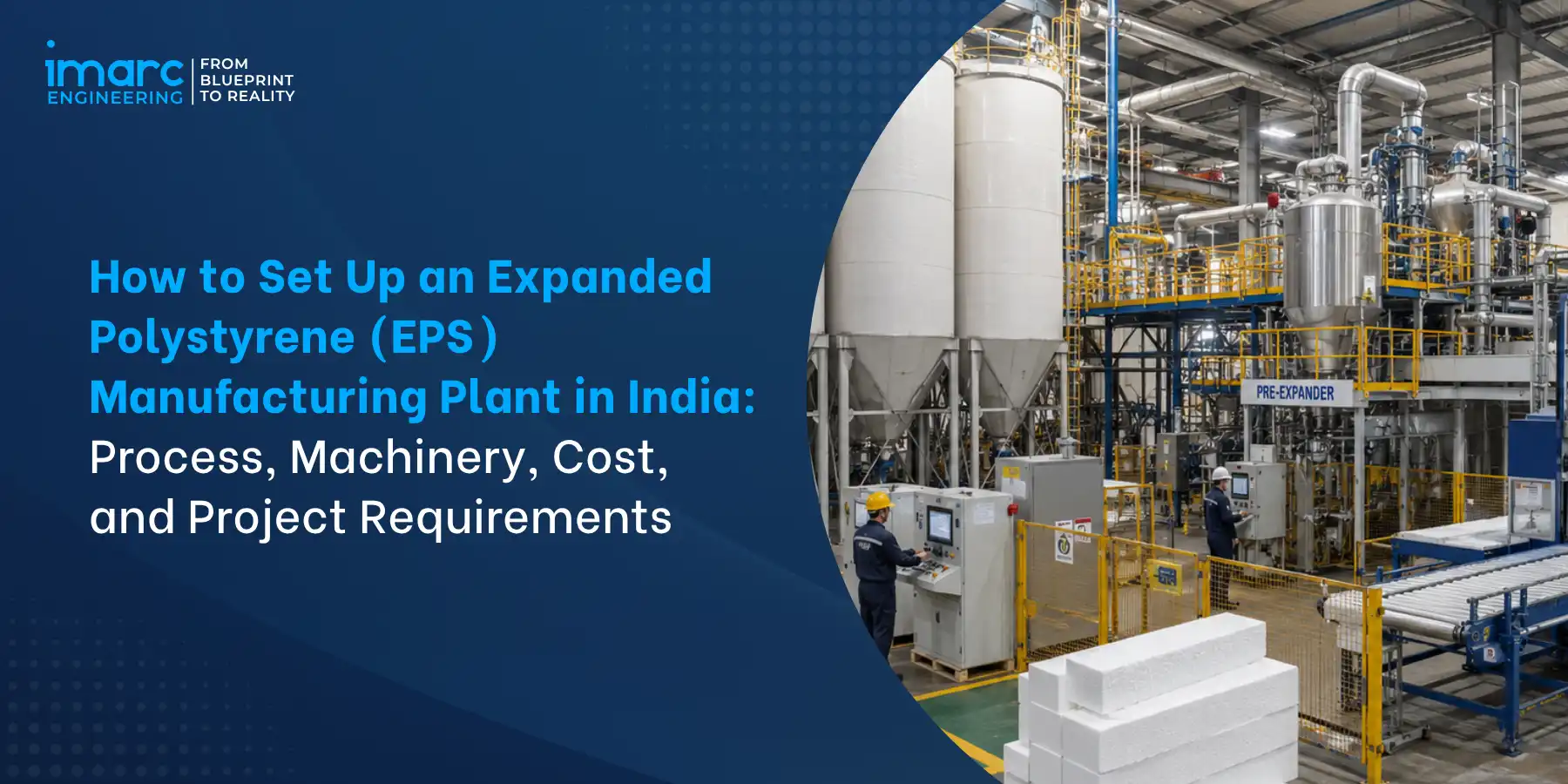
How to Set Up an Expanded Polystyrene (EPS) Manufacturing Plant in India: Process, Machinery, Cost, and Project Requirements
Introduction
For manufacturers, investors, and project developers evaluating an expanded polystyrene manufacturing plant in India in 2026, disciplined project planning across product mix, capacity, machinery, utilities, and regulatory compliance determines commercial viability. India's packaging and construction insulation markets create sustained EPS demand across electronics packaging, cold-chain, appliance packaging, construction insulation, and specialty applications. Well-planned EPS projects require integrated engineering rather than piecemeal machinery procurement.
Scope of this Guide
This guide answers the sponsor's question directly. How can manufacturers and project developers plan and set up a commercially viable EPS manufacturing plant in India based on product mix, capacity, process technology, machinery, utilities, project cost, compliance requirements, and target markets?
It walks through raw materials, expandable polystyrene beads, pre-expansion and moulding processes, machinery configuration, plant capacity brackets anchored to explicit assumptions, utilities including steam and compressed air, investment planning, and applicable regulatory requirements covering SPCB CTE/CTO, factory and fire-safety approvals, plastic-waste and EPR requirements where applicable, boiler compliance, hazardous-material and PESO requirements where triggered by the plant configuration, and relevant product standards such as IS 4671:2018 for thermal insulation applications.
Table of Contents
- Introduction
- Why EPS Manufacturing Matters for India in 2026
- What an EPS Manufacturing Plant Is and Why It Matters in India
- Raw Materials and Expandable Polystyrene Beads for EPS Production in India
- EPS Manufacturing Process from Pre-Expansion to Finished Products in India
- Machinery and Equipment for an EPS Manufacturing Plant in India
- Plant Capacity Utilities and Infrastructure for EPS Manufacturing in India
- Investment Capital Cost and Operating Economics for EPS Production in India
- Environmental Fire-Safety and Regulatory Requirements for EPS Plants in India
- Conclusion
1. Why EPS Manufacturing Matters for India in 2026
Four drivers make disciplined EPS plant setup a strategic priority for Indian manufacturers and investors in 2026.
1.1 Packaging Market Demand
India's electronics manufacturing, white goods, appliance, glass, ceramics, pharmaceutical, and cold-chain sectors generate sustained EPS packaging demand. Expanded polystyrene manufacturing in India serves regional packaging needs where local supply provides cost, logistics, and lead-time advantages against long-distance shipment of bulky low-density product.
EPS packaging offers shock absorption, thermal protection, and lightweight properties suited to high-value fragile goods. Regional EPS plants close to consumer clusters (Delhi-NCR, Pune, Bengaluru, Chennai, Hyderabad, Ahmedabad) support just-in-time delivery to packaging customers with reduced inventory and freight cost.
1.2 Construction Insulation Growth
India's energy conservation focus, cold-chain infrastructure expansion, and cold-storage build-out drive construction insulation demand. EPS boards and blocks serve building envelope insulation, cold storage panels, sandwich panel cores, insulated concrete forms (ICF), and roof/wall insulation applications. EPS used for thermal-insulation applications may need to meet applicable product specifications such as IS 4671:2018, which covers expanded polystyrene boards, blocks and related forms for thermal-insulation purposes.
Energy Conservation Building Code (ECBC) implementation across commercial buildings and cold-chain infrastructure investment create sustained insulation demand supporting commercial-scale EPS insulation manufacturing.
1.3 EPS vs XPS Distinction
EPS (Expanded Polystyrene) and XPS (Extruded Polystyrene) are distinct products with different manufacturing processes, machinery, and applications. EPS is made from expandable polystyrene beads (containing 4-7 percent pentane blowing agent) expanded and moulded with steam producing a fused-bead closed-cell structure. XPS is made from polystyrene resin extruded with blowing agent producing a uniform closed-cell structure.
XPS typically offers higher compressive strength and lower water absorption; EPS typically offers cost advantage and shape flexibility. This guide covers EPS manufacturing plant in India setup exclusively - XPS extrusion lines require entirely different machinery and process design.
1.4 Import Substitution and Domestic Sourcing
Domestic EPS manufacturing can reduce dependence on long-distance or imported supply for certain packaging, insulation and specialty applications while providing shorter lead times and product customisation. Expandable polystyrene bead is manufactured by petrochemical majors with growing domestic supply though certain specialty grades continue to be imported.
EPS finished product manufacturing serves regional markets with local supply advantages including reduced freight cost, shorter lead times, and customisation flexibility. Well-located EPS plants near consumer clusters deliver competitive advantages across multiple Indian regions.
2. What an EPS Manufacturing Plant Is and Why It Matters in India
Understanding what an EPS manufacturing plant is and why it matters in India begins with defining commercial-scale EPS production. EPS plants are integrated bead-processing and moulding facilities rather than simple foam-forming operations.
2.1 Definition and Scope
A commercial EPS production plant converts expandable polystyrene beads through pre-expansion, aging/stabilization, and steam moulding into finished EPS products including blocks (for cutting into boards and shapes) and moulded shapes (for custom packaging). Commercial plants combine bead reception and storage, pre-expander for controlled expansion, aging silos for bead stabilization, block or shape moulding machines, hot wire cutting systems, packaging, steam boiler, compressed air, and cooling water systems. Commercial EPS plants differ from small-scale operations through continuous operation capability, product consistency, safety compliance, and economic scale supporting commercial viability.
2.2 Plant Components
| Component | Function | Illustrative Elements |
|---|---|---|
| Bead Handling | Reception, storage, pneumatic conveying | Silos, blowers, conveying lines |
| Pre-Expansion | Bead expansion with steam to target density | Continuous or batch pre-expander |
| Aging/Stabilization | Bead conditioning for moulding readiness | Fluidized aging silos |
| Moulding | Steam moulding into blocks or shapes | Block moulding or shape moulding machines |
| Cutting | Block cutting into boards or shapes | Hot wire cutting machines |
| Utilities | Steam, compressed air, cooling, power | Boiler, compressor, cooling tower |
| Packaging | Finished product finishing and dispatch | Shrink wrapping, palletisation |
| Scrap Recycling | EPS scrap grinding and reincorporation | Grinder, dosing system |
2.3 Product Categories and Applications
- Packaging shapes: custom moulded EPS shapes for electronics, appliances, glass, ceramics
- Fish/perishable boxes: standard moulded boxes for cold-chain transport
- Insulation boards: cut from blocks for construction insulation (walls, roofs, cold storage)
- Sandwich panel cores: EPS core for prefab sandwich panels
- Insulated concrete forms (ICF): shaped EPS forms for concrete filling
- Geofoam blocks: lightweight fill for construction and infrastructure
- Lost formwork: shaped EPS voids for concrete construction
- Speciality shapes: custom industrial and consumer applications
2.4 Product Mix and Plant Design Impact
Product mix significantly affects plant design and machinery selection. Block-focused plants (insulation, geofoam) use block moulding machines with capacity focused on large blocks cut into standard boards. Shape-focused plants (custom packaging) use shape moulding machines with multiple moulds. Mixed plants require both machine types with corresponding capacity split.
Target foam density affects pre-expander capacity sizing. Fire-retardant (FR) grade requires FR-grade bead handling and dedicated production runs. Product specifications matched to target market during design avoid costly retrofits post-commissioning.
3. Raw Materials and Expandable Polystyrene Beads for EPS Production in India
Understanding raw materials and expandable polystyrene beads for EPS production in India establishes the input side of plant economics. Raw material selection determines product quality, production efficiency, and cost structure.
3.1 Expandable Polystyrene Bead
EPS raw materials primary input is expandable polystyrene beads (also called EPS pearls). Beads are spherical polystyrene particles containing 4-7 percent pentane as blowing agent that vaporises during steam heating creating cellular foam structure. Beads are supplied by petrochemical manufacturers in specified size grades typically 0.3-2.5 mm (smaller beads for thin-walled shapes and dense products; larger beads for insulation blocks and light-density products). Beads are supplied in 500-1,000 kg woven bags or bulk with specific handling requirements including cool storage and static electricity control.
3.2 Bead Grades and Product Applications
| Bead Grade | Application | Key Characteristics |
|---|---|---|
| General Purpose | Standard packaging, non-critical | Cost-optimised, general density range |
| Fire-Retardant (FR) | Construction insulation, ICF | Contains flame retardants per IS 4671:2018 |
| Food-Contact | Food packaging, fish boxes | Meets food-contact specifications |
| High-Impact | Heavy-duty packaging, geofoam | Enhanced mechanical properties |
| Speciality Grades | Custom industrial applications | Application-specific formulations |
3.3 Bead Storage and Handling
- EPS bead storage requires temperature-controlled or ventilated facilities preserving pentane content
- Fire safety compliance for storage areas due to pentane flammability
- Ventilation preventing pentane accumulation
- Static electricity control including grounded conveying
- FIFO inventory management preventing bead aging
- Shelf life typically 3-6 months from bead manufacture depending on grade and storage
- Bead sampling and quality verification against certificate of analysis (COA)
3.4 Secondary Inputs
Secondary inputs include steam (from an industrial boiler for pre-expansion and moulding), water (for cooling and boiler feed), compressed air (for pneumatic conveying and controls), electricity (for machinery drives), packaging materials (shrink film, corrugated packaging, wooden pallets and strapping), maintenance consumables, and process chemicals for water treatment. Consumable costs typically represent 5-8 percent of total operating cost.
4. EPS Manufacturing Process from Pre-Expansion to Finished Products in India
Understanding EPS manufacturing process from pre-expansion to finished products in India covers the sequential conversion steps. Process discipline determines product quality, yield, and operating efficiency.
4.1 Pre-Expansion
The EPS manufacturing process begins with EPS bead pre-expansion. Expandable polystyrene beads are fed to EPS pre-expander where steam heating at 85-95°C vaporises pentane causing bead expansion typically 40-50 times original volume. Continuous pre-expanders provide throughput with real-time density control; batch pre-expanders provide flexibility for varied densities.
Pre-expansion determines final product density with lower target density requiring larger expansion multiple. Pre-expander output is transferred pneumatically to aging silos. Pre-expansion is a critical process-control stage because expansion conditions directly influence bulk density, bead condition, product consistency and downstream moulding performance.
4.2 Aging and Stabilization
EPS aging and stabilization in fluidized silos allows expanded beads to reach equilibrium. Steam and pentane vapour that occupied bead cells diffuse out, and air diffuses in creating stable internal pressure. Aging typically requires 6-24 hours depending on bead grade, expanded density, and ambient conditions. Under-aged beads collapse during moulding; over-aged beads lose expansion capability. Aging silo capacity should accommodate 24–48-hour production requirement. Fluidization air prevents bead agglomeration and supports uniform aging.
4.3 Moulding Process
- EPS molding process uses steam chest molding: beads fed to mould cavity, mould closed, steam injected at 110-120°C
- Steam causes bead re-expansion and fusion at contact surfaces forming solid product
- Steam pressure typically 0.7-1.5 bar gauge depending on product density and thickness
- Cooling with water spray on mould exterior reduces product temperature and stabilises dimensions
- Vacuum applied to accelerate cooling and remove moisture
- Mould opens; product ejected with dimensional check
- Cycle time typically 2-8 minutes depending on product thickness and machine type
4.4 Block Moulding vs Shape Moulding
| Aspect | Block Moulding | Shape Moulding |
|---|---|---|
| Product Type | Large blocks (later cut) | Direct final shape |
| Typical Applications | Insulation boards, geofoam | Packaging shapes, fish boxes |
| Machine Type | Block moulding machine | Shape moulding machine |
| Cycle Time | 8-15 minutes typical | 2-6 minutes typical |
| Downstream Processing | Requires cutting operations | Direct-to-packaging |
| Mould Investment | Single large mould | Multiple product-specific moulds |
4.5 Cutting and Finishing
For block-moulded products, EPS drying in temperature-controlled area allows moisture equilibration typically 24-48 hours before cutting. EPS block cutting machine uses hot wire cutting with heated resistance wires cutting blocks into boards or profiled shapes. Automated CNC hot wire cutting supports complex 2D and 3D profiles. Trim scrap is collected for recycling. Direct-to-shape moulded products may only require deflashing and inspection before packaging.
5. Machinery and Equipment for an EPS Manufacturing Plant in India
Understanding machinery and equipment for an EPS manufacturing plant in India covers the largest single capital investment category. EPS manufacturing machinery selection should match product mix, capacity, and automation preferences.
5.1 Bead Handling and Pre-Expansion Machinery
- Bead reception and storage silos with pneumatic conveying
- Continuous or batch pre-expander with density control instrumentation
- Fluidized aging silos sized for 24-48 hour production requirement
- Inter-machine pneumatic conveying with rotary valves and blowers
- Weighing and dosing systems for pre-expander feeding
- Density measurement and quality control instrumentation
5.2 Moulding Machinery
- Block moulding machine: produces large EPS blocks (typical 1x1x4 m or 1x2x6 m) for cutting into boards
- Shape moulding machine: produces direct-to-shape moulded products with product-specific moulds
- Aluminium moulds for shape moulding designed per product with steam channels
- Mould change systems for shape moulding supporting product changeovers
- Automated demoulding and product handling
- Vacuum pump for accelerated cooling
5.3 Cutting and Finishing Equipment
- EPS block cutting machine with horizontal and vertical hot wire cutting
- CNC hot wire cutting for complex profiles
- Contour cutting machines for architectural and specialty shapes
- Trimming and finishing stations for shape-moulded products
- Product inspection and quality check stations
- Packaging equipment (shrink wrapping, palletisation, strapping)
5.4 Utilities and Support Equipment
Utility equipment includes industrial boiler, water treatment for boiler feed, air compressor and receiver, cooling tower for heat rejection, and DG set for backup power. EPS scrap recycling equipment includes grinder and dosing system for reincorporation into virgin bead feed.
Laboratory equipment for density measurement and quality parameters. Control room with PLC/SCADA for integrated plant operation. Fire protection system including sprinklers, hydrants, and portable extinguishers per NBC 2016 Part 4 with additional consideration for EPS flammability.
6. Plant Capacity Utilities and Infrastructure for EPS Manufacturing in India
Understanding plant capacity utilities and infrastructure for EPS manufacturing in India affects both operational efficiency and project economics. Capacity and infrastructure planning should be integrated rather than sequential decisions.
6.1 Production Capacity Categories
| Category | EPS Output | Land Area (Indicative) |
|---|---|---|
| Small Commercial | 500-1,500 kg/day (150-450 TPA) | 0.5-1.5 acres |
| Medium | 1,500-5,000 kg/day (450-1,500 TPA) | 1.5-3 acres |
| Large Industrial | 5,000-15,000 kg/day (1,500-4,500 TPA) | 3-6 acres |
6.2 Land and Layout Requirements
- Raw material storage zones for bead inventory (typically 15-30 days consumption with FIFO management)
- Finished goods storage with high volume-to-weight ratio requiring large warehouse area (EPS is low-density product)
- Plant layout with pre-expansion, aging silos, moulding shop, cutting area, packaging zones logically sequenced
- Boiler house located per fuel type with statutory clearances
- Pentane-containing bead storage segregated with fire safety compliance
- Fire tender access per NBC 2016 Part 4 requirements
- Truck movement zones supporting inbound bead and outbound finished product
- Future expansion allowance in initial site planning
6.3 Utilities Requirement
Utilities requirement for EPS plants is steam intensive. Steam generation through industrial boiler typically 500-3,000 kg/hr capacity depending on plant scale, with steam consumption 1.5-3 kg per kg EPS. Compressed air requirement for pneumatic conveying and controls typically 100-500 CFM at 6-8 bar. Cooling water system for mould cooling, vacuum system, and utility. Power (typical 100-500 kVA depending on capacity). DG set backup for critical loads. Boiler fuel selection (LPG, diesel, natural gas, biomass) affects operating cost significantly.
6.4 Storage Considerations for EPS Products
EPS product storage design differs from most manufacturing due to product characteristics. Low density (typically 10-40 kg/m³) means high volume per kg storage. Flammability requires fire safety infrastructure including sprinklers, compartmentation, and clear aisles. Static electricity buildup requires grounding and humidity control. Product stacking limits per NBC 2016 Part 4 fire safety guidelines. Segregated storage for FR-grade and standard-grade products. Storage area typically 30-50 percent of covered plant area due to volume characteristics.
7. Investment Capital Cost and Operating Economics for EPS Production in India
Understanding investment capital cost and operating economics for EPS production in India requires capacity-specific analysis rather than universal figures. The brackets below reflect indicative ranges anchored to explicit capacity and technology assumptions.
7.1 Capital Investment by Category
| Plant Category | Capacity Assumption | Machinery + Setup (INR) |
|---|---|---|
| Small Commercial | 500-1,500 kg/day, basic automation | 50 lakh to 1.5 crore |
| Medium | 1,500-5,000 kg/day, semi-automated | 1.5-5 crore |
| Large Industrial | 5,000-15,000 kg/day, fully automated | 5-15 crore |
7.2 Investment Composition
Plant investment typically distributes across moulding machinery (25-35 percent), pre-expander and aging silos (15-20 percent), boiler and utilities (15-20 percent), cutting and finishing equipment (8-12 percent), material handling and packaging (5-8 percent), civil works excluding land (10-15 percent), pre-operative expenses (3-5 percent), and contingency (5-8 percent). Machinery source (European, Chinese, domestic) affects capital cost with European machines commanding 2-3x premium. Working capital typically 20-30 percent of annual turnover.
7.3 Operating Cost Structure
- Bead raw material cost: 55-70 percent of variable cost (largest single component)
- Fuel cost (boiler): 8-15 percent depending on fuel type
- Power: 5-8 percent
- Labour: 8-12 percent depending on plant capacity and automation
- Packaging materials: 3-5 percent
- Consumables and maintenance: 3-5 percent
- Freight and dispatch: 5-10 percent (higher for distant customers due to bulk)
- Overhead: 5-8 percent
7.4 Project Feasibility Drivers
Project feasibility depends on multiple integrated factors. Commercial viability and market considerations for EPS manufacturing projects in India require assessment across location near consumer markets minimising freight cost given EPS bulk, capacity utilisation above 70 percent supporting fixed cost recovery, product mix balancing block and shape production per market opportunity, bead sourcing arrangements with reliable supply, fuel cost management given steam intensity, customer diversification across packaging and insulation markets, and fire safety compliance avoiding regulatory disruption. Well-planned EPS projects typically achieve EBITDA margins in 12-20 percent range subject to bead cost and market realization.
8. Environmental Fire-Safety and Regulatory Requirements for EPS Plants in India
Understanding environmental fire-safety and regulatory requirements for EPS plants in India covers plant setup compliance, product regulations, and fire safety framework. EPS has unique compliance considerations due to pentane blowing agent and plastic waste framework.
8.1 Central and State Approvals
| Approval | Authority | Framework |
|---|---|---|
| IEM Part A/B (via NSWS) | DPIIT | IDRA 1951 |
| CTE and CTO | State Pollution Control Board | Water Act 1974, Air Act 1981 |
| Factory Licence | State Directorate of Factories | OSH Code 2020 (in force 21 Nov 2025) |
| Fire NOC | State Fire Services | NBC 2016 Part 4 |
| Boiler Registration | Chief Inspector of Boilers | Boilers Act 2025 |
| PESO Approval | PESO | Pentane storage per SMPV(U) Rules 2016 |
| PWM/EPR Registration | CPCB | PWM Rules 2016 with 2026 amendment |
8.2 Plastic Waste Management Rules Compliance
Where EPS products constitute plastic packaging, the applicable obligations under the Plastic Waste Management Rules and Extended Producer Responsibility framework should be assessed based on the manufacturer's role and products placed on the market. Rigid plastic packaging falls within Category I of the EPR framework, and entities meeting the applicable Producer, Importer or Brand Owner (PIBO) definitions are subject to the corresponding registration, recycling and waste-management requirements. Annual returns filed by 30 June for previous financial year. Non-compliance attracts environmental compensation per CPCB assessment. PWM compliance is integral to EPS producer operations.
8.3 Fire Safety and Pentane Handling
EPS plants require enhanced fire safety framework due to pentane blowing agent in beads (highly flammable) and EPS product flammability. Fire NOC per National Building Code 2016 Part 4 with EPS-specific considerations. Sprinkler systems, water spray systems, and fire hydrants covering bead storage, aging silos, moulding shop, and finished goods warehouse.
Appropriate fire detection and alarm systems, ventilation, pentane-vapour monitoring where required, and static-electricity controls should form part of the plant's hazard-management strategy. Separate storage or handling of pentane may trigger PESO and hazardous-chemical requirements depending on the quantity, storage form and installation configuration. The applicability of the MSIHC Rules, 1989 should similarly be assessed against the hazardous chemicals, quantities and conditions present at the specific facility. Emergency-response planning and worker training should form part of the overall safety system.
8.4 Product Standards and EPS Scrap Recycling
Product standards include Bureau of Indian Standards IS 4671:2018 (Expanded Polystyrene for Thermal Insulation Purposes) governing thermal insulation grade EPS with specifications for density, thermal conductivity, dimensional stability, and flammability. Fire-retardant grade compliance per IS 4671:2018 required for construction insulation applications.
EPS scrap recycling through in-house grinder and reincorporation into virgin bead feed typically limited to 5-15 percent by weight preserving product quality. Post-consumer EPS collection through licensed recyclers as part of EPR obligations. Densified EPS has industrial recycling market as polystyrene feedstock.
Conclusion
Setting up an EPS manufacturing plant in India requires market and product-mix assessment, machinery selection, plant layout, utility planning, capacity and investment estimation, and regulatory compliance. Key requirements may include SPCB consent, factory licensing, fire-safety approvals, boiler registration, plastic EPR, PESO requirements, and BIS conformance.
Three priorities matter for sponsors. First, EPS and XPS use different manufacturing processes—steam-moulded expandable beads versus extrusion. Second, fire safety is critical because EPS is combustible and pentane may be used as a blowing agent. Third, product mix determines whether block moulding, shape moulding, or a combination of equipment is required, making these decisions important during initial plant design.
PURSUING EPS MANUFACTURING PLANT SETUP?
IMARC Engineering’s EPS manufacturing plant advisory team supports manufacturers, investors, and project developers with product-market assessment, EPS bead sourcing, machinery selection, plant layout, utility planning, investment estimation, operating economics, and regulatory compliance. Services cover pre-expansion, aging, block and shape moulding, hot-wire cutting, packaging, steam, compressed air, cooling water, and power requirements. The team also supports applicable IEM, SPCB CTE/CTO, factory licensing, fire-safety, boiler, plastic EPR, PESO, and BIS compliance requirements for commercial EPS manufacturing plants in India.
→ Schedule a free EPS plant scoping consultation with an IMARC specialist
Frequently Asked Questions
Setting up an EPS manufacturing plant in India involves market/product mix assessment, capacity planning, machinery selection (pre-expander, aging silos, block/shape moulding, cutting), plant layout, steam boiler and utility planning, PWM Rules 2016 EPR registration, SPCB CTE/CTO, factory licence under OSH Code 2020, and fire NOC.
The primary EPS raw materials input is expandable polystyrene beads containing 4-7% pentane as blowing agent, typically supplied by petrochemical manufacturers. Grades include general purpose (packaging), fire-retardant (construction/insulation), and food-contact grade per end-use. Secondary inputs include steam, water, compressed air, packaging materials, and process consumables.
The EPS manufacturing process converts expandable polystyrene beads through pre-expansion (steam heating to 85-95°C expanding beads 40-50 times), aging/stabilization for 6-24 hours in silos, moulding (block moulding for insulation blocks or shape moulding for packaging) using steam chest at 110-120°C, cooling, drying, and cutting.
EPS plant machinery includes pre-expander (continuous or batch), aging/stabilization silos with fluidization, block moulding machine (for insulation blocks) or shape moulding machine (for packaging applications), steam boiler, hot wire cutting for blocks, compressed air system, cooling water system, and EPS scrap recycling grinder unit.
EPS plant cost in India varies with capacity, machinery configuration, and automation level. Small units (500-1,500 kg/day output) typically require INR 50 lakh to 1.5 crore; medium (1,500-5,000 kg/day) INR 1.5-5 crore; large (5,000-15,000 kg/day) INR 5-15 crore excluding land, building, and working capital.
Plant capacity depends on target product mix (packaging, insulation blocks), market demand, and investment appetite. Machinery selection depends on product type: block moulding machine for insulation blocks and heavy packaging, shape moulding machine for custom packaging shapes, pre-expander sized to throughput and target foam density.
EPS plant utilities include steam (industrial boiler 500-3,000 kg/hr typical), compressed air, cooling water system, and power (typical 100-500 kVA). Infrastructure covers raw material storage (silos or warehouse for bead inventory), aging silos, moulding shop, block warehouse, cutting area, packaging area, and finished goods storage.
EPS plants require SPCB CTE/CTO under Water Act 1974 and Air Act 1981, factory licence under OSH Code 2020, Fire NOC per NBC 2016 Part 4, PWM Rules 2016 EPR registration via CPCB portal, PESO approval for pentane storage, MSIHC 1989 compliance, and boiler registration.
Recent Post

Trusted by Industry Leaders
We partner with global enterprises and ambitious businesses across sectors to deliver operational excellence, strategic insights, and sustainable growth through integrated solutions.











Success in Their Words
Real feedback from clients across industries. Discover how our solutions delivered measurable impact and operational excellence.

I wanted to express my sincere appreciation for your efforts in handling this matter. Your dedication and commitment have been truly commendable, and it is evident that you have put in tremendous hard work and expertise into resolving the issues at hand. We are greatly interested in continuing our collaboration with you in the future, as your professionalism and reliability have made you a trusted partner. Thank you once again for your invaluable contribution. We look forward to strengthening our partnership ahead.

It has been a pleasure working with the IMARC team. The insights provided were structured, clear, and highly valuable, helping us strengthen both our technical and financial planning with confidence. We deeply appreciate the team’s professionalism, responsiveness, and attention to detail throughout the engagement. Every requirement was well understood and effectively incorporated, resulting in a comprehensive and actionable output. Overall, our experience has been excellent, and I would gladly recommend IMARC to organizations seeking a reliable research partner.

Your service is truly exceptional. Working with the IMARC team has been a seamless and professional experience. The clarity of communication, responsiveness to queries, and consistent support at every stage made the entire engagement highly efficient. The insights shared were well-structured, practical, and perfectly aligned with our requirements, helping us make informed decisions with confidence. Overall, the dedication and professionalism demonstrated by your team stand out, and I would be glad to recommend IMARC as a reliable and trustworthy research partner.

IMARC did an outstanding job in preparing our study. They were punctual, precise, and consistently responsive throughout the entire process. The team delivered all the data we required in a clear, well-organized, and highly professional format. Their strong attention to detail, combined with their ability to meet every deadline without compromising quality, truly set them apart. Overall, their reliability and commitment made them an exceptional partner for our project, and we would gladly work with them again in the future.

IMARC made the whole process incredibly easy from start to finish. Everyone I interacted with via email was polite, professional, and straightforward to deal with, always keeping their promises regarding delivery timelines and remaining consistently solutions-focused. From my very first contact, I appreciated the professionalism and support shown by the entire IMARC team. I highly recommend IMARC to anyone seeking timely, affordable, and reliable information or advice. My experience with IMARC was excellent, and I truly cannot fault any aspect of it.

I’d like to express my sincere gratitude for the excellent work you accomplished with the study. Your ability to quickly understand our requirements and deliver high-quality results under tight timelines truly reflects your expertise, exceptional work ethic, and unwavering commitment to your customer’s success. The professionalism and responsiveness you demonstrated throughout the process made a significant difference. Our entire team and company are incredibly thankful for your dedication, reliability, and support. Once again, thank you for your outstanding contribution.