Manufacturing
November 03 2026
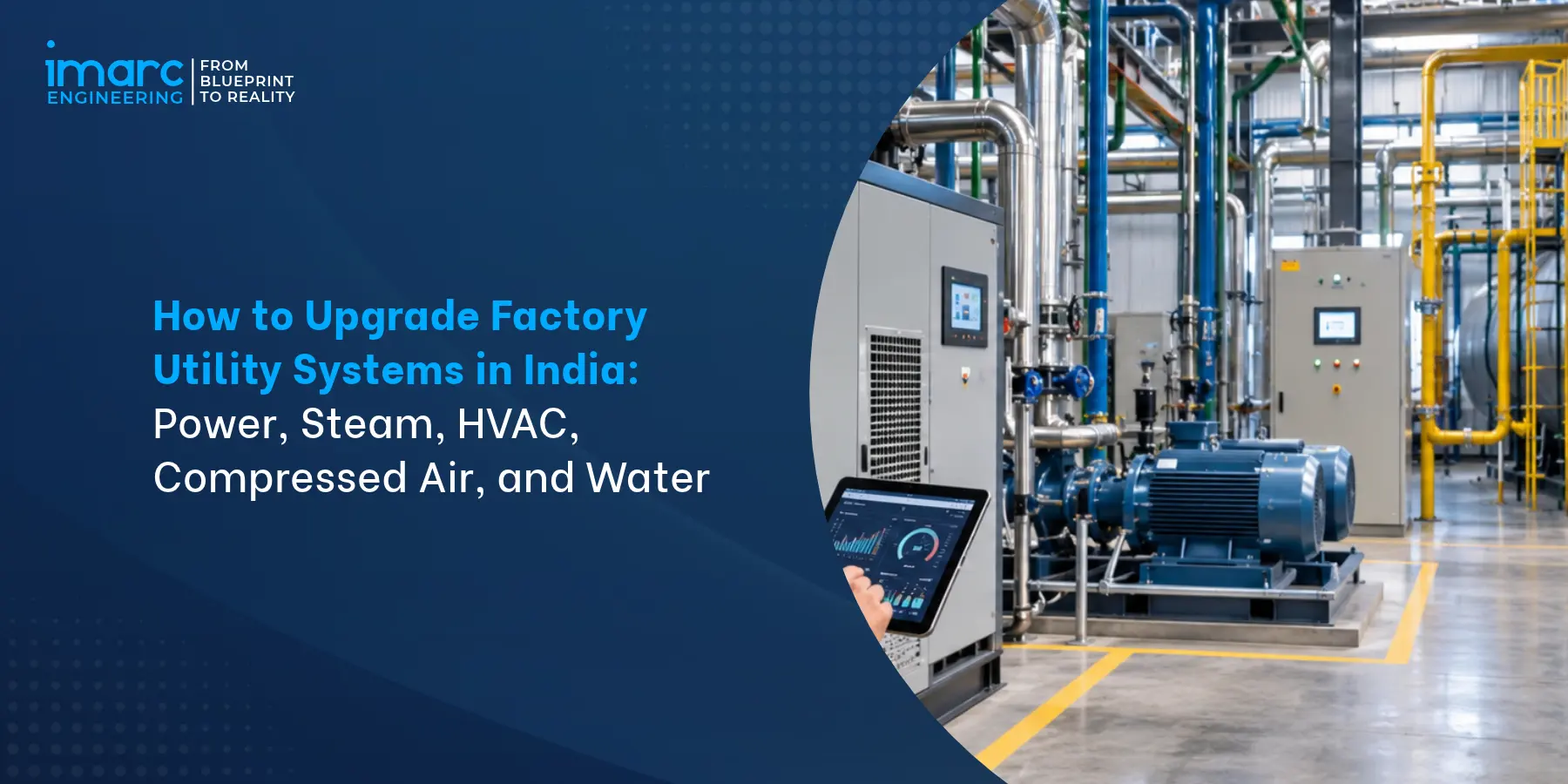
How to Upgrade Factory Utility Systems in India: Power, Steam, HVAC, Compressed Air, and Water
Introduction
For owners and engineering managers of operating manufacturing plants in India, factory utility upgradation is a project-execution challenge as much as a technical one. Electrical loads grow with each capacity addition, steam headers age and leak, compressed air systems run at inflated pressure to compensate for distribution losses, and HVAC equipment installed a decade ago no longer meets hygiene or comfort standards. The result is rising utility cost, unplanned downtime, and a growing gap between installed capacity and production demand.
This guide is written for plant owners, project engineers, and capital sponsors planning brownfield utility upgrades across electrical, steam, HVAC, compressed air, and water systems. It addresses how to assess existing infrastructure, determine additional capacity, evaluate upgrade options, estimate investment costs, plan shutdowns, coordinate safe tie-ins, and commission upgraded systems while keeping production disruption to the minimum that engineering discipline allows. Every figure that varies by project is presented as an indicative planning range, labelled accordingly, and must be replaced by site surveys, vendor quotations, and authority confirmations during the detailed project report stage.
Scope of this Guide
This guide answers one question: how can manufacturers in India plan and execute factory utility upgrades while managing capacity requirements, investment costs, production downtime, and operational risks? It covers brownfield upgrade execution for power, steam, HVAC, compressed air, and water utility systems in operating manufacturing plants from capacity assessment and upgrade option selection through equipment installation, shutdown planning, tie-ins, commissioning, and performance acceptance. New greenfield utility design, energy auditing methodology, and standalone energy-efficiency programmes are outside its scope.
Table of Contents
- Introduction
- Why Factory Utility Upgradation in India Matters for Plant Owners in 2026
- What Factory Utility Upgradation Involves and Why It Matters
- Factory Utility Upgradation in India: System Types, Capacity Planning, and Site Assessment
- Equipment Specifications and Procurement Requirements for Factory Utility Upgradation in India
- Core Upgrade Process Steps Part 1: Electrical, Steam, and Boiler System Upgradation in India
- Core Upgrade Process Steps Part 2: HVAC, Compressed Air, and Water System Upgradation in India
- Equipment Layout, System Integration, and Auxiliary Utility Requirements
- Approvals, Safety, and Project Economics for Factory Utility Upgradation in India
- Conclusion
1. Why Factory Utility Upgradation in India Matters for Plant Owners in 2026
Four structural conditions make disciplined factory utility upgradation in India commercially critical in 2026, and each changes what a plant owner should measure before committing capital.
1.1 Production Capacity Growth Outpacing Original Utility Design
A power system's adequacy should be assessed using recorded maximum demand, load profiles, power factor, transformer loading, operating duration and projected production requirements. Contracted demand and connected load are not directly comparable indicators of transformer loading. For example, a plant with 1 MVA of contracted demand and 1.8 MVA of connected load may still operate within transformer capacity if the loads do not run simultaneously. However, sustained demand above the sanctioned limit may require a review of the supply arrangement and electrical infrastructure.
Steam capacity should be assessed using measured consumption, peak coincident demand, operating pressure, and distribution losses. For example, an increase in production may raise steam demand beyond the boiler's available output during peak operating periods. However, the upgrade requirement should be established through a steam balance rather than by comparing the boiler's original rating with total connected process demand.
1.2 Regulatory and Compliance Pressure
The Bureau of Energy Efficiency's Perform, Achieve and Trade (PAT) scheme applies to designated consumers notified under the scheme. Manufacturers should first confirm whether their facility falls within the applicable sector and designation criteria before treating PAT targets as an upgrade requirement. Other relevant obligations may arise from electrical safety regulations, DISCOM supply conditions, State Electricity Regulatory Commission (SERC) regulations, and environmental consents.
Electrical connectivity standards, DISCOM supply agreements, and state electricity regulations serve different purposes. Requirements relating to protection systems, metering, sanctioned demand and power factor should therefore be verified against the applicable regulations, tariff orders and supply conditions for the facility's location. Environmental requirements should be checked against the plant's Consent to Establish, Consent to Operate, and applicable directions issued by the State Pollution Control Board.
1.3 Utility Infrastructure as a Capital Asset Requiring Lifecycle Management
The service life of transformers, boilers, compressors and associated controls varies with equipment design, operating conditions, duty cycle, maintenance history and environmental exposure. Rather than relying on a fixed replacement age, plant owners should assess equipment condition, failure history, performance deterioration, spare-parts availability, technological obsolescence and the cost of continued operation. These factors help determine whether refurbishment, component replacement, or complete system upgradation is commercially justified.
Replacing one system in isolation, without assessing the load demand on interconnected systems, typically produces a sub-optimal outcome: a new boiler feeding a corroded and heat-losing steam distribution network, or a new transformer supplying a switchgear panel with undersized busbars and ageing protection relays. A structured upgrade programme that sequences interventions across systems and integrates them with production planning delivers better capital efficiency than emergency replacements triggered by equipment failure.
1.4 The Cost of Deferred Upgradation
Deferring factory utility upgrades can increase equipment failure risks, operating costs and unplanned production downtime. Deteriorating infrastructure may also affect energy efficiency, process reliability and maintenance expenditure. Plant owners should assess these risks using operating records, equipment-condition assessments and measured utility performance. Comparing the cost of continued operation with planned upgrade investments helps determine when infrastructure improvements become technically and commercially justified.
2. What Factory Utility Upgradation Involves and Why It Matters
Factory utility upgradation in India is defined by the systems it touches, the operating constraints it must respect, and the gap between current and required performance it must close.
2.1 Definition and Scope of a Brownfield Utility Upgrade
A brownfield utility upgrade modifies or augments existing utility infrastructure electrical distribution, steam generation and distribution, HVAC, compressed air, or water treatment and supply inside an operating manufacturing facility, without the benefit of a clear site or an uninterrupted construction window.
Brownfield upgrades must be planned around the plant's production schedule, available shutdown windows, and dependence on existing utility systems. Some facilities can accommodate a planned full shutdown, while others may require phased installation and controlled tie-ins to keep critical operations running. Temporary utility arrangements may be considered where technically feasible, safe, and economically justified. The execution strategy should be selected after evaluating production sensitivity, isolation requirements, installation access, and the time required for testing and commissioning.
2.2 The Five Utility Systems and Their Upgrade Logic
The five systems that most commonly require upgrades in Indian manufacturing plants have distinct engineering requirements. Electrical upgrades may involve transformer augmentation, switchgear expansion, cable and busbar resizing, protection-system modernisation and power-factor correction based on measured demand and applicable supply conditions. Steam-system upgrades may include boiler capacity changes, burner modernisation, header modifications, steam-trap replacement and condensate recovery.
HVAC upgrades may involve chiller replacement, air-handling equipment, controls and refrigerant changes, subject to application requirements and equipment compatibility. Compressed-air upgrades may include compressor or dryer replacement, receiver augmentation, distribution-pipe modifications and leakage reduction. Water-system upgrades may involve treatment-capacity expansion, filtration, membrane systems, distribution pumps, reuse arrangements and effluent treatment. Any ZLD requirement should be verified against the facility's environmental consents and applicable regulatory directions.
2.3 Upgrade Triggers and Decision Criteria
A utility upgrade is triggered by one or more of four conditions: demand has grown beyond the installed system's rated capacity; equipment has reached or exceeded its economic life and is experiencing increasing maintenance frequency and cost; a new regulatory or quality requirement imposes a performance standard the existing system cannot meet; or a planned production capacity expansion requires utility headroom that the current infrastructure cannot provide.
The decision to upgrade rather than maintain is made on a lifecycle cost basis: the net present value of the upgrade investment including commissioning and production disruption is compared against the net present value of continued operation with its maintenance cost trajectory, production loss risk, and regulatory exposure. A plant that is nearing the end of its first major capital cycle will often find that a planned, integrated upgrade programme is more cost-effective than a series of reactive replacements.
2.4 Major Factory Utility Systems and Equipment
| Section | Function | Key Equipment |
|---|---|---|
| HT Metering and Incoming | Receive and meter high-tension supply from DISCOM | HT metering panel, CT/PT units, energy meters, surge arrestors |
| Main Distribution Substation | Step down HV to utilisation voltage and distribute to plant | 11kV/433V transformers, HT/LT switchgear, bus ducts, ACBs, MCCBs |
| Power Factor Correction | Maintain power factor in accordance with applicable DISCOM supply conditions and tariff requirements | Capacitor banks, APFC relay, harmonic filters |
| Boiler and Steam Generation | Generate saturated or superheated steam for process and utilities | Fire-tube or water-tube boilers, burners, economisers, feed water pumps |
| Steam Distribution Network | Convey steam to process users at required pressure | Steam headers, pressure reducing valves, safety valves, steam traps, insulation |
| HVAC Air Handling | Control temperature, humidity, and air quality in production spaces | Air handling units, chillers, cooling towers, FCUs, supply/return ductwork |
| Compressed Air System | Supply oil-free or lubricated compressed air at required pressure and quality | Screw compressors, refrigeration and desiccant dryers, receivers, distribution ring main |
| Industrial Water Treatment | Treat raw water to process, boiler feed, and potable quality | Clarifiers, pressure sand filters, activated carbon filters, softeners, RO/EDI units |
| Effluent Treatment | Treat process and utility effluent to consent discharge limits | Equalisation tanks, biological treatment, MBR or ETP, ZLD evaporators |
| Utilities Control and Monitoring | Integrate monitoring, alarming, and optimisation across systems | SCADA/BMS, PLCs, flow and energy meters, data historians |
3. Factory Utility Upgradation in India: System Types, Capacity Planning, and Site Assessment
Capacity planning and site assessment are the foundation of any factory utility upgradation in India programme they determine what must be upgraded, by how much, and in what sequence.
3.1 Electrical Load Assessment and Transformer Augmentation
Electrical load assessment should combine connected-load schedules, maximum demand records, load profiles, power factors and projected production growth. Transformer augmentation or replacement should be determined by peak demand, loading duration, thermal condition, redundancy, fault levels and future capacity requirements. Assess switchgear, busbars, cables and protection settings alongside transformer capacity. Confirm the utility's approval process and lead time with the relevant DISCOM.
3.2 Steam and Boiler Capacity Assessment
Boiler capacity assessment should begin with a steam balance covering process demand, operating pressure, peak coincidence and distribution losses. Inspect insulation, steam traps, condensate return and pressure-reducing stations to identify avoidable losses before adding boiler capacity. Where a genuine capacity deficit remains, evaluate boiler addition, replacement or heat recovery using measured demand and site-specific economics.
3.3 Compressed Air and HVAC Capacity Assessment
Compressed-air assessment should measure flow, operating pressure, compressor power, leakage and air quality under representative production conditions. HVAC assessment should recalculate thermal loads using current occupancy, process heat, building conditions, ventilation requirements, and operating hours. The results should establish whether existing equipment can meet forecast demand through optimisation or whether equipment augmentation, replacement or distribution modifications are necessary.
3.4 Industrial Water System and ZLD Assessment
Water-system assessment should quantify raw water intake, treatment capacity, process consumption, reuse and effluent generation. Engineers should compare existing infrastructure with projected production requirements to identify gaps in treatment, storage, pumping and distribution capacity. Any Zero Liquid Discharge (ZLD) requirement must be confirmed against the facility's environmental consents and applicable regulatory directions.
Where ZLD is required, assess effluent characteristics, treatment capacity, recovery targets and disposal constraints. The proposed configuration may include primary and secondary treatment, membrane-based recovery and evaporation, depending on site conditions. Equipment sizing and investment estimates should be supported by mass and energy balances, operating-cost analysis and applicable discharge requirements.
| Utility system | Existing capacity assessment | Forecast demand assessment | Upgrade decision |
|---|---|---|---|
| Electrical | Review maximum demand, transformer loading, load profile, power factor and distribution-system condition | Estimate additional demand from new machinery, operating hours and production expansion | Optimise load distribution, augment or replace transformers, or modify switchgear and cables where the assessment identifies a capacity or reliability gap |
| Steam and boilers | Review boiler output, operating pressure, peak steam consumption, condensate return and distribution losses | Prepare a steam balance for projected production volumes and simultaneous process requirements | Improve steam distribution and condensate recovery, optimise existing boilers, or add capacity if a verified deficit remains |
| Compressed air | Measure compressor output, pressure, power consumption, air quality, and leakage | Estimate additional air demand from new equipment and operating shifts | Reduce leakage and pressure losses, modify distribution piping or add compressor capacity where required |
| HVAC | Assess installed cooling capacity, thermal loads, airflow, humidity and equipment condition | Recalculate loads based on production changes, occupancy, ventilation, and process heat | Optimise existing equipment, upgrade chillers or AHUs, and modify distribution systems according to the revised load |
| Water and effluent | Review intake, treatment output, consumption, reuse, and effluent generation | Forecast water demand and wastewater volumes based on production capacity and process changes | Expand treatment, storage, pumping, reuse or effluent-treatment capacity according to the water balance and consent requirements |
The upgrade decision should not be based solely on the difference between installed capacity and forecast demand. Engineers should also assess equipment condition, operating constraints, redundancy, distribution losses, reliability requirements, and the feasibility of improving existing systems. This helps distinguish between a genuine capacity shortfall and a performance problem that can be resolved through optimisation or refurbishment.
4. Equipment Specifications and Procurement Requirements for Factory Utility Upgradation in India
Equipment specifications and procurement requirements should be developed around the existing plant infrastructure, operating conditions and proposed upgrade scope. In brownfield projects, equipment selection must account for compatibility with installed systems, available space, access for installation, connection points, utility requirements, maintenance needs and the effect of installation on ongoing production.
4.1 Electrical Upgrade Materials and Specifications
Electrical upgrade specifications should cover transformer ratings, winding and cooling arrangements, switchgear fault ratings, busbar capacity, cable sizing, earthing, protection systems and metering. Equipment selection should follow applicable BIS and IEC standards, supported by electrical load studies, fault-level calculations and compatibility assessments.
Procurement specifications should define technical ratings, integration with existing electrical infrastructure, inspection requirements, factory acceptance testing, documentation and commissioning responsibilities. Power-factor correction and harmonic mitigation equipment should be included where justified by measured operating conditions and applicable utility requirements.
4.2 Boiler and Steam System Materials
Boiler and steam-system specifications should account for existing operating pressure, temperature, fuel arrangements, connected pipework and available installation space. Identify the applicable Indian boiler regulations, approved pressure-part materials, design conditions, pipe class, valves, insulation and condensate recovery requirements. Boiler-water treatment should be selected based on feedwater analysis, boiler design and operating conditions. Confirm material certificates, inspection requirements and approvals with the relevant boiler authority and qualified designer.
4.3 HVAC and Compressed Air Equipment Specifications
HVAC equipment specifications should reflect the revised cooling load, indoor-air requirements, available electrical capacity, existing ductwork and compatibility with installed controls. Compressor and dryer selection should account for measured demand, required pressure, air quality, operating hours and redundancy. Piping, filters and associated components should be specified according to operating pressure, corrosion risk, installation constraints and maintenance requirements. Where existing equipment is retained, confirm that new components can operate reliably with the installed system.
4.4 Water Treatment Equipment and Chemical Requirements
Water-treatment equipment and chemicals should be selected according to feedwater quality, process requirements, existing treatment infrastructure, and the proposed treatment configuration. Assess the compatibility of new filtration, membrane, dosing and pumping equipment with existing systems. Chemical storage, containment, ventilation, labelling and emergency arrangements should reflect the hazards of the chemicals used and applicable safety requirements. Membrane replacement and maintenance schedules should be based on feedwater quality, operating performance and supplier recommendations.
5. Core Upgrade Process Steps Part 1: Electrical, Steam, and Boiler System Upgradation in India
The first group of core upgrade processes addresses the electrical distribution and steam generation systems that form the backbone of factory utility upgradation in India.
5.1 Electrical System Upgrade Execution
Electrical upgrades require revised single-line diagrams, transformer sizing, short-circuit analysis, relay coordination and cable sizing. Install and test new equipment before a planned shutdown, then execute the changeover using approved isolation, earthing and permit-to-work procedures in line with applicable CEA safety regulations. Determine the outage duration through site-specific planning, equipment requirements and rehearsed restoration procedures rather than assuming a fixed timeframe.
5.2 Boiler Installation and Commissioning
A boiler installation or replacement in an operating factory must be planned in accordance with the applicable provisions of the Boilers Act, 2025, the Indian Boiler Regulations and the procedures followed by the relevant State Boiler Directorate. The applicable requirements should be confirmed for the boiler type, design, pressure, capacity, and installation before procurement and fabrication. These may cover design scrutiny, inspection, testing, registration and permission for use, as applicable.
Site execution typically involves foundation preparation, equipment positioning, feedwater and fuel connections, steam outlet and blowdown pipework, flue-gas arrangements, instrumentation and safety systems. The installation plan should also account for access, lifting arrangements, existing utility connections, and the availability of space for auxiliary equipment. Condensate recovery and boiler-feedwater arrangements should be reviewed as part of the overall steam-system design.
The installation and commissioning schedule should be established using the selected boiler's manufacturing and delivery lead time, site readiness, civil and piping work, inspection requirements, testing and commissioning activities. A fixed installation duration should not be assumed without a defined project scope and execution schedule.
5.3 Steam Distribution Network Upgrade
Steam distribution upgrades should be planned around the plant's operating schedule, critical process users, isolation points and available shutdown windows. Begin with a survey of the existing network to identify pressure losses, damaged insulation, failed steam traps, condensate losses, corrosion and sections requiring replacement or resizing. Prepare the new pipework and supports in advance wherever practical, and identify the tie-in locations and isolation boundaries before work begins.
Temporary steam supply or bypass arrangements should only be used where a qualified engineering assessment confirms their suitability for the operating pressure, temperature, flow, material compatibility, mechanical loads and connection design. Flexible hoses should not be treated as a routine substitute for engineered steam piping. Where a new header is required, determine its nominal diameter through steam-flow calculations, allowable velocity, pressure drop and operating conditions. Specify pipe size using the applicable nominal pipe size or DN designation consistently.
Steam-trap replacement, insulation repairs and condensate recovery improvements can reduce avoidable losses. Their benefits should be estimated from a steam-system survey and verified through post-upgrade measurements. Do not assume a standard percentage of steam recovery or a fixed payback period across different plants.
5.4 Electrical Load Balancing and Power Quality
During electrical upgrade execution, verify load distribution, power-factor correction settings, harmonic performance and protection coordination under representative operating conditions. Commissioning should include relevant electrical measurements, relay testing, metering verification and integration checks with existing monitoring systems. Any deviations from approved design criteria or applicable supply requirements should be resolved before final handover.
6. Core Upgrade Process Steps Part 2: HVAC, Compressed Air, and Water System Upgradation in India
The second group of core upgrade processes covers HVAC, compressed air, and water systems, each of which requires specific shutdown planning and tie-in strategies for factory utility upgradation in India.
6.1 HVAC System Upgrade Execution
HVAC upgrades should begin with a review of the existing chiller, cooling tower, air-handling units, pumps, ductwork, controls and served production areas. Identify the equipment that can remain operational during installation and the sections that require isolation. Where production conditions require continuous temperature, humidity or air-quality control, assess whether temporary conditioning equipment is technically feasible and economically justified.
The execution plan should define equipment removal, lifting and installation routes, electrical and piping tie-ins, drainage connections and control-system modifications. Pre-installation work should be completed before the shutdown window wherever possible. After installation, carry out leak checks, flushing, electrical checks, control-loop verification and functional testing. Commissioning should confirm airflow, temperature, humidity, pressure and control performance against the approved design criteria before the affected production area returns to normal operation.
6.2 Compressed Air System Upgrade Execution
Compressed-air upgrades should be planned after confirming the required flow, operating pressure, air quality, redundancy and demand profile. Review the existing compressor room, receiver capacity, dryer arrangement, distribution ring main, drainage and electrical supply. Identify the sections that can be installed or modified without interrupting the existing air supply.
Where continuous compressed-air supply is essential, evaluate temporary compressor arrangements based on required capacity, air quality, pressure, connection compatibility and operating cost. Prepare new piping, supports, isolation valves, electrical connections and control interfaces before the changeover. During the planned tie-in, isolate and depressurise the relevant section, complete the connection and carry out leak and pressure checks. Commission the system by verifying pressure stability, flow, dew point and air quality under representative demand conditions.
6.3 Industrial Water and ZLD System Upgrade
Water and effluent-treatment upgrades should be sequenced around the plant's water demand, treatment capacity, storage availability and discharge requirements. Review the existing raw-water intake, treatment units, storage tanks, distribution pumps, reuse lines and effluent-treatment system. Identify tie-in points for new equipment and determine whether existing treatment units can remain operational during installation.
Temporary water supply, storage or effluent-handling arrangements may be required where the existing system must be isolated. Their suitability should be assessed against water quality, process demand, storage duration, environmental requirements and cost. Complete civil, piping, electrical and instrumentation work before the planned changeover wherever practical. Commissioning should include equipment checks, flushing, leak testing, instrument calibration and water-quality testing. Any revised effluent-treatment arrangement should demonstrate compliance with the facility's applicable consent conditions before the existing discharge or treatment arrangement is discontinued.
6.4 Shutdown Planning, Temporary Utility Arrangements, and Safe Tie-Ins
Brownfield utility upgrades require a shutdown plan that connects engineering readiness, production requirements, safety controls and restoration activities. The shutdown scope should identify every equipment item, pipeline, cable, valve and control system that must be isolated or modified. Define the isolation boundaries on approved drawings and confirm the responsibility of operations, maintenance, electrical, instrumentation, safety and contractor teams.
Shutdown readiness should cover:
- Approved engineering drawings, method statements, risk assessments and work permits.
- Completion of prefabrication, equipment inspections and material availability.
- Confirmed lifting plans, access routes, scaffolding and installation arrangements.
- Identified isolation points, lockout and tagout requirements, draining, depressurisation and purging procedures.
- Availability of tools, testing equipment, competent personnel and emergency arrangements.
- Agreed production shutdown and restoration schedule.
Temporary utility arrangements should be evaluated for critical services that cannot be interrupted. These may include temporary power, steam, compressed air, cooling or process water, depending on the plant's requirements. Each arrangement should undergo technical, safety and cost assessment. Capacity, connection compatibility, operating limits, monitoring and contingency provisions must be established before use. Temporary systems should not be installed or operated without approved engineering and safety procedures.
Go/no-go checks before shutdown execution should confirm that:
- The approved scope and drawings are available at the worksite.
- Equipment, materials, tools and contractors are ready.
- Production has completed the agreed shutdown and handover.
- Isolation boundaries have been verified by authorised personnel.
- Temporary arrangements and contingency measures are available where required.
- Inspection, testing and restoration teams are scheduled.
- The available shutdown window is adequate for the planned work and required testing.
During execution, monitor progress against the shutdown schedule and record any change in scope or site condition. If isolation cannot be verified, an unexpected hazard is identified, or the work cannot be completed safely within the available window, stop and reassess the plan rather than proceeding under time pressure.
After installation, complete mechanical, electrical and instrumentation checks, followed by pressure or leak testing where applicable. Verify interlocks, alarms, protection settings and operating parameters before introducing the utility. Restore systems in a controlled sequence, check for abnormal conditions and obtain operations-team acceptance. Temporary arrangements should only be removed after the permanent system has demonstrated stable performance, and the authorised team has approved the changeover.
7. Equipment Layout, System Integration, and Auxiliary Utility Requirements
Equipment selection, layout, and auxiliary utility assessment are important parts of brownfield upgrade planning. New equipment must be compatible with existing systems and fit within the available site layout, while meeting revised capacity, reliability, safety and maintenance requirements.
7.1 Electrical Equipment Selection and Layout
Electrical equipment layout should account for available substation space, equipment clearances, cable routing, ventilation, fire safety and maintenance access. Transformer or switchgear additions must be integrated with existing electrical distribution arrangements, protection systems and earthing infrastructure. Engineers should also assess installation access, future expansion requirements and the feasibility of executing connections within planned shutdown windows.
7.2 Boiler, Compressor, and Chiller Equipment Selection
Boiler, compressor and chiller installations should be planned around existing foundations, equipment rooms, piping networks, ventilation and maintenance access. Assess lifting routes, equipment clearances, drainage, exhaust arrangements and connections to existing utility distribution systems. Layout planning should also consider operational safety, vibration, noise, equipment replacement access and the potential impact on adjacent production activities.
7.3 Utilities for Upgraded Equipment
Confirm all auxiliary utility requirements from the selected equipment's approved technical data. Check electrical supply, cooling water, feedwater quality, fuel pressure, instrument air, ventilation, drainage and exhaust requirements against available site capacity. Include these loads in the utility balance before finalising procurement or equipment layout.
8. Approvals, Safety, and Project Economics for Factory Utility Upgradation in India
Statutory approvals, safety compliance, and a structured CAPEX and OPEX framework are the final integration layer of factory utility upgradation in India, and they determine whether the upgraded plant is permitted to operate and whether the investment is recoverable.
8.1 Electrical and Boiler Approvals
Electrical upgrades may require revised sanctioned-load approval, changes to the supply agreement, metering modifications or distribution-system augmentation. The applicable process depends on the connected load, proposed demand, voltage level, DISCOM procedures, state regulations and existing connection conditions. Before finalising the project schedule, obtain written confirmation from the relevant DISCOM on the required application, technical documents, charges, inspection and approval process.
Boiler installation, alteration and continued operation must comply with the applicable provisions of the Boilers Act, 2025, the Indian Boiler Regulations and the relevant state procedures. Requirements for design scrutiny, inspection, testing, registration, certification and permission to use should be confirmed with the State Boiler Directorate for the specific installation. Do not assume a uniform inspection or renewal sequence across all boiler categories and states.
Factory registration, licensing and occupational-safety obligations should be assessed under the Occupational Safety, Health and Working Conditions Code, 2020, and the applicable central or state rules. Manufacturers should confirm facility-specific requirements, relevant transitional provisions and compliance procedures with the appropriate authority.
8.2 Environmental and SPCB Approvals
Environmental approvals depend on the facility's existing consents, proposed changes, fuel, equipment capacity, and applicable emission or discharge standards. Review with the relevant State Pollution Control Board whether a Consent to Establish or Consent to Operate amendment is required for changes to boilers, generators, water treatment or effluent systems. Confirm applicable limits before finalising the design. The project team should document any required consent amendment or additional approval before equipment installation, commissioning or changes to the existing discharge arrangement.
8.3 Safety Requirements and Occupational Health
Utility upgrade safety planning should cover work permits, electrical isolation, confined-space entry, hot work, pressure-system hazards, and chemical handling. Apply the relevant CEA electrical safety regulations, boiler rules, gas-cylinder requirements and pressure-vessel regulations according to equipment type and service. Confirm whether PESO or other statutory approvals apply to the specific installation rather than assuming all pressure vessels require the same licence. For brownfield projects, the risk assessment should also cover simultaneous operations, contractor interfaces, live-system proximity, temporary utility connections, access restrictions, and the risk of affecting adjacent production lines. Review the method statement whenever site conditions or the approved work scope change.
8.4 Project Economics
Factory utility upgrade economics should compare the investment required to modify existing systems with the cost and operational risks of continuing to use them. The assessment should include initial capital expenditure, recurring operating costs, maintenance requirements, energy and water consumption, production downtime, equipment reliability and the expected service period of the proposed upgrade.
CAPEX estimation framework
| Cost component | Typical items to include |
|---|---|
| Main equipment | Transformers, switchgear, boilers, compressors, chillers, pumps, treatment units and associated packages |
| Auxiliary equipment | Motors, drives, instrumentation, control panels, valves, filters and safety devices |
| Civil and structural work | Foundations, equipment supports, trenches, platforms, access modifications and equipment-room changes |
| Piping and electrical installation | Steam and water piping, cables, busbars, ducting, insulation, supports and connections |
| Engineering and project services | Surveys, design, drawings, studies, project management, inspection and testing |
| Installation and commissioning | Equipment erection, contractor costs, pre-commissioning, commissioning and performance testing |
| Shutdown and temporary arrangements | Planned production interruption, temporary utility systems, changeover work and restoration |
| Contingency and statutory costs | Project contingency, applicable approvals, inspection charges and taxes |
OPEX estimation framework
| Cost component | Assessment basis |
|---|---|
| Electricity and fuel | Expected consumption under the revised operating profile |
| Water and treatment chemicals | Raw-water use, treatment demand, reuse and effluent handling |
| Maintenance | Preventive maintenance, spares, repairs and service contracts |
| Labour and operations | Additional operating and maintenance personnel, where required |
| Consumables | Filters, lubricants, membranes, resins and other replacement materials |
| Downtime and reliability | Planned maintenance requirements and residual risk of production interruption |
Illustrative lifecycle comparison
Consider a plant evaluating whether to retain an ageing compressed-air system or install a replacement package. The following figures are illustrative assumptions only and are not market quotations.
| Parameter | Existing system | Upgraded system |
|---|---|---|
| Annual electricity cost | INR 60 lakh | INR 45 lakh |
| Annual maintenance cost | INR 12 lakh | INR 8 lakh |
| Annual operating cost | INR 72 lakh | INR 53 lakh |
| Estimated annual operating-cost reduction | - | INR 19 lakh |
| Illustrative upgrade CAPEX | - | INR 76 lakh |
On these assumptions, the simple payback period is:
Simple payback = Upgrade CAPEX ÷ Annual operating-cost reduction
INR 76 lakh ÷ INR 19 lakh = 4 years
This illustrative calculation assumes that the INR 76 lakh represents the incremental investment required for the proposed upgrade compared with retaining the existing system. Any refurbishment expenditure avoided, residual equipment value, production losses during installation and additional operating costs should be incorporated into a detailed investment appraisal.
This calculation excludes financing costs, taxes, depreciation, changes in production output, residual value and the cost of planned downtime. Actual savings should be established using measured baseline consumption, vendor performance guarantees, operating hours, electricity tariffs and maintenance records.
For larger projects, compare the existing-system and upgraded-system scenarios over the expected evaluation period using discounted cash flow, net present value and lifecycle cost. Test the effect of changes in energy prices, operating hours, equipment performance, maintenance costs and production demand. This helps determine whether an upgrade is justified by operating savings, reliability improvement, compliance requirements or a combination of these factors.
Conclusion
Successful factory utility upgrades begin with a coordinated assessment of electrical, steam, HVAC, compressed-air and water systems. Plant owners should compare existing capacity with forecast demand, assess equipment condition and identify opportunities to optimise existing infrastructure before committing capital. Execution should be based on detailed engineering, safe isolation, practical shutdown planning, and technically validated temporary utility arrangements where required. Each upgraded system should be tested against defined performance and compliance criteria before being handed over for routine operation.
PURSUING A FACTORY UTILITY UPGRADATION IN INDIA?
IMARC Engineering supports manufacturers with feasibility studies, capacity assessment, plant layout, equipment selection and capital investment planning for industrial projects. Its engineering advisory services can help evaluate utility upgrade requirements, compare technical options and develop a project plan based on existing infrastructure, operating conditions and investment priorities.
→ Schedule a factory utility scoping consultation with an IMARC specialist
Frequently Asked Questions
Start with a capacity assessment of electrical, steam, HVAC, compressed-air and water systems. Evaluate upgrade options, complete detailed engineering, plan shutdowns and tie-ins, then commission and test the upgraded systems against defined performance criteria.
Consider an upgrade when demand exceeds available capacity, equipment reliability declines, maintenance costs rise, compliance requirements change or expansion needs additional utilities. Base the decision on condition assessments, demand forecasts, lifecycle costs and production risks.
Review electrical load records, steam balances, compressed-air flow and leakage, HVAC thermal loads, and water balances. Compare measured performance with projected production demand to identify capacity gaps and determine the required upgrade scope.
Depending on demand and equipment condition, upgrades may include transformer augmentation, switchgear and cable changes, protection coordination, power-factor correction and harmonic mitigation. Confirm capacity requirements and approvals with the relevant DISCOM and electrical authorities.
Assess steam demand, boiler performance, distribution losses, insulation, steam traps and condensate recovery. Repair avoidable losses before adding capacity. Plan boiler installation and steam-header modifications around applicable inspection requirements, safe isolation procedures and production shutdown windows.
Assess cooling loads, ventilation, refrigerant selection, compressor demand, leakage, pressure requirements and air quality. Select equipment based on measured operating conditions, efficiency, compatibility and maintenance needs. Phase installation to protect critical production environments.
Costs depend on equipment capacity, existing infrastructure, installation scope, civil modifications, shutdown requirements and redundancy. Obtain site-specific vendor quotations and prepare CAPEX and OPEX estimates with clearly stated assumptions, exclusions, contingency and sensitivity analysis.
Minimise downtime through advance engineering, pre-fabrication, staged installation, approved temporary utility arrangements and rehearsed changeovers. Use documented isolation procedures, permits and timed work plans, followed by testing and safe restoration before production resumes.
Requirements depend on the facility, equipment and location. They may include DISCOM approvals, boiler inspections, pollution-control consents, electrical safety clearances and applicable pressure-system requirements. Confirm statutory obligations with the relevant authorities before procurement and installation.
Commissioning includes equipment inspections, electrical and pressure tests, instrument checks, interlock verification and performance testing. Compare results against approved design criteria for capacity, pressure, temperature, flow, air quality and water quality. Resolve critical defects before handover.
Recent Post



Trusted by Industry Leaders
We partner with global enterprises and ambitious businesses across sectors to deliver operational excellence, strategic insights, and sustainable growth through integrated solutions.












Success in Their Words
Real feedback from clients across industries. Discover how our solutions delivered measurable impact and operational excellence.

I wanted to express my sincere appreciation for your efforts in handling this matter. Your dedication and commitment have been truly commendable, and it is evident that you have put in tremendous hard work and expertise into resolving the issues at hand. We are greatly interested in continuing our collaboration with you in the future, as your professionalism and reliability have made you a trusted partner. Thank you once again for your invaluable contribution. We look forward to strengthening our partnership ahead.

It has been a pleasure working with the IMARC team. The insights provided were structured, clear, and highly valuable, helping us strengthen both our technical and financial planning with confidence. We deeply appreciate the team’s professionalism, responsiveness, and attention to detail throughout the engagement. Every requirement was well understood and effectively incorporated, resulting in a comprehensive and actionable output. Overall, our experience has been excellent, and I would gladly recommend IMARC to organizations seeking a reliable research partner.

Your service is truly exceptional. Working with the IMARC team has been a seamless and professional experience. The clarity of communication, responsiveness to queries, and consistent support at every stage made the entire engagement highly efficient. The insights shared were well-structured, practical, and perfectly aligned with our requirements, helping us make informed decisions with confidence. Overall, the dedication and professionalism demonstrated by your team stand out, and I would be glad to recommend IMARC as a reliable and trustworthy research partner.

IMARC did an outstanding job in preparing our study. They were punctual, precise, and consistently responsive throughout the entire process. The team delivered all the data we required in a clear, well-organized, and highly professional format. Their strong attention to detail, combined with their ability to meet every deadline without compromising quality, truly set them apart. Overall, their reliability and commitment made them an exceptional partner for our project, and we would gladly work with them again in the future.

IMARC made the whole process incredibly easy from start to finish. Everyone I interacted with via email was polite, professional, and straightforward to deal with, always keeping their promises regarding delivery timelines and remaining consistently solutions-focused. From my very first contact, I appreciated the professionalism and support shown by the entire IMARC team. I highly recommend IMARC to anyone seeking timely, affordable, and reliable information or advice. My experience with IMARC was excellent, and I truly cannot fault any aspect of it.

I’d like to express my sincere gratitude for the excellent work you accomplished with the study. Your ability to quickly understand our requirements and deliver high-quality results under tight timelines truly reflects your expertise, exceptional work ethic, and unwavering commitment to your customer’s success. The professionalism and responsiveness you demonstrated throughout the process made a significant difference. Our entire team and company are incredibly thankful for your dedication, reliability, and support. Once again, thank you for your outstanding contribution.