Manufacturing
November 03 2026
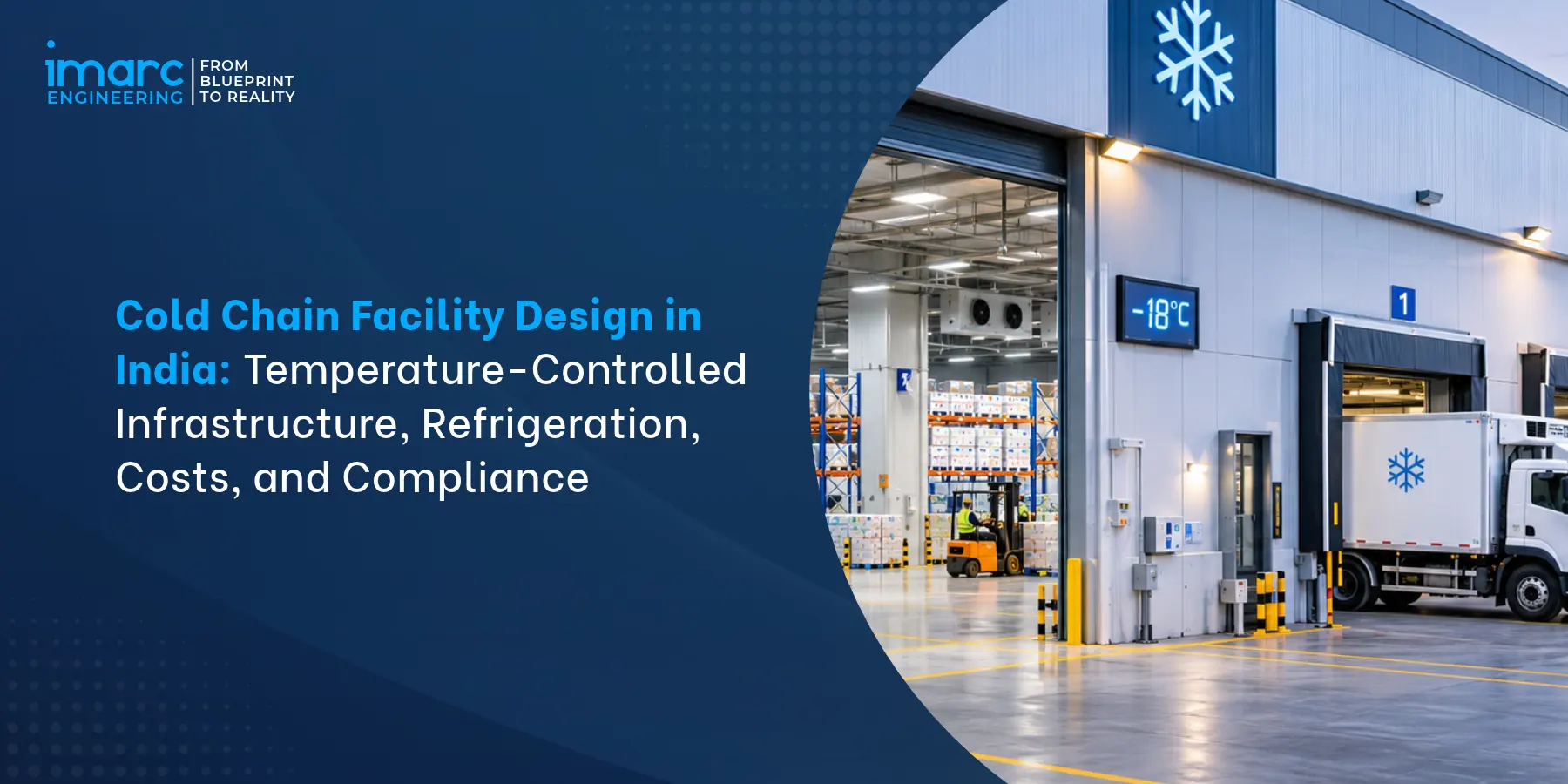
Cold Chain Facility Design in India: Temperature-Controlled Infrastructure, Refrigeration, Costs, and Compliance
Introduction
For food processors, pharmaceutical manufacturers, and logistics developers evaluating cold chain facility design in India in 2026, the engineering challenge sits at the intersection of product temperature requirements, refrigeration technology, insulation, backup power, and compliance. Food cold chain, pharmaceutical cold chain, and multi-tenant logistics cold storage are not interchangeable - each has distinct temperature zones, regulatory authority, and facility design.
Scope of this Guide
This guide covers cold chain facility design in India, including temperature zoning, storage capacity, refrigeration technology, insulation, utilities, monitoring, validation, regulatory compliance, CAPEX/OPEX, and DPR preparation. It compares food and pharmaceutical cold chain requirements from a facility planning and engineering perspective.
Table of Contents
- Introduction
- Why Cold Chain Facility Design in India Matters for Investors in 2026
- Cold Chain Facility Types and Product Temperature Zones for Design in India
- Storage Capacity Refrigeration Load and Insulation Design for Cold Chain Facilities in India
- Refrigeration Technology Selection for Industrial Cold Storage Facilities in India
- Infrastructure Utilities Backup Power and Material Handling for Cold Chain Facilities in India
- Temperature Monitoring Mapping and Cold Chain Validation Requirements in India
- Regulatory Framework and Compliance for Cold Chain Facilities in India
- CAPEX OPEX and DPR Execution for Cold Chain Facility Setup in India
- Conclusion
1. Why Cold Chain Facility Design in India Matters for Investors in 2026
Four drivers make disciplined cold chain facility investment strategically important in India.
1.1 Perishable and Pharmaceutical Supply Chain Expansion
Fruits, vegetables, dairy, meat, seafood, processed foods, vaccines, biologics, and temperature-sensitive pharmaceuticals all depend on an unbroken temperature-controlled chain. India's domestic consumption and export base in these categories continues to expand, driving demand for cold chain infrastructure planning across production clusters, pharmaceutical zones, and consumption centres.
1.2 Government Infrastructure Support
The Ministry of Food Processing Industries (MoFPI) supports eligible integrated cold chain projects under PM Kisan Sampada Yojana (PMKSY), subject to scheme guidelines, funding availability and application windows. Assistance rates and ceilings depend on the applicable scheme conditions. The National Horticulture Board (NHB) also administers cold storage schemes for eligible horticultural projects.
However, NHB suspended receipt of fresh applications for Grant of Clearance under its cold storage schemes in October 2026. Applicants should verify current scheme status and eligibility before including subsidies in project financing.
1.3 Pharma Export and Vaccine Infrastructure
Pharmaceutical cold-chain requirements depend on the products stored, the activities performed and the applicable Indian licensing framework. For pharmaceutical storage and distribution, relevant references include the WHO Good Storage and Distribution Practices for Medical Products (WHO Technical Report Series 1025, Annex 7) and the model guidance for time- and temperature-sensitive pharmaceutical products (WHO TRS 961, Annex 9).
WHO Technical Supplement 8 to TRS 961 provides guidance on temperature mapping of storage areas. These documents are technical guidance and do not replace applicable Indian law or licence conditions. For vaccine facilities operating under India's Universal Immunization Programme, consult the Ministry of Health and Family Welfare's Immunization Handbook for Health Workers and Cold Chain and Logistics Management guidance.
Vaccine storage conditions must reflect the specific vaccine and programme requirements. Commercial pharmaceutical warehouses should separately verify the applicable Drugs and Cosmetics Act, 1940, Drugs Rules, 1945, licence conditions and State Licensing Authority requirements. Do not treat manufacturing GMP provisions as automatically applicable to every standalone warehouse.
1.4 Energy, Refrigerant, and Reliability Economics
Electricity consumption, refrigeration efficiency and backup power can materially affect cold storage operating costs. Refrigerant selection should consider safety, energy performance, environmental impact, applicable regulations and the facility's operating life. India’s HFC phase-down under the Kigali Amendment begins in 2032, with staged reductions thereafter. BEE requirements should be checked for the specific equipment and facility category. Backup arrangements should reflect product sensitivity, temperature excursion risks and business continuity requirements.
2. Cold Chain Facility Types and Product Temperature Zones for Design in India
The first decision in cold chain facility setup is product-driven - what is stored, at what temperature range, and for what duration. Facility types and temperature zoning follow.
2.1 Cold Room vs Cold Warehouse
A cold room is an insulated space designed for temperature-controlled storage within an existing or purpose-built facility. A cold warehouse is generally a larger facility with dedicated refrigeration equipment, loading areas, material handling and, where required, multiple temperature zones. The distinction depends on capacity, layout, operating requirements and infrastructure rather than a universal volume threshold.
2.2 Food Cold Chain Temperature Zones
Food storage temperatures depend on the commodity, processing stage, packaging, shelf-life requirements and applicable food safety standards. Chilled, frozen, deep-frozen, controlled-atmosphere and blast-freezing areas may be required for different products. The design should specify product receiving temperatures, storage ranges, freezing requirements and permissible temperature excursions rather than apply one range to all food categories.
2.3 Pharmaceutical Cold Chain Temperature Zones
Pharmaceutical storage conditions must follow the product label, manufacturer’s specifications and applicable regulatory requirements. Common arrangements include controlled room temperature, refrigerated storage at 2–8°C, frozen storage and ultra-low-temperature storage for products that require it. Not every vaccine or biologic requires the same temperature range. Monitoring, alarm limits, backup systems and qualification should be designed around the product's stability requirements.
2.4 Multi-Tenant Logistics Cold Chain
Multi-tenant logistics cold storage serves third-party food brands, pharmaceutical distributors, and e-commerce fulfilment. Facility design accommodates mixed-SKU operations, multiple temperature zones in a single structure, segregated loading docks for different clients, and separate monitoring domains per tenant. Hygiene segregation between food and pharma tenants is design-critical where both are hosted.
| Facility Type | Typical Scale and Use |
|---|---|
| Cold room | Product, capacity and required temperature range |
| Chilled food storage | Commodity-specific temperature and humidity |
| Frozen food storage | Product specifications and freezing requirements |
| Blast freezer | Required freezing rate, product load and throughput |
| Pharmaceutical refrigerated storage | Product-specific conditions, often 2–8°C |
| Ultra-low-temperature storage | Product-specific requirements and validated equipment |
| Multi-tenant cold warehouse | Segregation, multiple zones, monitoring and operating needs |
3. Storage Capacity Refrigeration Load and Insulation Design for Cold Chain Facilities in India
A reliable cold chain warehouse design India proceeds from storage capacity, refrigeration load, and insulation design - in that order. Each decision cascades into equipment sizing and lifecycle cost.
3.1 Storage Capacity Planning
Storage capacity is defined in both volume (cubic metres of insulated space) and payload (tonnes of product at design density). Pallet storage uses adjustable pallet racking, drive-in racking, or mobile racking; bulk storage uses floor stacking in boxes or crates. Clear height drives vertical stacking; column grids drive aisle layout. Design margin for operational buffer, defrost cycles, and seasonal peak is standard. A product-density table drives the volume-to-tonnage conversion.
Assume a cold warehouse has 800 usable pallet positions, with a planned maximum product load of 800 kg per pallet.
- Usable pallet positions: 800
- Assumed average product load per pallet: 800 kg
- Calculated product storage capacity: 800 × 800 = 640,000 kg, or 640 tonnes
The calculated 640 tonnes represents the assumed maximum product payload at full pallet-position utilisation. Practical operating capacity may be lower depending on inventory mix, pallet loading, accessibility, occupancy targets, and operational requirements. Final storage capacity should be validated against the proposed racking layout and material-handling system.
3.2 Refrigeration Load Calculation
Refrigeration load calculation aggregates transmission load (heat gain through walls, ceiling, floor), infiltration load (air exchange through doors), product load (sensible heat from product cooldown and respiration heat for fresh produce), internal load (fans, lights, people, forklifts), defrost load, and safety margin. Peak hourly load, not average, drives compressor sizing. For blast freezers, product load dominates; for long-term storage, transmission and infiltration dominate.
Illustrative refrigeration-load calculation
Consider a hypothetical frozen-food facility with a design room temperature of −18°C. Assume the following preliminary loads:
| Load component | Illustrative load |
|---|---|
| Transmission through insulated envelope | 10 kW |
| Door opening and air infiltration | 8 kW |
| Fans, lighting, personnel and other internal loads | 5 kW |
| Product pull-down and freezing | 55 kW |
| Defrost and other applicable loads | 3 kW |
| Subtotal | 81 kW |
| Illustrative 10% design allowance | 8.1 kW |
| Preliminary total load | 89.1 kW |
The preliminary load is therefore approximately 89 kW under these assumptions. This is an illustrative estimate, not a refrigeration-system specification. The actual design must calculate each load from the envelope construction, outdoor design conditions, door activity, product type, product-entry temperature, throughput, freezing time, defrost strategy and operating schedule.
The final refrigeration capacity and compressor configuration must be selected using the calculated peak load, required operating conditions, equipment performance data and an appropriate allowance for system availability. Avoid adding a blanket safety margin if the individual load estimates already include equivalent allowances.
3.3 Insulation Design
Insulated cold storage envelopes commonly use PUR or PIR panels, with panel specification selected according to the design temperature, heat load, moisture conditions, fire performance and applicable standards. Panel thickness should be calculated from the required thermal performance rather than assigned solely by storage temperature. Vapour control, airtight joints, insulated floors and protection against ground freezing should be considered for relevant applications.
3.4 Thermal Performance
Thermal performance depends on envelope U-values, airtightness, door operation, insulation continuity and infiltration. Dock seals, suitable doors and vestibules can reduce unwanted air exchange. Thermal calculations should reflect local climate, operating schedules and product requirements. Refer to BIS IS 661:2019, Thermal Insulation of Cold Storage: Code of Practice, rather than IS 661:2000, and confirm the applicable edition during detailed engineering.
4. Refrigeration Technology Selection for Industrial Cold Storage Facilities in India
An industrial refrigeration system design selection matches storage temperature, cooling load, refrigerant policy, and safety constraints. Four configurations dominate Indian industrial practice.
4.1 Ammonia (R-717) Refrigeration
Ammonia is used in industrial refrigeration systems, particularly where large cooling loads justify centralised plant. It has zero ozone depletion potential and a low global warming potential, but its toxicity and applicable safety classification require engineered leak detection, ventilation, emergency procedures, trained operators and appropriate plant-room design.
4.2 Carbon Dioxide (R-744) Refrigeration
CO₂ systems may be configured as transcritical systems or as part of an ammonia–CO₂ cascade. Selection depends on cooling load, temperature levels, climate, energy performance, component availability and operator capability. CO₂ systems operate at high pressures and require equipment and controls designed for the selected operating conditions.
4.3 HFC and HFO Refrigerants
HFC and HFO refrigerants are used in selected packaged systems, chillers and refrigeration applications. Selection should account for global warming potential, safety classification, compatibility, efficiency, service availability and applicable refrigerant rules. India's HFC phase-down begins in 2032, but this does not mean that all HFC systems are immediately prohibited. Lower-GWP alternatives should be assessed on a lifecycle basis.
4.4 System Configuration
System configuration decisions include direct expansion versus flooded evaporators, single-stage versus two-stage compression for low-temperature applications, air-cooled versus evaporative condensers, variable-frequency drives for compressor and fan efficiency, hot-gas or electric defrost, and heat recovery for hot water or space heating where applicable. Material of construction for ammonia systems favours carbon steel with specialised valves and fittings.
| Technology | Typical Applications | Advantages | Key limitations and design considerations |
|---|---|---|---|
| Ammonia (R-717) | Large industrial cold stores, food processing and low-temperature applications | Very low global warming potential; established industrial refrigeration technology | Toxicity requires appropriate leak detection, ventilation, emergency planning and trained operators |
| Carbon dioxide (R-744) | Commercial and industrial refrigeration; cascade or transcritical systems | Very low global warming potential; suitable for appropriately designed low-temperature systems | High operating pressures; efficiency depends on system design, climate and operating conditions |
| Ammonia–CO₂ cascade | Large facilities with different temperature levels or specific safety and plant-layout needs | Can combine ammonia's efficiency in the plant room with CO₂ in selected distribution circuits | More complex system architecture, controls and maintenance requirements |
| HFC refrigerants | Packaged and selected medium- or low-temperature systems | Established equipment and service networks for some applications | Global warming potential varies; assess applicable refrigerant rules and long-term availability |
| HFO and lower-GWP blends | Selected packaged and commercial systems | Some options offer lower global warming potential than conventional HFC alternatives | Safety classification, flammability where applicable, compatibility, availability and service expertise require assessment |
No single refrigeration technology is optimal for every cold store. Compare alternatives using the same design load, temperature range, ambient conditions, operating hours and redundancy requirements. Evaluate installed cost, energy consumption, maintenance capability, refrigerant safety, environmental impact and expected equipment life. Confirm refrigerant compatibility and applicable regulatory requirements before selecting equipment.
5. Infrastructure Utilities Backup Power and Material Handling for Cold Chain Facilities in India
A temperature-controlled warehouse design requires integrated infrastructure, utilities, backup, and material handling planning alongside the refrigeration envelope.
5.1 Loading Dock Design
Loading dock design affects temperature stability, throughput and energy consumption. Dock seals, levellers, suitable doors and vestibules may reduce infiltration and improve loading operations. Dock quantity and configuration should be determined by vehicle movements, throughput, product segregation and operating schedules.
5.2 Material Handling
Material handling may include forklifts, reach trucks, pallet jacks, conveyors and automated storage and retrieval systems. Equipment selection should account for aisle dimensions, throughput, low-temperature performance, battery characteristics, operator safety and maintenance. Electric equipment may be preferable in enclosed areas, subject to charging, ventilation and operating requirements.
5.3 Backup Power Supply
Backup power should be sized according to critical refrigeration loads, controls, alarms, monitoring and the acceptable temperature excursion period. Generator capacity, redundancy, UPS coverage and automatic transfer arrangements should follow a documented risk assessment. Pharmaceutical facilities storing temperature-sensitive products may require more stringent resilience measures than facilities handling less sensitive products.
5.4 Water, Drainage and Fire Protection
Water, drainage and fire protection should be designed around the refrigeration system, cleaning processes, local conditions and applicable codes. Frozen-area drainage may require measures to prevent ice formation. Sprinkler configuration, refrigerant detection and emergency ventilation should be selected through fire engineering, hazard assessment, insurer requirements and applicable regulations rather than assuming one system is suitable for every cold store.
6. Temperature Monitoring Mapping and Cold Chain Validation Requirements in India
A compliant cold chain facility engineering programme designs monitoring, mapping, and validation as integral elements - not an afterthought. For pharmaceutical cold chain facilities, temperature monitoring, mapping, and qualification help demonstrate compliance with applicable product storage requirements, licensing conditions, and quality standards. Their scope depends on the products handled, facility operations, and regulatory obligations.
6.1 Temperature Monitoring Systems
Temperature monitoring should use suitable calibrated sensors, data loggers, alarms and documented procedures for responding to excursions. Pharmaceutical facilities commonly require continuous, time-stamped monitoring and defined escalation procedures, according to product requirements and applicable regulations. Electronic records should meet the requirements applicable to the facility and its markets. Where US FDA rules apply, 21 CFR Part 11 should be assessed specifically rather than treated as a universal Indian requirement. Calibration intervals and traceability should be documented in the quality system.
6.2 Temperature Mapping
Temperature mapping measures temperature distribution across a storage area under defined operating conditions and helps identify hot and cold spots. The protocol should consider loading patterns, door activity, seasonal conditions and recovery after disturbances where relevant. WHO Technical Supplement 8 provides guidance for pharmaceutical storage areas. Repeat mapping should be risk-based and conducted after significant changes or when required by applicable procedures or regulations.
6.3 Cold Chain Validation
Qualification and validation should demonstrate that the facility, refrigeration equipment and monitoring systems consistently meet defined requirements. DQ, IQ, OQ and PQ may form part of the pharmaceutical qualification programme, depending on the facility and applicable standards. Food facilities should establish appropriate food safety controls, including temperature monitoring and corrective action under their food safety management system.
6.4 Calibration
Monitoring instruments should be calibrated at documented intervals using suitable reference standards with appropriate traceability. The interval, acceptance criteria and response to out-of-tolerance results should be based on instrument performance, risk, use and applicable quality requirements. NABL-accredited calibration services may be used where appropriate; a single annual interval should not be presented as universal.
7. Regulatory Framework and Compliance for Cold Chain Facilities in India
The cold chain facility regulatory stack depends on the stored product. Food, pharmaceutical, and multi-tenant logistics facilities each have distinct primary authorities on top of common construction, pollution control, and safety requirements.
7.1 Food Cold Chain Compliance
Food cold storage businesses must obtain the appropriate FSSAI registration or licence under the Food Safety and Standards Act 2006 and applicable regulations. The required category depends on the activity and the eligibility criteria shown in FoSCoS, including storage capacity for cold and controlled-atmosphere storage. Operators must also follow applicable food hygiene and storage requirements. HACCP, FSMS and ISO 22000 may support food safety management or customer requirements, but certification should not be described as universally mandatory for all cold stores.
7.2 Pharmaceutical Cold Chain Compliance
Pharmaceutical storage and distribution requirements depend on the activity, products handled, licence category and applicable provisions of the Drugs and Cosmetics Act 1940 and Drugs Rules 1945. CDSCO and State Licensing Authorities exercise regulatory responsibilities as applicable. Revised Schedule M sets good manufacturing practice and premises, plant and equipment requirements for pharmaceutical manufacturing; it should not be presented as automatically governing every standalone pharmaceutical warehouse. WHO guidance on storage and distribution provides a useful reference, subject to applicable Indian requirements and product-specific conditions.
7.3 Refrigerant and Energy Compliance
Refrigerant compliance should be assessed against India's Ozone Depleting Substances (Regulation and Control) Rules 2000, as amended, and the applicable HFC phase-down framework under the Kigali Amendment. India’s HFC phase-down begins in 2032 with staged reductions. BEE energy labelling or efficiency requirements apply where the relevant equipment or product category is covered. Refrigerant and equipment selection should be checked against current rules and the intended operating life of the facility.
7.4 Cross-Cutting Approvals
Approvals depend on facility location, refrigerant inventory, operations, building classification and applicable state rules. Potential requirements include State Pollution Control Board consents, building and fire approvals, electrical safety clearances, groundwater permissions where applicable, and factory registration or licensing where the establishment falls within the relevant legal scope. Ammonia systems and other hazardous inventories may trigger additional safety and emergency-planning obligations. Legal Metrology, GST and Udyam requirements should be assessed according to the actual business activity. Confirm the applicable central and state provisions before finalising the compliance register.
| Approval or compliance area | When it may apply | What the project team should verify |
|---|---|---|
| FSSAI registration or licence | Food cold storage, food handling or related food business activities | Select the correct business activity and eligibility category through FoSCoS, including the applicable storage-capacity or turnover criteria |
| Drug licensing | Pharmaceutical wholesale, distribution, sale or other regulated activities | Confirm the applicable licence category and storage conditions under the Drugs and Cosmetics Act, 1940, Drugs Rules, 1945 and relevant State Licensing Authority requirements |
| Building and occupancy approvals | Construction, extension or change of use, as applicable | Confirm land-use permissions, sanctioned building plans, structural requirements, occupancy permissions and local development-control rules |
| Fire approval | Where required under applicable state or local fire rules | Verify fire NOC applicability, exits, fire-water arrangements, detection and suppression design, emergency access and refrigerant-related hazards |
| Pollution-control consent | Where required by the process, emissions, wastewater or applicable state rules | Determine whether Consent to Establish, Consent to Operate, wastewater or exhaust treatment and waste authorisations apply |
| Electrical safety | Electrical installations subject to applicable inspection or approval requirements | Check the Central Electricity Authority (Measures relating to Safety and Electric Supply) Regulations, 2023, as amended, along with relevant state electrical-inspectorate and DISCOM requirements |
| Refrigerant and hazardous-material obligations | Depending on refrigerant type, inventory, system design and applicable legal thresholds | Assess applicable Ozone Depleting Substances Rules, refrigerant-management obligations, pressure-system requirements, hazardous-chemical thresholds and emergency-planning duties |
| Groundwater and water permissions | Where groundwater extraction or other regulated water use is proposed | Verify the applicable groundwater authority, state permissions and any local restrictions before designing the water supply |
8. CAPEX OPEX and DPR Execution for Cold Chain Facility Setup in India
Understanding cold storage construction cost India needs discipline. Universal per-pallet or per-cubic-metre figures mislead; every facility is sized to its product mix, temperature zone, scale, and location.
8.1 CAPEX Drivers
Capital expenditure depends on land and civil works, insulated panels and flooring, refrigeration equipment, electrical infrastructure, backup power, racking, loading docks, monitoring systems, fire and safety measures, engineering services and commissioning. Pharmaceutical facilities may incur additional costs for qualification, validation, documentation and monitoring. Contingency should be set according to project maturity, site risks, procurement strategy and the level of design development rather than a fixed percentage for every project.
8.2 OPEX Components
Operating expenditure includes electricity, generator fuel, water, labour, maintenance, refrigerant, consumables, calibration, insurance and compliance. Energy cost depends on storage temperature, product throughput, equipment efficiency, ambient conditions, utilisation, electricity tariffs and operating practices. Frozen and ultra-low-temperature facilities may have higher energy demand than chilled facilities, but costs should be estimated from project-specific load calculations and operating scenarios.
8.3 Food vs Pharma Requirements Comparison
| Requirement | Food Cold Chain | Pharmaceutical Cold Chain |
|---|---|---|
| Primary regulatory framework | FSSAI and applicable food safety rules | Drugs and Cosmetics Act and applicable Drugs Rules |
| Storage conditions | Commodity-specific | Product-specific |
| Monitoring | Based on food safety and operating risks | Based on product requirements and applicable quality rules |
| Mapping | Risk- and process-dependent | Important for demonstrating storage-area performance |
| Qualification | Food safety controls and equipment checks | Qualification and validation as applicable |
| Backup power | Based on product risk and operating needs | Based on product stability and risk assessment |
8.4 DPR, Lifecycle and EPCM
A cold chain feasibility study should assess product requirements, demand, storage capacity, temperature zones, refrigeration options, insulation, utilities, backup power, monitoring, regulatory approvals, CAPEX, OPEX, risks and implementation planning. The DPR should document design assumptions, vendor requirements, sensitivity analysis and commissioning criteria. Project duration depends on facility scale, approvals, equipment lead times, construction conditions and validation requirements. EPC or EPCM contracts should define measurable acceptance criteria for temperature stability, recovery time, energy performance and commissioning.
Illustrative lifecycle-cost comparison
Assume a food cold-storage project is evaluating two refrigeration designs that meet the same storage-temperature, capacity, throughput and reliability requirements. The figures below are hypothetical and are provided only to demonstrate the comparison method.
| Cost assumption | Alternative A: Higher-efficiency design | Alternative B: Lower initial CAPEX |
|---|---|---|
| Initial project CAPEX | INR 8.00 crore | INR 6.50 crore |
| Annual OPEX | INR 1.20 crore | INR 1.55 crore |
| Evaluation period | 10 years | 10 years |
| Discount rate | 8% | 8% |
Undiscounted cost over 10 years
- Alternative A: INR8.00 crore + (INR 1.20 crore × 10) = INR 20.00 crore
- Alternative B: INR6.50 crore + (INR1.55 crore × 10) = INR 22.00 crore
Discounted lifecycle cost
Assuming annual OPEX is paid at each year-end, remains constant and is discounted at 8%, the 10-year annuity factor is approximately 6.71.
| Lifecycle-cost measure | Alternative A | Alternative B |
|---|---|---|
| Initial CAPEX | INR 8.00 crore | INR 6.50 crore |
| Present value of 10-year OPEX | INR 8.05 crore | INR 10.40 crore |
| Total discounted lifecycle cost | INR 16.05 crore | INR 16.90 crore |
Under these assumptions, Alternative A has a discounted lifecycle cost approximately INR 0.85 crore lower than Alternative B, despite its higher initial investment.
The comparison excludes inflation, financing costs, taxes, replacement expenditure and residual value. A project assessment should include these where material and test the result against changes in electricity tariffs, annual utilisation, maintenance costs, equipment life and refrigerant requirements. Both options must meet the same technical and compliance criteria before their costs are compared.
For a project-level decision, use a common evaluation period, discount rate, storage capacity, throughput and temperature profile for each alternative. Include initial CAPEX, annual energy and maintenance costs, scheduled replacement expenditure and other material cash flows. Test sensitivity to energy prices and utilisation before selecting the alternative with the lowest lifecycle cost that meets the facility's performance and compliance requirements.
Conclusion
Effective cold chain facility design requires product-specific temperature zoning, suitable refrigeration and insulation, reliable backup power, monitoring, regulatory compliance, and lifecycle cost planning. Food and pharmaceutical facilities need different storage, validation and safety arrangements, supported by a detailed project report (DPR) and EPCM execution.
Three priorities guide project planning: define product and temperature requirements before engineering, minimise heat infiltration through appropriate dock design, and select refrigeration systems based on safety, efficiency, environmental impact and long-term refrigerant regulations.
PLANNING A COLD CHAIN FACILITY IN INDIA?
IMARC Engineering provides cleanroom and cold chain design services for food, pharmaceutical and logistics facilities, covering temperature zoning, storage capacity planning, refrigeration load calculations, insulated envelopes, energy-efficient refrigeration systems, loading docks, backup power and continuous temperature monitoring. Services include pharmaceutical qualification and validation, regulatory licensing support, DPR preparation, FEED, detailed engineering, EPC/EPCM execution, commissioning and ramp-up.
→ Schedule a cold chain facility scoping consultation with an IMARC specialist
Frequently Asked Questions
Cold chain facility design starts with product temperature requirements, storage capacity, refrigeration load, insulation, utilities, monitoring and backup planning. Food and pharmaceutical facilities must follow the regulatory and quality requirements applicable to their products and operations.
A cold room is an insulated space designed for temperature-controlled storage within an existing or purpose-built facility. A cold warehouse is generally a larger operation with dedicated refrigeration plant, loading areas, material handling and potentially multiple temperature zones. The distinction depends on design and operational requirements, not a universal volume threshold.
Industrial cold storage may use ammonia, CO₂, ammonia–CO₂ cascade or suitable HFC/HFO systems. Selection depends on cooling load, temperature, safety, energy performance, environmental impact and lifecycle cost.
Cold storage capacity is defined in volume (cubic metres of insulated space) and payload (tonnes at design product density). Capacity planning aggregates pallet count, clear height, aisle layout, and operational buffer for defrost cycles and seasonal peaks. Product density tables drive volume-to-tonnage conversion.
Cold storage construction cost India depends on temperature zone, scale, insulated panel area and thickness, refrigeration configuration, backup power design, racking and material handling, loading dock quantity, monitoring, validation (pharma), and location. Universal per-pallet figures mislead - project-specific engineering drives any meaningful cost benchmark.
Monitoring systems may include calibrated sensors, data loggers, alarms and central monitoring. Pharmaceutical facilities should define recording, alarm, calibration and excursion-response requirements according to product conditions and applicable regulations.
Food cold chain facilities follow applicable FSSAI requirements and food safety controls. Pharmaceutical facilities must meet the storage and distribution requirements applicable to the products and licences involved, with qualification, monitoring and validation defined by relevant quality and regulatory requirements.
Temperature mapping records temperature distribution across a storage area to identify hot and cold spots. Test conditions, including empty or loaded operation, door activity and recovery, should be defined in the approved mapping protocol based on risk, facility use, operating patterns and applicable requirements. WHO Technical Supplement 8 provides relevant guidance.
Requirements depend on the products stored, facility operations, location and equipment. They may include FSSAI licensing for food storage, applicable drug regulations for pharmaceutical operations, pollution-control consents, building and fire approvals, electrical safety requirements and additional controls for hazardous refrigerants. Verify the applicable rules before commissioning.
Engineering consultants can support demand assessment, temperature zoning, refrigeration selection, capacity planning, utility design, regulatory mapping, CAPEX/OPEX modelling, DPR preparation, EPC/EPCM execution, commissioning and performance testing.
Recent Post





Trusted by Industry Leaders
We partner with global enterprises and ambitious businesses across sectors to deliver operational excellence, strategic insights, and sustainable growth through integrated solutions.












Success in Their Words
Real feedback from clients across industries. Discover how our solutions delivered measurable impact and operational excellence.

I wanted to express my sincere appreciation for your efforts in handling this matter. Your dedication and commitment have been truly commendable, and it is evident that you have put in tremendous hard work and expertise into resolving the issues at hand. We are greatly interested in continuing our collaboration with you in the future, as your professionalism and reliability have made you a trusted partner. Thank you once again for your invaluable contribution. We look forward to strengthening our partnership ahead.

It has been a pleasure working with the IMARC team. The insights provided were structured, clear, and highly valuable, helping us strengthen both our technical and financial planning with confidence. We deeply appreciate the team’s professionalism, responsiveness, and attention to detail throughout the engagement. Every requirement was well understood and effectively incorporated, resulting in a comprehensive and actionable output. Overall, our experience has been excellent, and I would gladly recommend IMARC to organizations seeking a reliable research partner.

Your service is truly exceptional. Working with the IMARC team has been a seamless and professional experience. The clarity of communication, responsiveness to queries, and consistent support at every stage made the entire engagement highly efficient. The insights shared were well-structured, practical, and perfectly aligned with our requirements, helping us make informed decisions with confidence. Overall, the dedication and professionalism demonstrated by your team stand out, and I would be glad to recommend IMARC as a reliable and trustworthy research partner.

IMARC did an outstanding job in preparing our study. They were punctual, precise, and consistently responsive throughout the entire process. The team delivered all the data we required in a clear, well-organized, and highly professional format. Their strong attention to detail, combined with their ability to meet every deadline without compromising quality, truly set them apart. Overall, their reliability and commitment made them an exceptional partner for our project, and we would gladly work with them again in the future.

IMARC made the whole process incredibly easy from start to finish. Everyone I interacted with via email was polite, professional, and straightforward to deal with, always keeping their promises regarding delivery timelines and remaining consistently solutions-focused. From my very first contact, I appreciated the professionalism and support shown by the entire IMARC team. I highly recommend IMARC to anyone seeking timely, affordable, and reliable information or advice. My experience with IMARC was excellent, and I truly cannot fault any aspect of it.

I’d like to express my sincere gratitude for the excellent work you accomplished with the study. Your ability to quickly understand our requirements and deliver high-quality results under tight timelines truly reflects your expertise, exceptional work ethic, and unwavering commitment to your customer’s success. The professionalism and responsiveness you demonstrated throughout the process made a significant difference. Our entire team and company are incredibly thankful for your dedication, reliability, and support. Once again, thank you for your outstanding contribution.