Manufacturing
October 28 2026
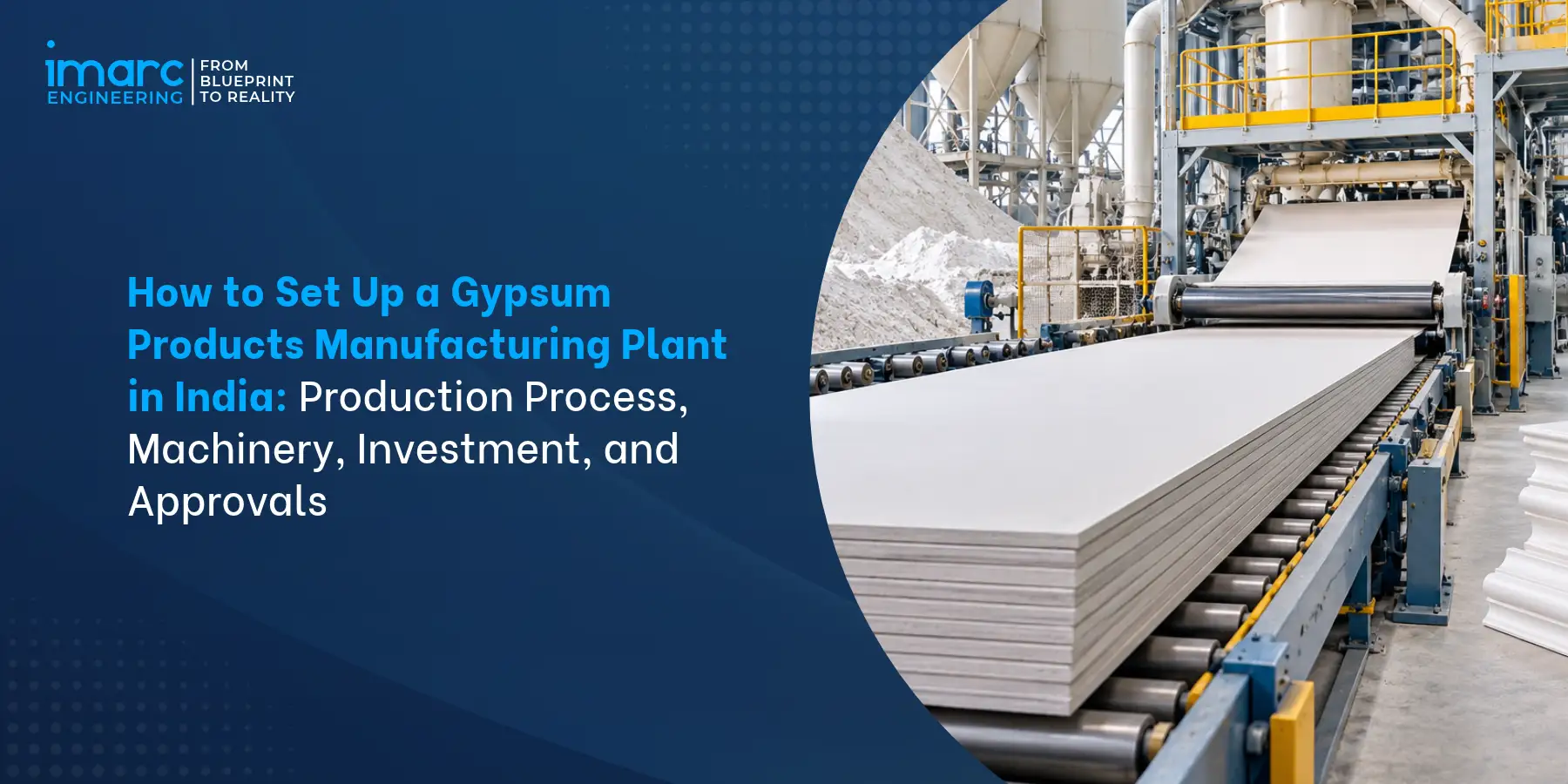
How to Set Up a Gypsum Products Manufacturing Plant in India: Production Process, Machinery, Investment, and Approvals
Introduction
For investors and project developers evaluating a gypsum products manufacturing plant in India as a long-term investment, the opportunity rests on sustained construction and renovation demand for gypsum powder, plaster of Paris (POP), and gypsum plaster boards. Each product uses the same base material (calcium sulphate dihydrate, CaSO4·2H2O) but needs different processing routes, machinery, utilities, quality standards and capital. Product selection drives everything that follows.
Scope of the Guide
This guide walks through gypsum products manufacturing plant setup from product and raw material selection through processing technology, machinery, utilities, regulatory approvals, CAPEX/OPEX, and DPR workflow, anchored to project-specific assumptions. Applicable BIS standards differ by product: gypsum plaster boards fall under the IS 2095 series and a Quality Control Order, building plaster under IS 2547, while ground gypsum for cement, agriculture or other uses is supplied to the buyer's specification. Gypsum mining and cement manufacturing are outside scope and covered elsewhere.
Table of Contents
- Introduction
- Why Gypsum Products Manufacturing Plant in India Matters for Investors in 2026
- Gypsum Product Categories and Chemistry for a Manufacturing Plant in India
- Natural Versus Synthetic Gypsum Sourcing for Gypsum Products Manufacturing in India
- Production Process for Gypsum Powder Plaster of Paris and Gypsum Board in India
- Machinery and Equipment Selection for a Gypsum Products Manufacturing Plant in India
- Plant Utilities Dust Control and Workplace Safety for Gypsum Manufacturing in India
- Regulatory Approvals and BIS Standards for Gypsum Manufacturing in India
- CAPEX OPEX DPR and Commissioning Workflow for Gypsum Products Manufacturing in India
- How to Set Up a Gypsum Products Manufacturing Plant in India
- Conclusion
1. Why Gypsum Products Manufacturing Plant in India Matters for Investors in 2026
Four drivers make disciplined gypsum product investment strategically important in India in 2026.
1.1 Construction and Renovation Demand
India's construction sector- residential housing, commercial complexes, hospitality, retail, and institutional buildings- drives sustained demand for gypsum products. Gypsum boards (drywalls) are increasingly used as alternatives to traditional brick-and-plaster partitions in selected applications, such as offices, retail interiors, and institutional buildings, where installation time, weight and acoustic performance matter. Interior finishing with POP ceiling, cornice, and decorative elements remains a mass-market segment. The gypsum manufacturing business in India benefits from both new construction and the growing renovation market.
1.2 Synthetic Gypsum Availability
Phosphogypsum generated by phosphoric acid and fertilizer plants, including facilities operated by Coromandel International, Paradeep Phosphates, IFFCO and Tata Chemicals, provides a potential source of synthetic gypsum in India. FGD gypsum recovered from thermal power plants also offers opportunities for additional feedstock supply as flue gas desulfurization systems are installed and commissioned to meet applicable SO₂ emission requirements. Synthetic gypsum can reduce dependence on naturally mined gypsum and provide logistical cost advantages for manufacturers located near suitable fertilizer and power plant clusters. However, commercial viability and suitability for gypsum plasterboard and plaster of Paris (POP) production depend on feedstock availability, purity, moisture content, impurities, processing requirements and transportation costs.
1.3 Import Substitution and Export Potential
India has imported gypsum from Oman, Thailand, and Iran in recent years to supplement domestic natural gypsum supply. Investors in gypsum board manufacturing plant and large POP plants reduce this import dependence- and some capacity serves export to South Asian, Middle Eastern, and African markets. Domestic manufacturers operating at reasonable scale participate in both import substitution and export opportunities.
1.4 Policy Support and Incentives
Central and state industrial policies can support a gypsum processing plant setup through measures such as capital or interest subsidies, stamp duty and electricity duty concessions, or benefits for MSME units registered under Udyam. Eligibility, benefit levels, sector coverage and policy validity vary by state, location, unit size and scheme period, and schemes are revised or closed over time. Investors should confirm the incentives currently notified for their state, product and investment size at DPR stage and treat them as upside in the financial model rather than a core assumption.
2. Gypsum Product Categories and Chemistry for a Manufacturing Plant in India
Three product categories dominate commercial gypsum manufacturing in India. Each uses the same base chemistry but at different processing stages.
2.1 Base Chemistry
Natural gypsum is calcium sulphate dihydrate (CaSO₄·2H₂O), containing two molecules of chemically bound water. Controlled heating removes approximately three-quarters of this water, producing calcium sulphate hemihydrate (CaSO₄·0.5H₂O), commonly known as plaster of Paris (POP) or stucco. Further heating can produce soluble anhydrite (anhydrite III) and, at higher temperatures, insoluble anhydrite (anhydrite II). The formation of these phases depends on processing conditions rather than fixed temperature thresholds.
Key factors include calciner type, heating rate, residence time, particle size, feed moisture and impurities. Atmospheric-pressure calcination generally produces beta hemihydrate, while controlled steam-pressure processing in an autoclave produces alpha hemihydrate. Operating temperatures and residence times should be established using OEM specifications and laboratory trials on the selected feedstock. When water is added to hemihydrate, it rehydrates to form calcium sulphate dihydrate. This reaction gives POP its setting properties and forms the basis of gypsum board manufacturing.
2.2 Gypsum Powder
Gypsum powder manufacturing plant produces finely ground raw gypsum (dihydrate) typically used as a retarder in cement, as a soil conditioner for sodic soils in agriculture, and as a feedstock input to downstream POP or board production. The process is simpler- crushing, drying (if moist feed), and grinding to specified fineness. No calcination is involved. Capacity ranges from small MSME units (10-50 TPD) to large cement-grade suppliers (several hundred TPD). CAPEX is the lowest among the three routes.
2.3 Plaster of Paris (POP)
Plaster of Paris manufacturing plant produces hemihydrate (CaSO4·0.5H2O) through calcination of ground gypsum. POP sets rapidly when mixed with water and is used for interior finishing (ceilings, cornices, decorative mouldings), orthopaedic casts (medical grade), ceramic mould making (industrial grade), and sculpting. Product variants include wall POP (building grade), medical grade (higher purity), and dental/ceramic grades. Gypsum building plaster is covered by the applicable IS 2547 standards. Medical, dental and ceramic-grade products may require different material specifications, quality controls and end-use requirements. Manufacturers should verify the current standard and applicable product classification before finalising production specifications.
2.4 Gypsum Plaster Boards
Gypsum board production line produces plasterboards (drywalls) continuously- POP slurry mixed with water and additives (foam, retarder, accelerator, starch) is cast between two paper facings, allowed to set on a conveyor, cut to length, dried in a tunnel dryer, and trimmed. Standards include IS 2095 (Part 1):2011 for plain gypsum plaster boards and IS 2095 Part 2 for reinforced boards and ceiling tiles.
Gypsum board production capacity depends on line speed, board width, thickness, product mix, dryer capacity, operating hours and equipment availability. Manufacturers should establish achievable annual output using OEM specifications and the proposed operating schedule. Board manufacturing is the highest-CAPEX route among the three.
2.5 Product Comparison
| Parameter | Gypsum Powder | Plaster of Paris (POP) | Gypsum Plaster Board |
|---|---|---|---|
| Core process | Crushing, drying (if feed is moist), grinding, classification, bagging | Crushing, grinding, calcination, cooling, ageing, screening, bagging | Stucco preparation (in-house calcination or purchased), slurry mixing, continuous forming between paper facings, setting, cutting, drying, trimming, bundling |
| Key machinery | Jaw or impact crusher, hammer mill, dryer where required, Raymond, ball or vertical roller mill, classifier, bag filters, packing machine | Powder section machinery plus calciner (kettle, rotary, flash or fluidised bed), hot gas generator or burner, cooler, ageing silos, screens | Stucco silos and dosing, additive feeders, foam generator, continuous mixer, forming station, setting belt, transverse cutter, multi-deck dryer, trimming and bundling line, PLC/SCADA |
| Main utilities | Electrical power for crushing, grinding and conveying; thermal energy only where drying is needed; compressed air for bag filters | Thermal energy for calcination (fuel choice drives cost), electrical power, compressed air, limited cooling water | Thermal energy for the board dryer and any in-house calcination, process water for slurry, electrical power, compressed air |
| Major CAPEX drivers | Crushing and grinding mills, dust collection, storage and packing, civil works | Calciner technology and capacity, fuel system and heat recovery, dust collection, ageing silos, QC laboratory | Forming line and multi-deck dryer, long linear building, paper and additive handling, automation and inspection, calcination section if integrated, warehousing |
| Typical capacity | 10-200+ TPD | 20-150+ TPD | 10-40 M sq.m/year |
| Relative CAPEX | Low | Moderate | High |
3. Natural Versus Synthetic Gypsum Sourcing for Gypsum Products Manufacturing in India
Feedstock choice shapes plant economics, location, and product fit. Natural gypsum and synthetic gypsum are the two primary categories- with different purity profiles, supply geography, and processing needs.
3.1 Natural Gypsum Sources
Rajasthan is India's principal natural gypsum-producing state, with important deposits in the Bikaner, Jaisalmer and Barmer districts. Additional deposits occur in Gujarat, Jammu & Kashmir and other parts of the country. The purity of natural gypsum varies by deposit, with calcium carbonate, silica and clay potentially occurring as impurities; therefore, feedstock quality should be confirmed through laboratory testing before procurement.
Manufacturers located away from domestic mining areas should assess transportation costs alongside imported gypsum prices, port handling charges and inland freight. Oman is a major source of imported gypsum for India, while Bhutan, Iran and other suppliers provide additional import channels. For most gypsum products manufacturing projects, the procurement of ore or processed gypsum from established suppliers is more relevant than developing captive mining operations, which fall outside the scope of this guide.
3.2 Phosphogypsum
Phosphogypsum is a byproduct of phosphoric acid manufacturing (used in fertilizer production). Indian phosphoric acid plants at Paradeep, Haldia, Vizag, and Coromandel sites generate large volumes of phosphogypsum. Commercial terms vary by generator, contract and local disposal constraints, and purity and impurity levels vary with the source phosphate rock, the acid process and the age of the stack, so each source should be sampled and tested before it is relied on. Impurities include residual phosphate, fluoride, and traces of radionuclides from source phosphate rock.
Phosphogypsum may require washing, neutralisation or other treatment depending on its composition, impurities and intended product. Manufacturers should evaluate material quality, relevant regulatory conditions and product-standard requirements before using it for gypsum boards or plaster. Locations near fertilizer plants can benefit on landed cost, but only after treatment cost, quality consistency and compliance obligations are included in the feedstock evaluation.
3.3 FGD Gypsum
Flue Gas Desulfurization (FGD) gypsum is produced when thermal power plants scrub SO2 from flue gases using lime or limestone slurries. FGD installation at Indian thermal plants is driven by Ministry of Environment, Forest and Climate Change (MoEF&CC) emission norms; a July 2025 amendment exempted Category C plants, located away from major cities and polluted areas, from SO2 limits and placed Category B plants under case-by-case review, so future supply depends on which units actually install and operate FGD systems.
Where scrubbing and dewatering are well controlled, FGD gypsum can be of high and consistent quality and is widely used for board manufacturing, but moisture, chlorides, fly ash carryover, unburnt carbon and limestone quality vary by plant and should be confirmed through testing and written supply specifications. Co-location with thermal plants that operate FGD units or dedicated FGD gypsum transport arrangements can meaningfully reduce feedstock cost for board manufacturers.
3.4 Feedstock Comparison and Implications
| Feedstock Type | Key Quality Considerations | Supply Geography |
|---|---|---|
| Natural gypsum (Rajasthan) | Purity varies by deposit; carbonate, silica and clay impurities; confirm by laboratory testing of each source | Rajasthan dominates; Gujarat, TN, J&K |
| Phosphogypsum | Residual phosphate, fluoride, acidity and radionuclides; purification and regulatory conditions usually apply | Fertilizer plants (East, South coast) |
| FGD gypsum | Moisture, chlorides, fly ash and unburnt carbon depend on scrubber and dewatering performance | Thermal power plants operating FGD units |
| Imported natural gypsum | Grade varies by source and supplier; verify specifications and test certificates against own laboratory results | Oman, Thailand, Iran via ports |
4. Production Process for Gypsum Powder Plaster of Paris and Gypsum Board in India
Each gypsum manufacturing process route has its own sequence. The three sections below describe the typical flows for Indian plants.
4.1 Gypsum Powder Processing
Raw gypsum (lumps up to 300 mm) arrives at the plant and feeds into primary jaw or impact crushers reducing it to 25-50 mm, followed by secondary crushing or roller mills to under 10 mm. Where feed is moist (natural gypsum from monsoon-season mining or synthetic gypsum from fertilizer plants), drying in a rotary or flash dryer is included, with gas and material temperatures controlled so that free moisture is removed without starting to dehydrate the gypsum; the operating range depends on dryer type, feed moisture and residence time and is set with the equipment supplier.
Gypsum is ground using suitable milling equipment, such as ball mills, Raymond mills or vertical roller mills. The required fineness and particle-size distribution depend on the intended application, buyer specifications and relevant product standards. Classifier separators control particle size distribution. Bagging in 25-50 kg bags or bulk silos completes the sequence.
4.2 Plaster of Paris Production
Plaster of Paris production begins with the crushing-grinding sequence described above, producing fine gypsum feed. The feed enters a calciner- traditionally a kettle calciner (batch, used in smaller plants) or more commonly a continuous rotary kiln, flash calciner, or fluidized-bed calciner for larger plants. Calcination drives off about three-quarters of the bound water, producing hemihydrate (CaSO4·0.5H2O). Material temperatures ranging between 150 to 180 degrees Celsius are commonly cited for beta hemihydrate, but the actual setpoint depends on calciner type, feed fineness and moisture, residence time and the product grade required, and is established through OEM guarantees and trial runs. Residence time is minutes to hours depending on calciner type. Calcined product (stucco) is cooled, aged in silos (ageing stabilises setting characteristics), and screened before bagging or dispatch to board lines.
4.3 Gypsum Board Manufacturing
Gypsum board forming is a continuous process. In the mixer, stucco (calcined gypsum) is combined with water, foam (reduces board density), starch (bonds core to paper), retarder (controls setting time), accelerator (triggers setting at the right point on the line), and glass fibres (for Type X fire-rated boards). The slurry discharges between a lower and upper paper facing on a continuously moving conveyor. The sheet travels along a setting conveyor where chemical hydration converts hemihydrate back to dihydrate- re-forming the gypsum crystal structure that gives the board its strength. A transverse saw cuts the continuous board to length (typically 2.4 metres or 3.0 metres). The cut boards enter a multi-deck dryer with several temperature zones; the profile is controlled so that free water is removed without recalcining the board core or damaging the paper facings, and zone temperatures are set by the line supplier for each board type and thickness. Trimming, bundling, and warehousing complete the line.
4.4 Process Comparison
The three routes differ sharply in process complexity. Gypsum powder is a mechanical operation (crushing, drying, grinding). POP adds a thermal operation (calcination). Board adds continuous chemical processing (slurry preparation, controlled hydration, drying) plus the paper facing conversion operation. Each step requires its own equipment, control, and expertise. For investors choosing a plant, the stepwise CAPEX and operational complexity scaling across these three routes should drive the product decision, not vice versa.
5. Machinery and Equipment Selection for a Gypsum Products Manufacturing Plant in India
The right gypsum manufacturing machinery selection depends on product, capacity, and automation level.
5.1 Crushing and Grinding Equipment
The crushing section typically includes primary jaw crusher (for lump feed), secondary impact crusher or hammer mill (for 10-50 mm reduction), and a rotary kiln dryer if feed is moist. Grinding uses Raymond mill, ball mill, or vertical roller mill depending on throughput and fineness target. Classifier separators and air cyclones recover product and recycle oversize. For large plants, PLC-controlled grinding circuits with real-time particle size measurement and dedicated dust collection systems (bag filters) are standard.
5.2 Calcination Equipment
Calcination equipment for POP production includes kettle calciners (batch or continuous), rotary calciners, flash calciners and fluidised bed calciners. The right choice depends on target capacity, product grade (wall plaster, board-grade stucco or specialty grades), required consistency, fuel, available space and budget, and suppliers offer each type across a range of sizes, so selection should rest on OEM proposals, feed trials and a DPR-stage comparison of CAPEX, fuel use and product quality rather than on a fixed capacity rule. Fuel can be natural gas, LPG, furnace oil, or increasingly biomass.
Heat recovery from exhaust gases to the dryer or preheater improves thermal efficiency. Temperature and residence-time control are critical to achieving the required hemihydrate composition and setting characteristics. Excessive or inappropriate calcination can change the product's phase composition and affect its performance in the intended application.
5.3 Board Line Equipment
A board line integrates a stucco silo and feed system, continuous mixer with multiple ingredient feeders, foam generator, forming station between paper rolls, setting conveyor, board cutting machines (typically a flying saw), multi-deck tunnel gypsum dryers with hot air circulation, trimming saws, bundling, and warehouse automation. Modern board lines operate at 20-60 metres per minute. Supervisory control via PLC/SCADA manages recipe, line speed, drying profile, and quality parameters. Vision inspection catches edge defects and surface flaws inline.
5.4 Auxiliary Equipment
Across all three routes, auxiliary equipment includes raw material storage silos, bucket elevators, screw conveyors, pneumatic conveying systems, bag filters and cyclones for dust capture, compressed air plant, cooling water system (where applicable), weighbridge, QC laboratory instruments (fineness, free water, setting time, strength testers per IS 2542 methods), packaging and palletising lines, and the plant control system. Compliance with safe-mechanical-guard norms under the OSH Code 2020 is designed in from layout stage.
6. Plant Utilities Dust Control and Workplace Safety for Gypsum Manufacturing in India
A well-sized utility envelope and disciplined safety management turn a technically correct gypsum processing plant setup into a safely operating one.
6.1 Thermal Energy and Power
Calcination and drying make thermal energy the single largest utility cost for POP and board plants. Natural gas, LPG, furnace oil, and increasingly biomass pellets or briquettes serve as fuel. Specific thermal energy consumption for calcination depends on technology (kettle calciners run higher per tonne than modern flash calciners) and heat recovery design.
For board plants, the board dryer is a significant thermal consumer, and its share of total demand depends on board type, core moisture, line speed, dryer design and whether stucco is calcined on site. Electrical load likewise depends on capacity, grinding technology, automation and the extent of pneumatic conveying, and should be calculated from the equipment list and mass and energy balance at DPR and basic engineering stage rather than taken from generic ranges.
6.2 Water and Compressed Air
Water is required for gypsum board slurry preparation, equipment cleaning and applicable cooling operations. Water-quality specifications should be established according to the product formulation, equipment requirements and process design. Compressed air may be required for instrumentation, pneumatic conveying, dust-collection equipment and process controls. Air quality, pressure, drying and filtration requirements should be specified according to the intended application and equipment manufacturer's recommendations.
6.3 Dust Control
Fine gypsum dust is the dominant workplace hazard across all three routes. Dust collection systems include enclosed conveying, cyclone separators for coarse dust, bag filters (pulse-jet type) at every transfer point and process stage, dust-tight building ventilation, and HEPA filtration where fine dust is handled.
Captured dust can be returned to the process or sold as a filler only where testing confirms that it meets the relevant quality requirements and is not contaminated, for example by over-calcined or anhydrite fines, fuel residues, filter media fibres or material from other product lines; dust that fails testing should be handled and disposed of as specified in the consent conditions.
Compliance with CPCB particulate emission norms via SPCB Consent to Operate under the Air (Prevention and Control of Pollution) Act 1981 drives emission control design. Exposure limits for workers are managed through local exhaust at dust-generating points and personal protective equipment (dust masks, respirators as needed).
6.4 Workplace Safety
Gypsum manufacturing involves high-temperature calcination, moving machinery, elevated conveyors, and significant dust- all addressed under the Occupational Safety Health and Working Conditions Code 2020 (effective 21 November 2025, which has replaced the Factories Act 1948). Safe-mechanical guards, lock-out tag-out protocols, confined-space entry procedures (for silos and calciner internals during maintenance), fire protection per NBC 2016 Part 4, worker PPE, and emergency response planning are integrated at design stage. Hot surfaces around calciners and dryers require insulation and barriers. Training and documented safe operating procedures are inspection items under OSH Code 2020.
7. Regulatory Approvals and BIS Standards for Gypsum Manufacturing in India
The compliance stack for gypsum manufacturing machinery installation and plant operation is sequenced across the project lifecycle.
7.1 Pollution Control Consent
State Pollution Control Board (SPCB) pollution control consent- Consent to Establish (CTE) and Consent to Operate (CTO)- is required under the Water (Prevention and Control of Pollution) Act 1974 and the Air (Prevention and Control of Pollution) Act 1981. Gypsum plants are typically Orange or Green category depending on scale and emissions profile. Where phosphogypsum is used, additional conditions on handling, storage, and traceability apply- and the Hazardous and Other Wastes Rules 2016 should be reviewed for classification-dependent provisions.
Environmental clearance (EC) under the EIA Notification, 2006, as amended, is required for projects or activities listed in its Schedule that meet the applicable category, threshold and other specified conditions. Manufacturers should verify the project's classification and EC applicability with the relevant environmental authority before commencing development.
Project-specific permissions may also include groundwater abstraction approval from the Central Ground Water Authority or the state authority where groundwater is used, SPCB authorisation for hazardous waste such as used oil, and any conditions attached to the industrial area or zone in which the site is located.
7.2 Factory Licensing and Fire Safety Approvals
Gypsum manufacturing facilities must comply with applicable factory registration, licensing and workplace safety requirements under the Occupational Safety, Health and Working Conditions Code, 2020, and relevant state rules. Factory layout approval, machinery safety, worker protection and emergency planning requirements should be confirmed with the competent state authority.
Fire-safety provisions, including detection systems, firefighting equipment and emergency exits, must comply with applicable state and local regulations. NBC 2016 Part 4 may guide fire and life-safety design where adopted or referenced by the relevant authority. Where diesel, furnace oil or other regulated petroleum products are stored, PESO licensing requirements under the Petroleum Rules, 2002, should be assessed based on the product, storage quantity, installation type and applicable exemptions.
7.3 BIS Product Standards
Gypsum plaster boards are covered by the IS 2095 series. Plain gypsum plaster boards follow IS 2095 (Part 1):2023, which replaced the 2011 edition. Coated or laminated boards are covered by IS 2095 (Part 2):2022, while reinforced gypsum plaster boards and ceiling tiles fall under IS 2095 (Part 3):2022. Glass fibre reinforced gypsum panels are covered by IS 17400:2021. These products fall within the Gypsum Based Building Materials (Quality Control) Order, 2024, issued by DPIIT under S.O. 1153(E), as amended. Products covered by the applicable QCO must conform to the relevant Indian Standards and carry the BIS Standard Mark under a valid BIS licence, subject to applicable exemptions.
Gypsum building plaster is specified under IS 2547 (Part 1):1976. Relevant testing standards include the IS 2542 series, while IS 12679:1987 covers by-product gypsum used in plaster, blocks and boards. Building plaster and plaster of Paris are not separately listed among the products covered by the 2024 Gypsum Based Building Materials QCO. Manufacturers should nevertheless verify whether any other mandatory requirements apply to their particular product. Before commercial production, manufacturers should confirm the latest BIS standards, QCO amendments, applicable exemptions and product-specific licensing requirements through the BIS and DPIIT portals.
7.4 Other Statutory Approvals
Supporting approvals include Udyam Registration (for eligible MSME benefits), GST registration, IEC (Import Export Code) for raw material imports or finished-goods exports, Legal Metrology Act 2009 and Legal Metrology (Packaged Commodities) Rules 2011 compliance for retail pack declarations (where relevant), and electricity connection with the state DISCOM. For plants using phosphogypsum, where applicable, AERB (Atomic Energy Regulatory Board) guidance on naturally occurring radioactive materials content should be checked- phosphate rock origin determines whether this applies.
8. CAPEX OPEX DPR and Commissioning Workflow for Gypsum Products Manufacturing in India
Understanding gypsum plant setup cost requires discipline. Universal CAPEX figures mislead- each project is sized to its product, scale, feedstock, and automation level.
8.1 CAPEX Drivers
Primary CAPEX drivers scale by product. Gypsum powder plants have the lowest CAPEX- crushing, drying, grinding, and bagging. POP plants add the calciner, which is the single largest line item and varies significantly by technology (kettle, rotary, flash, fluidised bed). Board plants add the continuous mixer and forming line, the tunnel dryer (another high-CAPEX item), paper reel feed and tension systems, and the automated cutting-trimming-bundling train. Building and civil (long linear building for board line), utilities, dust collection, QC laboratory, land, licensing, and project management complete the envelope. Contingency should be set in the DPR to reflect the maturity of the cost estimate, the share of imported equipment, foreign exchange exposure and site conditions, rather than taken as a fixed percentage.
8.2 OPEX Components
Primary OPEX components are raw material (gypsum ore, phosphogypsum or FGD gypsum- purchase plus landed logistics), thermal energy (calciner and dryer fuel- dominant for POP and board plants), electrical power, water, paper (board plants only- two paper rolls per board), additives (starch, foam, retarder, accelerator for board; cost per board moderate), labour (operators, QC, maintenance, warehouse, management), consumables (filter bags, grinding media, saw blades), maintenance and spares, scrap, logistics, insurance, and depreciation.
Raw material, energy, labour, maintenance, packaging and logistics costs should be estimated separately for each product. Their relative contribution depends on plant capacity, feedstock source, fuel choice, automation, product mix and local operating conditions.
8.3 DPR Preparation
A disciplined gypsum manufacturing project report (DPR) covers promoter and company profile, market and demand study, product and capacity selection with rationale, raw material sourcing plan (natural or synthetic), technology and machinery selection, process flow with mass and energy balance, plant layout, utilities, CAPEX and OPEX, financial projections with sensitivity, implementation schedule, risk register, compliance stack covering SPCB CTE/CTO, Factory Licence, Fire NOC, BIS alignment, Environmental Clearance where applicable, and vendor shortlist. A defensible DPR supports lender appraisal and government incentive application linkage.
8.4 Project Lifecycle and Commissioning
A typical greenfield gypsum manufacturing project runs pre-feasibility and market scoping, DPR and bank sanction, parallel regulatory applications (SPCB CTE, factory layout approval, Fire NOC, Udyam, EC where applicable), FEED and detailed engineering, equipment ordering with vendor negotiation, civil construction, equipment installation, utility commissioning, trial production, BIS-aligned product testing, and commercial launch.
The step-by-step setup sequence is set out in Section 9. Project duration is not fixed: it depends on product route and capacity, whether machinery is domestic or imported, OEM delivery and erection schedules, land and approval readiness, civil works scope and the time needed to stabilise trial production. Powder plants generally move fastest and integrated board lines take longest, but a realistic schedule should be built from vendor-confirmed delivery periods and the approval timelines of the chosen state.
9. How to Set Up a Gypsum Products Manufacturing Plant in India
Setting up a gypsum products manufacturing plant follows a staged workflow. Each step below draws on the earlier sections of this guide and should be closed out before major capital is committed to the next.
9.1 Select the Product: Gypsum Powder, POP or Gypsum Boards
Start by deciding which product, or product mix, the plant will make. Gypsum powder needs the least equipment and capital, POP adds a calciner and thermal energy, and gypsum boards add a continuous forming line, dryer, paper and additives, along with mandatory BIS certification under the QCO. The choice should reflect the promoter's customer access, technical capability and funding, because it fixes the machinery, utilities, approvals and plant capacity that follow (Sections 2 and 4).
9.2 Assess Market Feasibility
A gypsum plant feasibility study tests whether demand for the chosen product can be secured within an economic freight radius. It should map target customer segments (cement plants, agriculture, contractors, interior applicators, dealers or board distributors), competing domestic and imported supply, price realisation by grade, and the volumes that offtake discussions or letters of intent can support. The outcome is a recommended product mix and plant capacity with a ramp-up profile.
9.3 Secure Raw Material Sourcing
Identify natural gypsum suppliers, importers or synthetic gypsum generators within a workable distance, and obtain representative samples for laboratory testing of CaSO4·2H2O content, free moisture and the impurities relevant to the target product. Compare landed cost, supply reliability and any treatment needs for each source, and move toward supply agreements that fix quality specifications, volumes and testing responsibilities (Section 3). Board projects should cover paper and additive supply in the same exercise.
9.4 Prepare the DPR
DPR preparation brings the product, market and feedstock work together with process design, mass and energy balance, indicative layout, shortlisted site options, technology route, CAPEX and OPEX, financing structure, sensitivity analysis, implementation schedule and compliance plan (Section 8.3). A bankable DPR is the basis for lender appraisal, equity decisions and any incentive applications, so its cost and schedule assumptions should come from vendor quotations and the applicable state rules rather than generic benchmarks.
9.5 Finalise the Site
Confirm the site against the DPR assumptions: land use and industrial zoning, distance to feedstock and customers, road or rail access, power and water availability, space for the full process line (a board line needs a long linear building), buffer from residential areas, and any siting restrictions in the SPCB's consent rules. Industrial parks run by state development corporations can shorten land and utility approvals, but allotment terms and available plot sizes should be checked early.
9.6 Select Technology and Machinery
Issue technical specifications to shortlisted OEMs for crushing, grinding, calcination, board forming, drying and dust collection as applicable (Section 5). Evaluate bids on product quality guarantees, fuel and power consumption, automation, spares and service support, and lifecycle cost, not purchase price alone. Feed trials on the selected raw material at the supplier's test facility are useful before the calciner and grinding mill are finalised.
9.7 Obtain Regulatory Approvals
Apply in parallel for SPCB Consent to Establish, factory building plan approval, fire safety approval, power and water connections, and Environmental Clearance where the project falls within the EIA Notification (Section 7). For board products covered by the QCO, plan the BIS licence early, as BIS requires the production line and in-house laboratory to be ready for factory inspection and sample testing before a licence is granted. Consent to Operate, the factory licence and BIS licences must be in place before commercial production.
9.8 Complete Plant Engineering
Basic and detailed engineering convert the DPR into buildable designs: process flow diagrams and P&IDs, equipment layout, civil and structural design, utilities, electrical distribution, dust collection ducting, fire protection and control systems. Engineering should integrate OEM interface data and SPCB consent conditions so that stack heights, emission control equipment and safety provisions are designed in rather than retrofitted.
9.9 Procure Equipment
Place orders against the evaluated technical bids with clear scope splits, performance guarantees, delivery schedules, inspection and testing at the manufacturer's works, and erection and commissioning support. For imported machinery, build customs clearance, freight and foreign exchange exposure into the schedule and budget. An EPC or EPCM structure can be used to manage multiple vendors and interfaces under one coordinated plan.
9.10 Install, Test and Commission the Plant
Civil works, equipment erection and utility connections are followed by mechanical completion checks, no-load and load trials, and plant commissioning with the OEMs. Trial production verifies capacity, fuel and power consumption, and product quality against the target standard, with samples tested in the in-house laboratory and, where required, an external BIS-recognised laboratory. Performance guarantee tests, operator training and documented operating procedures close out the project before handover to commercial operations.
Conclusion
An effective gypsum products manufacturing plant in India starts with the right product, whether gypsum powder, plaster of Paris or gypsum board, matched to secured demand and to feedstock that has been tested for the intended grade. Process technology, machinery and utilities are then sized to that product and scale, with dust control and workplace safety designed in, and the approval stack, covering SPCB consent, the factory licence, fire NOC and, for boards, BIS certification under the QCO, is mapped for the chosen site before the DPR is finalised.
Three closing reminders for project sponsors. First, product selection drives everything downstream. Gypsum powder, POP, and board are different plants- machinery, utilities, CAPEX, and customer segments differ. Pick the product that matches your market knowledge and secured demand. Second, feedstock location matters. Natural gypsum concentration in Rajasthan and synthetic gypsum supply near fertilizer and power clusters shape site economics- plant location should match feedstock geography. Third, thermal energy is the OPEX swing. Calciner and dryer fuel choice (natural gas, LPG, furnace oil, biomass) and heat recovery design shape unit cost through the plant life- these are design-stage decisions, not operational tweaks.
PLANNING A GYPSUM PRODUCTS MANUFACTURING PLANT IN INDIA?
IMARC Engineering's gypsum products manufacturing plant project and engineering advisory team supports investors from product selection and feedstock evaluation through technology and machinery specification, plant layout and utilities, regulatory mapping (SPCB consent, factory licence, fire NOC, BIS certification and QCO compliance), DPR preparation with sensitivity analysis, FEED and detailed engineering, EPC/EPCM contracting, construction supervision, trial production and ramp-up.
→ Schedule a gypsum plant scoping consultation with an IMARC specialist
Frequently Asked Questions
A gypsum manufacturing business in India requires product selection (powder, POP, or board), feedstock sourcing, machinery specification, utilities and dust control, SPCB CTE/CTO, Factory Licence under OSH Code 2020, Fire NOC per NBC 2016, BIS alignment, and DPR for bank sanction.
Gypsum manufacturing produces ground gypsum powder (cement retarder, soil conditioner), plaster of Paris or POP (interior finishing, orthopaedic casts, ceramic moulds, dental grades), and gypsum plaster boards or drywalls (partitions, ceilings) covered under IS 2095. Each uses the same base chemistry at different processing stages.
Gypsum plant setup cost scales with product. Powder plants are lowest CAPEX (crushing, drying, grinding). POP plants add the calciner. Board plants are highest with mixer, forming line, and tunnel dryer. Universal figures mislead- costing requires defined product, scale, and feedstock.
Gypsum manufacturing machinery for powder includes crushers (jaw, impact), dryer, grinding mill (Raymond or ball), classifier, dust collection, and bagging. POP adds a calciner (kettle, rotary kiln, flash, or fluidised bed) operated at a temperature set by calciner type, feed and product grade, plus product cooling, ageing silos, and screening.
Gypsum board manufacturing mixes stucco (calcined gypsum) with water, foam, starch, retarder, and accelerator in a continuous mixer. The slurry is cast between two paper facings on a moving conveyor, hydrates and sets, is cut to length, dried in a tunnel dryer, trimmed, and bundled.
Gypsum powder is ground raw gypsum (dihydrate) used as a cement retarder and soil conditioner. Plaster of Paris is calcined gypsum (hemihydrate) that sets with water for interior finishing. Gypsum boards use POP slurry cast between paper facings for partitions and ceilings.
Raw materials are natural gypsum (Rajasthan, Gujarat, TN, J&K, imports), phosphogypsum from fertilizer plants, or FGD gypsum from thermal power plants, with purity and impurities varying by source, so each supply should be tested against the target product grade. Board plants also need paper facings and additives such as starch, foam, retarder and accelerator. Utilities include thermal energy (natural gas, LPG, furnace oil, biomass) for calcination and drying, electrical power, water, compressed air, and dust collection systems.
Gypsum plant licences include SPCB CTE/CTO under Water Act 1974 and Air Act 1981 (consent category confirmed with the state SPCB), Factory Licence under OSH Code 2020, Fire NOC per NBC 2016, Environmental Clearance under EIA 2006 where thresholds apply, Udyam, GST, and BIS certification for gypsum boards under IS 2095, mandatory under the Gypsum Based Building Materials (Quality Control) Order, 2024; building plaster under IS 2547 is certified voluntarily unless buyers require it.
Gypsum manufacturing investment profitability depends on raw material cost (natural vs synthetic), thermal energy cost (fuel choice), capacity utilisation, product mix (board vs POP vs powder), channel strategy (institutional, retail, construction), freight radius, and BIS certification supporting premium customer access. Outcomes vary with execution.
Gypsum manufacturing consultants India provide product and market scoping, feedstock analysis, technology and machinery selection, plant layout and utilities engineering, DPR with sensitivity analysis, regulatory mapping covering SPCB, Factory Licence, Fire NOC and BIS, and EPCM execution from FEED through commissioning.
Recent Post
Trusted by Industry Leaders
We partner with global enterprises and ambitious businesses across sectors to deliver operational excellence, strategic insights, and sustainable growth through integrated solutions.






Success in Their Words
Real feedback from clients across industries. Discover how our solutions delivered measurable impact and operational excellence.

I wanted to express my sincere appreciation for your efforts in handling this matter. Your dedication and commitment have been truly commendable, and it is evident that you have put in tremendous hard work and expertise into resolving the issues at hand. We are greatly interested in continuing our collaboration with you in the future, as your professionalism and reliability have made you a trusted partner. Thank you once again for your invaluable contribution. We look forward to strengthening our partnership ahead.

It has been a pleasure working with the IMARC team. The insights provided were structured, clear, and highly valuable, helping us strengthen both our technical and financial planning with confidence. We deeply appreciate the team’s professionalism, responsiveness, and attention to detail throughout the engagement. Every requirement was well understood and effectively incorporated, resulting in a comprehensive and actionable output. Overall, our experience has been excellent, and I would gladly recommend IMARC to organizations seeking a reliable research partner.
Your service is truly exceptional. Working with the IMARC team has been a seamless and professional experience. The clarity of communication, responsiveness to queries, and consistent support at every stage made the entire engagement highly efficient. The insights shared were well-structured, practical, and perfectly aligned with our requirements, helping us make informed decisions with confidence. Overall, the dedication and professionalism demonstrated by your team stand out, and I would be glad to recommend IMARC as a reliable and trustworthy research partner.

IMARC did an outstanding job in preparing our study. They were punctual, precise, and consistently responsive throughout the entire process. The team delivered all the data we required in a clear, well-organized, and highly professional format. Their strong attention to detail, combined with their ability to meet every deadline without compromising quality, truly set them apart. Overall, their reliability and commitment made them an exceptional partner for our project, and we would gladly work with them again in the future.

IMARC made the whole process incredibly easy from start to finish. Everyone I interacted with via email was polite, professional, and straightforward to deal with, always keeping their promises regarding delivery timelines and remaining consistently solutions-focused. From my very first contact, I appreciated the professionalism and support shown by the entire IMARC team. I highly recommend IMARC to anyone seeking timely, affordable, and reliable information or advice. My experience with IMARC was excellent, and I truly cannot fault any aspect of it.

I’d like to express my sincere gratitude for the excellent work you accomplished with the study. Your ability to quickly understand our requirements and deliver high-quality results under tight timelines truly reflects your expertise, exceptional work ethic, and unwavering commitment to your customer’s success. The professionalism and responsiveness you demonstrated throughout the process made a significant difference. Our entire team and company are incredibly thankful for your dedication, reliability, and support. Once again, thank you for your outstanding contribution.