Manufacturing
September 08 2026
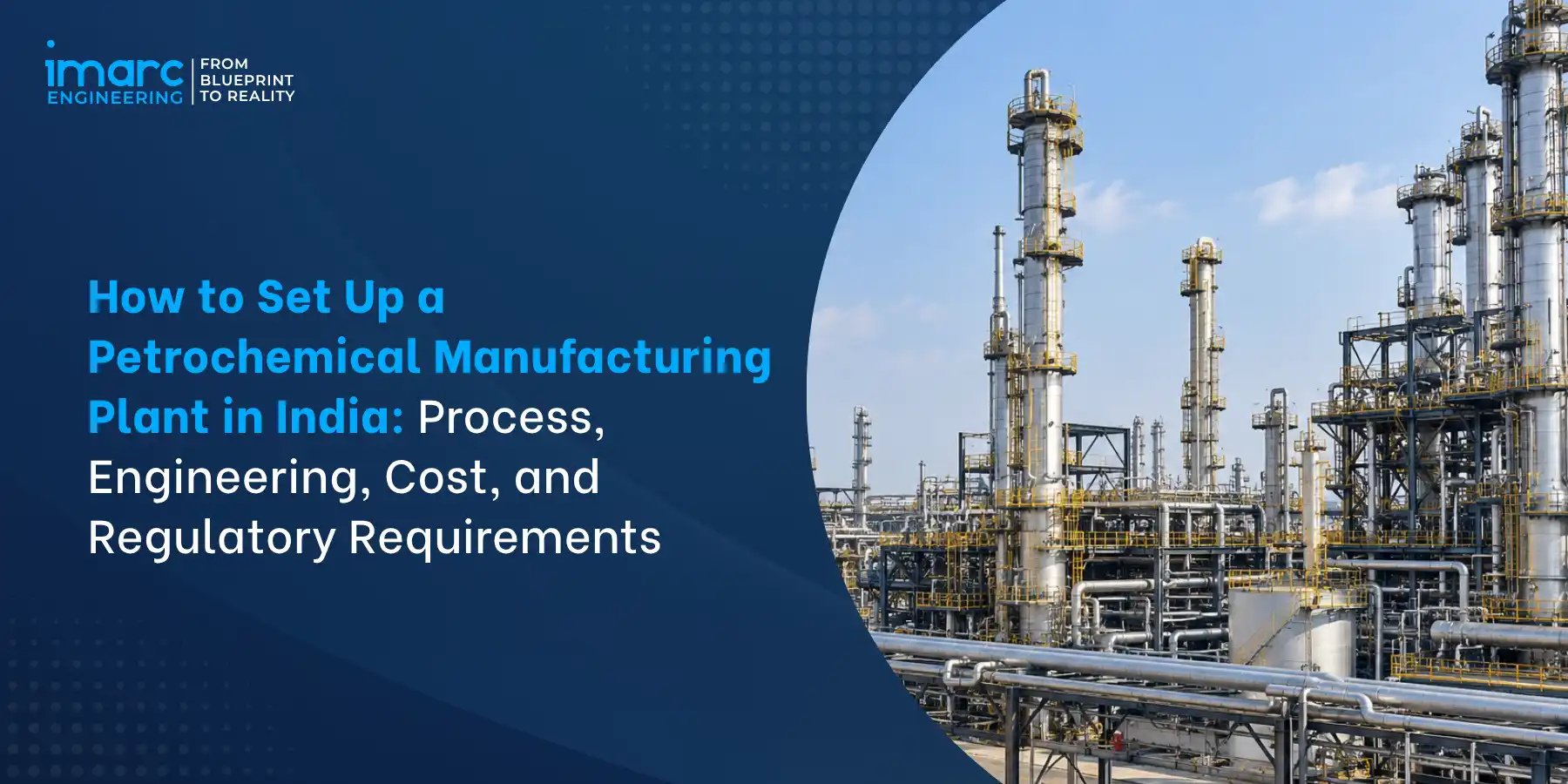
How to Set Up a Petrochemical Manufacturing Plant in India: Process, Engineering, Cost, and Regulatory Requirements
Introduction
For manufacturers, investors, and project developers evaluating a petrochemical manufacturing plant in India in 2026, disciplined integration across product-feedstock selection, process technology, engineering, capital execution, and regulatory compliance determines project viability. India's petrochemical demand continues to grow with domestic capacity expansion supported by three operational PCPIRs (Petroleum, Chemicals and Petrochemicals Investment Regions) attracting INR 3,49,192 crore cumulative investment. Well-planned facilities integrate technology licensing, engineering, and regulatory strategy from project inception rather than sequential post-facto retrofits.
Scope of this Guide
This guide answers the sponsor's question directly. How can manufacturers and investors plan and develop a petrochemical plant in India based on target products, feedstock availability, process technology, plant capacity, engineering requirements, regulatory approvals, and project economics? It walks through feedstock and technology selection, engineering phases (concept through detailed engineering), process equipment, utilities and storage, process safety per MSIHC Rules 1989 and CAEPPR 1996, regulatory framework covering environmental clearance under EIA Notification 2006, and investment brackets anchored to explicit capacity and product-mix assumptions.
Table of Contents
- Introduction
- Why Petrochemical Manufacturing Matters for India in 2026
- What a Petrochemical Manufacturing Plant Is and Why It Matters in India
- Feedstock Selection and Process Technology for Petrochemical Manufacturing in India
- Process Engineering and Plant Design for Petrochemical Projects in India
- Process Equipment Reactors and Columns for Petrochemical Manufacturing in India
- Utilities Storage and Infrastructure for a Petrochemical Plant in India
- Process Safety Fire Protection and Environmental Systems for Petrochemical Plants in India
- Regulatory Approvals Investment and Commissioning for Petrochemical Plants in India
- Conclusion
1. Why Petrochemical Manufacturing Matters for India in 2026
Four drivers make disciplined petrochemical plant setup a strategic priority for Indian manufacturers and investors in 2026.
1.1 Growing Domestic Demand
India remains a net importer of many petrochemical products with sustained demand growth across polyolefins, polyesters, styrenics, engineering plastics, specialty chemicals, and elastomers. Downstream consumption spans packaging, textiles, construction, automotive, agriculture, healthcare, electronics, and industrial applications.
Petrochemical manufacturing in India supports import substitution across multiple product categories with logistics, currency, and lead-time advantages against long-distance shipment. Well-executed plants deliver competitive advantages across domestic markets and export opportunities to regional destinations.
1.2 Policy Support and PCPIR Framework
Indian policy framework supports petrochemical manufacturing including PCPIR (Petroleum, Chemicals and Petrochemicals Investment Regions) policy administered by Department of Chemicals & Petrochemicals under Ministry of Chemicals & Fertilizers. Three PCPIRs approved at Dahej (Gujarat), Vishakhapatnam-Kakinada (Andhra Pradesh), and Paradeep (Odisha) with three operational offering integrated infrastructure.
New Scheme of Petrochemicals (NSP) as Central Sector Scheme with Chemical Promotion and Development Scheme (CPDS) sub-scheme. Bhavya Rasayan Scheme (INR 3,030 crore) approved in Union Budget 2026-27 for three new Chemical Parks on plug-and-play model. 100 percent FDI under automatic route for most chemical sectors.
1.3 Integration with Refineries and Gas Infrastructure
India's refining capacity and expanding natural gas infrastructure create feedstock availability supporting petrochemical development. Refinery-petrochemical integration through steam crackers using naphtha feedstock, integrated aromatic complexes, and downstream units support integrated economics. Natural gas terminal proximity supports gas-based petrochemical plants using ethane, propane, or LPG. Petrochemical industry in India has moved from standalone units to integrated complexes reflecting global norm. Feedstock proximity remains the strongest single determinant of location decisions.
Natural gas also serves as a key feedstock for ammonia production, which supports the fertilizer industry. These linkages between gas processing and chemical production are particularly important in fertilizer manufacturing plant operations, where reliable feedstock availability, process efficiency, and consistent production are essential.
1.4 Export Potential
India serves as a competitive petrochemical manufacturing base for export markets across Middle East, Africa, Southeast Asia, and other destinations. Coastal PCPIRs offer port access supporting import of feedstock and export of products. Free Trade Agreements and preferential access to specific markets create additional export advantages.
Export-oriented facilities typically integrate world-scale capacity supporting competitive unit economics against global suppliers. Domestic-plus-export orientation reduces single-market risk supporting project financial resilience.
2. What a Petrochemical Manufacturing Plant Is and Why It Matters in India
Understanding what a petrochemical manufacturing plant is and why it matters in India begins with defining commercial-scale petrochemical production. Petrochemical plants are integrated process-engineering facilities rather than assembly operations.
2.1 Definition and Scope
A commercial petrochemical production plant is an integrated process facility converting hydrocarbon feedstock (naphtha, natural gas, ethane, propane, LPG, coal derivatives) into intermediate or downstream petrochemical products (olefins, aromatics, polymers, specialty chemicals) through thermal cracking, catalytic reforming, polymerisation, or other chemical processes.
Commercial plants integrate feedstock reception and storage, pre-treatment and separation, reaction or conversion sections with process-specific reactors, furnaces or other conversion equipment, product separation through distillation, product purification, storage tank farm, utility systems (steam, cooling water, power, compressed air, nitrogen, flare), effluent treatment, safety systems, and control room infrastructure.
2.2 Plant Components
| Component | Function | Illustrative Elements |
|---|---|---|
| Feedstock Reception | Reception, storage, pre-treatment | Tank farm, pipelines, dryers |
| Reaction Section | Chemical conversion of feedstock | Cracker furnaces, reactors, catalysts |
| Separation | Product recovery and purification | Distillation columns, absorbers |
| Compression | Gas compression for process | Multi-stage compressors |
| Product Storage | Intermediate and final product | Pressurised and atmospheric tanks |
| Utilities | Steam, water, air, nitrogen, power | Boilers, cooling towers, N2 plant |
| Safety Systems | Fire, gas detection, flare | Fire water, gas detectors, flare stack |
| Environmental | Effluent, emission, waste | ETP, scrubbers, waste storage |
2.3 Product Categories and Plant Design Impact
Product category significantly affects plant design and required infrastructure. Steam crackers producing ethylene, propylene, and BTX (benzene, toluene, xylene) from naphtha require large integrated complexes with cracker furnaces, quench systems, compression trains, and multiple downstream product recovery sections. Aromatic complexes producing benzene, toluene, and xylenes require catalytic reformer and separation trains.
Polymer plants (polyethylene, polypropylene, polyester) require polymerisation reactors and pelletisation. Specialty petrochemical plants for smaller-volume products may use batch reactors and different unit operations. Plant design decisions should follow target product and process technology selection rather than universal assumptions.
3. Feedstock Selection and Process Technology for Petrochemical Manufacturing in India
Understanding feedstock selection and process technology for petrochemical manufacturing in India establishes the strategic foundation. Feedstock and technology decisions drive all downstream engineering, capital, and operating cost implications.
3.1 Feedstock Categories
- Petrochemical feedstock selection depends on target product, availability, and cost stability
- Naphtha feedstock: most widely used in India, supports mixed olefin/aromatic production through steam cracking, typically sourced from refineries
- Gas-based and light-hydrocarbon feedstocks, including ethane, propane and LPG, may support olefin production depending on feedstock availability and the selected process route
- Crude oil derivatives and heavier hydrocarbons for large integrated complexes
- Coal-to-chemicals routes (methanol-to-olefins) - established in some geographies
- Bio-based feedstocks (bio-ethanol, bio-naphtha) - emerging in specialty applications
- Feedstock availability within economical logistics radius is a primary location driver
3.2 Process Routes and Products
| Process Route | Primary Products | Typical Feedstock |
|---|---|---|
| Steam Cracker | Ethylene, propylene, BTX | Naphtha, ethane, propane |
| Catalytic Reformer | Aromatics (BTX) | Naphtha |
| Propane Dehydrogenation | Propylene | Propane |
| Methanol-to-Olefins | Ethylene, propylene | Methanol (via coal/gas) |
| Polymerisation | PE, PP, PVC, PS, PET | Olefins, aromatics |
3.3 Technology Licensor Selection
Process technology selection and technology licensor engagement is one of the most consequential project decisions. Established licensors include Lummus, LyondellBasell, INEOS, UOP (Honeywell), Axens, ExxonMobil, Sinopec, TechnipEnergies, ThyssenKrupp Industrial Solutions, Chevron Lummus, Grace, and others depending on process. Selection criteria include process performance (yields, product quality, catalyst life), capital cost, operating cost (energy, catalyst, utilities), track record with similar-scale plants, licensor support commitments during project execution and operations, royalty terms, and technology transfer scope. Technology selection typically follows feasibility study with 3-6 shortlisted licensors evaluated technically and commercially before final selection.
3.4 Ethylene and Propylene Production Focus
Ethylene production and propylene production are the largest volume olefins with combined capacity representing the backbone of most petrochemical complexes. Steam cracking of naphtha produces both olefins with variable yield ratios adjusted by operating severity. Propane dehydrogenation dedicated propylene production has gained ground for merchant propylene supply. Aromatics (benzene, toluene, xylenes) are produced from catalytic reforming or as steam cracker co-products. Product mix selection during design phase should balance capital efficiency with market demand and downstream integration opportunities.
4. Process Engineering and Plant Design for Petrochemical Projects in India
Understanding process engineering and plant design for petrochemical projects in India covers the engineering phases from concept through detailed engineering. Engineering discipline determines capital efficiency, operational reliability, and project feasibility outcomes.
4.1 Engineering Phases
- Concept study and pre-feasibility: initial product/market/feedstock assessment with order-of-magnitude estimates
- Feasibility study: technical and financial evaluation supported by preliminary capital and operating cost estimates
- Basic Engineering Package (BEP): from technology licensor including material balance, PFDs, key equipment specifications
- Front-End Engineering Design (FEED): +/-15 percent estimate accuracy, P&IDs, equipment sizing, layout
- Detailed engineering: full engineering deliverables for procurement and construction
- Procurement, construction, pre-commissioning, and commissioning
4.2 Engineering Deliverables
- Material balance and energy balance establishing flow rates, compositions, temperatures, and heat duties
- Process flow diagram (PFD) showing major equipment and flow paths
- Piping and instrumentation diagram (P&ID) showing all piping, valves, instruments, and controls
- Equipment datasheets and specifications for procurement
- 3D plot plan and equipment layout
- Piping isometrics and support drawings
- Electrical single line diagrams and cable schedules
- Control system architecture and safety instrumented system (SIS) design
4.3 Site Selection and Plant Layout
Site selection factors include feedstock proximity (refinery, gas terminal, pipeline), port access for import/export (particularly critical for naphtha imports and product exports), PCPIR designation with pre-approved infrastructure, utility availability (water, power, gas), buffer distance requirements per safety norms, environmental sensitivity of location, workforce availability, and state government support.
Plant layout should follow process flow with segregated hazardous storage, adequate spacing between units per NBC and OISD guidelines, escape routes, and emergency response infrastructure. Site selection should precede detailed engineering as many design decisions depend on site-specific characteristics.
5. Process Equipment Reactors and Columns for Petrochemical Manufacturing in India
Understanding process equipment reactors and columns for petrochemical manufacturing in India covers the largest single capital investment category. Process equipment selection follows technology licensor specifications with local fabrication where feasible.
5.1 Reactors and Furnaces
- Reactors configurations vary by process: fixed bed, fluidised bed, moving bed, slurry, tubular reactors
- Cracker furnaces for steam cracking with radiant coils and convection sections
- Catalytic reformer reactors with catalyst circulation systems
- Polymerisation reactors (gas phase, slurry, solution) per product type
- Reactor design per ASME BPVC Section VIII with regulatory pressure vessel certification
5.2 Distillation and Separation
- Distillation columns form the largest equipment category by volume (cold train, hot train, dryers, splitters)
- Cryogenic separation columns for cold train operations
- Trayed and packed columns per separation requirements
- Absorption and stripping columns for gas treating
- Drying columns for feedstock and product moisture removal
5.3 Heat Transfer and Rotating Equipment
- Heat exchangers (shell-and-tube, plate, air-cooled) per TEMA and ASME standards representing 20-30 percent of process equipment count
- Compressors (centrifugal, reciprocating, screw) per API 617 and API 618 for process gas compression
- Pumps (centrifugal, positive displacement) per API 610 for process and utility service
- Turbines (steam, gas) for compressor and generator drive
- Fired heaters for process heating per API 560
5.4 Piping and Storage
- Storage tanks per API 650 (atmospheric) and API 620 (low-pressure) for feedstock and product tank farm
- Pressurised storage vessels per ASME BPVC for LPG, ethylene, propylene
- Process piping per ASME B31.3 with material selection matching service
- Structural steel for equipment support and pipe rack per relevant IS/AISC codes
6. Utilities Storage and Infrastructure for a Petrochemical Plant in India
Understanding utilities storage and infrastructure for a petrochemical plant in India covers the enabling systems representing 15-25 percent of total plant capital. Utility design has significant impact on operational reliability and cost.
6.1 Process Utilities
- Process utilities design should follow process requirements from FEED stage rather than post-facto sizing
- Steam system: high-pressure, medium-pressure, low-pressure steam with multi-level distribution and condensate recovery
- Cooling water system: circulating cooling tower systems providing process cooling with makeup water treatment
- Compressed air and instrument air (oil-free, dried) for pneumatic controls and utility service
- Nitrogen system for equipment purging, blanketing hazardous storage, and process protection
- Boiler feed water and DM water for boiler feed and process use
- Power distribution with substation and dedicated backup for critical loads
6.2 Storage Infrastructure
- Storage tanks for feedstock (naphtha, LPG, ethane), intermediates (ethylene, propylene, aromatics), and finished products
- Tank farm design per OISD standards with dyking, spacing, and fire protection
- Pressurised storage for gases (LPG, ethylene) per PESO/SMPV(U) Rules 2016
- Atmospheric floating roof tanks for volatile hydrocarbons per API 650
- Tank capacity typically supporting 15-30 days consumption depending on logistics
- Product loading facilities: rail siding, truck loading, marine loading arms
6.3 Flare System and Safety Infrastructure
Flare system is a critical safety infrastructure for petrochemical plants covering emergency depressurisation, process venting, and startup/shutdown handling. Elevated or enclosed ground flares sized per relief scenarios with knockout drum, water seal, and smokeless burning provisions. Flare gas recovery systems minimise flaring during normal operations.
Fire water system with dedicated storage (typically 4-8 hours capacity), diesel-driven and electric-driven fire water pumps, hydrants, monitors, deluge systems, and foam systems per OISD standards. Emergency shutdown (ESD) system covering plant-wide safe shutdown scenarios.
6.4 Buildings and Site Infrastructure
Buildings include control room (blast-resistant per site risk assessment), substation buildings, workshop, laboratory, warehouse, administrative building, and canteen. Site infrastructure covers approach roads, internal roads, boundary wall, guard rooms, weighbridges, parking, drainage, and landscaping. Utility corridors and pipe rack system connecting process units.
Fire tender access per NBC 2016 Part 4. Water source (raw water reservoir or river/borewell) with treatment for process, utility, and firefighting use. Waste storage areas including hazardous waste per Hazardous & Other Wastes Rules 2016.
7. Process Safety Fire Protection and Environmental Systems for Petrochemical Plants in India
Understanding process safety fire protection and environmental systems for petrochemical plants in India covers the compliance infrastructure. Safety and environmental discipline is not optional overlay but integrated into every plant function.
7.1 Process Safety Framework
- Process safety program covering hazardous chemical inventory, process hazards analysis, safe operating procedures, and management of change
- HAZOP study (Hazard and Operability) during design phase identifying process hazards and required safeguards
- LOPA (Layer of Protection Analysis) for critical hazards determining Safety Integrity Level (SIL)
- Safety Instrumented System (SIS) per IEC 61511 for critical process safety functions
- Emergency response plan per Chemical Accidents (Emergency Planning, Preparedness and Response) Rules 1996
- MSIHC Rules 1989 compliance including onsite and offsite emergency plans for Major Accident Hazard (MAH) units
- Worker training on hazardous chemicals and emergency response per policy requirements
7.2 Hazardous Chemical Storage and Handling
Hazardous chemical storage per Manufacture, Storage and Import of Hazardous Chemicals Rules 1989 (MSIHC) with threshold quantity notification, safety report, and emergency planning obligations for MAH units. PESO approvals under Petroleum Act 1934 for petroleum products and Explosives Act 1884 for classified chemicals. Static and Mobile Pressure Vessels (Unfired) Rules 2016 for pressurised storage tanks.
Hazardous chemical inventory management with segregation of incompatible materials, ventilation controls, and spill containment. Handling procedures with worker PPE per material safety data sheet (MSDS) requirements.
7.3 Fire Protection System
- Fire protection system per NBC 2016 Part 4 with petrochemical-specific considerations under OISD standards
- Fire water storage with 4-8 hours capacity depending on hazard classification
- Fire water network with hydrants at 30-45 m spacing across plant
- Water spray systems (deluge) for critical equipment cooling
- Foam systems for flammable liquid tank protection
- Dry chemical powder (DCP) for gas fire suppression
- Gas detection systems (LEL, H2S, CO) with alarm and automatic response
- Fire and gas (F&G) system integrated with control system and emergency response
7.4 Environmental Systems
Effluent treatment plant (ETP) with primary, secondary, and tertiary treatment for wastewater treatment meeting SPCB discharge standards. Zero Liquid Discharge (ZLD) increasingly required for water-scarce regions. Emission control covering SO2, NOx, VOC, particulate matter through scrubbers, thermal oxidisers, low-NOx burners, and continuous emission monitoring (CEMS).
Hazardous waste management per Hazardous & Other Wastes (Management and Transboundary Movement) Rules 2016 through authorised recyclers and disposal facilities. Ambient air quality monitoring across plant boundary. Noise Pollution Rules 2000 compliance for equipment noise.
8. Regulatory Approvals Investment and Commissioning for Petrochemical Plants in India
Understanding regulatory approvals and environmental clearance for petrochemical plants in India alongside investment capital cost project economics and commissioning for petrochemical plants in India completes the project development framework.
8.1 Regulatory Approvals
| Approval | Authority | Framework |
|---|---|---|
| IEM Part A/B (via NSWS) | DPIIT | IDRA 1951 |
| Environmental Clearance | MoEFCC (Category A) | EIA Notification 2006 |
| CTE and CTO | State Pollution Control Board | Water Act 1974, Air Act 1981 |
| MSIHC Compliance | State Factories Directorate | MSIHC Rules 1989 |
| PESO Approval | PESO | Petroleum Act 1934, SMPV(U) Rules 2016 |
| Boiler Registration | Chief Inspector of Boilers | Boilers Act 2025 |
| Factory Licence | State Directorate of Factories | OSH Code 2020 (21 Nov 2025) |
| Fire NOC | State Fire Services | NBC 2016 Part 4 |
8.2 Capital Investment by Plant Scale
| Plant Category | Capacity Assumption | Investment (INR) |
|---|---|---|
| Small specialty | 10,000-50,000 TPA specialty petrochemical | 200-1,000 crore |
| Medium | 50,000-300,000 TPA single product | 1,000-5,000 crore |
| Large integrated | 500,000+ TPA cracker complex | 10,000-40,000 crore |
8.3 CAPEX Composition and Operating Economics
- CAPEX and OPEX composition varies by product and technology
- Process equipment: 30-40 percent of CAPEX
- Piping and instrumentation: 15-20 percent
- Civil and structural: 10-15 percent
- Electrical and controls: 8-12 percent
- Utilities: 10-15 percent
- Storage and offsites: 8-12 percent
- Technology licence fee: 3-6 percent (upfront + royalty per production)
- Engineering, project management, and contingency: 10-15 percent
8.4 Engineering, Procurement, Construction, and Commissioning
Most petrochemical projects use EPCM (Engineering, Procurement, Construction Management)/ EPC/hybrid contracting model with engineering contractor managing design and procurement while multiple construction contractors execute site work under supervision. Alternative lump-sum EPC (Engineering, Procurement, Construction) contracting for defined-scope projects.
Detailed engineering typically 12-18 months. Procurement of long-lead equipment (compressors, reactors, large columns) 18-30 months. Construction 24-36 months for medium plants and 36-48 months for large complexes. Pre-commissioning and commissioning covers mechanical completion, utility commissioning, inert running, feedstock introduction, and performance guarantee test typically 4-8 months. Overall greenfield timeline 4-6 years from investment decision to commercial operation.
Conclusion
Setting up a petrochemical manufacturing plant in India involves product-market and feedstock assessment, technology selection, engineering from concept to detailed design, site selection near feedstock and PCPIRs, process equipment and utilities planning, process safety, environmental management, regulatory approvals, CAPEX estimation, and EPCM execution. Greenfield projects may span 4–6 years, depending on scale, technology, product mix, and site.
Three key reminders for petrochemical plant sponsors: feedstock and technology choices shape project economics, design, and location; safety and environmental controls should be integrated from the outset rather than added later; and CAPEX, timelines, and regulatory requirements vary with capacity, product mix, technology, and site. Realistic assumptions and conservative planning are essential for project viability.
PURSUING PETROCHEMICAL MANUFACTURING PLANT SETUP?
IMARC Engineering's petrochemical manufacturing plant advisory team supports manufacturers, investors, and project developers with product-market assessment across polyolefins, polyesters, styrenics, engineering plastics, specialty chemicals, and elastomers; feedstock strategy covering naphtha, natural gas, crude derivatives, methanol-to-olefins, and bio-based routes; technology licensor evaluation; and engineering support from concept and feasibility studies through FEED and detailed engineering. Services include site selection, process equipment and utilities planning, process safety covering HAZOP, LOPA, SIL/SIS, regulatory approvals, environmental systems, capital investment estimation, EPCM strategy, and integrated commissioning for compliant commercial operations.
→ Schedule a free petrochemical plant scoping consultation with an IMARC specialist
Frequently Asked Questions
Setting up a petrochemical manufacturing plant in India involves product/feedstock selection, technology licensor selection, feasibility study, process engineering (PFD, P&ID, material and energy balance), site selection, environmental clearance, MSIHC/PESO approvals, EPCM contractor engagement, construction, pre-commissioning, and commissioning across 4-6 years for greenfield petrochemical projects.
Petrochemical feedstock varies by target product. Common feedstocks include naphtha (from refineries), natural gas (ethane, propane, LPG), crude oil derivatives, coal (via coal-to-chemicals), and increasingly bio-based feedstocks. Naphtha feedstock supports mixed olefin/aromatic production; natural gas feedstock (ethane) primarily supports ethylene production with limited co-products.
Process technology selection depends on target product, feedstock characteristics, plant capacity, and market requirements. Manufacturers typically license technology from established licensors (Lummus, LyondellBasell, INEOS, UOP, Axens, ExxonMobil, Sinopec). Selection involves technical evaluation, capital and operating cost comparison, licensor track record, support commitments, and royalty terms.
Petrochemical plant equipment includes reactors, distillation columns, heat exchangers, compressors, pumps, storage tanks, and process piping. Utilities include steam system, cooling water system, compressed air, nitrogen system, boiler feed water, DM water, effluent treatment plant, and flare. Utility investment typically 15-25 percent of plant CAPEX.
Petrochemical plant cost in India varies significantly by capacity, product mix, feedstock, and technology. Small specialty petrochemical units typically require INR 200-1,000 crore; medium plants INR 1,000-5,000 crore; large integrated cracker complexes INR 10,000-40,000 crore excluding land and pipelines.
Location factors include feedstock proximity (refinery, gas terminal, or pipeline), port access for import/export, PCPIR designation (Dahej, Vishakhapatnam-Kakinada, Paradeep, utility availability, and buffer distances per safety norms. Plant capacity depends on feedstock availability, market demand, capital appetite, and target product economies of scale.
Petrochemical plants require Environmental Clearance under EIA Notification 2006 (Category A), SPCB CTE/CTO under Water Act 1974 and Air Act 1981, MSIHC Rules 1989 for hazardous chemicals, PESO approvals under Petroleum Act 1934, factory licence under OSH Code 2020, and Fire NOC per NBC 2016.
Major stages of engineering, constructing, and commissioning a petrochemical plant include feasibility study, technology licensing, basic engineering (BEP), front-end engineering design (FEED), detailed engineering via EPCM contractor, procurement, construction, pre-commissioning, commissioning with utilities and inert running, start-up with feedstock introduction, and performance guarantee test.
Recent Post


Trusted by Industry Leaders
We partner with global enterprises and ambitious businesses across sectors to deliver operational excellence, strategic insights, and sustainable growth through integrated solutions.











Success in Their Words
Real feedback from clients across industries. Discover how our solutions delivered measurable impact and operational excellence.

I wanted to express my sincere appreciation for your efforts in handling this matter. Your dedication and commitment have been truly commendable, and it is evident that you have put in tremendous hard work and expertise into resolving the issues at hand. We are greatly interested in continuing our collaboration with you in the future, as your professionalism and reliability have made you a trusted partner. Thank you once again for your invaluable contribution. We look forward to strengthening our partnership ahead.

It has been a pleasure working with the IMARC team. The insights provided were structured, clear, and highly valuable, helping us strengthen both our technical and financial planning with confidence. We deeply appreciate the team’s professionalism, responsiveness, and attention to detail throughout the engagement. Every requirement was well understood and effectively incorporated, resulting in a comprehensive and actionable output. Overall, our experience has been excellent, and I would gladly recommend IMARC to organizations seeking a reliable research partner.

Your service is truly exceptional. Working with the IMARC team has been a seamless and professional experience. The clarity of communication, responsiveness to queries, and consistent support at every stage made the entire engagement highly efficient. The insights shared were well-structured, practical, and perfectly aligned with our requirements, helping us make informed decisions with confidence. Overall, the dedication and professionalism demonstrated by your team stand out, and I would be glad to recommend IMARC as a reliable and trustworthy research partner.

IMARC did an outstanding job in preparing our study. They were punctual, precise, and consistently responsive throughout the entire process. The team delivered all the data we required in a clear, well-organized, and highly professional format. Their strong attention to detail, combined with their ability to meet every deadline without compromising quality, truly set them apart. Overall, their reliability and commitment made them an exceptional partner for our project, and we would gladly work with them again in the future.

IMARC made the whole process incredibly easy from start to finish. Everyone I interacted with via email was polite, professional, and straightforward to deal with, always keeping their promises regarding delivery timelines and remaining consistently solutions-focused. From my very first contact, I appreciated the professionalism and support shown by the entire IMARC team. I highly recommend IMARC to anyone seeking timely, affordable, and reliable information or advice. My experience with IMARC was excellent, and I truly cannot fault any aspect of it.

I’d like to express my sincere gratitude for the excellent work you accomplished with the study. Your ability to quickly understand our requirements and deliver high-quality results under tight timelines truly reflects your expertise, exceptional work ethic, and unwavering commitment to your customer’s success. The professionalism and responsiveness you demonstrated throughout the process made a significant difference. Our entire team and company are incredibly thankful for your dedication, reliability, and support. Once again, thank you for your outstanding contribution.