Manufacturing
November 27 2026
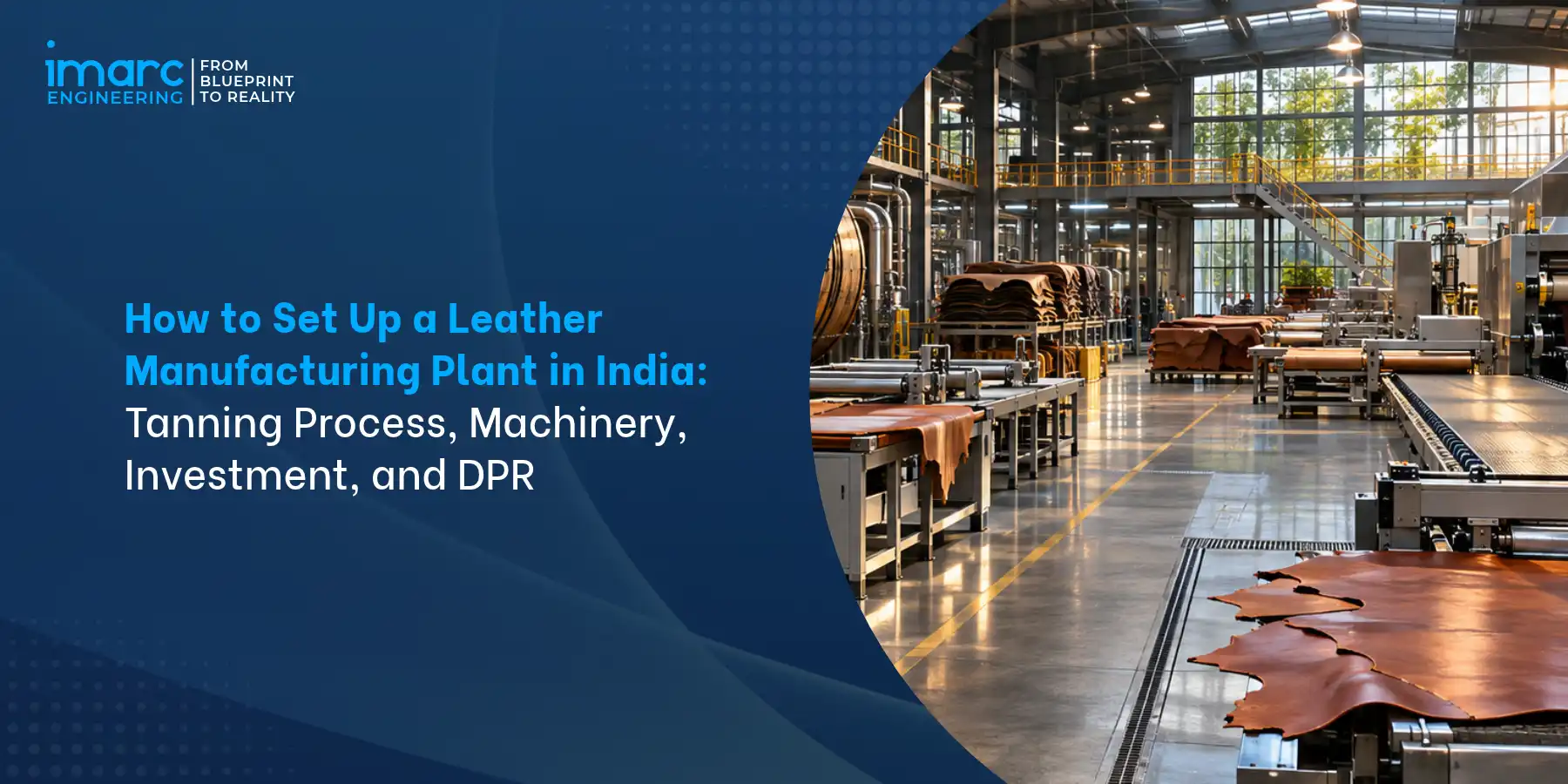
How to Set Up a Leather Manufacturing Plant in India: Tanning Process, Machinery, Investment, and DPR
Introduction
Investors planning a leather manufacturing plant in India in 2026 must evaluate three key factors: the manufacturing configuration, the plant location and the wastewater treatment strategy. The proposed facility may operate as an integrated raw-hide-to-finished leather unit, a wet-blue-to-finished processing plant or a finishing-only facility.
Site selection should consider access to established tannery clusters with Common Effluent Treatment Plant (CETP) infrastructure or the feasibility of developing a standalone treatment system. These decisions influence capital investment, operating costs and regulatory requirements.
Environmental compliance is a critical consideration for tannery projects due to wastewater generation, chemical use and waste management requirements. Under the applicable CPCB industrial classification framework, tannery operations are categorised according to their manufacturing processes and pollution potential.
The relevant Red or Orange category classification should be confirmed against the current CPCB classification and applicable SPCB requirements before finalising the project approval strategy. The classification of crust-to-finished and other specialised operations should be confirmed with the relevant State Pollution Control Board (SPCB) based on the actual process and waste streams.
Scope of this Guide
This guide walks through leather manufacturing plant setup from configuration selection and tanning process through machinery, raw materials, plant layout, wastewater infrastructure, regulatory compliance, quality control, CAPEX/OPEX, and DPR preparation - calibrated to the CPCB, SPCB, and NGT framework in force in November 2026. Downstream leather goods manufacturing (shoes, bags, upholstery) is a distinct business covered elsewhere.
Table of Contents
-
Introduction
-
Why Leather Manufacturing Plant Setup in India Matters for Investors in 2026
-
Types of Leather Manufacturing Facilities and Configuration Selection
-
Leather Manufacturing Process: Raw Hides to Finished Leather
-
Leather Tanning Technologies Machinery and Raw Materials
-
Land Plant Layout Utilities and Wastewater Infrastructure
-
Regulatory Framework Quality Control and Leather Testing
-
CAPEX OPEX Working Capital and Financial Feasibility for a Leather Plant in India
-
DPR Preparation Project Risks and EPCM Support for a Leather Plant in India
-
Conclusion
1. Why Leather Manufacturing Plant Setup in India Matters for Investors in 2026
Four drivers make disciplined leather plant investment strategically important in India in 2026.
1.1 Established Industry Base and Export Share
India has one of the world's largest established leather industries, with historical clusters in Tamil Nadu (Vellore, Ranipet, Pallavaram, Dindigul), West Bengal (Kolkata Bantala), Uttar Pradesh (Kanpur), and Punjab (Jalandhar). Domestic and export demand for finished leather supports footwear, leather goods, automotive upholstery, and apparel. A disciplined leather manufacturing business in India can serve buyer segments ranging from mass-market domestic to premium European and North American export markets.
1.2 Cluster vs Standalone Siting
Several established tannery clusters in India have Common Effluent Treatment Plant (CETP) infrastructure for shared wastewater treatment. However, availability, treatment capacity, connection eligibility, pretreatment requirements and discharge conditions vary by cluster. Investors should verify the operating status and available capacity of the relevant CETP, along with applicable SPCB and cluster-specific conditions, before selecting a site. Standalone facilities generally require an appropriately designed in-house Effluent Treatment Plant (ETP), with treatment and reuse requirements determined by the applicable consent conditions.
1.3 Environmental Expectation is Non-negotiable
Tannery wastewater management is a major project-design consideration because of the presence of high organic loads, dissolved salts, sulphides and chromium. Zero Liquid Discharge (ZLD) is not a universal requirement for every tannery in India. Its applicability depends on relevant NGT directions, SPCB consent conditions and the requirements governing the particular industrial cluster or CETP. Project developers should confirm these obligations before finalising the wastewater treatment configuration and associated investment.
1.4 Export Customer Technical Expectations
Export customers, particularly in European footwear, apparel and automotive supply chains, may require leather to meet EU REACH restrictions and buyer-specific restricted substance lists. The REACH restriction for chromium VI applies a maximum concentration of 3 mg/kg in covered leather articles that come into contact with the skin.
Testing can be carried out using ISO 17075-1:2017 or the applicable reference method. For certain restricted aromatic amines derived from azo colourants in dyed leather, ISO 17234-1:2024 provides the relevant test method. Additional chemical and performance requirements depend on the product and customer specification.
2. Types of Leather Manufacturing Facilities and Configuration Selection
The first leather factory setup decision is the manufacturing configuration. Three configurations dominate commercial practice in India, each with distinct machinery, effluent profile, and investment envelope.
2.1 Three Manufacturing Configurations
| Configuration | Production Scope | Main Investment Consideration |
|---|---|---|
| Integrated tannery | Raw hides/skins to finished leather | Highest process integration, machinery and effluent-treatment requirements; ZLD where specifically mandated |
| Wet-blue-to-finished | Wet-blue inputs through retanning, dyeing, drying and finishing | Moderate CAPEX; requires wet-processing equipment and appropriate effluent management |
| Finishing-only | Crust leather through surface finishing | Lower CAPEX; wastewater requirements depend on finishing chemicals, wet operations and cleaning processes |
2.2 Chrome vs Vegetable Tanning
Chrome tanning uses basic chromium sulphate to produce wet-blue leather and is widely used for commercial applications requiring flexibility, durability and consistent processing. Vegetable tanning uses plant-derived tannins, such as wattle, mimosa, quebracho and chestnut extracts, to produce leather with different firmness, appearance and ageing characteristics. Its processing cycle is generally longer than chrome tanning. The choice of tanning system affects chemical consumption, process duration, effluent characteristics, machinery requirements and the finished product's properties.
2.3 Specialist and Hybrid Facilities
Beyond the three main configurations, specialist facilities focus on vegetable-tanned leather (dedicated pit tanning or veg drum), chrome-free tanning using glutaraldehyde or syntans (growing in EU-oriented segments), high-end exotic leathers (ostrich, reptile - under CITES compliance where applicable), and automotive upholstery-grade leather with tight dimensional and performance specifications. Specialisation adds value but demands tighter QC and customer qualification discipline.
2.4 Choosing the Right Configuration
Configuration choice follows target customer, raw material access, environmental compliance envelope, and capital availability. First-time investors may consider wet-blue processing or finishing-only facilities because they generally require fewer upstream processing operations than an integrated tannery. However, environmental classification, consent requirements and wastewater-management obligations depend on the actual process and site conditions.
3. Leather Manufacturing Process: Raw Hides to Finished Leather
The leather manufacturing process for an integrated tannery converts raw hides and skins into finished leather through beamhouse, tanning, retanning-dyeing-fatliquoring, and finishing stages. Each stage has distinct chemical, water, and effluent profile.
3.1 Beamhouse Operations
Beamhouse operations prepare the raw hide for tanning. Soaking rehydrates the preserved hide and removes salt, dirt, and blood. Liming (with lime and sodium sulphide) loosens hair and opens the collagen fibre structure. Fleshing - performed on a fleshing machine - removes subcutaneous flesh and fat. Deliming removes residual lime; bating with enzymes softens the pelt. These steps generate significant effluent load (BOD, COD, sulphide, lime).
3.2 Tanning
Pickling (with acid and salt) prepares the pelt to receive tanning chemicals. Chrome tanning in wooden or stainless-steel drums uses basic chromium sulphate at controlled pH and temperature; the chromium cross-links collagen fibres to produce stable wet-blue leather - bluish in colour, resistant to microbial attack, ready for further processing or sale. Vegetable tanning uses tannins from plant sources over longer processing cycles to produce brown firm leather.
3.3 Retanning Dyeing Fatliquoring
After tanning, wet-blue leather is sammyed to remove excess water, split where required and shaved to the specified thickness. It is then neutralised, retanned using suitable syntans or other tanning agents, dyed to the required shade and fatliquored to achieve the desired softness and flexibility. These operations determine important characteristics such as colour, handle, fullness and performance. The leather then moves to setting or sammying operations before drying.
3.4 Drying Finishing and Inspection
Following wet processing, leather undergoes setting-out or sammying, as required, to remove excess moisture and improve its surface condition. It is then dried using toggle, vacuum, pasting or hang-drying systems. Conditioning or reconditioning restores suitable moisture levels before mechanical operations such as staking, trimming, toggling and buffing, depending on the product specification. The leather at this stage is generally classified as crust leather.
Crust leather is subsequently finished through operations such as coating, spraying, roller application, embossing and plating. Finished leather is inspected, graded, measured and dispatched. Finished leather area is generally measured in square feet or square metres.
4. Leather Tanning Technologies Machinery and Raw Materials
An integrated leather tanning machinery suite covers beamhouse, tanning, wet-finishing, drying, and surface-finishing stations. Technology selection matched to product mix drives investment profile.
4.1 Core Machinery
Machinery selection depends on whether the facility processes raw hides, wet-blue leather or crust leather. An integrated tannery requires equipment across beamhouse, tanning, wet processing, drying and finishing. Wet-blue processing units do not require the complete beamhouse line, while finishing-only plants focus on drying, conditioning and surface treatment.
| Equipment | Primary function | Applicable configuration |
|---|---|---|
| Soaking and liming drums | Rehydrate hides and loosen hair | Integrated tannery |
| Fleshing and unhairing machines | Remove flesh, fat and hair | Integrated tannery |
| Deliming and bating equipment | Prepare pelts for tanning | Integrated tannery |
| Tanning drums | Process hides using chrome or vegetable tanning agents | Integrated tannery |
| Sammying machine | Remove excess water from leather | Integrated and wet-blue-to-finished |
| Splitting and shaving machines | Adjust leather thickness | Integrated and wet-blue-to-finished |
| Retanning, dyeing and fatliquoring drums | Adjust colour, softness and leather properties | Integrated and wet-blue-to-finished |
| Setting-out machine | Remove excess moisture and smooth leather | Integrated and wet-blue-to-finished |
| Toggle and vacuum dryers | Dry leather to the required moisture level | All configurations, depending on process |
| Staking machine | Soften and improve leather handle | All configurations, depending on process |
| Buffing machine | Prepare the surface for finishing | All configurations, where required |
| Spray booths and roller coaters | Apply finishing chemicals and coatings | All configurations involving surface finishing |
| Plating and embossing presses | Apply texture and surface patterns | Finishing operations |
| Measuring machines | Measure finished leather area | All configurations |
Equipment quantities, drum capacities and machine specifications should be established from the planned throughput, hide or skin type, batch sizes, process sequence and finished-product requirements.
4.2 Raw Materials
| Raw Material / Input | Primary Role |
|---|---|
| Raw hides and skins (cow, buffalo, goat, sheep) | Primary feedstock; salt-preserved or fresh |
| Wet-blue leather (configuration 2) | Pre-tanned input for retan-dye-finish plants |
| Crust leather (configuration 3) | Semi-finished input for finishing-only plants |
| Lime, sodium sulphide, ammonium sulphate | Beamhouse chemicals |
| Basic chromium sulphate | Chrome tanning agent |
| Vegetable tannins (wattle, mimosa, quebracho, chestnut) | Vegetable tanning |
| Syntans, retanning agents | Property adjustment |
| Dyes (acid, direct, reactive) | Colour development |
| Fatliquors, oils, emulsifiers | Softness and flexibility |
| Finishing chemicals (binders, pigments, top-coats) | Surface finish |
4.3 Water Steam and Electricity
Water requirements depend on the manufacturing configuration, hide or skin type and processing capacity. Water quality parameters such as hardness, chloride and iron content should be evaluated because they can affect process consistency and leather quality. Filtration, softening or reverse osmosis should be selected based on raw-water testing and process requirements.
Steam is required for process heating, hot-water preparation and certain drying operations, depending on the plant configuration. Boiler capacity should be determined through a process-wise steam-load assessment. Fuel selection, condensate recovery, boiler efficiency, emissions and water treatment should also be considered.
Electricity is required for tanning drums, fleshing and shaving machines, dryers, pumps, compressors, finishing lines, material handling and wastewater-treatment equipment. The electrical load assessment should account for connected loads, operating schedules, peak demand, transformer capacity and backup requirements.
Water metering, energy monitoring and resource-recovery measures should be incorporated into the plant design. Utility consumption should be estimated from equipment specifications and production requirements rather than generic per-hide assumptions.
4.4 Material Handling and Workflow
Hide handling is heavy-labour work. Material flows from inbound raw-hide receipt and salt-stock storage, to beamhouse drums, to tanning drums, to Sammy and split, to shave and retan, to drying and crusting, to finishing, to packaging and dispatch. Overhead trolleys, drum-loading gear, and trolleys for sammyed and crust leather support the workflow. Layout discipline matters - leather processing plant cost increases with inefficient workflow through longer cycles and higher WIP inventory.
5. Land Plant Layout Utilities and Wastewater Infrastructure
Facility layout and infrastructure for a leather tanning plant in India are shaped by configuration, environmental compliance envelope, and - critically - wastewater management strategy.
5.1 Plant Layout
Material flow proceeds from raw-hide receiving and salt-stock, to beamhouse (drums with effluent drain), to tanning drums, to wet-finishing bays (sammy, split, shave, retan, dye, fatliquor), to drying area (toggle rails, vacuum dryers), to crusting storage, to finishing lines (coating booths, roller coaters), to measuring and dispatch. Chemical storage is segregated (acids separate from alkalis, oxidisers separate from organics). The ETP is typically located downstream of the beamhouse and tanning drains for gravity collection.
5.2 Water, Steam and Electrical Utilities
Utility planning should cover raw-water intake, treatment based on water quality, storage and distribution to process areas, steam generation, electrical supply and wastewater management. Boiler capacity should be determined by the steam requirements of tanning, drying and other process operations. Fuel selection should consider availability, operating cost, boiler specifications and applicable air-emission requirements. Water recycling and recovery systems should be incorporated where technically feasible and required by the applicable environmental conditions.
5.3 Wastewater Infrastructure
Tannery wastewater should be segregated according to its source and characteristics. Beamhouse effluent may contain high organic loads, sulphides and suspended solids, while spent chrome liquor requires separate collection and chromium recovery. Treatment systems may include screening, equalisation, pH adjustment, chemical treatment, coagulation-flocculation, biological treatment and tertiary polishing, depending on the required discharge or reuse quality.
Chrome recovery systems should be designed to recover chromium sulphate from spent chrome liquor. Sludge and other treatment residues must be characterised and managed under the applicable hazardous waste requirements.
5.4 ETP, CETP and ZLD
Standalone tanneries generally require an appropriately designed in-house ETP or another SPCB-approved treatment arrangement. Units in authorised tannery clusters may use a CETP where connection capacity is available and applicable pretreatment and discharge conditions are met. Treatment responsibilities must be clearly defined through consent conditions and operating agreements.
Where ZLD is mandated, the system may include reverse osmosis, multiple-effect evaporation and crystallisation, with reject and salt management designed to meet the relevant environmental requirements.
6. Regulatory Framework Quality Control and Leather Testing
The regulatory stack for a leather processing factory combines CPCB/SPCB environmental approvals, factory and labour compliance, hazardous waste handling, and customer-driven technical standards.
6.1 Environmental Compliance
Environmental compliance for tannery projects includes applicable Consent to Establish (CTE) and Consent to Operate (CTO) requirements from the State Pollution Control Board under the Water (Prevention and Control of Pollution) Act, 1974, and the Air (Prevention and Control of Pollution) Act, 1981.
Under CPCB's revised 2025 industrial classification, raw-to-finished, raw-to-wet-blue and wet-blue-to-finished tanning operations are classified as Red category industries. Vegetable tanning is classified as Orange category. Other configurations, including crust-to-finished operations, should be assessed with the relevant SPCB based on their actual processes, emissions and effluent generation. Applicable CTE and CTO requirements should be confirmed before establishing the facility.
Leather, skin and hide processing projects should be assessed under Item 4(f) of the EIA Notification, 2006, and its subsequent amendments. Environmental Clearance requirements depend on the proposed activity, location, project category and applicable conditions. The project developer should confirm the relevant approval pathway with the competent environmental authority before proceeding.
A separate environmental clearance may not be required for an individual unit within an industrial estate or leather complex that has already obtained prior EC, provided the estate's environmental appraisal covers the proposed activity and the unit complies with the EC conditions. The Ministry's clarification dated 25 November 2025 specifies the information required for comprehensive appraisal, including proposed industries, common infrastructure, layout, pollution loads and environmental safeguards. Individual units remain subject to applicable SPCB consents and environmental conditions.
Tannery wastewater must comply with the applicable effluent discharge standards under the Environment (Protection) Rules, 1986, as amended, and relevant SPCB consent conditions. Treatment requirements may include segregation of wastewater streams, chromium recovery, salt management and appropriate treatment infrastructure, depending on the manufacturing process and applicable regulatory obligations.
CPCB and SPCB requirements, including applicable CETP conditions, water reuse obligations and site-specific ZLD directions, should be assessed before finalising the plant's environmental infrastructure.
6.2 Hazardous Waste and Chromium
Chromium-bearing residues, treatment sludge and other wastes generated by tanning operations must be assessed and managed under the applicable Hazardous and Other Wastes (Management and Transboundary Movement) Rules, 2016, as amended. Waste classification, chromium recovery obligations, storage, transport and disposal requirements should be verified against the relevant waste categories and SPCB authorisation conditions.
Residual sludge and other hazardous wastes must be characterised, stored, transported and disposed of in accordance with applicable regulatory requirements. Where disposal is required, waste should be sent to an appropriately authorised Treatment, Storage and Disposal Facility (TSDF). Hazardous waste authorisation and record-keeping requirements should be verified with the relevant SPCB.
6.3 Factory Fire and Other Approvals
Other statutory requirements depend on the plant's location, workforce, installed equipment and chemical storage arrangements. Factory or establishment registration, plan approval and applicable licensing should be assessed under the Occupational Safety, Health and Working Conditions Code, 2020, effective from 21 November 2025, and the relevant state rules.
Fire-safety approvals and Fire NOC requirements should be confirmed with the competent state or local authority. Plant design should incorporate applicable fire-safety requirements, including relevant provisions of the National Building Code of India 2016, where adopted. Electrical installation approvals may be required from the competent electrical inspectorate, depending on the installation and state requirements.
Boiler registration, inspection and certification should be assessed under the Boilers Act, 2025, which came into force on 1 May 2025 and replaced the Boilers Act, 1923. Boilers falling within the Act's definition must meet applicable registration, inspection and certification requirements before use. The applicability should be checked against the statutory definition, exemptions and relevant state procedures.
6.4 Quality Control and Leather Testing
Quality control should cover leather thickness, area, tensile strength, tear strength, colour fastness, flex resistance, softness and other performance characteristics specified by the intended application. Applicable leather testing standards should be selected according to the finished product, customer requirements and test parameters. Relevant BIS and ISO methods may cover physical strength, thickness, colour fastness, chemical composition and restricted substances. The exact standard number, part and current edition should be verified before publication.
Chemical compliance testing may include chromium VI determination using ISO 17075-1:2017 and the analysis of certain aromatic amines derived from azo colourants using ISO 17234-1:2024. Export-oriented facilities should also evaluate applicable EU REACH restrictions and customer-specific restricted substance lists. Automotive, footwear and apparel buyers may impose additional performance, durability, chemical and quality-management requirements, which should be incorporated into the plant's quality control system.
7. CAPEX OPEX Working Capital and Financial Feasibility for a Leather Plant in India
Understanding leather tanning plant cost India needs discipline. Universal per-hide or per-tonne CAPEX figures mislead - every plant is engineered to configuration, product mix, scale, and wastewater approach.
7.1 CAPEX Drivers
Primary CAPEX drivers include the manufacturing configuration (integrated, wet-blue-to-finished or finishing-only), production capacity, machinery requirements, wastewater treatment infrastructure and site development costs. Other considerations include boilers, utilities, acid-resistant flooring in wet-processing areas, chemical storage, installation and engineering expenses.
Standalone ETP or CETP connection costs should be assessed according to the selected site, while ZLD-related investment should be included wherever specifically required. Project contingency should be based on engineering maturity, vendor quotations, site conditions and implementation risks rather than a fixed percentage.
7.2 OPEX Components
Major OPEX components include raw hides and skins, tanning and finishing chemicals, water, steam, electricity, labour, machinery maintenance, effluent treatment, sludge disposal, packaging, freight and regulatory compliance. Actual costs depend on the manufacturing configuration, product mix, production volume, procurement arrangements and capacity utilisation.
Raw-hide prices, chemical consumption, energy requirements and wastewater-treatment expenses should be evaluated as key cost variables in the financial model. Their impact on operating margins should be assessed through project-specific cost estimates and sensitivity analysis.
7.3 Working Capital
Leather manufacturing can require substantial working capital because of raw-hide inventory, work-in-progress across multiple processing stages, crust and finished-leather stock, and customer receivables. Inventory requirements should be modelled according to production schedules, procurement lead times, hide preservation requirements, process cycle times and expected demand. Receivable assumptions should reflect negotiated payment terms, buyer credit periods and export arrangements. The DPR should assess these requirements separately for domestic and export customers.
7.4 Financial Feasibility
Financial feasibility should evaluate project CAPEX, operating expenditure, production capacity, finished-leather yields, product realisation, working capital and projected cash flows. Investment appraisal may include Net Present Value (NPV), Internal Rate of Return (IRR), payback period and Debt Service Coverage Ratio (DSCR).
Financial assumptions should be tested against variations in hide prices, chemical costs, capacity utilisation, product mix, rejection rates, export realisation and wastewater-treatment expenses. Debt assumptions and DSCR requirements should be aligned with the proposed financing structure and lender requirements.
Illustrative Financial Assumptions for an Integrated Tannery
The following example demonstrates how a tannery DPR can link raw-hide processing capacity with finished leather output, operating costs and revenue. These figures are illustrative planning assumptions, not industry benchmarks.
| Parameter | Illustrative assumption | Financial modelling basis |
|---|---|---|
| Manufacturing configuration | Integrated tannery | Raw hides to finished leather |
| Daily input capacity | 100 hides | Planned production throughput |
| Average hide weight | 25 kg | To be validated through procurement data |
| Daily raw-hide input | 2.5 tonnes | 100 hides × 25 kg |
| Operating days | 300 days/year | Planned production calendar |
| Annual hide input | 30,000 hides | Daily capacity × operating days |
| Finished leather yield | 35 sq. ft./hide (hypothetical net saleable-area assumption) | Actual yield must be validated through representative production trials and should account for hide size, quality, trimming and rejection losses. |
| Daily finished leather output | 3,500 sq. ft. | Hides processed × area yield |
| Annual finished leather output at 100% utilisation | 10.5 lakh sq. ft. | Daily output × operating days |
| Raw-hide procurement cost | Project-specific INR/hide | Supplier quotations and hide quality |
| Chemicals and consumables | Project-specific INR/hide | Process recipes and consumption estimates |
| Labour and maintenance | Annual operating budget | Staffing, shifts and equipment requirements |
| Water and electricity | Consumption × applicable tariffs | Process and equipment load calculations |
| Steam and boiler costs | Fuel, water and maintenance costs | Steam demand and boiler efficiency |
| Effluent treatment | Wastewater volume × treatment cost | ETP/CETP charges, chemicals, energy and sludge disposal |
| Finished leather revenue | Saleable area × realised INR/sq. ft. | Product grade, customer contracts and market quotations |
| By-product realisation | Based on saleable quantities | Recovery and buyer quotations |
The financial model should also account for capacity utilisation, processing losses, rejected leather, inventory, receivables, working capital, depreciation, interest and taxes. ETP or CETP operating costs should be calculated separately from production costs. ZLD-related investment and operating expenses should be included only where applicable. Sensitivity analysis should test changes in hide prices, finished leather yield, selling prices, chemical consumption, energy costs and wastewater-treatment expenses.
8. DPR Preparation Project Risks and EPCM Support for a Leather Plant in India
A disciplined leather manufacturing plant DPR integrates technical, market, environmental, and financial planning into a lender-ready document.
8.1 DPR Component Framework
| DPR Component | What to Cover |
|---|---|
| Product mix and customer segments | Footwear, upholstery, garments, goods, export vs domestic |
| Raw hide/skin availability | Local and imported sourcing, quality, seasonality |
| Processing capacity | Hides/day, skins/day, tonnes/day |
| Finished leather output | Square feet or square metres per month |
| Tanning technology | Chrome, vegetable, chrome-free; machinery configuration |
| Chemicals and water | Chemical mix, water quality, consumption |
| Land, utilities, layout | Beamhouse, tanning, finishing, chemical storage, ETP |
| Effluent and sludge | Primary/secondary/tertiary; CETP or standalone; ZLD applicability |
| CAPEX, OPEX, working capital | Vendor quotes, hide buffer, WIP cycle |
| Material yield and rejections | Project-specific yield assumptions based on hide type, input quality, processing configuration, product specification and expected process losses |
| Financial projections | Revenue, cash flow, NPV, IRR, DSCR, break-even, sensitivity |
| Implementation and risk | Approvals cycle, monsoon, hide supply, market swings |
Illustrative Capacity Conversion: Hides to Finished Leather Area
Tannery capacity should be calculated using the number and weight of hides or skins processed, operating days, capacity utilisation and the expected saleable leather area. Finished leather output should be established through representative production trials because hide size, quality, thickness, trimming losses and product specifications affect the final area.
The basic calculation is:
- Daily raw-hide input (tonnes): Hides processed per day × average hide weight (kg) ÷ 1,000
- Daily finished leather output (sq. ft.): Hides processed per day × average saleable area per hide
- Annual saleable finished leather output = Rated daily hide-processing capacity × Net saleable leather area per hide × Scheduled operating days × Capacity utilisation.
The net area yield must already account for expected trimming, grading and rejection losses to avoid double-counting.
Illustrative example:
| Parameter | Assumption |
|---|---|
| Hides processed per day | 100 |
| Average hide weight | 25 kg |
| Daily raw-hide input | 2.5 tonnes |
| Average saleable finished area per hide | 35 sq. ft. |
| Daily finished leather output | 3,500 sq. ft. |
| Annual operating days | 300 |
| Annual output at full utilisation | 10.5 lakh sq. ft. |
| Annual output at 80% utilisation | 8.4 lakh sq. ft. |
The assumed yield of 35 sq. ft. per hide is illustrative and must be validated through sample processing and finished-leather measurement. Wet-blue-to-finished and crust-to-finished facilities should use their respective input quantities and process yields rather than raw-hide assumptions. Goat and sheep skins should be modelled separately from larger hides. The DPR should also account for grading, rejection, trimming and other saleable-area losses.
8.2 Key Project Risks
Key project risks include raw-hide supply and price fluctuations, changes in chemical and energy costs, wastewater-treatment expenses, export demand and currency movements, product rejection due to quality deviations, and changes in environmental consent conditions.
Export-oriented facilities must also assess applicable EU REACH restrictions, including chromium VI limits for covered leather articles in contact with the skin, restrictions on certain azo colourants and buyer-specific restricted substance lists. Mitigation measures include diversified sourcing, reliable chemical suppliers, robust quality control, effective effluent management, worker safety procedures and sensitivity-based financial planning.
8.3 EPCM Support
EPCM support may cover feasibility assessment, DPR preparation with vendor-based CAPEX estimates, FEED and plant layout engineering, machinery evaluation, utility and wastewater system planning, and coordination of regulatory documentation and applications.
Project execution support may include construction supervision, mechanical and electrical installation oversight, ETP or ZLD commissioning coordination, trial production and assistance with export customer qualification. Statutory approvals remain subject to review and grant by the competent authorities. EPCM is particularly valuable given the environmental compliance complexity and configuration-specific technology choices.
8.4 Setup Checklist
The planning checklist covers verified configuration (integrated, wet-blue, finishing-only), product and customer strategy, DPR with vendor-quote CAPEX, land secured with cluster/standalone wastewater route defined, SPCB CTE applied, Factory Licence, Fire NOC, boiler registration, hazardous waste authorisation, hide sourcing contracts, chemical vendor qualification, machinery orders placed, ETP or CETP tie-up signed, trial batches with REACH Cr(VI) testing, export customer sample approvals, and operations SOP with worker training documented.
Conclusion
Setting up a leather manufacturing plant in India requires the right configuration, process technology, machinery, raw material sourcing and wastewater infrastructure. Investors must assess applicable SPCB consents, environmental clearance, effluent standards, hazardous waste rules, factory and fire-safety requirements, and boiler registration under the Boilers Act, 2025. A project-specific DPR should cover CAPEX, OPEX, working capital, financial projections and implementation planning.
Three factors are critical to project success. First, configuration selection determines investment, effluent load and target markets. Second, wastewater planning must account for CETP access or a standalone ETP, with ZLD where specifically mandated. Third, export requirements, including EU REACH restrictions, azo-dye limits and buyer-specific standards, should be incorporated into process and quality control from the outset.
PLANNING A LEATHER MANUFACTURING PLANT IN INDIA?
IMARC Engineering's Leather Manufacturing Plant Project and Engineering Advisory team supports investors across plant configuration, product strategy, process engineering, machinery selection, raw material sourcing and chemical supply-chain planning. Its services cover plant layout, utilities, wastewater treatment infrastructure, regulatory approvals, quality control and REACH compliance. The team also provides DPR preparation, CAPEX and working capital modelling, financial projections, sensitivity analysis and EPCM support, including equipment installation, ETP commissioning, trial production and export customer qualification.
→ Schedule a leather plant scoping consultation with an IMARC specialist
Frequently Asked Questions
Setting up a leather manufacturing plant requires configuration selection, market assessment, a Detailed Project Report (DPR), site selection, machinery procurement and raw material planning. Investors must also assess applicable environmental clearances, SPCB consents, factory requirements, fire-safety approvals and wastewater treatment arrangements before commissioning.
Leather manufacturing involves beamhouse operations such as soaking, liming, fleshing, deliming and bating, followed by tanning using chrome or vegetable agents. Wet processing includes splitting, shaving, retanning, dyeing and fatliquoring. The leather is then dried, softened, surface-finished, inspected and graded.
Leather tanning plant investment depends on production capacity, manufacturing configuration, machinery, land, utilities and wastewater treatment requirements. An integrated tannery generally requires a different investment structure from a wet-blue processing or finishing-only facility. A project-specific DPR with vendor quotations provides a reliable CAPEX estimate.
Leather manufacturing machinery may include soaking and tanning drums, fleshing and unhairing machines, splitting and shaving machines, sammying and setting-out equipment, dryers, staking and buffing machines, spray booths, roller coaters, embossing presses and measuring equipment. The machinery selection depends on plant configuration, capacity and product specifications.
A tannery processes raw hides or skins through beamhouse operations and tanning to produce tanned leather. A finishing plant processes semi-finished leather, such as wet-blue or crust leather, through further treatment and surface finishing. Their machinery requirements, effluent profiles and investment needs differ.
Leather manufacturing requires raw hides and skins or semi-finished leather, depending on the plant configuration. Other inputs include lime, sodium sulphide, acids, basic chromium sulphate, vegetable tannins, syntans, retanning agents, dyes, fatliquors and finishing chemicals such as binders, pigments and topcoats.
Land requirements depend on production capacity, manufacturing configuration, machinery layout, raw material storage, utilities and wastewater infrastructure. Integrated tanneries generally need more space than finishing-only facilities because they include beamhouse and tanning operations. Site selection must also consider industrial zoning and environmental conditions.
Requirements may include SPCB Consent to Establish and Consent to Operate, environmental clearance under Item 4(f) of the EIA Notification, 2006, where applicable, and hazardous waste authorisation. Tannery effluent must meet Schedule I standards under the Environment (Protection) Rules, 1986. Site-specific conditions also apply.
Standalone facilities generally require an in-house Effluent Treatment Plant (ETP) designed for their wastewater characteristics and treatment requirements. Units in approved tannery clusters may use a Common Effluent Treatment Plant (CETP), subject to connection and pretreatment conditions. Finishing facilities also require appropriate wastewater management.
A leather manufacturing plant DPR should cover market demand, product mix, raw material availability, production capacity, process technology, machinery, land, utilities and wastewater infrastructure. It should also include vendor-based CAPEX, OPEX, working capital, material yields, financial projections, implementation schedules and project risk assessments.
Recent Post


Trusted by Industry Leaders
We partner with global enterprises and ambitious businesses across sectors to deliver operational excellence, strategic insights, and sustainable growth through integrated solutions.











Success in Their Words
Real feedback from clients across industries. Discover how our solutions delivered measurable impact and operational excellence.

I wanted to express my sincere appreciation for your efforts in handling this matter. Your dedication and commitment have been truly commendable, and it is evident that you have put in tremendous hard work and expertise into resolving the issues at hand. We are greatly interested in continuing our collaboration with you in the future, as your professionalism and reliability have made you a trusted partner. Thank you once again for your invaluable contribution. We look forward to strengthening our partnership ahead.

It has been a pleasure working with the IMARC team. The insights provided were structured, clear, and highly valuable, helping us strengthen both our technical and financial planning with confidence. We deeply appreciate the team’s professionalism, responsiveness, and attention to detail throughout the engagement. Every requirement was well understood and effectively incorporated, resulting in a comprehensive and actionable output. Overall, our experience has been excellent, and I would gladly recommend IMARC to organizations seeking a reliable research partner.

Your service is truly exceptional. Working with the IMARC team has been a seamless and professional experience. The clarity of communication, responsiveness to queries, and consistent support at every stage made the entire engagement highly efficient. The insights shared were well-structured, practical, and perfectly aligned with our requirements, helping us make informed decisions with confidence. Overall, the dedication and professionalism demonstrated by your team stand out, and I would be glad to recommend IMARC as a reliable and trustworthy research partner.

IMARC did an outstanding job in preparing our study. They were punctual, precise, and consistently responsive throughout the entire process. The team delivered all the data we required in a clear, well-organized, and highly professional format. Their strong attention to detail, combined with their ability to meet every deadline without compromising quality, truly set them apart. Overall, their reliability and commitment made them an exceptional partner for our project, and we would gladly work with them again in the future.

IMARC made the whole process incredibly easy from start to finish. Everyone I interacted with via email was polite, professional, and straightforward to deal with, always keeping their promises regarding delivery timelines and remaining consistently solutions-focused. From my very first contact, I appreciated the professionalism and support shown by the entire IMARC team. I highly recommend IMARC to anyone seeking timely, affordable, and reliable information or advice. My experience with IMARC was excellent, and I truly cannot fault any aspect of it.

I’d like to express my sincere gratitude for the excellent work you accomplished with the study. Your ability to quickly understand our requirements and deliver high-quality results under tight timelines truly reflects your expertise, exceptional work ethic, and unwavering commitment to your customer’s success. The professionalism and responsiveness you demonstrated throughout the process made a significant difference. Our entire team and company are incredibly thankful for your dedication, reliability, and support. Once again, thank you for your outstanding contribution.