Manufacturing
September 01 2026
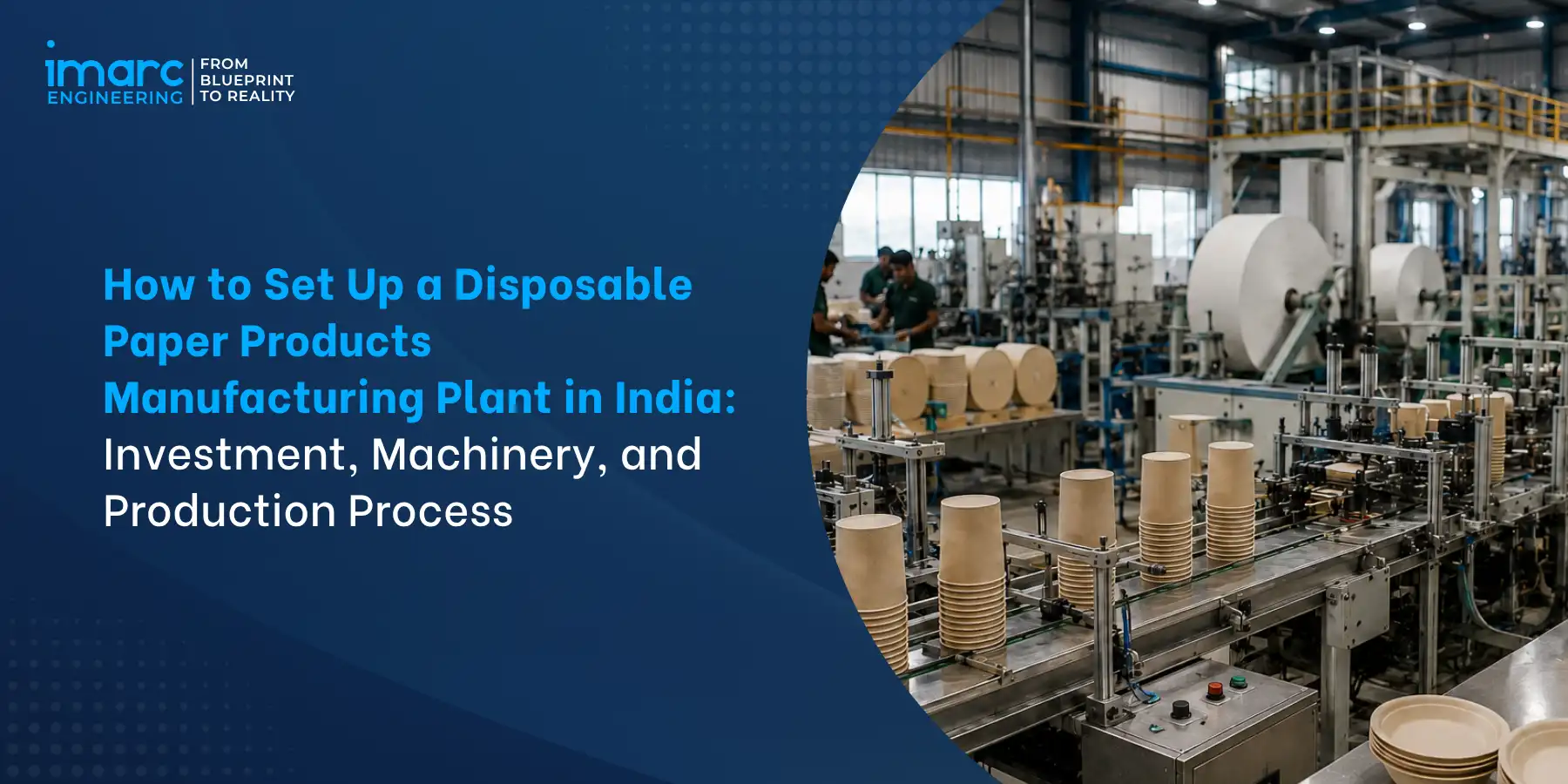
How to Set Up a Disposable Paper Products Manufacturing Plant in India: Investment, Machinery, and Production Process
Introduction
For investors and manufacturers evaluating a disposable paper products manufacturing plant in India in 2026, disciplined planning across product mix, capacity, raw materials, machinery, and regulatory compliance determines project success.
The single-use plastic restrictions under the Plastic Waste Management Rules, 2016, as amended, took effect from 1 July 2022 for identified single-use plastic items including plates, cups, glasses, cutlery, straws, stirrers, and trays. These restrictions have strengthened the commercial case for alternative food-service products, including paper-based cups, plates, bowls, and trays.
Scope of this Guide
This guide answers the sponsor's question directly. How can investors and manufacturers set up a disposable paper products manufacturing plant by selecting the right product mix, production capacity, machinery, raw materials, infrastructure, and investment model? It walks through product-mix planning, raw materials, differentiated processes across cups, plates, bowls, and trays, machinery selection, plant infrastructure, investment brackets anchored to capacity, and food-contact regulatory framework covering FSSAI, BIS, and PWM Rules.
Table of Contents
- Introduction
- Why Disposable Paper Products Manufacturing Matters in India
- What Disposable Paper Products Can Be Manufactured and Product Mix Planning in India
- Raw Materials and Paper Grades for Disposable Paper Products in India
- Manufacturing Processes for Paper Cups, Plates, Bowls, and Trays
- Machinery and Equipment for Disposable Paper Products Manufacturing in India
- Plant Layout Utilities and Infrastructure for Disposable Paper Products Manufacturing in India
- Investment Capital Cost and Operating Economics for Disposable Paper Products in India
- Licences Approvals and Food-Contact Regulatory Requirements in India
- Conclusion
1. Why Disposable Paper Products Manufacturing Matters in India
Four drivers make disciplined disposable paper products plant setup a strategic priority for Indian investors in 2026.
1.1 Regulatory Push from Single-Use Plastic Ban
Single-use plastic ban effective 1 July 2022 under Plastic Waste Management Rules 2016 as amended prohibits plastic plates, cups, glasses, cutlery (forks, spoons, knives), straws, stirrers, and trays for food service. Enforcement intensified across major metros (Delhi, Mumbai, Bengaluru, Chennai) creating durable demand for paper alternatives.
Disposable paper products containing plastic coatings or layers may also require assessment under the Plastic Waste Management framework and applicable Extended Producer Responsibility (EPR) requirements, depending on the material composition and the entity's role in the packaging value chain. Manufacturers should therefore evaluate the regulatory implications of barrier materials alongside product performance and cost.
1.2 Demand Ecosystem Diversification
Demand for disposable paper products spans multiple customer segments. Quick-service restaurants (QSR) chains including domestic and international brands. Cloud kitchens and food delivery platforms. Institutional catering including corporate cafeterias, hospitals, educational institutions, and events. Coffee shops and beverage chains driving paper cup demand.
E-commerce food delivery driving takeaway packaging demand. Traditional retail and street food sector adopting paper following newspaper prohibition under FSS (Packaging) Regulations 2018. Diverse demand ecosystem supports capacity utilisation across product categories reducing single-customer concentration risk.
1.3 Capital and Operational Accessibility
Compared with integrated pulp and paper manufacturing, disposable paper products manufacturing generally operates as a converting activity using purchased paperboard as feedstock. This can substantially reduce capital intensity because the plant can focus on printing, cutting, forming, finishing, and packaging rather than primary pulp and paper production. Actual investment varies considerably with product mix, production capacity, automation, printing integration, coating strategy, and plant configuration.
Environmental footprint is limited to converting operations without pulp and paper primary manufacturing. Regulatory complexity focuses on food-contact compliance rather than large-scale environmental clearance requirements.
1.4 Policy Alignment and Sustainability Positioning
Paper products manufacturing aligns with Government of India sustainability policies. Vocal for Local initiative supporting domestic manufacturing. Sustainability policy framework favouring biodegradable alternatives to single-use plastics. Extended Producer Responsibility framework encouraging recyclable and compostable materials. MSME support through Udyam registration for small units.
Applicable state industrial policies may also provide incentives or support for eligible manufacturing and packaging investments. Water-based barrier coatings and bio-based coatings such as PLA may support specific sustainability objectives, but recyclability, compostability, and end-of-life performance depend on the coating chemistry, product construction, certification, and available waste-management infrastructure.
2. What Disposable Paper Products Can Be Manufactured and Product Mix Planning in India
Understanding what disposable paper products can be manufactured and product mix planning in India determines plant configuration, machinery selection, and investment sizing. Product mix decisions establish the baseline for all subsequent planning.
2.1 Primary Product Categories
| Product | Typical Application | Manufacturing Approach |
|---|---|---|
| Paper Cups (hot beverage) | Coffee, tea, hot chocolate | Food-grade barrier-coated cup stock, sidewall forming |
| Paper Cups (cold beverage) | Cold drinks, juice, smoothies | Food-grade barrier-coated cup stock selected for moisture and condensation resistance, sidewall forming |
| Paper Plates | Snack service, meal service | Board sheet, hydraulic press forming |
| Paper Bowls | Soup, curry, gravy items | Coated board, deep-draw forming |
| Paper Trays / Containers | Takeaway meals, packaged food | Die cut and folded, glued or sealed |
| Paper Lids / Sleeves | Accessories for cups | Die cut, folded, adhesive-bonded |
2.2 Product Mix Considerations
Product selection determines machinery investment, raw material sourcing, and target customer segments. Single-product focus (e.g., paper cups only) supports specialisation, higher capacity utilisation on dedicated machinery, and simpler operations. Multi-product configuration supports customer one-stop-shop appeal, better capacity balancing, and cross-selling opportunities but requires higher machinery investment and complex operations. Common combinations include (a) paper cups plus lids and sleeves, (b) paper plates plus bowls, (c) full range including cups, plates, bowls, and containers, and (d) specialised products such as double-wall cups or paperboard trays incorporating application-specific barrier laminates.
2.3 Capacity Considerations Per Product
Equipment speeds and production capacities should be treated as indicative planning ranges rather than fixed output benchmarks. Actual output depends on product dimensions, paperboard specification, machine configuration, automation level, changeover requirements, operating efficiency, and downtime. Manufacturers should therefore distinguish between machine nameplate speed and achievable plant production when sizing capacity.
- Paper cup manufacturing plant in India: single machine typically 50-150 cups/min; typical plant 4-10 machines producing 1-5 lakh cups per shift
- Paper plate manufacturing plant in India: single machine typically 40-100 plates/min; typical plant 3-8 machines producing 1-3 lakh plates per shift
- Paper bowls: 40-120 pieces/min per machine; capacity comparable to cups
- Paper trays: 20-60 trays/min depending on size; typically larger unit value
- Combined product plant supports capacity balancing across product-mix seasonality
2.4 Product-Market Alignment
Product mix should align with target market economics and customer requirements. B2B institutional customers typically prefer bulk-packed standard products with predictable specifications. QSR chains typically require branded printed products meeting specific quality and printing standards. E-commerce food delivery prefers leak-proof coated products with strong branding options.
Premium coffee chains prefer double-wall insulated cups. Sustainability-focused customers increasingly prefer water-based barrier coating or PLA alternatives to PE coating. Product mix positioned against target customer preferences supports commercial success beyond production capability alone.
3. Raw Materials and Paper Grades for Disposable Paper Products in India
Raw materials and paper grades for disposable paper products in India determine both product performance and regulatory compliance. Paperboard specifications should match product requirements and food-contact regulations under FSS (Packaging) Regulations 2018.
3.1 Food-Grade Paperboard Grades
Paperboard raw materials for disposable paper products typically fall in 170-350 GSM range depending on application. Virgin fibre paperboard is preferred for direct food contact per FSSAI Recycled Plastic Amendment (May 2022) restrictions on recycled materials for direct food contact. Common grades include cup stock paperboard (170-320 GSM for cups and bowls), plate stock paperboard (270-350 GSM for plates), tray board (280-400 GSM for containers), and speciality grades for premium applications. Solid Bleached Sulphate (SBS) and Folding Boxboard (FBB) are common paperboard categories used for disposable food-contact applications.
3.2 Coatings and Barrier Materials
- PE coated paper (polyethylene extrusion coating) - traditional water and grease barrier for cups, bowls, and trays
- Water-based barrier-coated paper – alternative barrier system for selected applications; recyclability or compostability should be assessed based on the specific coating chemistry, product construction, certification, and available processing infrastructure
- PLA (Polylactic Acid) coating - bio-based compostable alternative for premium sustainable products
- Wax coating - traditional grease barrier for select food-contact applications
- Aluminium foil lamination - for premium hot food containers
- Uncoated grades - for dry food service and outer packaging
3.3 Supporting Materials
Beyond primary paperboard, disposable paper products require supporting materials including food-safe printing inks compliant with IS 15495 for printing on the outer surface, food-grade adhesives conforming to FSSAI food-contact standards for cup bottom sealing and tray gluing, packaging materials (LDPE bags, corrugated cartons) for finished goods, and process chemicals including release agents for plate forming. Material sourcing should verify food-contact certification, migration test compliance, and consistency of quality supporting downstream production efficiency.
3.4 Raw Material Sourcing
Domestic paperboard suppliers include ITC PSPD, JK Paper, West Coast Paper, Century Pulp and Paper, TNPL, and Emami Paper Mills. Imported paperboard from Southeast Asia (Indonesia, Thailand), Europe (Finland, Sweden, Germany), and North America is common for premium and speciality applications. PE resin sourcing from domestic (Reliance, IOCL, HPCL, GAIL) or imported. Multi-source strategy supports supply continuity. Raw material cost typically represents 45-60 percent of variable manufacturing cost.
4. Manufacturing Processes for Paper Cups, Plates, Bowls, and Trays
Paper cup paper plate paper bowl and paper tray manufacturing processes in India differ substantially across product categories. Manufacturers should not treat the disposable paper products manufacturing process as uniform across cups, plates, bowls, and trays; each product family follows a distinct process flow requiring dedicated machinery.
4.1 Paper Cup Production Process
- Paper cup production process begins with PE-coated paperboard rolls received in reels of 170-320 GSM
- Flexographic or offset printing on the outer surface (design, branding)
- Die cutting into fan-shaped cup blanks (sidewall) and separate bottom disc blanks
- Cup forming: sidewall rolling, heat sealing at seam, bottom disc insertion, bottom heat sealing
- Top rim curling for rigidity and drinking comfort
- Quality inspection: dimensional check, leak testing on sample basis
- Bulk packaging in LDPE bags followed by corrugated cartons
4.2 Paper Plate Production Process
Paper plate production process typically follows two approaches. Die-pressed plates using paperboard sheets: die cutting circular blanks from 270-350 GSM board, hydraulic press forming with heated die creating plate profile with rim, single-layer or double-layer construction, cooling and stacking. Molded pulp plates using wet pulp: less common in disposable paper products segment and dominated by bagasse and moulded fibre. Die-pressed process dominates paperboard-based plate manufacturing. Plate lines typically operate at 40-100 plates per minute per press machine.
4.3 Paper Bowl and Container Process
Paper bowl manufacturing uses forming principles similar to paper cups, with machinery and tooling adapted to the bowl's larger diameter, geometry, depth, and sealing requirements. Coated paperboard (typically 240-320 GSM) processed through printing, die cutting into wider fan-shaped blanks, sidewall forming with deeper draw, bottom insertion and sealing, and rim finishing.
Container variants including salad bowls, soup bowls, and takeaway containers use similar principles with product-specific dimensions and closures. Paper tray manufacturing uses die cutting from board sheet, creasing at fold lines, mechanical folding, and either adhesive gluing or heat sealing at corners depending on tray design.
4.4 Cross-Product Process Elements
Common process elements across product categories include printing (flexo or offset), die cutting, quality inspection, and packaging. Distinct elements include forming approach (sidewall rolling for cups/bowls versus hydraulic pressing for plates versus fold-and-glue for trays), coating application (typically pre-coated board rather than in-line coating), and finishing (rim curling, edge sealing).
Common versus distinct process element understanding guides machinery investment decisions supporting product mix flexibility versus dedicated single-product optimisation. Cross-product common elements support shared printing and packaging infrastructure across product-specific forming lines.
5. Machinery and Equipment for Disposable Paper Products Manufacturing in India
Machinery and equipment for disposable paper products manufacturing in India represent the largest single capital investment category. Paper products manufacturing equipment selection should match product mix, target capacity, quality requirements, and automation preferences.
5.1 Paper Cup Line Machinery
- Paper cup forming machine (50-150 cups/min per machine, semi-automatic to fully automatic) - INR 8-25 lakh per machine
- Die cutting machine for cup blanks - INR 5-15 lakh depending on speed and automation
- Printing machine for paper products (flexo 4-6 colour typical) - INR 15-60 lakh depending on printing width and speed
- Ripple/embossing machine for double-wall insulated cups - INR 12-20 lakh
- PE coating machine (if in-line coating) - INR 40-80 lakh (typically outsourced)
5.2 Paper Plate and Bowl Line Machinery
- Hydraulic paper plate forming machine (40-100 plates/min) - INR 3-8 lakh per machine typical
- Paper bowl forming machine - INR 10-20 lakh depending on capacity and automation
- Automatic feeding and stacking systems - INR 3-8 lakh
- Combined printing station shared with cup line supports capacity utilisation
5.3 Paper Tray Line Machinery
- Automatic tray forming machine - INR 15-40 lakh depending on tray types and speed
- Die cutting and creasing machine (Bobst, Sanwa, domestic equivalents) - INR 10-30 lakh
- Heat sealing / gluing station - INR 5-15 lakh
- Multi-product tray lines supporting varied container designs
5.4 Supporting Equipment
Supporting equipment covers utilities and quality infrastructure. Air compressors and receiver tanks. Chillers for cooling forming dies. Boilers or hot oil systems for heat sealing (where applicable). Roll handling systems including turret unwinders. Quality inspection equipment including leak testers, dimensional gauges, and printing quality inspection. Metal detectors and X-ray systems for premium food-contact assurance. Packaging equipment including bag sealers, cartoning, and shrink wrapping. Material handling including pallet trucks, forklifts, and roll trolleys. Supporting equipment typically represents 15-25 percent of primary machinery cost.
6. Plant Layout Utilities and Infrastructure for Disposable Paper Products Manufacturing in India
Plant layout utilities and infrastructure for disposable paper products manufacturing in India affects both operational efficiency and food-safety compliance. Layout should support material flow, hygiene requirements, and future capacity expansion.
6.1 Plant Layout Zones
- Raw material storage: air-conditioned or humidity-controlled zone for paperboard rolls and sheets
- Printing area: separate zone with ink storage and ventilation
- Die cutting area: adjacent to forming with WIP staging
- Forming lines: cup, plate, bowl, and tray lines with product-specific zones
- Quality inspection: dedicated inspection area with laboratory support
- Finished goods: bulk packing, cartoning, and dispatch zones
- Warehouse: separate raw material and finished goods areas
- Utilities: compressor room, chiller room, and electrical substation
6.2 Space Requirements by Capacity
| Plant Category | Typical Capacity | Approximate Built-up Area |
|---|---|---|
| Small single product | 1-5 lakh pieces/day | 5,000-10,000 sq. ft |
| Medium multi-product | 5-15 lakh pieces/day | 15,000-30,000 sq. ft |
| Large multi-product | 15-50 lakh pieces/day | 40,000-80,000 sq. ft |
| Integrated multi-product | 50+ lakh pieces/day | 1-2 lakh sq. ft |
6.3 Utilities and Services
Power connection typically 100-500 kVA depending on capacity, three-phase supply from state DISCOM. Compressed air 5-15 CFM per cup forming machine typical. Cooling water for forming die temperature control. Steam or hot oil for heat sealing where applicable. Water supply for utility and hygiene requirements.
Effluent generation minimal for converting operations (unlike paper mills) but requires basic treatment for compliance. Solid waste generation includes paperboard trimming (recyclable), packaging waste, and reject products. Ventilation with adequate air changes supporting operator comfort and product hygiene. Backup power (DG set) covering critical loads recommended.
6.4 Hygiene and Food-Safety Infrastructure
Food-contact product manufacturing requires hygiene infrastructure beyond conventional factory setup. Personnel hygiene facilities including changing rooms and hand-washing stations. Pest control programme covering entire facility. Food-safety training per FSSAI Schedule 4 requirements. Product handling systems avoiding direct human contact with finished food-contact surfaces. HACCP-based food safety management supporting FSSAI licence maintenance. Hygiene infrastructure investment typically 5-10 percent of total plant cost.
7. Investment Capital Cost and Operating Economics for Disposable Paper Products in India
Investment capital cost and operating economics for disposable paper products in India vary significantly with capacity, product mix, and automation. Paper products manufacturing investment figures without defined capacity and configuration mislead. The brackets below reflect typical ranges anchored to explicit assumptions.
7.1 Capital Investment by Plant Category
| Plant Category | Product Mix and Capacity | Machinery + Setup (INR) |
|---|---|---|
| Micro/Small | Single product, 1-5 lakh pieces/day | 25-75 lakh |
| Small-Medium | 2-3 products, 5-10 lakh pieces/day | 75 lakh - 1.5 crore |
| Medium | 3-4 products, 10-20 lakh pieces/day | 1.5-3 crore |
| Medium-Large | Full range, 20-40 lakh pieces/day | 3-6 crore |
| Large | Full range, 40-80 lakh pieces/day | 6-10 crore |
| Integrated Large | Multi-product plus premium lines | 10-25 crore |
7.2 Investment Composition
Plant investment typically distributes across primary machinery (55-65 percent), building and civil works (15-20 percent excluding land), utilities and services (8-12 percent), quality and inspection equipment (3-5 percent), material handling (3-5 percent), pre-operative expenses (3-5 percent), and contingency (5-8 percent).
Land and building cost vary significantly by location representing separate capital component. Working capital typically 15-25 percent of annual turnover covering raw material inventory, WIP, finished goods, and receivables. Total project cost estimation should include all components rather than machinery alone.
7.3 Operating Cost Structure
Variable manufacturing cost includes raw material (paperboard 45-60 percent, coatings and adhesives 5-10 percent), packaging materials 3-5 percent, and utilities (power 4-6 percent, others 1-2 percent). Fixed costs include depreciation 5-8 percent, labour 8-12 percent, quality and compliance 2-3 percent, administrative overhead 3-5 percent, and marketing/distribution 5-8 percent. EBITDA margins typically 12-20 percent depending on product mix, capacity utilisation, and pricing power.
7.4 Profitability Drivers
- Capacity utilisation above 70 percent for machinery cost recovery
- Product mix optimisation favouring higher-margin premium products
- Raw material sourcing efficiency including multi-source strategy and volume negotiation
- Energy efficiency and productivity improvement reducing per-unit cost
- Working capital discipline including inventory turns and receivables management
- Value-added coatings (barrier, printed) supporting price premium
- Direct customer relationships avoiding channel margin erosion
8. Licences Approvals and Food-Contact Regulatory Requirements in India
Licences approvals and food-contact regulatory requirements in India for disposable paper products manufacturing focus on food safety compliance beyond conventional factory requirements. Regulatory framework has evolved significantly following the single-use plastic ban.
8.1 Food-Contact Regulatory Framework
Food Safety and Standards (Packaging) Regulations 2018 (with 2022 amendments) administered by FSSAI is the primary food-contact regulatory framework governing paper for boxes, cartons, plates, cups, and paper lids in direct contact with food. Materials must be food grade and free from contaminants.
Draft FSS (Packaging) Amendment Regulations 2026 under public consultation (comments closed 10 May 2026) proposes formal definition of food contact material (FCM) and non-intentionally added substances (NIAS); 2018 Regulations remain the operative instrument. FSSAI Schedule I references applicable Indian Standards for paper and paperboard for food contact.
8.2 Relevant BIS Standards
- IS 6615: General purpose packing/wrapping paper (as applicable to product)
- IS 1776: Folding box board, uncoated (as applicable to product category)
- IS 15495: Printing Ink for Food Packaging
- IS 17088: procedures and requirements for plastics and plastic products
- Product-specific BIS certification where applicable to food-grade paper grades
- Specific applicable IS depends on product and coating type
8.3 Central and State Approvals
| Approval | Authority | Framework |
|---|---|---|
| FSSAI Licence (Manufacturing) | FSSAI | FSS Act 2006, FSS (Packaging) Regulations 2018 |
| FSSAI Schedule 4 compliance | FSSAI | GMP for food packaging manufacturing |
| IEM Part A/B (via NSWS) | DPIIT | IDRA 1951 |
| CTE and CTO | State Pollution Control Board | Water Act 1974, Air Act 1981 |
| Factory Licence | State Directorate of Factories | OSH Code 2020 (in force 21 Nov 2025) |
| Fire NOC | State Fire Services | NBC 2016 Part 4 |
| GST, PAN, EPF, ESI | CBIC, IT Dept, EPFO, ESIC | CGST Act 2017, IT Act 1961 |
| EPR Registration | CPCB | PWM Rules 2016 (for PE-coated products) |
8.4 EPR and Sustainability Framework
Where disposable paper products incorporate plastic coatings, laminates, or other polymer layers, manufacturers and downstream businesses should assess whether the resulting product falls within applicable plastic-packaging categories under the Plastic Waste Management framework. Registration, reporting, EPR targets, and other compliance obligations depend on the product configuration and the entity's regulatory role, and should therefore be determined on a case-by-case basis.
Water-based barrier coating and PLA alternatives offer regulatory advantages. Integrated feasibility supplier evaluation and commissioning for disposable paper products in India covering technology, machinery suppliers, food-contact compliance, and sustainability positioning supports credible project planning.
Conclusion
Setting up a disposable paper products plant in India requires product mix planning, food-grade paperboard sourcing, suitable coating selection, product-specific machinery, hygienic plant layout, and capacity-based investment planning. Compliance includes FSSAI Packaging Regulations, applicable BIS standards, and EPR requirements. Commissioning timelines and investment vary with capacity, automation, and product mix.
Sponsors should remember three priorities: product mix drives machinery and process requirements; food-safety compliance must be embedded from commissioning; and capacity assumptions must underpin cost estimates. Cups, plates, bowls, and trays require different manufacturing processes and equipment, making product-specific planning essential for realistic CAPEX, OPEX, and project execution.
PURSUING DISPOSABLE PAPER PRODUCTS PLANT SETUP?
IMARC Engineering’s disposable paper products manufacturing advisory team supports investors and manufacturers with market feasibility, product mix and capacity planning, food-grade paperboard and coating selection, machinery evaluation, plant layout, utility planning, food-safety compliance, CAPEX/OPEX modelling, and project commissioning.
The team also supports regulatory planning covering FSSAI, applicable BIS standards, NSWS/IEM, SPCB consents, Factory Licence, Fire NOC, GST, EPF/ESI, and EPR requirements, along with supplier evaluation and integrated project planning.
→ Schedule a free disposable paper products plant scoping consultation with an IMARC specialist
Frequently Asked Questions
Setting up a disposable paper products manufacturing plant in India involves market feasibility, product mix selection (cups, plates, bowls, trays), capacity planning, food-grade raw material sourcing, machinery selection, plant layout design, utility planning, FSSAI Packaging Regulations 2018 compliance, factory licence, and commissioning across 6-15 months.
A single plant can manufacture paper cups, paper plates, paper bowls, paper trays, and containers. Product mix depends on target market, capacity utilisation, and machinery. Cups and bowls use similar forming; plates use press-forming; trays use fold-and-glue or press-forming, requiring dedicated production lines.
Disposable paper products require food-grade paperboard (170-350 GSM typical), PE coated paper for hot/cold liquid applications, water-based barrier coated paper as sustainable alternative, PLA-coated paperboard for bio-based products, food-safe printing inks compliant with IS 15495, and adhesives conforming to FSSAI food-contact standards under Regulations 2018.
Paper cup manufacturing machinery includes cup forming machines (50-150 cups/min), die cutting machine units, flexo or offset printing machines, PE coating machines, rim curling stations, quality inspection, and packaging machines. Paper plate lines add hydraulic plate forming presses; tray lines add automatic tray forming machines.
Paper cup production process involves printing, blank cutting, sidewall forming, bottom insertion, and rim curling. Paper plate production process uses die cutting and hydraulic press forming. Paper bowl manufacturing follows cup principles with deeper draw. Paper tray manufacturing uses die cutting, creasing, folding, and gluing.
Disposable paper products plant cost varies significantly by capacity and product mix. Small single-product units (1-5 lakh pieces/day) typically require INR 25-75 lakh; medium multi-product units (5-15 lakh pieces/day) INR 1-3 crore; large integrated units (15-50 lakh pieces/day) INR 3-10 crore excluding land and building.
Disposable paper products manufacturing plants require FSSAI licence for food-contact materials, FSS Packaging Regulations 2018 compliance, BIS certification (IS 6615, IS 1776, IS 15495 for inks), SPCB CTE/CTO, Factory Licence under OSH Code 2020, Fire NOC, GST, EPR for PE-coated products, and IEM registration.
Feasibility depends on target market demand, product mix, capacity utilisation, raw material cost (paperboard 45-60 percent of variable cost), machinery selection, energy cost, labour cost, regulatory compliance, and location. Profitability drivers include capacity utilisation above 70 percent, product-mix margins, and value-added coatings (barrier, printed).
Recent Post



Trusted by Industry Leaders
We partner with global enterprises and ambitious businesses across sectors to deliver operational excellence, strategic insights, and sustainable growth through integrated solutions.












Success in Their Words
Real feedback from clients across industries. Discover how our solutions delivered measurable impact and operational excellence.

I wanted to express my sincere appreciation for your efforts in handling this matter. Your dedication and commitment have been truly commendable, and it is evident that you have put in tremendous hard work and expertise into resolving the issues at hand. We are greatly interested in continuing our collaboration with you in the future, as your professionalism and reliability have made you a trusted partner. Thank you once again for your invaluable contribution. We look forward to strengthening our partnership ahead.

It has been a pleasure working with the IMARC team. The insights provided were structured, clear, and highly valuable, helping us strengthen both our technical and financial planning with confidence. We deeply appreciate the team’s professionalism, responsiveness, and attention to detail throughout the engagement. Every requirement was well understood and effectively incorporated, resulting in a comprehensive and actionable output. Overall, our experience has been excellent, and I would gladly recommend IMARC to organizations seeking a reliable research partner.

Your service is truly exceptional. Working with the IMARC team has been a seamless and professional experience. The clarity of communication, responsiveness to queries, and consistent support at every stage made the entire engagement highly efficient. The insights shared were well-structured, practical, and perfectly aligned with our requirements, helping us make informed decisions with confidence. Overall, the dedication and professionalism demonstrated by your team stand out, and I would be glad to recommend IMARC as a reliable and trustworthy research partner.

IMARC did an outstanding job in preparing our study. They were punctual, precise, and consistently responsive throughout the entire process. The team delivered all the data we required in a clear, well-organized, and highly professional format. Their strong attention to detail, combined with their ability to meet every deadline without compromising quality, truly set them apart. Overall, their reliability and commitment made them an exceptional partner for our project, and we would gladly work with them again in the future.

IMARC made the whole process incredibly easy from start to finish. Everyone I interacted with via email was polite, professional, and straightforward to deal with, always keeping their promises regarding delivery timelines and remaining consistently solutions-focused. From my very first contact, I appreciated the professionalism and support shown by the entire IMARC team. I highly recommend IMARC to anyone seeking timely, affordable, and reliable information or advice. My experience with IMARC was excellent, and I truly cannot fault any aspect of it.

I’d like to express my sincere gratitude for the excellent work you accomplished with the study. Your ability to quickly understand our requirements and deliver high-quality results under tight timelines truly reflects your expertise, exceptional work ethic, and unwavering commitment to your customer’s success. The professionalism and responsiveness you demonstrated throughout the process made a significant difference. Our entire team and company are incredibly thankful for your dedication, reliability, and support. Once again, thank you for your outstanding contribution.