Manufacturing
July 08 2026
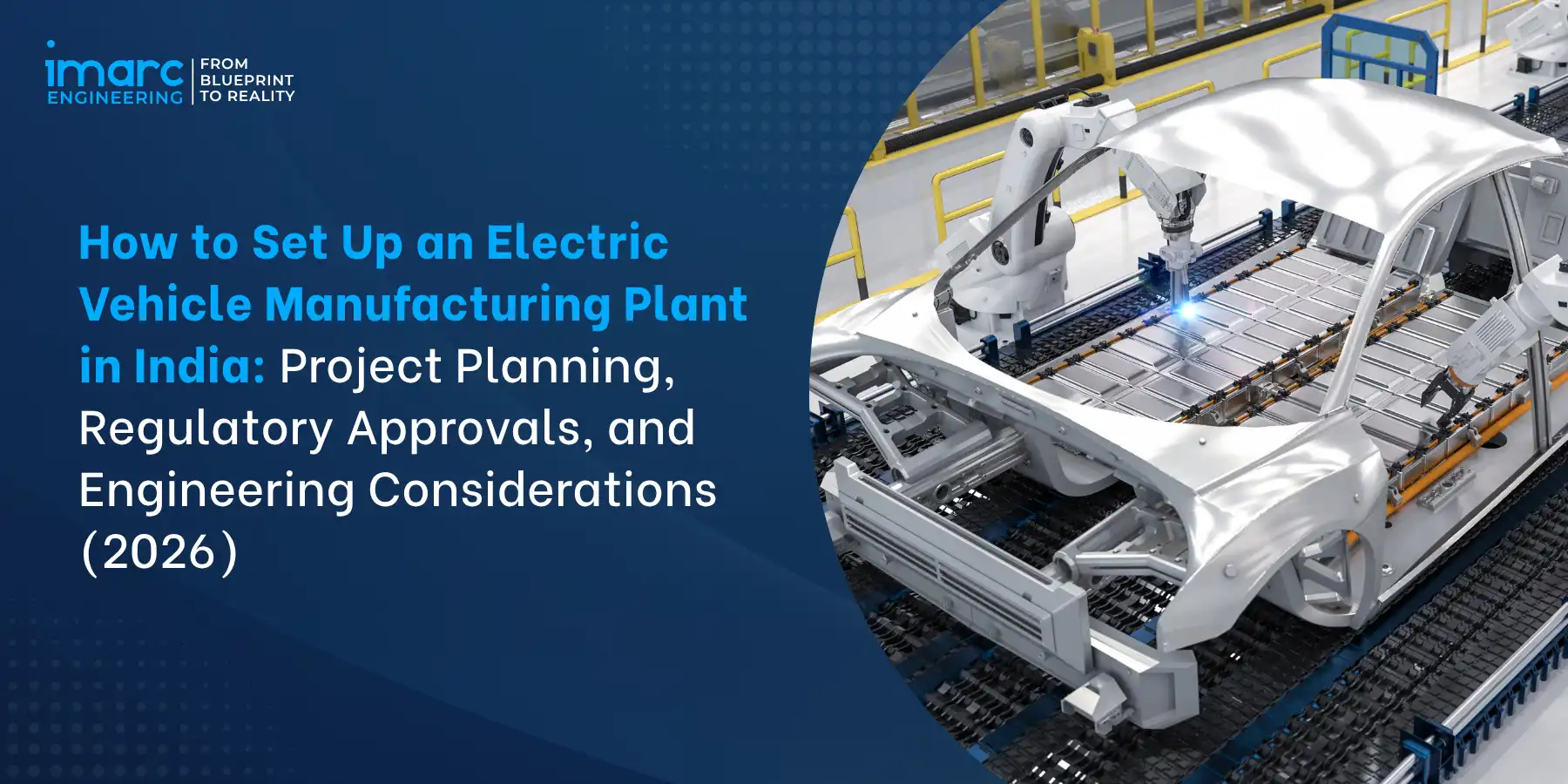
How to Set Up an Electric Vehicle Manufacturing Plant in India: Project Planning, Regulatory Approvals, and Engineering Considerations (2026)
Introduction
India's electric vehicle industry is rapidly evolving from an emerging market into a major manufacturing destination. Supported by rising domestic demand, localisation initiatives, battery manufacturing investments, export opportunities, and government incentives, India is attracting significant investments across electric two-wheelers, passenger vehicles, commercial vehicles, battery packs, and advanced cell manufacturing. As a result, many manufacturers and investors are evaluating new EV production facilities across multiple states.
For any promoter or investor planning to establish an electric vehicle manufacturing plant in India in 2026, the opportunity is materially compelling, but execution complexity is substantial. The convergence of the PM E-Drive Scheme, PLI Automobile and Auto Components Scheme, PLI Advanced Chemistry Cell battery storage support, progressive state EV policies, and rising domestic EV demand collectively make this one of the most strategically supported industrial opportunities.
Scope of This Guide
This guide answers the sponsor's engineering, regulatory, and planning an electric vehicle manufacturing plant in India. It walks through the sector context, plant configuration options across two-wheelers, three-wheelers, four-wheelers, and commercial vehicles, step-by-step setup pathway, feasibility discipline, EV manufacturing regulatory approvals, detailed engineering considerations, capital cost benchmarks, and the practices that separate well-executed EV manufacturing plant setup from projects facing cost overruns, homologation delays, or PLI qualification shortfalls.
Table of Contents
- Introduction
- Why Electric Vehicle Manufacturing in India Matters in 2026
- EV Categories and Plant Configurations
- How to Set Up an Electric Vehicle Manufacturing Plant in India
- EV Manufacturing Plant Feasibility Study in India
- Regulatory Approvals for EV Manufacturing Plant in India
- EV Manufacturing Plant Engineering and Design Services in India
- EV Manufacturing Plant Setup Cost in India
- Common Mistakes and Best Practices
- Conclusion
1. Why Electric Vehicle Manufacturing in India Matters in 2026
Four structural drivers make EV manufacturing a strategically compelling investment opportunity for Indian and international sponsors in 2026.
1.1 Central Policy Framework
The PM E-Drive Scheme launched in October 2024 with INR 10,900 crore outlay for the 2024-26 window supports electric two-wheelers, three-wheelers, buses, ambulances, and trucks with structured demand incentives and public charging infrastructure.
The PLI Scheme for Automobile and Auto Components with INR 25,938 crore outlay administered by the Ministry of Heavy Industries incentivises Advanced Automotive Technology (AAT) products including battery electric vehicles - Champion OEMs receive 13-18 percent incentive on determined sales value with Component Champions receiving 8-13 percent. The PLI Advanced Chemistry Cell scheme with INR 18,100 crore outlay supports 50 GWh of battery cell manufacturing capacity.
1.2 State-Level Support
State Governments across Delhi, Maharashtra, Tamil Nadu, Karnataka, Gujarat, Telangana, Andhra Pradesh, Kerala, and Uttar Pradesh have introduced structured EV manufacturing policies. Common instruments include capital subsidies, SGST reimbursement, stamp duty exemption, land at concessional rates, electricity duty exemption, and expedited approvals.
Tamil Nadu, Maharashtra, and Gujarat have emerged as particularly active states with substantial OEM investments including Tata Motors, Ola Electric, and multiple international entrants. State-level policy stacking materially improves project economics.
1.3 Rising Domestic Demand
Electric vehicle penetration in India is progressively accelerating across segments. Electric two-wheeler and three-wheeler segments have achieved meaningful market share; four-wheeler EV segment is expanding rapidly with new model launches; commercial EV segment led by e-buses and e-LCVs is gaining traction.
Corporate fleet electrification, last-mile delivery electrification, and government procurement mandates are collectively driving structural demand growth. Investment in domestic manufacturing capacity aligns with import substitution objectives and progressive customs duty differentials on CBUs versus components.
1.4 Automotive Supply Chain Localisation
The EV transition requires deep localisation of new supply chains - battery cells, battery packs, electric motors, motor controllers, power electronics, thermal management systems, and EV-specific software.
India's mature automotive Tier-1 and Tier-2 supplier base provides foundation but requires substantial capability development for EV components. Localisation depth affects both PLI qualification (Domestic Value Addition thresholds) and long-term cost competitiveness. Structured supply chain development is often as important as plant setup itself.
2. EV Categories and Plant Configurations
The most consequential early decision in EV factory project planning is vehicle category and plant configuration choice. Category choice determines capital intensity, technology requirements, homologation pathway, and market access.
2.1 The Vehicle Category Spectrum
| Category | Typical Volume Range | Indicative Capex Range |
|---|---|---|
| Electric Two-Wheeler (2W) | 50,000-500,000 units/year | INR 100-800 crore |
| Electric Three-Wheeler (3W) | 20,000-200,000 units/year | INR 50-300 crore |
| Electric Four-Wheeler (4W) Assembly | 50,000-200,000 units/year | INR 800-4,000 crore |
| Integrated 4W OEM (BIW to Assembly) | 100,000-500,000 units/year | INR 3,000-15,000 crore |
| Electric Bus / Commercial Vehicle | 1,000-20,000 units/year | INR 300-2,000 crore |
| Battery Cell Gigafactory | 1-10 GWh/year | INR 3,000-15,000 crore per GWh scale |
2.2 Assembly vs Integrated Plant Configuration
Assembly plants procure sub-assemblies including body panels, battery packs, motors, and electronics from external suppliers and integrate them into finished vehicles. Advantages include lower capital cost, faster commissioning, and easier vendor management. Disadvantages include limited PLI Domestic Value Addition qualification and lower long-term cost competitiveness.
Integrated OEM plants perform stamping, body-in-white welding, paint, powertrain integration, and general assembly in-house. Advantages include stronger PLI qualification, better long-term margins, and technology control. Disadvantages include higher capital cost and longer commissioning. Most electric vehicle factory setup projects choose configuration based on volume ambition and PLI qualification strategy.
2.3 Battery Pack Assembly - The Critical Sub-System
Battery pack assembly is the most critical sub-system in any EV manufacturing plant. Options include: fully integrated cell-to-pack (requires cell manufacturing capability, typically only for very large OEMs); pack assembly from imported or purchased cells (common approach); and fully outsourced pack supply (limits PLI qualification).
Effective battery pack assembly plant setup typically involves clean room environments, structured cell-testing, welding stations (laser or ultrasonic), thermal management assembly, BMS integration, and functional testing. Standalone battery pack assembly plants typically involve INR 100-500 crore capital depending on capacity and integration depth.
2.4 Cell Manufacturing
Cell manufacturing represents the most technically demanding and capital-intensive sub-system. PLI ACC Scheme supports up to 50 GWh of domestic cell capacity with awarded manufacturers including Ola Electric, Reliance, Rajesh Exports, and others.
Cell gigafactory capex typically runs INR 3,000-15,000 crore per GWh scale reflecting the complexity of electrode coating, calendaring, cell assembly, and formation-aging. Cell chemistry choice (LFP, NMC, others) affects both capex and downstream applications. Only sponsors with substantial capital and technology partnerships should evaluate direct cell manufacturing.
3. How to Set Up an Electric Vehicle Manufacturing Plant in India
The end-to-end pathway from concept to Start of Production (SOP) typically runs 30-54 months. Understanding how to set up an electric vehicle manufacturing plant in India helps sponsors plan realistic timelines and sequenced investment commitments.
3.1 The Six-Stage Project Roadmap
| Stage | Activities | Typical Duration |
|---|---|---|
| 1. Feasibility & Strategy | Product, market, technology, location, PLI | 3-6 months |
| 2. Approvals & Financing | EC, factory licence, PLI application, financing | 12-18 months |
| 3. Detailed Engineering | Process, utilities, layout, automation, civil | 6-12 months |
| 4. Construction | Civil, MEP, equipment installation, utilities | 18-30 months |
| 5. Homologation & Commissioning | AIS type approval, test, ramp-up | 6-12 months |
| 6. Start of Production | Commercial production and PLI compliance | SOP milestone |
3.2 Product Strategy and Technology Selection
Concept-stage work establishes product portfolio, target volumes, technology architecture, and manufacturing configuration. Product decisions include vehicle category focus (2W, 3W, 4W, commercial), price segment positioning, battery technology (LFP vs NMC vs solid-state exploration), range and performance targets, and platform-sharing strategy. Technology partnerships with global OEMs, tier-1 suppliers, or licensed technology providers may accelerate time-to-market for first-time entrants. Concept documents form the basis for pre-feasibility studies and internal go/no-go decisions.
3.3 Approvals and Financing in Parallel
Approvals initiation and financing arrangement operate in parallel to compress timeline. Environmental Clearance under EIA Notification 2006 takes 12-24 months. State Pollution Control Board Consent to Establish is prerequisite for construction. Factory Licence, Fire NOC, Petroleum Licence for paint shop, and PLI Scheme application are initiated in the same window. Term loan financing at typical 60:40 to 70:30 debt-equity is arranged during this period.
3.4 Engineering, Construction, and Homologation
Detailed engineering covers process design (BIW, paint, general assembly, battery pack, final line), utilities (power, compressed air, cooling, water treatment), automation systems (robots, conveyors, MES), civil works, safety systems, and battery-specific infrastructure (test lab, fire protection, thermal management).
Structured EV plant construction management in India runs 18-30 months coordinating civil, MEP, equipment installation, and interface management. Vehicle homologation through Automotive Research Association of India (ARAI) or International Centre for Automotive Technology (iCAT) per AIS standards and CMVR must be completed before commercial sales. AIS 156 with amendments covers EV safety including battery safety post recent fire incidents.
4. EV Manufacturing Plant Feasibility Study in India
A rigorous EV manufacturing plant feasibility study is the foundation of investment-grade decision-making. A structured EV manufacturing feasibility study covers technical, commercial, regulatory, financial, and PLI-qualification dimensions.
4.1 Technical Feasibility
Technical feasibility covers vehicle platform selection, powertrain architecture (motor type, controller, transmission), battery technology and thermal management approach, manufacturing process design (BIW, paint, assembly, battery pack), automation and Industry 4.0 integration level, plant capacity and future scalability, and quality management framework aligned with IATF 16949.
Technology partnerships or licensing choices are evaluated. Site suitability including power availability, water sourcing, road/rail connectivity, workforce availability, and proximity to component suppliers is verified.
4.2 Commercial and Market Assessment
Commercial feasibility covers target market segments and volumes, competitive positioning against existing and expected competitors, distribution and dealer strategy, aftersales network, charging infrastructure ecosystem interaction, corporate and fleet channel opportunities, and export potential. Market projections should incorporate realistic assumptions about segment growth, competitive intensity, and technology evolution. Sensitivity to demand assumptions is typically the largest single variable driving project economics.
4.3 Regulatory and PLI Feasibility
Regulatory feasibility maps approvals timeline including Environmental Clearance, factory licence, and vehicle homologation. PLI qualification analysis is critical - Champion OEM and Component Champion categories have specific Domestic Value Addition thresholds progressive over the incentive period.
PLI scheme benefits for EV manufacturing plants qualification requires structured supplier development plans, component-wise DVA calculation, and Advanced Automotive Technology product certification. Missing PLI qualification materially affects project IRR.
4.4 Financial Modelling
Financial modelling integrates capital cost estimates, operating cost projections including bill-of-materials evolution, revenue projections at market-appropriate pricing, working capital requirements, financing structure, tax provisions, PLI incentive projections, state incentive stacking, and sensitivity analysis. Bank-quality models are essential for term loan approval. Sensitivity to battery cell cost, exchange rate, volume, and pricing typically drives the largest project economics variations.
5. Regulatory Approvals for EV Manufacturing Plant in India
Regulatory approvals for EV manufacturing plant in India span Central and State levels with several automotive-specific approvals. Structured approval planning avoids the sequential-approval trap where each wait for its predecessor.
5.1 The Approvals Map
| Approval | Issuing Authority | Timing |
|---|---|---|
| Environmental Clearance (EC) | MoEFCC / State EIAA | Pre-construction |
| Consent to Establish/Operate | State Pollution Control Board | Pre-construction/COD |
| Factory Licence | State Directorate of Factories | Pre-COD |
| Fire NOC | State Fire Services | Pre-COD |
| Petroleum Licence (Paint Shop) | PESO under Explosives Act | Pre-commissioning |
| Vehicle Homologation (AIS/CMVR) | ARAI / iCAT / other AIS agencies | Pre-sales |
| PLI Scheme Approval | Ministry of Heavy Industries | Pre-investment |
| State Industrial Approvals | State industrial infrastructure agencies | Pre-construction |
5.2 Environmental Clearance
Automobile manufacturing (Category 4b under EIA Notification 2006 schedule) typically requires Environmental Clearance. Process includes Form 1 application, Terms of Reference (ToR) issue by Expert Appraisal Committee (EAC), baseline environmental studies, Environmental Impact Assessment (EIA) report preparation, public consultation including public hearing, EAC appraisal, and clearance letter with binding conditions. Timelines typically span 12-24 months from application. Environmental Management Plan commitments become binding operational obligations.
5.3 Vehicle Homologation Under AIS and CMVR
Vehicle homologation is the automotive-specific approval sequence. Central Motor Vehicles Rules 1989 (CMVR) with Automotive Industry Standards (AIS) apply. Type approval is granted by ARAI, iCAT, CIRT, and other AIS testing agencies against product-specific standards.
Key EV standards include AIS 156 (EV safety including recent amendments on battery safety following fire incidents), AIS 038 (electric propulsion for cars), AIS 049 (Battery-Operated Vehicles), IS 17017 series (EV connectors), and IS 17691 (EV cables). AIS 004 governs the type approval procedure itself. Homologation must be complete before commercial sales commence.
5.4 PLI Scheme Application
PLI Auto and PLI ACC applications are made to Ministry of Heavy Industries within scheme windows with structured documentation. Applications require detailed capacity plans, capex projections, DVA calculation methodology, employment projections, and quality certifications.
Successful applicants sign Application Package Documents. Ongoing compliance requires annual verification of investment, sales, and DVA achievement. Missing PLI milestones affects incentive disbursement. Structured PLI compliance function is standard practice for beneficiary companies.
6. EV Manufacturing Plant Engineering and Design Services in India
EV manufacturing plant engineering and design services integrate process, mechanical, electrical, instrumentation, and civil disciplines across the plant boundary. Structured EV manufacturing engineering reduces field rework, protects schedule, and delivers the operating asset that project economics depend on.
6.1 Manufacturing Process Design
Process engineering scope varies by plant configuration. Integrated 4W plants require body-in-white shop (stamping presses, robotic welding lines, sub-assembly cells), paint shop (pre-treatment, electro-deposition primer, sealer, top-coat, curing ovens, sludge treatment), battery pack assembly (clean rooms, cell stack-up, welding, thermal management installation, BMS integration, testing), motor and powertrain integration, general assembly (trim, chassis, final line), and end-of-line testing including test track.
2W and 3W plants have simpler process flow but similar core disciplines. Vendor selection typically involves ABB, KUKA, FANUC, DURR, Comau, and comparable automation suppliers with proven Indian references.
6.2 Utility Systems and Infrastructure
Utilities represent 15-25 percent of EV plant capital cost. Power infrastructure (10-40 MW for integrated 4W plants; 2-8 MW for 2W plants) typically combines grid supply with substation, backup diesel/gas generation, UPS for critical systems, and increasingly captive renewable energy integration. Compressed air supports assembly operations.
Cooling water supports paint shop and manufacturing processes. Process water and DM water support paint pre-treatment and battery testing. Effluent treatment addresses paint shop discharge and typically operates under Zero Liquid Discharge design per CPCB directives for painting operations.
6.3 Automation and Industry 4.0 Integration
Modern EV plants deploy substantial EV manufacturing plant automation and Industry 4.0 capability from inception. Robotic body welding, automated paint application, robotic battery pack assembly, and machine vision quality inspection are standard for integrated plants. Manufacturing Execution System (MES) integrates production planning, work-in-progress tracking, quality data, and equipment status.
Battery traceability from cell to pack to vehicle supports warranty, recall, and safety compliance. Digital twin capability for process simulation and plant optimisation is emerging. Automation architecture should support progressive capability addition without full replacement.
6.4 Safety, Fire, and Battery-Specific Engineering
EV plants require battery-specific safety engineering. Cell storage areas require thermal runaway protection, gas detection for battery failure scenarios, specialised fire suppression (aqueous vermiculite or comparable rather than water alone, quarantine areas for defective batteries, and structured emergency response protocols.
Paint shop requires explosion-proof electrical equipment in classified zones, VOC handling, and fire protection. Test track and end-of-line facilities require driver safety and vehicle containment considerations. Hazardous area classification per IEC 60079 applies. Battery safety compliance interfaces with AIS 156 and evolving CBI/DGCS guidelines on battery incident reporting.
7. EV Manufacturing Plant Setup Cost in India
EV manufacturing plant setup cost in India varies significantly by vehicle category, plant configuration, automation level, and localisation depth. Understanding the cost structure supports informed investment planning and effective bank engagement.
7.1 Capital Cost Component Breakdown
| Cost Component | Assembly Plant Share | Integrated Plant Share |
|---|---|---|
| Process Equipment | 40-50% | 35-45% |
| Utilities & Infrastructure | 15-20% | 15-25% |
| Civil Works & Buildings | 10-15% | 12-18% |
| Electrical & Automation | 10-15% | 10-15% |
| Homologation & Testing | 3-5% | 3-5% |
| Erection & Commissioning | 5-8% | 5-8% |
| Contingency & Pre-op Expenses | 5-8% | 5-8% |
7.2 Cost Variability Drivers
Key cost variability drivers include vehicle category (2W plants cost fractions of integrated 4W plants), plant configuration (assembly-only versus integrated body-in-white to final), automation level (manual to fully automated production lines), localisation depth (higher DVA requires more in-house manufacturing capability), paint shop selection (electro-deposition vs powder coating vs bespoke arrangements), battery integration approach (external pack purchase vs in-house pack assembly), and site conditions (greenfield land development requirements). Standard cost benchmarks should be adjusted for these variables during specific project sizing.
7.3 Financing and PLI Incentive Impact
Term loan financing typically at 60:40 to 70:30 debt-equity ratio. State Bank of India, Punjab National Bank, Union Bank, Bank of Baroda, and Axis Bank are common consortium leaders for automotive projects. Working capital arrangements cover materials procurement cycle.
PLI Auto scheme incentives materially affect project IRR when incorporated in financial model. State-level capital subsidies and stamp duty exemptions stack with Central PLI. Effective policy stacking can improve project IRR by 3-6 percentage points versus unstacked baseline.
7.4 Return Considerations
Well-designed EV projects at appropriate scale typically target project IRR in the 12-18 percent range depending on segment and PLI qualification. Payback periods run 6-10 years. Battery cost is the single largest variable-cost variable affecting margins - typically 30-45 percent of vehicle BOM.
Cell cost trajectory, exchange rate movement, and volume ramp-up profile together determine actual margin evolution. Poor supplier development, weak PLI qualification, or homologation delays can materially erode returns.
8. Common Mistakes and Best Practices
8.1 Under-Scoped Homologation Planning
Homologation delays extend time to commercial sales beyond planned SOP.
Best practice: engage ARAI, iCAT, or comparable AIS agency early; structured pre-testing at supplier level; parallel homologation across variants where feasible; contingency planning for AIS 156 amendment implications.
8.2 Weak PLI Qualification Strategy
PLI qualification requires structured Domestic Value Addition achievement across the incentive period. Assembly-heavy strategies fail DVA thresholds.
Best practice: structured supplier development plan with DVA calculation for each component; conservative DVA projections; annual verification discipline; contingency planning for supplier delays affecting DVA.
8.3 Battery Safety Engineering Retrofits
EV battery fire incidents have driven AIS 156 amendments and heightened regulatory scrutiny. Retrofitting battery safety engineering after design freeze costs materially more than upfront integration.
Best practice: integrate battery safety from concept stage; specialised fire protection; thermal management redundancy; structured cell testing and quarantine areas; incident response protocol development pre-COD.
8.4 Sequential Rather Than Parallel Approvals
Waiting for one approval before initiating the next extends approvals stage from typical 12-18 months to 24-36 months.
Best practice: parallel initiation of Environmental Clearance, State Pollution Control Board approvals, land acquisition, financing, and PLI Scheme application; dedicated approvals coordinator; structured escalation for delays.
8.5 Weak Automation Architecture Decisions
Automation architectures locked into single-vendor or non-standard platforms constrain future flexibility.
Best practice: architect for interoperability using standards (OPC UA, ISA-95); MES-independent equipment selection; digital twin capability provisioning; progressive automation capability addition rather than day-one maximum automation.
Conclusion
Establishing an electric vehicle manufacturing plant in India requires much more than identifying a market opportunity. The success of an EV manufacturing project depends on careful feasibility assessment, site selection, engineering design, regulatory approvals, supply chain planning, utility infrastructure, automation strategy, and disciplined project execution. Decisions made during the planning stage have a direct impact on project cost, commissioning timelines, operational efficiency, and long-term competitiveness.
A structured, engineering-led approach enables manufacturers to reduce execution risks, optimise capital investment, and build scalable, future-ready production facilities. Coordinating engineering, regulatory approvals, procurement, construction, commissioning, and compliance from the outset helps minimise delays and supports a smoother transition from project planning to commercial production.
Three closing reminders for EV project sponsors. First, invest in structured feasibility discipline before financial closure - product strategy, technology selection, PLI qualification pathway, supplier development plan, homologation timeline, and financial modelling that survives bank scrutiny materially determine downstream outcomes.
Second, sequence approvals in parallel - Environmental Clearance, State Pollution Control Board consents, factory licence, PLI application, and homologation initiation can and should progress simultaneously through structured coordination.
Third, integrate battery safety engineering from concept stage - AIS 156 amendments and evolving regulatory scrutiny following battery fire incidents make retrofit battery safety materially expensive and schedule-disruptive, while upfront integration is manageable.
PLANNING YOUR EV MANUFACTURING PROJECT?
IMARC Engineering's EV project advisory team supports promoters, investors, and project development teams across product strategy, feasibility studies, PLI qualification analysis, approvals coordination, technology selection, detailed engineering, battery safety integration, construction management, homologation support, and post-SOP operations optimisation for greenfield and expansion EV projects across two-wheeler, three-wheeler, four-wheeler, and commercial vehicle segments alongside battery pack assembly and cell manufacturing.
→ Schedule a free EV project scoping consultation with an IMARC specialist
Frequently Asked Questions
Costs vary widely by category. EV manufacturing plant setup cost in India typically ranges INR 100-800 crore for 2W plants; INR 800-4,000 crore for 4W assembly plants; INR 3,000-15,000 crore for fully integrated 4W OEM plants; INR 3,000-15,000 crore per GWh scale for battery cell gigafactories.
Central schemes include PM E-Drive, PLI Auto and Auto Components, and PLI Advanced Chemistry Cell. State EV policies add capital subsidies, tax exemptions, and land support.
End-to-end timeline from concept to Start of Production is typically 30-54 months. EV factory project planning with parallel approvals and engineering-construction overlap can compress timelines, but structural steps like Environmental Clearance and homologation require inherent processing time.
Key approvals include Environmental Clearance under EIA Notification 2006, State Pollution Control Board consents, Factory Licence, Fire NOC, Petroleum Licence for paint shop, vehicle homologation through ARAI or iCAT per AIS/CMVR standards, and PLI Scheme approval. Parallel sequencing is essential.
AIS 156 is the Automotive Industry Standard covering EV safety including battery safety. Amendments following EV battery fire incidents have tightened requirements. Compliance is mandatory for vehicle homologation. EV manufacturing engineering must integrate AIS 156 requirements from design stage rather than as retrofit.
Yes. Smaller greenfield EV manufacturing plant opportunities exist in 2W and 3W segments at capital deployment of INR 100-500 crore. Battery pack assembly plants at INR 100-500 crore are also accessible to mid-scale investors. 4W and cell manufacturing require substantially higher capital commitment.
PLI schemes require achievement of Domestic Value Addition thresholds progressive over the incentive period. DVA is calculated based on domestic-sourced components as percentage of ex-factory value. Assembly-heavy strategies typically fail DVA thresholds. Structured supplier development is essential for PLI qualification.
Depends on volume ambition, PLI qualification strategy, and long-term positioning. Assembly plants have lower capex and faster commissioning but limit PLI qualification and long-term margins. Integrated OEM plants have higher capex and longer commissioning but stronger PLI qualification and better long-term economics. Most electric vehicle factory setup in India decisions balance these considerations against sponsor strategy and capital availability.
Recent Post
Trusted by Industry Leaders
We partner with global enterprises and ambitious businesses across sectors to deliver operational excellence, strategic insights, and sustainable growth through integrated solutions.












Success in Their Words
Real feedback from clients across industries. Discover how our solutions delivered measurable impact and operational excellence.

I wanted to express my sincere appreciation for your efforts in handling this matter. Your dedication and commitment have been truly commendable, and it is evident that you have put in tremendous hard work and expertise into resolving the issues at hand. We are greatly interested in continuing our collaboration with you in the future, as your professionalism and reliability have made you a trusted partner. Thank you once again for your invaluable contribution. We look forward to strengthening our partnership ahead.

It has been a pleasure working with the IMARC team. The insights provided were structured, clear, and highly valuable, helping us strengthen both our technical and financial planning with confidence. We deeply appreciate the team’s professionalism, responsiveness, and attention to detail throughout the engagement. Every requirement was well understood and effectively incorporated, resulting in a comprehensive and actionable output. Overall, our experience has been excellent, and I would gladly recommend IMARC to organizations seeking a reliable research partner.

Your service is truly exceptional. Working with the IMARC team has been a seamless and professional experience. The clarity of communication, responsiveness to queries, and consistent support at every stage made the entire engagement highly efficient. The insights shared were well-structured, practical, and perfectly aligned with our requirements, helping us make informed decisions with confidence. Overall, the dedication and professionalism demonstrated by your team stand out, and I would be glad to recommend IMARC as a reliable and trustworthy research partner.

IMARC did an outstanding job in preparing our study. They were punctual, precise, and consistently responsive throughout the entire process. The team delivered all the data we required in a clear, well-organized, and highly professional format. Their strong attention to detail, combined with their ability to meet every deadline without compromising quality, truly set them apart. Overall, their reliability and commitment made them an exceptional partner for our project, and we would gladly work with them again in the future.

IMARC made the whole process incredibly easy from start to finish. Everyone I interacted with via email was polite, professional, and straightforward to deal with, always keeping their promises regarding delivery timelines and remaining consistently solutions-focused. From my very first contact, I appreciated the professionalism and support shown by the entire IMARC team. I highly recommend IMARC to anyone seeking timely, affordable, and reliable information or advice. My experience with IMARC was excellent, and I truly cannot fault any aspect of it.

I’d like to express my sincere gratitude for the excellent work you accomplished with the study. Your ability to quickly understand our requirements and deliver high-quality results under tight timelines truly reflects your expertise, exceptional work ethic, and unwavering commitment to your customer’s success. The professionalism and responsiveness you demonstrated throughout the process made a significant difference. Our entire team and company are incredibly thankful for your dedication, reliability, and support. Once again, thank you for your outstanding contribution.