India Approves 4,874 EV Chargers Under PM E-Drive Scheme with INR 503 Crore Funding
June 01, 2026
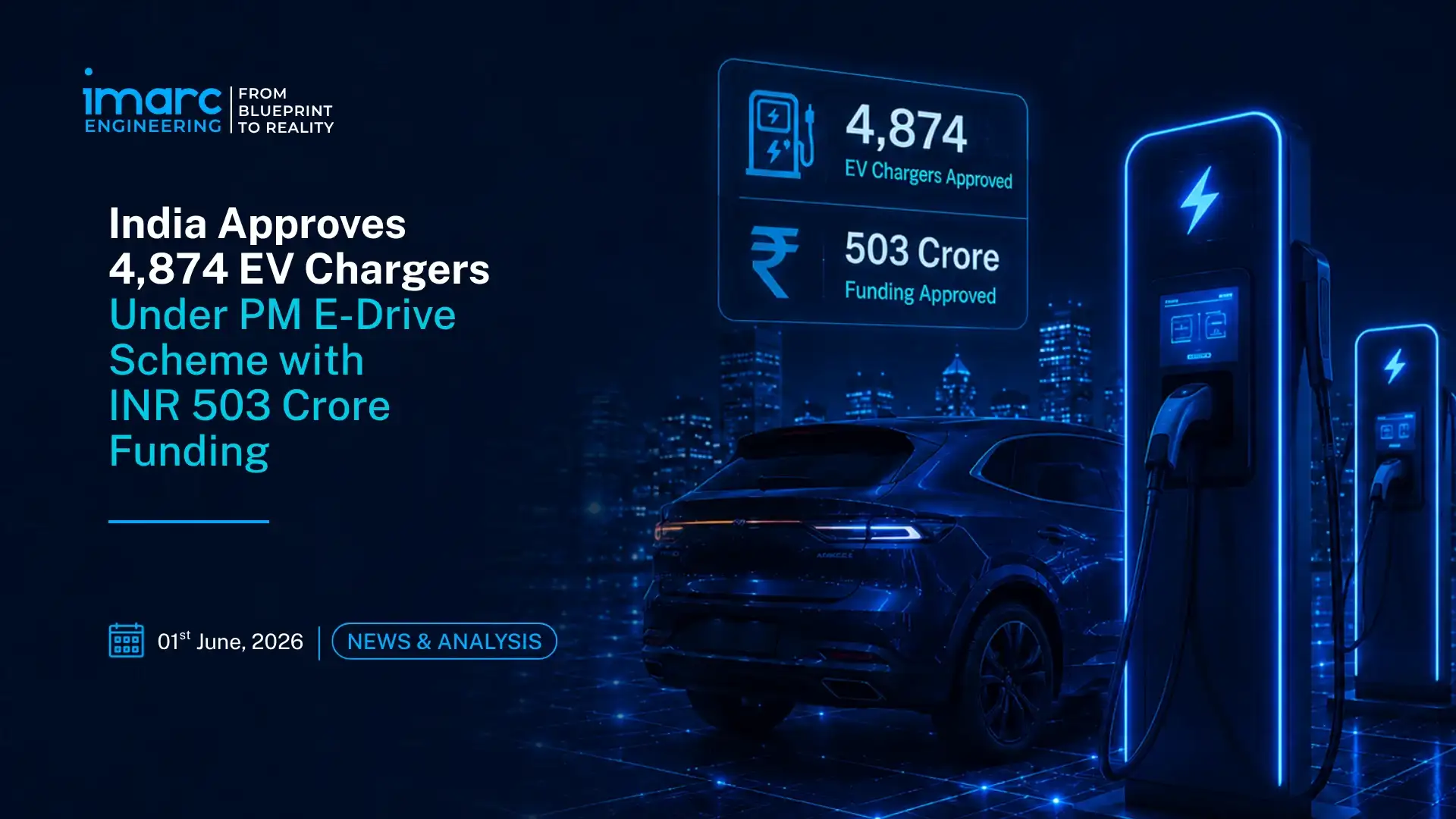
On May 12, 2026, the Ministry of Heavy Industries convened a national conference on EV charging infrastructure in Bengaluru, the most significant policy event on charging deployment since PM E-DRIVE scheme was launched. Union Minister H.D. Kumaraswamy announced the approval of proposals worth Rs 503.86 crore for installing 4,874 electric vehicle chargers infrastructure nationwide under the PM E-DRIVE scheme.
Simultaneously, the government unveiled plans for the Unified Bharat eCharge platform, a single digital interface for EV users to locate chargers, access networks, and make payments across all operators nationwide. Taken together, these two developments represent the largest coordinated push for public EV charging infrastructure India has seen, and they are reshaping the investment and execution landscape for everyone from oil marketing companies and state governments to charge point operators and EV manufacturers.
The May 12 Announcement: What Was Approved, Who Gets What, and How It Fits the Larger Picture
The May 12 approval under the PM E-Drive Scheme allocated Rs 503.86 crore for 4,874 PM E-Drive EV charging stations across eight states: Karnataka, Rajasthan, Andhra Pradesh, Uttar Pradesh, Gujarat, Kerala, Telangana, and Tamil Nadu. Karnataka received the largest share with Rs 123.26 crore for 1,243 chargers. The projects will be implemented by HPCL, IOCL, BPCL, and participating state governments, leveraging their existing fuel-retail and transport infrastructure to accelerate deployment of EV charging infrastructure in India.
The approval forms part of the scheme’s dedicated Rs 2,000 crore charging-infrastructure budget, aimed at deploying approximately 72,300 public EV charging stations in India. With a total outlay of Rs 10,900 crore, the broader scheme also supports electric two-wheelers, three-wheelers, buses, e-trucks, and e-ambulances. The latest allocation represents about 25% of the charging-infrastructure budget being activated in a single tranche, highlighting the accelerating pace of India EV chargers 2026 deployment.
The scale of the programme is notable. While FAME II supported the installation of 8,932 public chargers, the PM E-Drive Scheme targets 72,300 chargers nationwide. As of March 2026, government data showed 27,737 chargers installed and 22,753 operational, underscoring the significant expansion required to build a nationwide electric vehicle charging network in India.
The Unified Bharat eCharge Platform: India's UPI Moment for EV Charging
Alongside the latest PM E-Drive Scheme charger approvals, the most significant announcement at the May 12 Bengaluru conference was the Unified Bharat eCharge platform. Designed as a UPI-like interface for EV charging, the platform will enable users to locate chargers, book charging slots, make payments, and access charger availability through a single application. BHEL has been designated as the nodal agency for developing the platform and managing demand aggregation.
The initiative aims to address one of the biggest challenges facing EV charging infrastructure in India, network fragmentation. Today, EV users often rely on multiple apps and payment systems across different charging operators. The Unified Bharat eCharge platform will create an interoperability framework that allows networks operated by companies such as Maruti Suzuki, Tata Motors, Mahindra, Indian Oil, BPCL, HPCL, ChargeZone, Bolt.Earth, and Statiq to function through a common interface.
Developed with support from NPCI, the platform is expected to create a more seamless electric vehicle charging network in India, allowing drivers to access compatible chargers nationwide through a single application. This interoperability model could become as transformative for India EV chargers 2026 as UPI was for digital payments.
The Existing Network: What India Has and Where the Gaps Are
India’s EV charging infrastructure in India has expanded rapidly, with 27,737 public charging stations installed and 22,753 operational as of March 2026. Growth has been significant, rising from 6,586 public chargers in March 2023 to over 29,000 by mid-2025. Uttar Pradesh, Karnataka, Maharashtra, and Tamil Nadu lead the country in charger deployment, with Tamil Nadu standing out for strong highway accessibility.
Despite this progress, charger availability remains concentrated in major cities. Many Tier-2 and Tier-3 cities, semi-urban regions, and rural corridors remain underserved, even as EV adoption accelerates in states such as Bihar and Assam. To address this gap, the PM E-Drive Scheme is prioritising deployment along 50 national highway corridors and at high-traffic locations. The involvement of HPCL, IOCL, and BPCL provides a ready-made backbone for expanding public EV charging stations in India through their extensive fuel-station network.
Grid Readiness and the Infrastructure Execution Challenge
The Ministry of Heavy Industries is coordinating with the Ministry of Power, state governments, and industry stakeholders to address one of the biggest barriers to EV charging infrastructure in India: grid readiness. Fast-charging hubs require substantial power infrastructure, including transformers, feeders, and distribution equipment, which many existing locations lack. The government's focus on accessibility, affordability, and reliability suggests that grid upgrades will increasingly be integrated into PM E-Drive EV charging stations deployment plans.
Standardisation is another key priority. India's charging ecosystem currently uses multiple connector standards, creating complexity for both operators and users. The government's emphasis on interoperability aims to simplify the electric vehicle charging network in India, while the Unified Bharat eCharge platform is expected to provide a common digital layer connecting different charging networks and operators.
What the 4,874 Charger Approval Means for the EV Ecosystem
The May 12 approval is significant because it shows that the PM E-Drive Scheme has moved into active deployment. The approval of 4,874 chargers demonstrates that the implementation model involving oil marketing companies, state governments, and the Ministry of Heavy Industries is functioning as intended.
It also confirms that the Unified Bharat eCharge platform is progressing from concept to execution. For stakeholders across the EV ecosystem, this is a strong signal that EV charging infrastructure in India is being developed through a coordinated national programme. The approved chargers are an important milestone toward the scheme's target of 72,300 PM E-Drive EV charging stations nationwide.
India installed 27,737 public chargers over a decade. PM E-DRIVE is targeting way more. The infrastructure race is real, the funding is committed, and the execution window is now.
Explore IMARC Engineering's EV Charging Infrastructure Advisory Services for end-to-end project planning and implementation support.
About IMARC Engineering
IMARC Engineering is an end-to-end EPCM and industrial consulting firm supporting EV infrastructure developers, charge point operators, and government agencies with feasibility studies, DPR preparation, site selection, utility infrastructure design, equipment specification, civil and electrical engineering, procurement management, and project commissioning for EV charging infrastructure projects across India. IMARC Engineering helps CPOs, OMCs, state governments, and EV manufacturers design and deliver charging infrastructure that is grid-ready, commercially viable, and future-proof. Whether you are deploying under the PM E-DRIVE scheme, building a private charging depot, or designing a highway charging corridor, IMARC Engineering is the partner that bridges investment intent and on-ground execution.
Latest News
-
PM Modi Launches INR 753.68 Crore VOC Port Infrastructure Projects in Tamil Nadu
October 14, 2026
-
India's Manufacturing Sector Shows Recovery in Q2 FY27 as 95% of Firms Report Stable or Higher Output
October 12, 2026
-
Puri Greenfield Airport Gets Environmental Clearance, Advancing INR 5,631 Crore Project in Odisha
October 09, 2026
-
IEX Subsidiary Applies for Coal Exchange Registration Under India’s New Coal Exchange Rules 2026
September 30, 2026
-
India Pushes Domestic Shipping Container Manufacturing with INR 10,000 Crore Assistance Scheme
September 25, 2026
Trusted by Industry Leaders
We partner with global enterprises and ambitious businesses across sectors to deliver operational excellence, strategic insights, and sustainable growth through integrated solutions.









Success in Their Words
Real feedback from clients across industries. Discover how our solutions delivered measurable impact and operational excellence.

I wanted to express my sincere appreciation for your efforts in handling this matter. Your dedication and commitment have been truly commendable, and it is evident that you have put in tremendous hard work and expertise into resolving the issues at hand. We are greatly interested in continuing our collaboration with you in the future, as your professionalism and reliability have made you a trusted partner. Thank you once again for your invaluable contribution. We look forward to strengthening our partnership ahead.

It has been a pleasure working with the IMARC team. The insights provided were structured, clear, and highly valuable, helping us strengthen both our technical and financial planning with confidence. We deeply appreciate the team’s professionalism, responsiveness, and attention to detail throughout the engagement. Every requirement was well understood and effectively incorporated, resulting in a comprehensive and actionable output. Overall, our experience has been excellent, and I would gladly recommend IMARC to organizations seeking a reliable research partner.

Your service is truly exceptional. Working with the IMARC team has been a seamless and professional experience. The clarity of communication, responsiveness to queries, and consistent support at every stage made the entire engagement highly efficient. The insights shared were well-structured, practical, and perfectly aligned with our requirements, helping us make informed decisions with confidence. Overall, the dedication and professionalism demonstrated by your team stand out, and I would be glad to recommend IMARC as a reliable and trustworthy research partner.

IMARC did an outstanding job in preparing our study. They were punctual, precise, and consistently responsive throughout the entire process. The team delivered all the data we required in a clear, well-organized, and highly professional format. Their strong attention to detail, combined with their ability to meet every deadline without compromising quality, truly set them apart. Overall, their reliability and commitment made them an exceptional partner for our project, and we would gladly work with them again in the future.

IMARC made the whole process incredibly easy from start to finish. Everyone I interacted with via email was polite, professional, and straightforward to deal with, always keeping their promises regarding delivery timelines and remaining consistently solutions-focused. From my very first contact, I appreciated the professionalism and support shown by the entire IMARC team. I highly recommend IMARC to anyone seeking timely, affordable, and reliable information or advice. My experience with IMARC was excellent, and I truly cannot fault any aspect of it.

I’d like to express my sincere gratitude for the excellent work you accomplished with the study. Your ability to quickly understand our requirements and deliver high-quality results under tight timelines truly reflects your expertise, exceptional work ethic, and unwavering commitment to your customer’s success. The professionalism and responsiveness you demonstrated throughout the process made a significant difference. Our entire team and company are incredibly thankful for your dedication, reliability, and support. Once again, thank you for your outstanding contribution.
Ready to Experience the IMARC Advantage?
Whether you're planning a new facility, expanding operations, optimizing performance, or facing complex challenges—IMARC Engineering brings the expertise, experience, and commitment needed for success.