Manufacturing
July 30 2026
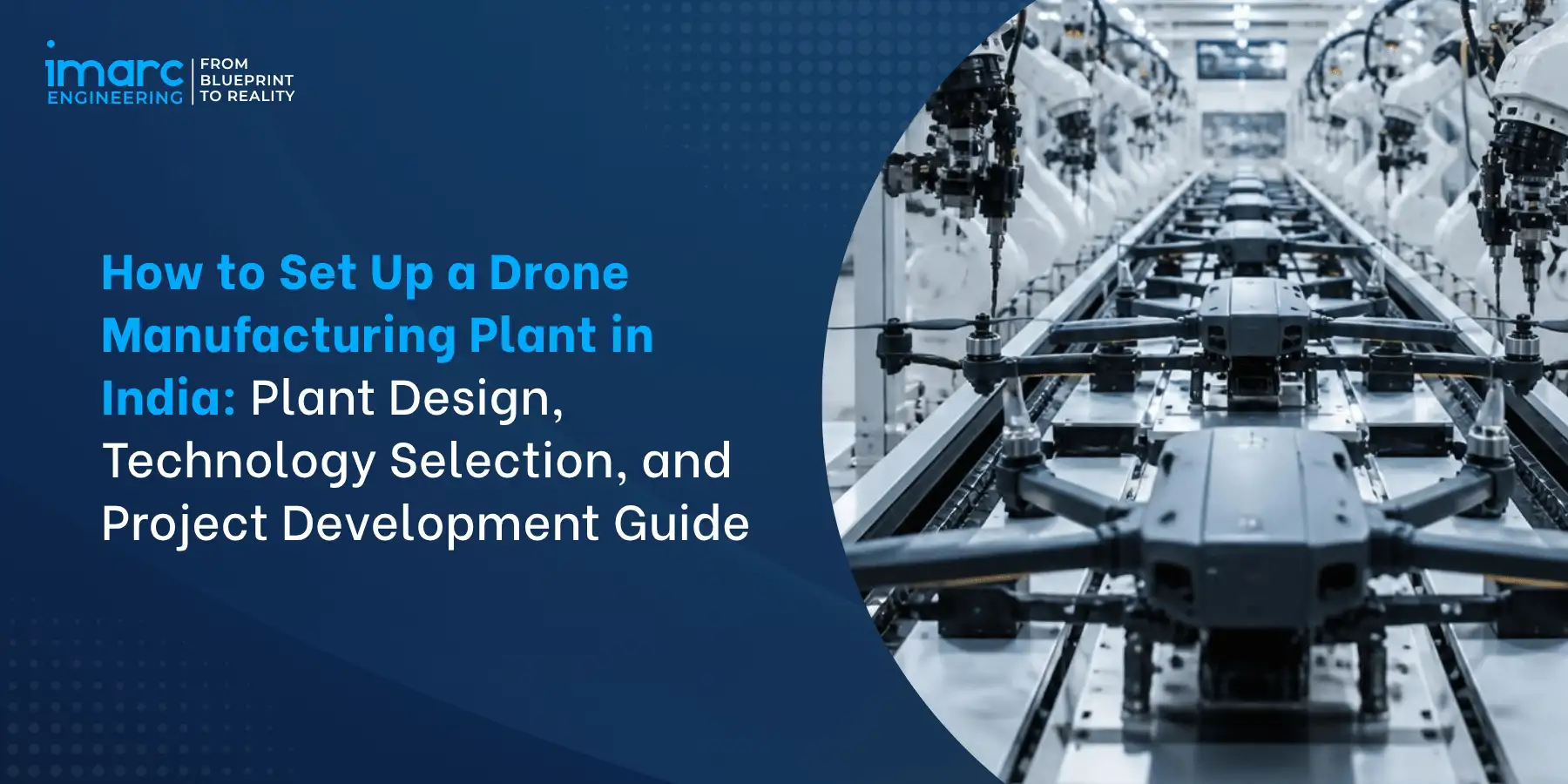
How to Set Up a Drone Manufacturing Plant in India: Plant Design, Technology Selection, and Project Development Guide
Introduction
For any investor or aerospace developer planning a drone manufacturing plant in India in 2026, the project extends materially beyond assembling unmanned aerial vehicles. Successful facilities integrate product architecture, manufacturing technology selection, electronics and mechanical assembly systems, testing infrastructure, plant layout, utilities, automation, quality management, regulatory compliance, and engineering validation into a coherent development programme.
India's Drone Rules 2021, PLI scheme for drones, growing defence and civilian applications, and expanding domestic OEM ecosystem collectively create attractive but engineering-intensive sector opportunities.
Scope of this Guide
This guide answers the sponsor's set-up question directly. What should investors know about technology selection, plant design, engineering, regulatory approvals, infrastructure, and project execution before investing? It walks through the sector context, structured project development lifecycle, technology selection, plant design, components manufacturing, DGCA regulatory pathway, testing infrastructure, and the practices that separate structured drone manufacturing plant setup from projects that struggle with type certification, quality consistency, or commercial viability.
Table of Contents
- Introduction
- Why Drone Manufacturing in India Matters in 2026
- How to Set Up a Drone Manufacturing Plant in India
- Drone Manufacturing Technology Selection for Indian Manufacturers
- Drone Assembly Plant Design and Layout in India
- Drone Components Manufacturing and Electronics Assembly in India
- DGCA Regulatory Approvals for Drone Manufacturing Plants in India
- Testing and Certification Infrastructure for Drone Manufacturers in India
- Common Mistakes and Best Practices
- Conclusion
1. Why Drone Manufacturing in India Matters in 2026
Four structural drivers make drone manufacturing an attractive sector opportunity for Indian investors in 2026.
1.1 Policy Support and PLI Scheme
The Ministry of Civil Aviation (MoCA) launched the Production Linked Incentive (PLI) Scheme for Drones and Drone Components in 2021 with an outlay of approximately INR 120 crore over three years. Drone Rules 2021 provide a liberalised operating and manufacturing framework.
Ban on drone imports (subject to defined exceptions) creates structured domestic market opportunity. UAV manufacturing under the Make in India and Atmanirbhar Bharat frameworks accesses multiple policy support layers.
1.2 Defence and Security Demand
India's defence forces have expanded drone acquisition materially covering surveillance, reconnaissance, precision strike, logistics, and swarm applications. iDEX (Innovations for Defence Excellence), TDF (Technology Development Fund), and Positive Indigenisation Lists progressively favour domestic manufacturers.
Border security agencies, paramilitary forces, and state police forces have expanded drone deployment. Structured defence demand supports both large defence OEMs and specialised drone startups.
1.3 Civilian and Commercial Applications
Civilian applications continue expanding rapidly across agriculture (Kisan drones for spraying, mapping, and monitoring), surveying and mapping, infrastructure inspection, delivery, filming and photography, environmental monitoring, mining, and warehouse management.
Namo Drone Didi scheme supports women self-help groups deploying agricultural drones. Structured civilian and commercial demand creates diversified revenue opportunities beyond defence dependency.
1.4 Ecosystem Development
India's drone ecosystem has expanded materially with dedicated OEMs (Ideaforge, Garuda Aerospace, Dhaksha, Zen Technologies), defence public sector participation (BEL, HAL, DRDO labs), private aerospace groups (Adani, Tata Advanced Systems, Reliance Defence, Bharat Forge subsidiaries), and a growing components ecosystem covering flight controllers, cameras, sensors, and airframe materials.
Structured ecosystem development supports both new entrants pursuing greenfield manufacturing project routes and expansion of existing UAV manufacturing plant operations.
2. How to Set Up a Drone Manufacturing Plant in India
Understanding how to set up a drone manufacturing plant in India helps sponsors sequence engineering and commercial decisions correctly. Structured drone manufacturing project development integrates feasibility, product architecture, technology selection, engineering, statutory approvals, and construction into a coherent programme.
2.1 The Six-Stage Development Roadmap
| Stage | Activities | Typical Duration |
|---|---|---|
| Feasibility and DPR | Market, product, technology, financial analysis | 3-6 months |
| Product and Technology Selection | Design, prototyping, sourcing strategy | 4-6 months |
| Detailed Engineering | Process, MEP, cleanroom, automation design | 6-12 months |
| Regulatory Approvals | DGCA type certification, CTE/CTO, Factory | 6-18 months |
| Construction and Commissioning | Civil, MEP, equipment installation, testing | 12-18 months |
| Commercial Operations | Production ramp-up, type certification, dispatch | Ongoing |
2.2 Drone Manufacturing Plant Capex and Financial Modelling
Structured drone manufacturing plant capex and financial modelling covers investment sizing, opex projections, and viability analysis. Small assembly plants (5,000-25,000 units per year) typically require INR 5-25 crore. Medium manufacturing facilities (25,000-100,000 units per year) typically require INR 25-200 crore.
Large integrated plants with in-house component manufacturing (above 100,000 units per year) typically require INR 200-1,000 crore. Defence-grade facilities with specialised testing infrastructure typically range INR 100-2,000 crore. Component vertical integration typically multiplies capex 2-3 times over pure assembly.
2.3 Product Architecture and Feasibility
Product architecture definition precedes technology and infrastructure decisions. Target product categories (nano, micro, small, medium, or large per Drone Rules 2021 weight classifications), applications (defence, agriculture, surveying, delivery, inspection), rotary versus fixed-wing versus hybrid configurations, autonomy level, endurance, and payload capability collectively shape all downstream decisions.
Feasibility studies typically extend 3-6 months covering product-market fit, competitive positioning, regulatory pathway, and financial modelling. Structured feasibility prevents defaulting to generic templates that miss product-specific requirements.
3. Drone Manufacturing Technology Selection for Indian Manufacturers
Drone manufacturing technology selection for Indian manufacturers matches product architecture, target volume, cost structure, and quality requirements. The drone manufacturing process spans multiple disciplines integrating mechanical, electronic, software, and testing capabilities.
3.1 Airframe Manufacturing Options
| Technology | Best For | Key Characteristics |
|---|---|---|
| Carbon fiber composite layup | Mid-to-high-end drones | Lightweight, high strength, moderate cost |
| Injection molding (ABS, PC) | High-volume consumer drones | Low unit cost, high tooling investment |
| 3D printing (SLS, FDM, SLA) | Prototypes, low-volume | Design flexibility, higher unit cost |
| CNC machining (aluminum, alloys) | Precision structural parts | Superior tolerance, moderate volumes |
| Sheet metal fabrication | Structural frames | Cost-effective for larger drones |
3.2 Electronics Manufacturing Approach
Electronics manufacturing approaches range from full outsourcing to complete vertical integration. Surface Mount Technology (SMT) lines with pick-and-place equipment, reflow ovens, and Automated Optical Inspection (AOI) support high-volume PCB assembly. Manual assembly stations complement SMT for low-volume specialised assemblies.
Third-party PCB assembly through Electronic Manufacturing Services (EMS) providers reduces initial capex but limits margin capture and IP protection. Vertical integration typically becomes economical above 50,000-100,000 units per year.
3.3 Automation and Manual Assembly Mix
Automation-manual mix depends on volume, product complexity, and labour cost. High-volume simple drones justify substantial automation including robotic pick-and-place, automated screwing, automated calibration, and automated packaging.
Low-volume complex drones favour manual assembly with structured Standard Operating Procedures, jigs and fixtures, and quality gates. Structured mix decisions during design phase materially affect capex, floor space, and operational flexibility.
3.4 Software Development and Integration
Software including flight control firmware, ground control station applications, mission planning software, and data analytics distinguishes drone products materially. In-house software capability supports product differentiation and continuous improvement.
Development environments, testing infrastructure, and structured version control support disciplined software engineering. Airworthiness-critical software follows RTCA DO-178C standards for aerospace applications. Structured software development integrated with hardware manufacturing supports coherent product releases.
4. Drone Assembly Plant Design and Layout in India
Drone assembly plant design and layout integrate functional zones, material flow, quality controls, and support infrastructure. Well-designed drone manufacturing plant design supports both current production and future capacity expansion.
4.1 Functional Zones
- Receiving and warehouse for raw materials and components
- Airframe manufacturing zone (composites, machining, injection molding)
- Electronics assembly (SMT line, manual assembly, testing)
- Sub-assembly stations (motors, ESC, propellers, battery)
- Main integration and final assembly line
- Testing areas (bench, environmental, flight)
- Quality assurance and inspection stations
- Finished goods warehouse and dispatch
- Cleanroom for sensitive electronics (ISO 14644 classification per requirement)
- Administrative and support facilities
4.2 Cleanroom and Controlled Environment
Cleanroom requirements match component sensitivity. Camera and optical sensor assembly typically requires ISO 14644 Class 8 (100000) cleanroom with controlled temperature, humidity, and particulates. PCB assembly typically requires ESD-controlled environment per IEC 61340.
Battery assembly requires structured safety separation, ventilation, and fire suppression per Li-ion handling protocols. Structured environmental controls integrated during design are materially cheaper than post-commissioning retrofits.
4.3 Material Flow Optimisation
Effective drone assembly plant layout follows structured one-way material flow from receiving through processing to dispatch. Sub-assembly stations feed main integration line minimising cross-flow. Testing stations positioned before finished goods dispatch enable rejection before packaging.
Lean manufacturing principles including Just-in-Time (JIT) delivery, Kanban signalling, and 5S workplace organisation support both quality and productivity. Structured material flow typically reduces handling cost 15-25 percent versus poorly organised layouts.
4.4 Automation and Digital Integration
Automation integration during design supports both quality consistency and scalability. Manufacturing Execution Systems (MES), Enterprise Resource Planning (ERP), Product Lifecycle Management (PLM), and Quality Management Systems (QMS) collectively support operational visibility and traceability.
Component-level traceability through barcode or RFID supports quality control and warranty management. Structured digital architecture during initial design outperforms post-commissioning retrofit for both cost and effectiveness.
5. Drone Components Manufacturing and Electronics Assembly in India
Drone components manufacturing and electronics assembly determines vertical integration depth, cost structure, and IP protection. Component strategy shapes long-term competitive positioning.
5.1 Core Components and Sourcing Strategy
| Component | Function | Typical Sourcing |
|---|---|---|
| Airframe/chassis | Structure | In-house or contract manufacturer |
| Motors and ESC | Propulsion | Imported or increasingly domestic |
| Propellers | Thrust generation | Domestic manufacturers available |
| Battery pack (LiPo, Li-ion) | Power | Cell import; pack assembly domestic |
| Flight controller (FCU) | Autopilot | Import or in-house design |
| GPS/GNSS module | Positioning | Import |
| Cameras and gimbals | Payload | Import or specialised domestic |
| Sensors (LiDAR, thermal, RGB) | Data capture | Predominantly import |
| RF communication modules | Telemetry, control | Import or domestic |
5.2 PCB Assembly Line Setup
SMT-based PCB assembly line typically includes solder paste printer, pick-and-place machine (single or multi-head based on volume), reflow oven, Automated Optical Inspection (AOI), In-Circuit Testing (ICT), and Functional Testing (FCT) stations.
Line throughput ranges from 5,000 to 50,000 boards per shift depending on complexity and automation. Wave soldering supplements SMT for through-hole components. Structured line design supports both current volume and 2-3-year growth without major reconfiguration.
5.3 Battery Manufacturing Considerations
Lithium polymer (LiPo) and lithium-ion battery pack assembly requires specialised safety infrastructure. Cell testing and matching, tab welding, pack assembly, Battery Management System (BMS) integration, safety testing, and environmental testing collectively define battery capability.
Cell sourcing typically remains import-dependent though pack assembly is increasingly domestic. Structured safety infrastructure including thermal runaway containment, fire suppression, and structured ventilation is prerequisite for battery operations.
5.4 Value Addition Under PLI Scheme
PLI scheme requires minimum 40 percent value addition for eligibility, materially shaping component strategy for scheme beneficiaries. Higher domestic value addition supports both PLI benefits and competitive positioning.
Vertical integration priorities in drone manufacturing project development for Indian OEMs typically include airframe manufacturing, PCB assembly, motor manufacturing, and battery pack assembly given current Indian supplier ecosystem. Structured value-addition planning during feasibility stage supports both PLI compliance and long-term competitive positioning.
6. DGCA Regulatory Approvals for Drone Manufacturing Plants in India
DGCA regulatory approvals for drone manufacturing plants combine aviation-specific approvals from the Directorate General of Civil Aviation (DGCA) with standard industrial statutory approvals. Structured approval sequencing at project outset materially compresses total timelines.
6.1 Drone Rules 2021 Framework
The Drone Rules 2021 issued by the Ministry of Civil Aviation (MoCA) provide the parent framework superseding the earlier CAR 1.0 framework. Key provisions include drone category classification by weight (nano up to 250 grams; micro 250 grams to 2 kg; small 2 to 25 kg; medium 25 to 150 kg; large above 150 kg); Unique Identification Number (UIN) for individual drones; Type Certificate for drone models; DigitalSky Platform for online approvals; Remote Pilot Certificate for operators; and structured operational zones (green, yellow, red).
6.2 Type Certification
| Certification Element | Authority | Purpose |
|---|---|---|
| Type Certificate (TC) | DGCA / QCI-certified certification body | Model-level airworthiness |
| Certificate of Manufacture | DGCA | Manufacturer authorisation |
| Unique Identification Number | DigitalSky Platform | Individual drone registration |
| Import Clearance | DGFT | Component and equipment imports |
| BIS Certification (where applicable) | Bureau of Indian Standards | Component-level standards |
| Quality Standards | ISO 9001, AS9100 for defence | Manufacturing quality |
6.3 Standard Industrial Approvals
Beyond aviation-specific approvals, standard industrial approvals apply including Environmental Clearance under EIA 2006 (typically not triggered for pure assembly but may apply for advanced fabrication activities); Consent to Establish and Consent to Operate from State Pollution Control Board under Water Act 1974 and Air Act 1981; Factory License under Occupational Safety Health and Working Conditions Code 2020 (in force from 21 November 2025); Fire NOC under NBC 2016 Part 4; and Building Plan Approval per local municipal bye-laws. State-level industrial estate allotments through corporations like MIDC, GIDC, KIADB, and TSIIC simplify parallel approvals through single-window processes.
6.4 Defence and Export Considerations
Defence-focused drone manufacturers require additional approvals including Industrial License from DIPP where applicable, Defence Ministry supplier registration, DGQA (Directorate General of Quality Assurance) approval for defence supplies, and SCOMET (Special Chemicals, Organisms, Materials, Equipment and Technologies) compliance for export controls.
Export markets require destination-country certifications and sanctions compliance. Structured defence and export pathway planning during project development supports both compliance and commercial engagement.
7. Testing and Certification Infrastructure for Drone Manufacturers in India
Testing and certification infrastructure for drone manufacturers in India supports both regulatory compliance and quality consistency. Structured testing typically consumes 15-25 percent of production floor space and requires proportional capex commitment.
7.1 Component-Level Testing
Component-level testing verifies individual parts before assembly. Battery testing includes cycle life, capacity, temperature, and safety testing per applicable IEC standards. Motor testing includes thrust, efficiency, and reliability testing. Electronics testing includes ICT, functional testing, and burn-in testing. Sensor calibration ensures measurement accuracy. Structured component-level testing prevents downstream assembly issues that compound diagnostic complexity.
7.2 Assembly and Integration Testing
- Motor-propeller thrust and balance testing
- Flight controller functional testing
- RF communication range and reliability testing
- GPS/GNSS accuracy verification
- Camera and sensor payload testing
- Battery-drone system testing (power, endurance)
- Software integration and functional testing
- Weather sealing and environmental protection testing
7.3 Environmental and Airworthiness Testing
Environmental testing per applicable ISO 21384 UAS standards includes temperature cycling, humidity, vibration, EMI/EMC (electromagnetic interference and compatibility), shock, and altitude testing. Anechoic chambers support RF characterisation.
Vibration test rigs verify structural integrity. Environmental chambers simulate extreme operating conditions. Structured environmental testing infrastructure is prerequisite for type certification particularly for defence and premium commercial applications.
7.4 Flight Testing Infrastructure
Flight testing infrastructure includes indoor flight cages for controlled testing and outdoor test ranges for real-world validation. Indoor cages typically extend 20-50 metres with adequate ceiling height and mesh containment.
Outdoor test ranges require DGCA approvals as designated test areas. Test flight documentation supports type certification submissions. Structured flight testing integrated with quality assurance workflows supports both certification and continuous quality improvement.
8. Common Mistakes and Best Practices
8.1 Under-Investment in Type Certification Planning
Projects proceeding to construction without structured type certification planning routinely face commissioning delays.
Best practice: DGCA engagement during feasibility stage; certification pathway mapped and documented; testing infrastructure sized for certification requirements; documentation systems designed for certification submissions; realistic certification timelines (typically 12-24 months) in project schedule.
8.2 Weak Component Sourcing Strategy
Import-dependent supply chains produce exposure to lead time and price volatility.
Best practice: multi-source strategy for critical components; domestic supplier development where feasible; strategic inventory for import-dependent items; long-term supplier agreements with structured pricing; supplier quality development supporting Indian ecosystem maturation.
8.3 Deferred Software Capability
Hardware-focused projects deferring software capability produce product differentiation gaps.
Best practice: software architecture defined during product design; software team recruited during initial engineering; version control and development environments established early; software testing infrastructure integrated with hardware testing; continuous improvement discipline supporting product evolution.
8.4 Inadequate Testing Infrastructure
Testing infrastructure treated as post-commissioning addition produces both quality and certification delays.
Best practice: testing infrastructure sized during basic engineering; environmental chambers, anechoic chambers, and flight test areas planned during layout design; testing equipment procurement integrated with production equipment; testing team recruited and trained during commissioning; testing SOPs developed pre-commissioning.
8.5 Insufficient Quality Management System
Quality management treated as certification checkbox rather than operating discipline undermines both certification and commercial confidence.
Best practice: ISO 9001:2015 implementation from Day 1; AS9100 for defence-focused operations; structured quality documentation aligned with certification requirements; supplier quality management; measurement and continuous improvement; customer feedback integration.
Conclusion
Setting up a drone manufacturing plant in India in 2026 is a multidisciplinary technology-intensive project spanning airframe, electronics, software, testing, and regulatory certification. India's Drone Rules 2021 framework, PLI scheme, growing defence and civilian demand, and expanding domestic OEM ecosystem collectively create attractive but engineering-intensive sector opportunities.
Successful drone manufacturing projects depend on selecting technology that aligns with the product architecture and production volumes, planning the DGCA certification pathway early, and investing in software capabilities that enhance product performance, autonomy, and long-term competitiveness.
PLANNING YOUR DRONE MANUFACTURING PROJECT?
IMARC Engineering's end-to-end drone manufacturing plant project development advisory team supports investors, manufacturers, and aerospace developers across market and feasibility studies, product architecture definition, technology pathway evaluation, DPR preparation, engineering design, airframe and electronics manufacturing strategy, cleanroom and controlled environment design, testing infrastructure planning, DGCA regulatory approvals coordination including type certification and Certificate of Manufacture, PLI scheme value addition planning, EPC or EPCM contractor evaluation, construction supervision, commissioning coordination, and commercial operations ramp-up for rotary-wing, fixed-wing, VTOL hybrid, and specialised drone projects across small, medium, and large-scale developments in India.
→ Schedule a free drone plant project scoping consultation with an IMARC specialist
Frequently Asked Questions
A drone manufacturing plant in India is an industrial facility that designs, manufactures, assembles, and tests unmanned aerial vehicles including airframe, electronics, software integration, and testing. Facilities range from small assembly operations to large integrated plants with in-house component manufacturing including PCB assembly, injection molding, composite manufacturing, and battery pack assembly.
Small assembly plants (5,000-25,000 units per year) typically require INR 5-25 crore. Medium manufacturing facilities (25,000-100,000 units per year) typically require INR 25-200 crore. Large integrated plants (above 100,000 units per year) typically require INR 200-1,000 crore. Defence-grade facilities with specialised testing infrastructure typically range INR 100-2,000 crore. Component vertical integration multiplies capex 2-3 times.
Key approvals include DGCA Type Certificate for drone models, Certificate of Manufacture from DGCA, Unique Identification Number registration through DigitalSky Platform, State Pollution Control Board Consent to Establish and Consent to Operate, Factory License under OSH Code 2020, Fire NOC, and DGFT registration for imports. Structured DGCA regulatory approvals for drone manufacturing plants should begin during detailed engineering.
Drone Rules 2021 define five categories by weight: nano (up to 250 grams), micro (250 grams to 2 kg), small (2 to 25 kg), medium (25 to 150 kg), and large (above 150 kg). Each category has distinct operational restrictions and certification requirements. Selection of target category drives product design, testing requirements, and regulatory pathway.
The Production Linked Incentive (PLI) Scheme for Drones and Drone Components launched by MoCA in 2021 provides INR 120 crore outlay over three years for eligible manufacturers. Minimum value addition threshold is 40 percent for eligibility. Scheme supports both drone assembly and drone components manufacturing and electronics assembly covering flight controllers, airframes, propellers, and specialised components.
Common technologies include carbon fiber composite layup for mid-to-high-end drones, injection molding (ABS, polycarbonate) for high-volume consumer drones, 3D printing (SLS, FDM, SLA) for prototypes and low-volume applications, CNC machining for precision structural parts, and sheet metal fabrication for larger drone frames. Selection matches product category, volume, and cost structure.
Total project timeline typically extends 30-48 months from feasibility to commercial operations. Feasibility and DPR: 3-6 months. Design and engineering: 6-12 months. Regulatory approvals: 6-18 months (parallel). Construction: 12-18 months. Commissioning: 3-6 months. Type certification adds 12-24 months. Structured parallel execution compresses total elapsed time.
Structured testing and certification infrastructure for drone manufacturers includes component testing (batteries, motors, electronics), assembly testing (thrust, RF, GPS accuracy), environmental testing (temperature, humidity, vibration, EMI/EMC), anechoic chamber for RF characterisation, and flight testing infrastructure (indoor cages, outdoor test ranges). Testing infrastructure typically consumes 15-25 percent of production floor space.
Major Indian drone OEMs include Ideaforge (public), Garuda Aerospace, Dhaksha Unmanned Systems, Zen Technologies, Adani Defence and Aerospace, Reliance Defence, Tata Advanced Systems, Bharat Forge subsidiaries, Bharat Electronics (BEL), Hindustan Aeronautics (HAL), and DRDO laboratories. The ecosystem has expanded materially since 2020 supporting both defence and civilian applications.
Recent Post




Trusted by Industry Leaders
We partner with global enterprises and ambitious businesses across sectors to deliver operational excellence, strategic insights, and sustainable growth through integrated solutions.












Success in Their Words
Real feedback from clients across industries. Discover how our solutions delivered measurable impact and operational excellence.

I wanted to express my sincere appreciation for your efforts in handling this matter. Your dedication and commitment have been truly commendable, and it is evident that you have put in tremendous hard work and expertise into resolving the issues at hand. We are greatly interested in continuing our collaboration with you in the future, as your professionalism and reliability have made you a trusted partner. Thank you once again for your invaluable contribution. We look forward to strengthening our partnership ahead.

It has been a pleasure working with the IMARC team. The insights provided were structured, clear, and highly valuable, helping us strengthen both our technical and financial planning with confidence. We deeply appreciate the team’s professionalism, responsiveness, and attention to detail throughout the engagement. Every requirement was well understood and effectively incorporated, resulting in a comprehensive and actionable output. Overall, our experience has been excellent, and I would gladly recommend IMARC to organizations seeking a reliable research partner.

Your service is truly exceptional. Working with the IMARC team has been a seamless and professional experience. The clarity of communication, responsiveness to queries, and consistent support at every stage made the entire engagement highly efficient. The insights shared were well-structured, practical, and perfectly aligned with our requirements, helping us make informed decisions with confidence. Overall, the dedication and professionalism demonstrated by your team stand out, and I would be glad to recommend IMARC as a reliable and trustworthy research partner.

IMARC did an outstanding job in preparing our study. They were punctual, precise, and consistently responsive throughout the entire process. The team delivered all the data we required in a clear, well-organized, and highly professional format. Their strong attention to detail, combined with their ability to meet every deadline without compromising quality, truly set them apart. Overall, their reliability and commitment made them an exceptional partner for our project, and we would gladly work with them again in the future.

IMARC made the whole process incredibly easy from start to finish. Everyone I interacted with via email was polite, professional, and straightforward to deal with, always keeping their promises regarding delivery timelines and remaining consistently solutions-focused. From my very first contact, I appreciated the professionalism and support shown by the entire IMARC team. I highly recommend IMARC to anyone seeking timely, affordable, and reliable information or advice. My experience with IMARC was excellent, and I truly cannot fault any aspect of it.

I’d like to express my sincere gratitude for the excellent work you accomplished with the study. Your ability to quickly understand our requirements and deliver high-quality results under tight timelines truly reflects your expertise, exceptional work ethic, and unwavering commitment to your customer’s success. The professionalism and responsiveness you demonstrated throughout the process made a significant difference. Our entire team and company are incredibly thankful for your dedication, reliability, and support. Once again, thank you for your outstanding contribution.