Renewable Energy & Sustainability
June 19 2026
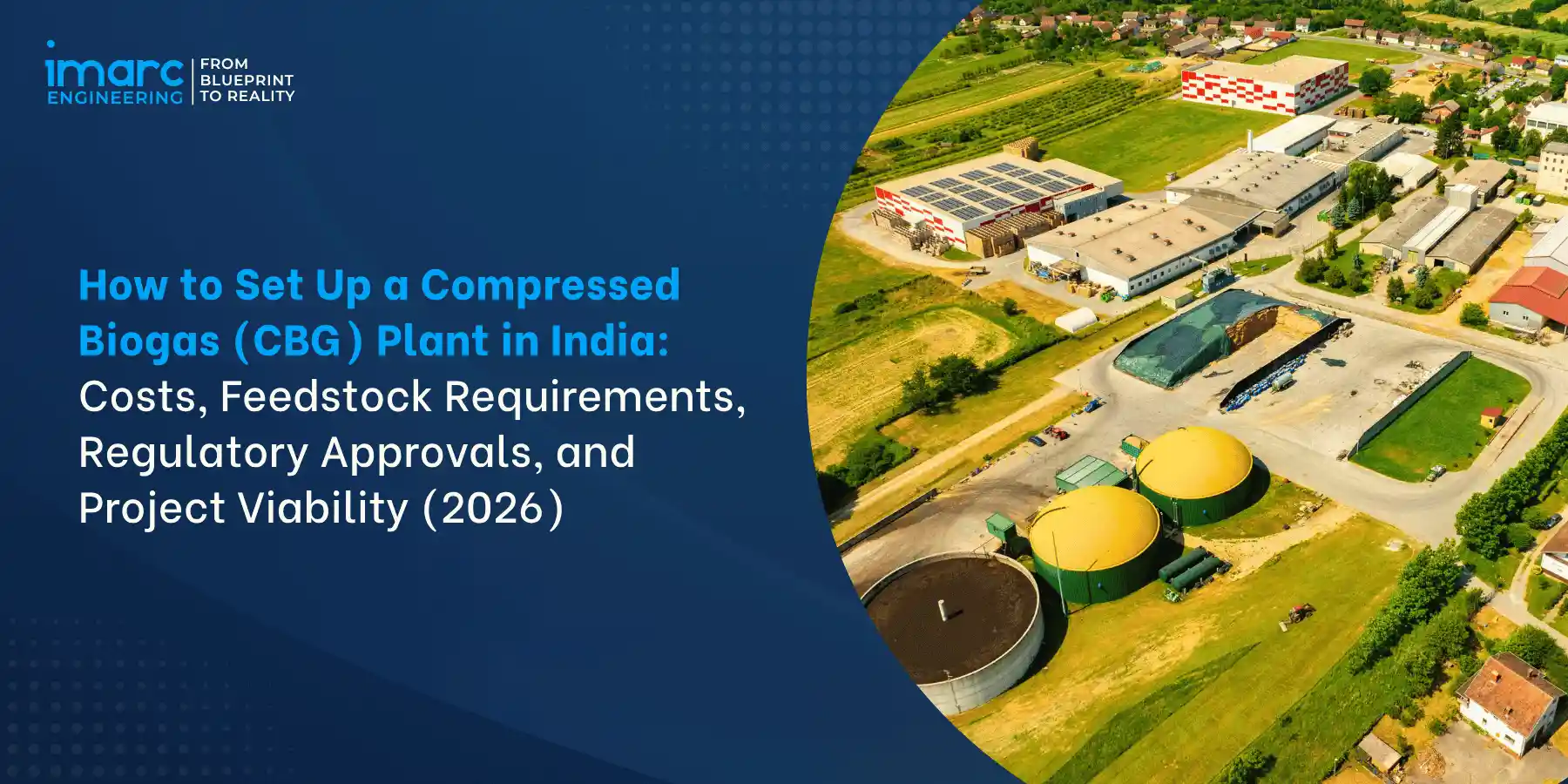
How to Set Up a Compressed Biogas (CBG) Plant in India: Costs, Feedstock Requirements, Regulatory Approvals, and Project Viability (2026)
Introduction
The economics of compressed biogas plant setup in India shifted decisively in 2025-26. With the introduction of mandatory CBG Blending Obligation (CBO) from FY 2025-26, the revised CBG procurement price of INR 1,478 per mmBtu effective from June 2025, and the Union Budget 2026-27 central excise duty exemption on the CBG portion of blended CNG, the policy framework for compressed biogas has strengthened significantly.
Additional support through the Biomass Aggregation Machinery (BAM) Scheme, RBI Priority Sector Lending status, and 15-year offtake agreements with OMCs has further improved project economics. As a result, the financial viability of CBG projects is materially stronger today than during the early years of the SATAT programme.
This guide answers the planning developer's question: how do I set up a CBG plant in India, covering the six-phase development framework, SATAT scheme in India procurement mechanics, feedstock requirements, capex structure, regulatory approvals, and project viability assessment for a compressed biogas project in India in 2026.
Table of Contents
- Introduction
- Why CBG Has Become Strategic in 2026
- How to Set Up a Compressed Biogas Plant in India - Six-Phase Framework
- SATAT Scheme Benefits for CBG Developers - Procurement Mechanics
- CBG Plant Feedstock Requirements in India
- CBG Plant Cost Breakdown in India
- Regulatory Approvals for Biogas Plant in India
- CBG Plant Feasibility Study - Project Viability Assessment
- Common Mistakes and Best Practices
- Conclusion
1. Why CBG Has Become Strategic in 2026
Four structural drivers underpin the strategic case for CBG investment in 2026.
1.1 Mandatory CBO Creates Guaranteed Demand
The National Biofuels Coordination Committee (NBCC) approved the phase-wise mandatory blending of CBG in CNG (transport) and PNG (domestic) segments of the City Gas Distribution (CGD) sector. Starting FY 2025-26 at 1 percent, the CBO scales to 3 percent in FY 2026-27, 4 percent in FY 2027-28, and 5 percent from FY 2028-29 onwards. With India's natural gas consumption around 165 MMSCMD, even 1 percent translates into substantial volumes. CGD entities are now legally obligated to procure CBG, transforming the offtake risk profile from voluntary to mandatory.
1.2 Revised Procurement Price Strengthens Project Returns
MoPNG revised the CBG procurement price in May 2025, increasing the base from 80 percent to 85 percent of the average CNG retail selling price. The new rate effective from 1 June 2025 stands at INR 1,478 per mmBtu (excluding GST) or approximately INR 77.4 per kg at 95 percent methane content for deliveries up to 50 km. Compression charges of INR 8 per kg remain unchanged. Transportation support of INR 1.50 per kg applies for 50-75 km and INR 2.50 per kg for distances beyond 75 km. The pricing methodology gives developers structural alignment with CNG market trends.
1.3 Energy Security and Import Substitution
India currently imports approximately 50 percent of its natural gas demand. CBG offers a domestic, renewable alternative produced from indigenous biomass and waste streams. The IEEFA analysis suggests that replacing 20 percent of natural gas consumption with CBG and biomethane by 2030 could cut LNG import bills by approximately USD 29 billion between FY 2025 and FY 2030. The strategic case extends beyond commercial returns to national energy security and trade balance objectives.
1.4 Rural Economy and Waste Management Co-Benefits
CBG plants convert agricultural residues, animal waste, municipal solid waste, press mud from sugar mills, and other organic waste streams into transport fuel and Fermented Organic Manure (FOM). The model creates rural employment, reduces stubble burning emissions, supports the GOBARdhan initiative under Swachh Bharat Mission, and aligns with India's net-zero commitment by 2070. The Market Development Assistance of INR 1,500 per MT on FOM under the Department of Fertilizers further strengthens the by-product revenue stream, supporting the broader case for renewable energy projects India.
2. How to Set Up a Compressed Biogas Plant in India - Six-Phase Framework
A compressed biogas project in India follows a structured six-phase development lifecycle. The framework applies broadly across feedstock categories with adaptations for agricultural residue, MSW, press mud, and other source streams.
| Phase | Activity | Typical Duration |
|---|---|---|
| 1. Feasibility & Site Selection | Feedstock survey, site identification, business case, LoI from OMC | 3-6 months |
| 2. Statutory Approvals | PCB consents, building plan, factory registration, PESO | 4-8 months |
| 3. Detailed Engineering | Process design, equipment specification, layout, MEP | 3-5 months |
| 4. EPC Construction | Civil, MEP, digesters, gas upgradation, compression systems | 12-18 months |
| 5. Commissioning & Testing | Process commissioning, BIS IS 16087:2016 compliance, OMC trials | 2-4 months |
| 6. Commercial Operations | OMC offtake, FOM sale, capacity ramp, optimisation | Continuous |
2.1 Feasibility and Site Selection
The strategic foundation establishes feedstock availability (10-year supply visibility recommended), site identification (typically 5-10 acres for 5-10 TPD plants), OMC engagement for Expression of Interest (EoI) submission and Letter of Intent (LoI), and integrated business case modelling. The SATAT portal at iocletenders.nic.in and other OMC portals provide EoI invitations. Securing the LoI from IOCL, BPCL, HPCL, GAIL, or IGL is the gateway to subsequent project bankability.
2.2 Statutory Approvals and Engineering
Approvals proceed in parallel with detailed engineering. State Pollution Control Board categorises CBG under 'White Category' (least polluting) - simplifying CTE/CTO requirements. PESO licensing applies to high-pressure gas storage at 250 bar. Building Plan Approval, Fire NOC under NBC 2016 Part 4, factory/establishment registration under the OSH Code 2020 (in force from 21 November 2025), and hazardous waste authorisation where applicable complete the approval stack.
2.3 EPC Construction and Commissioning
Construction-stage capex deployment dominates project cost - feedstock pre-processing systems, anaerobic digesters (typically CSTR or plug-flow designs), gas storage, gas upgradation (CO2 removal to achieve 90+ percent methane per IS 16087:2016), compression to 250 bar, dispensing infrastructure, and ancillary utilities. Commissioning involves systems testing, gas quality validation, BIS standard compliance verification, and OMC commercial trials. End-to-end project timeline typically runs 24-36 months from feasibility to commercial operations.
3. SATAT Scheme Benefits for CBG Developers - Procurement Mechanics
The SATAT scheme India (Sustainable Alternative Towards Affordable Transportation) launched on 1 October 2018 by the Ministry of Petroleum and Natural Gas (MoPNG) remains the foundational policy framework supporting CBG investment. Understanding the procurement mechanics is essential for project bankability.
3.1 The SATAT Architecture and Current Progress
Under SATAT, Public Sector Oil Marketing Companies (OMCs) including IOCL, BPCL, HPCL, GAIL, and IGL invite Expressions of Interest (EoI) from potential entrepreneurs to set up CBG plants and supply CBG. The OMCs execute long-term commercial agreements (typically 15 years, extendable on mutual consent) at notified procurement prices.
As of July 2025, the SATAT portal records 108 commissioned CBG plants with 1,094 active LOIs. The MoPNG Annual Report 2024-25 indicates approximately 100 CBG and biogas plants commissioned with around 700 MT per day capacity, supplying approximately 315 retail outlets and industrial customers.
3.2 Revised Procurement Pricing - The May 2025 Notification
| Pricing Element | Current Rate | Notes |
|---|---|---|
| Base CBG price | INR 1,478 per mmBtu (excluding GST) | 85% of average CNG retail price (revised from 80%) |
| Price per kg basis | Approx INR 77.4 per kg | At 95% methane content, deliveries up to 50 km |
| Compression charge | INR 8 per kg | Unchanged |
| Transport support (50-75 km) | INR 1.50 per kg | New transportation fee structure |
| Transport support (>75 km) | INR 2.50 per kg | Distance-tiered support |
| GST applicability | 5% (typical) | Standard GST treatment |
3.3 Off-Take Mechanics and Payment Terms
OMC offtake operates through structured commercial agreements. The 15-year offtake agreement provides revenue certainty over the project life. Quality requirements per IS 16087:2016 mandate minimum 90 percent methane content and compression to 250 bar pressure. The CBG-CGD Synchronisation Scheme operated by GAIL enables CBG injection into the CGD network at Uniform Base Price (UBP) blended with domestic natural gas. Payment terms are structured but developers should plan working capital for occasional payment delays - a recurring industry concern flagged in policy reviews.
3.4 Complementary Schemes Supporting CBG Economics
Beyond SATAT procurement, several Central schemes layer additional support. MNRE Central Financial Assistance under the National Bioenergy Programme - up to INR 4 crore per 4,800 kg/day CBG production capacity, capped at INR 10 crore per plant. Biomass Aggregation Machinery (BAM) Scheme - INR 564 crore outlay for FY 2023-24 to FY 2026-27, providing 50 percent subsidy on biomass machinery cost capped at INR 90 lakh per project.
Market Development Assistance (MDA) - INR 1,500 per MT for Fermented Organic Manure (FOM) by-product. RBI Priority Sector Lending status (since 4 September 2020) supports debt financing. Union Budget 2026-27 introduced central excise duty exemption on the biogas/CBG portion of blended CNG - a major financial improvement.
3.5 The CBO-Driven Demand Outlook
Petroleum and Natural Gas Minister Hardeep Singh Puri indicated that the CBG Blending Obligation could attract approximately INR 37,500 crore in investments and enable establishment of 750 CBG projects by 2028-29. Indian Oil Corporation has issued LOIs for 325 plants targeting 0.78 MMTPA of CBG production. Reliance Industries has committed to setting up 100 CBG plants over five years, utilising approximately 5.5 MT of agricultural residue and organic waste annually. The project pipeline shows Uttar Pradesh leading with 55 projects, followed by Maharashtra (27), Gujarat (23), and Madhya Pradesh (20).
Streamline your CBG plant approval process with IMARC Engineering's Regulatory Approval and Licensing Services.
4. CBG Plant Feedstock Requirements in India
Feedstock availability and economics determine CBG plant viability more than any other variable. Feedstock for CBG plants must be evaluated for quantity, quality, seasonality, cost, and logistics over a 10-15 year project horizon.
4.1 Feedstock Categories and Yield
| Feedstock Type | Typical Sources | Application Context |
|---|---|---|
| Agricultural residue | Paddy straw, wheat straw, sugarcane trash, maize stalks | Punjab, Haryana, UP - addresses stubble burning |
| Press mud | Sugar industry by-product | Maharashtra, UP, Karnataka sugar belts |
| Animal waste | Cattle dung, poultry litter | Dairy clusters; lower yield but consistent |
| Municipal solid waste | Segregated organic fraction | Urban centres with waste segregation |
| Food and industrial waste | Food processing, distilleries, sewage sludge | Industrial clusters; consistent supply |
4.2 Feedstock Sizing and Supply Strategy
A 10 TPD CBG plant typically requires 200-300 tonnes per day of wet feedstock (agricultural residue at higher rates given lower moisture; press mud and cattle dung at varying rates). Supply chain reliability is the single largest project risk. Mitigation strategies: long-term feedstock contracts with Farmer Producer Organisations (FPOs) and agricultural cooperatives; diversified feedstock mix to manage seasonality; biomass aggregation infrastructure supported by the BAM scheme; secured access to sugar mill press mud through tie-ups with sugar cooperatives; integration with municipal waste segregation programmes for MSW feedstock.
4.3 Pre-Processing Requirements
Different feedstock categories require different pre-processing. Agricultural residue requires chopping, shredding, and moisture conditioning for an agricultural residue-based CBG plant setup. Press mud needs storage and moisture management. Animal waste requires solid-liquid separation. MSW requires segregation, contamination removal, and homogenisation. Pre-processing equipment can represent 15-25 percent of total plant capex - sponsors should size pre-processing capability to feedstock specifics rather than assume standard configurations.
4.4 Feedstock Aggregation and BAM Scheme
MoPNG launched the Biomass Aggregation Machinery (BAM) scheme on 2 February 2024 specifically to address feedstock collection challenges. The scheme provides 50 percent financial assistance on biomass machinery procurement cost (balers, choppers, transport equipment, storage solutions) up to INR 90 lakh per project. Total outlay INR 564 crore for FY 2023-24 through FY 2026-27. The scheme materially de-risks the feedstock supply chain - sponsors should structure BAM applications in coordination with the primary plant approval pathway.
5. CBG Plant Cost Breakdown in India
Understanding biogas plant cost in India structure enables informed budgeting, financing, and incentive optimisation. Project capex scales with plant capacity, feedstock type, and technology choice.
5.1 Indicative Capex by Plant Capacity
| Plant Capacity (TPD CBG) | Indicative Total Capex | Typical Application |
|---|---|---|
| 2-4 TPD (small-scale) | INR 8-18 crore | Entry-level entrepreneurs, FPO models, dairy clusters |
| 5-10 TPD (mid-scale) | INR 20-50 crore | Standard SATAT scheme participants |
| 10-20 TPD (larger) | INR 50-100 crore | Sugar mill press mud, large agricultural clusters |
| 20-30 TPD (large) | INR 100-150 crore | Multi-feedstock industrial-scale operations |
| 30+ TPD (industrial) | INR 150-300+ crore | Reliance / IOCL-scale flagship projects |
5.2 Capex Composition
CBG plant capex typically distributes across cost categories. Feedstock pre-processing systems (15-25 percent) - shredders, conveyors, storage, contamination removal. Anaerobic digesters and biogas storage (25-35 percent) - the largest single category; CSTR (continuously stirred tank reactor) or plug-flow digester designs depending on feedstock.
Gas upgradation and CO2 separation (15-20 percent) - PSA (pressure swing adsorption), membrane separation, or water scrubbing technologies. Compression and storage at 250 bar (8-12 percent) - the SATAT compliance requirement. Civil and balance of plant (10-15 percent) - foundations, buildings, MEP. Pre-operating, contingency, and other (5-10 percent).
5.3 Operating Cost Structure
CBG plant operating cost dominated by feedstock acquisition. Feedstock cost (40-55 percent of opex) - varies by feedstock type and supply chain structure; long-term contracts and BAM-supported aggregation materially affect economics. Labour (10-15 percent). Utilities including power and water (8-12 percent). Maintenance (8-12 percent).
Compression fuel and consumables (5-10 percent). Insurance, administrative, and other (5-10 percent). Operating cost per kg of CBG produced typically runs INR 40-55 per kg depending on feedstock economics and plant scale - against current procurement price of approximately INR 77.4 per kg providing healthy operating margin.
5.4 Financing Structure
CBG projects typically finance through 65:35 to 70:30 debt-equity structures. Debt sources benefit from RBI Priority Sector Lending status - SBI, Bank of Baroda, Punjab National Bank, and other public sector banks; private banks; NBFCs. MNRE CFA (up to INR 10 crore per plant) reduces the equity requirement. BAM Scheme support on biomass machinery (up to INR 90 lakh per project) further reduces capex burden. The OMC offtake agreement at notified price provides debt service certainty supporting longer-tenure financing - typically 10-12 year project finance loans against the offtake.
6. Regulatory Approvals for Biogas Plant in India
The CBG plant approvals in India architecture is relatively streamlined versus comparable industrial categories - reflecting Government policy support for the sector. Mapping the approval pathway correctly at project initiation prevents avoidable execution delay.
6.1 The Approval Stack
| Approval | Authority | Stage |
|---|---|---|
| State Industrial Park Allotment / Land | State Industrial Corporation / Private | Pre-construction |
| Building Plan Approval | Local Development Authority | Pre-construction |
| Consent to Establish (CTE) | State Pollution Control Board ('White Category') | Pre-construction |
| Factory / Establishment Registration | OSH Code 2020 (in force 21 Nov 2025) | Pre-operation |
| Fire NOC (Provisional and Final) | State Fire Services under NBC 2016 Part 4 | Pre-construction / pre-operation |
| PESO Licence (high-pressure storage) | Petroleum and Explosives Safety Org. | Pre-operation |
| Consent to Operate (CTO) | State Pollution Control Board | Pre-operation |
| BIS IS 16087:2016 Compliance | BIS / OMC verification | Pre-commercial |
| LoI from OMC | IOCL / BPCL / HPCL / GAIL / IGL | Pre-construction |
| GST / IEC / Sectoral Registrations | GST and DGFT respectively | Operational |
6.2 White Category Classification
The Central Pollution Control Board (CPCB) categorises CBG projects under the 'White Category' - the least polluting category. White Category projects do not require Environmental Clearance under EIA Notification 2006 (for typical CBG plant scales) and have streamlined CTE/CTO procedures with State Pollution Control Boards. The classification reflects the net environmental benefit of CBG production - converting waste streams into clean fuel while producing organic fertiliser as by-product. The simplified approval pathway is a significant policy advantage over comparable energy projects.
6.3 PESO Requirements - The Key Safety Approval
Petroleum and Explosives Safety Organisation (PESO) approval is the most safety-critical regulatory requirement. CBG storage and dispensing at 250 bar pressure (similar to CNG) requires structured safety design including pressure vessel certification, dispensing pump approvals, fire safety infrastructure, ATEX-zone classification for hazardous areas, and operator training certification. PESO licences are issued under the Gas Cylinder Rules 2016 and Static and Mobile Pressure Vessels (Unfired) Rules 2016. Engaging PESO-empanelled consultants from design stage materially compresses approval timelines.
6.4 OMC LoI - The Commercial Gateway
Beyond statutory approvals, the LoI from an OMC (IOCL, BPCL, HPCL, GAIL, or IGL) is the commercial gateway to project bankability. The LoI confirms OMC commitment to procure CBG at notified prices for the agreed term (typically 15 years). The 1,094 active LOIs as of July 2025 against only 108 commissioned plants indicates ample LoI availability for credible developers. Application is via the SATAT portal at iocletenders.nic.in and respective OMC portals. Detailed feasibility study, feedstock supply commitment, and land/site documentation strengthen LoI award likelihood.
7. CBG Plant Feasibility Study - Project Viability Assessment
A rigorous biogas plant feasibility study is the foundation of bankable project structuring and lender diligence. The study should integrate technical, commercial, and regulatory dimensions over the full project life.
7.1 The Feasibility Study Scope
A comprehensive CBG feasibility study covers eight core dimensions. Feedstock assessment - quantity, quality, seasonality, supply contracts, 10-year availability. Site evaluation - land suitability, utility access, logistics, environmental conditions. Technology selection - digester type, gas upgradation technology, compression configuration. Market and offtake - OMC engagement, LoI feasibility, CGD connectivity. Regulatory pathway - approvals mapping with timeline. Financial modelling - capex, opex, revenue, IRR, debt service coverage. Risk assessment - feedstock, technology, regulatory, market, climate risks. Implementation plan - phasing, EPC strategy, commissioning timeline.
7.2 Key Viability Metrics
Indicative project viability metrics for typical 5-10 TPD biomass-based biogas plant setup India: Project IRR typically 14-22 percent post-tax depending on feedstock economics; debt service coverage ratio (DSCR) typically 1.4-1.7x supporting comfortable debt service; payback period 5-8 years; revenue contribution - 75-85 percent from CBG sales to OMC, 10-20 percent from FOM sales, 2-5 percent from other by-products. The structural improvements (revised CBG pricing at 85 percent of CNG, mandatory CBO, excise duty exemption) materially improve these metrics versus pre-2025 conditions.
7.3 Sensitivity and Stress Testing
Sensitivity analysis should test variations in feedstock cost (the dominant operating expense), CBG yield from feedstock (technology and operating efficiency), CBG procurement price (although now tied to CNG index providing structural support), OMC payment timelines (recurring industry concern), and capex overrun scenarios. Stress testing typically models 20-30 percent feedstock cost increase, 15-25 percent capex overrun, 10-15 percent yield reduction, and 6-12 month commissioning delay scenarios. Projects that maintain DSCR above 1.2x and positive IRR under stress scenarios qualify for bank lending; those that fail stress tests require additional equity or reduced debt structuring.
7.4 The Bankability Documentation Package
Lender-ready documentation typically includes: detailed feasibility study with sensitivity scenarios; LoI from OMC; feedstock supply MoUs or agreements; land title or lease documentation; statutory approval status; promoter group financial standing; CBG Engineering, Procurement and Construction (EPC) contract structure; technology vendor capability documentation; operations and maintenance arrangement. IMARC Engineering delivers comprehensive CBG plant feasibility study services India supporting the full bankability package - from feedstock survey through financial modelling and lender presentation.
8. Common Mistakes and Best Practices
8.1 Inadequate Feedstock Supply Security
Developers that initiate CBG projects without 10-year feedstock supply visibility routinely face operational disruption during seasonal availability gaps or competitive supply pressure.
Best practice: long-term feedstock contracts with FPOs, sugar cooperatives, or municipal authorities; diversified feedstock mix across categories; integration with BAM scheme for aggregation infrastructure; secured backup feedstock channels for seasonal substitution.
8.2 Underestimating Working Capital
CBG projects involve substantial working capital requirements - feedstock procurement (often advance payment to suppliers), inventory in process (anaerobic digestion takes 25-40 days), receivables from OMCs (occasional payment delays), and operating costs.
Best practice: working capital provision of 15-20 percent of total project cost; bank limits structured alongside term loan; cash flow modelling under stress scenarios.
8.3 Treating PESO as Late-Stage Approval
PESO licensing is safety-critical and engineering-intensive. Developers that defer PESO engagement to late construction stage face commissioning delays as design changes prove necessary.
Best practice: PESO consultant engagement at engineering design phase; ATEX-zone classification integrated into facility layout; PESO licence application well ahead of commissioning.
8.4 Inadequate FOM Marketing Strategy
Fermented Organic Manure revenue can contribute 10-20 percent of total project revenue but requires structured marketing arrangements with fertiliser distributors, organic farming networks, or institutional buyers. Developers that treat FOM as residual rather than commercial product capture lower by-product revenue.
Best practice: FOM marketing strategy at feasibility stage; MDA scheme registration; certification under Fertiliser Control Order 1985.
8.5 Overlooking CGD Connectivity for Direct Injection
Direct CBG injection into the CGD pipeline network (under the CBG-CGD Synchronisation Scheme valid until 2033) eliminates compression and transport costs versus the cascade-based supply model. Developers in proximity to CGD networks should evaluate direct injection economics.
Best practice: CGD operator engagement at feasibility stage; pipeline connectivity assessment; Synchronisation Scheme application where economic.
Conclusion
Compressed biogas plant setup in India in 2026 operates in a materially improved policy environment versus prior SATAT years. The mandatory CBG Blending Obligation, scaling from 1 percent to 5 percent through FY 2028-29, together with the revised procurement price at 85 percent of CNG retail, the Union Budget 2026-27 excise duty exemption on the biogas/CBG portion of blended CNG, and the BAM scheme has significantly improved project viability.
Additional support through MNRE Central Financial Assistance of up to INR 10 crore per plant, RBI Priority Sector Lending status, and 15-year OMC offtake agreements collectively define the most favourable CBG investment environment in the scheme’s history. However, the implementation reality, only 108 plants commissioned by July 2025 against the 5,000 SATAT target, highlights both execution complexity and a structural undersupply opportunity for credible developers entering the market now.
Three closing reminders. First, secure 10-year feedstock visibility before project commitment - feedstock supply risk is the single largest cause of CBG project underperformance, and the BAM scheme provides aggregation infrastructure support that materially de-risks the supply chain.
Second, engage OMCs for LoI early and structure feasibility studies to lender bankability standards - the 1,094 active LOIs against 108 commissioned plants indicate ample commercial gateway availability for prepared developers.
Third, integrate PESO licensing and process safety design at engineering stage - the 250 bar compression and storage requirement is the most safety-critical regulatory dimension and benefits from early-stage specialist engagement.
PLANNING A CBG PLANT INVESTMENT?
IMARC Engineering's CBG plant EPC services in India team supports developers across feasibility, statutory approvals, OMC engagement, detailed engineering, EPC execution, and commissioning. Whether you are a first-time CBG developer, an agricultural cooperative establishing FPO-linked capacity, a sugar mill integrating press mud-based generation, or a strategic investor building a multi-plant portfolio under SATAT, our team can support you end-to-end.
→ Schedule a free CBG project scoping consultation with an IMARC specialist
Frequently Asked Questions
A 5-10 TPD plant typically requires INR 20-50 crore total capex; 10-20 TPD plants run INR 50-100 crore. Biogas plant cost in India varies by feedstock type, technology, and scale.
End-to-end from feasibility to commercial operations typically runs 24-36 months including approvals (4-8 months), engineering (3-5 months), and construction (12-18 months).
Effective from 1 June 2025, the CBG procurement price is INR 1,478 per mmBtu (excluding GST) or approximately INR 77.4 per kg — set at 85 percent of average CNG retail price. The SATAT scheme in India also provides transportation support of INR 1.50-2.50 per kg for distances 50-75 km and beyond.
Permitted feedstock for CBG plants includes agricultural residue (paddy/wheat straw, sugarcane trash), press mud, cattle dung, poultry litter, municipal solid waste, food waste, and sewage sludge. A 10 TPD plant requires approximately 200-300 tonnes per day of wet feedstock.
Yes. MNRE provides Central Financial Assistance up to INR 10 crore per plant under the National Bioenergy Programme. The BAM Scheme provides 50 percent subsidy on biomass aggregation machinery (capped at INR 90 lakh). CBG plant approvals in India also benefit from RBI Priority Sector Lending status.
Yes. The 15-year OMC offtake agreement at notified price provides revenue certainty supporting 65:35 debt-equity structuring. Renewable energy projects in India benefit from RBI PSL status; CBG projects typically achieve 14-22 percent post-tax IRR with DSCR of 1.4-1.7x.
Mandatory CBO under NBCC requires CGD entities to blend 1 percent CBG in CNG/PNG from FY 2025-26, rising to 3 percent in FY 2026-27, 4 percent in FY 2027-28, and 5 percent from FY 2028-29 onwards - guaranteeing demand for CBG producers.
Recent Post


Trusted by Industry Leaders
We partner with global enterprises and ambitious businesses across sectors to deliver operational excellence, strategic insights, and sustainable growth through integrated solutions.










Success in Their Words
Real feedback from clients across industries. Discover how our solutions delivered measurable impact and operational excellence.

I wanted to express my sincere appreciation for your efforts in handling this matter. Your dedication and commitment have been truly commendable, and it is evident that you have put in tremendous hard work and expertise into resolving the issues at hand. We are greatly interested in continuing our collaboration with you in the future, as your professionalism and reliability have made you a trusted partner. Thank you once again for your invaluable contribution. We look forward to strengthening our partnership ahead.

It has been a pleasure working with the IMARC team. The insights provided were structured, clear, and highly valuable, helping us strengthen both our technical and financial planning with confidence. We deeply appreciate the team’s professionalism, responsiveness, and attention to detail throughout the engagement. Every requirement was well understood and effectively incorporated, resulting in a comprehensive and actionable output. Overall, our experience has been excellent, and I would gladly recommend IMARC to organizations seeking a reliable research partner.

Your service is truly exceptional. Working with the IMARC team has been a seamless and professional experience. The clarity of communication, responsiveness to queries, and consistent support at every stage made the entire engagement highly efficient. The insights shared were well-structured, practical, and perfectly aligned with our requirements, helping us make informed decisions with confidence. Overall, the dedication and professionalism demonstrated by your team stand out, and I would be glad to recommend IMARC as a reliable and trustworthy research partner.

IMARC did an outstanding job in preparing our study. They were punctual, precise, and consistently responsive throughout the entire process. The team delivered all the data we required in a clear, well-organized, and highly professional format. Their strong attention to detail, combined with their ability to meet every deadline without compromising quality, truly set them apart. Overall, their reliability and commitment made them an exceptional partner for our project, and we would gladly work with them again in the future.

IMARC made the whole process incredibly easy from start to finish. Everyone I interacted with via email was polite, professional, and straightforward to deal with, always keeping their promises regarding delivery timelines and remaining consistently solutions-focused. From my very first contact, I appreciated the professionalism and support shown by the entire IMARC team. I highly recommend IMARC to anyone seeking timely, affordable, and reliable information or advice. My experience with IMARC was excellent, and I truly cannot fault any aspect of it.

I’d like to express my sincere gratitude for the excellent work you accomplished with the study. Your ability to quickly understand our requirements and deliver high-quality results under tight timelines truly reflects your expertise, exceptional work ethic, and unwavering commitment to your customer’s success. The professionalism and responsiveness you demonstrated throughout the process made a significant difference. Our entire team and company are incredibly thankful for your dedication, reliability, and support. Once again, thank you for your outstanding contribution.