Manufacturing
August 04 2026
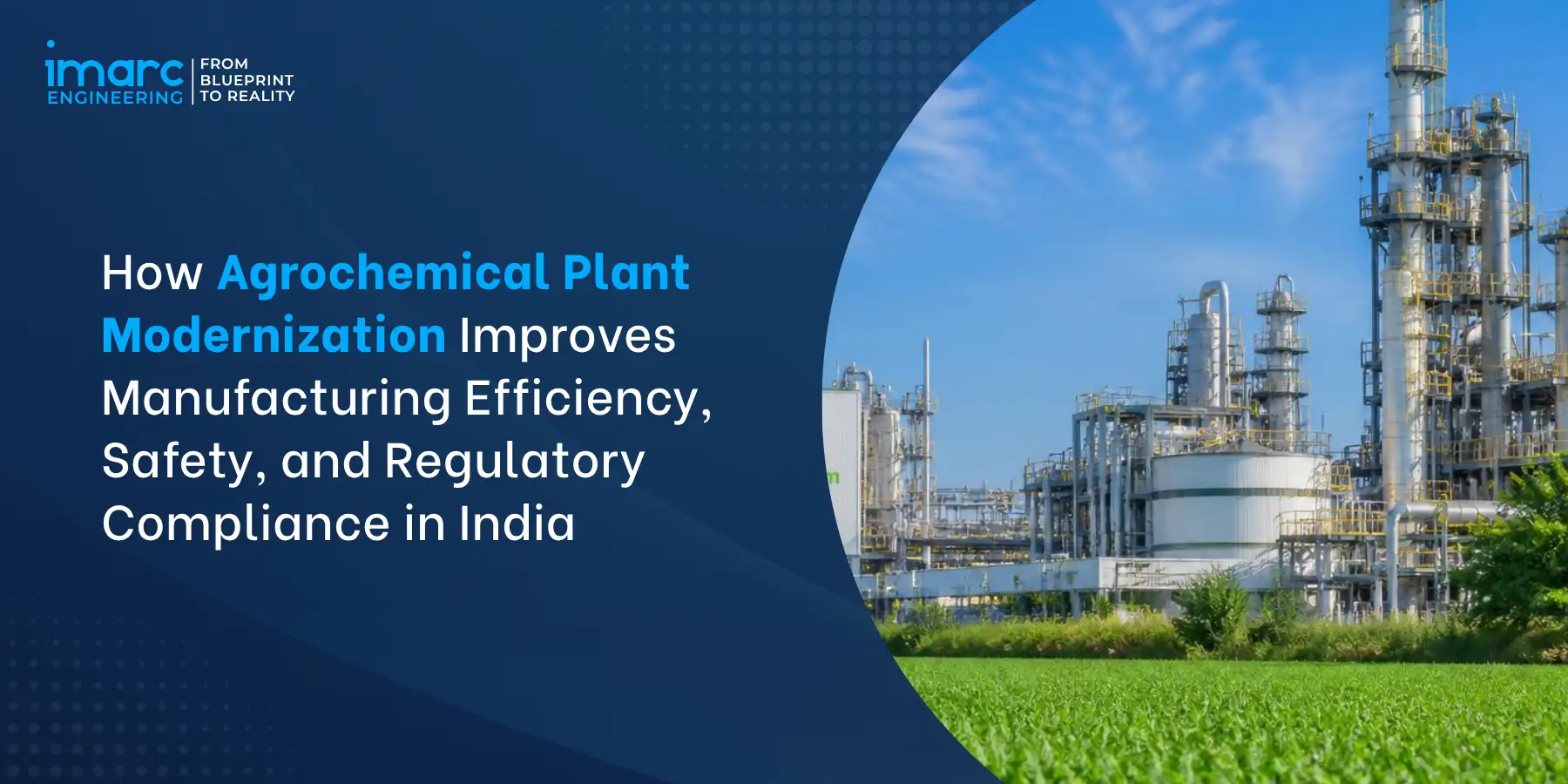
How Agrochemical Plant Modernization Improves Manufacturing Efficiency, Safety, and Regulatory Compliance in India
Introduction
For any Indian agrochemical manufacturer operating existing production assets in 2026, structured agrochemical plant modernization in India involves materially more than replacing aging equipment. Successful transformation requires engineering-led planning across process optimisation, automation, plant layout, utility upgrades, environmental compliance, safety systems, digital monitoring, and production efficiency.
India's expanding regulatory framework, buyer expectations, sustainability requirements, and export market opportunities collectively make disciplined brownfield plant modernization a strategic priority rather than periodic capex exercise.
Scope of this Guide
This guide answers the sponsor's modernisation question directly. How can agrochemical manufacturing consulting improve efficiency, safety, regulatory compliance, and long-term competitiveness while minimising disruption to existing production? It walks through drivers, a phased modernization roadmap, process automation, safety compliance, energy and utility optimisation, environmental compliance, and the practices that separate structured modernisation from ad-hoc capex commitments that fail to deliver expected outcomes.
Table of Contents
- Introduction
- Why Agrochemical Plant Modernization in India Matters in 2026
- Why Modernize Agrochemical Manufacturing Plants in India
- Brownfield Agrochemical Plant Modernization Roadmap in India
- Process Optimization and Automation for Agrochemical Plants in India
- Safety and Regulatory Compliance Upgrades for Agrochemical Plants in India
- Energy Efficiency and Utility Optimization for Agrochemical Plants in India
- Environmental Compliance and Effluent Management for Agrochemical Plants in India
- Common Mistakes and Best Practices
- Conclusion
1. Why Agrochemical Plant Modernization in India Matters in 2026
Four structural drivers make disciplined modernisation a strategic priority for Indian agrochemical manufacturers in 2026.
1.1 Expanding Regulatory Framework
Insecticides Act 1968 with Insecticides Rules 1971 administered by Central Insecticides Board and Registration Committee (CIB&RC) governs product registration and manufacturing. Manufacture, Storage and Import of Hazardous Chemicals Rules 1989 (MSIHC) impose process safety requirements.
Environmental (Protection) Act 1986 and associated pollution control rules progressively tighten. Occupational Safety Health and Working Conditions Code 2020 (in force from 21 November 2025) modernises factory safety framework. Integrated manufacturing safety compliance across these frameworks materially exceeds legacy expectations.
1.2 Enforcement Intensification
State Pollution Control Board enforcement has materially intensified through structured inspections, closure powers, and penalty escalation. Central Pollution Control Board (CPCB) directs sectoral action plans particularly for chemical clusters. Chemical Accidents Rules 1996 require Emergency Preparedness and Response.
Public Liability Insurance Act 1991 imposes financial liability. Legacy facilities face regulatory enforcement risk that modernisation materially reduces. Non-compliance costs including penalties, closures, litigation, and reputational damage typically exceed structured modernisation investment.
1.3 Buyer and Export Market Requirements
Global agrochemical buyers progressively require documented quality systems, safety performance, environmental credentials, and sustainability commitments. FAO/WHO Codex Alimentarius Maximum Residue Limits (MRLs), OECD guidelines, Good Laboratory Practice (GLP) compliance, and Good Manufacturing Practice (GMP) standards shape international engagement. EU MRL harmonisation and destination-country restrictions progressively shape product acceptance. Structured modernisation supports both regulatory compliance and buyer confidence supporting export market access.
1.4 Operating Economics and Competitiveness
Legacy facilities typically operate at materially lower efficiency than modernised counterparts. Energy consumption 20-40 percent higher than best-in-class, water consumption similarly elevated, and downtime materially higher collectively affect competitive position.
Structured modernisation typically delivers 15-30 percent production efficiency improvement, 15-30 percent energy reduction, and 20-40 percent water reduction. Manufacturers combining operating cost improvements with sustainability positioning increasingly outperform sustainability laggards commercially.
2. Why Modernize Agrochemical Manufacturing Plants in India
Understanding the drivers for agrochemical plant modernization helps manufacturers build a clearer business case for investment. Modernization decisions are typically driven by a combination of production efficiency, capacity constraints, process safety, environmental compliance, product quality, automation, and changing market requirements, rather than a single CapEx consideration.
Manufacturers evaluating whether to upgrade an existing facility or develop additional production capacity can also explore IMARC Engineering’s guide to fertilizer manufacturing plant setup in India for broader insights into plant investment, equipment, process planning, and regulatory considerations.
2.1 Modernisation Business Case Drivers
| Driver | Typical Modernisation Impact | Priority |
|---|---|---|
| Production efficiency and capacity | 15-30 percent improvement | Core commercial driver |
| Product quality and yield | 3-8 percent yield improvement | Buyer and margin impact |
| Safety incidents | 40-70 percent reduction | Regulatory and moral imperative |
| Energy consumption | 15-30 percent reduction | Operating cost and sustainability |
| Water consumption | 20-40 percent reduction | Operating cost and compliance |
| Effluent generation | 30-50 percent reduction | Environmental compliance |
| Unplanned downtime | 20-40 percent reduction | Capacity utilisation |
2.2 Brownfield vs Greenfield Economics
Brownfield modernisation typically requires 40-60 percent of equivalent greenfield capex given existing utilities, infrastructure, and approvals. Modernisation avoids land acquisition, initial statutory approvals, workforce recruitment, and market development challenges.
Payback for efficiency-focused interventions typically extends 3-6 years. Safety and environmental compliance interventions typically justify on regulatory and liability grounds rather than pure financial payback. Structured brownfield economics typically outperform greenfield alternatives for capacity expansion at existing locations.
2.3 Manufacturing Efficiency Improvement
Structured manufacturing efficiency improvement through modernisation combines process optimisation, automation, layout improvements, utility upgrades, and predictive maintenance into integrated programmes.
Individual interventions produce incremental benefits; integrated modernisation produces cumulative efficiency gains that structured programmes consistently outperform ad-hoc capex commitments. Integrated modernization typically produces 30-50 percent higher total impact versus disconnected point improvements at equivalent capex investment.
3. Brownfield Agrochemical Plant Modernization Roadmap in India
Brownfield agrochemical plant modernization roadmap sequences assessment, design, and phased execution supporting operational continuity. Brownfield manufacturing projects face different constraints than greenfield including production continuity, spatial limitations, and stakeholder complexity that structured roadmaps address.
3.1 The Structured Modernisation Roadmap
| Stage | Activities | Typical Duration |
|---|---|---|
| Baseline Assessment | Current state audit, gap analysis, benchmarking | 6-10 weeks |
| Modernisation Strategy | Priority definition, business case, phasing | 4-8 weeks |
| Basic Design (FEED) | Process, MEP, automation, safety, environmental | 12-20 weeks |
| Detailed Engineering | Full engineering package for phased execution | 6-12 months |
| Procurement and Construction | Phased execution minimising production disruption | 12-24 months |
| Commissioning and Handover | Startup, performance testing, operator training | 3-6 months |
3.2 Modernisation Capex and Financial Modelling
Agrochemical plant modernization capex and financial modelling supports investment sizing and business case development. Small modernisation programmes (single unit safety upgrade, targeted automation) typically require INR 5-25 crore. Medium modernisation covering process, utility, safety, and automation typically requires INR 25-150 crore.
Large comprehensive plant-wide modernisation typically requires INR 150-600 crore. Investment scales with plant size, existing modernity, target scope, and technology sophistication. Structured business case combining cost savings, capacity benefits, regulatory risk reduction, and market positioning supports informed capex commitment.
3.3 Phased Execution for Operational Continuity
Phased execution minimises production disruption during modernisation. Utility modernisation typically precedes process interventions supporting infrastructure. Non-critical process modernisation during planned shutdowns leverages existing maintenance windows.
Critical process modernisation during extended shutdowns with structured commissioning support production restart. Structured phasing balancing modernisation progress with operational continuity typically extends total programme timeline versus disruptive execution but supports commercial continuity during modernisation.
3.4 Stakeholder Engagement
Modernisation stakeholders extend beyond project team to include operations personnel affected by process changes, EHS teams overseeing safety upgrades, environmental agencies overseeing compliance changes, buyers with quality expectations, and financial stakeholders monitoring capex commitment.
Structured stakeholder engagement including operator training, EHS integration, regulatory pre-consultation, and buyer communication materially improves modernisation outcomes. Change management workstream typically consumes 10-20 percent of programme resource but determines whether technical upgrades achieve intended benefits.
4. Process Optimization and Automation for Agrochemical Plants in India
Process optimization and automation for agrochemical plants typically delivers the largest single modernisation contribution across efficiency, quality, and safety dimensions. Structured manufacturing process optimization combined with industrial automation in manufacturing systematically improves operational performance.
4.1 Process Optimisation Levers
- Continuous processing replacing batch operations where feasible
- Microreactor and flow chemistry technology for specific applications
- Process intensification through better mixing, heat transfer, mass transfer
- Yield optimisation through improved control and monitoring
- Solvent recovery reducing raw material consumption
- Waste heat recovery from reactors and utilities
- Digital twin models supporting design and optimisation
- Predictive maintenance replacing scheduled maintenance
4.2 Automation and Control Systems
Distributed Control Systems (DCS) provide the modern control backbone. Common platforms include Honeywell Experion, Emerson DeltaV, ABB 800xA, Yokogawa Centum VP, and Siemens PCS 7. Programmable Logic Controllers (PLC) support specific applications. Safety Instrumented Systems (SIS) per IEC 61511 provide independent safety functions.
Human-Machine Interfaces (HMI) support operator interaction. Structured DCS implementation typically produces 5-15 percent efficiency benefit beyond legacy pneumatic and single-loop controls while materially improving safety and data availability.
4.3 Digital Monitoring and Industry 4.0
Digital monitoring and Industry 4.0 for agrochemical plants India integrates process data, quality data, energy data, and maintenance data into structured operational intelligence. Manufacturing Execution Systems (MES) coordinate production.
Enterprise Resource Planning (ERP) integrates commercial and operational data. Data historians (OSIsoft PI, AVEVA Wonderware, Aspen) enable trending and analytics. Advanced analytics and machine learning increasingly optimise operations. Structured Industry 4.0 deployment supports both current operations and continuous improvement.
4.4 Batch Process Control and Recipe Management
Batch process control per ISA-88 standards supports recipe-based operations common in agrochemical formulation. Structured recipe management enables product variation without operational chaos. Batch reporting supports both quality traceability and regulatory documentation.
Materials genealogy from raw materials through packaging supports investigation and recall capability. Structured batch control materially outperforms manual batch operations across quality, efficiency, and traceability dimensions.
5. Safety and Regulatory Compliance Upgrades for Agrochemical Plants in India
Safety and regulatory compliance upgrades for agrochemical plants address structured risk reduction and framework compliance simultaneously. Process safety failures produce catastrophic consequences making safety upgrades non-negotiable rather than economically discretionary.
5.1 Process Safety Framework
Structured Process Safety Management (PSM) framework covers process safety information, process hazard analysis, operating procedures, training, contractors, pre-startup safety review, mechanical integrity, hot work permits, management of change, incident investigation, emergency response, and compliance audits. Hazard and Operability (HAZOP) studies identify process hazards.
Layers of Protection Analysis (LOPA) quantifies risk reduction requirements. Safety Integrity Level (SIL) per IEC 61511 defines required protection layer performance. Structured PSM implementation supports both regulatory compliance and operational safety.
5.2 Safety System Modernisation
| System | Standards | Modernisation Focus |
|---|---|---|
| Fire detection and suppression | NFPA 13, NBC 2016 Part 4, TAC | Coverage expansion, response time |
| Gas detection | OISD-118, NFPA 496 | Detector density, integration |
| Safety Instrumented Systems | IEC 61508, IEC 61511 | SIL rating, functional testing |
| Emergency shutdown | API RP 14C, IEC 61511 | Response time, testing frequency |
| Deflagration/explosion protection | NFPA 68, NFPA 69 | Dust and vapour hazards |
| Emergency response infrastructure | MSIHC Rules, Chemical Accidents Rules 1996 | On-site and off-site plans |
5.3 Regulatory Compliance Upgrades
Regulatory compliance upgrades address expanding framework requirements. Petroleum and Explosives Safety Organisation (PESO) approvals for hazardous chemical storage upgrade. Factory License compliance under OSH Code 2020.
CIB&RC product registration maintenance and product portfolio updates. CPCB and SPCB emissions and effluent standards compliance. Continuous Emissions Monitoring Systems (CEMS) integration. Structured regulatory register with defined ownership prevents both compliance gaps and enforcement surprises.
5.4 Occupational Health and Safety
Occupational health and safety upgrades address worker exposure and safety across modernised operations. ISO 45001 Occupational Health and Safety Management Systems provide structured framework. Ergonomic assessment supports worker health. Personal Protective Equipment (PPE) programmes with structured training.
Industrial hygiene monitoring covering air quality, noise, and chemical exposure. Occupational medical surveillance per OSH Code 2020 requirements. Structured OHS integration during modernisation materially outperforms post-commissioning retrofits.
6. Energy Efficiency and Utility Optimization for Agrochemical Plants in India
Energy efficiency and utility optimization for agrochemical plants typically delivers substantial operating cost benefits with attractive payback periods. Utility infrastructure represents 30-45 percent of typical agrochemical plant capex making utility modernisation materially consequential.
6.1 Energy Efficiency Levers
- IE3 and IE4 high-efficiency motors progressively replacing IE1/IE2
- Variable Frequency Drives for variable-load applications
- Steam system optimisation (boiler efficiency, insulation, condensate recovery)
- Compressed air system optimisation (leak reduction, pressure minimisation)
- Chiller and cooling water system upgrades
- Waste heat recovery from reactors and utilities
- LED lighting with occupancy and daylight controls
- Energy Management System per ISO 50001 with structured continuous improvement
6.2 Renewable Energy Integration
Renewable energy integration progressively supports energy cost management. Rooftop solar photovoltaic typically achieves 3-5 year payback for facilities with adequate roof area. Green Open Access Rules 2022 enable commercial renewable procurement for large consumers. Group captive and third-party PPA structures support facilities without adequate on-site potential.
Planned renewable procurement typically supports 20-40 percent renewable coverage for well-planned facilities. Combining efficiency-first with renewable deployment materially outperforms renewable-only approaches.
6.3 Utility Infrastructure Modernisation
Utility infrastructure modernisation supports both efficiency and reliability. Boiler and steam system upgrades including higher efficiency burners, economisers, and blow-down heat recovery. Cooling water system modernisation including cooling tower efficiency, side-stream filtration, and chemical treatment. Chilled water system upgrades including variable speed chillers and thermal storage.
Compressed air system upgrades including centrifugal compressors for base load and variable speed for variable demand. Integrated utility modernisation typically produces 15-30 percent utility cost reduction.
6.4 Water Conservation and Reuse
Water conservation and reuse become progressively important as water availability constraints tighten. Reverse osmosis and demineralisation optimisation. Cooling water blow-down treatment and reuse. Wash water and rinse water reuse. Process condensate recovery.
Rainwater harvesting for utility make-up. Structured water strategy typically supports 20-40 percent water consumption reduction with commensurate effluent generation reduction supporting environmental compliance. Zero Liquid Discharge (ZLD) implementation where regulations require.
7. Environmental Compliance and Effluent Management for Agrochemical Plants in India
Environmental compliance and effluent management for agrochemical plants address progressively stringent regulatory expectations. Agrochemical facilities face materially higher environmental scrutiny than general industrial operations given hazardous chemistry involved.
7.1 Effluent Treatment Modernisation
Effluent treatment plant (ETP) modernisation addresses tightening discharge standards. Primary treatment for solids removal, secondary biological treatment for organic load reduction, and tertiary treatment for polishing form standard multi-stage approach. Membrane bioreactor (MBR) technology increasingly deployed for stringent discharge requirements.
Reverse osmosis for further concentration. Multiple Effect Evaporator (MEE) and Agitated Thin Film Drying (ATFD) for Zero Liquid Discharge (ZLD) implementation. Structured ETP modernisation supports both compliance and water reuse enabling water positive positioning.
7.2 Air Emissions Control
- Bag filters for particulate matter from powder handling
- Wet scrubbers for water-soluble emissions
- Activated carbon adsorption for VOC (Volatile Organic Compounds)
- Regenerative Thermal Oxidiser (RTO) for high-concentration VOC
- Catalytic oxidation for specific applications
- Continuous Emissions Monitoring System (CEMS) per CPCB requirements
- Ambient air quality monitoring around plant boundaries
- Structured stack emissions testing and reporting
7.3 Solid Waste and Hazardous Waste Management
Solid and hazardous waste management under Hazardous and Other Wastes Rules 2016 requires structured discipline. Waste segregation at source, secure temporary storage, structured record keeping, transporter and TSDF (Treatment Storage Disposal Facility) selection through authorised operators, and manifest system compliance collectively support regulatory adherence.
Waste minimisation through process changes, solvent recovery, and material recycling reduces both compliance burden and disposal cost. Structured waste management materially reduces both operating cost and regulatory risk.
7.4 Extended Producer Responsibility and Sustainability
Plastic Waste Management Rules 2016 as amended in 2022 impose Extended Producer Responsibility on packaging producers, importers, and brand owners including agrochemical manufacturers using plastic packaging. CPCB EPR Portal registration is mandatory. Sustainability reporting under SEBI BRSR framework for top 1000 listed companies progressively expands.
Green certifications including LEED, IGBC, and ISO 14001 support both compliance and buyer engagement. Structured sustainability integration during modernisation supports both regulatory compliance and commercial positioning.
8. Common Mistakes and Best Practices
8.1 Ad-Hoc Point Solutions Rather Than Integrated Programme
Individual equipment upgrades without integrated planning produce suboptimal results and stranded investments.
Best practice: comprehensive baseline assessment identifying full modernisation opportunity; integrated business case combining multiple lever benefits; structured programme sequencing supporting synergy capture; phased execution minimising disruption; documented programme governance with defined milestones.
8.2 Under-Investment in Baseline Assessment
Modernisation designed on unclear baseline understanding produces both surprises and suboptimal outcomes.
Best practice: structured baseline audit covering process, utilities, safety, environmental, and control systems; benchmarking against industry best practice; gap analysis identifying specific improvement opportunities; capex sizing with defined engineering basis; sensitivity analysis on key assumptions.
8.3 Weak Safety Integration
Safety upgrades treated as separate track from operational modernisation produce both stranded investment and compliance gaps.
Best practice: integrated safety-operations design during basic engineering; HAZOP and LOPA during design phase; SIS design integrated with control system upgrades; emergency response integrated with modernised operations; safety culture change management alongside technology deployment.
8.4 Insufficient Change Management
Technology deployments without organisational change management routinely fail to deliver intended benefits.
Best practice: change management workstream from programme inception; operator engagement early in design decisions; role-specific training with hands-on practice; performance metrics aligned with modernisation objectives; recognition programmes reinforcing new behaviours; sustained management attention through implementation and stabilisation.
8.5 Weak Vendor and Contractor Selection
Vendor and contractor selection driven by lowest bid rather than best-fit produces both quality and schedule challenges.
Best practice: structured vendor evaluation with defined criteria covering technical capability, project management maturity, financial strength, references, and cultural fit; balanced contracts preventing lowest-bid races; performance guarantees with defined KPIs; structured contract administration during execution; retention structure supporting completion discipline.
Conclusion
Structured agrochemical plant modernization in India in 2026 combines process optimisation, automation and digital monitoring, safety and regulatory compliance upgrades, energy and utility optimisation, environmental compliance and effluent management, and disciplined change management into coherent transformation programmes. India's expanding regulatory framework, enforcement intensification, buyer expectations, and operating cost economics collectively make disciplined modernisation a strategic capability rather than periodic capex exercise.
Successful agrochemical plant modernisation depends on integrated planning, thorough baseline assessment before investment, and early integration of safety and environmental engineering to maximise efficiency, compliance, and long-term performance.
PLANNING YOUR AGROCHEMICAL PLANT MODERNIZATION?
IMARC Engineering's agrochemical plant modernization and brownfield manufacturing advisory team supports plant sponsors, operations heads, and EHS leaders across baseline assessment and current-state audit, gap analysis and benchmarking, modernisation strategy development with structured business case, Basic Design (FEED) integrated across process, MEP, safety, and environmental, detailed engineering, HAZOP and LOPA studies, Safety Instrumented Systems design per IEC 61511, energy efficiency and renewable integration, ISO 45001, 14001, and 50001 deployment, regulatory approvals coordination including PESO, CIB&RC, SPCB, and Factory License compliance, EPC or EPCM contractor evaluation, construction supervision, commissioning coordination, and structured change management for agrochemical facilities across sectors in India.
→ Schedule a free agrochemical plant modernisation scoping consultation with an IMARC specialist
Frequently Asked Questions
Structured agrochemical plant upgrade addresses expanding regulatory framework, enforcement intensification, buyer and export market requirements, and operating economics simultaneously. Legacy facilities typically operate at materially lower efficiency than modernised counterparts with elevated energy and water consumption, higher downtime, and progressive compliance risk. Structured modernisation delivers cumulative benefits across efficiency, safety, and commercial dimensions.
Structured modernisation typically delivers 15-30 percent production efficiency improvement, 3-8 percent yield improvement, 40-70 percent safety incident reduction over 2-3 year post-implementation periods, 15-30 percent energy reduction, 20-40 percent water reduction, 30-50 percent effluent generation reduction, and 20-40 percent unplanned downtime reduction. Benefits accumulate over multi-year programme horizons supporting sustained commercial performance.
Manufacturing efficiency improvement through modernisation combines process optimisation, automation and digital monitoring, layout improvements, utility upgrades, and predictive maintenance. Continuous processing replacing batch operations where feasible, DCS deployment supporting consistent control, Industry 4.0 analytics identifying optimisation opportunities, and structured maintenance discipline collectively produce cumulative efficiency gains materially outperforming individual interventions.
Modernisation supports manufacturing safety compliance through Process Safety Management framework, HAZOP and LOPA studies, Safety Instrumented Systems per IEC 61511, updated fire and gas detection, and emergency response infrastructure. Regulatory compliance upgrades address expanding framework including OSH Code 2020, PESO approvals, CPCB emissions standards, and CIB&RC product registration. Structured integration typically reduces safety incidents 40-70 percent.
Common technologies include Distributed Control Systems (Honeywell Experion, Emerson DeltaV, ABB 800xA, Yokogawa Centum VP, Siemens PCS 7), Manufacturing Execution Systems, Safety Instrumented Systems per IEC 61511, continuous processing and microreactors, effluent treatment including Membrane Bioreactor and Zero Liquid Discharge, air emissions control including Regenerative Thermal Oxidiser and scrubbers, Energy Management Systems per ISO 50001, and Industry 4.0 platforms integrating operational data.
Key considerations include comprehensive baseline assessment establishing current-state understanding, integrated multi-dimensional programme design combining process, safety, environmental, and digital dimensions, phased execution supporting operational continuity during modernisation, structured safety integration through HAZOP and LOPA studies during design, environmental engineering integration, and change management proportional to technology deployment. Structured engineering integration outperforms sequential planning.
Brownfield plant modernization typically requires 40-60 percent of equivalent greenfield capex given existing utilities, infrastructure, statutory approvals, workforce, and market position. Modernisation avoids land acquisition, initial approvals, workforce recruitment, and market development. Payback for efficiency-focused interventions typically extends 3-6 years. Safety and environmental compliance interventions justify on regulatory and liability grounds rather than pure financial payback.
Engineering consultants providing agrochemical manufacturing consulting support baseline assessment, modernisation strategy development, Basic Design (FEED), detailed engineering, HAZOP and LOPA facilitation, regulatory approvals coordination, EPC or EPCM contractor evaluation, construction supervision, commissioning coordination, and structured change management. Advisory bridges internal capability gaps supporting complex multi-dimensional programmes.
Total modernisation timeline typically extends 24-42 months from baseline assessment to commissioning. Baseline assessment 6-10 weeks. Modernisation strategy 4-8 weeks. Basic Design (FEED) 12-20 weeks. Detailed engineering 6-12 months. Procurement and construction 12-24 months with phased execution. Commissioning 3-6 months. Structured parallel execution across workstreams and phased brownfield delivery balancing modernisation with production continuity typically extends elapsed time versus greenfield execution.
Recent Post


Trusted by Industry Leaders
We partner with global enterprises and ambitious businesses across sectors to deliver operational excellence, strategic insights, and sustainable growth through integrated solutions.








Success in Their Words
Real feedback from clients across industries. Discover how our solutions delivered measurable impact and operational excellence.

I wanted to express my sincere appreciation for your efforts in handling this matter. Your dedication and commitment have been truly commendable, and it is evident that you have put in tremendous hard work and expertise into resolving the issues at hand. We are greatly interested in continuing our collaboration with you in the future, as your professionalism and reliability have made you a trusted partner. Thank you once again for your invaluable contribution. We look forward to strengthening our partnership ahead.

It has been a pleasure working with the IMARC team. The insights provided were structured, clear, and highly valuable, helping us strengthen both our technical and financial planning with confidence. We deeply appreciate the team’s professionalism, responsiveness, and attention to detail throughout the engagement. Every requirement was well understood and effectively incorporated, resulting in a comprehensive and actionable output. Overall, our experience has been excellent, and I would gladly recommend IMARC to organizations seeking a reliable research partner.

Your service is truly exceptional. Working with the IMARC team has been a seamless and professional experience. The clarity of communication, responsiveness to queries, and consistent support at every stage made the entire engagement highly efficient. The insights shared were well-structured, practical, and perfectly aligned with our requirements, helping us make informed decisions with confidence. Overall, the dedication and professionalism demonstrated by your team stand out, and I would be glad to recommend IMARC as a reliable and trustworthy research partner.

IMARC did an outstanding job in preparing our study. They were punctual, precise, and consistently responsive throughout the entire process. The team delivered all the data we required in a clear, well-organized, and highly professional format. Their strong attention to detail, combined with their ability to meet every deadline without compromising quality, truly set them apart. Overall, their reliability and commitment made them an exceptional partner for our project, and we would gladly work with them again in the future.

IMARC made the whole process incredibly easy from start to finish. Everyone I interacted with via email was polite, professional, and straightforward to deal with, always keeping their promises regarding delivery timelines and remaining consistently solutions-focused. From my very first contact, I appreciated the professionalism and support shown by the entire IMARC team. I highly recommend IMARC to anyone seeking timely, affordable, and reliable information or advice. My experience with IMARC was excellent, and I truly cannot fault any aspect of it.

I’d like to express my sincere gratitude for the excellent work you accomplished with the study. Your ability to quickly understand our requirements and deliver high-quality results under tight timelines truly reflects your expertise, exceptional work ethic, and unwavering commitment to your customer’s success. The professionalism and responsiveness you demonstrated throughout the process made a significant difference. Our entire team and company are incredibly thankful for your dedication, reliability, and support. Once again, thank you for your outstanding contribution.