Manufacturing
July 31 2026
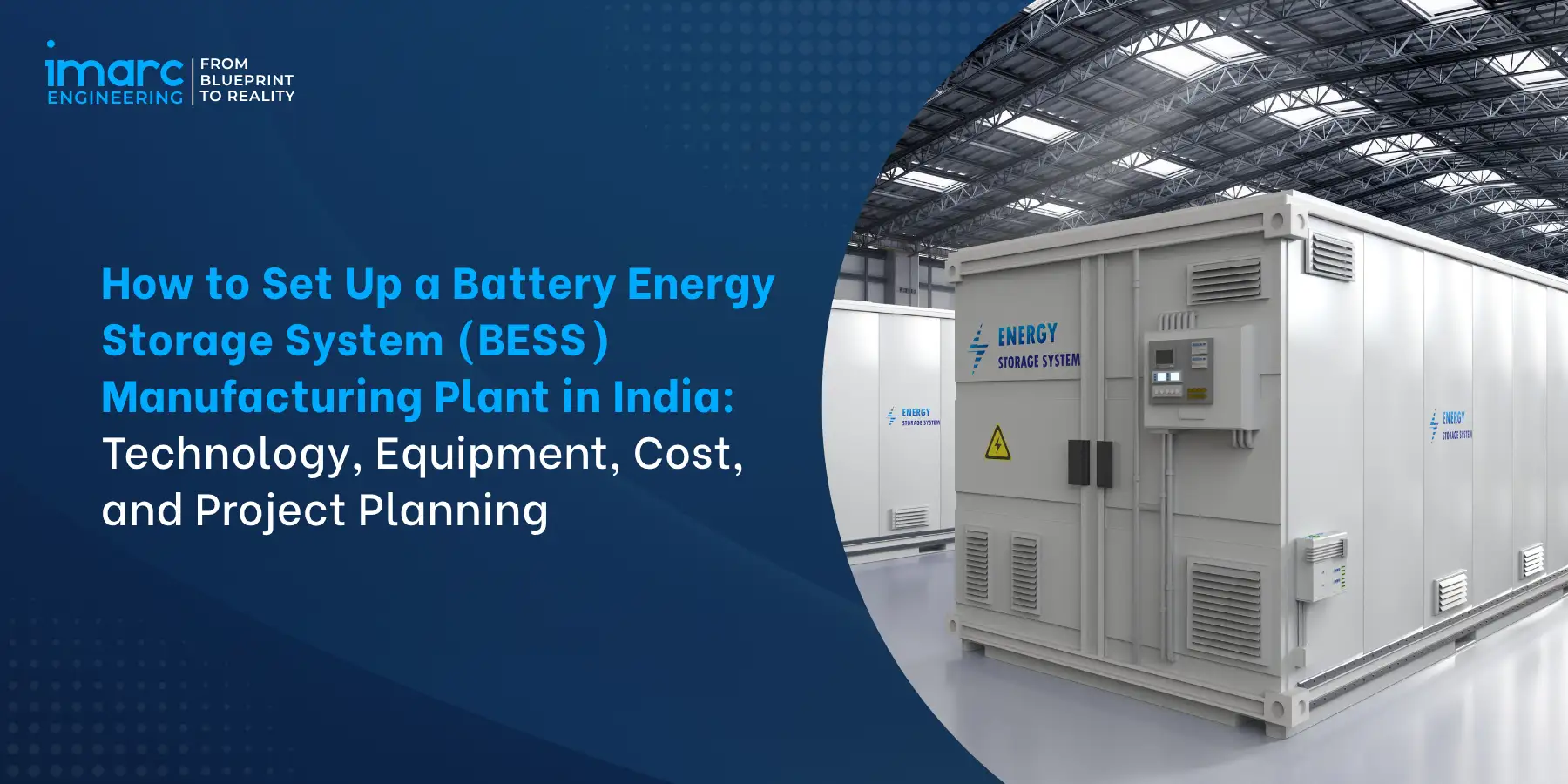
How to Set Up a Battery Energy Storage System (BESS) Manufacturing Plant in India: Technology, Equipment, Cost, and Project Planning
Introduction
For investors and manufacturers entering India's expanding energy storage value chain in 2026, developing a Battery Energy Storage System (BESS) manufacturing plant in India requires disciplined evaluation of product strategy, technology selection, manufacturing capacity, equipment planning, regulatory requirements, and system integration capabilities.
BESS manufacturing in the Indian context typically focuses on battery module and pack assembly, integration with Battery Management System (BMS), Power Conversion System (PCS), and Energy Management System (EMS) subsystems, thermal management, fire protection, enclosure or container integration, and system-level testing rather than cell manufacturing.
Scope of this Guide
This guide answers the sponsor's project question directly. How can investors plan and establish a facility by selecting the right technology, production equipment, infrastructure, capacity, and project development strategy? It walks through market opportunity, setup roadmap, product strategy and technology selection, capacity and site decisions, module pack and rack assembly process, equipment planning, regulatory framework, and the practices separating BESS plant design from ad-hoc developments that consistently fail commercial or operational expectations.
Table of Contents
- Introduction
- Why BESS Manufacturing Matters in India
- How to Set Up a BESS Manufacturing Plant in India
- BESS Product Strategy and Technology Selection in India
- Capacity Planning and Site Selection for BESS Manufacturing in India
- BESS Module Pack and Rack Assembly Process in India
- BESS Manufacturing Equipment and Production Line Design in India
- Regulatory Approvals and Safety Compliance for BESS Manufacturing in India
- Common Mistakes and Best Practices
- Conclusion
1. Why BESS Manufacturing Matters in India
Four structural drivers make BESS manufacturing a strategic opportunity for Indian investors in 2026.
1.1 Grid-Scale Energy Storage Deployment
India's renewable capacity addition combined with 24x7 electricity commitments progressively requires substantial energy storage deployment. Ministry of Power framework including Energy Storage Obligation (ESO) mechanism supports demand development. Central Electricity Regulatory Commission (CERC) storage regulations governing tariff and grid integration.
Solar Energy Corporation of India (SECI) tenders for solar-BESS hybrid projects producing baseline deployment. NITI Aayog projections indicate cumulative deployment potential of 40-60 GWh by 2030 supporting sustained manufacturing demand across grid-scale, distribution, and behind-the-meter applications.
1.2 Localisation Policy and PLI Support
The Production Linked Incentive (PLI) Scheme for Advanced Chemistry Cell (ACC) Battery Storage, with an INR 18,100 crore outlay and a targeted manufacturing capacity of 50 GWh, is intended to strengthen domestic cell manufacturing. As domestic ACC capacity develops, downstream BESS manufacturers may benefit from greater localisation opportunities and a more diversified cell supply ecosystem.
State-level incentives across Gujarat, Karnataka, Tamil Nadu, and Maharashtra supplement central support. Localisation policy supports domestic manufacturing economics that import-dependent models cannot achieve.
1.3 Industrial and Commercial Demand
Commercial and industrial (C&I) energy storage demand progressively expands across data centres, manufacturing operations, telecom infrastructure, and commercial buildings. Behind-the-meter BESS supporting peak shaving, demand charge management, and backup power.
Distribution utility deployment for grid stability and renewable integration. Microgrid applications in remote industrial locations. Battery Energy Storage System Manufacturing Serving multiple demand segments can help manufacturers diversify their customer base and reduce dependence on a single application or buyer category.
1.4 Import Substitution and Strategic Autonomy
Historical BESS system dependence on imports particularly from China, Korea, and other markets creates supply chain vulnerabilities. Geopolitical considerations, currency exposure, and shipping delays affect deployment economics. Domestic manufacturing supporting strategic autonomy in energy infrastructure.
Progressive backward integration from module assembly to component manufacturing supporting deeper value chain participation. Domestic manufacturing capability materially supports both commercial economics and strategic considerations that import dependence cannot achieve.
2. How to Set Up a BESS Manufacturing Plant in India
Understanding how to set up a BESS manufacturing plant in India helps sponsors sequence decisions correctly. BESS manufacturing process development integrates market assessment, product strategy, feasibility, technology selection, engineering, approvals, construction, and commissioning into coherent project execution.
2.1 The Structured Setup Roadmap
| Stage | Activities | Typical Duration |
|---|---|---|
| Market and Product Strategy | Application segmentation, product definition, competitive analysis | 3-6 months |
| Feasibility and DPR | Techno-commercial evaluation, financial modelling | 3-6 months |
| Technology and Partner Selection | Cell sourcing, BMS/PCS/EMS partnerships | 4-8 months (parallel) |
| Site Selection and Approvals | Land, environmental clearance, PESO, CEA | 6-12 months |
| Detailed Engineering | Process design, plant layout, equipment specs | 4-8 months |
| Procurement and Construction | Equipment sourcing, civil works, installation | 10-18 months |
| Commissioning and Ramp-Up | Line qualification, testing, product certification | 4-8 months |
2.2 Capex Opex and Financial Modelling for BESS Manufacturing in India
CAPEX, OPEX and financial modelling for BESS manufacturing in India vary significantly with manufacturing scope, target capacity, automation level, testing infrastructure, localisation strategy, and the degree of system integration. As indicative planning ranges, small assembly facilities (100–500 MWh per year) may require approximately INR 20–100 crore, while medium integration facilities (500 MWh to 2 GWh per year) may require approximately INR 100–500 crore.
Large integrated facilities (2–5 GWh per year) may require INR 500–2,000 crore, while giga-scale projects that include battery cell manufacturing can require substantially higher investment. These ranges should be treated as preliminary estimates, as actual project costs depend on plant configuration, equipment specifications, land and building requirements, testing capabilities, utilities, and localisation.
Key OPEX drivers include battery cells and components, skilled manpower, electricity for production and testing, HVAC and environmental controls, equipment maintenance, quality assurance, certification and testing, logistics, warranty provisions, and working capital. Financial modelling should evaluate these costs alongside capacity utilisation, product mix, localisation, inventory cycles, and expected selling prices to determine project feasibility.
2.3 Manufacturing Model Selection
Manufacturing model selection materially affects both capex and operational complexity. Module and pack assembly from imported cells offering lowest capital intensity and fastest market entry. Integrated module, pack, and system integration adding electrical integration, BMS, PCS, and EMS scope. Container fabrication and system-level integration for grid-scale applications.
Full cell manufacturing plus downstream integration for strategic long-term positioning. Model selection matched to promoter capability, capital availability, and strategic ambition typically outperforms attempted full vertical integration for new entrants.
3. BESS Product Strategy and Technology Selection in India
BESS product strategy and technology selection in India establish the commercial foundation determining which market segments the facility will serve. Product decisions during feasibility stage affect downstream engineering, equipment, and capital decisions.
3.1 Application Segmentation
- Utility-scale storage supporting grid stability, ancillary services, and renewable integration
- Solar-plus-storage hybrid for SECI and State tenders
- Commercial and industrial (C&I) storage for peak shaving and demand management
- Data centre backup and uninterruptible power supply applications
- Telecom tower backup storage
- Behind-the-meter residential and small commercial storage
- Microgrid applications for remote industrial locations
- Electric vehicle charging infrastructure buffer storage
3.2 Battery Chemistry Selection
Battery chemistry selection depends on application requirements. Lithium Iron Phosphate (LFP) dominates stationary storage applications offering thermal safety, long cycle life above 4,000-6,000 cycles, and cost efficiency. Nickel Manganese Cobalt (NMC) offering higher energy density suits space-constrained applications.
Lithium Titanate (LTO) offering extreme cycle life above 15,000 cycles suits high-throughput applications. Sodium-ion emerging as cost-competitive alternative for stationary applications. Vanadium redox flow batteries suiting very long duration storage. Chemistry selection matched to application supports both commercial and technical fit.
3.3 System Architecture Components
BESS product architecture integrates multiple subsystems. Battery modules containing cells with primary electrical, thermal, and mechanical integration. Packs combining modules with pack-level Battery Management System (BMS) monitoring and control.
Racks combining packs for capacity aggregation. Power Conversion System (PCS) interfacing DC battery output with AC grid or load. Energy Management System (EMS) providing system-level control and grid integration. Thermal management, fire suppression, enclosure, and switchgear completing system integration.
3.4 Localisation Strategy
Localisation strategy affects both cost economics and strategic positioning. Cell import strategy suits early-stage market entry with lower capital intensity. Cell qualification for domestic sourcing progressively supporting supply chain resilience. BMS and control system localisation supporting India-specific grid conditions and network integration. Container and enclosure localisation supporting logistics economics. Phased localisation typically outperforms attempted immediate full localisation particularly for new entrants navigating technology, supply chain, and commercial complexity simultaneously.
4. Capacity Planning and Site Selection for BESS Manufacturing in India
Capacity planning and site selection for BESS manufacturing in India establish structural commercial parameters. Poor capacity or site decisions typically produce irreversible commercial disadvantages that planning during feasibility prevents.
4.1 Capacity Ranges and Selection
| Category | Annual Capacity | Typical Scope |
|---|---|---|
| Small assembly | 100-500 MWh per year | Module and pack from imported cells |
| Medium integration | 500 MWh - 2 GWh per year | Pack plus system-level integration |
| Large integrated | 2-5 GWh per year | Full BESS with container fabrication |
| Giga-scale | 5-plus GWh per year | Includes cell manufacturing |
4.2 Capacity Determination Factors
Capacity selection considers addressable market demand within economic distribution radius, capital availability supporting appropriate investment tier, technology and operational complexity matched to promoter capability, cell sourcing certainty supporting sustained production, and progressive scaling opportunities enabling phased investment. Under-sized capacity produces scale disadvantages and market credibility limitations. Over-sized capacity produces persistent underutilisation with disproportionate fixed cost burden. Phased capacity development starting with module and pack assembly then progressively adding system integration and cell manufacturing typically supports sustainable scaling.
4.3 Site Selection Criteria
-
Industrial estate or manufacturing zone status supporting regulatory clarity
- Power infrastructure supporting testing loads at grid-scale capacity
- Skilled workforce availability across electrical, electronics, and mechanical disciplines
- Logistics connectivity for cell inbound and finished system outbound
- Water availability for thermal management systems testing
- Environmental clearance feasibility given siting characteristics
- Fire safety infrastructure and emergency response capability
- Local regulatory environment across State and municipal authorities
- PLI ACC scheme location incentives where applicable
4.4 Infrastructure Utilities and Safety Systems for BESS Plants in India
Infrastructure, utilities, and safety requirements for BESS manufacturing plants vary with facility capacity, production scope, automation level, and testing intensity. Electrical infrastructure should be sized based on production equipment, battery cycling and testing systems, environmental chambers, HVAC, and other connected loads. Uninterruptible power supply may be required for critical operations and control systems.
Other utility requirements may include chilled water for testing and thermal-management systems, compressed air for pneumatic equipment and assembly tooling, and controlled HVAC for temperature- and humidity-sensitive operations. Fire detection, suppression, segregation, ventilation, and emergency response systems should be designed specifically for lithium-ion battery hazards based on project-specific risk assessment and applicable safety requirements. Infrastructure planning should also provide reasonable capacity for future production expansion.
5. BESS Module Pack and Rack Assembly Process in India
BESS module pack and rack assembly process represents the core value-add of Indian BESS manufacturing. Structured battery module and pack assembly combines electrical, mechanical, and thermal integration across sequential production stages.
5.1 Module Assembly Stages
| Stage | Function |
|---|---|
| Cell incoming inspection | Visual, dimensional, and electrical parameter verification |
| Cell grading and sorting | Voltage, capacity, and internal resistance matching |
| Cell arrangement | Configuration per module design (series and parallel) |
| Electrical interconnection | Laser welding, ultrasonic welding, or wire bonding |
| Sensing wiring | Voltage and temperature sensor installation for BMS |
| Mechanical assembly | Cell holders, structural framing, potting where applicable |
| Module-level testing | Insulation resistance, capacity verification |
| Labelling and traceability | Serial number, chemistry, and manufacturing data |
5.2 Pack Assembly and BMS Integration
Pack assembly combines multiple modules with pack-level electronics. Module electrical and mechanical integration producing pack assemblies. BMS hardware installation covering monitoring, protection, and communication functions. BMS firmware loading and calibration per battery chemistry and application. Thermal management integration covering cooling plates, liquid cooling, or forced air.
Fire suppression integration at pack level where design requires. Pack-level electrical testing covering insulation resistance, hi-pot, communication, and BMS function verification. Structured discipline preventing subsequent field failures outperforms rushed pack assembly.
5.3 Rack Assembly and System Integration
Rack assembly combines multiple packs supporting capacity aggregation. Rack structural assembly with electrical bussing between packs. Rack-level BMS master integration with pack-level slave BMS units. Rack switchgear installation including contactors, fuses, and disconnects.
Rack-level cooling distribution. Rack testing covering full-charge and discharge cycles verifying capacity and BMS coordination. Structured rack assembly supporting downstream container or enclosure integration typically distinguishes systematic manufacturers from those experiencing field integration challenges.
5.4 Enclosure and Container Integration
Grid-scale BESS typically requires enclosure or BESS container manufacturing integration. Standard 20-foot or 40-foot ISO container adaptation supporting 2-5 MWh per container typical. Purpose-built cabinet enclosures for smaller applications.
Thermal management HVAC or liquid cooling integration. Fire detection and suppression per NFPA 855 principles. Electrical integration including PCS interface, switchgear, and auxiliary systems. Structured container integration typically distinguishes grid-scale-ready manufacturers from those limited to pack-level supply.
6. BESS Manufacturing Equipment and Production Line Design in India
BESS manufacturing equipment and production line design translate process design into operational infrastructure. Structured equipment selection matched to capacity, product mix, and quality targets outperforms generic equipment procurement.
6.1 Core Manufacturing Equipment
- Automated cell testing and grading stations with sorter integration
- Laser welding systems for cell-to-busbar interconnection
- Wire bonding equipment for cell tab connection
- Ultrasonic welding stations for busbar and terminal assembly
- Automated assembly conveyors with workstation layout
- Torque-controlled fastening tools with data logging
- BMS programming and calibration stations
- Cell and module cyclers for capacity verification
- Insulation resistance and hi-pot testers
- Automated storage and retrieval systems (AS/RS) for WIP
- Manufacturing Execution System (MES) integration
- Product Lifecycle Management (PLM) integration
6.2 Testing and Validation Equipment
- Environmental chambers for temperature and humidity testing
- Thermal shock chambers for thermal cycling tests
- Vibration and shock test benches per UN 38.3 requirements
- EMC and EMI test facilities
- Fire propagation testing capability per UL 9540A
- Grid-scale PCS test benches supporting rated capacity
- HVAC and liquid cooling test rigs
- System-level Factory Acceptance Test (FAT) stations
6.3 Production Line Layout Principles
Production line layout supports material flow efficiency, quality, and safety. Linear flow from cell receiving through progressive assembly to system integration and testing. Segregated raw material and finished product zones with strict inventory management. Electrostatic Discharge (ESD) controlled zones for electronics assembly.
Clean room environments for BMS assembly where product requirements demand. Emergency response paths and fire barriers between high-energy zones. Fire-critical operations separated from process areas with buffer distance. Layout during design phase outperforms retrofit modifications during operations.
6.4 Automation and Digital Manufacturing
Automation intensity typically scales with capacity and product mix. Manual assembly suits low-volume high-mix operations. Semi-automated assembly with operator-assisted stations suits medium volumes. Fully automated production lines suit high-volume standardised products.
Digital manufacturing integration including Manufacturing Execution System (MES), Product Lifecycle Management (PLM), and Industrial Internet of Things (IIoT) supports real-time monitoring, traceability, and quality analytics. Digital manufacturing typically distinguishes progressive manufacturers from those relying on paper-based systems that scale poorly.
7. Regulatory Approvals and Safety Compliance for BESS Manufacturing in India
Regulatory approvals and safety compliance for BESS manufacturing provide the framework within which manufacturing must operate. Compliance planning during feasibility stage prevents project delays and post-approval design changes.
7.1 Required Approvals
| Approval | Authority | Trigger |
|---|---|---|
| Environmental Clearance | MoEFCC or SEIAA per EIA 2006 | Category A or B project scale |
| Consent to Establish | State Pollution Control Board | Pre-construction |
| Consent to Operate | State Pollution Control Board | Pre-commissioning |
| Factory Licence | State Directorate of Factories | Under OSH Code 2020 |
| Fire NOC | State Fire Services | Per NBC 2016 Part 4 |
| PESO Licence | PESO under Explosives Act 1884 | For hazardous material storage |
| Electrical Approval | State Electrical Inspectorate | Under CEA Regulations |
| Battery EPR Registration | CPCB Battery EPR Portal | Under Battery Waste Rules 2022 |
7.2 Product Safety Standards
Product compliance covers international standards adapted for Indian conditions. IEC 62933 series covers electrical energy storage systems including IEC 62933-1 (terminology), IEC 62933-2-1 (unit parameters), and IEC 62933-5-2 (safety of grid-integrated systems). Underwriters Laboratories UL 9540 covers energy storage systems and equipment. UL 9540A covers test methodology for evaluating thermal runaway propagation. UL 1973 covers batteries for stationary applications. UL 1741 covers inverters and converters. NFPA 855 covers installation standards. Compliance across international and Indian standards supports both domestic and export market engagement.
7.3 Grid Connection and Cybersecurity
Grid connection compliance covers Central Electricity Authority (CEA) Grid Connectivity Regulations 2019 with technical standards for connectivity. IEEE 1547 international standard for interconnection. IEEE 2030 for smart grid interoperability. Cybersecurity compliance covers CEA Cyber Security in Power Sector Guidelines 2021 for grid-connected systems. IEC 62443 international standard for industrial cybersecurity. Cybersecurity integration during design phase outperforms retrofit approaches particularly for utility-scale deployments requiring attestation.
7.4 Transportation and Handling
Lithium-ion cell and battery transportation requires appropriate classification, packaging, labelling, documentation, and handling based on the shipment configuration and mode of transport. UN 38.3 testing is an important requirement for lithium batteries entering transport, while the applicable UN classification depends on whether batteries are shipped independently, packed with equipment, or contained within equipment.
For road transportation in India, applicable transport and hazardous-goods requirements should be evaluated based on the materials and shipment configuration involved. Structured transportation planning helps improve safety and compliance across inbound cell shipments and outbound BESS products.
8. Common Mistakes and Best Practices
8.1 Under-Investment in Testing Infrastructure
Facilities constructed without adequate testing infrastructure face product quality issues, certification delays, and buyer credibility challenges.
Best practice: testing infrastructure sized for target product certification requirements; environmental chambers, thermal shock, vibration test facilities per UN 38.3; UL 9540A fire propagation testing capability or partner arrangements; grid-scale PCS test benches supporting system-level validation; system Factory Acceptance Test stations supporting customer witness testing.
8.2 Cell Sourcing Strategy Gaps
Battery cells can represent a significant share of BESS material costs, making an inadequate sourcing strategy a major cost, quality, and supply-chain risk.
Best practice: develop a multi-source cell strategy across qualified suppliers and geographies; establish long-term sourcing arrangements with appropriate volume, pricing, quality, delivery, and supply-continuity provisions; qualify domestic cell suppliers as Indian manufacturing capacity develops; maintain appropriate strategic inventory for supply-chain resilience; and use suitable commercial mechanisms to manage cell price volatility.
8.3 Inadequate Fire Safety Infrastructure
Standard fire safety infrastructure inadequate for lithium-ion hazards produces material incident exposure.
Best practice: conduct a project-specific fire and thermal-runaway risk assessment; provide appropriate detection, suppression, ventilation, segregation, emergency isolation, and response systems; use relevant propagation testing and product safety data to inform facility design; and involve fire authorities, insurers, and specialist engineers during the design stage.
8.4 Product Certification Timeline Under-Estimation
Product certification timelines routinely exceed initial estimates producing commercial launch delays.
Best practice: certification planning during feasibility with realistic timelines; parallel certification workstreams across UL, IEC, and BIS frameworks; testing partner engagement early including third-party laboratories; pilot production supporting certification samples; certification project management preventing sequential delays undermining commercial launch.
8.5 Weak Systems Integration Capability
Manufacturers focused solely on module or pack production without system integration capability face limited addressable market.
Best practice: progressive integration capability development across pack, rack, container, and system levels; BMS, PCS, and EMS partnership development supporting integrated solutions; grid-scale project engagement supporting field learning; customer solution capability distinguishing systematic integrators from component suppliers; strategic technology partnerships accelerating integration capability development.
Conclusion
BESS manufacturing combines market assessment, product strategy, technology selection, capacity planning, engineering, regulatory approvals, testing infrastructure, and system integration. Growing grid-scale storage demand, PLI ACC support, and energy transition goals make BESS manufacturing a strategic investment opportunity.
Successful projects depend on investing early in testing infrastructure, adopting lithium-ion-specific fire safety standards, and building system integration capabilities beyond component assembly.
PLANNING YOUR BESS MANUFACTURING PLANT?
IMARC Engineering's BESS manufacturing plant and project development advisory team supports investors, sponsors, and energy storage entrepreneurs across market opportunity assessment covering utility-scale, C&I, and behind-the-meter segments, product strategy and technology selection across LFP, NMC, LTO, and emerging sodium-ion chemistries, feasibility studies and Detailed Project Report (DPR) preparation, capacity planning matched to market demand and PLI ACC scheme alignment, site selection support, cell sourcing strategy across imported and domestic supply, detailed engineering including process design and plant layout, equipment specification covering laser welding, wire bonding, cell cyclers, environmental chambers, thermal shock chambers, vibration test benches, EMC facilities, capex and opex financial modelling, offtake relationship development, and project governance for BESS manufacturing plant development across India.
→ Schedule a free BESS manufacturing plant scoping consultation with an IMARC specialist
Frequently Asked Questions
BESS plant development typically includes market strategy, feasibility and DPR, technology selection, site selection and approvals, detailed engineering, procurement and construction, and commissioning. Depending on project scope, facilities generally take 24-42 months to progress from feasibility to stable commercial production.
Indian BESS facilities primarily manufacture battery modules, packs, racks, BMS-integrated systems, PCS and EMS assemblies, thermal management systems, fire protection solutions, and complete battery containers. Most plants assemble imported or domestic cells rather than manufacture battery cells, which requires significantly higher investment.
BESS manufacturing uses battery chemistries such as LFP, NMC, LTO, sodium-ion, and vanadium redox flow, supported by Battery Management Systems (BMS), Power Conversion Systems (PCS), Energy Management Systems (EMS), thermal management, and fire protection. Technology selection depends on the intended application and performance requirements.
Core equipment includes cell testing systems, laser and ultrasonic welding machines, assembly lines, BMS programming stations, battery cyclers, electrical safety testers, environmental chambers, vibration testing equipment, fire testing facilities, and Manufacturing Execution Systems (MES). Equipment selection depends on plant capacity and product range.
Project costs vary with capacity and scope. Assembly facilities typically require INR 20-500 crore, while large integrated plants need INR 500-2,000 crore. Giga-scale facilities with cell manufacturing may exceed INR 3,000 crore, with battery cells accounting for most material costs.
BESS plants require reliable electrical infrastructure, UPS systems, chilled water, compressed air, HVAC with temperature and humidity control, ESD-protected assembly areas, and fire protection systems designed for lithium battery hazards. Proper infrastructure supports safe operations, product quality, and future capacity expansion.
Key approvals include Environmental Clearance (where applicable), SPCB Consent to Establish and Operate, Factory Licence, Fire NOC, Electrical Approval, PESO licence where required, and Battery EPR registration. Product compliance commonly follows IEC 62933, UL 9540, UL 1973, NFPA 855, and related standards.
Project feasibility depends on market demand, suitable technology selection, capacity planning, reliable cell sourcing, certification and testing capability, regulatory approvals, fire safety, system integration expertise, secured customers, and adequate working capital. Project planning significantly improves commercial viability.
Recent Post


Trusted by Industry Leaders
We partner with global enterprises and ambitious businesses across sectors to deliver operational excellence, strategic insights, and sustainable growth through integrated solutions.












Success in Their Words
Real feedback from clients across industries. Discover how our solutions delivered measurable impact and operational excellence.

I wanted to express my sincere appreciation for your efforts in handling this matter. Your dedication and commitment have been truly commendable, and it is evident that you have put in tremendous hard work and expertise into resolving the issues at hand. We are greatly interested in continuing our collaboration with you in the future, as your professionalism and reliability have made you a trusted partner. Thank you once again for your invaluable contribution. We look forward to strengthening our partnership ahead.

It has been a pleasure working with the IMARC team. The insights provided were structured, clear, and highly valuable, helping us strengthen both our technical and financial planning with confidence. We deeply appreciate the team’s professionalism, responsiveness, and attention to detail throughout the engagement. Every requirement was well understood and effectively incorporated, resulting in a comprehensive and actionable output. Overall, our experience has been excellent, and I would gladly recommend IMARC to organizations seeking a reliable research partner.

Your service is truly exceptional. Working with the IMARC team has been a seamless and professional experience. The clarity of communication, responsiveness to queries, and consistent support at every stage made the entire engagement highly efficient. The insights shared were well-structured, practical, and perfectly aligned with our requirements, helping us make informed decisions with confidence. Overall, the dedication and professionalism demonstrated by your team stand out, and I would be glad to recommend IMARC as a reliable and trustworthy research partner.

IMARC did an outstanding job in preparing our study. They were punctual, precise, and consistently responsive throughout the entire process. The team delivered all the data we required in a clear, well-organized, and highly professional format. Their strong attention to detail, combined with their ability to meet every deadline without compromising quality, truly set them apart. Overall, their reliability and commitment made them an exceptional partner for our project, and we would gladly work with them again in the future.

IMARC made the whole process incredibly easy from start to finish. Everyone I interacted with via email was polite, professional, and straightforward to deal with, always keeping their promises regarding delivery timelines and remaining consistently solutions-focused. From my very first contact, I appreciated the professionalism and support shown by the entire IMARC team. I highly recommend IMARC to anyone seeking timely, affordable, and reliable information or advice. My experience with IMARC was excellent, and I truly cannot fault any aspect of it.

I’d like to express my sincere gratitude for the excellent work you accomplished with the study. Your ability to quickly understand our requirements and deliver high-quality results under tight timelines truly reflects your expertise, exceptional work ethic, and unwavering commitment to your customer’s success. The professionalism and responsiveness you demonstrated throughout the process made a significant difference. Our entire team and company are incredibly thankful for your dedication, reliability, and support. Once again, thank you for your outstanding contribution.