Manufacturing
July 24 2026
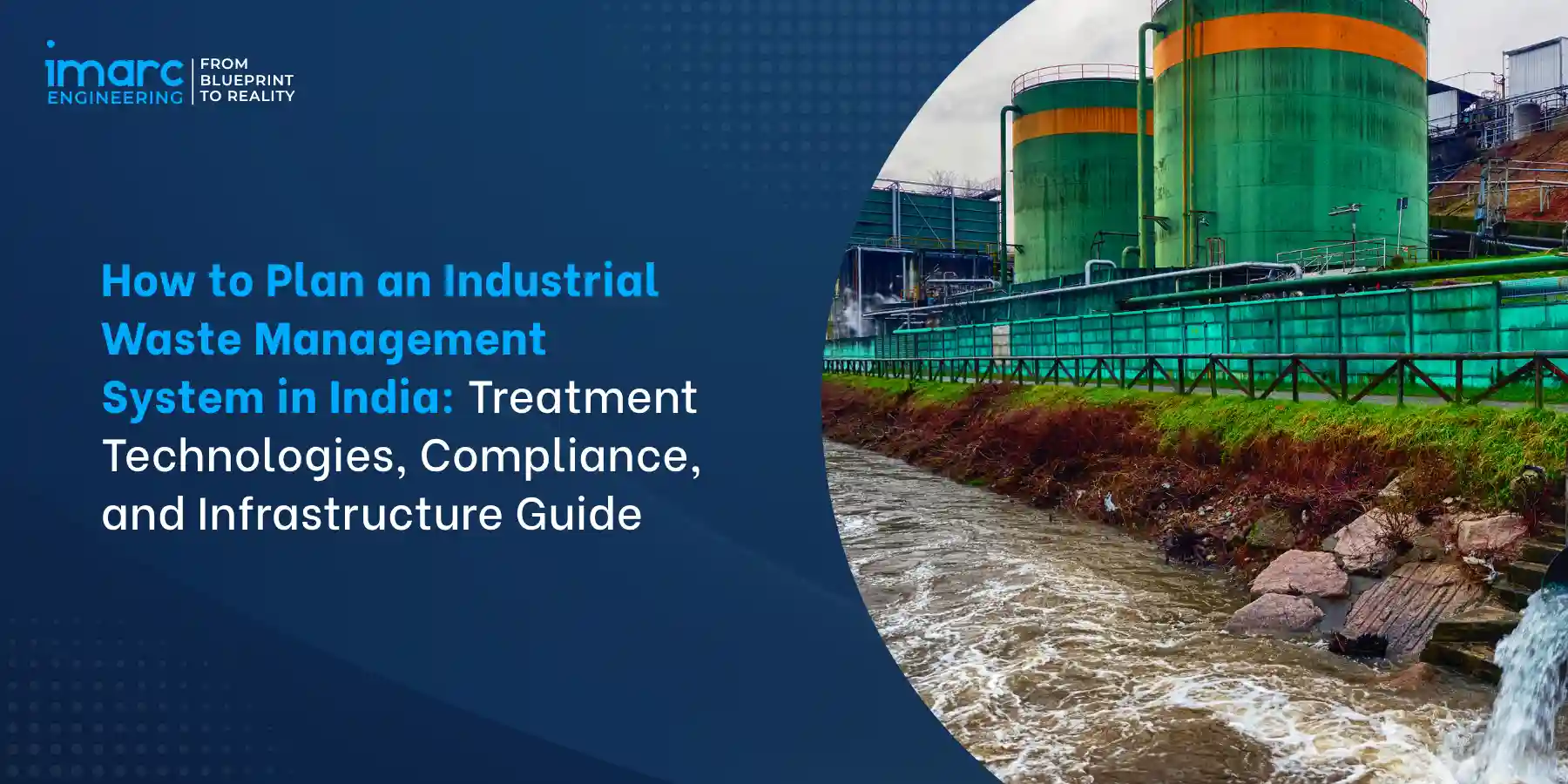
How to Plan an Industrial Waste Management System in India: Treatment Technologies, Compliance, and Infrastructure Guide
Introduction
For any promoter planning a manufacturing or industrial project in India, an industrial waste management system is not a peripheral service, it is a load-bearing element of project bankability, regulatory compliance, and operational sustainability.
Well-planned systems designed during early project stages integrate seamlessly with plant infrastructure, satisfy Central Pollution Control Board (CPCB) and State Pollution Control Board (SPCB) requirements, and deliver long-term operating economics. Retrofits routinely cost 2-4 times the design-integrated equivalent while producing worse regulatory outcomes.
Scope of this Guide
This guide answers the sponsor's system-design question directly. How should industrial waste management in India be designed to meet regulatory requirements, support sustainable operations, and integrate efficiently with plant infrastructure? It walks through structured planning workflow, treatment technologies (Effluent Treatment Plants, Sewage Treatment Plants, Zero Liquid Discharge systems, hazardous waste handling), regulatory compliance framework, infrastructure planning, and the practices that separate sustainable industrial waste management from reactive end-of-pipe compliance.
Table of Contents
- Introduction
- Why Industrial Waste Management in India Matters
- How to Plan an Industrial Waste Management System in India
- Industrial Waste Treatment Technologies for Indian Manufacturers
- Hazardous Waste Management for Manufacturing Plants in India
- Effluent Treatment Plant Design and Compliance in India
- Zero Liquid Discharge System Design in India
- CPCB Waste Management Guidelines Compliance in India
- Common Mistakes and Best Practices
- Conclusion
1. Why Industrial Waste Management in India Matters
Four structural drivers make disciplined waste management engineering a strategic priority for Indian manufacturing sponsors.
1.1 Regulatory Framework Has Progressively Tightened
The regulatory framework has materially tightened over the last decade. Environment (Protection) Act 1986, Water Act 1974, and Air Act 1981 provide parent legislation. CPCB and SPCB effluent and emission standards have progressively become stricter.
Sector-specific rules including Hazardous and Other Wastes (Management and Transboundary Movement) Rules 2016 (as amended), Solid Waste Management Rules 2016, Plastic Waste Management Rules 2016 (amended), E-Waste (Management) Rules 2022, and Bio-Medical Waste Management Rules 2016 impose material-specific obligations. Non-compliance produces plant shutdowns, criminal liability for management, and revenue loss that dwarfs waste-system investment.
1.2 CPCB Sector-Specific Standards and ZLD
CPCB has notified 17 categories of highly polluting industries (distilleries, sugar, fertilizer, pulp and paper, chlor-alkali, pharmaceuticals, dyes, pesticides, oil refineries, petrochemicals, tanneries, thermal power, cement, iron and steel, copper smelters, zinc smelters, aluminum smelters).
Zero Liquid Discharge (ZLD) is mandated for several of these categories. Sector-specific effluent, emission, and hazardous waste norms shape technology selection for facilities in these sectors. Structured technology matching to sector obligations is prerequisite for approval.
1.3 Buyer, Investor, and ESG Expectations
Global buyers, financial institutions, and ESG frameworks require documented environmental performance. IATF 16949, ISO 14001, GRI reporting, buyer-specific supplier codes, and green financing all reference structured waste management.
Investors evaluating manufacturing projects specifically scrutinise environmental risk profiles. Well-designed systems support both compliance and commercial engagement while poor systems increasingly foreclose commercial opportunities.
1.4 Operating Economics and Circular Economy
Waste management economics have shifted from pure cost to potential value. By-product recovery, water reuse, energy recovery from waste, and materials circular flows increasingly offset waste management operating costs.
Common Effluent Treatment Plants (CETPs) and Common Treatment, Storage and Disposal Facilities (CTSDFs) in organised industrial estates reduce individual facility costs. Structured waste-to-value strategies transform waste management from cost centre toward operational asset.
2. How to Plan an Industrial Waste Management System in India
Understanding how to plan an industrial waste management system in India helps sponsors sequence engineering decisions correctly. Structured industrial waste management planning and industrial waste management infrastructure planning integrated with process design from concept stage is materially cheaper than end-of-pipe retrofit and delivers superior regulatory outcomes.
2.1 The Structured Planning Workflow
| Stage | Activities | Typical Duration |
|---|---|---|
| Waste Characterisation | Streams, volumes, composition, hazards | 4-8 weeks |
| Regulatory Mapping | Applicable rules, standards, authorisations | 3-6 weeks |
| Technology Selection | Treatment pathway, redundancy, footprint | 6-10 weeks |
| Basic Engineering | PFDs, P&IDs, layouts, water balance | 8-14 weeks |
| Detailed Engineering | Equipment specs, civil, MEP, controls | 16-24 weeks |
| Approvals and Construction | CTE, CTO, HW Authorization, build | 18-36 months |
2.2 Waste Characterisation as Foundation
Waste characterisation is the analytical foundation for every downstream decision. Wastewater characterisation covers flow rates, BOD (Biochemical Oxygen Demand), COD (Chemical Oxygen Demand), TSS (Total Suspended Solids), TDS (Total Dissolved Solids), pH, specific contaminants (heavy metals, oil and grease, phenols, cyanides), and variability patterns.
Solid waste characterisation covers quantity, physical form, chemical composition, hazard classification per Schedule I of Hazardous Waste Rules, moisture content, and calorific value where relevant. Air emission characterisation covers sources, quantities, and pollutant composition. Without accurate characterisation, technology selection defaults to over-specification (excess capex) or under-specification (compliance failure).
2.3 Design Basis and Sustainability Integration
Design basis documentation covers waste characterisation, regulatory standards to be met, treatment targets, redundancy philosophy, expansion provisioning, and integration with process operations. Sustainability integration during design supports circular economy outcomes — water reuse strategies reducing fresh water demand, energy recovery from anaerobic digestion or waste-to-energy, by-product recovery (metals, chemicals, fertiliser value from sludge), and materials circular flows. Structured sustainable industrial waste management decisions taken at design stage typically yield 15-30 percent lower lifecycle costs than compliance-only approaches.
3. Industrial Waste Treatment Technologies for Indian Manufacturers
Industrial waste treatment technologies for Indian manufacturers span multiple waste streams (wastewater, solid waste, hazardous waste, air emissions) with mature technology options for each. Selection of appropriate industrial waste treatment technologies matches waste characteristics, regulatory targets, and capex-opex trade-offs.
3.1 Wastewater Treatment Unit Operations
| Stage | Common Technologies | Typical Purpose |
|---|---|---|
| Preliminary | Screening, grit removal, oil/grease separation | Physical removal, protect downstream |
| Primary | Sedimentation, flotation, equalisation | Suspended solids, load equalisation |
| Secondary Biological | Activated sludge, MBBR, SBR, UASB, MBR | BOD/COD reduction |
| Tertiary | Sand filtration, activated carbon, UF, RO | Polishing, reuse-quality water |
| Advanced | AOP, ozonation, ion exchange | Recalcitrant contaminants |
| Zero Liquid Discharge | MEE, MVR, ATFD, crystalliser | Complete water recovery |
3.2 Solid and Hazardous Waste Treatment
Solid waste treatment options include composting for biodegradable waste, Refuse Derived Fuel (RDF) production, biomethanation for organic waste, incineration for energy recovery, and secure landfill for residuals.
Hazardous waste treatment includes incineration for organic hazardous waste, secure landfill for inorganic hazardous residues, co-processing in cement kilns per CPCB guidelines, and CPCB-authorised recyclers for specific waste categories. Common Treatment, Storage and Disposal Facilities (CTSDFs) provide shared infrastructure for smaller generators.
3.3 Air Pollution Control Technologies
- Electrostatic Precipitator (ESP) for particulate control
- Bag filters for high-efficiency particulate removal
- Cyclones for coarse particulate separation
- Wet scrubbers for particulate and gaseous pollutants
- Selective Catalytic Reduction (SCR) and SNCR for NOx
- Flue Gas Desulphurization (FGD) for SO2
- Activated carbon for VOC and mercury capture
- Continuous emission monitoring systems (CEMS)
3.4 Technology Selection Framework
Technology selection weighs waste characteristics (concentration, variability, hazard class), regulatory targets (sector standards, ZLD applicability, emission norms), site constraints (footprint, utility availability, expansion room), capex versus opex trade-offs, operator skill requirements, and reliability under Indian operating conditions. Structured selection through techno-commercial evaluation prevents defaulting to familiar technologies that may not optimally match specific waste characteristics.
4. Hazardous Waste Management for Manufacturing Plants in India
Hazardous waste management for manufacturing plants operates under the Hazardous and Other Wastes (Management and Transboundary Movement) Rules 2016 (as amended). Structured hazardous waste management covers identification, storage, treatment, transport, and final disposal with structured documentation throughout.
4.1 Hazardous Waste Identification
Schedule I of the Hazardous Waste Rules 2016 lists processes generating hazardous waste with waste categorisation by process. Schedule II specifies concentration-based hazardous waste. Schedule III covers wastes applicable for transboundary movement.
Categorisation triggers specific storage, treatment, and disposal obligations. Waste generation quantification per stream supports authorisation applications, disposal contracts, and compliance reporting. Structured identification at facility design stage is materially cheaper than retroactive assessment.
4.2 On-Site Storage and Handling
On-site hazardous waste storage requires dedicated areas with impervious flooring, secondary containment, appropriate segregation preventing incompatible waste mixing, adequate ventilation, spill response infrastructure, and structured signage per CPCB guidelines.
Maximum storage duration is 90 days from generation before disposal or authorised transfer. Structured storage design during facility engineering prevents both regulatory violations and safety incidents. Manifest documentation tracks waste from generation through disposal.
4.3 Treatment and Disposal Pathways
Treatment and disposal options include on-site pre-treatment (physical, chemical, thermal reduction), authorised TSDF disposal (Common TSDF operators serve industrial clusters), incineration facilities for organic hazardous waste with energy recovery, secure landfills for stabilised inorganic residues, co-processing in cement kilns per CPCB Guidelines on Co-Processing in Cement Kilns, and recycling through CPCB-authorised recyclers for specific waste categories (used oil, batteries, e-waste).
4.4 Authorisation and Compliance Reporting
Hazardous waste generators require authorisation under Rule 6 of the Hazardous Waste Rules from State Pollution Control Board. Authorisation applications include waste quantification, storage details, disposal arrangements, transport agreements, and emergency response plans. Ongoing compliance includes annual returns (Form 4), manifest documentation, and any incident reporting. Structured compliance culture supported by digital tracking materially reduces both administrative burden and violation risk.
5. Effluent Treatment Plant Design and Compliance in India
Effluent treatment plant design and compliance translate wastewater characterisation and regulatory targets into engineered treatment systems. Well-designed Effluent Treatment Plants (ETPs) and Sewage Treatment Plants (STPs) meet CPCB effluent standards while supporting operational reliability and cost efficiency.
5.1 Design Basis and Water Balance
Design basis documentation covers influent characterisation (flow, BOD, COD, TSS, TDS, pH, specific contaminants), effluent quality targets (CPCB general standards or sector-specific), treated water reuse targets, redundancy philosophy (standby units, N+1 configurations for critical processes), and expansion provisioning.
Water balance quantifies water inflow, process consumption, wastewater generation, treated water production, and recycle/reuse flows. Structured water balance supports both ETP sizing and freshwater demand reduction opportunities.
5.2 ETP and STP Technology Selection
Effluent Treatment Plant technology selection matches waste characteristics. Activated sludge and MBBR (Moving Bed Biofilm Reactor) suit typical medium-strength industrial wastewater. SBR (Sequential Batch Reactor) suits variable flow patterns.
MBR (Membrane Bioreactor) delivers superior effluent quality suitable for direct reuse. UASB (Upflow Anaerobic Sludge Blanket) suits high-organic wastewater with biogas recovery. Sewage Treatment Plants (STPs) for domestic wastewater use similar biological technologies typically at smaller scale with sequential batch reactor and MBBR as common choices.
5.3 CPCB Effluent Standards
| Parameter | General Standards (Inland Surface Water) | Typical Unit |
|---|---|---|
| pH | 5.5 to 9.0 | - |
| BOD (Biochemical Oxygen Demand) | Not exceeding 30 | mg/L |
| COD (Chemical Oxygen Demand) | Not exceeding 250 | mg/L |
| TSS (Total Suspended Solids) | Not exceeding 100 | mg/L |
| Oil and Grease | Not exceeding 10 | mg/L |
| Ammoniacal Nitrogen | Not exceeding 50 | mg/L |
5.4 ETP Investment and Compliance
Effluent Treatment Plant investment varies with flow, waste strength, and effluent targets. Small ETPs typically cost INR 25 lakh - 2 crore for basic biological treatment. Medium ETPs typically cost INR 2-10 crore including tertiary treatment. Complex ETPs with advanced tertiary and specialised technologies (RO, MBR, AOP) can exceed INR 10-25 crore.
STPs typically cost INR 10 lakh - 10 crore based on capacity. Continuous compliance verification through daily monitoring, monthly analytical testing, and online monitoring for critical parameters supports both regulatory compliance and operational optimisation.
6. Zero Liquid Discharge System Design in India
Zero Liquid Discharge system design has emerged as a mandatory requirement for several highly polluting sectors and an increasingly common expectation for water-stressed regions. Zero Liquid Discharge (ZLD) achieves complete water recovery with no liquid effluent leaving the plant boundary.
6.1 ZLD Configuration
Typical ZLD configuration integrates pre-treatment (biological ETP), pre-concentration (Reverse Osmosis to concentrate salts), evaporation (Multi-Effect Evaporator or Mechanical Vapour Recompression), crystallisation (Agitated Thin Film Dryer or crystalliser), and salt recovery. Recovered water re-enters process; recovered salts are disposed as solid waste or beneficiated. Well-designed ZLD systems achieve water recovery of 90-98 percent versus zero recovery in conventional discharge systems.
6.2 Technology Selection Within ZLD
- Reverse Osmosis (RO) for pre-concentration: energy-efficient up to typical salinity limits
- Multi-Effect Evaporator (MEE) for concentration: mature technology, moderate energy
- Mechanical Vapour Recompression (MVR): high energy efficiency, higher capex
- Agitated Thin Film Dryer (ATFD) for near-dry residues
- Crystalliser for salt recovery from concentrated brines
- Hybrid configurations: RO followed by MEE + ATFD is common
6.3 ZLD Investment and Operating Cost
ZLD systems represent substantial capex — typically INR 5-100 crore depending on flow, salinity, and hybrid configuration. Operating costs are dominated by energy consumption for evaporation. Mechanical Vapour Recompression (MVR) reduces energy consumption versus MEE at higher capex.
Integration with process heat sources (waste heat recovery) materially improves ZLD economics. Structured configuration and lifecycle economics evaluation guide the appropriate ZLD investment for specific facility characteristics.
6.4 ZLD Applicability and Alternatives
ZLD is mandatory for several CPCB-notified categories including distilleries, textile dyeing, and specific chemical processes. Voluntary ZLD deployment increasingly serves water-stressed regions and buyers requiring documented water stewardship. Alternatives to full ZLD include Minimal Liquid Discharge (MLD) approaches with substantially reduced discharge but not complete recovery, treated water reuse for non-critical applications, and shared ZLD infrastructure at cluster level. Structured evaluation matches ZLD approach to regulatory obligation, water availability, and commercial context.
7. CPCB Waste Management Guidelines Compliance in India
CPCB waste management guidelines compliance translates central and state pollution control regulations into structured facility-level obligations. Understanding the industrial waste management compliance architecture supports both project approvals and continuing operations.
7.1 Statutory Authorisations Required
| Authorisation | Authority | Purpose |
|---|---|---|
| Environmental Clearance | MoEFCC / SEIAA (per EIA 2006) | Pre-construction environmental approval |
| Consent to Establish (CTE) | State Pollution Control Board | Pre-construction consent |
| Consent to Operate (CTO) | State Pollution Control Board | Pre-commissioning operational consent |
| Hazardous Waste Authorization | SPCB under HW Rules 2016 | Generation, storage, transport, disposal |
| Plastic Waste EPR Registration | CPCB under PW Rules | Extended producer responsibility |
| E-Waste EPR Registration | CPCB under E-Waste Rules 2022 | Electronic waste producer obligations |
| Battery EPR Registration | CPCB under Battery Rules 2022 | Battery producer obligations |
7.2 CPCB Sector-Specific Standards
CPCB has notified sector-specific effluent, emission, and hazardous waste standards for 17 categories of highly polluting industries. Sector-specific standards typically supersede general standards for regulated categories. Compliance requires meeting the more stringent applicable standard.
Continuous Emission Monitoring Systems (CEMS) and Continuous Effluent Quality Monitoring Systems (CEQMS) are mandatory for many sectors with data transmitted to CPCB. Structured monitoring supports both compliance verification and operational optimisation.
7.3 Compliance Documentation and Reporting
Ongoing compliance covers monthly analytical monitoring per authorisation conditions, annual returns (Form 4 for hazardous waste, Form V for wastewater and emissions, EPR annual reports for plastic/e-waste/battery), waste manifest documentation, corrective and preventive action tracking for non-compliances, and audit-ready records supporting SPCB and CPCB inspections. Digital compliance management systems increasingly support this administrative workload while providing audit trails supporting regulatory engagement.
7.4 Non-Compliance Consequences
Non-compliance consequences include closure directions under Section 5 of Environment Protection Act, CTE or CTO revocation, criminal proceedings against directors and management under environmental legislation, financial penalties, and reputational damage.
National Green Tribunal proceedings have progressively increased in aggressive enforcement particularly on ZLD, hazardous waste, and effluent standards. Structured compliance discipline is materially cheaper than the litigation and shutdown risk that unstructured operations face.
8. Common Mistakes and Best Practices
8.1 Deferring Waste System Design
Waste systems designed after process design is frozen produce integration compromises, larger footprints, and higher costs.
Best practice: waste management workstream initiated during basic engineering; integrated PFDs covering process and waste streams; water balance developed alongside process design; waste characterisation validated through pilot studies where necessary.
8.2 Under-Investing in Characterisation
Systems designed against assumed rather than measured waste characteristics routinely underperform.
Best practice: comprehensive characterisation including flow, load, and variability patterns; representative sampling protocols; multiple sampling campaigns capturing seasonal and operational variations; conservative design margins reflecting characterisation uncertainty.
8.3 Weak Operator Preparation
Well-designed systems operated by untrained personnel underperform.
Best practice: operator identification during construction; comprehensive training including theoretical and hands-on components; documented Standard Operating Procedures for routine and abnormal operations; structured shift handover protocols; ongoing refresher training and competency assessment.
8.4 Reactive Compliance Culture
Facilities that operate in reactive compliance mode face recurring surprises.
Best practice: pre-emptive compliance monitoring exceeding statutory minima; structured internal audits; dedicated environmental compliance function with senior management access; early engagement with SPCB during application and inspection cycles; documented compliance culture supporting audit and litigation defence.
8.5 Neglecting Sustainability Opportunities
Waste management treated purely as compliance cost misses value creation.
Best practice: Sustainable waste management solutions for manufacturers that include structured evaluation of water reuse opportunities; energy recovery from anaerobic digestion or waste-to-energy; by-product recovery (metals, chemicals, fertiliser value); materials circular flows; cluster-level shared infrastructure where feasible.
Conclusion
Structured industrial waste management system development for Indian manufacturing projects combines regulatory compliance under Environment Protection Act, Water Act, Air Act, and material-specific rules with operational discipline supporting sustainable operations.
Well-planned systems integrated during early project stages satisfy CPCB and SPCB requirements, deliver operational reliability, support circular economy value creation, and preserve enterprise commercial engagement.
Manufacturers combining rigorous waste characterisation, structured technology selection matched to regulatory obligations, disciplined statutory approvals sequencing, and proactive compliance culture consistently deliver systems that operate at design intent throughout the plant lifecycle.
Three closing reminders for manufacturing sponsors. First, initiate waste management engineering during basic project engineering rather than at detailed design stage. Waste system integration with process design determines lifecycle costs and compliance outcomes; retrofit engineering is materially more expensive.
Second, ground technology selection in comprehensive waste characterisation. Systems designed against assumed characteristics routinely underperform; measured characterisation supports realistic technology matching.
Third, invest in operator preparation and proactive compliance culture. Well-designed systems require well-prepared operators supported by structured Standard Operating Procedures, monitoring discipline, and ongoing capability development.
PLANNING YOUR INDUSTRIAL WASTE MANAGEMENT SYSTEM?
IMARC Engineering's industrial waste management system planning and engineering advisory team supports manufacturing sponsors, plant heads, and environmental engineering teams across waste characterisation, regulatory pathway mapping, treatment technology selection, Effluent Treatment Plant design, Sewage Treatment Plant design, Zero Liquid Discharge system engineering, hazardous waste management planning, air pollution control system design, statutory approvals coordination including Environmental Clearance and Consent to Establish and Operate, hazardous waste authorisation, EPR compliance for plastic, e-waste, and battery obligations, commissioning support, and ongoing compliance advisory for greenfield industrial developments and brownfield expansions across sectors.
→ Schedule a free industrial waste management scoping consultation with an IMARC specialist
Frequently Asked Questions
An industrial waste management system is an integrated set of processes and infrastructure covering waste characterisation, segregation, storage, treatment, and disposal for wastewater, solid waste, hazardous waste, and air emissions from an industrial facility. Structured systems satisfy CPCB and SPCB regulations while supporting operational sustainability.
The framework includes Environment (Protection) Act 1986, Water Act 1974, Air Act 1981, EIA Notification 2006, Hazardous Waste Rules 2016 (as amended), Solid Waste Management Rules 2016, Plastic Waste Rules 2016, E-Waste Rules 2022, Battery Waste Rules 2022, and Bio-Medical Waste Rules 2016. CPCB waste management guidelines provide sector-specific and general standards.
Zero Liquid Discharge (ZLD) achieves complete water recovery with no liquid effluent leaving the plant boundary. ZLD is mandatory for several highly polluting sectors including distilleries, textile dyeing, and specific chemical processes. Voluntary ZLD increasingly serves water-stressed regions. Typical water recovery is 90-98 percent.
Effluent Treatment Plants (ETPs) treat industrial wastewater with variable characteristics including specific pollutants from manufacturing processes. Sewage Treatment Plants (STPs) treat domestic wastewater with more predictable characteristics. ETPs typically require more sophisticated technology combinations; STPs use standardised biological treatment. Both must meet applicable CPCB standards before discharge or reuse.
Small ETPs typically cost INR 25 lakh - 2 crore for basic biological treatment. Medium ETPs typically cost INR 2-10 crore including tertiary treatment. Complex ETPs with advanced tertiary and specialised technologies (RO, MBR, AOP) can exceed INR 10-25 crore. Actual costs depend on flow, waste characteristics, and effluent quality targets.
Common industrial waste treatment technologies include activated sludge, Moving Bed Biofilm Reactor (MBBR), Sequential Batch Reactor (SBR), Upflow Anaerobic Sludge Blanket (UASB), Membrane Bioreactor (MBR) for secondary biological treatment; sand filtration, activated carbon, ultrafiltration, and Reverse Osmosis (RO) for tertiary treatment; and Multi-Effect Evaporator (MEE) and crystalliser systems for Zero Liquid Discharge.
Hazardous waste management authorisation under Rule 6 of Hazardous Waste Rules 2016 is granted by State Pollution Control Board. Applications include waste quantification, storage details, disposal arrangements with authorised TSDF operators, transport agreements, and emergency response plans. Ongoing compliance includes Form 4 annual returns and manifest documentation.
EPR obligations under Plastic Waste Management Rules, E-Waste Rules 2022, and Battery Waste Rules 2022 require producers, importers, and brand owners to arrange collection and processing of end-of-life products meeting targets prescribed by CPCB. EPR registration with CPCB is required alongside targeted collection and processing through authorised recyclers.
Ongoing environmental compliance for manufacturing plants requires monitoring per authorisation conditions, monthly analytical testing, annual returns filing, waste manifest documentation, corrective action tracking, and audit-ready records. Continuous monitoring systems (CEMS, CEQMS) support several sectors. Proactive compliance culture with dedicated environmental function materially reduces violation risk.
Recent Post
Trusted by Industry Leaders
We partner with global enterprises and ambitious businesses across sectors to deliver operational excellence, strategic insights, and sustainable growth through integrated solutions.



Success in Their Words
Real feedback from clients across industries. Discover how our solutions delivered measurable impact and operational excellence.

I wanted to express my sincere appreciation for your efforts in handling this matter. Your dedication and commitment have been truly commendable, and it is evident that you have put in tremendous hard work and expertise into resolving the issues at hand. We are greatly interested in continuing our collaboration with you in the future, as your professionalism and reliability have made you a trusted partner. Thank you once again for your invaluable contribution. We look forward to strengthening our partnership ahead.

It has been a pleasure working with the IMARC team. The insights provided were structured, clear, and highly valuable, helping us strengthen both our technical and financial planning with confidence. We deeply appreciate the team’s professionalism, responsiveness, and attention to detail throughout the engagement. Every requirement was well understood and effectively incorporated, resulting in a comprehensive and actionable output. Overall, our experience has been excellent, and I would gladly recommend IMARC to organizations seeking a reliable research partner.

Your service is truly exceptional. Working with the IMARC team has been a seamless and professional experience. The clarity of communication, responsiveness to queries, and consistent support at every stage made the entire engagement highly efficient. The insights shared were well-structured, practical, and perfectly aligned with our requirements, helping us make informed decisions with confidence. Overall, the dedication and professionalism demonstrated by your team stand out, and I would be glad to recommend IMARC as a reliable and trustworthy research partner.

IMARC did an outstanding job in preparing our study. They were punctual, precise, and consistently responsive throughout the entire process. The team delivered all the data we required in a clear, well-organized, and highly professional format. Their strong attention to detail, combined with their ability to meet every deadline without compromising quality, truly set them apart. Overall, their reliability and commitment made them an exceptional partner for our project, and we would gladly work with them again in the future.

IMARC made the whole process incredibly easy from start to finish. Everyone I interacted with via email was polite, professional, and straightforward to deal with, always keeping their promises regarding delivery timelines and remaining consistently solutions-focused. From my very first contact, I appreciated the professionalism and support shown by the entire IMARC team. I highly recommend IMARC to anyone seeking timely, affordable, and reliable information or advice. My experience with IMARC was excellent, and I truly cannot fault any aspect of it.

I’d like to express my sincere gratitude for the excellent work you accomplished with the study. Your ability to quickly understand our requirements and deliver high-quality results under tight timelines truly reflects your expertise, exceptional work ethic, and unwavering commitment to your customer’s success. The professionalism and responsiveness you demonstrated throughout the process made a significant difference. Our entire team and company are incredibly thankful for your dedication, reliability, and support. Once again, thank you for your outstanding contribution.