Manufacturing
June 26 2026
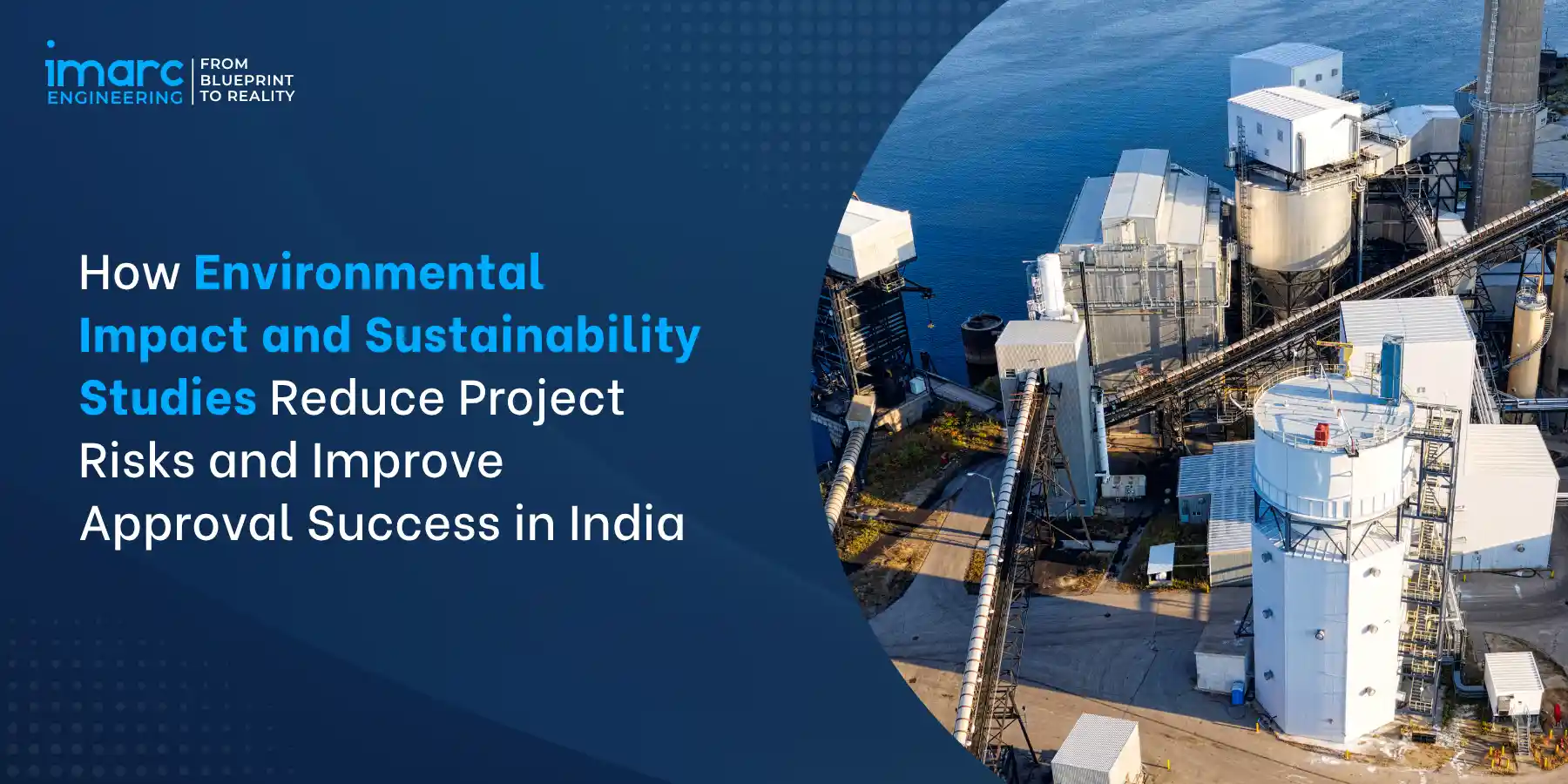
How Environmental Impact and Sustainability Studies Reduce Project Risks and Improve Approval Success in India
Introduction
For any industrial or infrastructure project in India, environmental impact assessment in India is among the longest-lead approvals on the critical path. The framework spans the Environment (Protection) Act 1986, EIA Notification 2006, and a growing set of sectoral statutes. Project developers face a dual challenge.
For many projects, environmental and sustainability studies are not simply regulatory requirements. They influence site selection, project design, financing decisions, stakeholder acceptance, and long-term operational performance. Projects that identify environmental risks early are often better positioned to secure approvals, avoid costly redesigns, and attract investor confidence.
First, securing the Environmental Clearance (EC) needed to commence construction. Second, managing the broader sustainability profile that increasingly shapes lender, investor, customer, and community acceptance. Disciplined environmental and sustainability studies at the project planning stage materially compress approval timelines, reduce litigation risk, lower lifecycle costs, and improve long-term commercial outcomes.
Scope of This Guide
This guide answers the project developer's planning question directly. How do sustainability studies in India and environmental risk assessment reduce project risks. How do they improve regulatory approval success. It walks through the EIA framework, the risk-reduction logic, the EC approval process, sustainability assessment scope, due diligence triggers, ESG-aligned studies for project approvals, and the discipline that distinguishes approval-ready developers from those facing delay or rejection.
Table of Contents
- Introduction
- Why Environmental Impact Assessment in India Matters in 2026
- The Regulatory Framework - EIA Notification 2006 and Beyond
- How Environmental Impact Assessment Reduces Project Risks in India
- Environmental Clearance Approval Process in India
- Sustainability Assessment for Industrial Projects in India
- Environmental Due Diligence Consultant in India - When and Why
- ESG Impact Studies for Project Approvals India
- Common Mistakes and Best Practices
- Conclusion
1. Why Environmental Impact Assessment in India Matters in 2026
Four structural drivers make a disciplined EIA approach essential for any project developer.
1.1 EIA is the Gateway to Project Construction
Most industrial and infrastructure projects above prescribed thresholds cannot commence construction without an Environmental Clearance. The EC pathway is typically 12-24 months for larger Category A projects and 6-12 months for Category B projects. Delays in obtaining EC delay all downstream construction, financial close, and revenue start. The single most consequential variable in project schedule is often EIA timeline discipline.
1.2 NGT and Court Scrutiny Has Increased
The National Green Tribunal (NGT) was established in 2010 under the NGT Act 2010. Its specialised jurisdiction has materially raised the scrutiny applied to Environmental Clearances. Inadequately conducted EIA studies, weak public consultation, or insufficient Environmental Management Plans (EMPs) routinely face NGT challenges. Court-ordered project halts during construction or operation are materially more disruptive than delays at the planning stage.
1.3 Lender and Investor Diligence is Tightening
Domestic banks, NBFCs, and increasingly institutional investors apply Environmental and Social Risk Assessment frameworks aligned with IFC Performance Standards and Equator Principles. Inadequate EIA, weak EMP, or unresolved community issues directly affect debt and equity pricing. Foreign direct investors layer EU CSDDD, CSRD, and OECD MNE Guidelines obligations. Project bankability and certain capital sources are linked to EIA quality.
1.4 Community and Reputational Considerations
Community-led opposition has stopped or delayed several major projects over the past decade. Mining, thermal power, large infrastructure, and chemical complexes face elevated community scrutiny. A rigorous EIA with structured public consultation, clear EMP commitments, and credible monitoring frameworks materially reduces community risk. The reverse - perfunctory EIA - amplifies community opposition and reputational risk.
2. The Regulatory Framework - EIA Notification 2006 and Beyond
The Indian environmental compliance in India framework spans multiple statutes administered by Central and state authorities. Understanding the layered architecture is foundational to compliant project execution.
2.1 The Statutory Stack
| Instrument | Year | Scope |
|---|---|---|
| Environment (Protection) Act | 1986 | Parent environmental statute |
| Water (Prevention and Control of Pollution) Act | 1974 | Water pollution control via SPCBs |
| Air (Prevention and Control of Pollution) Act | 1981 | Air pollution control via SPCBs |
| Forest (Conservation) Amendment Act | 2023 | Forest land diversion (replaces FCA 1980) |
| Wildlife (Protection) Act | 1972 | Wildlife habitat protection |
| National Green Tribunal Act | 2010 | Environmental adjudication |
| EIA Notification (under EPA 1986) | 2006 | Environmental Clearance framework |
| Hazardous Waste Management Rules | 2016 | Hazardous waste handling |
2.2 Authority Architecture
The Ministry of Environment, Forest and Climate Change (MoEFCC) administers the Central-level framework. SEIAA (State Environment Impact Assessment Authority) handles state-level Category B projects. EAC (Expert Appraisal Committee) appraises Category A; SEAC (State Expert Appraisal Committee) appraises Category B. CPCB and SPCBs operate as enforcement bodies. NGT operates as the specialised adjudication forum. NABET (National Accreditation Board for Education and Training) accredits EIA consultant organisations - only NABET-accredited consultants can prepare EIA reports for EC submission.
2.3 Project Categorisation
Schedule of EIA Notification 2006 lists project categories with thresholds. The EIA notification 2006 compliance process in India classifies projects into Category A (larger / more sensitive, going to MoEFCC after EAC appraisal) and Category B (smaller, going to SEIAA after SEAC appraisal). Category B is further split into B1 (requires EIA study and public consultation) and B2 (exempted from full EIA but requires CTE/CTO from SPCB). Categorisation drives the entire downstream process - sponsors should verify their project category at planning stage to plan timeline and budget correctly.
2.4 Forest and Wildlife Considerations
Projects involving forest land require additional Forest Clearance under the Forest (Conservation) Amendment Act 2023 (which replaced the 1980 Act). Wildlife Clearance under the Wildlife (Protection) Act 1972 may apply for projects near protected areas. CRZ (Coastal Regulation Zone) Notification 2019 governs coastal projects. These parallel clearances often determine overall timeline rather than EC itself. Integrated planning across EC, FC, Wildlife, and CRZ is essential for projects with multi-dimensional environmental footprint.
3. How Environmental Impact Assessment Reduces Project Risks in India
A rigorous environmental risk assessment in India operates as one of the strongest project risk management tools available to developers. Disciplined environmental risk assessment for industrial projects identifies risks early, quantifies them, and structures mitigation that protects both project economics and stakeholder relationships.
3.1 Early Risk Identification
EIA studies systematically examine project impacts across air, water, soil, noise, ecology, socio-economic dimensions, and cumulative effects. Issues that would otherwise surface at construction or operation stage - groundwater stress, air quality non-attainment, ecology disruption, displacement - are identified during planning. Mitigation designed at the planning stage is materially less expensive than retrofits. Early identification also shapes site selection, technology choice, and design decisions that lock in long-term cost outcomes.
3.2 Strengthened Regulatory Defensibility
A well-conducted EIA report supported by structured public consultation and a credible Environmental Management Plan creates a defensible regulatory record. The EAC or SEAC review proceeds smoothly when data quality is sound. NGT challenges face higher rejection rates when the underlying EIA is rigorous. Court orders staying or quashing ECs typically follow weak EIA studies, inadequate public consultation, or factually thin EMPs - rigorous studies reduce litigation risk materially.
3.3 Improved Stakeholder Acceptance
Public consultation done well - rather than as a procedural box-tick - builds stakeholder confidence. Communities want their concerns heard. Local authorities want clear commitments. NGOs want credible environmental safeguards. A rigorous EIA process creates a documented record of stakeholder engagement and committed mitigation. Projects with strong stakeholder records face fewer operational disruptions, reduced opposition during construction, and smoother long-term operations.
3.4 Lower Lifecycle Cost
Environmental costs avoided at design stage compound over project life. Effluent treatment requirements identified upfront drive correct sizing rather than expensive expansions. Air pollution controls designed at construction stage cost a fraction of retrofits. Solid and hazardous waste management integrated into operations runs cleaner than retrofitted systems. Energy efficiency built into facility design produces sustained operating cost savings. A rigorous EIA pays for itself many times over through avoided lifecycle costs.
3.5 Investor and Lender Confidence
Modern project finance routinely incorporates Environmental and Social Risk Assessment alongside commercial diligence. Banks aligned with Equator Principles, multilateral lenders applying IFC Performance Standards, and ESG-conscious institutional investors evaluate EIA quality as part of investment decisions. Strong EIA documentation supports faster financial close, better debt pricing, and broader access to capital. Weak EIA documentation creates the financing-side risk that often dwarfs the regulatory-side risk.
4. Environmental Clearance Approval Process in India
Understanding the end-to-end process supports realistic timeline planning. The environmental clearance in India process follows a structured sequence with each stage having statutory implications. The step-by-step environmental clearance in India workflow described below applies broadly to Category A and B1 projects with category-specific variations.
4.1 The Six-Stage Workflow
| Stage | Activity | Typical Duration |
|---|---|---|
| 1. Screening | Categorisation as A, B1, or B2 from Schedule | 2-4 weeks |
| 2. Scoping | Terms of Reference (ToR) by EAC / SEAC | 8-12 weeks |
| 3. EIA Study | Field survey, baseline data, impact modelling, EMP | 12-26 weeks |
| 4. Public Consultation | Hearing in project area; written comments | 6-10 weeks |
| 5. Appraisal | EAC / SEAC review of Final EIA Report | 8-16 weeks |
| 6. Grant or Refusal | MoEFCC / SEIAA decision and EC letter | 4-8 weeks |
4.2 Screening and Scoping
Screening establishes whether the project requires EC under the EIA Notification 2006 Schedule. Category determination follows. The developer then submits Form 1, Pre-Feasibility Report, and (for B1 / A category) draft ToR proposals. EAC or SEAC reviews and issues final ToR within prescribed timelines. The ToR defines the scope of the EIA study - what impacts to assess, which seasons to monitor, what baseline parameters to capture. ToR quality directly affects downstream study quality.
4.3 EIA Study and Public Consultation
The EIA study is conducted by a NABET-accredited organization. Field data collection typically covers one full season minimum (often three seasons - winter, summer, monsoon). Baseline data covers air, water, soil, noise, ecology, demographics, and socio-economic conditions. Impact modelling uses air dispersion models, water quality models, noise propagation models, and ecological risk assessments. The Draft EIA Report goes to public consultation - a hearing in the project district plus written comments period. Public concerns and response form part of the Final EIA Report.
4.4 Appraisal and Grant
The Final EIA Report goes to EAC or SEAC for appraisal. The committee may seek additional information, mandate design changes, or impose conditions. On satisfactory appraisal, the committee recommends grant to MoEFCC (Category A) or SEIAA (Category B). The authority issues the Environmental Clearance letter with binding conditions covering pre-construction, construction, and operational stages. Compliance reports are required at defined intervals - typically six-monthly during construction and operation.
5. Sustainability Assessment for Industrial Projects in India
Beyond statutory EIA, sustainability assessment for projects has emerged as a complementary discipline. It addresses dimensions that EIA may not fully cover but that investors, lenders, customers, and communities increasingly demand.
5.1 What Sustainability Studies Cover
Sustainability studies extend beyond statutory EIA to address climate-related risks, water stewardship, circular economy considerations, biodiversity impact beyond regulatory thresholds, supply chain sustainability, social impact, and governance dimensions. They typically align with frameworks such as GRI Standards, TCFD, ISSB, SASB, IFC Performance Standards, and Equator Principles. The output supports investor disclosures, lender ESRA documentation, and customer ESG audits.
5.2 The Sustainability Study Scope
- Climate risk - physical risks (flooding, heat stress, water stress) and transition risks (carbon pricing, technology shifts)
- Water stewardship - sourcing sustainability, recycle and reuse, watershed impact
- Energy and carbon - intensity benchmarks, renewable PPA opportunities, Net Zero alignment
- Waste and circular economy - reduction, reuse, recycle, valorisation
- Biodiversity and ecology - beyond regulatory threshold, including offset planning
- Social impact - employment, livelihoods, community development, indigenous rights
- Supply chain sustainability - tier-1 and value chain mapping
- Governance - board oversight, policies, risk integration, disclosure quality
5.3 Integration with EIA and Approval Process
Sustainability studies typically run alongside or after EIA - leveraging the EIA baseline while extending into voluntary dimensions. Some sustainability findings strengthen the EIA itself - climate risk identified in sustainability work may add to flood, heat, or drought analysis in EIA. Where the project pursues IFC, Equator Principles, or multilateral financing, the sustainability study often becomes part of the lender Environmental and Social Action Plan.
5.4 Sustainability Reporting Linkage
SEBI BRSR Core requirements apply to top 1000 listed companies in India (phased glide path from FY 2023-24 through FY 2026-27). Listed sponsors need project-level data to populate corporate disclosures. Sustainability studies at project planning stage establish the data architecture that supports ongoing BRSR reporting. Foreign sponsors face parallel EU CSRD, UK requirements, and similar frameworks. Project-level sustainability discipline links directly to corporate disclosure obligations.
6. Environmental Due Diligence Consultant in India - When and Why
Beyond greenfield EIA, environmental due diligence in India has emerged as an essential discipline at multiple project milestones. The discipline supports informed decision-making across the project and transaction lifecycle.
6.1 When Environmental Due Diligence is Triggered
Common triggers include M&A transactions involving operating facilities, project acquisitions, lender pre-disbursement diligence, IPO and listing diligence, divestiture preparation, joint venture formation, and periodic operational reviews. Each trigger has slightly different scope but shares the core objective of surfacing environmental liabilities, compliance gaps, and risk exposure that affect transaction value or operational decisions.
6.2 Scope of Environmental Due Diligence
Typical scope covers historic contamination assessment - particularly for industrial sites with long operational history. Compliance status review covering EC conditions, CTE/CTO compliance, hazardous waste authorisations, and statutory return filings. Litigation and notices review. EMP implementation effectiveness. Air, water, and soil contamination evidence. Solid and hazardous waste handling adequacy. Decommissioning and closure liability assessment. Insurance and reserve adequacy.
6.3 Pre-Purchase vs Ongoing Due Diligence
Pre-purchase diligence focuses on liabilities being transferred - historic contamination, ongoing non-compliance, and pending litigation. Ongoing diligence focuses on operational discipline - EC compliance, EMP implementation, monitoring data quality, and risk readiness. Both share methodology but differ in emphasis. M&A transactions typically require both - the buyer assesses inherited risk while planning post-close operational improvement.
6.4 Deliverables and Use Cases
Standard deliverables include the Environmental Due Diligence Report with executive summary, findings register prioritised by criticality, remediation cost estimates, residual risk assessment, and recommended remediation programme. Buyers use the report for purchase price negotiation, escrow structuring, and post-close action planning. Lenders use it for credit committee submission. Boards use it for major investment decisions. The report's quality directly affects the quality of downstream commercial decisions.
6.5 Phase I, Phase II, and Phase III Studies
Environmental due diligence often follows a phased approach. Phase I covers documentary review, site visit, regulatory database search, and stakeholder interviews without intrusive sampling. Phase II involves intrusive sampling of soil, groundwater, and sediment where Phase I indicates potential contamination. Phase III covers detailed remediation planning where Phase II confirms significant contamination. Most M&A transactions complete Phase I; complex industrial sites often progress through Phase II; only sites with confirmed material contamination reach Phase III remediation planning.
7. ESG Impact Studies for Project Approvals India
The convergence of regulatory approvals with broader ESG expectations is the most significant shift in Indian project approval landscape over the past five years. ESG compliance in India is no longer optional for projects seeking institutional capital, listed-company sponsorship, or international engagement.
7.1 ESG Frameworks Relevant to Indian Projects
SEBI BRSR (Business Responsibility and Sustainability Reporting) applies to top 1000 listed Indian companies. BRSR Core (July 2023 amendment) introduced limited assurance for nine ESG attributes with phased applicability from FY 2023-24 (Top 150) through FY 2026-27 (Top 1000). Value chain disclosure extends to partners accounting for 2 percent and above of purchases or sales, up to 75 percent threshold. International frameworks include IFC Performance Standards, Equator Principles, GRI Standards, TCFD, ISSB, SASB, EU CSDDD, and CSRD.
7.2 Voluntary, Lender-Required, and Investor-Required ESG Studies
Voluntary ESG studies support corporate positioning and stakeholder communication. Lender-required studies follow specific lender frameworks - IFC Performance Standards for IFC funding, Equator Principles for participating banks. Investor-required studies follow fund-specific frameworks or LP requirements. ESG-conscious institutional investors layer additional fund-level frameworks. Indian listed sponsors face SEBI BRSR Core mandatory requirements. Most large industrial projects today face at least one of these layers.
7.3 Integration with EIA
ESG studies and EIA studies have material overlap but distinct emphasis. EIA focuses on statutory compliance with sectoral environmental thresholds. ESG studies focus on broader sustainability dimensions including climate, biodiversity beyond regulatory thresholds, human rights, governance, and disclosure quality. Best practice is to plan both studies in parallel from project conception - sharing baseline data, public consultation insights, and stakeholder engagement frameworks while producing distinct deliverables for different audiences.
7.4 ESG and Approval Success
Strong ESG documentation supports faster appraisal in increasingly ESG-aware regulatory environments. EAC and SEAC committees increasingly value structured climate risk assessment, biodiversity offset planning, and social impact mitigation. Strong ESG documentation also speeds lender due diligence, reduces investor diligence cycles, and improves capital terms. Projects with weak ESG profiles increasingly face capital access constraints even after securing statutory approvals.
7.5 Climate Risk Disclosure Expectations
Climate risk has become a central pillar of project-level ESG studies. Physical risks include flood risk, heat stress, water stress, and storm exposure. Transition risks include carbon pricing, technology shifts, regulatory tightening, and market preference changes. TCFD-aligned scenario analysis covering at least one well-below-2-degree pathway is the emerging baseline expectation. Indian listed sponsors face SEBI BRSR Core climate disclosure requirements; multilateral and ESG-conscious lenders apply similar expectations for project financing decisions.
8. Common Mistakes and Best Practices
8.1 Starting EIA Late in Project Planning
Projects that initiate EIA after detailed design face material schedule pressure. EIA findings may require design changes that delay engineering.
Best practice: initiate EIA scoping discussion immediately after Pre-Feasibility Report; engage NABET-accredited ESG organisation early; integrate EIA findings into engineering design from the start.
8.2 Inadequate Baseline Data Collection
Single-season baseline data routinely faces appraisal challenges. Inadequate spatial sampling produces weak impact predictions.
Best practice: three-season baseline minimum for most projects; structured sampling design with statistical power; quality assured laboratory analysis; transparent data presentation in the EIA report.
8.3 Treating Public Consultation as Box-Tick
Public consultation done as procedural compliance produces weak stakeholder records and elevated litigation risk.
Best practice: structured pre-consultation engagement with local communities; transparent disclosure of project plans; genuine response to community concerns; documented changes to project design or EMP based on community input.
8.4 Weak Environmental Management Plan
EMPs that read as generic mitigation lists face appraisal challenges and post-grant compliance difficulties.
Best practice: project-specific EMP with quantitative mitigation commitments; clear responsibility assignment; budget allocation for mitigation; monitoring framework with measurable indicators; structured compliance reporting protocol.
8.5 Ignoring the Sustainability Dimension
Projects that obtain statutory EC without parallel sustainability assessment face capital-side and customer-side issues despite regulatory compliance.
Best practice: integrate sustainability assessment with EIA from start; align with frameworks investors and lenders use; build data architecture that supports both regulatory and disclosure requirements; treat sustainability as a value driver rather than a cost.
Conclusion
Disciplined environmental impact assessment in India in 2026 has moved from procedural compliance to a strategic project management discipline. The EIA Notification 2006 framework administered through MoEFCC and SEIAA continues to govern statutory clearances. Layered onto this are growing expectations from NGT scrutiny, lender ESRA frameworks aligned with Equator Principles and IFC Performance Standards, investor diligence guided by SEBI BRSR Core, EU CSDDD, and CSRD, and community accountability shaped by structured public consultation requirements.
Project developers that integrate rigorous EIA with parallel sustainability assessment, structured environmental due diligence at key milestones, and ESG-aligned project planning consistently achieve faster industrial project approvals in India and superior long-term project outcomes.
Three closing reminders for project developers planning new investments. First, treat EIA as a project management discipline that begins at Pre-Feasibility Report rather than a clearance application activity that begins after detailed design.
Second, integrate sustainability assessment with statutory EIA from the start - the data architecture, stakeholder engagement, and risk identification work supports both regulatory and disclosure requirements while producing materially better risk-adjusted project economics.
Third, engage NABET-accredited organisation, structured public consultation specialists, and ESG-aware advisory at the planning stage - the cost of upfront expertise is materially lower than the cost of approval delays, NGT challenges, or post-construction litigation.
PLANNING YOUR ENVIRONMENTAL AND SUSTAINABILITY STUDIES?
IMARC Engineering's environmental and sustainability advisory team supports industrial project developers, infrastructure sponsors, mining and energy operators, manufacturing investors, and listed-company sponsors across the EIA and sustainability lifecycle, from project planning and EC application through post-grant compliance, due diligence support, and ongoing ESG reporting integration.
→ Schedule a free environmental approvals scoping consultation with an IMARC specialist
Frequently Asked Questions
Projects above thresholds listed in Schedule of EIA Notification 2006 require EC. Environmental approvals in India cover sectors including mining, thermal power, river valley, infrastructure (highways, ports, airports), large buildings, fertilizers, petrochemicals, cement, steel, and many industrial categories.
Category A projects typically take 12-24 months end-to-end. Category B projects take 6-12 months. Timelines depend on project complexity, baseline data adequacy, public consultation outcomes, and EAC/SEAC workload.
Only NABET-accredited EIA organisation are authorised to prepare EIA reports submitted under the EIA Notification 2006 framework. NABET (National Accreditation Board for Education and Training) maintains the accreditation list.
EIA is the statutory regulatory study under EIA Notification 2006 for Environmental Clearance. Sustainability studies in India extend beyond statutory scope to cover climate risk, biodiversity beyond regulatory thresholds, social impact, governance, and ESG disclosure dimensions. Both are typically required for large projects.
Yes, for Category A and Category B1 projects under EIA Notification 2006. Public consultation involves a hearing in the project area plus a written comments period. Category B2 projects are exempted from full EIA and public consultation.
Recent Post




Trusted by Industry Leaders
We partner with global enterprises and ambitious businesses across sectors to deliver operational excellence, strategic insights, and sustainable growth through integrated solutions.










Success in Their Words
Real feedback from clients across industries. Discover how our solutions delivered measurable impact and operational excellence.

I wanted to express my sincere appreciation for your efforts in handling this matter. Your dedication and commitment have been truly commendable, and it is evident that you have put in tremendous hard work and expertise into resolving the issues at hand. We are greatly interested in continuing our collaboration with you in the future, as your professionalism and reliability have made you a trusted partner. Thank you once again for your invaluable contribution. We look forward to strengthening our partnership ahead.

It has been a pleasure working with the IMARC team. The insights provided were structured, clear, and highly valuable, helping us strengthen both our technical and financial planning with confidence. We deeply appreciate the team’s professionalism, responsiveness, and attention to detail throughout the engagement. Every requirement was well understood and effectively incorporated, resulting in a comprehensive and actionable output. Overall, our experience has been excellent, and I would gladly recommend IMARC to organizations seeking a reliable research partner.

Your service is truly exceptional. Working with the IMARC team has been a seamless and professional experience. The clarity of communication, responsiveness to queries, and consistent support at every stage made the entire engagement highly efficient. The insights shared were well-structured, practical, and perfectly aligned with our requirements, helping us make informed decisions with confidence. Overall, the dedication and professionalism demonstrated by your team stand out, and I would be glad to recommend IMARC as a reliable and trustworthy research partner.

IMARC did an outstanding job in preparing our study. They were punctual, precise, and consistently responsive throughout the entire process. The team delivered all the data we required in a clear, well-organized, and highly professional format. Their strong attention to detail, combined with their ability to meet every deadline without compromising quality, truly set them apart. Overall, their reliability and commitment made them an exceptional partner for our project, and we would gladly work with them again in the future.

IMARC made the whole process incredibly easy from start to finish. Everyone I interacted with via email was polite, professional, and straightforward to deal with, always keeping their promises regarding delivery timelines and remaining consistently solutions-focused. From my very first contact, I appreciated the professionalism and support shown by the entire IMARC team. I highly recommend IMARC to anyone seeking timely, affordable, and reliable information or advice. My experience with IMARC was excellent, and I truly cannot fault any aspect of it.

I’d like to express my sincere gratitude for the excellent work you accomplished with the study. Your ability to quickly understand our requirements and deliver high-quality results under tight timelines truly reflects your expertise, exceptional work ethic, and unwavering commitment to your customer’s success. The professionalism and responsiveness you demonstrated throughout the process made a significant difference. Our entire team and company are incredibly thankful for your dedication, reliability, and support. Once again, thank you for your outstanding contribution.