Manufacturing
August 07 2026
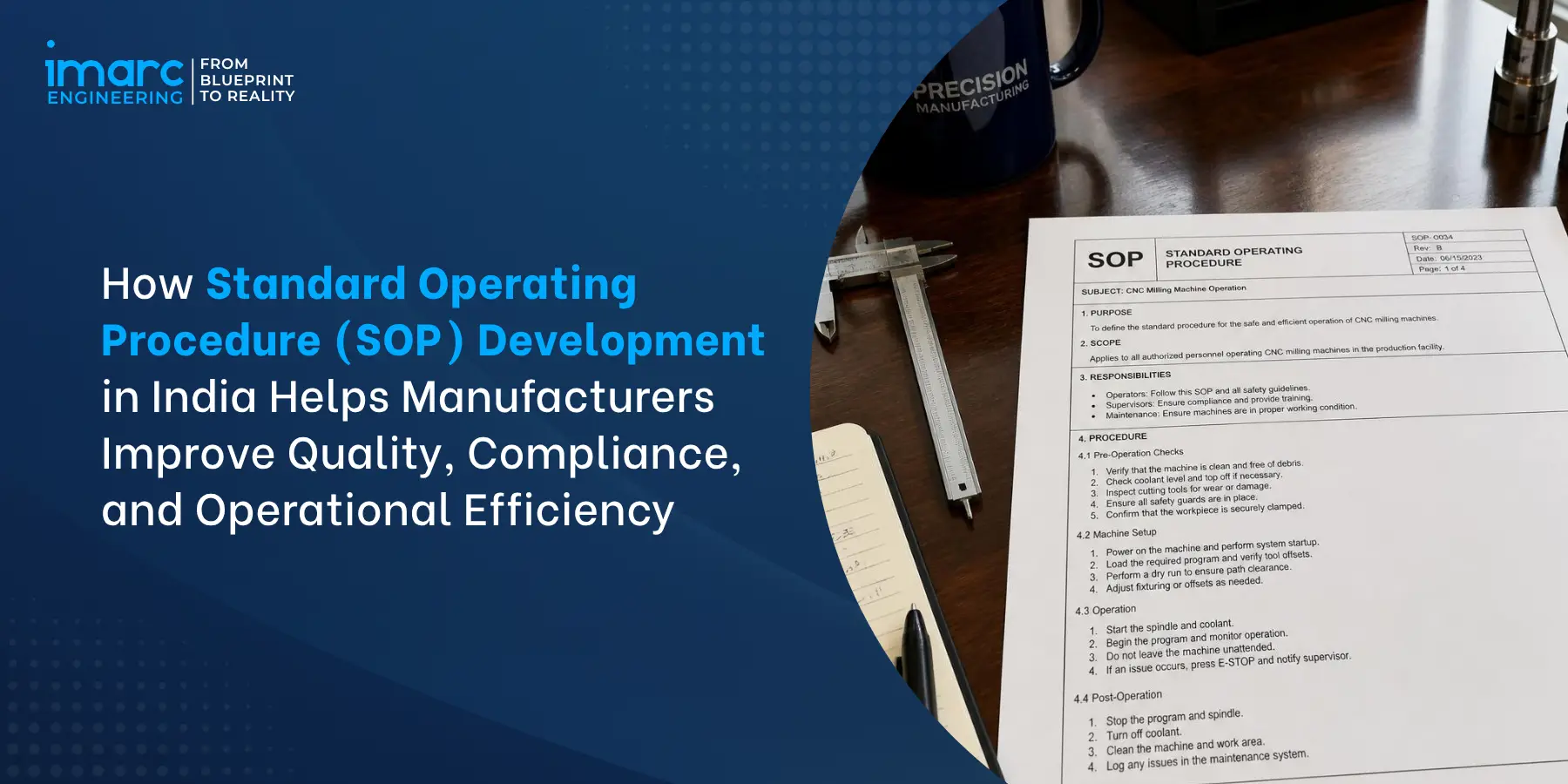
How Standard Operating Procedure (SOP) Development in India Helps Manufacturers Improve Quality, Compliance, and Operational Efficiency
Introduction
For any Indian manufacturer pursuing quality leadership, regulatory compliance, and operational excellence in 2026, structured Standard Operating Procedure (SOP) development in India is a strategic operational capability rather than a documentation exercise.
Well-developed SOPs standardise processes, improve quality, reduce operational variability, and support regulatory compliance while enabling workforce consistency, training effectiveness, and production reliability. Structured manufacturing SOP development progressively distinguishes quality leaders from compliance laggards across sectors.
Scope of this Guide
This guide answers the quality leader's SOP question directly. How can professional SOP development improve process consistency, regulatory compliance, product quality, and operational efficiency? It walks through structured development workflow, SOP writing discipline, ISO 9001 and GMP compliance integration, equipment and maintenance procedures, safety and quality protocols, document control, and the practices that separate structured SOP documentation from templated exercises that fail regulatory scrutiny and operational effectiveness.
Table of Contents
- Introduction
- Why SOP Development Matters in Indian Manufacturing
- How to Develop Effective Manufacturing SOPs in India
- Structured SOP Writing and Documentation for Indian Manufacturers
- SOP Development for ISO 9001 and GMP Compliance in India
- Equipment Operation SOPs and Maintenance Procedures in India
- Safety and Quality SOPs for Manufacturing Plants in India
- Document Control and Revision Management for Manufacturing SOPs in India
- Common Mistakes and Best Practices
- Conclusion
1. Why SOP Development Matters in Indian Manufacturing
Four structural drivers make disciplined SOP development a strategic priority for Indian manufacturers in 2026.
1.1 Regulatory Framework Intensification
Indian manufacturing regulatory frameworks progressively require structured documented procedures. Central Drugs Standard Control Organisation (CDSCO) enforces Schedule M requirements as revised in 2024. Food Safety and Standards Authority of India (FSSAI) mandates Schedule 4 Good Manufacturing Practices.
Bureau of Indian Standards (BIS) certifications require structured quality management. Environmental regulators progressively require documented procedures under Consent to Operate conditions. Buyer supplier codes across automotive, aerospace, pharmaceutical, and consumer categories increasingly require documented procedures supporting audit readiness.
1.2 Quality and Consistency Requirements
Buyer quality expectations progressively tighten across sectors. Six Sigma quality levels, Right First Time (RFT) targets above 95 percent, and defects-per-million targets below 100 progressively become baseline rather than premium.
Sustained quality achievement requires disciplined process standardization reducing operational variability. Structured SOPs ensure consistent execution across shifts, operators, and locations that unwritten operator knowledge cannot sustain across turnover, growth, and complexity increases.
1.3 Workforce Turnover and Training Discipline
Manufacturing workforce turnover including operators, supervisors, and specialists progressively challenges knowledge continuity. Structured SOPs and work instructions enable systematic training, reduce onboarding time (typically 30-50 percent for structured SOP-based training), and preserve operational knowledge across personnel changes.
Progressive skills shortages in specialised functions further elevate SOP importance as knowledge codification mechanism. Structured documentation materially outperforms informal knowledge transfer across scale.
1.4 Buyer Audit and Certification Requirements
Global buyer audit programmes, IATF 16949 automotive supplier requirements, aerospace AS9100 certification, pharmaceutical GMP audits, and export market inspections progressively require documented procedures with structured audit trails.
Buyer supplier scorecards weight documentation discipline alongside product quality performance. Structured SOP development supporting demonstrable audit readiness materially outperforms reactive compliance approaches that fail buyer audits and progressively lose supplier status.
2. How to Develop Effective Manufacturing SOPs in India
Understanding how to develop effective manufacturing SOPs in India helps quality leaders sequence programme decisions correctly. Structured SOP development services integrate process analysis, drafting, review, deployment, and continuous improvement into coherent programmes.
2.1 The Six-Stage Development Roadmap
| Stage | Activities | Typical Duration |
|---|---|---|
| Scope and Prioritisation | SOP inventory, gap analysis, prioritisation | 3-6 weeks |
| Process Mapping | Gemba walks, SIPOC, swimlanes, flowcharts | 4-8 weeks |
| Drafting | Structured writing, cross-functional input | 8-16 weeks |
| Review and Approval | Technical, quality, compliance reviews | 3-6 weeks |
| Training and Deployment | Roll-out, competency assessment, handover | 4-8 weeks |
| Sustainment | Compliance monitoring, review cycles, revisions | Ongoing |
2.2 Document Hierarchy
Structured quality documentation follows established hierarchy. Level 1 covers Quality Manual and Quality Policy defining organisational commitments. Level 2 covers Standard Operating Procedures (SOPs) describing what, when, where, and by whom activities occur. Level 3 covers Work Instructions describing how activities are performed in step-by-step detail. Level 4 covers Records and Forms capturing evidence of execution. Structured hierarchy prevents both procedural gaps and administrative overload from misplacing content across levels.
2.3 SOP Development Cost and Engagement Models
Structured SOP development cost and engagement models India scale with scope and complexity. Basic SOP sets for single facilities and single products typically require INR 5-25 lakh over 3-6 months. Comprehensive frameworks for multi-product facilities typically require INR 25 lakh-2 crore over 6-12 months.
Full quality management system implementation including SOPs typically requires INR 50 lakh-5 crore over 12-18 months. Electronic Quality Management System (eQMS) and Document Management System (DMS) software typically requires INR 15 lakh-2 crore additional. Structured engagement supports both current requirements and sustainment capability development.
3. Structured SOP Writing and Documentation for Indian Manufacturers
Structured SOP writing and documentation for Indian manufacturers translates process understanding into usable operational guidance. Well-written SOPs materially outperform templated documents that operators ignore in practice.
3.1 Standard SOP Components
- Title, Document ID, and Version number
- Purpose or Objective statement
- Scope defining applicability
- Responsibilities identifying roles
- Definitions and abbreviations glossary
- Materials, equipment, and prerequisites
- Procedure with numbered step-by-step instructions
- Safety precautions and Personal Protective Equipment
- Quality checks and acceptance criteria
- Documentation requirements and records
- References to related SOPs and standards
- Revision history with change rationale
- Appendices including flowcharts, checklists, forms
3.2 Writing Principles
Effective SOP writing follows structured principles. Active voice materially outperforms passive constructions for operator clarity. Short sentences typically limited to 20 words or less improve comprehension. Numbered steps with single actions per step support execution discipline. Consistent terminology across SOPs supports training economics.
Visual elements including flowcharts, photographs, and diagrams supplement text where beneficial. Language appropriate to operator literacy including regional language versions where warranted supports practical use. Structured writing standards ensure consistency across large SOP portfolios.
3.3 Process Mapping Foundations
Process mapping precedes SOP drafting. Suppliers-Inputs-Process-Outputs-Customers (SIPOC) diagrams provide high-level process overview. Swimlane diagrams show cross-functional handoffs. Value Stream Mapping identifies value-added versus non-value-added activities.
Business Process Modeling Notation (BPMN) provides standardised process notation. ANSI-standard flowcharts document decision logic. Gemba walks observing actual work practice materially outperform desk-based mapping. Structured process mapping typically extends 4-8 weeks for medium-scope programmes producing analytical foundation for SOP drafting.
3.4 Cross-Functional Development
Effective SOP development integrates cross-functional input. Operations personnel contribute practical execution knowledge. Quality function contributes standards and validation requirements. Engineering contributes technical accuracy. Maintenance contributes equipment operation guidance.
Safety function contributes hazard identification and controls. Compliance function contributes regulatory alignment. Structured cross-functional development supports both accuracy and organisational buy-in that single-function drafting typically cannot achieve.
4. SOP Development for ISO 9001 and GMP Compliance in India
SOP development for ISO 9001 and GMP compliance integrates internationally recognised quality frameworks with domestic regulatory requirements. Structured ISO SOP documentation and GMP SOP development support both certification achievement and sustained compliance.
4.1 ISO 9001 Quality Management System Framework
ISO 9001:2015 Quality Management Systems requires structured documented information under Clause 7.5. Required documented procedures cover control of documents, control of records, internal audits, control of nonconforming product, corrective action, and preventive action. Additional SOPs cover product realisation, monitoring and measurement, resource management, and management review.
Structured SOP hierarchy aligned with ISO 9001 clauses supports both certification audits and operational discipline. Related standards include ISO 14001 (Environmental), ISO 45001 (Health & Safety), and ISO 50001 (Energy).
4.2 GMP Framework for Regulated Industries
| Framework | Sector Application |
|---|---|
| WHO Good Manufacturing Practices | Global pharmaceutical baseline |
| US FDA 21 CFR Parts 210 and 211 | Pharmaceutical for US market access |
| EU GMP Guidelines | Pharmaceutical for EU market |
| PIC/S Guide to GMP | Internationally harmonised pharma GMP |
| Schedule M (D&C Rules 1945, revised 2024) | Indian pharmaceutical |
| ICH Q7 | Active Pharmaceutical Ingredient GMP |
| ICH Q10 | Pharmaceutical Quality System |
| FSSAI Schedule 4 | Food Good Manufacturing Practices |
| 21 CFR Part 11 | Electronic records and signatures |
4.3 Sector-Specific Frameworks
Sector-specific frameworks build on general quality standards. IATF 16949 governs automotive quality management with specific SOP requirements. AS9100 governs aerospace quality management. ISO 13485 governs medical devices quality management.
ISO 22000 and HACCP govern food safety management. ISO 17025 governs testing and calibration laboratories. Structured SOP frameworks aligned with sector standards support both compliance and buyer engagement in respective sectors.
4.4 Quality Management SOPs
Quality management SOP frameworks cover the specific procedures required for structured quality operations. Standard SOPs include change control, deviation management, Corrective and Preventive Action (CAPA), risk assessment, supplier qualification, batch record review, equipment qualification (IQ/OQ/PQ), calibration management, cleaning validation for regulated industries, environmental monitoring, out-of-specification investigation, product recall, and internal audit. Structured quality SOPs materially outperform ad-hoc quality management particularly in regulated sectors.
5. Equipment Operation SOPs and Maintenance Procedures in India
Equipment operation SOPs and maintenance procedures translate manufacturer specifications and maintenance requirements into operational discipline. Equipment SOPs typically represent 30-50 percent of total manufacturing SOP portfolio by volume.
5.1 Equipment Operation SOPs
Equipment operation SOPs cover startup procedures with pre-operation checks, normal operation with parameter monitoring, shutdown procedures including safe state establishment, emergency operations including E-stop protocols, changeover procedures for multi-product equipment, and cleaning between batches or campaigns.
OEM manuals provide technical foundation while site-specific factors require adaptation. Structured equipment SOPs materially reduce both operational errors and equipment damage supporting both productivity and asset life extension.
5.2 Maintenance SOPs
- Preventive maintenance (PM) procedures with defined intervals
- Corrective maintenance triggered by equipment failures
- Predictive maintenance based on condition monitoring outputs
- Lockout-Tagout (LOTO) safety isolation procedures
- Work permit procedures for hot work, confined space, and elevated work
- Spare parts issue and return procedures
- Contract maintenance oversight procedures
- Equipment qualification and calibration procedures
5.3 Work Instruction Development
Work instruction development provides step-by-step operational guidance at Level 3 of the documentation hierarchy. Work instructions materially exceed SOPs in operational detail supporting untrained operators through complex tasks.
Visual work instructions incorporating photographs, diagrams, and increasingly video content support diverse literacy levels and complex tasks. Structured work instruction development materially reduces training time and operational errors for repetitive activities.
5.4 Training and Workforce Enablement
Training and workforce enablement through SOPs in India transforms documented procedures into operational competence. Structured training programmes cover initial SOP training with defined competency assessment, refresher training on defined cycles, change management training when SOPs are revised, and cross-training supporting workforce flexibility.
Learning Management Systems (LMS) support scaled training administration. Structured training discipline materially outperforms ad-hoc SOP reading that leaves operational competence uncertain.
6. Safety and Quality SOPs for Manufacturing Plants in India
Safety and quality SOPs for manufacturing plants address the specific procedural requirements around personnel safety and product quality. Both dimensions typically require dedicated SOP subsets given specialised regulatory and technical content.
6.1 Safety SOPs
- Personal Protective Equipment (PPE) selection and use
- Chemical handling and Material Safety Data Sheet (MSDS) protocols
- Hazard identification and risk assessment procedures
- Emergency response including fire, chemical spill, medical
- Confined space entry per applicable standards
- Working at height with fall protection
- Electrical safety including lockout-tagout
- Incident reporting and investigation procedures
- Contractor safety management
- Occupational health surveillance under OSH Code 2020
6.2 Occupational Health and Safety Framework
Safety SOPs align with Occupational Safety Health and Working Conditions Code 2020 (in force from 21 November 2025), ISO 45001 Occupational Health and Safety Management Systems, and sector-specific safety frameworks. Hazard and Operability (HAZOP) studies inform SOP development for high-hazard operations.
Layers of Protection Analysis (LOPA) supports SOP development for critical safety procedures. Structured safety SOPs supporting both regulatory compliance and workforce protection materially outperform generic safety documentation.
6.3 Quality Control SOPs
Quality Control SOPs cover incoming material inspection, in-process quality checks, finished product testing, calibration of measuring instruments, sampling procedures per applicable standards, laboratory testing methods, statistical process control including control charts, non-conforming product handling, and retention samples management. Analytical method validation per ICH Q2 for regulated products. Structured QC SOPs supporting both routine operations and regulatory audit requirements.
6.4 Quality Assurance SOPs
Quality Assurance SOPs cover supplier qualification and audit, internal audit programme, management review, customer complaint handling, product recall procedures, change control, deviation and Out-of-Specification (OOS) investigation, Corrective and Preventive Action (CAPA), risk management per ISO 31000 and ICH Q9, product release procedures, and Annual Product Review (APR) or Product Quality Review (PQR) for regulated products. Structured QA SOPs supporting both compliance and operational discipline.
7. Document Control and Revision Management for Manufacturing SOPs in India
Document control and revision management for manufacturing SOPs sustains SOP effectiveness across time and organisational change. Uncontrolled documents progressively lose both effectiveness and compliance value.
7.1 Document Control Framework
| Element | Requirement |
|---|---|
| Unique document identifier | SOP-Department-Sequence-Version format typical |
| Version control | Numerical major/minor with change rationale |
| Approval workflow | Author, Reviewer, Approver with roles |
| Distribution control | Controlled copies with version tracking |
| Obsolete document handling | Structured retrieval and archival |
| Change control | Formal process for SOP updates |
| Training verification | Documented competency post-changes |
| Audit trail | Full history of creation, changes, approvals |
7.2 Revision Cycles and Triggers
SOPs require periodic review to sustain relevance. Structured review cycles typically 12-24 months for standard SOPs and shorter for critical SOPs. Additional revision triggers include regulatory changes, equipment modifications, process improvements, incident-driven learning, audit findings, deviation trends, and organisational changes.
Structured review discipline prevents SOP obsolescence while managing revision workload. Balance between stability and continuous improvement requires structured governance.
7.3 Electronic Document Management Systems
Electronic Document Management Systems (DMS) and electronic Quality Management Systems (eQMS) support scaled SOP management. Common platforms include MasterControl, Veeva Vault, Qualio, Sparta Systems (TrackWise), IQVIA, and ETQ Reliance.
Platforms support document lifecycle management, workflow automation, training management, and audit trail generation. 21 CFR Part 11 compliance for electronic records and signatures required for regulated industries. Structured DMS deployment typically extends 6-12 months for medium-sized facilities supporting sustained SOP discipline.
7.4 Audit Readiness and Compliance
Structured document control supports both routine operations and audit readiness. Regulatory inspections including CDSCO, FSSAI, US FDA (for exporters), and state inspections require documented procedures with structured audit trails.
Buyer audits progressively require SOP demonstration and training records. ISO surveillance and re-certification audits assess documentation discipline alongside operational compliance. Structured audit-ready documentation materially outperforms reactive preparation immediately before inspections.
8. Common Mistakes and Best Practices
8.1 Templated Copy Without Site Adaptation
SOPs copied from template libraries without site-specific adaptation produce documents that operators cannot practically follow.
Best practice: SOPs grounded in actual site processes through Gemba walks; cross-functional development incorporating operator input; iterative review and refinement; pilot testing before broad deployment; language and literacy adaptation to workforce reality.
8.2 Over-Detailed or Under-Detailed Content
SOPs overly detailed become unusable while under-detailed SOPs lack operational guidance value.
Best practice: content depth matched to task complexity and operator experience; work instructions supporting SOPs for complex tasks; visual elements including flowcharts and photographs supplementing text; structured writing standards preventing both extremes; regular readability assessment through operator feedback.
8.3 Weak Document Control Discipline
SOPs deployed without structured document control progressively lose both effectiveness and compliance value.
Best practice: unique document identifiers with structured taxonomy; version control with change rationale; formal approval workflow; controlled distribution preventing uncontrolled copies; obsolete document handling; audit trail supporting compliance verification; electronic document management for scaled operations.
8.4 Training Deficiency Undermining SOP Value
SOPs deployed without structured training produce operational disconnect between documentation and practice.
Best practice: SOP training integrated with deployment; competency assessment before authorising operators; refresher training on defined cycles; change management training for revisions; training records supporting compliance verification; Learning Management System (LMS) for scaled training administration.
8.5 Static SOPs Without Continuous Improvement
SOPs treated as static documents miss continuous improvement opportunities and progressively lose operational alignment.
Best practice: structured review cycles balancing stability and improvement; deviation and CAPA feedback informing SOP updates; operator feedback mechanisms; performance metrics identifying improvement opportunities; management review integrating SOP effectiveness with broader QMS performance.
Conclusion
Standard Operating Procedure (SOP) development in India combines process mapping, cross-functional drafting, consistent documentation practices, ISO and GMP framework alignment, sector-specific compliance, equipment and maintenance procedures, safety and quality protocols, document control infrastructure, training integration, and continuous improvement into a coherent operational framework.
Effective SOP implementation depends on documenting actual shop-floor practices, integrating operator training with deployment, and establishing robust document control systems that scale with manufacturing operations.
PLANNING YOUR SOP DEVELOPMENT PROGRAMME?
IMARC Engineering's SOP development and manufacturing documentation advisory team supports quality leaders, operations heads, and manufacturing sponsors across baseline assessment covering existing documentation and compliance gaps, SOP prioritisation and scope definition, process mapping through Gemba walks and cross-functional workshops, structured SOP drafting with technical writers and subject matter experts, work instruction development, quality management SOP frameworks, GMP compliance across pharmaceutical Schedule M, WHO GMP, sector-specific frameworks including IATF 16949 automotive, AS9100 aerospace, ISO 13485 medical devices, ISO 22000 and HACCP food safety, ISO 17025 laboratories, document control infrastructure and electronic Document Management System (DMS) deployment, Learning Management System (LMS) integration for training, change management, and continuous improvement across sectors in India.
→ Schedule a free SOP development scoping consultation with an IMARC specialist
Frequently Asked Questions
A Standard Operating Procedure is a documented set of step-by-step instructions describing how activities should be performed to ensure consistency, quality, safety, and compliance. Structured Standard Operating Procedure (SOP) Development in India covers manufacturing, quality control, quality assurance, equipment operation, maintenance, safety, cleaning, calibration, and administrative procedures collectively defining organisational operational discipline.
SOPs standardise processes reducing operational variability, improve quality and consistency across shifts and operators, support regulatory compliance including ISO and GMP frameworks, enable systematic training and reduce onboarding time (typically 30-50 percent), support audit readiness for buyers and regulators, preserve operational knowledge across workforce turnover, and provide foundation for continuous improvement. Structured SOPs materially outperform informal knowledge transfer across scale.
SOPs supporting process standardization reduce operational variability driving both quality performance and consistency. Structured programmes typically deliver 15-30 percent quality improvement, 25-50 percent deviation reduction, 15-30 percent rework and scrap reduction, and 40-70 percent audit finding reduction. Right First Time (RFT) targets and defects-per-million improvement follow structured SOP deployment supporting sustained quality achievement.
Standard components include title, document ID, and version; purpose or objective; scope defining applicability; responsibilities; definitions and abbreviations; materials, equipment, and prerequisites; step-by-step procedure with numbered instructions; safety precautions and PPE; quality checks and acceptance criteria; documentation requirements; references; revision history; and appendices including flowcharts and checklists. Structured components ensure comprehensive operational guidance.
SOP development for ISO 9001 and GMP compliance provides documented information required under respective frameworks. ISO 9001:2015 Clause 7.5 mandates documented information supporting Quality Management System. GMP frameworks including WHO GMP, US FDA 21 CFR Parts 210 and 211, Schedule M revised 2024, ICH Q7, and FSSAI Schedule 4 require structured procedures across operational, quality, and compliance dimensions. Structured SOP frameworks support both certification and sustained compliance.
Structured review cycles typically 12-24 months for standard SOPs and shorter for critical SOPs. Additional revision triggers include regulatory changes, equipment modifications, process improvements, incident-driven learning, audit findings, deviation trends, and organisational changes. Structured review discipline prevents SOP obsolescence while managing revision workload supporting continuous improvement without change fatigue.
SOP development services from engineering consultants support baseline assessment, process mapping, cross-functional drafting with technical writers and subject matter experts, ISO and GMP framework alignment, sector-specific compliance, document control infrastructure setup, electronic Document Management System deployment, training integration through Learning Management Systems, change management, and continuous improvement. Structured integrated advisory typically outperforms fragmented internal-only development.
Standard Operating Procedures typically describe what, when, where, and by whom activities occur at Level 2 of documentation hierarchy. Work instructions describe how activities are performed in step-by-step detail at Level 3. Work instructions materially exceed SOPs in operational detail supporting complex tasks or newer operators. Both documents work together with Level 1 Quality Manual providing organisational commitments and Level 4 Records capturing execution evidence.
Structured SOP development typically extends 3-9 months for medium-sized facilities and 12-18 months for large or highly regulated operations. Scope and prioritisation 3-6 weeks. Process mapping 4-8 weeks. Drafting 8-16 weeks. Review and approval 3-6 weeks. Training and deployment 4-8 weeks. Parallel execution across workstreams compresses total elapsed time. Sustainment continues indefinitely with structured review cycles.
Recent Post


Trusted by Industry Leaders
We partner with global enterprises and ambitious businesses across sectors to deliver operational excellence, strategic insights, and sustainable growth through integrated solutions.









Success in Their Words
Real feedback from clients across industries. Discover how our solutions delivered measurable impact and operational excellence.

I wanted to express my sincere appreciation for your efforts in handling this matter. Your dedication and commitment have been truly commendable, and it is evident that you have put in tremendous hard work and expertise into resolving the issues at hand. We are greatly interested in continuing our collaboration with you in the future, as your professionalism and reliability have made you a trusted partner. Thank you once again for your invaluable contribution. We look forward to strengthening our partnership ahead.

It has been a pleasure working with the IMARC team. The insights provided were structured, clear, and highly valuable, helping us strengthen both our technical and financial planning with confidence. We deeply appreciate the team’s professionalism, responsiveness, and attention to detail throughout the engagement. Every requirement was well understood and effectively incorporated, resulting in a comprehensive and actionable output. Overall, our experience has been excellent, and I would gladly recommend IMARC to organizations seeking a reliable research partner.

Your service is truly exceptional. Working with the IMARC team has been a seamless and professional experience. The clarity of communication, responsiveness to queries, and consistent support at every stage made the entire engagement highly efficient. The insights shared were well-structured, practical, and perfectly aligned with our requirements, helping us make informed decisions with confidence. Overall, the dedication and professionalism demonstrated by your team stand out, and I would be glad to recommend IMARC as a reliable and trustworthy research partner.

IMARC did an outstanding job in preparing our study. They were punctual, precise, and consistently responsive throughout the entire process. The team delivered all the data we required in a clear, well-organized, and highly professional format. Their strong attention to detail, combined with their ability to meet every deadline without compromising quality, truly set them apart. Overall, their reliability and commitment made them an exceptional partner for our project, and we would gladly work with them again in the future.

IMARC made the whole process incredibly easy from start to finish. Everyone I interacted with via email was polite, professional, and straightforward to deal with, always keeping their promises regarding delivery timelines and remaining consistently solutions-focused. From my very first contact, I appreciated the professionalism and support shown by the entire IMARC team. I highly recommend IMARC to anyone seeking timely, affordable, and reliable information or advice. My experience with IMARC was excellent, and I truly cannot fault any aspect of it.

I’d like to express my sincere gratitude for the excellent work you accomplished with the study. Your ability to quickly understand our requirements and deliver high-quality results under tight timelines truly reflects your expertise, exceptional work ethic, and unwavering commitment to your customer’s success. The professionalism and responsiveness you demonstrated throughout the process made a significant difference. Our entire team and company are incredibly thankful for your dedication, reliability, and support. Once again, thank you for your outstanding contribution.