Manufacturing
August 10 2026
How Engineering-Led Equipment Procurement in India Improves Manufacturing Project Success
Introduction
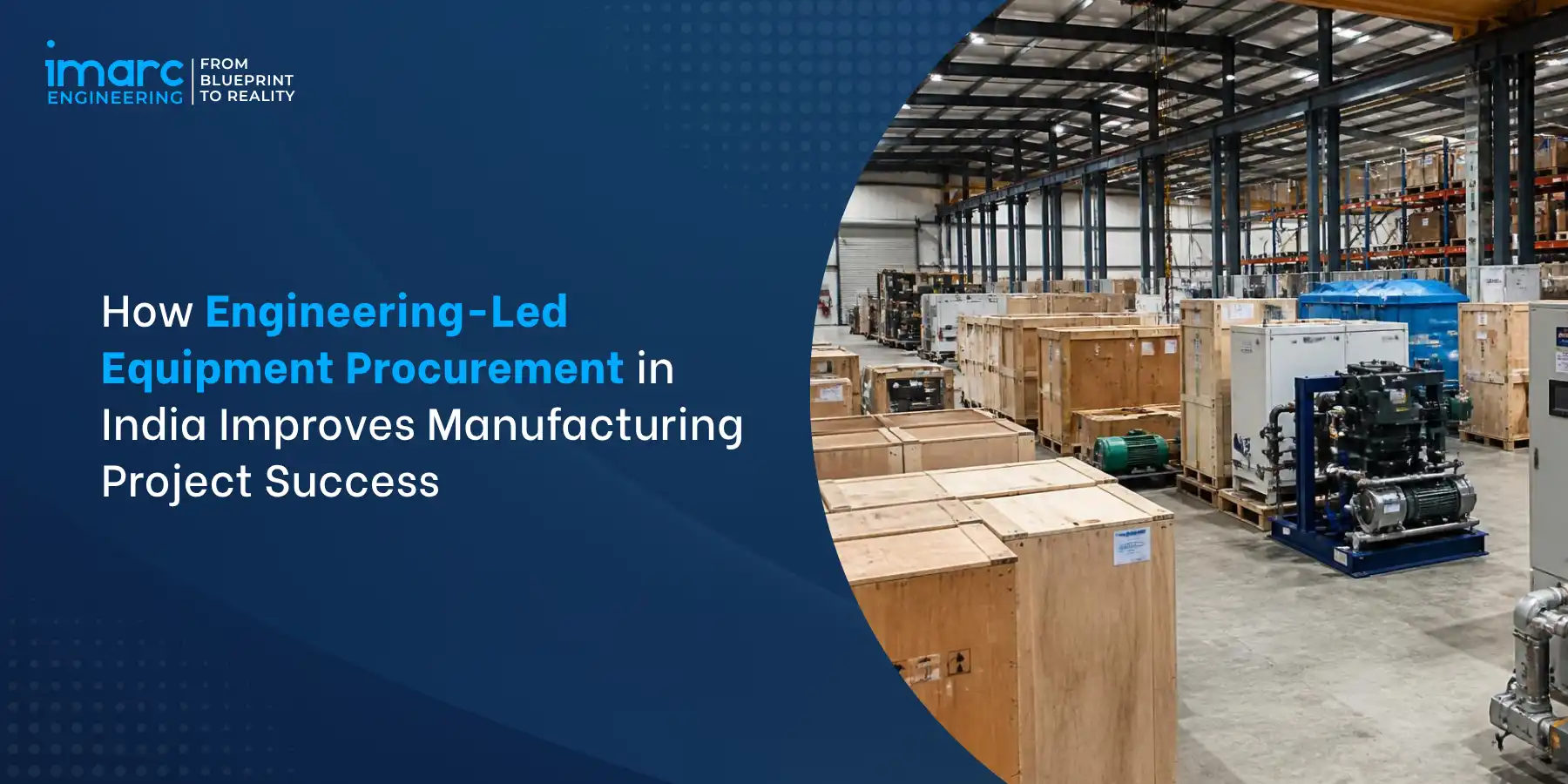
For any Indian manufacturer investing in new production capacity in 2026, disciplined equipment procurement in India extends materially beyond purchasing machinery from suppliers. Engineering-led procurement approach directly influences manufacturing project success, operational efficiency, lifecycle costs, and plant reliability.
The process integrates technical requirement analysis, specification development, vendor evaluation, bid analysis, Factory Acceptance Testing (FAT), Site Acceptance Testing (SAT), and commissioning support into a coordinated procurement programme.
Scope of this Guide
This guide answers the manufacturing sponsor's procurement question directly. How can engineering-led equipment procurement reduce risks, select the right equipment, improve project execution, and achieve better long-term manufacturing performance? It walks through structured drivers, procurement workflow, technical specification discipline, vendor prequalification and evaluation, bid evaluation methodology, structured factory acceptance testing (FAT) and site acceptance testing (SAT), lifecycle cost assessment, and the practices that separate structured procurement engineering from transactional purchasing that consistently disappoints project outcomes.
Table of Contents
- Introduction
- Why Engineering-Led Equipment Procurement Matters in 2026
- How to Procure Industrial Equipment for Manufacturing Plants in India
- Technical Specification and RFQ Preparation for Equipment Procurement in India
- Vendor Prequalification and Evaluation for Manufacturing Equipment in India
- Technical and Commercial Bid Evaluation for Equipment Procurement in India
- Factory Acceptance Testing and Site Acceptance Testing for India
- Lifecycle Cost Assessment for Equipment Procurement in India
- Common Mistakes and Best Practices
- Conclusion
1. Why Engineering-Led Equipment Procurement Matters in 2026
Four structural drivers make disciplined procurement engineering a strategic priority for Indian manufacturers in 2026.
1.1 Capital Intensity and Procurement Impact
Equipment procurement typically represents 40-65 percent of manufacturing project capex across sectors. Poor procurement decisions materially affect both immediate project costs and long-term operational economics.
Structured procurement engineering typically delivers 5-15 percent procurement cost reduction and 10-25 percent lifecycle cost reduction versus ad-hoc purchasing. On multi-hundred crore capital commitments, procurement engineering economics alone typically support structured advisory investment materially exceeding programme cost.
1.2 Technical Complexity Growth
Modern manufacturing equipment integrates progressively sophisticated technology across process, automation, safety, environmental, and digital dimensions. Structured manufacturing equipment selection requires integrated evaluation across these dimensions rather than single-driver technology comparison.
Complexity growth outpaces internal procurement team capability at most manufacturers producing progressive dependency on structured engineering support. Ad-hoc procurement approaches consistently underperform structured engineering-led evaluation as technology complexity grows.
1.3 Supply Chain and Geopolitical Considerations
Global supply chain dynamics including geopolitical tensions, tariff changes, currency volatility, and shipping disruptions progressively affect procurement decisions. Domestic versus imported equipment evaluation requires structured analysis. Vendor consolidation and dual-sourcing strategies.
Documented supply chain risk assessment during procurement. Warranty and service network considerations across geographies. Structured procurement engineering materially supports resilient supply chain construction that ad-hoc approaches typically cannot achieve.
1.4 Compliance and Certification Requirements
Sector-specific equipment certification requirements progressively expand. Bureau of Indian Standards (BIS) mandatory certifications for specific equipment categories. Petroleum and Explosives Safety Organisation (PESO) approvals for hazardous applications. Central Drugs Standard Control Organisation (CDSCO) requirements for pharmaceutical equipment.
CE marking for European market equipment. UL and CSA certifications for North American components. ATEX and IECEx certifications for hazardous atmosphere equipment. Structured procurement engineering ensuring certification compliance materially outperforms ad-hoc procurement that produces late-stage compliance surprises.
2. How to Procure Industrial Equipment for Manufacturing Plants in India
Understanding how to procure industrial equipment for manufacturing plants in India helps sponsors sequence procurement decisions correctly. Structured equipment procurement services integrate requirement analysis, specification, sourcing, evaluation, contracting, expediting, inspection, and commissioning into coherent workflow.
2.1 The Structured Procurement Engineering Workflow
Structured equipment procurement and engineered equipment sourcing strategies integrate requirement analysis, specification, sourcing, evaluation, contracting, expediting, inspection, and commissioning into a coherent workflow.
| Stage | Activities | Typical Duration |
|---|---|---|
| Requirement Analysis | Process needs, capacity, technology, integration | 3-6 weeks |
| Specification Development | Technical specs, RFQ preparation, drawings | 4-8 weeks |
| Vendor Prequalification | Long list, RFI, capability assessment | 4-6 weeks |
| Tendering and Bidding | RFQ issue, clarifications, bid submission | 6-10 weeks |
| Bid Evaluation | Technical then commercial evaluation, negotiation | 4-8 weeks |
| Contracting | Purchase order, terms, warranties, timelines | 2-4 weeks |
| Expediting and Inspection | Manufacturing progress, third-party inspection | 3-12 months (parallel) |
| FAT, Delivery, SAT, Commissioning | Factory testing, transit, site testing, startup | 2-6 months |
2.2 Equipment Procurement Cost and Engagement Models
Equipment procurement cost and engagement models scale with project complexity and scope. Basic procurement engineering for single equipment packages typically requires INR 5-25 lakh over 3-6 months. Comprehensive procurement engineering for major projects typically requires INR 25 lakh-5 crore over 6-18 months.
Full project procurement management typically requires INR 1-15 crore for large integrated facilities. Fee structures typically range 2-8 percent of equipment value depending on scope. Structured engagement supports both current procurement and internal capability development.
2.3 Governance and Documentation
Structured procurement governance covers Procurement Committee with executive representation for major awards, structured Delegation of Authority (DOA) matrices defining approval levels, formal Purchase Requisition and Purchase Order workflows, structured contract terms including delivery, warranty, liquidated damages, and payment milestones, documented change management preventing scope creep, and structured record retention supporting future audit. Robust governance materially outperforms informal procurement across large or complex projects.
3. Technical Specification and RFQ Preparation for Equipment Procurement in India
Technical specification and RFQ preparation for equipment procurement define the engineering foundation on which vendor evaluation and downstream project success rest. Structured technical specification development materially outperforms generic RFQs that produce non-comparable bids and downstream disputes.
3.1 Technical Specification Components
- Scope of supply with clear battery limits
- Performance requirements including throughput, quality, and utility consumption
- Applicable design codes and international standards
- Materials of construction with metallurgy specifications
- Process parameters including temperature, pressure, and flow
- Utility requirements with connection specifications
- Documentation deliverables including drawings, calculations, and manuals
- Testing requirements including FAT and SAT protocols
- Painting, coating, and surface treatment
- Packaging and shipping requirements
- Warranty terms and service requirements
- Spare parts scope covering commissioning, two-year, and lifetime spares
3.2 Design Codes and Applicable Standards
Structured specification references applicable design codes and standards. American Society of Mechanical Engineers (ASME) Boiler and Pressure Vessel Code (BPVC) for pressure equipment. American Petroleum Institute standards including API 610 for centrifugal pumps, API 617 for compressors, and API 686 for machinery installation. Institute of Electrical and Electronics Engineers (IEEE) for electrical equipment.
National Fire Protection Association (NFPA) standards. International Electrotechnical Commission IEC 60204 for machinery electrical safety. Bureau of Indian Standards (BIS) for domestic requirements. Structured code specification prevents both under-specification and unnecessary premium pricing.
3.3 RFQ Preparation Discipline
RFQ documents combine technical specifications, commercial terms, evaluation criteria, submission requirements, and timeline into structured tender packages. Bidder instructions clearly define documentation expectations preventing incomplete or incomparable bids. Structured pricing formats supporting apples-to-apples comparison across bidders.
Clear commercial terms including delivery, payment milestones, warranty, and liquidated damages. Structured evaluation criteria weighting communicated to bidders supporting transparency and legitimate expectations. Structured RFQ preparation materially reduces both bid evaluation complexity and post-award disputes.
3.4 Battery Limits and Interface Definition
Structured battery limit definition prevents costly interface disputes during execution. Physical battery limits including foundation edges, piping tie-ins, and cable termination points. Process battery limits including inlet and outlet conditions.
Utility battery limits with defined connection points and quality. Documentation battery limits defining what vendor provides versus buyer scope. Structured interface matrices for complex multi-vendor projects preventing scope gaps and overlaps. Battery limit clarity materially reduces both project risk and change order disputes during execution.
4. Vendor Prequalification and Evaluation for Manufacturing Equipment in India
Vendor prequalification and evaluation for manufacturing equipment ensures qualified bidders before tender issuance rather than post-bid discovery of vendor limitations. Structured vendor evaluation materially reduces both bid evaluation complexity and post-award performance issues.
4.1 Vendor Evaluation Criteria
| Dimension | Evaluation Focus |
|---|---|
| Technical capability | Product portfolio, engineering strength, R&D |
| Manufacturing capacity | Facility scale, workload, delivery capability |
| Financial strength | Balance sheet, credit rating, financial track record |
| Quality certifications | ISO 9001, sector-specific certifications |
| Reference installations | Comparable projects, performance history |
| Service network | Geographic coverage, response capability |
| Delivery track record | Schedule performance on comparable orders |
| Warranty and after-sales | Terms, response time, parts availability |
4.2 Prequalification Process
Structured prequalification typically begins with long-list development from published sources, industry references, and previous experience. Request for Information (RFI) surveys capability, capacity, and interest. Reference site visits validating technical claims.
Financial evaluation covering solvency and stability. Structured scoring against defined criteria produces qualified short-list for tender participation. Prequalification typically extends 4-6 weeks producing structured shortlist preventing tender participation by unqualified bidders.
4.3 Reference Site Visits
Structured reference site visits validate vendor claims through direct observation. Visits typically cover comparable installations, operator interviews, and OEM interaction observation. Structured questionnaires ensuring comparable information across visits. Documented reference reports supporting evaluation.
Reference reliability considerations including whether references are current customers, whether references were suggested by vendor versus independent identification, and whether visited sites accurately represent target application. Structured reference discipline materially outperforms vendor-selected reference conversations.
4.4 Vendor Risk Assessment
Structured vendor risk assessment considers financial risk (bankruptcy exposure), delivery risk (schedule slippage history), quality risk (defect and warranty history), service risk (post-sale support capability), commercial risk (litigation history), technology risk (obsolescence exposure), and geopolitical risk (supply chain exposure).
Documented risk register with mitigation strategies supports informed vendor selection. Structured risk assessment materially outperforms reliance on vendor self-representation of capabilities and stability.
5. Technical and Commercial Bid Evaluation for Equipment Procurement in India
Technical and commercial bid evaluation for equipment procurement typically follows structured two-envelope discipline separating technical assessment from commercial consideration. Structured separation supports genuinely capability-driven selection rather than lowest-price-wins dynamics.
5.1 Technical Bid Evaluation
Technical bid evaluation assesses each bid against specification requirements independent of price. Compliance matrix documenting each specification clause against vendor response. Technical clarifications resolving ambiguities and gaps. Vendor engineering discussions during clarification phase. Structured scoring across technical dimensions with defined weights.
Technical qualification threshold above which bids proceed to commercial evaluation. Technically non-compliant bids typically eliminated regardless of price advantages preventing lowest-cost-poor-outcome trap that undermines project success.
5.2 Commercial Bid Evaluation
Commercial bid evaluation of technically qualified bids covers total cost of ownership rather than initial price alone. Price breakdown analysis identifying cost components. Payment milestone economics considering time value. Warranty terms and liquidated damages considered as commercial terms.
Currency and exchange rate provisions. Escalation clauses and their impact. Delivery timeline commercial implications. Structured commercial evaluation supporting decisions on total value rather than initial price minimisation.
5.3 Lifecycle Cost Considerations
Lifecycle cost considerations integrated with commercial evaluation cover projected operating costs over equipment life. Energy consumption differences producing materially different lifecycle economics. Maintenance costs including scheduled maintenance and expected repair frequency.
Spare parts consumption. Reliability and availability implications. Terminal value considerations at end-of-life. Structured lifecycle analysis materially outperforms initial-price-only evaluation particularly for high-utilisation critical equipment.
5.4 Negotiation and Award
Structured negotiation covers technical clarifications, commercial terms improvement, warranty enhancement, and delivery schedule refinement. Documented negotiation records supporting audit compliance. Best and final offer (BAFO) discipline preventing endless negotiation rounds.
Structured award decisions with documented rationale supporting Procurement Committee approval. Post-award communications with unsuccessful bidders supporting relationship management. Structured discipline outperforms informal negotiation which produces both suboptimal terms and disputes.
6. Factory Acceptance Testing and Site Acceptance Testing for India
Factory acceptance testing and site acceptance testing for India provide structured verification supporting equipment quality and performance before commissioning. Structured FAT and SAT discipline distinguishes procurement engineering from transactional purchase-and-hope approaches.
6.1 Factory Acceptance Testing
Factory Acceptance Testing (FAT) verifies equipment at vendor facility before dispatch. Structured FAT protocol defines test procedures, acceptance criteria, and documentation requirements. Buyer or buyer-appointed inspector attendance during FAT ensures direct verification. Third-party inspection agencies including SGS, Bureau Veritas, TUV, and DNV provide independent verification. Documented FAT reports supporting acceptance and payment milestones.
FAT identifies quality issues at vendor facility where correction is materially cheaper than post-delivery remediation. Structured FAT typically extends 1-3 days for standard equipment and up to 2 weeks for complex integrated systems.
6.2 FAT Scope and Testing
- Visual inspection covering workmanship and completeness
- Dimensional verification against approved drawings
- Material certification review including test certificates
- Pressure and leak testing where applicable
- Electrical continuity, insulation, and function testing
- Mechanical operation testing under simulated conditions
- Performance testing where facility permits
- Documentation review including drawings, manuals, and certifications
- Punch list documenting outstanding items with resolution timeline
6.3 Site Acceptance Testing
Site Acceptance Testing (SAT) verifies equipment performance at destination site after installation. Structured SAT protocol defines site-specific tests covering installation quality, utility integration, control system integration, and performance validation. SAT typically extends 1-4 weeks depending on equipment complexity and process integration requirements.
Documented SAT reports supporting final acceptance and payment milestones. Regulated industries additionally require Installation Qualification (IQ), Operational Qualification (OQ), and Performance Qualification (PQ) protocols documenting equipment fitness for purpose.
6.4 SAT Scope and Testing
- Installation verification against approved drawings
- Utility integration testing at operating conditions
- Control system integration with existing DCS or PLC
- Safety system function testing including interlocks
- Performance testing at rated production conditions
- Quality output verification at target specifications
- Energy consumption verification against specifications
- Warranty commencement documentation
- Punch list closure supporting final acceptance
7. Lifecycle Cost Assessment for Equipment Procurement in India
Lifecycle cost assessment for equipment procurement transforms procurement from initial-price-driven purchase to Total Cost of Ownership (TCO) decision. Structured lifecycle analysis materially outperforms price-only evaluation particularly for high-utilisation critical equipment.
7.1 Total Cost of Ownership Framework
Total Cost of Ownership (TCO) framework covers initial capex including equipment purchase and installation, energy consumption over equipment life (typically 15-25 years for major equipment), scheduled maintenance and consumables, spare parts and unscheduled repairs, downtime and lost production opportunity, refurbishment and upgrade costs during life, disposal and terminal value at end-of-life, and warranty coverage period. Structured TCO analysis discounting future cash flows produces present value comparison across bidders supporting genuinely value-based decisions.
7.2 Energy Consumption Considerations
Energy consumption differences between competing equipment typically produce materially different lifecycle economics. IE3 and IE4 high-efficiency motors versus IE1 and IE2. Variable Frequency Drives versus fixed-speed operation. Heat recovery integration. Insulation quality.
Structured energy consumption analysis at expected operating conditions supports quantified TCO comparison. Higher initial capex for efficient equipment frequently produces material lifecycle savings that price-only evaluation misses.
7.3 Reliability and Availability Considerations
Reliability differences between bidders produce materially different operational outcomes. Mean Time Between Failures (MTBF), Mean Time To Repair (MTTR), spare parts availability, and service network responsiveness collectively affect availability.
High-reliability equipment supporting greater than 95 percent availability typically outperforms marginal-reliability equipment despite initial price differences. Structured reliability analysis using vendor data and reference site experience supports informed evaluation.
7.4 Equipment Inspection and Documentation for Procurement
Structured equipment inspection and documentation for procurement India supports both procurement discipline and long-term operational continuity. Documentation deliverables include equipment drawings (General Arrangement, cross-sections, foundation), calculations (structural, thermal, process), material test certificates, quality control records, welding qualifications where applicable, painting records, testing records, operation manuals, maintenance manuals, spare parts catalogues, and warranty documentation. Structured documentation packages materially support both initial acceptance and long-term operational discipline.
8. Common Mistakes and Best Practices
8.1 Weak Technical Specification
Generic specifications copied from previous projects without structured adaptation produce vendor confusion and downstream disputes.
Best practice: specifications developed for specific application requirements; battery limits clearly defined; applicable design codes referenced; performance requirements quantified; documentation deliverables enumerated; FAT and SAT protocols defined; sensitivity analysis on key specification decisions; independent review of critical specifications before RFQ issue.
8.2 Insufficient Vendor Prequalification
Tendering without structured vendor prequalification produces non-comparable bids from vendors ranging from world-class to marginal.
Best practice: structured long-list development from published and industry sources; RFI covering capability, capacity, and interest; reference site visits validating claims; financial evaluation; structured scoring producing qualified short-list; documented rationale for both included and excluded vendors.
8.3 Lowest-Price Selection Without Lifecycle Consideration
Purchase decisions based on initial price without lifecycle consideration produce disappointing operational economics.
Best practice: two-envelope evaluation separating technical qualification from commercial evaluation; total cost of ownership analysis over expected equipment life; energy consumption analysis at expected operating conditions; reliability analysis using vendor and reference data; structured evaluation matrix weighting initial price appropriately alongside lifecycle factors.
8.4 Skipping or Rushed FAT
Factory Acceptance Testing conducted perfunctorily or skipped entirely produces quality surprises during commissioning.
Best practice: structured FAT protocol developed during specification phase; buyer or buyer-appointed inspector attendance; third-party inspection agency engagement for complex or critical equipment; documented FAT reports with punch lists; punch list resolution before dispatch; payment milestones tied to FAT completion supporting vendor commitment to quality.
8.5 Weak Contract Terms and Documentation
Purchase orders lacking comprehensive terms produce disputes during execution.
Best practice: structured purchase orders covering scope, price, delivery, payment milestones, warranty, liquidated damages, insurance, force majeure, and dispute resolution; documented technical specifications incorporated by reference; structured change management procedures; documented FAT and SAT protocols; comprehensive vendor documentation obligations; retention structure supporting warranty period compliance.
Conclusion
Equipment procurement in India in 2026 combines requirement analysis, technical specification development, vendor prequalification and evaluation, structured technical and commercial bid evaluation, factory acceptance testing and site acceptance testing verification, lifecycle cost assessment, structured contract terms, and expediting and inspection discipline into coherent engineering-led programmes.
Three closing reminders for manufacturing sponsors. First, invest in specification development proportional to project scale. Generic specifications produce vendor confusion and downstream disputes; structured specifications developed for specific applications materially reduce project risk. Second, prequalify vendors before tender issuance. Post-bid discovery of vendor limitations wastes both bid evaluation resource and produces suboptimal awards; structured prequalification supports capability-driven vendor short-lists. Third, treat FAT and SAT as critical quality gates rather than administrative formalities. Skipped or rushed acceptance testing routinely produces quality surprises during commissioning; structured verification with third-party inspection where warranted protects both project outcomes and vendor accountability.
PLANNING YOUR EQUIPMENT PROCUREMENT PROGRAMME?
IMARC Engineering's equipment procurement engineering and technical advisory team supports manufacturing sponsors, project directors, and procurement leaders across requirement analysis and process needs assessment, technical specification development integrating process, mechanical, electrical, instrumentation, safety, and environmental dimensions, technical bid evaluation with compliance matrices, commercial bid evaluation with Total Cost of Ownership analysis, lifecycle cost assessment, structured negotiation and contract terms, Factory Acceptance Testing (FAT) supervision, Site Acceptance Testing (SAT) supervision, commissioning support, warranty administration, and structured project governance for manufacturing equipment procurement across sectors in India.
→ Schedule a free equipment procurement scoping consultation with an IMARC specialist
Frequently Asked Questions
Equipment procurement in India for manufacturing is the structured engineering process of acquiring industrial machinery covering requirement analysis, specification development, vendor prequalification, tendering, technical and commercial bid evaluation, factory acceptance testing, delivery, site acceptance testing, and commissioning support. Structured procurement engineering extends materially beyond purchasing to influence manufacturing project success, operational efficiency, and lifecycle costs.
Structured procurement engineering typically delivers 5-15 percent procurement cost reduction, 10-25 percent lifecycle cost reduction, 15-30 percent schedule improvement, 30-50 percent warranty claims reduction, and 90-plus percent right-first-time equipment selection versus 60-70 percent for ad-hoc procurement. Engineering discipline reduces both immediate project risks and long-term operational disappointments materially outperforming transactional purchasing.
Structured procurement typically follows eight stages: requirement analysis (3-6 weeks), specification development (4-8 weeks), vendor prequalification (4-6 weeks), tendering and bidding (6-10 weeks), bid evaluation (4-8 weeks), contracting (2-4 weeks), expediting and inspection (3-12 months parallel), and FAT, delivery, SAT, and commissioning (2-6 months). Total programmes typically extend 12-24 months for major equipment packages.
Technical specification development covers scope of supply with battery limits, performance requirements, applicable design codes including ASME BPVC, API, IEEE, NFPA, IEC, and BIS standards, materials of construction, process parameters, utility requirements, documentation deliverables, testing requirements including FAT and SAT protocols, painting and coating, packaging and shipping, warranty and service, and spare parts scope. Structured specifications developed for specific applications outperform generic templates.
Structured vendor evaluation covers technical capability, manufacturing capacity, financial strength, quality certifications including ISO 9001, reference installations, service network, delivery track record, and warranty and after-sales support. Prequalification typically extends 4-6 weeks through long-list development, RFI, reference site visits, financial evaluation, and structured scoring producing qualified short-list preventing tender participation by unqualified bidders.
Technical bid evaluation assesses bids against specification requirements independent of price using compliance matrices, technical clarifications, and structured scoring across technical dimensions. Commercial bid evaluation of technically qualified bids covers total cost of ownership including initial price, payment milestone economics, warranty terms, liquidated damages, and lifecycle considerations. Structured two-envelope discipline separating technical from commercial supports capability-driven selection rather than lowest-price-wins dynamics.
Factory acceptance testing (FAT) verifies equipment at vendor facility before dispatch. Structured FAT protocol covers visual inspection, dimensional verification, material certification review, pressure and leak testing where applicable, electrical and mechanical function testing, performance testing where facility permits, documentation review, and punch list documentation. FAT identifies quality issues at vendor facility where correction is materially cheaper than post-delivery remediation typically extending 1-3 days for standard equipment and up to 2 weeks for complex integrated systems.
Site acceptance testing (SAT) verifies equipment performance at destination site after installation. Structured SAT covers installation verification, utility integration testing, control system integration with existing DCS or PLC, safety system function testing, performance testing at rated conditions, quality output verification, and energy consumption verification. SAT typically extends 1-4 weeks depending on equipment complexity. Regulated industries additionally require IQ, OQ, and PQ protocols documenting equipment fitness for purpose.
Risk reduction combines structured specification discipline preventing vendor confusion, vendor prequalification ensuring qualified bidders, structured bid evaluation on technical merit and lifecycle economics, comprehensive contract terms covering delivery, warranty, and liquidated damages, structured expediting and third-party inspection, FAT with defined protocols and punch list resolution, SAT with performance validation, and warranty administration during coverage period. Engineering-led procurement materially outperforms transactional purchasing across risk dimensions.
Equipment procurement consultants support requirement analysis, technical specification development, RFQ preparation, vendor prequalification and evaluation, technical and commercial bid evaluation, lifecycle cost analysis, contract negotiation, expediting and third-party inspection coordination, FAT and SAT supervision, documentation review, commissioning support, and warranty administration. An integrated engineering approach typically delivers better procurement outcomes than fragmented support.
Recent Post




Trusted by Industry Leaders
We partner with global enterprises and ambitious businesses across sectors to deliver operational excellence, strategic insights, and sustainable growth through integrated solutions.











Success in Their Words
Real feedback from clients across industries. Discover how our solutions delivered measurable impact and operational excellence.

I wanted to express my sincere appreciation for your efforts in handling this matter. Your dedication and commitment have been truly commendable, and it is evident that you have put in tremendous hard work and expertise into resolving the issues at hand. We are greatly interested in continuing our collaboration with you in the future, as your professionalism and reliability have made you a trusted partner. Thank you once again for your invaluable contribution. We look forward to strengthening our partnership ahead.

It has been a pleasure working with the IMARC team. The insights provided were structured, clear, and highly valuable, helping us strengthen both our technical and financial planning with confidence. We deeply appreciate the team’s professionalism, responsiveness, and attention to detail throughout the engagement. Every requirement was well understood and effectively incorporated, resulting in a comprehensive and actionable output. Overall, our experience has been excellent, and I would gladly recommend IMARC to organizations seeking a reliable research partner.

Your service is truly exceptional. Working with the IMARC team has been a seamless and professional experience. The clarity of communication, responsiveness to queries, and consistent support at every stage made the entire engagement highly efficient. The insights shared were well-structured, practical, and perfectly aligned with our requirements, helping us make informed decisions with confidence. Overall, the dedication and professionalism demonstrated by your team stand out, and I would be glad to recommend IMARC as a reliable and trustworthy research partner.

IMARC did an outstanding job in preparing our study. They were punctual, precise, and consistently responsive throughout the entire process. The team delivered all the data we required in a clear, well-organized, and highly professional format. Their strong attention to detail, combined with their ability to meet every deadline without compromising quality, truly set them apart. Overall, their reliability and commitment made them an exceptional partner for our project, and we would gladly work with them again in the future.

IMARC made the whole process incredibly easy from start to finish. Everyone I interacted with via email was polite, professional, and straightforward to deal with, always keeping their promises regarding delivery timelines and remaining consistently solutions-focused. From my very first contact, I appreciated the professionalism and support shown by the entire IMARC team. I highly recommend IMARC to anyone seeking timely, affordable, and reliable information or advice. My experience with IMARC was excellent, and I truly cannot fault any aspect of it.

I’d like to express my sincere gratitude for the excellent work you accomplished with the study. Your ability to quickly understand our requirements and deliver high-quality results under tight timelines truly reflects your expertise, exceptional work ethic, and unwavering commitment to your customer’s success. The professionalism and responsiveness you demonstrated throughout the process made a significant difference. Our entire team and company are incredibly thankful for your dedication, reliability, and support. Once again, thank you for your outstanding contribution.