Manufacturing
June 18 2026
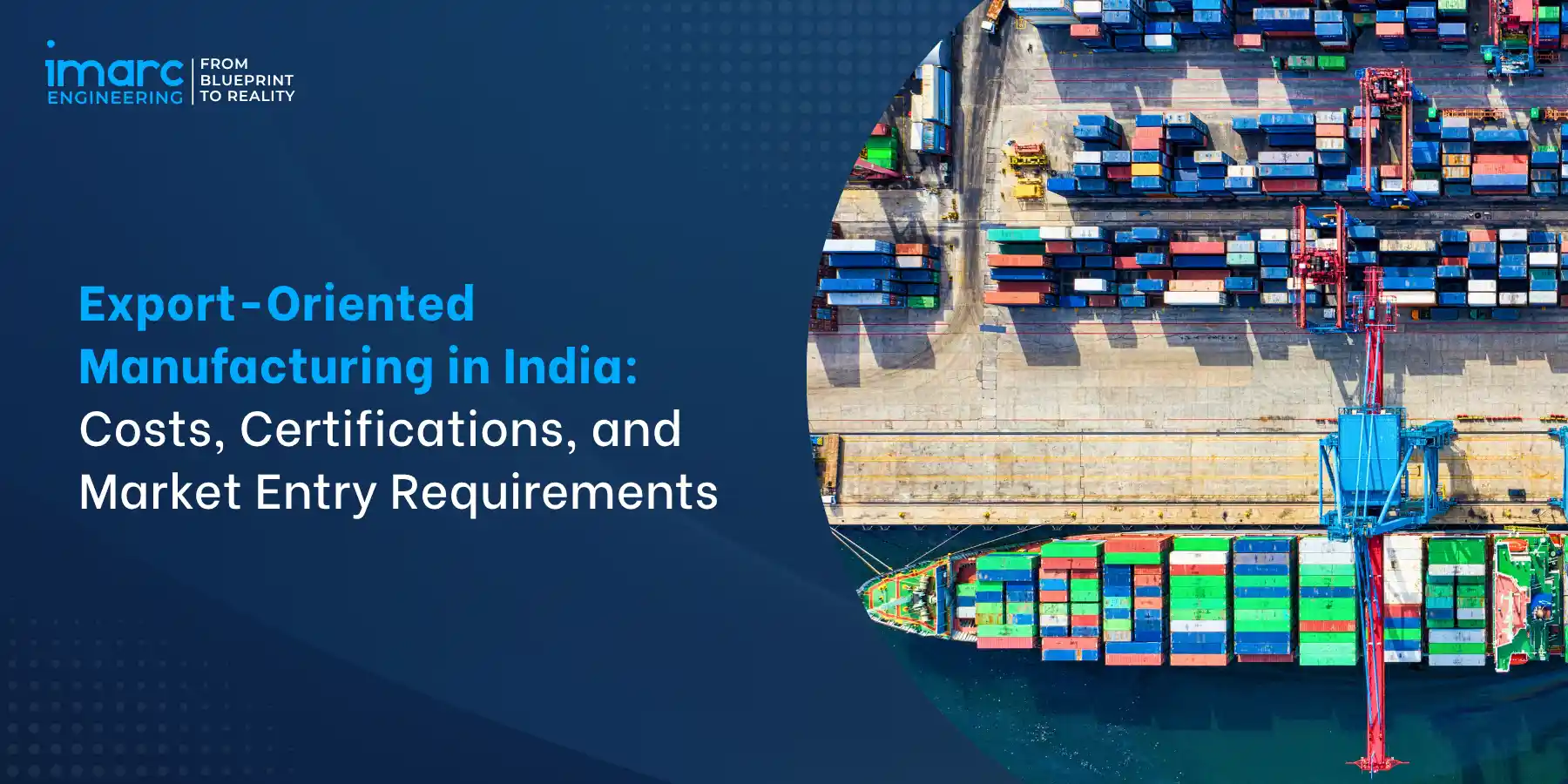
Export-Oriented Manufacturing in India: Costs, Certifications, and Market Entry Requirements
Introduction
For Indian and international manufacturers building production capacity targeted at international markets in 2026, export-oriented manufacturing in India has emerged as one of the most strategically important capital allocation opportunities of the decade. The Foreign Trade Policy 2023, RoDTEP incentives, EOU and SEZ schemes, sector-specific PLI programs, and trade agreements such as the India-UAE CEPA, India-Australia ECTA, and India-EFTA TEPA have collectively strengthened export-oriented manufacturing in India, creating one of the most favorable environments for export manufacturing in India in over a decade.
Yet building manufacturing for export in India remains operationally complex. Manufacturers must navigate FTP 2023 scheme selection, secure regulatory approvals, achieve destination-market certifications, structure trade documentation, banking relationships, and ECGC coverage. Along with these, they have to manage customs procedures through ICEGATE, comply with EU CBAM transitional and definitive obligations from 2026, satisfy customer audits including ESG, labour, and product compliance; and continuously optimise the scheme structure for shifting policy and tariff dynamics.
Underweight planning produces export ventures that capture only a fraction of available incentive value or fail to access target markets; disciplined planning produces ventures that scale efficiently into global markets.
Scope of This Guide
Drawing on IMARC Engineering's experience supporting export-oriented manufacturers, EOU and SEZ unit setups, market entry programmes, and trade compliance engagements across pharmaceuticals, electronics, automotive, chemicals, food, engineering, textiles, and consumer goods, this guide lays out a practical framework for export market entry in India through manufacturing capacity. You will find a clear view on why export-oriented manufacturing has become strategic; the FTP 2023 framework; the EOU and SEZ scheme architectures; RoDTEP and other export incentives; the IEC application; cost structures; common pitfalls; and an integrated checklist.
Table of Contents
- Introduction
- Why Export-Oriented Manufacturing in India Has Become Strategic in 2026
- Foreign Trade Policy 2023 Framework and DGFT Architecture
- How to Set Up an Export-Oriented Manufacturing Unit in India
- Export-Oriented Unit (EOU) Scheme Benefits in India
- SEZ Unit Setup for Export Manufacturing in India
- RoDTEP Scheme Benefits for Indian Exporters
- Export Incentive Schemes for Indian Manufacturers in 2026
- How to Obtain IEC Code for Export Business in India
- Cost of Setting Up Export-Oriented Manufacturing in India
- Export Market Entry Consultant for Manufacturers India - Checklist
- Conclusion
1. Why Export-Oriented Manufacturing in India Has Become Strategic in 2026
Understanding why export-focused investment has emerged as a strategic priority for Indian and international manufacturers starts with five structural drivers that have shifted the commercial calculus materially over the past 3-5 years.
1.1 China-Plus-One Has Routed Global Manufacturing Demand to India
Global brands, OEMs, and multinational manufacturers pursuing supply chain diversification under China-Plus-One have routed substantial manufacturing volumes to India since 2020. The pattern spans electronics, pharmaceuticals, automotive components; specialty chemicals; textiles; food processing; and engineering goods.
Cumulative manufacturing FDI inflows exceeded USD 165 billion over the past decade per DPIIT data. The structural shift has produced sustained demand for Indian export-oriented manufacturing capacity from global buyers seeking alternatives to concentrated Chinese sourcing.
1.2 FTP 2023 Has Provided Continuous Policy Architecture
The Foreign Trade Policy 2023 (FTP 2023), effective from 1 April 2023, replaced the earlier fixed five-year FTP framework (FTP 2015-2020) with a continuous policy structure that allows ongoing updates without major policy resets. The continuous framework provides exporters with greater predictability for long-term capacity investment decisions; introduces WTO-compliant remission schemes (RoDTEP, RoSCTL) replacing earlier export-linked incentives; supports paperless and real-time digital facilitation through DGFT portals; integrates with Make in India and Digital India initiatives. The structural stability has made export-focused investment commitments more secure than under prior policy frameworks.
1.3 PLI Scheme Incentives Reward Export Capacity Commitments
The PLI framework with INR 1.97 lakh crore outlay across 14 strategic sectors and INR 2.16 lakh crore of committed investment by early 2026 has driven substantial manufacturing capacity expansion that aligns naturally with export ambitions. Sector-specific PLI schemes - electronics, pharmaceuticals, automotive, specialty steel, food processing, white goods, textiles, drone, IT hardware, solar PV, ACC battery, telecom networking equipment, medical devices, and high-efficiency solar - frequently include export performance commitments alongside domestic capacity targets. The PLI-export alignment makes investment commitments materially more economic than non-incentivised alternatives.
1.4 Active FTAs Have Expanded Tariff-Advantaged Access
India has expanded its preferential trade access through Free Trade Agreements (FTAs) and Comprehensive Economic Partnership Agreements (CEPAs) - producing tariff advantages versus competitor manufacturing locations. Key recent agreements: India-UAE Comprehensive Economic Partnership Agreement effective 1 May 2022; India-Australia Economic Cooperation and Trade Agreement effective 29 December 2022; India-EFTA Trade and Economic Partnership Agreement signed 10 March 2024 covering Iceland, Liechtenstein, Norway, and Switzerland.
Older agreements with ASEAN, South Korea, Japan, and the SAARC region continue. Negotiations with the United Kingdom and European Union remain active. The cumulative tariff-advantaged market access creates structural cost advantages for India-based exporters that competitor manufacturing locations cannot match.
1.5 RoDTEP Restoration Has Reaffirmed Government Export Commitment
The restoration of RoDTEP benefits for Advance Authorisation holders, EOUs, and SEZs from 1 June 2025 through DGFT notification, and the subsequent extension of the entire RoDTEP scheme to 31 March 2026 dated 30 September 2025, reaffirmed Government commitment to export competitiveness. The scheme covers 10,780 HS lines for DTA exports and 10,795 for AA/EOU/SEZ exports, with rates published in Appendix 4R and Appendix 4RE on the DGFT portal. The FY 2025-26 allocation of INR 18,233 crore (USD 2.13 billion) reflects sustained budgetary support. Recent rate adjustments require ongoing monitoring by exporters.
2. Foreign Trade Policy 2023 Framework and DGFT Architecture
Mapping the FTP 2023 architecture correctly at the start of any export-oriented project is the foundation of efficient compliance and full incentive capture. The framework spans the parent statute, the policy document, the administering authority, and the operational scheme structure that export manufacturing in India engages.
2.1 The Statutory and Policy Stack
| Instrument | Year | Scope |
|---|---|---|
| Foreign Trade (Development and Regulation) Act | 1992 | Parent statute for India's foreign trade regulation |
| Foreign Trade Policy 2023 | 2023 | Operative policy framework (effective 1 April 2023; continuous framework) |
| Special Economic Zones Act | 2005 | SEZ scheme framework |
| Customs Act | 1962 | Customs procedures, classification, and duties |
| Customs Tariff Act | 1975 | Tariff schedules; updated through Finance Acts |
| Central GST Act | 2017 | GST framework including export zero-rating |
| RBI Master Direction on Export of Goods and Services | Current | Banking and forex framework for exports |
2.2 The DGFT Authority Architecture
The Directorate General of Foreign Trade (DGFT) operates under the Department of Commerce, Ministry of Commerce and Industry, Government of India. DGFT functions: formulating and implementing FTP; issuing Importer-Exporter Codes (IEC); administering export schemes including RoDTEP, Advance Authorisation, EPCG, and EOU; managing the SCOMET (Special Chemicals, Organisms, Materials, Equipment and Technologies) list for sensitive exports; aligning Indian Trade Classification (Harmonised System) with Customs Tariff Act updates; coordinating with state governments through the Export Promotion Mission.
Operationally, DGFT works through Regional Authorities (RAs) located across major export hubs that process authorisations and licences. The DGFT portal at dgft.gov.in provides digital access to most exporter services.
2.3 The Core Export Schemes Under FTP 2023
| Scheme | Mechanism | Best For |
|---|---|---|
| EOU (Export-Oriented Unit) | Customs-bonded unit; duty-free imports; export commitment | Sector-specific exporters seeking duty-free input access |
| SEZ Unit | Notified zone; broader tax framework; export-focused | Large-scale exporters; zone-based ecosystem |
| DTA + RoDTEP | Domestic Tariff Area unit with RoDTEP refund of embedded taxes | Most exporters; flexible operations; domestic + export sales |
| Advance Authorisation (AA) | Duty-free import of inputs against export obligation | Inputs-intensive exports with defined input-output norms |
| EPCG (Export Promotion Capital Goods) | Zero-duty import of capital goods with export commitment | Capital-equipment intensive new manufacturing |
| Duty Drawback | Refund of customs duties on exported products | Most exporters; baseline scheme |
2.4 The WTO Compliance Architecture
FTP 2023 schemes are designed for WTO compliance, particularly under the Agreement on Subsidies and Countervailing Measures (SCM Agreement). The earlier Merchandise Exports from India Scheme (MEIS) was discontinued following WTO dispute findings; the replacement RoDTEP scheme operates on a remission rather than incentive basis - refunding embedded duties and taxes that would otherwise distort export competitiveness rather than providing additional export subsidies. RoSCTL (Rebate of State and Central Taxes and Levies) for apparel and made-ups operates on similar remission principles. The WTO-compliant design provides export schemes that can sustain in international trade dispute proceedings - giving manufacturers durability of benefits.
2.5 The Trade Facilitation Infrastructure
Multiple digital and institutional infrastructure components support export operations. ICEGATE (Indian Customs Electronic Data Interchange Gateway) - the digital portal for customs filings, RoDTEP scrip processing, and import-export documentation. DGFT portal - online application, tracking, and management of all DGFT schemes. National Single Window System - integrated approvals across 32 ministries and 29 states/UTs.
PM Gati Shakti National Master Plan (October 2021) - integrated infrastructure planning across 44 ministries. EXIM Bank of India and Export Credit Guarantee Corporation (ECGC) - financing and credit insurance. Export Promotion Councils (EPCs) across sectors providing market intelligence and facilitation. The collective infrastructure has substantially compressed operational friction for export-oriented manufacturers versus pre-2020 conditions.
3. How to Set Up an Export-Oriented Manufacturing Unit in India
Setting up export-focused manufacturing in India follows a structured workflow that integrates entity formation, manufacturing setup, regulatory licensing, and scheme registration into a coordinated programme. The framework applies broadly across sectors with sector-specific adaptations.
3.1 The Six-Phase Setup Lifecycle
| Phase | Activity | Typical Duration |
|---|---|---|
| 1. Strategy and Scheme Selection | Target market analysis, scheme comparison (EOU/SEZ/DTA), business case | 4-8 weeks |
| 2. Entity Formation and Initial Registrations | Company incorporation, PAN, GST, IEC, banking setup | 4-8 weeks |
| 3. Manufacturing Setup | Site selection, plant build, equipment installation, statutory clearances | 12-30 months |
| 4. Scheme Registration and Approvals | EOU/SEZ unit approval, RoDTEP eligibility assessment, sector licences | 8-16 weeks |
| 5. Destination-Market Certifications | CE / FDA / sector-specific certifications for target markets | 6-18 months |
| 6. Commercial Operations Launch | First export consignments, customer qualification, scale-up | Ongoing |
3.2 Strategy and Scheme Selection
The strategic foundation determines optimal scheme selection. Target market analysis - identifying primary export geographies (United States, European Union, United Kingdom, Middle East, ASEAN, etc.) and the tariff treatment, certification requirements, and customer profile in each. Product profile assessment - identifying product complexity, input intensity, capital equipment requirements, and lifecycle considerations.
Scheme comparison - evaluating EOU vs SEZ vs DTA-with-RoDTEP based on input duty intensity, sales mix (export-only vs export-plus-domestic), capital equipment requirements, location preferences, and customer expectations. Business case modelling - projecting revenue, cost, capital, and incentive impact under each scheme structure over a 7-10-year horizon. The output: documented strategic foundation supporting subsequent execution.
3.3 Entity Formation and Initial Registrations
For first-time Indian operations, entity formation precedes scheme registration. Company incorporation under the Companies Act 2013 - typically through a wholly-owned subsidiary for foreign sponsors or appropriate Indian corporate vehicle for domestic sponsors. PAN and TAN application. GST registration with Letter of Undertaking (LUT) for zero-rated export supplies. IEC (Importer-Exporter Code) application through DGFT (free since 2020, processed online).
Bank account opening with authorised dealer (AD) bank capable of handling export transactions. Authorised dealer category bank relationships - SBI, ICICI, HDFC, Axis, and others provide comprehensive export-import banking services. AD Category-1 banks support full forex transactions. Foreign sponsors additionally complete FDI compliance under the FDI policy administered by DPIIT.
3.4 Manufacturing Setup with Export Orientation
Manufacturing infrastructure for export-oriented production typically integrates additional considerations beyond domestic production. Site selection - SEZ location for SEZ scheme participants; designated EOU premises (often within industrial parks); DTA scheme with port and airport proximity. Quality systems aligned with destination market requirements (US FDA, EU GMP, JIS, IATF 16949 for auto, ISO 13485 for medical devices, FSSAI plus export-target certifications for food).
Capacity sizing matched to export-volume commitments where PLI or other schemes apply. Logistics infrastructure including port-proximity warehousing, container handling, and freight forwarding partnerships. Sustainability and ESG features increasingly required by international customers and lenders including ISO 14001, ISO 45001, and sector-specific ESG audits.
3.5 Scheme Registration and Compliance Setup
Once manufacturing infrastructure is in place, scheme-specific registrations proceed. EOU unit setup - application to Development Commissioner under FTP 2023; LOP (Letter of Permission) issuance; customs-bonded unit setup with bond execution. SEZ unit setup - application to SEZ Development Commissioner; LOA (Letter of Approval); zone-specific unit registration.
RoDTEP eligibility assessment - automatic for IEC holders; e-scrip generation through ICEGATE on export filings. Sector-specific licensing aligned with FTP scheme - drugs export licensing for pharma; FSSAI export endorsement for food; BIS export-specific compliance; sectoral export promotion council membership.
3.6 Destination-Market Certification Acquisition
Most export markets require destination-specific certifications acquired in parallel with manufacturing setup. United States - FDA Establishment Registration for food, drugs, medical devices; USDA Organic where applicable; UL listing for electrical equipment. European Union - CE marking under applicable directives (Machinery, Low Voltage, RoHS, REACH, Medical Devices Regulation); EU GMP for pharmaceuticals. United Kingdom - UKCA marking (post-Brexit). Japan - JIS marking, PMDA registration for medical devices. Middle East and Halal markets - Halal certification from recognised authorities.
Global voluntary standards - ISO 9001, ISO 14001, ISO 45001, IATF 16949, ISO 13485, ISO 22000 as relevant; SA8000 for labour; SMETA, amfori BSCI for ethical trade. Certification acquisition typically runs 6-18 months and should be planned in parallel with manufacturing setup rather than sequentially after commercial readiness.
4. Export-Oriented Unit (EOU) Scheme Benefits in India
The Export-Oriented Unit (EOU) scheme has been one of India's most established export promotion frameworks, providing customs-bonded operation, duty-free imports, and structured benefits for export-focused manufacturers.
4.1 The EOU Concept and Operational Framework
Under the EOU scheme administered through Development Commissioners under FTP 2023, an Export-Oriented Unit operates as a customs-bonded manufacturing or service unit committed to export. Key operational features: bonded warehouse status enabling duty-free import of capital goods, raw materials, components, and consumables; export commitment with prescribed Net Foreign Exchange (NFE) earnings over a defined period (typically 5 years); permission for limited Domestic Tariff Area (DTA) sales subject to scheme conditions; integration with broader export-incentive framework (RoDTEP after recent restoration, Advance Authorisation parallelisation, EPCG availability). EOU units typically locate within industrial parks but can also operate as standalone facilities subject to bond setup.
4.2 Core EOU Benefits
- Duty-free import of capital goods, raw materials, components, and consumables required for production
- GST treatment with zero rating on exports and Letter of Undertaking facility
- Limited DTA sale permission subject to fulfilment of NFE earnings
- RoDTEP refund of embedded taxes (restored from 1 June 2025 for EOU exports per DGFT notification)
- Access to Advance Authorisation and EPCG schemes in parallel where input requirements warrant
- Income tax benefits historically (largely phased out under current framework)
- Single-window facilitation through Development Commissioner office
- Special procedural simplifications for export documentation
4.3 EOU Application and Approval Process
EOU establishment follows a structured application process. Project proposal submission to the Development Commissioner of the jurisdictional Special Economic Zone covering business plan, projected exports, employment generation, investment commitment, and product profile. Approval committee evaluation - Unit Approval Committee under the Development Commissioner reviews the proposal against EOU scheme criteria.
Letter of Permission (LOP) issuance on successful evaluation - typically valid for 5 years with renewal provisions. Bond execution and customs registration - manufacturer executes the bond and bank guarantee covering the duty-free import value; customs assigns bond number and operational authorisation. Operational commencement subject to satisfactory infrastructure and compliance setup verification. End-to-end timeline typically 8-16 weeks for clean applications.
4.4 EOU Compliance Obligations
EOU operations involve ongoing compliance obligations beyond initial setup. Net Foreign Exchange (NFE) earnings - cumulative NFE must remain positive over the prescribed period; tracking and quarterly reporting required. Quarterly Progress Reports (QPRs) to Development Commissioner covering exports, DTA sales, employment, and other parameters. Annual performance review against scheme commitments.
Customs supervision over bonded operations including inputs receipt, processing, and finished goods dispatch. Periodic audit by customs and Development Commissioner. The compliance burden is material but manageable through structured systems and dedicated EOU compliance resourcing.
4.5 EOU Exit and Conversion Options
EOU status can be exited or converted under prescribed procedures. De-bonding - manufacturer pays applicable duties on remaining capital goods and inventory; unit converts to DTA operation; typically when export volumes have grown materially and DTA + RoDTEP scheme has become more economic than continued EOU structure.
SEZ conversion - movement of EOU unit into SEZ structure for sponsors valuing zone benefits. Renewal - LOP renewal at 5-year intervals subject to satisfactory performance. The exit and conversion options provide flexibility as the manufacturer's business profile evolves over time.
5. SEZ Unit Setup for Export Manufacturing in India
Special Economic Zones (SEZs) operate under the SEZ Act 2005 administered by the Ministry of Commerce and Industry, providing structured fiscal and operational benefits for export-focused units operating within notified zones.
5.1 The SEZ Framework
SEZs are notified geographical zones treated as foreign territory for trade operations and tariff purposes. Operational features: customs-bonded status with duty-free imports for SEZ unit operations; GST treatment with zero-rated supplies to SEZ; export-focused unit operations with limited DTA sale provisions; common infrastructure including utilities, roads, and ancillary facilities; structured governance through SEZ Development Commissioners.
SEZs come in multiple categories - multi-product SEZs (Sri City, Mahindra City, etc.); sector-specific SEZs (pharma SEZs in Hyderabad and elsewhere; IT/ITES SEZs; biotech SEZs; gems and jewellery SEZs); private SEZs developed by private operators; government-developed SEZs.
5.2 Core SEZ Benefits
- Duty-free import of capital goods, raw materials, components, and consumables
- GST zero-rating on supplies to SEZ unit; Integrated GST (IGST) refund mechanism for inputs
- Customs procedures simplified within zone
- Common infrastructure utilities at zone level
- RoDTEP refund of embedded taxes (restored from 1 June 2025 for SEZ exports)
- Single-window facilitation through Development Commissioner
- Income tax benefits under historical SEZ Act provisions (largely phased out for new SEZs post-2020)
- Authorised Economic Operator (AEO) and similar customs simplifications
5.3 SEZ vs EOU - Selection Considerations
SEZ and EOU schemes share many features but differ in important respects. Location flexibility - EOU can be set up at most locations subject to bond setup; SEZ unit must be within notified SEZ. Infrastructure - SEZs provide shared infrastructure reducing per-unit overhead; EOUs typically operate standalone with separate infrastructure setup. GST treatment - SEZ supplies are zero-rated; EOU operates with GST registration and LUT-based export zero-rating; mechanically different but commercially similar.
Tax structure - SEZ historically had stronger income tax provisions (largely phased out for new SEZs post-2020); current schemes broadly comparable. Sector ecosystems - some SEZs offer strong sector clustering (Hyderabad pharma SEZ, Cochin biotech SEZ) providing ecosystem benefits; EOU outside such clusters lacks this benefit.
5.4 SEZ Unit Setup Process
SEZ unit establishment follows a structured process. SEZ identification - candidate SEZ selection based on sector fit, location, infrastructure quality, and commercial terms. Application to SEZ Developer for plot/built-up space allotment. Letter of Approval (LOA) application to the SEZ Development Commissioner including business plan, projected exports, investment commitment, and product profile.
Approval Committee review and LOA issuance on satisfactory evaluation. Bond execution with customs covering the duty-free import value. Operational commencement with periodic compliance reporting. Total elapsed timeline typically 12-20 weeks from SEZ identification to operational status for well-prepared applications.
5.5 SEZ Operational Considerations
SEZ operations involve specific considerations versus standalone DTA or EOU setup. Mandatory minimum export performance commitments per LOA. DTA sales restrictions - typically permitted only on payment of full applicable duties and taxes. Customs supervision over inputs, processing, and outputs at zone level. Compliance reporting to Development Commissioner including Quarterly Performance Reports. Bond and bank guarantee maintenance.
SEZ unit transfer within zone or to another SEZ subject to prescribed procedures. Termination provisions including de-bonding option if SEZ structure no longer optimal. The structured framework requires dedicated SEZ compliance capability but provides corresponding operational benefits for committed export operations.
6. RoDTEP Scheme Benefits for Indian Exporters
The Remission of Duties and Taxes on Exported Products (RoDTEP) scheme has emerged as one of the most consequential export incentive frameworks in India - operationalised since 1 January 2021 and now restored across all eligible exporter categories after a temporary withdrawal phase in early 2025.
6.1 The RoDTEP Concept and Operational History
RoDTEP is a WTO-compliant remission scheme that refunds embedded duties and taxes on exported products that are not refunded under other existing mechanisms - covering items such as VAT on fuel for transportation, electricity duty, Mandi tax, stamp duty, and similar embedded taxes. RoDTEP replaced the earlier Merchandise Exports from India Scheme (MEIS), which was discontinued following WTO dispute findings.
The scheme operationalised from 1 January 2021 has scaled materially through subsequent years - cumulative disbursements exceeded INR 57,976 crore (USD 6.78 billion) by 31 March 2025 per Government data. The FY 2025-26 budget allocated INR 18,233 crore (USD 2.13 billion) to RoDTEP across product categories. RoDTEP benefits had temporarily lapsed for Advance Authorisation holders, Export-Oriented Units, and Special Economic Zone units on 5 February 2025 but were restored effective 1 June 2025 through DGFT notification, addressing exporter concerns over cost disparity.
6.2 Scheme Coverage and Recent Extensions
RoDTEP coverage has expanded materially over time. For FY 2025-26, the scheme covers 10,780 HS lines for Domestic Tariff Area (DTA) exports and 10,795 HS lines for exports by Advance Authorisation holders, EOUs, and SEZs. Eligible items, rates, and per-unit value caps are published in Appendix 4R (for DTA units) and Appendix 4RE (for AA/EOU/SEZ) on the DGFT portal. The scheme was extended via DGFT Notification No. 35/2025 dated 30 September 2025 to remain applicable through 31 March 2026, providing exporters with planning visibility.
Recent rate adjustments through DGFT Notification No. 60/2025-26 reduced RoDTEP rates to 50 percent of existing levels for most HS lines, though a corrigendum dated 24 February 2026 exempted export products under ITC HS Chapters 01 to 24 (covering certain agricultural and food categories) from the rate reduction. Exporters should review current eligibility and benefit calculations against published Appendices 4R and 4RE.
6.3 RoDTEP Mechanics and e-Scrip Process
RoDTEP benefits flow through a digital e-scrip mechanism integrated with ICEGATE (Indian Customs Electronic Data Interchange Gateway). The workflow: exporter files Shipping Bill at customs with RoDTEP claim; on export realisation and customs verification, the system generates an e-scrip credited to the exporter's account; the e-scrip is a transferable instrument that can be used by the exporter to pay basic customs duty on imports or transferred to other importers; the scrip has a defined validity period for utilisation.
The digital workflow eliminates paperwork and accelerates benefit realisation compared to historical refund-based schemes. Exporters must maintain proper Shipping Bill filings with accurate HS classification, RoDTEP claim flag, and supporting documentation to ensure smooth scrip generation.
6.4 Operational Considerations for Maximising RoDTEP Benefits
Several operational disciplines maximise RoDTEP benefit capture. Accurate HS classification - mis-classification produces either denied benefits or audit recovery actions; classification should be reviewed by qualified customs specialists particularly for products at HS line boundaries. Complete Shipping Bill filing with RoDTEP claim flag at the time of export rather than retrospective claims. Compliance with per-unit value caps where applicable to specific HS lines.
Documentation maintenance supporting any post-export verification. Periodic reconciliation between filed RoDTEP claims and e-scrip credits to identify any processing delays or discrepancies. Strategic e-scrip utilisation - manufacturers with import requirements can use scrips directly; those without can transfer to importers at market discounts. For high-volume exporters, structured RoDTEP management can recover 1-4 percent of export value as embedded tax refund - a material benefit that justifies dedicated trade compliance resourcing.
7. Export Incentive Schemes for Indian Manufacturers in 2026
Beyond RoDTEP, the Indian export incentive landscape includes several established schemes serving different exporter categories, input intensities, capital equipment needs, and sector profiles. Understanding the scheme architecture enables informed selection and parallel utilisation where eligible.
7.1 The Export Incentive Scheme Stack
| Scheme | Mechanism | Best Suited For |
|---|---|---|
| RoDTEP | Refund of embedded duties and taxes via e-scrip | All physical goods exporters across sectors |
| Advance Authorisation (AA) | Duty-free import of inputs against export obligation | Inputs-intensive exports with defined SION norms |
| EPCG | Zero customs duty on capital goods with export commitment | New manufacturing with capital equipment imports |
| Duty Drawback | Refund of customs duties on inputs in exported products | Baseline scheme for all exporters |
| RoSCTL | Rebate of State and Central Taxes and Levies | Apparel and made-ups exporters |
| Interest Equalisation Scheme | Interest subvention on export credit | MSME and identified sector exporters |
| ECGC Cover | Export credit insurance against buyer/country risk | All exporters with export receivables exposure |
7.2 Advance Authorisation Scheme
The Advance Authorisation (AA) scheme enables duty-free import of inputs (raw materials, components, consumables) physically incorporated in export products, subject to fulfilment of export obligation within a prescribed time period. The scheme operates against Standard Input-Output Norms (SION) published by DGFT for various product categories; products without SION can apply under self-declared norms. Key benefits: customs duty, IGST, and Anti-Dumping Duty (ADD) exemption on imported inputs; duty saving typically 10-25 percent of input cost depending on input customs rates; pre-import authorisation for advance planning.
Compliance obligations: export obligation fulfilment over 18-24 months typically; SION compliance with documented input-output relationships; redemption procedures including third-party Chartered Engineer certification of input utilisation. AA suits manufacturers with material imported input content - particularly in pharmaceuticals, chemicals, electronics, and engineering goods.
7.3 EPCG Scheme - Export Promotion Capital Goods
The EPCG scheme allows import of capital goods (machinery, equipment, spares, components for incorporation in capital goods) at zero customs duty against an export obligation typically equal to 6 times the duty saved over 6 years from authorisation date. Key benefits: zero customs duty on capital goods import; substantial cash flow benefit at project setup stage; ability to import latest international technology; access to capital equipment not domestically available.
Compliance obligations: export obligation fulfilment - typically annual block targets with final compliance verification at year 6; capital goods cannot be transferred to non-EPCG entities during the obligation period; redemption with documented export performance. EPCG suits new manufacturing setups with material capital equipment import requirements - particularly for advanced manufacturing technology, specialised machinery, and process equipment.
7.4 RoSCTL for Apparel and Made-Ups
The Rebate of State and Central Taxes and Levies (RoSCTL) scheme operates specifically for apparel and made-ups exports, refunding embedded state and central taxes not refunded under other mechanisms. The scheme has been an important enabler for Indian textile and apparel exporters competing in price-sensitive international markets.
Operational mechanics are similar to RoDTEP - rates published by DGFT, e-scrip generation through ICEGATE, transferability of scrips. RoSCTL coverage and rates are reviewed periodically; current rates should be verified from DGFT portal for specific product categories. The scheme is particularly valuable for apparel exporters serving United States, European Union, United Kingdom, and Middle East markets.
7.5 Trade Finance and Insurance Support
Beyond duty-refund schemes, the export ecosystem provides trade finance and risk-cover support. Interest Equalisation Scheme - interest subvention typically 2-3 percent on pre-shipment and post-shipment export credit for identified sectors and MSME exporters. Export Credit Guarantee Corporation (ECGC) of India Ltd - export credit insurance covering commercial risk (buyer default) and political risk (country/transfer issues) on export receivables.
EXIM Bank of India - export financing, project export support, and structured trade finance. Authorised Dealer Category-1 (AD-1) banks providing forex-handling, LC discounting, packing credit, and post-shipment finance. The collective finance and insurance infrastructure supports exporters in managing working capital cycles and credit risk that would otherwise constrain export growth.
7.6 Parallel Scheme Utilisation
Many of the export incentive schemes can be utilised in parallel for compounding benefit. A typical export-oriented manufacturer might utilise: EPCG at project setup for capital equipment duty saving; Advance Authorisation for inputs-intensive product lines; RoDTEP on all eligible export shipments for embedded tax refund; ECGC cover on credit-sale export receivables; Interest Equalisation Scheme on export credit for eligible sectors.
The parallel utilisation requires careful scheme selection at each transaction to avoid double-counting. Mature exporters operate structured scheme-allocation matrices ensuring full benefit capture across the product portfolio.
8. How to Obtain IEC Code for Export Business in India
The Importer-Exporter Code (IEC) is the foundational regulatory identifier for any export-import business in India - required for almost all cross-border trade transactions and a prerequisite for accessing FTP 2023 schemes.
8.1 The IEC Concept and Statutory Basis
IEC is a 10-digit unique identifier issued by the Directorate General of Foreign Trade (DGFT) under the Foreign Trade (Development and Regulation) Act, 1992. No goods or services import or export can be undertaken without a valid IEC, with limited exceptions for specific categories (gifts, samples below prescribed value, certain personal imports).
The IEC is linked to the entity's PAN since 2017 - the IEC number now matches the entity's PAN. Since 2020, IEC issuance has been free of charge with online processing through the DGFT portal - removing the historical INR 250-500 fee that had applied previously. The IEC is permanent once issued, subject to annual updation requirement.
8.2 IEC Application Process
IEC application follows a streamlined online process.
Step 1 - Visit DGFT portal at dgft.gov.in and select IEC Application.
Step 2 - Register / login using business PAN, mobile, and email with OTP verification.
Step 3 - Complete the online IEC application on the DGFT portal.
Step 4 - Upload supporting documents per checklist.
Step 5 - Digital signature certificate (DSC) or Aadhaar e-signature for application submission.
Step 6 - DGFT system processes the application typically within 1-3 working days for clean submissions.
Step 7 - IEC certificate issuance via portal download with the assigned IEC number (matching the PAN).
8.3 IEC Documents Required
- PAN card of the entity (proprietor / firm / company / LLP)
- Aadhaar card of proprietor / authorised signatory
- Address proof of business premises (electricity bill, telephone bill, lease deed, sale deed, GST registration certificate, or municipal property tax receipt)
- Bank certificate from authorised dealer bank or cancelled cheque showing business name and account number
- Photograph of proprietor / partner / director (recent passport-size)
- Digital signature certificate (Class-3) or Aadhaar e-signature
- For companies and LLPs: Certificate of Incorporation, Memorandum and Articles of Association / LLP Agreement, Board Resolution authorising the signatory
- For partnership firms: Partnership Deed
8.4 IEC Validity and Annual Updation
IEC is permanent once issued and does not require periodic renewal in the traditional sense. However, since 2021, the DGFT has implemented an annual updation requirement - IEC holders must update or confirm their details online between April and June each year through the DGFT portal. Failure to complete annual updation triggers deactivation of the IEC, with reactivation requiring updated details submission.
The annual updation is procedural and typically takes 10-15 minutes for entities with no changes. Material business changes (entity transformation, address changes, signatory changes, banking changes) require IEC modification application separate from annual updation.
8.5 Post-IEC Compliance Obligations
IEC issuance is the foundation for export operations but triggers parallel compliance requirements. GST registration with Letter of Undertaking (LUT) for zero-rated export supplies. Sectoral export licences where applicable (drugs export licence, food export endorsement under FSSAI, etc.). Membership in relevant Export Promotion Council (EPC) - APEDA for processed food, Pharmexcil for pharma, EEPC for engineering, GJEPC for gems and jewellery, AEPC for apparel, etc. (provides RCMC - Registration Cum Membership Certificate required for several DGFT schemes).
Authorised Dealer (AD) bank relationship for export realisation. BIS or sectoral certifications where applicable. The structured compliance setup positions the IEC holder to access the full FTP 2023 scheme architecture.
9. Cost of Setting Up Export-Oriented Manufacturing in India
Understanding the cost economics of manufacturing investment in India for export markets enables informed budgeting, sourcing strategy, and scheme structuring. The cost components fall into four broad categories, land and approvals, construction and equipment, certification and compliance, and pre-operating, with distinct economics under EOU, SEZ, and DTA structures.
9.1 The Capex Stack for Export-Oriented Manufacturing
| Cost Category | Typical % of Total Capex | EOU/SEZ Advantage |
|---|---|---|
| Land and plot premium | 5-12% | SEZ often premium location; EOU flexible |
| Civil and structural construction | 15-25% | Similar across structures |
| Process equipment (imported share) | 25-45% | Duty-free under EOU/SEZ/EPCG |
| MEP, utilities, automation | 10-18% | Similar across structures |
| Destination-market certifications | 2-6% | Similar across structures; sector-specific |
| Statutory licensing and approvals | 1-3% | Single-window benefits under SEZ |
| EPCM / project management | 4-8% | Similar across structures |
| Pre-operating and validation | 3-6% | Similar across structures |
| Working capital provision | 8-15% | RoDTEP cash-flow benefit reduces WC |
| Contingency | 8-12% | Similar across structures |
9.2 Scheme-Driven Cost Comparison
Choice of scheme structure materially affects total capex and ongoing costs. EOU structure - duty-free import of capital goods and inputs provides upfront capex saving typically 12-22 percent on the imported equipment portion; ongoing duty-free input access maintains material cost advantage; bond and bank guarantee requirement consumes some working capital. SEZ structure - similar capex benefits to EOU plus zone-level common infrastructure economies; potentially additional plot premium for SEZ location; integration with zone ecosystem benefits.
DTA with RoDTEP - no upfront duty saving on imports but RoDTEP refunds embedded taxes on each export; EPCG can be utilised in parallel for capital equipment duty saving; full operational flexibility without bond constraints. For high-import-intensity products, EOU or SEZ typically wins on TCO; for low-import-intensity products with mixed domestic/export sales, DTA + RoDTEP + sector-specific schemes often produces lower TCO.
9.3 Destination-Market Certification Costs
Acquiring export certifications in India for target markets typically represents 2-6 percent of project capex depending on sector and certification depth. United States FDA Establishment Registration - compliance infrastructure investment (cGMP systems for pharma, FSMA framework for food) can run INR 50 lakh to INR 5 crore depending on facility scale. European Union CE marking under applicable directives - notified body audit and certification typically INR 5-50 lakh per product family; ongoing audit maintenance INR 2-15 lakh annually.
ISO certifications (9001, 14001, 45001, sector-specific) - INR 2-10 lakh per certification with annual surveillance audits. IATF 16949 for automotive components - INR 5-20 lakh. ISO 13485 for medical devices - INR 5-25 lakh. Sector-specific (BRCGS, IFS, Global G.A.P., USDA Organic, EU Organic, Halal, Kosher) - typically INR 3-15 lakh per certification. Cumulative certification investment for multi-market exporters can easily run INR 50 lakh to INR 5 crore over the first 2-3 years.
9.4 Ongoing Operating Cost Differentials
Beyond capex, ongoing operating cost structure varies by scheme. EOU operations - QPR filing, NFE tracking, customs supervision costs; typical dedicated compliance resourcing of INR 30-80 lakh annually for mid-scale operations. SEZ operations - LOA compliance reporting, customs supervision; zone-level common service charges; typically, INR 50 lakh to INR 2 crore annually depending on scale.
DTA operations - GST compliance, RoDTEP claim management, Drawback claim management, sectoral compliance; typically, INR 20-60 lakh annually. Trade-finance costs - LC opening, discounting, packing credit, post-shipment credit - typically 6-9 percent annualised for working capital cycle. ECGC credit cover - 0.3-0.8 percent of insured exposure. The cost differentials interact with revenue and incentive impacts to determine overall scheme economics.
9.5 Financing Export-Oriented Manufacturing
Financing structures for export-oriented manufacturing benefit from several specialised channels. EXIM Bank of India provides project export finance, foreign currency loans, and structured trade finance. Authorised Dealer Category-1 banks provide working capital facilities including packing credit (pre-shipment finance typically up to 270 days at concessional rates), post-shipment finance (export bills discounting, advance against export receivables), and LC discounting. Interest Equalisation Scheme provides 2-3 percent interest subvention on eligible export credit for identified sectors and MSME exporters.
NaBFID increasingly supports infrastructure-aligned manufacturing capacity. Sustainability-linked loans tie pricing benefits to demonstrated ESG performance - particularly relevant for export-oriented manufacturing serving sustainability-conscious EU and US markets. The structured financing ecosystem typically supports debt-equity ratios of 65:35 to 70:30 for well-structured export projects.
10. Export Market Entry Consultant for Manufacturers India - Checklist
10.1 Common Mistakes in Export-Oriented Manufacturing Setup
Selecting Scheme Structure Without TCO Analysis
Many sponsors select EOU, SEZ, or DTA structures based on incomplete analysis - choosing EOU because import duties seem high without modelling RoDTEP-DTA alternative, or selecting DTA for operational flexibility without recognising the duty cost on high-import-content products.
Discipline: structured TCO modelling across EOU, SEZ, and DTA structures over 7-10 year horizon with sensitivity to volume, sales mix, input duty rates, and scheme benefits.
Treating Certification as Post-Production Sequential
Sponsors that complete manufacturing setup and only then begin destination-market certification routinely face 6-18 month commercial commissioning delays as CE marking, FDA registration, or sector-specific certifications proceed.
Discipline: parallel certification track from project planning stage; quality system design aligned with destination requirements from facility design phase; notified body and FDA agent engagement at project initiation.
Underestimating Compliance Resourcing
Export-oriented manufacturing - particularly under EOU or SEZ structures - involves material ongoing compliance burden (QPR filings, NFE tracking, customs supervision, RoDTEP claims, scheme audits). Sponsors that under-resource compliance routinely face penalty proceedings, missed incentive captures, and audit findings.
Discipline: dedicated trade compliance team or external advisory engagement from setup phase; structured compliance calendar with monthly tracking; periodic internal audit on scheme compliance.
Inadequate FTA Tariff-Advantage Analysis
Indian exporters can capture material tariff advantages through India-UAE CEPA, India-Australia ECTA, India-EFTA TEPA, and other agreements - but capture requires Certificate of Origin compliance, value-addition rule satisfaction, and structured documentation. Sponsors that ignore FTA opportunities or fail to comply with rules of origin routinely lose 5-15 percent of available tariff arbitrage.
Discipline: FTA tariff-advantage analysis at target market selection; structured rules-of-origin compliance from supplier sourcing; documented value-addition tracking; Certificate of Origin discipline.
Weak Customer Audit Readiness
International customers - particularly in pharma, food, automotive, electronics, and textiles - conduct rigorous supplier audits covering quality, ESG, labour compliance, and product specifications. Sponsors that complete certifications but lack continuous audit readiness face customer disqualification.
Discipline: integrated quality and ESG management systems aligned with customer audit standards (SMETA, amfori BSCI, RBA, customer-specific); structured audit response capability with prepared documentation; periodic mock audits.
10.2 Integrated Export-Oriented Manufacturing Checklist
Strategy and Scheme Selection Phase
- Target export markets identified with tariff, certification, and customer landscape mapped
- EOU vs SEZ vs DTA scheme selection completed with TCO comparison
- FTA tariff-advantage opportunities mapped (UAE CEPA, Australia ECTA, EFTA TEPA, ASEAN, etc.)
- PLI scheme alignment evaluated where sector-relevant
- Business case modelled with 7-10 year horizon
Entity and Registration Phase
- Company incorporation under Companies Act 2013 completed
- PAN, TAN, GST registration with LUT completed
- IEC application submitted and obtained through DGFT portal
- AD Category-1 bank relationships established
- Sectoral Export Promotion Council membership obtained (RCMC)
- FDI compliance completed for foreign sponsors
Manufacturing Setup Phase
- Site selection completed (SEZ allotment / EOU premises / industrial park plot)
- Plant and equipment selection aligned with destination-market requirements
- Quality systems designed to international standard (ISO 9001/14001/45001, sector-specific)
- Construction and equipment installation completed
- Statutory clearances obtained (Environment, Fire NOC, Building, Pollution Control)
Scheme and Certification Phase
- EOU / SEZ unit approval obtained from Development Commissioner
- Bond execution completed with customs
- RoDTEP enrolment confirmed (automatic for IEC holders)
- Destination-market certifications obtained (US FDA, EU CE, JIS, sector-specific)
- Sector-specific export licences obtained (drugs export, food endorsement, etc.)
Commercial Operations Phase
- Customer qualification audits completed
- First export consignment processed with full documentation
- ECGC cover initiated on credit-sale exports
- Trade finance facilities operational
- Compliance monitoring routine established (QPR, RoDTEP, GST, sectoral)
Conclusion
Export-oriented manufacturing in India has emerged as a major growth opportunity, supported by the Foreign Trade Policy (FTP) 2023, RoDTEP incentives, EOU and SEZ schemes, and other export promotion frameworks. These initiatives help strengthen export-focused manufacturing in India by reducing costs, improving competitiveness, and supporting global market access.
The ecosystem is further supported by sector-specific PLI schemes, strong manufacturing investment in India, and expanding trade agreements such as the India-UAE CEPA, India-Australia ECTA, and India-EFTA TEPA. Together, these measures are accelerating export market entry in India, enhancing export compliance in India, and creating a favorable environment for manufacturing for export in India.
Three closing reminders. First, integrate scheme selection, certification strategy, and market entry sequencing at project initiation rather than treating them as sequential post-production exercises - the choices made at planning stage determine commercial outcomes for years.
Second, run parallel tracks across entity formation, manufacturing setup, scheme registration, and destination-market certification - sequential execution adds 6-18 months of avoidable delay that competitor manufacturers in other locations will exploit.
Third, build dedicated trade compliance capability from Day 1 - export-oriented manufacturing involves material ongoing compliance that under-resourced operations consistently fail to manage, leaving incentive capture and audit readiness materially weaker than disciplined operations.
PLANNING EXPORT-ORIENTED MANUFACTURING IN INDIA?
IMARC Engineering's export-oriented manufacturing and trade compliance specialists are ready to help. Whether you are an international sponsor entering Indian manufacturing for export markets, an existing Indian manufacturer scaling export operations under PLI alignment, a sponsor evaluating EOU vs SEZ vs DTA-with-incentives structure for a new project, or a multi-product exporter optimising trade compliance across the portfolio, our team can support you with end-to-end advisory and execution.
→ Get expert advice — schedule a free export-oriented manufacturing consultation
Frequently Asked Questions
Export-oriented manufacturing in India typically takes 18–36 months from project planning to the first export shipment. Timelines depend on facility construction, regulatory approvals, export certifications in India, and destination-market requirements.
There is no universal minimum investment requirement for export-focused manufacturing in India under EOU or SEZ schemes. Investment levels vary by sector, project scale, and commercial viability, making manufacturing investment in India flexible for different business models.
Yes. Both EOU and SEZ units can sell products in the Domestic Tariff Area (DTA), subject to applicable scheme conditions and duties. Businesses pursuing export-focused manufacturing should evaluate domestic sales provisions when selecting the most suitable operating structure.
The EU Carbon Border Adjustment Mechanism (CBAM) affects exporters of selected carbon-intensive products entering the European market. Companies engaged in export-oriented manufacturing in India may need emissions reporting, verification, and enhanced export compliance in India to maintain access to EU markets.
IMARC Engineering provides end-to-end support for export-oriented manufacturing in India, including project setup, export market entry in India, regulatory approvals, DGFT registrations, export certifications in India, customs compliance, trade incentive optimisation, and ongoing export compliance in India management.
Recent Post


Trusted by Industry Leaders
We partner with global enterprises and ambitious businesses across sectors to deliver operational excellence, strategic insights, and sustainable growth through integrated solutions.










Success in Their Words
Real feedback from clients across industries. Discover how our solutions delivered measurable impact and operational excellence.

I wanted to express my sincere appreciation for your efforts in handling this matter. Your dedication and commitment have been truly commendable, and it is evident that you have put in tremendous hard work and expertise into resolving the issues at hand. We are greatly interested in continuing our collaboration with you in the future, as your professionalism and reliability have made you a trusted partner. Thank you once again for your invaluable contribution. We look forward to strengthening our partnership ahead.

It has been a pleasure working with the IMARC team. The insights provided were structured, clear, and highly valuable, helping us strengthen both our technical and financial planning with confidence. We deeply appreciate the team’s professionalism, responsiveness, and attention to detail throughout the engagement. Every requirement was well understood and effectively incorporated, resulting in a comprehensive and actionable output. Overall, our experience has been excellent, and I would gladly recommend IMARC to organizations seeking a reliable research partner.

Your service is truly exceptional. Working with the IMARC team has been a seamless and professional experience. The clarity of communication, responsiveness to queries, and consistent support at every stage made the entire engagement highly efficient. The insights shared were well-structured, practical, and perfectly aligned with our requirements, helping us make informed decisions with confidence. Overall, the dedication and professionalism demonstrated by your team stand out, and I would be glad to recommend IMARC as a reliable and trustworthy research partner.

IMARC did an outstanding job in preparing our study. They were punctual, precise, and consistently responsive throughout the entire process. The team delivered all the data we required in a clear, well-organized, and highly professional format. Their strong attention to detail, combined with their ability to meet every deadline without compromising quality, truly set them apart. Overall, their reliability and commitment made them an exceptional partner for our project, and we would gladly work with them again in the future.

IMARC made the whole process incredibly easy from start to finish. Everyone I interacted with via email was polite, professional, and straightforward to deal with, always keeping their promises regarding delivery timelines and remaining consistently solutions-focused. From my very first contact, I appreciated the professionalism and support shown by the entire IMARC team. I highly recommend IMARC to anyone seeking timely, affordable, and reliable information or advice. My experience with IMARC was excellent, and I truly cannot fault any aspect of it.

I’d like to express my sincere gratitude for the excellent work you accomplished with the study. Your ability to quickly understand our requirements and deliver high-quality results under tight timelines truly reflects your expertise, exceptional work ethic, and unwavering commitment to your customer’s success. The professionalism and responsiveness you demonstrated throughout the process made a significant difference. Our entire team and company are incredibly thankful for your dedication, reliability, and support. Once again, thank you for your outstanding contribution.