Manufacturing
June 18 2026
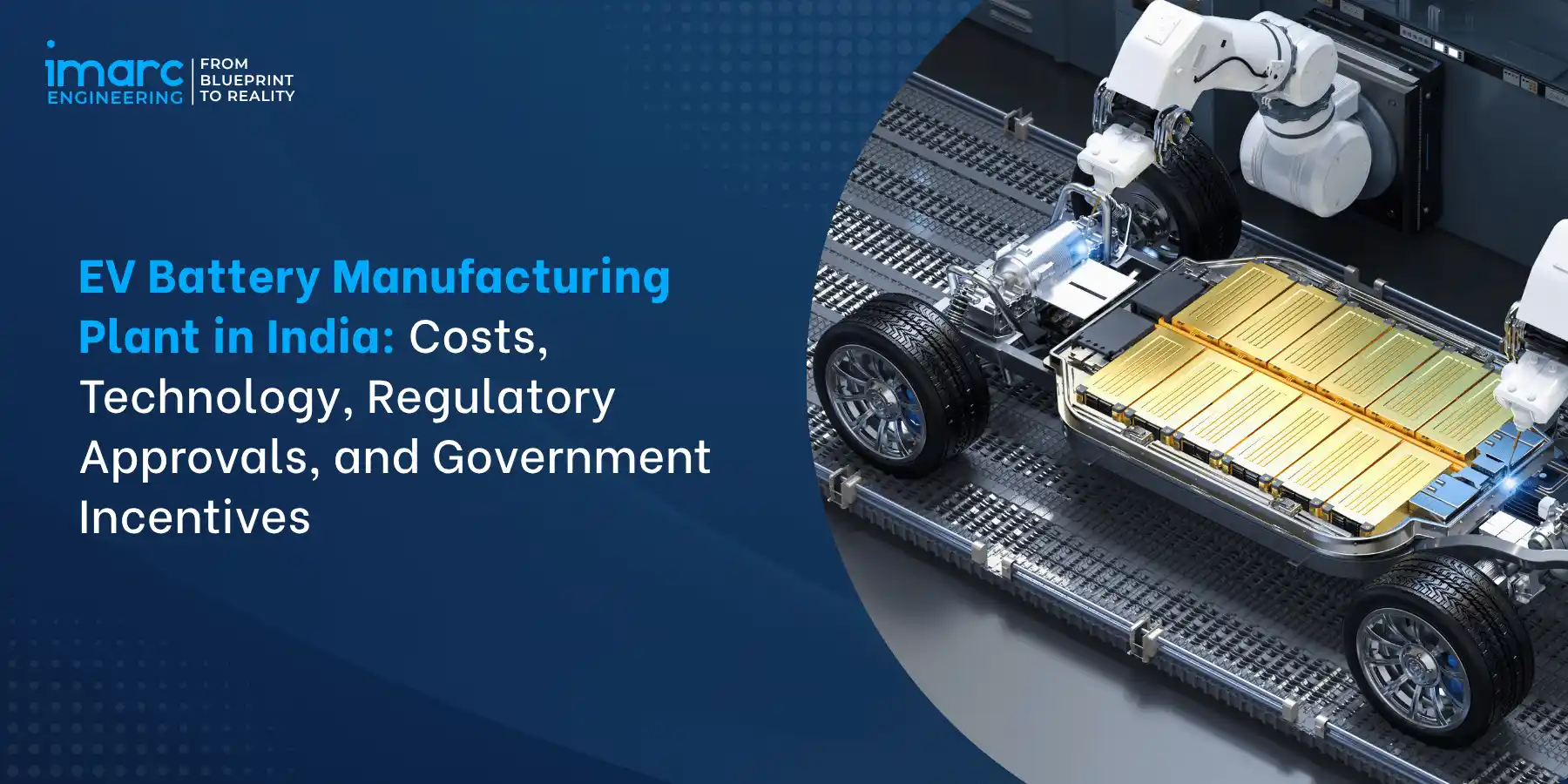
How to Set Up an EV Battery Manufacturing Plant in India: Costs, Technology, Regulatory Approvals, and Government Incentives (2026 Guide)
Introduction
Setting up an EV battery manufacturing plant in India in 2026 sits at the convergence of strong policy support and structural market growth. India's Production Linked Incentive (PLI) Scheme for Advanced Chemistry Cell (ACC) Battery Storage aims to establish 50 GWh of domestic cell manufacturing capacity. In parallel, the PM E-Drive Scheme, launched in October 2024 with an outlay of INR 10,900 crore through 31 March 2026, is supporting EV adoption and strengthening demand for locally manufactured batteries.
The regulatory environment has also evolved significantly. The Battery Waste Management Rules, 2022, with their Extended Producer Responsibility (EPR) framework, AIS-156 (including Amendment 3 effective from October 2022), and BIS standards such as IS 16893 for lithium-ion cell safety and IS 17387 for battery packs have established a structured compliance regime. Additionally, the Critical Minerals Mission approved by the Union Cabinet in January 2025 is supporting long-term raw material security, collectively shaping the operating environment for new entrants in India's battery manufacturing sector.
Yet execution has lagged ambition. As of October 2025, only approximately 2.8 percent (1.4 GWh) of the 50 GWh ACC PLI target has been commissioned, entirely by Ola Electric per JMK Research and IEEFA reports. Beyond PLI beneficiaries, more than 10 additional companies including Tata Agratas (20 GWh plant in Gujarat), Amara Raja, Exide, Mahindra, and others are committing over 100 GWh of capacity producing a broader battery manufacturing investment in India landscape than the PLI list alone suggests.
This guide answers the planning sponsor's question: how do I set up an EV battery factory setup in India, cell manufacturing, pack assembly, or both, across costs, technology, regulatory approvals, and incentives?
Table of Contents
- Introduction
- Why EV Battery Manufacturing in India Has Become Strategic in 2026
- How to Set Up an EV Battery Manufacturing Plant in India - Six-Phase Framework
- Cell Manufacturing vs Pack Assembly - The Strategic Choice
- EV Battery Manufacturing Technology Selection India
- EV Battery Plant Cost Breakdown India 2026
- Regulatory Approvals for Battery Manufacturing in India
- Government Incentives for EV Battery Manufacturers in India
- Common Mistakes and Best Practices
- Conclusion
1. Why EV Battery Manufacturing in India Has Become Strategic in 2026
Four structural drivers underpin the strategic case for battery manufacturing investment in India in 2026.
1.1 Demand Side - EV Penetration and Energy Storage Growth
Global EV battery usage reached approximately 1,187 GWh in 2025, registering 31.7 percent year-on-year growth. India's EV adoption trajectory across two-wheelers, three-wheelers, and increasingly passenger and commercial vehicles, supported by the PM E-Drive Scheme (INR 10,900 crore through March 2026), produces sustained domestic demand. Grid-scale stationary energy storage requirements - 10 GWh earmarked under ACC PLI for grid applications - layer additional demand.
1.2 Import Substitution and Strategic Autonomy
India imported the vast majority of lithium-ion cells historically - primarily from China. Strategic autonomy, supply chain resilience, and trade balance objectives drive policy support for domestic manufacturing. The Critical Minerals Mission approved January 2025 and the establishment of KABIL (Khanij Bidesh India Ltd) for overseas mineral acquisition complement downstream manufacturing incentives.
1.3 Policy Support Architecture
Multiple layered policy frameworks support new manufacturing. ACC PLI Scheme (INR 18,100 crore for 50 GWh capacity); PM E-Drive Scheme for end-demand stimulation; state-level EV and battery manufacturing policies in Maharashtra, Tamil Nadu, Gujarat, Karnataka, Telangana, Uttar Pradesh, Madhya Pradesh; National Manufacturing Policy frameworks; Phased Manufacturing Programme (PMP) for batteries; Battery Swapping Policy. The combined architecture provides incentive layering for committed manufacturers.
1.4 Technology Localisation Opportunity
Beyond capacity, India increasingly attracts technology localisation - cell chemistry development; cathode active material (CAM) production; anode active material capability; electrolyte manufacturing; battery management system (BMS) IP; cell-to-pack and cell-to-chassis design innovation. Manufacturers investing in technology localisation rather than pure assembly capture deeper economic and strategic value. As domestic battery production expands, lithium-ion battery recycling in India will also become increasingly important for recovering critical minerals and supporting a more circular battery supply chain.
2. How to Set Up an EV Battery Manufacturing Plant in India - Six-Phase Framework
A step-by-step EV battery manufacturing plant setup in India operates across six structured phases. The framework applies to cell manufacturing gigafactories, pack assembly plants, and integrated facilities with phase-specific complexity scaling.
| Phase | Activity | Typical Duration |
|---|---|---|
| 1. Strategy & Business Case | Technology selection, scale decision, target market, PLI evaluation | 8-16 weeks |
| 2. Site & Power Tie-up | Industrial park allotment, power infrastructure, statutory clearances | 6-12 months |
| 3. Detailed Engineering | Process design, equipment specification, layout, MEP | 4-8 month |
| 4. Construction & Equipment | Civil, MEP, process equipment import and installation | 18-30 months |
| 5. Validation & Certification | BIS, AIS-156 certification, customer qualification trials | 4-12 months |
| 6. Commercial Production | Capacity ramp, yield improvement, DVA milestone tracking | Continuous |
2.1 Strategy and Business Case
The starting decision frames everything downstream - cell manufacturing vs pack assembly vs integrated; technology choice (LFP, NMC, LMFP, sodium-ion); cell format (cylindrical, prismatic, pouch); scale (typically 1-50 GWh); target market (EV passenger, two/three-wheeler, commercial vehicle, stationary storage); PLI participation (with ACC PLI Domestic Value Addition - DVA - commitments of 25 percent at 2 years and 60 percent at 5 years per scheme guidelines).
2.2 Site Selection and Power Infrastructure
Cell manufacturing gigafactories require 50-200+ MW sustained power, dedicated HT grid connection, large land parcels (typically 50-200+ acres for 10-50 GWh), industrial park infrastructure, and proximity to ports for equipment import and raw material logistics. Common sites: Gujarat (Sanand for Tata Agratas; Jamnagar for Reliance), Tamil Nadu (Krishnagiri for Ola), Karnataka, Maharashtra, Telangana. Site-power tie-up is consistently the longest-lead workstream.
2.3 Detailed Engineering
Process engineering covers cell manufacturing workflow (electrode coating, calendering, slitting, cell assembly, formation and aging, testing) or pack assembly workflow (cell sorting, module assembly, BMS integration, pack assembly, end-of-line testing). MEP design covers HV/MV/LV electrical, dry-room (with dewpoint requirements below -40 degC for cell manufacturing), HVAC, fire suppression (typically novec or argonite gas systems for cell areas), nitrogen and inert gas systems, deionised water, compressed air, exhaust and scrubbing systems for solvent vapours.
2.4 Construction, Equipment, and Validation
Construction-stage capex deployment dominates total project cost. Process equipment (typically imported from China, South Korea, Japan, or Europe) accounts for 50-65 percent of capex. Installation, commissioning, integrated systems testing, and process validation runs 6-18 months. BIS certification under Compulsory Registration Scheme (CRS), AIS-156 certification for EV batteries, and customer-specific qualification trials (typically 6-12 months for major OEM customers) follow before full commercial revenue.
3. Cell Manufacturing vs Pack Assembly - The Strategic Choice
The single most consequential decision in any battery manufacturing plant setup in India project is whether to manufacture cells, assemble packs from imported cells, or operate an integrated facility. The choice drives capex, technology dependency, PLI eligibility, and competitive positioning.
| Dimension | Cell Manufacturing | Pack Assembly |
|---|---|---|
| Capex per GWh | INR 1,000-1,500 crore | INR 200-400 crore for 1-2 GWh |
| Technology Dependency | Deep IP and process know-how required | Lower; integration and BMS focus |
| Equipment Lead Time | 12-24 months (imported) | 6-12 months |
| PLI Eligibility | Eligible under ACC PLI | Not directly eligible under ACC PLI |
| Margin Capture | Higher value addition | Lower value addition |
| Time to Market | 30-48 months | 18-24 months |
3.1 The Cell Manufacturing Pathway
Cell manufacturing - the focus of lithium-ion cell manufacturing plant setup in India - delivers the deepest economic value capture and strategic positioning but demands the largest capital, technology, and execution commitment. Capex typically runs INR 1,000-1,500 crore per GWh of installed capacity (USD 120-180 million per GWh) - making a 10 GWh facility an INR 10,000-15,000 crore commitment. The ACC PLI scheme requires minimum INR 225 crore per GWh investment threshold and the technology / process know-how typically requires either in-house development or technology transfer arrangements (commonly from Chinese, Korean, or Japanese partners).
3.2 The Pack Assembly Pathway
Pack assembly - the focus of battery pack assembly plant setup in India - has substantially lower capital and technology barriers. A 1-2 GWh pack assembly plant typically requires INR 200-400 crore capex covering cell sorting, module assembly, BMS integration, pack housing, end-of-line testing, and ancillary infrastructure. Pack assembly is suited to entry into battery manufacturing for sponsors without cell technology capability, OEM captive integration (auto manufacturers integrating battery pack production with vehicle assembly), and stationary storage providers customising battery solutions. Pack assemblers source cells from domestic gigafactories (where available) or import from China, Korea, or Japan.
4. EV Battery Manufacturing Technology Selection India
Cell chemistry and format selection define both manufacturing process and end-product positioning. ACC battery manufacturing in India covers Advanced Chemistry Cells including lithium-ion (LFP, NMC, LMFP), sodium-ion (emerging), and longer-horizon solid-state technologies.
4.1 Lithium-Ion Cell Chemistries
| Chemistry | Energy Density | Best Suited For |
|---|---|---|
| LFP (Lithium Iron Phosphate) | Lower (~150-180 Wh/kg) | Entry/mid EV, two-wheelers, stationary storage; safety-focused |
| NMC (Nickel-Manganese-Cobalt) | Higher (~200-260 Wh/kg) | Premium EVs, range-focused applications |
| LMFP (Lithium Manganese Iron Phosphate) | Mid (~180-220 Wh/kg) | Emerging balance of LFP and NMC characteristics |
| Sodium-ion | Lower (~120-160 Wh/kg) | Emerging; cost-advantaged, low-temperature applications |
| Solid-state (longer horizon) | Projected higher | Future-generation; commercialisation 2027-2030+ |
4.2 Cell Format Considerations
Three primary cell formats dominate. Cylindrical (18650, 21700, 4680) - mature, robust, well-established supply chains; suited for premium EVs and where format-flexible BMS designs work. Prismatic - high volumetric efficiency, increasingly dominant in passenger EVs particularly with LFP chemistry; growing share in Chinese and Korean manufacturer roadmaps. Pouch - higher energy density potential but mechanical challenges; common in premium applications. Cell format selection cascades into pack design, BMS architecture, and thermal management requirements.
4.3 Technology Sourcing Strategy
Sponsors face a strategic choice on technology origin. In-house development - Ola Electric's 'Bharat Cell' 4680 with 70+ patents - high cost and risk but deep IP and strategic autonomy. Technology transfer from Chinese, Korean, or Japanese partners - faster time-to-market but ongoing royalty and supply dependencies; geopolitical considerations in some sourcing paths. Joint venture with established cell manufacturers - balanced risk-reward; common in PLI-aligned commitments. Agratas Energy operates an R&D centre in the United Kingdom focusing on next-generation technology.
4.4 Cathode and Anode Localisation
Cell manufacturing process value is concentrated in active materials. Cathode Active Material (CAM) - traditionally imported; localisation is a key DVA milestone under PLI ACC; the Critical Minerals Mission supports upstream raw material access. Anode Active Material (AAM) - graphite-based predominantly; localisation efforts emerging. Electrolyte and separator - increasingly produced domestically. Cell-to-pack and cell-to-chassis design integration captures additional value at the system level. Sponsors should plan vertical integration depth alongside cell manufacturing capacity.
5. EV Battery Plant Cost Breakdown India 2026
Understanding the EV battery plant cost in India structure enables informed budgeting, financing, and PLI commitment sizing. The capex stack differs materially between cell manufacturing and pack assembly facilities.
5.1 Cell Manufacturing Capex Stack
| Cost Category | % of Total Capex | Notes |
|---|---|---|
| Land and site development | 4-8% | Plot premium, levelling, site infrastructure |
| Civil and structural | 10-15% | RCC structure with dry-room provisions |
| Process equipment (mainly imported) | 50-65% | Electrode coating, calendering, cell assembly, formation |
| MEP (HV electrical, HVAC, dry-room) | 12-18% | Dewpoint -40 degC requirement increases MEP intensity |
| Utilities (water, gas, exhaust) | 3-6% | Deionised water, nitrogen, solvent recovery |
| IT, automation, MES | 3-5% | Process control, traceability, quality |
| Pre-operating and validation | 3-6% | Process qualification, certification trials |
| Contingency | 8-12% | Process risk premium |
5.2 Indicative Total Capex Benchmarks
Cell manufacturing total capex typically runs INR 1,000-1,500 crore per GWh of installed capacity - making a 5 GWh facility approximately INR 5,000-7,500 crore (USD 600-900 million), a 10 GWh facility approximately INR 10,000-15,000 crore (USD 1.2-1.8 billion), and a 20 GWh facility approximately INR 20,000-30,000 crore (USD 2.4-3.6 billion). The ACC PLI scheme requires a minimum INR 225 crore per GWh investment threshold. Pack assembly capex is materially lower - typically INR 200-400 crore for 1-2 GWh capacity (USD 25-50 million).
5.3 Operating Cost Considerations
Cell manufacturing operating economics depend on cell-level cost per kWh achievable - global benchmarks are USD 100-130 per kWh declining trajectory at scale. Material costs typically represent 65-75 percent of cell-level cost; labour 5-10 percent; energy 5-10 percent; depreciation and other 10-15 percent. Indian operations target competitive parity with imported cells once scale and DVA milestones are achieved. Pack assembly cost per kWh adds to cell cost - typically INR 1.5-3 lakh per kWh for finished pack depending on application and BMS sophistication.
5.4 Financing Structures
Indian battery manufacturing projects typically finance through 60:40 to 70:30 debt-equity structures with debt from domestic banks (SBI, ICICI, HDFC, Axis), NBFCs, and NaBFID (with approximately INR 3.03 lakh crore approved and INR 1.09 lakh crore disbursed by December 2025) increasingly active in infrastructure-adjacent manufacturing. International capital flows through strategic partners, institutional investors, and dedicated battery investment platforms. PLI commitments materially improve financing terms for awardees through committed government incentive flows over five years.
6. Regulatory Approvals for Battery Manufacturing in India
The battery manufacturing approvals in India architecture spans Central statutes, sectoral safety standards, and state-level approvals. The full approval list is more extensive than most sponsors initially appreciate.
6.1 The Approval Stack
| Approval | Authority | Stage |
|---|---|---|
| Environmental Clearance | SEIAA / MoEFCC under EIA Notification 2006 | Pre-construction |
| Consent to Establish (CTE) | State Pollution Control Board | Pre-construction |
| Building Plan Approval | Local Development Authority / Municipal | Pre-construction |
| Fire NOC (Provisional and Final) | State Fire Services under NBC 2016 Part 4 | Pre-construction / pre-operation |
| Factory / Establishment Registration | OSH Code 2020 (in force 21 Nov 2025) | Pre-operation |
| Consent to Operate (CTO) | State Pollution Control Board | Pre-operation |
| Hazardous Waste Authorisation | State PCB under HWMR 2016 | Pre-operation |
| PESO Approval (for solvents/chemicals) | Petroleum and Explosives Safety Org. | Pre-operation |
| BIS CRS Registration (cells/packs) | BIS under BIS Act 2016 | Product-level |
| AIS-156 Compliance | ARAI / ICAT for EV batteries | Product-level |
| EPR Registration under BWMR 2022 | CPCB | Operational |
6.2 Secor-Specific Compliance
Battery manufacturing-specific compliance overlays standard industrial approvals. BIS Compulsory Registration Scheme (CRS) under BIS Act 2016 - applies to lithium-ion cells (IS 16893 series) and battery packs (IS 17387); product-level testing and certification required. AIS-156 (Automotive Industry Standard) with Amendment 3 effective October 2022 - mandatory for EV batteries, covering thermal propagation, vibration, mechanical shock, and other safety dimensions; testing typically at ARAI (Pune) or ICAT (Manesar). Battery Waste Management Rules 2022 (BWMR 2022) impose Extended Producer Responsibility on producers and importers - registration with CPCB required.
6.3 Process Safety Considerations
Cell manufacturing involves materially elevated process safety considerations versus general manufacturing. Solvent handling (NMP, DMC, EMC, DEC) requires PESO clearance and structured ATEX-zone classification. Dry-room operations with dewpoint below -40 degC introduce HVAC complexity. Cell formation and aging processes carry thermal runaway risk requiring specialised fire suppression (typically argon, nitrogen, or specialty agents). Hazardous Waste Management Rules 2016 compliance for solvent waste, cell scrap, and process residues. Sponsors should integrate process safety design at engineering phase rather than as retrofit.
6.4 State-Specific Approval Variations
State-level processes vary materially. Gujarat, Maharashtra, Karnataka, and Tamil Nadu operate single-window investment promotion frameworks that compress approval timelines. State industrial parks (typically NICDP nodes or state SIDC parks) carry park-level approvals reducing site-level scope. State Investment Promotion Bureau engagement at project initiation typically accelerates approval flow. End-to-end approval timelines from project initiation to operational status typically run 12-30 months depending on state, project scale, and approval complexity.
7. Government Incentives for EV Battery Manufacturers in India
Central and state incentive architecture has expanded materially over the past 5 years, anchored by the ACC PLI Scheme. ACC PLI scheme benefits for battery manufacturers represent the single largest Central commitment, supplemented by complementary frameworks.
7.1 ACC PLI Scheme - Status and Mechanics
Launched October 2021 under the Ministry of Heavy Industries (MHI) with INR 18,100 crore (USD 2.08 billion) outlay targeting 50 GWh of advanced cell capacity. Incentive structure: incentives spread over five years post-production tied to actual production, energy efficiency, and Domestic Value Addition (DVA) milestones (25 percent at 2 years; 60 percent at 5 years).
Required investment: minimum INR 225 crore per GWh. Allocation status: First auction (2022) allocated 30 GWh to Ola Electric (20 GWh), Reliance New Energy (5 GWh), Rajesh Exports (5 GWh), and Hyundai Global Motors (20 GWh that was later withdrawn). Second auction (September 2024) allocated 10 GWh to Reliance, with 10 GWh re-tendered and 10 GWh reserved for future.
7.2 ACC PLI Implementation Reality and Recent Updates
As of October 2025, only 2.8 percent (1.4 GWh) of the 50 GWh target has been commissioned per JMK Research and IEEFA reports - entirely by Ola Electric. Ola has scaled back to 5 GWh by FY2029. Reliance has indicated on-time commissioning of its 10 GWh second-round capacity but the 5 GWh first-round capacity is delayed. Rajesh Exports lags with progress limited to land acquisition.
Penalties have been levied (Ola INR 12.5 lakh per day; Reliance and Rajesh Exports INR 5 lakh per day for missed December 2024 milestones). The Government is considering relaxing rules including extension of timelines by 18 months and modified localisation requirements. The first PLI disbursement of INR 73.7 crore to Ola Electric was announced in March 2025.
7.3 Complementary Central Schemes
Beyond ACC PLI, several Central schemes support battery manufacturing economics. PM E-Drive Scheme (October 2024) - INR 10,900 crore through 31 March 2026 supporting EV adoption demand. PLI Automotive Scheme - supports auto component and EV value chain. National Programme on Advanced Chemistry Cell Battery Storage - broader framework.
Faster Adoption and Manufacturing of Electric Vehicles (FAME II) - largely concluded; replaced by PM E-Drive. Critical Minerals Mission (Cabinet approved January 2025) - supports upstream raw material access including lithium, cobalt, nickel, and rare earths. KABIL (Khanij Bidesh India Ltd) - public sector enterprise for overseas critical mineral acquisition.
7.4 State-Level EV and Battery Policies
Multiple states operate dedicated EV and battery manufacturing policies layering state incentives over Central frameworks. Maharashtra EV Policy and Industrial Policy; Tamil Nadu EV Policy 2023; Gujarat EV Policy; Karnataka EV Policy; Telangana EV Policy; Uttar Pradesh EV Manufacturing Policy; Madhya Pradesh EV Policy.
Common incentive types: capital subsidy (typically 10-25 percent on fixed capital investment, capped at specific maximums); interest subsidy on term loans; electricity duty exemptions; stamp duty exemptions; SGST refunds; employment incentives. State incentives are typically additive to Central PLI - a well-structured manufacturing investment can capture both.
7.5 Practical Incentive Optimisation
Capturing full incentive value requires structured approach. Map applicability across ACC PLI (if pursuing cell manufacturing at PLI-qualifying scale), state-level capital/interest/electricity/stamp duty incentives, and complementary Central schemes. Engage State Investment Promotion Bureau at project initiation - typically 3-6 months before formal allotment - to optimise eligibility and incentive structuring.
Document Domestic Value Addition milestones rigorously for PLI compliance. Track localisation against PLI commitments; recent policy direction indicates possible relaxation but compliance discipline remains essential. Coordinate compliance reporting across Central and state authorities.
8. Common Mistakes and Best Practices
8.1 Underestimating Technology Dependency
Many sponsors enter cell manufacturing underestimating the depth of process technology and intellectual property required. The ACC PLI experience demonstrates - none of the qualified PLI bidders across both auction rounds had prior cell manufacturing experience beyond Exide and Amara Raja (neither of whom qualified).
Discipline: structured technology partnership at concept stage; in-house R&D investment alongside technology transfer; realistic capability ramp planning.
8.2 Inadequate Supply Chain Localisation Planning
ACC PLI Domestic Value Addition commitments (25 percent at 2 years; 60 percent at 5 years) require structured supply chain localisation across cathode materials, anode materials, electrolyte, separator, and battery components. Sponsors that defer localisation planning miss milestone commitments.
Discipline: Phased Manufacturing Programme planning at project initiation; supplier development for critical components; integration with the Critical Minerals Mission for upstream materials.
8.3 Power Tie-up and Site Selection Delays
Cell manufacturing requires 50-200+ MW of sustained, reliable power. Sponsors that select sites without verified power tie-up face 12-24 month commissioning delays.
Discipline: power tie-up engagement at concept stage; state utility and SLDC coordination; renewable PPA structuring where economic; site selection coordinated with power infrastructure availability.
8.4 PESO and Process Safety Underestimation
Solvent handling, dry-room operations, and cell formation processes carry materially elevated process safety requirements versus general manufacturing. Sponsors that under-scope PESO clearances, ATEX-zone classification, fire suppression specification, and hazardous waste handling face costly retrofits or commissioning delays.
Discipline: process safety design at engineering phase; PESO engagement at project planning; specialised fire suppression specification; HWMR 2016 compliance from operations start.
8.5 Insufficient Customer Qualification Lead Time
Major OEM customers typically require 6-12 month qualification trials including PPAP, customer-specific testing, and pilot production validation. Sponsors that plan commercial revenue immediately on production commissioning routinely face 12-18 month revenue ramp delays.
Discipline: customer qualification programmes commenced before plant commissioning; pilot cell samples from technology partners pre-commissioning; staged commercial scale-up matched to customer qualification timelines.
Conclusion
Setting up an EV battery manufacturing plant in India in 2026 is a structurally attractive but operationally demanding undertaking. The ACC PLI Scheme (INR 18,100 crore for 50 GWh target with INR 73.7 crore first disbursement to Ola Electric in March 2025); the PM E-Drive Scheme (INR 10,900 crore through March 2026); state-level EV and battery policies; the Critical Minerals Mission approved January 2025; and the broader 100+ GWh of capacity being committed by Tata Agratas, Amara Raja, Exide, Mahindra, and others outside the PLI framework collectively define a market of unprecedented scale. The implementation reality — only 2.8 percent of the PLI target commissioned by October 2025 — underscores the execution complexity that distinguishes battery manufacturing from conventional industrial setup.
Three closing reminders. First, treat technology selection and partnership as the foundational decision - cell chemistry, format, and IP origin determine capex, time-to-market, competitive positioning, and PLI eligibility.
Second, plan supply chain localisation alongside cell manufacturing - DVA milestones cannot be achieved through downstream commitments alone and require structured upstream supplier development from project initiation.
Third, engage power tie-up, PESO clearances, and process safety design at concept stage rather than execution stage - these are the recurring delay drivers that the ACC PLI experience has surfaced industry-wide.
PLANNING AN EV BATTERY MANUFACTURING INVESTMENT?
IMARC Engineering's EV battery manufacturing and ACC advisory team supports sponsors across cell manufacturing gigafactories, pack assembly plants, and integrated facilities — from technology selection and PLI participation strategy through site selection, statutory approvals, EPC execution, BIS/AIS-156 certification, and commercial scale-up. Whether you are an OEM building captive capacity, a strategic investor entering the sector, or a domestic manufacturer scaling an existing platform, our team is ready to engage.
→ Schedule a free EV battery manufacturing scoping consultation
Frequently Asked Questions
Cell manufacturing capex typically runs INR 1,000-1,500 crore per GWh; pack assembly capex is INR 200-400 crore for 1-2 GWh. EV battery plant cost in India for a 10 GWh cell facility is approximately INR 10,000-15,000 crore.
End-to-end from concept to commercial production typically runs 30-48 months for cell manufacturing; 18-24 months for pack assembly. Power tie-up and equipment lead time are the longest-lead workstreams.
ACC PLI is closed for new applicants in the original 50 GWh allocation. ACC battery manufacturing in India future rounds may open as the Government reviews implementation; sponsors should monitor MHI notifications. The minimum investment threshold was INR 225 crore per GWh.
The core battery manufacturing approvals in India stack includes Environmental Clearance, CTE/CTO, building plan, fire NOC, factory/establishment registration under OSH Code 2020, PESO approval, BIS CRS, AIS-156, hazardous waste authorisation, and EPR registration under BWMR 2022.
Yes - 100 percent FDI is permitted under the automatic route per DPIIT policy. Multiple foreign-backed operations are active including international JV structures and wholly-owned subsidiaries.
Gujarat, Tamil Nadu, Karnataka, Maharashtra, and Telangana lead for lithium-ion battery manufacturing in India due to industrial infrastructure, port access, state EV policies, and existing ecosystem. Site selection should balance incentives, power availability, talent, and logistics.
Recent Post

Trusted by Industry Leaders
We partner with global enterprises and ambitious businesses across sectors to deliver operational excellence, strategic insights, and sustainable growth through integrated solutions.












Success in Their Words
Real feedback from clients across industries. Discover how our solutions delivered measurable impact and operational excellence.

I wanted to express my sincere appreciation for your efforts in handling this matter. Your dedication and commitment have been truly commendable, and it is evident that you have put in tremendous hard work and expertise into resolving the issues at hand. We are greatly interested in continuing our collaboration with you in the future, as your professionalism and reliability have made you a trusted partner. Thank you once again for your invaluable contribution. We look forward to strengthening our partnership ahead.

It has been a pleasure working with the IMARC team. The insights provided were structured, clear, and highly valuable, helping us strengthen both our technical and financial planning with confidence. We deeply appreciate the team’s professionalism, responsiveness, and attention to detail throughout the engagement. Every requirement was well understood and effectively incorporated, resulting in a comprehensive and actionable output. Overall, our experience has been excellent, and I would gladly recommend IMARC to organizations seeking a reliable research partner.

Your service is truly exceptional. Working with the IMARC team has been a seamless and professional experience. The clarity of communication, responsiveness to queries, and consistent support at every stage made the entire engagement highly efficient. The insights shared were well-structured, practical, and perfectly aligned with our requirements, helping us make informed decisions with confidence. Overall, the dedication and professionalism demonstrated by your team stand out, and I would be glad to recommend IMARC as a reliable and trustworthy research partner.

IMARC did an outstanding job in preparing our study. They were punctual, precise, and consistently responsive throughout the entire process. The team delivered all the data we required in a clear, well-organized, and highly professional format. Their strong attention to detail, combined with their ability to meet every deadline without compromising quality, truly set them apart. Overall, their reliability and commitment made them an exceptional partner for our project, and we would gladly work with them again in the future.

IMARC made the whole process incredibly easy from start to finish. Everyone I interacted with via email was polite, professional, and straightforward to deal with, always keeping their promises regarding delivery timelines and remaining consistently solutions-focused. From my very first contact, I appreciated the professionalism and support shown by the entire IMARC team. I highly recommend IMARC to anyone seeking timely, affordable, and reliable information or advice. My experience with IMARC was excellent, and I truly cannot fault any aspect of it.

I’d like to express my sincere gratitude for the excellent work you accomplished with the study. Your ability to quickly understand our requirements and deliver high-quality results under tight timelines truly reflects your expertise, exceptional work ethic, and unwavering commitment to your customer’s success. The professionalism and responsiveness you demonstrated throughout the process made a significant difference. Our entire team and company are incredibly thankful for your dedication, reliability, and support. Once again, thank you for your outstanding contribution.