Manufacturing
June 24 2026
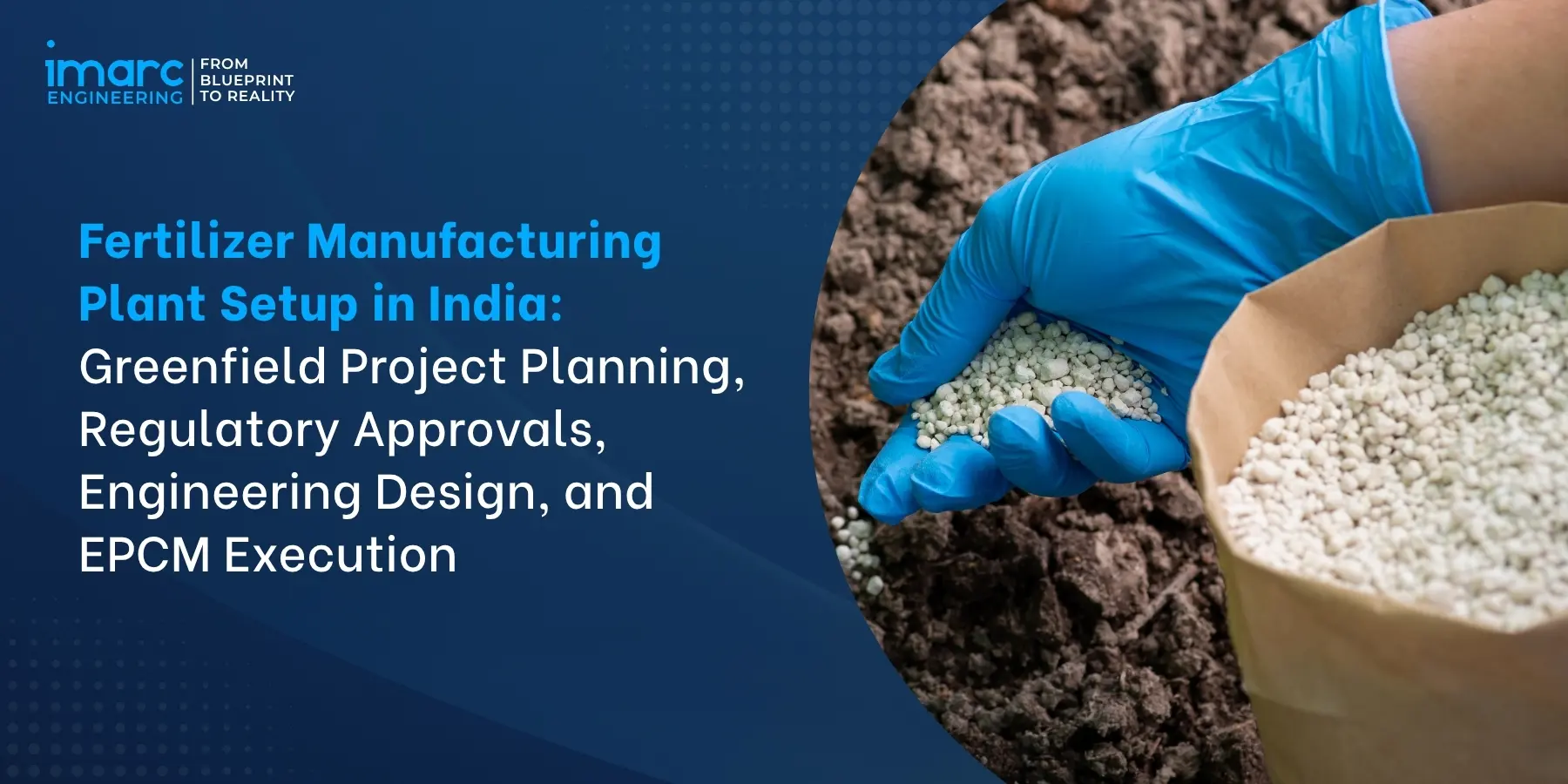
Fertilizer Manufacturing Plant Setup in India: Greenfield Project Planning, Regulatory Approvals, Engineering Design, and EPCM Execution
Introduction
Setting up a fertilizer manufacturing plant in India sits at the intersection of one of the world's largest agricultural input markets, strategic Government policy support for domestic self-reliance, and an established engineering and EPCM ecosystem capable of executing world-scale projects.
India's fertilizer sector is further supported by rising domestic production, the revival and expansion of urea manufacturing capacity, growing adoption of specialty and nano fertilizers, and sustained Government initiatives aimed at improving nutrient efficiency and reducing import dependence. Together, these factors have strengthened the commercial case for new fertilizer manufacturing investments across urea, NPK, specialty fertilizers, biofertilizers, micronutrients, and emerging next-generation nutrient products. As a result, interest in developing a fertilizer manufacturing plant in India has increased significantly among domestic investors, global agribusiness companies, and industrial groups seeking long-term participation in the country's agricultural supply chain.
Scope of This Guide
This guide answers the developer's planning question directly: how do I plan, approve, engineer, and execute a fertilizer plant project in India in 2026. It walks through the industry landscape, six-phase development framework, greenfield project planning, the regulatory and Environmental Clearance pathway, EPCM execution discipline, cost structure, financing, and common-mistake avoidance for new entrants. The objective is to make fertilizer plant development in India predictable and bankable for sponsors at every scale.
Table of Contents
- Introduction
- Why Fertilizer Manufacturing in India Has Become Strategic in 2026
- Fertilizer Industry Landscape - Products, Capacity, and Demand
- How to Set Up Fertilizer Plant in India - Six-Phase Framework
- Greenfield Fertilizer Manufacturing Project India - Planning Essentials
- Fertilizer Plant Regulatory Approvals in India and Environmental Clearance Requirements
- EPCM Services for Fertilizer Industry Projects
- Project Cost Structure and Financing
- Common Mistakes and Best Practices
- Conclusion
1. Why Fertilizer Manufacturing in India Has Become Strategic in 2026
Four structural drivers underpin the strategic case for fertilizer manufacturing investment in 2026.
1.1 Agricultural Demand and Import Substitution
India is the world's second-largest consumer of fertilizers globally, supporting an agricultural sector that employs approximately 60 percent of the workforce and contributes around 15 percent to the economy. Urea production grew 35 percent over the past decade to 30.667 MT in 2024-25; combined DAP and NPK output grew 44 percent to 15.878 MT.
Yet India remained materially import-dependent for DAP, MOP (almost entirely imported), and phosphoric acid. Import substitution alongside domestic agricultural demand growth produces sustained capacity expansion opportunity for new fertilizer industry investment in India.
1.2 The Five-Plant Revival Demonstrates Policy Commitment
The revival of five closed urea plants under the New Urea Investment Policy 2012 represents the largest fertilizer capacity addition in India in the past two decades. Gorakhpur (UP), Sindri (Jharkhand), Barauni (Bihar), and RFCL Ramagundam (Telangana) are operational; Talcher Fertilizers (Odisha) - the first coal-gasification-based urea plant - is under execution at 65.02 percent physical progress as of January 2025 and expected to be operationalised by mid-2025. Combined capacity of the five plants exceeds 65 LMT per annum at 12.7 LMT (1.27 MMTPA) each.
1.3 PM-PRANAM and Alternate Nutrient Programmes
The PM Programme for Restoration, Awareness, Nourishment and Amelioration of Mother Earth (PM-PRANAM) launched in 2023 incentivises balanced fertiliser use and alternative nutrients. Nano Urea and Nano DAP - with Nano DAP notified under the Fertilizer Control Order 1985 on 2 March 2023 - offer 80+ percent nutrient efficiency, reduced logistics cost, and lower soil contamination.
IFFCO operates three Nano Urea plants at Kalol, Phulpur, and Aonla (combined 17 crore bottles annual capacity); Nano DAP production across 3 operational plants totals approximately 7.64 crore bottles per year. Sulphur Coated Urea (Urea Gold) approved by CCEA on 28 June 2023 expands product portfolio. The diversification opens space for new specialty fertilizer manufacturing investments.
1.4 Subsidy Architecture and Subsidy-Linked Returns
The fertilizer subsidy regime - approximately INR 2.55 lakh crore in FY23 - structures sustained Government commitment to the sector. Urea operates under the New Pricing Scheme (NPS) with energy-efficiency-linked subsidy; P&K fertilizers operate under the Nutrient Based Subsidy (NBS) framework. Direct Benefit Transfer (DBT) channels subsidy through the One Nation One Fertilizer (Bharat brand, 2022) platform. The subsidy framework supports investor returns provided plants meet efficiency, energy, and quality benchmarks.
Fertilizer industry in India operates with structurally different commercial economics versus general manufacturing, requiring sponsors to model returns within the subsidy architecture. The broader agrochemical plant modernization in India, including parallel expansion in pesticides, plant growth regulators, bio-stimulants, and specialty agrochemicals — layers additional commercial opportunity for integrated manufacturers diversifying beyond pure fertilizer production.
2. Fertilizer Industry Landscape - Products, Capacity, and Demand
Understanding the product and capacity landscape is the foundation of structured fertilizer plant development in India. The category spans nitrogen-based primary fertilizers through specialty and bio-fertilizers.
2.1 Major Fertilizer Categories
| Product Category | Composition | Typical Application |
|---|---|---|
| Urea (granular and prilled) | 46% Nitrogen | Mainstay nitrogenous fertilizer; ~31 MT annual |
| DAP (Di-Ammonium Phosphate) | 18% N, 46% P2O5 | Major phosphatic fertilizer; partial imports |
| MOP (Muriate of Potash) | 60% K2O | Almost entirely imported; potash fertilizer |
| NPK Complex fertilizers | Various grades (10-26-26, 12-32-16, etc.) | Balanced nutrition; multiple producers |
| SSP (Single Super Phosphate) | 16% P2O5 | Low-cost phosphate option |
| Nano Urea / Nano DAP | Nano formulation | Emerging; 80+ percent efficiency |
| Sulphur Coated Urea (Urea Gold) | 37% N with S coating | Slow-release; RCF production |
| Specialty / water-soluble | Various | Drip irrigation, horticulture, controlled release |
2.2 Indian Production Capacity and Major Players
Major producers include cooperatives (IFFCO, KRIBHCO), public sector enterprises (NFL, RCF etc.), and private sector players (Coromandel International, Chambal Fertilizers, GSFC, GNFC, ZACL, Paradeep Phosphates, Deepak Fertilisers). The cooperative and PSU sectors dominate urea production; private sector is more prominent in complex fertilizers, SSP, and specialty grades.
2.3 Feedstock and Raw Material Considerations
Urea production is predominantly natural gas-based through ammonia synthesis (Haber-Bosch process) followed by urea synthesis. The Talcher plant pioneers coal gasification as alternative feedstock - reducing import dependency on natural gas. Phosphate fertilizer production requires rock phosphate (largely imported), sulphuric acid, and phosphoric acid. Complex fertilizers blend nitrogen, phosphate, and potash inputs. Feedstock security and pricing - particularly natural gas pooling and rock phosphate sourcing - are central commercial and policy variables for new investments.
2.4 Geographic Distribution
Major fertilizer production hubs include Gujarat (GSFC, GNFC, IFFCO), Uttar Pradesh (Gorakhpur, IFFCO Phulpur and Aonla, Indo Gulf), Telangana (RFCL Ramagundam, Coromandel), Jharkhand (Sindri), Bihar (Barauni), Odisha (Talcher, Paradeep Phosphates), Maharashtra (RCF), Punjab (NFL), and Tamil Nadu (MFL, Coromandel). Site selection for new plants typically considers feedstock proximity (port-based for imported inputs, gas pipeline access for urea), agricultural market proximity, and state industrial incentives.
3. How to Set Up Fertilizer Plant in India - Six-Phase Framework
A how to set up fertilizer plant in India engagement unfolds across six structured phases. The framework applies to urea, complex NPK, SSP, specialty fertilizer, and bio-fertilizer projects with phase-specific complexity scaling.
| Phase | Activity | Typical Duration |
|---|---|---|
| 1. Strategy & Feasibility | Product, scale, feedstock, business case, DPR | 4-8 months |
| 2. Site & Feedstock Tie-up | Land, statutory clearances, raw material agreements | 8-15 months |
| 3. Detailed Engineering | Process, FEED, BEDP, MEP, civil design | 6-12 months |
| 4. EPCM Construction | Civil, MEP, process equipment, integrated commissioning | 24-36 months |
| 5. Trial Runs & Validation | Process commissioning, FCO compliance, BIS testing | 3-6 months |
| 6. Commercial Operations | Capacity ramp, subsidy compliance, optimisation | Continuous |
3.1 Strategy and Feasibility
Planning a fertilizer manufacturing plant in India begins with several strategic decisions that influence technology selection, approvals, project cost, and long-term profitability. Product choice - urea, DAP, NPK complex, SSP, specialty, biofertilizer, or integrated complex. Scale - typically 1.27 MMTPA for urea (matching the standard NIP-2012 module); smaller scale for NPK, SSP, and specialty. Feedstock strategy - natural gas (with pooled pricing access), coal gasification, imported rock phosphate, or domestic raw materials.
Target market - subsidised mainstream (urea, DAP, NPK under NBS) or unsubsidised specialty. The Detailed Project Report (DPR) and feasibility study at this stage feeds into investment Committee approval, lender due diligence, and downstream regulatory submissions.
3.2 Site Selection and Feedstock Tie-up
Urea plant sites typically require 200-500 acres including main plant, ammonia and urea storage, granulation, bagging, dispatch infrastructure, township, and effluent treatment. Power requirement: 50-150 MW captive plus grid backup. Natural gas tie-up through GAIL or other suppliers under pooled gas pricing.
For coal gasification, integrated coal supply through Coal India subsidiaries or captive blocks. NPK and specialty plant footprints are materially smaller. State Investment Promotion Bureau engagement at this stage typically accelerates downstream approvals.
3.3 Detailed Engineering and EPCM Construction
Detailed engineering covers process engineering (ammonia synthesis, urea synthesis, granulation, bagging - typically Haldor Topsoe, KBR, Stamicarbon, or Saipem licensing for urea; phosphoric acid and complex fertilizer technologies from Jacobs, Prayon, Solvay, and others); FEED (Front-End Engineering Design); BEDP (Basic Engineering and Detailed Process); civil and structural; MEP (mechanical, electrical, piping, instrumentation, controls); and integrated 3D modelling. EPCM construction spans civil (foundations, structural, buildings), MEP installation, process equipment installation (with significant equipment imports from European, Japanese, Korean, and Chinese suppliers), and integrated commissioning. Construction takes 24-36 months for urea complexes; 18-24 months for NPK; 12-18 months for SSP and specialty.
3.4 Trial Runs, Validation, and Commercial Operations
Pre-commercial validation includes integrated systems testing (IST), performance guarantee tests against contracted equipment specifications, Fertilizer Control Order (FCO) 1985 compliance verification, BIS testing where applicable (IS 5406 for urea and other), Pollution Control Board CTO issuance, PESO clearance verification, factory licence under OSH Code 2020, and subsidy registration with the Department of Fertilizers. Commercial production typically ramps over 6-12 months to full plate capacity. Subsidy disbursement under DBT begins after registration and quality compliance verification.
4. Greenfield Fertilizer Manufacturing Project India - Planning Essentials
A greenfield fertilizer manufacturing plant in India differs materially from brownfield expansion or revival projects in capital intensity, regulatory complexity, and execution lead time. Disciplined planning at concept stage compresses execution risk.
4.1 Site Selection Criteria
- Feedstock availability and logistics - natural gas pipeline access for urea; coal availability for gasification; port proximity for imported raw materials (rock phosphate, sulphur, MOP)
- Power and water - typically 50-150 MW power and 5,000-15,000 m3 per day water for urea complexes
- Land availability - 200-500 acres for integrated urea complexes; 50-200 acres for NPK and complex
- Agricultural market proximity - reducing dispatch logistics across major consumer states
- Environmental sensitivity - avoiding eco-sensitive zones, river basins, coastal regulation zones
- State industrial incentive frameworks - capital subsidies, electricity duty waivers, GST refunds where applicable
- Skilled workforce availability and training infrastructure
- Rail, road, and port logistics for inbound raw materials and outbound product
4.2 Process Technology Selection
Process technology licensing is a foundational decision. Urea synthesis - Haldor Topsoe (Denmark), KBR (USA), Stamicarbon (Netherlands), Saipem (Italy), and Toyo Engineering (Japan) dominate. Ammonia synthesis - similar licensor set. Phosphoric acid - Jacobs, Prayon, Solvay, Yara, Nuberg. NPK complex - PRT/Norsk Hydro, OSAKA Yuki, Incro, Sackett. Granulation - drum granulation (Norsk Hydro, Prayon, Toyo), pipe reactor, pug mill, or spherodizer based on product and capacity.
Bio-fertilizer technologies are typically Indian or developed in collaboration with ICAR/ICRISAT. Technology selection affects energy efficiency, product quality, environmental footprint, and licensee royalty structure.
4.3 Power, Water, and Utilities Strategy
Urea complexes typically operate captive cogeneration plants (40-100 MW) supplemented by grid backup; new investments increasingly evaluate renewable PPA structures for sustainability reporting. Water sourcing through state utility, dedicated reservoirs, or river/groundwater (with appropriate clearances). Water consumption typically 5,000-15,000 m3 per day for urea complexes; zero liquid discharge (ZLD) increasingly mandated by Pollution Control Boards. Steam, compressed air, instrument air, nitrogen, and inert gas infrastructure scaled to process requirements. Utilities account for 12-18 percent of total project capex.
4.4 Workforce and Operational Readiness
Urea complexes typically employ 400-800 direct staff plus 800-1,500 indirect/contract workers. Skilled workforce categories: process engineers, instrumentation engineers, electrical engineers, mechanical maintenance, quality control chemists, EHS officers, control room operators, plant operators, and administrative staff. Workforce training typically begins 12-18 months before commissioning with structured curriculum covering process operations, emergency response, statutory compliance, and quality systems. Operational readiness covers SOPs, maintenance procedures, quality management system documentation, regulatory compliance frameworks, and safety management system implementation.
5. Fertilizer Plant Regulatory Approvals in India and Environmental Clearance Requirements
The fertilizer plant regulatory approvals architecture in India is among the most complex in Indian industrial regulation, reflecting the hazardous chemicals involved, environmental sensitivities, and product quality requirements. Mapping the full approval pathway at project initiation prevents the execution-stage delays that fragmented approval planning routinely produces.
5.1 The Approval Stack
| Approval | Authority | Stage |
|---|---|---|
| Environmental Clearance under EIA 2006 | MoEFCC / SEIAA (depending on category) | Pre-construction |
| Forest Clearance (if applicable) | MoEFCC under FCA 1980 | Pre-construction |
| Consent to Establish (CTE) | State Pollution Control Board | Pre-construction |
| Building Plan Approval | Local Development Authority | Pre-construction |
| Fire NOC (Provisional and Final) | State Fire Services under NBC 2016 Part 4 | Pre-construction / pre-operation |
| Factory Registration under OSH Code 2020 | Chief Inspector of Factories (in force 21 Nov 2025) | Pre-operation |
| Consent to Operate (CTO) | State Pollution Control Board | Pre-operation |
| Hazardous Waste Authorisation | State PCB under HWMR 2016 | Pre-operation |
| PESO Licence (for ammonia, hazardous chemicals) | Petroleum and Explosives Safety Org. | Pre-operation |
| MSIHC Rules compliance | MoEFCC under MSIHC Rules 1989 | Operational |
| FCO 1985 Registration | Department of Fertilizers / State Agriculture | Product-level |
| BIS Certification (urea IS 5406, etc.) | Bureau of Indian Standards | Product-level |
5.2 Environmental Clearance Process
The environmental clearance for fertilizer plant under EIA Notification 2006 is the most consequential and longest-lead approval. Fertilizer manufacturing falls under Category 'A' (requiring MoEFCC clearance for projects above threshold capacity) or 'B' (SEIAA clearance) per the Schedule. Process: Terms of Reference (ToR) determination by Expert Appraisal Committee (EAC); Environmental Impact Assessment (EIA) study covering air quality, water quality, soil, noise, ecology, hazardous chemical risk assessment; public consultation and hearing in the project area; EAC review and clearance recommendation; MoEFCC / SEIAA grant of EC. End-to-end timeline typically 12-24 months. Sponsors should engage MoEFCC-empanelled EIA consultants and plan EC application immediately after FEED completion.
5.3 Hazardous Chemical and PESO Compliance
Fertilizer plants handle materially hazardous chemicals - anhydrous ammonia, sulphuric acid, phosphoric acid, methanol, urea melt, and various process chemicals. Manufacture, Storage and Import of Hazardous Chemicals (MSIHC) Rules 1989 administered by MoEFCC require structured On-Site and Off-Site Emergency Plans, Major Accident Hazard (MAH) compliance, Process Safety Management (PSM) systems, and periodic safety audits. PESO licensing under Explosives Act 1884 and related rules covers high-pressure ammonia storage, urea synthesis pressure vessels, and related equipment. Chemical Accidents (Emergency Planning, Preparedness and Response) Rules 1996 layer additional obligations on MAH installations.
5.4 Product Quality Approvals
Product-level approvals include Fertilizer Control Order (FCO) 1985 registration under Essential Commodities Act 1955 - administered by Department of Fertilizers and state Agriculture departments - covering product specifications, packaging, labelling, and quality standards. BIS certification under specific Indian Standards (IS 5406 for urea, and others) where applicable. Subsidy registration with the Department of Fertilizers under NPS-III for urea or NBS for P&K fertilizers. Sales registration with state Agriculture departments. Periodic product testing and compliance verification by Central Fertilizer Quality Control and Training Institute (CFQCTI) and state laboratories.
6. EPCM Services for Fertilizer Industry Projects
Effective EPCM services for fertilizer industry projects distinguish successful capacity additions from delayed or under-economic projects. The Engineering, Procurement, and Construction Management model concentrates technical, commercial, and execution accountability under unified project management while allowing flexibility on equipment vendor selection.
6.1 The EPCM Engagement Structure
EPCM models concentrate design, vendor selection, contractor management, and construction supervision under a single experienced EPCM consultant - typically engaged by the project owner under cost-reimbursable or fixed-fee structures. The model differs from EPC (lump-sum turnkey) by retaining vendor selection flexibility and direct owner-supplier contracting; the EPCM consultant manages but does not contract for equipment and construction. EPCM is preferred for complex fertilizer projects where technology licensing, multiple specialised equipment packages, and owner-driven design decisions require flexibility. EPC is preferred where speed-to-execution and contractual risk transfer outweigh design flexibility.
6.2 EPCM Scope of Services
- Front-End Engineering Design (FEED) and Basic Engineering and Detailed Process (BEDP)
- Process licensing coordination with Haldor Topsoe, KBR, Stamicarbon, Saipem, or other licensors
- Detailed engineering across civil, structural, mechanical, electrical, piping, instrumentation
- 3D modelling and clash detection (using SP3D, PDMS, AVEVA E3D, or equivalent platforms)
- Equipment specification, vendor pre-qualification, and bid evaluation
- Procurement coordination and expediting
- Construction management - civil, mechanical, electrical, instrumentation packages
- Project controls - schedule, cost, quality, HSE governance
- Integrated commissioning support and performance guarantee testing
6.3 Schedule and Budget Discipline
Fertilizer EPCM projects involve multiple parallel critical paths - process equipment manufacturing and import; civil and structural construction; MEP installation; integrated commissioning. EPCM project controls integrate these paths through Primavera P6 schedules, earned value management, structured change control, vendor expediting, and weekly steering committee governance. Effective EPCM execution typically delivers projects within 10-15 percent of original budget and 5-10 percent of original schedule; ineffective EPCM execution can overshoot by 50+ percent on both dimensions.
6.4 Process Safety Integration in EPCM
Fertilizer EPCM execution must integrate process safety from FEED through commissioning. Hazard and Operability (HAZOP) studies at FEED and detailed design stages; Layer of Protection Analysis (LOPA) for high-risk scenarios; Process Safety Management (PSM) system design; structured ATEX-zone classification for hazardous areas; emergency shutdown and depressurisation system design; structured fire and gas detection; integration with MSIHC Rules 1989 and Chemical Accidents Rules 1996 compliance frameworks. Process safety integration at design stage prevents the retrofits and operational restrictions that post-construction process safety gaps routinely require.
7. Project Cost Structure and Financing
Understanding fertilizer project capex and financing structures enables informed budgeting and bankability planning. Indicative ranges vary materially by product category, scale, and technology choice.
7.1 Indicative Capex by Project Type
| Project Type | Typical Capacity | Indicative Total Capex |
|---|---|---|
| Urea Complex (NIP-2012 module) | 1.27 MMTPA (12.7 LMT) | INR 8,000-12,000 crore |
| NPK Complex Fertilizer | 0.5-1.5 MMTPA | INR 1,500-3,500 crore |
| DAP / Phosphatic Complex | 0.5-1.5 MMTPA | INR 2,500-5,000 crore |
| SSP Plant | 0.2-0.8 MMTPA | INR 200-500 crore |
| Specialty Fertilizer | 10-100 KTPA | INR 50-300 crore |
| Nano Urea / Nano DAP | 1-2 crore bottles per year | INR 150-400 crore |
| Bio-fertilizer / Organic | 5-50 KTPA | INR 25-150 crore |
7.2 Capex Composition
Fertilizer plant capex typically distributes across cost categories. Process equipment (typically 40-60 percent) - the largest single category; significant import content for ammonia synthesis, urea synthesis, granulation, and gas handling equipment. Civil and structural (10-15 percent) - foundations, buildings, storage, infrastructure.
MEP - electrical, instrumentation, piping (15-20 percent). Utilities (8-12 percent) - power, water, steam, compressed air, nitrogen, effluent treatment. Engineering and management fees (4-7 percent). Land, pre-operating, and contingency (8-12 percent). Sponsors should plan currency hedging for USD-denominated equipment imports (typically 30-50 percent of total capex).
7.3 Financing Structures
Fertilizer projects typically finance through 65:35 to 75:25 debt-equity structures. Debt sources: domestic banks (SBI, PNB, Bank of Baroda, Canara, Indian Bank consortium), NBFCs, NaBFID (with approximately INR 3.03 lakh crore approved and INR 1.09 lakh crore disbursed by December 2025) for infrastructure-adjacent projects, ECB (External Commercial Borrowing) for foreign currency portion. Multilateral funding (World Bank, ADB) selectively available for green ammonia and sustainability-linked projects. Subsidy-backed cash flows under NPS-III (urea) or NBS (P&K) support debt service certainty. Sponsors should plan a structured information memorandum and lender engagement starting at FEED stage.
7.4 Subsidy Receivables and Working Capital
Fertilizer industry working capital management has historically been challenged by subsidy receivables timing. Direct Benefit Transfer (DBT) operational since 2018 has improved disbursement discipline; current receivable cycles are materially better than pre-DBT era but periodic timing pressures remain. Sponsors should plan working capital of 18-25 percent of annual revenue covering raw material inventory, work-in-progress, finished goods, and subsidy receivables. Bank limits for working capital should be structured alongside term loan and aligned with the subsidy disbursement cycle.
8. Common Mistakes and Best Practices
8.1 Underestimating Environmental Clearance Timeline
Sponsors that initiate EC application late in project planning face 12-24 month delays as Terms of Reference determination, EIA study, public consultation, and Expert Appraisal Committee review progress through statutory timelines.
Best practice: EC application immediately after FEED completion; experienced EIA consultant engagement; structured public consultation planning; proactive Expert Appraisal Committee engagement.
8.2 Inadequate Feedstock Tie-up Discipline
Urea projects without verified natural gas tie-up or coal supply agreements face commissioning delays, sub-optimal pricing, and operational instability.
Best practice: feedstock supply agreements at FEED stage; pooled gas pricing analysis; coal block allocation or long-term coal supply contracts for coal-based projects; backup feedstock arrangements for operational reliability.
8.3 Process Safety as Retrofit Rather Than Design Input
MSIHC Rules 1989 compliance, ATEX classification, emergency shutdown systems, and fire and gas detection integrated as retrofits routinely face cost and schedule penalty versus design-stage integration.
Best practice: process safety integration from FEED; HAZOP at FEED and detailed design; structured PSM system; integrated emergency response planning.
8.4 Weak EPCM Project Controls
Fertilizer projects involve multiple parallel critical paths and complex vendor management. Sponsors relying on basic schedule tracking without earned value management, structured change control, and integrated risk tracking routinely face cost and schedule overruns of 30-50 percent.
Best practice: experienced EPCM consultant engagement; Primavera P6 schedules with earned value tracking; weekly steering committee governance; structured change control board.
8.5 Insufficient Workforce and Operational Readiness Planning
Projects that defer workforce hiring and training to post-construction stage face commissioning delays and ramp-up issues.
Best practice: workforce hiring 12-18 months before commissioning; structured training programmes including simulator-based control room operator training; SOP and quality system documentation pre-commissioning; vendor-led training for specialised equipment.
How IMARC Engineering supports fertilizer plant manufacturing in India?
IMARC Engineering supports fertilizer manufacturing plant development in India across the complete project lifecycle, from feasibility assessment and business planning to regulatory approvals, engineering design, EPCM execution, and operational readiness. Our team assists investors, agribusiness companies, fertilizer manufacturers, and industrial groups with market and techno-economic feasibility studies, Detailed Project Reports (DPRs), site selection, Environmental Clearance and statutory approval management, feedstock strategy development, process technology evaluation, and greenfield project planning.
We also provide engineering and project management support covering FEED, detailed engineering, procurement coordination, construction management, commissioning assistance, and compliance with FCO, environmental, safety, and industrial regulations. Whether you are developing a urea, NPK, SSP, specialty fertilizer, nano fertilizer, or biofertilizer facility, IMARC Engineering helps reduce project risk, accelerate execution, and improve long-term operational and commercial viability.
Conclusion
Setting up a fertilizer manufacturing plant in India in 2026 is a complex but strategically rewarding undertaking. India's fertilizer sector is supported by rising domestic production, the revival of urea manufacturing capacity, emerging products such as Nano Urea, Nano DAP, and Urea Gold, and sustained government support through initiatives such as PM-PRANAM and fertilizer subsidies, creating a favorable investment environment for new fertilizer manufacturing projects.
Three closing reminders for sponsors planning new fertilizer manufacturing investments in India. First, initiate Environmental Clearance application immediately after FEED completion - EC is consistently the longest-lead approval and the determinative variable in overall project schedule.
Second, secure feedstock tie-up at concept stage - natural gas pooling, coal supply agreements, or rock phosphate sourcing arrangements affect both project economics and operational reliability; defer feedstock planning at peril.
Third, integrate process safety, MSIHC compliance, and PESO clearances from FEED stage - retrofit-stage process safety integration is materially more expensive than design-stage integration and routinely faces operational restrictions.
PLANNING A FERTILIZER MANUFACTURING PROJECT IN INDIA?
IMARC Engineering's fertilizer manufacturing advisory team supports investors, manufacturers, agribusiness companies, and industrial groups across the entire project lifecycle, from feasibility studies and technology selection to regulatory approvals, detailed engineering, plant setup, and commercial operations. Whether you are establishing a new greenfield fertilizer plant, expanding existing production capacity, diversifying into specialty fertilizer products, or evaluating a fertilizer manufacturing investment opportunity, our team can provide end-to-end technical, regulatory, and project development support.
→ Schedule a free fertilizer manufacturing project consultation with an IMARC specialist
Frequently Asked Questions
Total capex for a fertilizer manufacturing plant in India varies by category: urea complex INR 8,000-12,000 crore for 1.27 MMTPA; NPK complex INR 1,500-3,500 crore; SSP plant INR 200-500 crore; specialty fertilizer INR 50-300 crore; bio-fertilizer INR 25-150 crore.
End-to-end from feasibility to commercial operations typically runs 48-72 months for urea complexes (including 12-24 months Environmental Clearance); 36-48 months for NPK complex; 24-36 months for SSP; 18-30 months for specialty and bio-fertilizers.
Yes. 100 percent FDI is permitted under the automatic route in fertilizer industry in India per DPIIT FDI Policy. Foreign investors operate through wholly owned subsidiaries or joint venture structures under Companies Act 2013 and FEMA 1999.
Core fertilizer plant regulatory approvals in India include Environmental Clearance under EIA Notification 2006, CTE/CTO from State PCB, building plan, fire NOC, factory registration under OSH Code 2020, PESO licence, MSIHC Rules compliance, hazardous waste authorisation, FCO 1985 product registration, and BIS certification.
Yes. New urea plants operate under the New Pricing Scheme (NPS-III) with energy-efficiency-linked subsidy. P&K fertilizers operate under Nutrient Based Subsidy (NBS). FY23 fertilizer subsidy budget was approximately INR 2.55 lakh crore.
EPC (lump-sum turnkey) concentrates contractual risk with a single contractor at fixed price; EPCM (Engineering, Procurement, Construction Management) retains owner control over equipment vendor selection and direct contracting. EPCM services for fertilizer industry projects are preferred for complex projects requiring design flexibility and technology licensing coordination.
Recent Post

Trusted by Industry Leaders
We partner with global enterprises and ambitious businesses across sectors to deliver operational excellence, strategic insights, and sustainable growth through integrated solutions.









Success in Their Words
Real feedback from clients across industries. Discover how our solutions delivered measurable impact and operational excellence.

I wanted to express my sincere appreciation for your efforts in handling this matter. Your dedication and commitment have been truly commendable, and it is evident that you have put in tremendous hard work and expertise into resolving the issues at hand. We are greatly interested in continuing our collaboration with you in the future, as your professionalism and reliability have made you a trusted partner. Thank you once again for your invaluable contribution. We look forward to strengthening our partnership ahead.

It has been a pleasure working with the IMARC team. The insights provided were structured, clear, and highly valuable, helping us strengthen both our technical and financial planning with confidence. We deeply appreciate the team’s professionalism, responsiveness, and attention to detail throughout the engagement. Every requirement was well understood and effectively incorporated, resulting in a comprehensive and actionable output. Overall, our experience has been excellent, and I would gladly recommend IMARC to organizations seeking a reliable research partner.

Your service is truly exceptional. Working with the IMARC team has been a seamless and professional experience. The clarity of communication, responsiveness to queries, and consistent support at every stage made the entire engagement highly efficient. The insights shared were well-structured, practical, and perfectly aligned with our requirements, helping us make informed decisions with confidence. Overall, the dedication and professionalism demonstrated by your team stand out, and I would be glad to recommend IMARC as a reliable and trustworthy research partner.

IMARC did an outstanding job in preparing our study. They were punctual, precise, and consistently responsive throughout the entire process. The team delivered all the data we required in a clear, well-organized, and highly professional format. Their strong attention to detail, combined with their ability to meet every deadline without compromising quality, truly set them apart. Overall, their reliability and commitment made them an exceptional partner for our project, and we would gladly work with them again in the future.

IMARC made the whole process incredibly easy from start to finish. Everyone I interacted with via email was polite, professional, and straightforward to deal with, always keeping their promises regarding delivery timelines and remaining consistently solutions-focused. From my very first contact, I appreciated the professionalism and support shown by the entire IMARC team. I highly recommend IMARC to anyone seeking timely, affordable, and reliable information or advice. My experience with IMARC was excellent, and I truly cannot fault any aspect of it.

I’d like to express my sincere gratitude for the excellent work you accomplished with the study. Your ability to quickly understand our requirements and deliver high-quality results under tight timelines truly reflects your expertise, exceptional work ethic, and unwavering commitment to your customer’s success. The professionalism and responsiveness you demonstrated throughout the process made a significant difference. Our entire team and company are incredibly thankful for your dedication, reliability, and support. Once again, thank you for your outstanding contribution.