India Plans NPCIL Consulting Arm for Engineering and Regulatory Support to Private Nuclear Power Projects
August 31, 2026
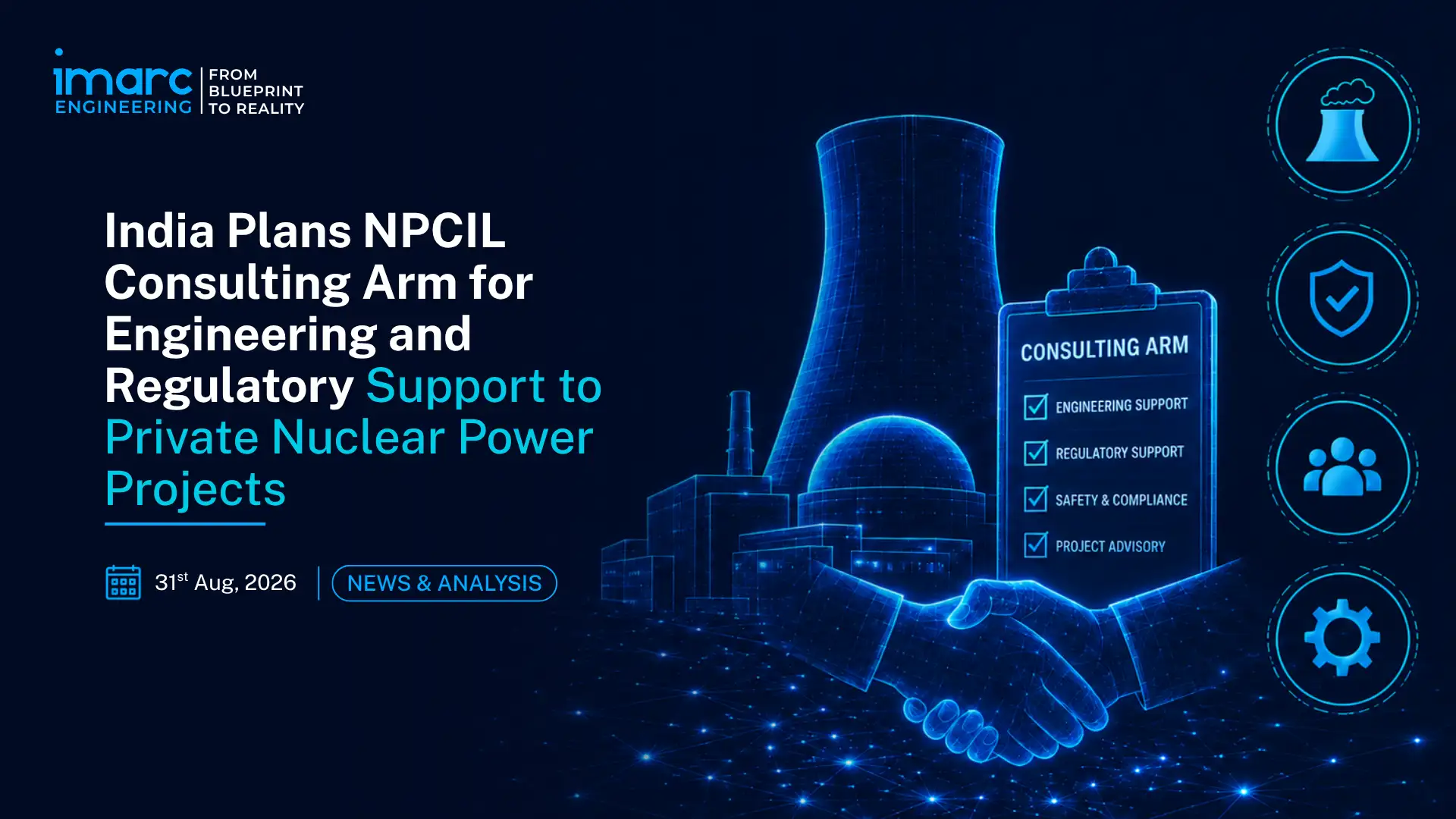
The Nuclear Power Corporation of India Ltd (NPCIL) plans to set up a new design vertical intended to provide technological support to private companies and state governments seeking to deploy indigenous nuclear reactor technology, The Indian Express reported today, citing sources familiar with the matter. The proposal is currently under process rather than approved or operational, and queries sent to the Department of Atomic Energy (DAE) and NPCIL did not elicit a response, underscoring that this remains a reported plan rather than a confirmed, finalised structure.
The move comes months after India's tightly regulated nuclear power sector was opened to private participation under the Sustainable Harnessing and Advancement of Nuclear Energy for Transforming India (SHANTI) Act, enacted in December 2025, and follows the recent release of draft rules under that Act expected to clarify the legal framework for licensing new nuclear projects once notified. For manufacturers, industrial groups, and state utilities now evaluating private nuclear power projects in India, the reported proposal offers an early signal of how the government may structure technical support for a sector it has only just begun to open up.
What is India's Proposed NPCIL Design Vertical for Private Nuclear Power Projects?
According to the reporting, the planned vertical would function as a gateway for entities seeking access to pressurised heavy-water reactor (PHWR) technology and associated technical expertise, covering technology support, design reviews, and quality assurance. NPCIL currently implements all of India's PHWR-based nuclear power projects using indigenous technology, and the country's entire 8.7 gigawatt-electric (GWe) of nuclear capacity is run and operated by NPCIL alone.
The rationale for a dedicated support function traces back to the Central Electricity Authority's (CEA) roadmap for achieving 100 GWe of nuclear capacity by 2047, which had earlier identified PHWRs as a prime candidate for adoption by other public sector undertakings and private companies and flagged that NPCIL's own expansion pipeline may leave it unable to directly hand-hold every new entrant.
The CEA's roadmap had suggested that a proposed support agency could be established under the DAE, drawing experts from the Bhabha Atomic Research Centre (BARC), the Indira Gandhi Centre for Atomic Research, and other specialised DAE units, a structural suggestion that may or may not precisely match how NPCIL's own reported vertical is eventually organised, since the two have been described separately in available reporting.
How Could NPCIL Support Private Companies Entering India's Nuclear Power Sector?
If established as reported, the vertical's stated scope, technology support, design reviews, and quality assurance, would address a specific gap the CEA identified: private and state-government entrants generally lack in-house nuclear design and engineering capability, since India's PHWR technology has, until now, existed almost entirely within NPCIL. Positioning NPCIL, or a dedicated unit linked to it, as a central technical resource would let new entrants draw on established design standards and quality assurance processes rather than developing that capability independently.
This structure would also need to operate alongside the licensing and regulatory framework the SHANTI Act and its draft rules are establishing separately, the technical support role reported here is distinct from, though complementary to, the licensing authority and safety oversight functions that fall under the Act's regulatory provisions.
Why is PHWR Technology Central to This Proposal?
The reported plan's focus on PHWR technology reflects a cost and familiarity advantage that is shaping how private entrants are approaching India's nuclear sector more broadly. Industry estimates cited in the reporting place the cost of India's indigenous PHWRs at around INR 18 crore per megawatt-electric (MWe), compared with approximately INR 34 crore per MWe for Russian reactor technology, with reactors from France and the United States estimated to cost considerably more.
India has direct experience with the cost risk foreign technology can carry: the French-assisted nuclear power project at Jaitapur in Maharashtra has remained stalled for years, with high projected electricity costs a key obstacle to its progress. As one nuclear industry expert quoted in the reporting put it, foreign reactor technology becomes viable in India largely through bulk procurement, which is not realistic at this early stage when no single buyer is likely to order 15 or 25 reactors at once, meaning private players are, for now, most likely to favour PHWRs on cost grounds alone, reinforced by an established domestic supply chain and vendor ecosystem.
Executives from Adani Atomic Energy and Jindal Steel reportedly said as much last week, describing the existing 700 MWe PHWR design as a practical starting point for scaling capacity, with foreign reactor technologies and small modular reactors (SMRs) potentially playing a role only as the sector matures.
What Engineering, Site Selection and Technical Considerations Do Private Nuclear Developers Need to Weigh?
Even with structured technical support, a private developer entering nuclear power still faces the fundamental requirements of any nuclear project. These include selecting reactor technology suited to the project's scale, cost parameters, and site conditions. Site selection must also consider seismic conditions, cooling-water availability, population density, and grid connectivity.
Detailed engineering remains necessary across civil, mechanical, electrical, and instrumentation systems, particularly for PHWR-based projects. The regulatory pathway will also become clearer once the SHANTI Act's rules are finalised and notified, defining licensing, safety, and operational requirements in greater detail.
A dedicated design-support vertical could help reduce the technical knowledge gap for new entrants. However, it cannot replace project-specific feasibility, engineering, and construction work. Financing, liability, and regulatory issues will also remain relevant as the SHANTI Act framework develops.
How Could Private Participation Support India's Nuclear Power Expansion?
The scale of ambition among prospective private entrants gives some sense of why structured technical support matters. Adani Group and Jindal Steel are reportedly planning to develop 10 GWe and 18 GWe of nuclear capacity respectively in the coming years, figures that, combined, would represent more than three times India's current total operating nuclear capacity of 8.7 GWe.
For India's stated target of 100 GWe of nuclear capacity by 2047 to be realistic, a meaningful share of that expansion will need to come from entities beyond NPCIL's own pipeline, which is precisely the gap the CEA's roadmap and NPCIL's reported design vertical both appear aimed at closing.
Whether the vertical is ultimately structured within NPCIL, under the DAE more broadly as the CEA suggested, or in some other form, the underlying need, a scalable source of PHWR design, technical, and quality-assurance support for entrants without NPCIL's decades of in-house experience, is unlikely to disappear regardless of the final institutional design.
NPCIL's reported design vertical is, for now, a proposal under process, not a chartered entity, and not yet confirmed by the agencies involved. But the reasoning behind it, laid out plainly in the CEA's own roadmap, is hard to dispute- India cannot reach 100 GWe of nuclear capacity by 2047 if every new entrant has to rebuild PHWR design expertise from scratch.
IMARC Engineering’s Perspective
NPCIL's reported plan for a dedicated design vertical, still at the proposal stage and unconfirmed by official comment, points to a genuine structural gap in India's nuclear expansion strategy: private and state entrants have capital and ambition, but not the decades of in-house PHWR design experience NPCIL holds.
At IMARC Engineering, we see this as a reminder that even with strong technical backing from an entity like NPCIL, private nuclear power projects in India will still require project-specific feasibility studies, site selection grounded in seismic and water-availability data, engineering coordination across the many disciplines a PHWR facility demands, and careful regulatory planning as the SHANTI Act's rules move from draft to notification.
As companies such as Adani and Jindal Steel advance multi-gigawatt nuclear ambitions built around PHWR technology, the organisations that pair whatever centralised technical support ultimately emerges with rigorous, independent project engineering will be best positioned to convert India's opening nuclear sector into operating capacity, rather than a pipeline of announced but undeveloped projects.
Latest News
-
SunBridge BioEnergy Starts Commercial Production at INR 350 Crore, 300 KLD Ethanol Plant in Madhya Pradesh
October 15, 2026
-
PM Modi Launches INR 753.68 Crore VOC Port Infrastructure Projects in Tamil Nadu
October 14, 2026
-
India's Manufacturing Sector Shows Recovery in Q2 FY27 as 95% of Firms Report Stable or Higher Output
October 12, 2026
-
Puri Greenfield Airport Gets Environmental Clearance, Advancing INR 5,631 Crore Project in Odisha
October 09, 2026
-
IEX Subsidiary Applies for Coal Exchange Registration Under India’s New Coal Exchange Rules 2026
September 30, 2026
Trusted by Industry Leaders
We partner with global enterprises and ambitious businesses across sectors to deliver operational excellence, strategic insights, and sustainable growth through integrated solutions.












Success in Their Words
Real feedback from clients across industries. Discover how our solutions delivered measurable impact and operational excellence.

I wanted to express my sincere appreciation for your efforts in handling this matter. Your dedication and commitment have been truly commendable, and it is evident that you have put in tremendous hard work and expertise into resolving the issues at hand. We are greatly interested in continuing our collaboration with you in the future, as your professionalism and reliability have made you a trusted partner. Thank you once again for your invaluable contribution. We look forward to strengthening our partnership ahead.

It has been a pleasure working with the IMARC team. The insights provided were structured, clear, and highly valuable, helping us strengthen both our technical and financial planning with confidence. We deeply appreciate the team’s professionalism, responsiveness, and attention to detail throughout the engagement. Every requirement was well understood and effectively incorporated, resulting in a comprehensive and actionable output. Overall, our experience has been excellent, and I would gladly recommend IMARC to organizations seeking a reliable research partner.

Your service is truly exceptional. Working with the IMARC team has been a seamless and professional experience. The clarity of communication, responsiveness to queries, and consistent support at every stage made the entire engagement highly efficient. The insights shared were well-structured, practical, and perfectly aligned with our requirements, helping us make informed decisions with confidence. Overall, the dedication and professionalism demonstrated by your team stand out, and I would be glad to recommend IMARC as a reliable and trustworthy research partner.

IMARC did an outstanding job in preparing our study. They were punctual, precise, and consistently responsive throughout the entire process. The team delivered all the data we required in a clear, well-organized, and highly professional format. Their strong attention to detail, combined with their ability to meet every deadline without compromising quality, truly set them apart. Overall, their reliability and commitment made them an exceptional partner for our project, and we would gladly work with them again in the future.

IMARC made the whole process incredibly easy from start to finish. Everyone I interacted with via email was polite, professional, and straightforward to deal with, always keeping their promises regarding delivery timelines and remaining consistently solutions-focused. From my very first contact, I appreciated the professionalism and support shown by the entire IMARC team. I highly recommend IMARC to anyone seeking timely, affordable, and reliable information or advice. My experience with IMARC was excellent, and I truly cannot fault any aspect of it.

I’d like to express my sincere gratitude for the excellent work you accomplished with the study. Your ability to quickly understand our requirements and deliver high-quality results under tight timelines truly reflects your expertise, exceptional work ethic, and unwavering commitment to your customer’s success. The professionalism and responsiveness you demonstrated throughout the process made a significant difference. Our entire team and company are incredibly thankful for your dedication, reliability, and support. Once again, thank you for your outstanding contribution.
Ready to Experience the IMARC Advantage?
Whether you're planning a new facility, expanding operations, optimizing performance, or facing complex challenges—IMARC Engineering brings the expertise, experience, and commitment needed for success.