India's Manufacturing Sector Shows Recovery in Q2 FY27 as 95% of Firms Report Stable or Higher Output
October 12, 2026
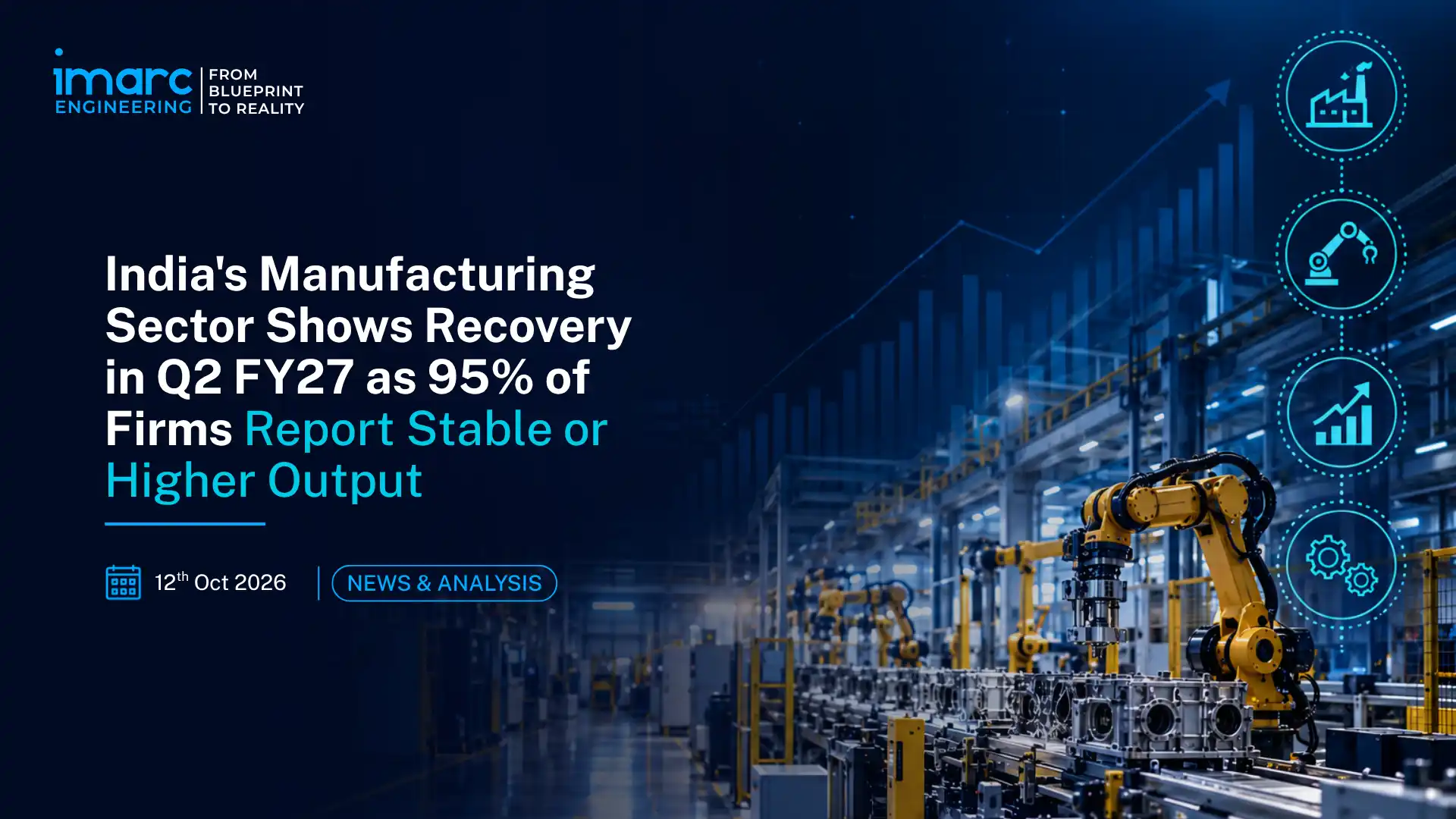
The India manufacturing sector Q2 FY27 showed a clear improvement in sentiment, with 95% of surveyed manufacturers reporting stable or higher production levels in FICCI's latest Quarterly Survey on Manufacturing, released on October 6, 2026. The figure was 77% in the previous quarter. FICCI also reported stronger manufacturing orders and higher capacity utilization.
The survey also records rising costs and a steady rather than accelerating investment outlook. The 95% figure represents manufacturers reporting stable or higher production, not a 95% increase in factory output. The survey covered approximately 225 manufacturing firms across nine sectors, representing both large enterprises and SMEs, with combined annual turnover exceeding INR 2 lakh crore.
What Does FICCI's Q2 FY27 Manufacturing Survey Reveal?
The survey covers July to September 2026 and shows a broad rebound in sentiment across the nine sectors it tracks. FICCI links the recovery partly to the easing effects of the West Asia crisis, while noting that some sectors are still affected. It describes "overall positive sentiments and stable domestic fundamentals for manufacturing growth". The survey reflects the views of participating firms, so it is best read as an indicator of direction, not as an official measure of output.
What Percentage of Indian Manufacturers Reported Stable or Higher Production?
About 95% of respondents reported stable or higher production, up from 77% in Q1 FY27. The category combines firms with unchanged production and firms with higher production, and the coverage reviewed does not separate the two. A reading of "stable" shows that firms avoided a fall in output. It does not show that they expanded it. This distinction matters for anyone reading the headline figure as evidence of a production boom.
What Does the Survey Indicate About Manufacturing Orders and Demand?
About 90% of respondents reported higher or stable orders, compared with 77% in the previous quarter. On exports, about 80% reported shipments at or above year-ago levels, up from 74%. FICCI said export diversification efforts by the government and industry "seem to be yielding results". Inventory levels were flat in a miscellaneous category of sectors, which FICCI attributed to low demand from geopolitical tensions and working capital limits. Demand recovery was therefore broad but not uniform.
How Did Manufacturing Capacity Utilization Change in Q2 FY27?
Average capacity utilization rose to about 75% from 72% in the previous survey. Glass reported the highest utilization at 88%, and machine tools the lowest at 68%. The gap between sectors shows that some manufacturers are running close to practical limits while others still have spare capacity. Hiring intentions also improved: about 43% of respondents plan to add workers in the next three months, up from 35%. About one-third of respondents reported a shortage of skilled workers.
By sector, FICCI expects strong growth in automotive and auto components, with respondents expecting growth of 10% to 20%. Machine tools and metal products are expected to see strong-to-moderate growth, and capital goods, chemicals, glass, electronics, electrical equipment and textiles moderate growth. These are expectations from respondents, not measured outcomes.
What Challenges Continue to Affect India's Manufacturing Recovery?
Cost is the main counterweight to the positive indicators. About 83% of respondents said production costs had risen as a share of sales, up from 79% in the previous quarter. FICCI attributed this mainly to higher raw material prices, energy costs, currency depreciation, and rising logistics and utility costs. The average borrowing rate reported by respondents rose to 9.1% from 8.9%, although about 90% said bank funding was adequate.
Respondents also cited geopolitical tensions, tariffs, trade restrictions and uncertain demand as barriers to expansion, along with skill shortages, raw material availability, logistics expenses and regulatory challenges. Manufacturers asked the government to lower logistics, energy and input costs, make credit cheaper for MSMEs, speed up regulatory approvals and act faster against cheap imports.
How Do Other Industrial Indicators Compare?
Other recent releases point the same way. The National Statistics Office reported that the Index of Industrial Production grew 8.0% year-on-year in August 2026, with manufacturing up 9.0% and 18 of 23 industry groups growing. Capital goods output rose 16.9%. Separately, the HSBC India Manufacturing PMI was 55.1 in September, up from 52.8 in August, with new orders growing at their fastest pace in seven months and input cost inflation accelerating. These are separate datasets with different methods from the FICCI survey, but they are consistent with a recovery in factory production, alongside continued cost pressure.
What Are the Implications for Manufacturing Investment and Capacity Expansion?
FICCI describes the six-month investment outlook as steady. Higher capacity utilization combined with firmer orders suggests that many firms are first using existing facilities more fully, while geopolitical and cost uncertainty keeps larger commitments cautious. The survey does not establish an immediate increase in greenfield investment.
For manufacturers evaluating new investments, higher capacity utilisation and stronger order books may support closer assessment of debottlenecking, machinery upgrades and production efficiency improvements before committing to major capacity additions. However, the survey does not establish that firms are prioritising these investments over greenfield projects. Capacity expansion becomes more likely where utilization is already high, as in glass, and where demand visibility is strongest, as in automotive and auto components.
A strong survey quarter shows momentum, not a mandate. The manufacturers best placed to benefit are those who convert higher utilization and firmer orders into disciplined, phased capacity decisions.
IMARC Engineering’s Perspective
The FICCI findings suggest a recovery in utilization more than a new wave of plant construction, and project planning should reflect that. At IMARC Engineering, we see three questions for manufacturers at this stage. First, how much production headroom remains within individual facilities, since sector-level capacity utilisation can indicate pressure on existing capacity but does not reveal the bottlenecks or expansion requirements of a particular plant. Second, which upgrades, such as automation, energy efficiency and process improvements, reduce operating costs when raw material prices, energy costs and logistics costs are all rising.
Third, which expansion options stay viable if demand weakens or trade conditions change, which favours phased, modular capacity over one large commitment. We support manufacturers with techno-economic feasibility studies, debottlenecking and modernization assessments, and DPR preparation, so that capacity decisions rest on utilization, cost and demand data and not on a single quarter's sentiment.
Latest News
-
India's Manufacturing Sector Shows Recovery in Q2 FY27 as 95% of Firms Report Stable or Higher Output
October 12, 2026
-
Puri Greenfield Airport Gets Environmental Clearance, Advancing INR 5,631 Crore Project in Odisha
October 09, 2026
-
IEX Subsidiary Applies for Coal Exchange Registration Under India’s New Coal Exchange Rules 2026
September 30, 2026
-
India Pushes Domestic Shipping Container Manufacturing with INR 10,000 Crore Assistance Scheme
September 25, 2026
-
India’s Growing GCC Sector Brings Greenfield Setup and Regulatory Compliance into Focus
September 24, 2026
Trusted by Industry Leaders
We partner with global enterprises and ambitious businesses across sectors to deliver operational excellence, strategic insights, and sustainable growth through integrated solutions.











Success in Their Words
Real feedback from clients across industries. Discover how our solutions delivered measurable impact and operational excellence.

I wanted to express my sincere appreciation for your efforts in handling this matter. Your dedication and commitment have been truly commendable, and it is evident that you have put in tremendous hard work and expertise into resolving the issues at hand. We are greatly interested in continuing our collaboration with you in the future, as your professionalism and reliability have made you a trusted partner. Thank you once again for your invaluable contribution. We look forward to strengthening our partnership ahead.

It has been a pleasure working with the IMARC team. The insights provided were structured, clear, and highly valuable, helping us strengthen both our technical and financial planning with confidence. We deeply appreciate the team’s professionalism, responsiveness, and attention to detail throughout the engagement. Every requirement was well understood and effectively incorporated, resulting in a comprehensive and actionable output. Overall, our experience has been excellent, and I would gladly recommend IMARC to organizations seeking a reliable research partner.

Your service is truly exceptional. Working with the IMARC team has been a seamless and professional experience. The clarity of communication, responsiveness to queries, and consistent support at every stage made the entire engagement highly efficient. The insights shared were well-structured, practical, and perfectly aligned with our requirements, helping us make informed decisions with confidence. Overall, the dedication and professionalism demonstrated by your team stand out, and I would be glad to recommend IMARC as a reliable and trustworthy research partner.

IMARC did an outstanding job in preparing our study. They were punctual, precise, and consistently responsive throughout the entire process. The team delivered all the data we required in a clear, well-organized, and highly professional format. Their strong attention to detail, combined with their ability to meet every deadline without compromising quality, truly set them apart. Overall, their reliability and commitment made them an exceptional partner for our project, and we would gladly work with them again in the future.

IMARC made the whole process incredibly easy from start to finish. Everyone I interacted with via email was polite, professional, and straightforward to deal with, always keeping their promises regarding delivery timelines and remaining consistently solutions-focused. From my very first contact, I appreciated the professionalism and support shown by the entire IMARC team. I highly recommend IMARC to anyone seeking timely, affordable, and reliable information or advice. My experience with IMARC was excellent, and I truly cannot fault any aspect of it.

I’d like to express my sincere gratitude for the excellent work you accomplished with the study. Your ability to quickly understand our requirements and deliver high-quality results under tight timelines truly reflects your expertise, exceptional work ethic, and unwavering commitment to your customer’s success. The professionalism and responsiveness you demonstrated throughout the process made a significant difference. Our entire team and company are incredibly thankful for your dedication, reliability, and support. Once again, thank you for your outstanding contribution.
Ready to Experience the IMARC Advantage?
Whether you're planning a new facility, expanding operations, optimizing performance, or facing complex challenges—IMARC Engineering brings the expertise, experience, and commitment needed for success.