India's Glass Manufacturing Capacity Expands as New Investments Drive Plant Development and Industrial Growth
August 04, 2026
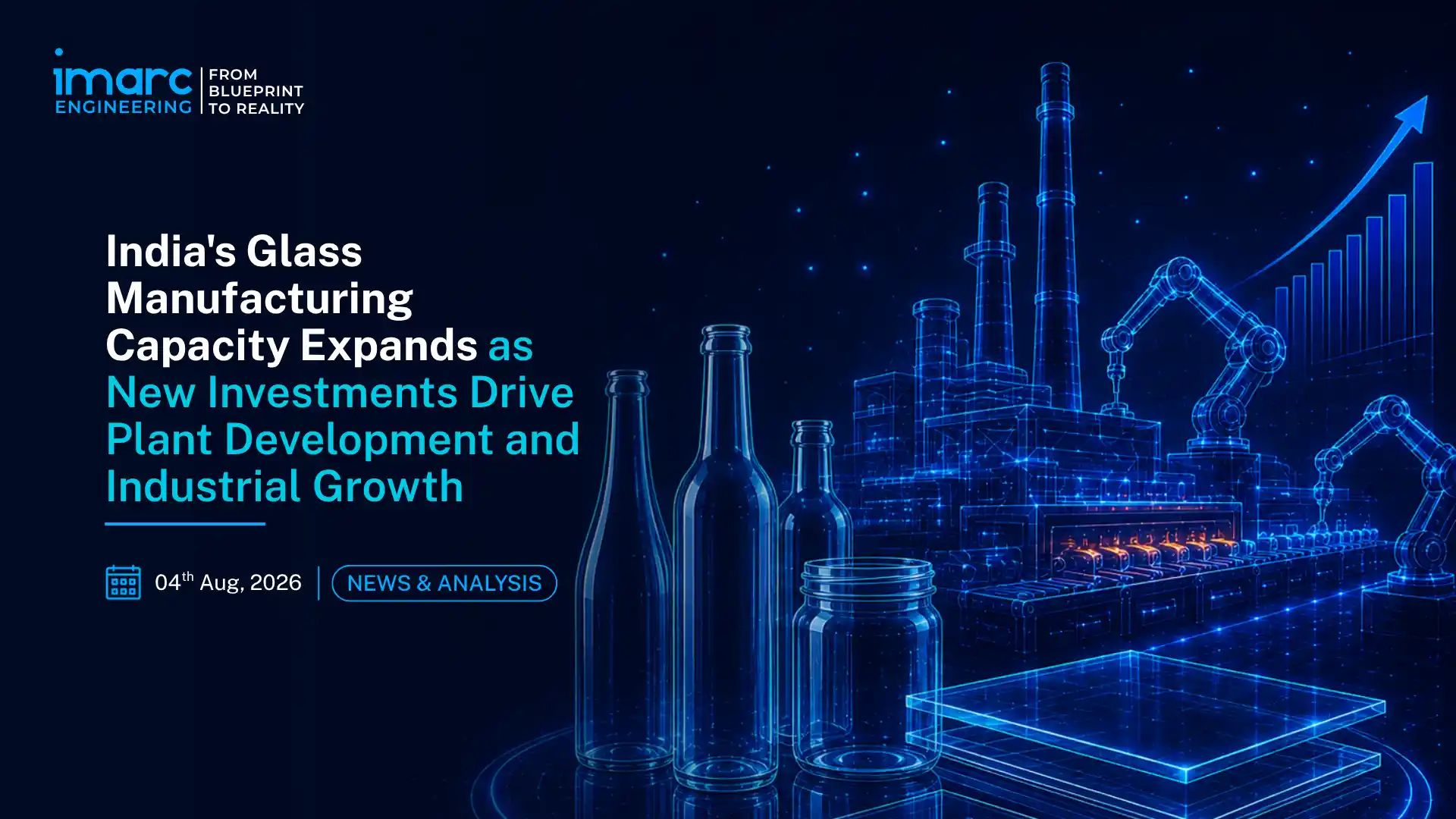
In July 2026, AGI Greenpac, an Indian container glass manufacturer, reported Q1 FY2026-27 standalone revenue of INR 785 crore, up approximately 14.16% year-on-year, alongside confirmation that its 500 tonnes-per-day (TPD) greenfield glass manufacturing plant under construction at Gwalior, Madhya Pradesh remains on track for commissioning by March 2027.
The announcement is one data point in a broader wave of capacity investment reshaping India's glass manufacturing industry through 2026, from Borosil Renewables' INR 950 crore solar glass expansion in Gujarat to AGI Greenpac's own container glass build-out, all arriving as India's flat glass market is projected to grow from USD 3.93 billion in 2025 to roughly USD 6.39 billion by 2034.
For manufacturers, investors, and engineering firms watching this sector, glass manufacturing capacity in India is expanding on a scale and across enough product segments that it now warrants close attention as an industrial investment category in its own right.
Why is India's Glass Manufacturing Capacity Expanding?
The expansion is being driven by a straightforward supply-demand gap: India's construction, automotive, renewable energy, packaging, and consumer sectors are growing faster than domestic glass production capacity has historically kept pace with, leaving a persistent reliance on imports that policy and private capital are now moving to close. Glass manufacturing in India has also benefited from a specific trade policy correction.
The government imposed a five-year anti-dumping duty on solar glass imports from China and Vietnam, effective December 4, 2024, after domestic producers demonstrated that underpriced imports were undercutting local manufacturing economics. That single measure has directly unlocked new investment: Borosil Renewables cited the anti-dumping duty explicitly as the basis for reviving and expanding its solar glass capacity, having previously placed expansion plans on hold amid import pressure.
What Factors Are Driving New Investments?
Three factors stand out in the current wave of investment. First, policy correction in solar glass: Borosil Renewables' board approved a revised expansion plan to add 600 TPD of solar glass capacity, through two new furnaces, SG-4 and SG-5, at 300 TPD each, at an estimated cost of INR 950 crore at its Bharuch, Gujarat facility, with commissioning targeted for December 2026. This takes the company's total solar glass capacity from 1,000 TPD toward 1,600 TPD, reinforcing its position as India's principal domestic solar glass producer at a moment when the country's solar manufacturing programme depends on a reliable local glass supply chain.
Second, sustained demand growth in container and packaging glass: AGI Greenpac's Gwalior facility, backed by an investment of roughly INR 700 crore, will lift the company's container glass capacity from around 2,100 TPD to 2,600 TPD, a roughly 25% increase, aimed at alcoholic beverage, pharmaceutical, and food packaging demand.
The company's existing container glass plants are already running at close to 95% utilisation, and its specialty glass capacity has separately been expanded to 200 TPD, both indicators of a manufacturer whose existing capacity is structurally sold out ahead of new supply coming online. AGI Greenpac is simultaneously diversifying into aluminium beverage cans with a separate INR 1,000 crore, two-phase facility in Hathras, Uttar Pradesh, signalling how packaging-glass manufacturers are expanding their broader manufacturing infrastructure in India rather than glass capacity alone.
Third, broader industrial and construction demand: India's flat glass market is driven by urbanisation, green building codes favouring high-performance glazing, and automotive sector expansion, with the automotive glass segment specifically projected to grow from roughly USD 948.7 million in 2025 toward USD 1,433.7 million by 2034.
Which Industries Are Increasing Demand for Glass Products?
Construction is the largest demand driver for float glass manufacturing, as smart city projects, commercial real estate, and green building codes increase specification of high-performance and energy-efficient glazing. Automotive is a close second: India's vehicle production and export volumes, more than 5.3 million vehicles exported in FY2025, are driving both original equipment and aftermarket demand for windshield and window glass, reinforced by the Automotive Mission Plan's ambition to make India the world's third-largest automotive manufacturing hub.
Renewable energy, specifically solar module manufacturing, has become one of the fastest-growing demand segments for glass manufacturing plant capacity, since every solar panel manufactured domestically requires solar glass as a critical input, a dependency that made the anti-dumping duty on Chinese and Vietnamese imports so consequential for the sector.
Packaging, particularly alcoholic beverage, food, and pharmaceutical packaging, continues to drive container glass manufacturing demand, evidenced by AGI Greenpac's near-full utilisation. Consumer glassware, laboratory glass, and specialty glass round out a demand base broad enough that India's overall glass market is estimated at roughly USD 5.2 billion in 2025, with projections toward USD 9.0 billion by 2034.
What Opportunities Do These Investments Create for Manufacturers and Investors?
The scale of undersupply relative to demand growth is itself the opportunity. A domestic glass manufacturing industry in India running near full utilisation across container glass, and only recently protected from import dumping in solar glass, indicates pricing power and demand visibility that support new capacity commitments with reasonable confidence.
For investors, this creates a window to back both capacity expansions by established manufacturers and genuinely new entrants across float glass, specialty glass, and architectural glass, where import substitution and regional demand clusters offer structurally supported investment cases.
How Does Capacity Expansion Influence Future Plant Development?
The current cycle indicates that future glass manufacturing plant development in India is trending toward greenfield projects positioned for raw material access and regional demand coverage, rather than incremental additions at existing sites alone.
AGI Greenpac's choice of Madhya Pradesh for its greenfield container glass plant, and Gold Plus Group's Karnataka facility entering the solar glass segment, both reflect manufacturers deliberately expanding their industrial footprint into new states rather than concentrating further capacity at legacy locations.
This geographic diversification has implications for site selection, logistics planning, and raw material sourcing (silica sand, soda ash, limestone) that each new entrant into industrial manufacturing investment in the glass sector must plan around independently, since India's established glass clusters in Gujarat and Maharashtra do not automatically extend their supply chain advantages to a new site elsewhere.
Why is Engineering Planning Important for New Glass Manufacturing Projects?
Glass manufacturing is capital-intensive and technically unforgiving of design shortcuts. A furnace campaign typically runs for a decade or more once commissioned, which means technology selection, furnace type, energy source, batch and melting configuration, locked in at the design stage determines the plant's cost structure and output quality for its entire operating life.
Float glass, container glass, and specialty glass processes each demand different furnace design, annealing, and forming line configurations, and getting this technology selection wrong at the front end is far more costly to correct than a delay during construction.
Utility and infrastructure planning is equally critical: glass furnaces are energy-intensive, historically dependent on natural gas, and require carefully engineered combustion, batch handling, and emissions control systems to meet both production and environmental compliance requirements, a fact underscored by Borosil Renewables' own experience managing fuel-cost volatility linked to imported LNG prices during its recent expansion.
Getting the plant layout, material handling, and utility sizing right from the concept stage, rather than retrofitting later, is what separates a glass factory setup that hits its commissioning date and output specification from one that does not.
India's glass manufacturers are betting hundreds of crores on the belief that domestic demand will keep outrunning domestic supply. Whether that bet pays off, furnace by furnace, depends less on the investment announcement than on the engineering discipline that turns a furnace design into a plant that runs at capacity for the next decade.
IMARC Engineering’s Perspective
India's glass manufacturing capacity is expanding on the back of real, demonstrated demand, from AGI Greenpac's near-full container glass utilisation to the anti-dumping-duty-driven revival of Borosil Renewables' solar glass expansion, and both examples show manufacturers moving quickly to convert market opportunity into ground-broken projects.
At IMARC Engineering, we see this as a sector where engineering consulting for manufacturing plants determines execution outcomes more than most, because a glass furnace project offers little room to correct a poor technology or site decision once construction is underway.
We support manufacturers and investors across float glass manufacturing, container glass manufacturing, and specialty glass manufacturing with feasibility studies, technology and furnace selection, detailed plant design, utility and energy infrastructure planning, and EPCM project execution, the full scope of industrial project development a greenfield glass facility requires.
As demand from construction, automotive, renewable energy, and packaging continues to outpace domestic supply, the manufacturers who pair their capital commitment with rigorous engineering planning at the front end will be the ones whose new capacity comes online on schedule, at the quality and cost the investment case assumed.
Latest News
-
Wood Wins USD 200 Million ExxonMobil Construction Services Contract for PNG LNG Brownfield Projects
September 18, 2026
-
IHCL Signs 125-Key Greenfield Gateway Hotel in Sambalpur, Expanding Odisha Portfolio
September 18, 2026
-
Thoothukudi Mega Shipyard Moves Forward with INR 6.78 Crore Geotechnical and Seabed Investigation Tender
September 17, 2026
-
Nagpur–Warangal Greenfield Highway Targets December 2027 Completion as Land Acquisition Bottlenecks Ease
September 16, 2026
-
BRICS New Delhi Declaration 2026 Focuses on Resilient Supply Chains, Critical Minerals and Energy Cooperation
September 15, 2026
Trusted by Industry Leaders
We partner with global enterprises and ambitious businesses across sectors to deliver operational excellence, strategic insights, and sustainable growth through integrated solutions.









Success in Their Words
Real feedback from clients across industries. Discover how our solutions delivered measurable impact and operational excellence.

I wanted to express my sincere appreciation for your efforts in handling this matter. Your dedication and commitment have been truly commendable, and it is evident that you have put in tremendous hard work and expertise into resolving the issues at hand. We are greatly interested in continuing our collaboration with you in the future, as your professionalism and reliability have made you a trusted partner. Thank you once again for your invaluable contribution. We look forward to strengthening our partnership ahead.

It has been a pleasure working with the IMARC team. The insights provided were structured, clear, and highly valuable, helping us strengthen both our technical and financial planning with confidence. We deeply appreciate the team’s professionalism, responsiveness, and attention to detail throughout the engagement. Every requirement was well understood and effectively incorporated, resulting in a comprehensive and actionable output. Overall, our experience has been excellent, and I would gladly recommend IMARC to organizations seeking a reliable research partner.

Your service is truly exceptional. Working with the IMARC team has been a seamless and professional experience. The clarity of communication, responsiveness to queries, and consistent support at every stage made the entire engagement highly efficient. The insights shared were well-structured, practical, and perfectly aligned with our requirements, helping us make informed decisions with confidence. Overall, the dedication and professionalism demonstrated by your team stand out, and I would be glad to recommend IMARC as a reliable and trustworthy research partner.

IMARC did an outstanding job in preparing our study. They were punctual, precise, and consistently responsive throughout the entire process. The team delivered all the data we required in a clear, well-organized, and highly professional format. Their strong attention to detail, combined with their ability to meet every deadline without compromising quality, truly set them apart. Overall, their reliability and commitment made them an exceptional partner for our project, and we would gladly work with them again in the future.

IMARC made the whole process incredibly easy from start to finish. Everyone I interacted with via email was polite, professional, and straightforward to deal with, always keeping their promises regarding delivery timelines and remaining consistently solutions-focused. From my very first contact, I appreciated the professionalism and support shown by the entire IMARC team. I highly recommend IMARC to anyone seeking timely, affordable, and reliable information or advice. My experience with IMARC was excellent, and I truly cannot fault any aspect of it.

I’d like to express my sincere gratitude for the excellent work you accomplished with the study. Your ability to quickly understand our requirements and deliver high-quality results under tight timelines truly reflects your expertise, exceptional work ethic, and unwavering commitment to your customer’s success. The professionalism and responsiveness you demonstrated throughout the process made a significant difference. Our entire team and company are incredibly thankful for your dedication, reliability, and support. Once again, thank you for your outstanding contribution.
Ready to Experience the IMARC Advantage?
Whether you're planning a new facility, expanding operations, optimizing performance, or facing complex challenges—IMARC Engineering brings the expertise, experience, and commitment needed for success.