BRICS New Delhi Declaration 2026 Focuses on Resilient Supply Chains, Critical Minerals and Energy Cooperation
September 15, 2026
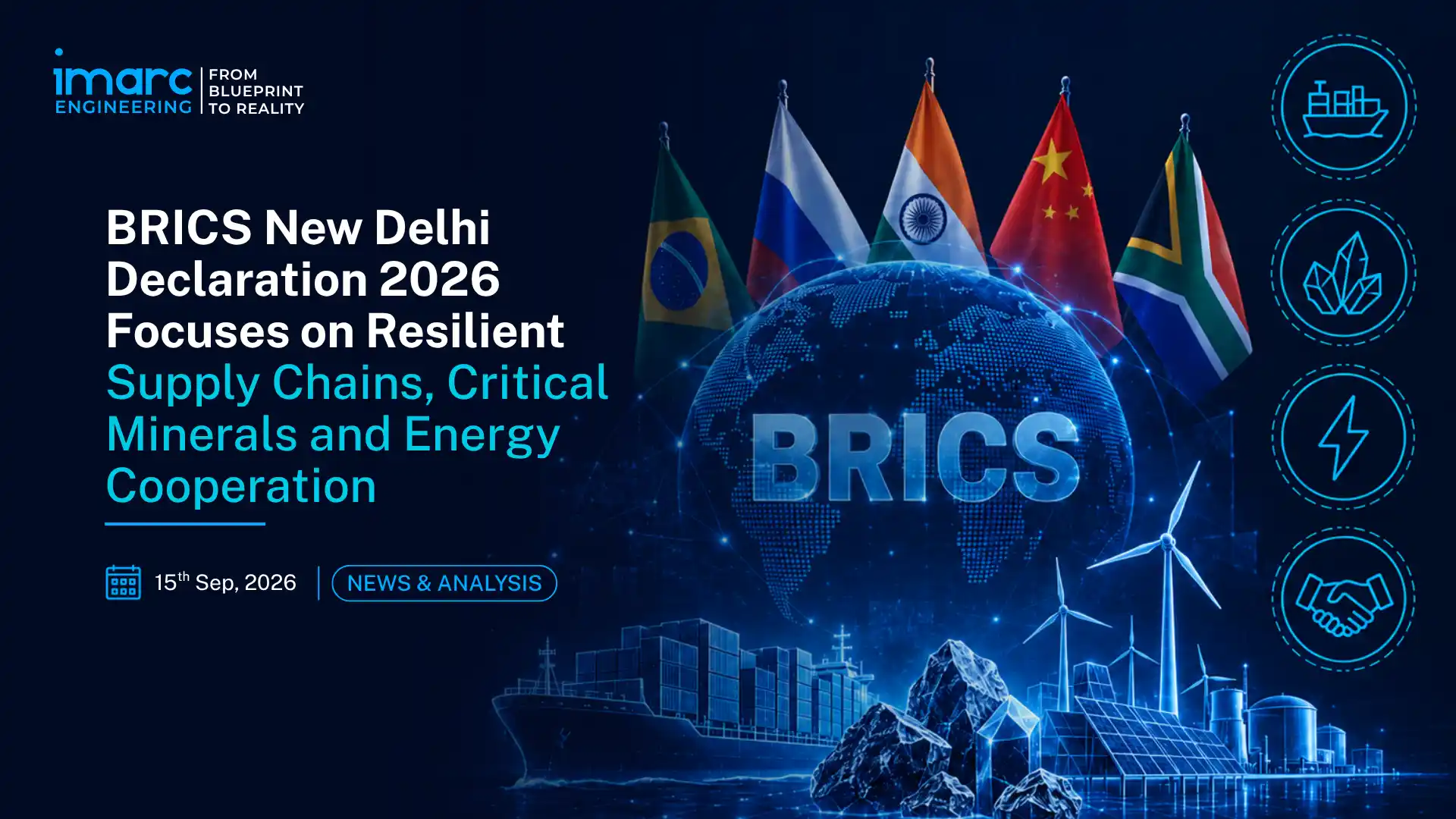
Leaders of BRICS countries adopted the New Delhi Declaration 2026 on September 12 during the 18th BRICS Summit held at Bharat Mandapam in New Delhi under India's chairship and the theme “Building for Resilience, Innovation, Cooperation and Sustainability.” The declaration sets out the grouping's shared priorities across trade, energy security, critical minerals, resilient supply chains, technology and broader economic cooperation.
Among its most substantive economic sections, the declaration sets out shared positions on critical minerals, energy security, resilient supply chains, and international trade, positions that carry real signalling weight for how BRICS economies, including India, may approach manufacturing and infrastructure investment in the years ahead. It is worth stating plainly at the outset: this is a diplomatic and policy-cooperation document, not a funding instrument or investment sanction, and it does not itself commit any government or company to specific projects or capital outlays.
What is the BRICS New Delhi Declaration 2026?
The declaration is the consensus outcome document of the 2026 BRICS Summit, reflecting India's priorities during its chairship year and spanning economic cooperation, technology, energy, trade, and geopolitical issues including West Asia and UN Security Council reform. Beyond the economic content, the declaration expressed deep concern over the continued escalation of tensions in West Asia, urged maximum restraint, and voiced serious concern over attacks on civilian infrastructure and IAEA-safeguarded nuclear facilities, while stressing that trade, supply chains, and energy flows through the region must remain open.
On global governance, the grouping backed China and Russia's roles as permanent UN Security Council members and supported India's case for permanent membership of a reformed Council. The declaration also endorsed a more inclusive, safe, and development-oriented approach to artificial intelligence and reaffirmed commitment to peaceful space exploration, highlighting the bloc's Remote Sensing Satellite Constellation.
What Does the Declaration Say About Critical Minerals?
BRICS leaders backed supply chains for critical minerals that are "reliable, responsible, diversified, resilient, fair, sustainable and just," while explicitly stressing that resource-rich nations must retain full sovereignty over their mineral wealth. The declaration called for such supply chains to promote benefit sharing, value addition, and economic diversification in resource-rich countries, rather than simply extracting raw material for processing elsewhere.
It also recognised critical minerals' role in developing zero- and low-emission energy technologies and in strengthening broader energy security, explicitly linking the critical minerals language to the declaration's separate energy security commitments rather than treating the two as unrelated topics.
What Does the Declaration Say About Energy Security?
The declaration highlighted "the need to enhance energy security by ensuring energy market stability and maintaining undisrupted flows of energy from diverse sources, strengthening value chains, ensuring resilience and protection of critical energy infrastructure, including cross-border infrastructure."
The language places energy-supply continuity, diversified sources, resilient value chains and protection of critical infrastructure at the centre of the bloc's energy-security agenda. The declaration also recognises that fossil fuels will continue to play an important role in the energy mix of emerging and developing economies while supporting just, orderly and inclusive energy transitions.
What Does BRICS 2026 Say About Renewable Energy and the Energy Transition?
BRICS leaders adopted a Terms of Reference and Action Plan for a BRICS Photovoltaic Industry Working Group on September 12, part of a broader clean-technology agenda linking solar manufacturing, hydrogen, smart grids, and energy storage with industrial development across the bloc. The declaration also welcomes the further development of the BRICS Global Value Chain Action Plan 2026–2030, with particular attention to helping emerging market and developing economies move up global value chains, which calls for greater developing-country participation in higher-value manufacturing through investment, technology transfer, and industrial cooperation, and it calls for fair competition in renewable energy markets.
Trishant Dev, Deputy Programme Manager for the Climate Change and Green Economy Programme at the Centre for Science and Environment, described the bloc as "organising around competitiveness and forwarding a shared agenda in clean technology manufacturing for the Global South." The declaration frames this alongside a "just energy transition" that balances rising clean energy deployment with continued fossil fuel use in emerging economies, rather than mandating a uniform transition pathway across members with very different energy mixes.
How Does the Declaration Address Resilient Global Supply Chains?
Resilience is a common theme across the declaration’s sections on critical minerals, energy, and manufacturing rather than a standalone commitment. Together, the critical minerals provisions, energy infrastructure protections, and Global Value Chain Action Plan outline a shared BRICS approach to supply chain resilience based on diversified sourcing, stronger infrastructure protection, and greater value addition within resource-rich and manufacturing-capable member economies. Taken together, these provisions signal an effort to reduce supply-chain vulnerability while expanding the role of developing economies in higher-value manufacturing and production.
What Does the Declaration Say About Tariffs and International Trade?
The declaration explicitly opposed the Carbon Border Adjustment Mechanism (CBAM) and other "unilateral, punitive, discriminatory and protectionist measures that are not in line with international law," arguing such measures undermine developing countries' efforts to address climate change and build adaptive capacity. More broadly, the declaration raised concern over the growing use of unilateral tariff and non-tariff measures, arguing these distort trade and are inconsistent with World Trade Organization rules, and it warned that indiscriminate tariff increases and protectionist measures threaten global trade and supply chains.
This trade language was reinforced separately by the BRICS Finance Ministers and Central Bank Governors' joint statement issued the day before the leaders' declaration, which also condemned unilateral tariff and non-tariff measures without naming specific countries. The declaration also supported greater use of local currencies in cross-border trade and endorsed BRICS Pay as a mechanism for cross-border payments. It backed the BRICS Payment Task Force’s efforts to develop interoperable and low-cost payment systems, while stopping short of supporting the creation of a common BRICS currency.
How Could BRICS Cooperation Influence Manufacturing and Industrial Investment and What Could It Mean for India?
The declaration's critical minerals, energy security, and Global Value Chain Action Plan language points toward a shared policy direction among BRICS members, favouring domestic value addition in mineral-rich economies, diversified and protected energy supply chains, and greater developing-country participation in higher-value manufacturing, but it is important not to overstate what this represents.
The declaration is a statement of shared policy intent among sovereign governments, not a binding investment commitment, a funding mechanism, or a guarantee of specific manufacturing or infrastructure projects; individual governments and private investors would still need to translate this cooperative framework into national policy, financing, and project decisions before any capacity is actually built.
For India specifically, the declaration's emphasis on critical mineral value addition and the newly adopted Photovoltaic Industry Action Plan align with existing domestic priorities and could provide additional diplomatic and cooperative backing for those efforts, particularly around technology transfer and coordination with other resource-rich BRICS members. Whether that translates into concrete new manufacturing or infrastructure investment in India will depend on the specific bilateral and multilateral agreements that follow from this declaration, not on the declaration's text alone.
Eleven governments have unanimously agreed that critical mineral, energy, and manufacturing supply chains need to become more resilient, diversified, and value-additive, a meaningful diplomatic signal, but still a statement of shared intent rather than a funded project pipeline. Whether the New Delhi Declaration's language on critical minerals, energy security, and industrial cooperation becomes real manufacturing capacity in India and across BRICS will depend on the specific policies, financing, and engineering execution that follow, not on the declaration's adoption alone.
IMARC Engineering’s Perspective
The BRICS New Delhi Declaration 2026 signals a broad consensus among BRICS economies on policy priorities around critical mineral value addition, energy infrastructure resilience, and higher-value manufacturing participation areas directly relevant to India's industrial and energy investment agenda. At IMARC Engineering, we view the declaration as a policy-cooperation signal that could shape the environment for future manufacturing and infrastructure investment decisions, rather than as a commitment that directly creates or funds new projects.
The Photovoltaic Industry Action Plan and Global Value Chain Action Plan 2026-2030 may open doors for technology transfer, cooperative frameworks, and diplomatic support around solar manufacturing, critical mineral processing, and energy infrastructure resilience, but converting that supportive environment into an actual commissioned facility still requires the same fundamentals every project needs including feasibility studies, technology selection, site and supply chain planning, and disciplined project execution.
As India and other BRICS economies work to act on the declaration's stated priorities over the coming months and years, the companies and developers that pair this improving cooperative policy backdrop with rigorous project engineering will be the ones that actually convert shared intent into operating manufacturing and energy capacity.
Latest News
-
BRICS New Delhi Declaration 2026 Focuses on Resilient Supply Chains, Critical Minerals and Energy Cooperation
September 15, 2026
-
NTPC Invites EOI for Grid-Connected Sodium-Ion Battery Storage Pilot in India
September 14, 2026
-
Tamil Nadu Shortlists Cheyyur and Manellore for Chennai’s Second Airport, AAI to Assess Feasibility
September 10, 2026
-
East Central Railway Invites INR 4,040 Crore EPC Bids for Koderma Detour Double-Line Project
September 09, 2026
-
NHAI Receives 17 Bids for INR 8,300 Crore Rameshwar-Paradeep Coastal Highway Project
September 08, 2026
Trusted by Industry Leaders
We partner with global enterprises and ambitious businesses across sectors to deliver operational excellence, strategic insights, and sustainable growth through integrated solutions.












Success in Their Words
Real feedback from clients across industries. Discover how our solutions delivered measurable impact and operational excellence.

I wanted to express my sincere appreciation for your efforts in handling this matter. Your dedication and commitment have been truly commendable, and it is evident that you have put in tremendous hard work and expertise into resolving the issues at hand. We are greatly interested in continuing our collaboration with you in the future, as your professionalism and reliability have made you a trusted partner. Thank you once again for your invaluable contribution. We look forward to strengthening our partnership ahead.

It has been a pleasure working with the IMARC team. The insights provided were structured, clear, and highly valuable, helping us strengthen both our technical and financial planning with confidence. We deeply appreciate the team’s professionalism, responsiveness, and attention to detail throughout the engagement. Every requirement was well understood and effectively incorporated, resulting in a comprehensive and actionable output. Overall, our experience has been excellent, and I would gladly recommend IMARC to organizations seeking a reliable research partner.

Your service is truly exceptional. Working with the IMARC team has been a seamless and professional experience. The clarity of communication, responsiveness to queries, and consistent support at every stage made the entire engagement highly efficient. The insights shared were well-structured, practical, and perfectly aligned with our requirements, helping us make informed decisions with confidence. Overall, the dedication and professionalism demonstrated by your team stand out, and I would be glad to recommend IMARC as a reliable and trustworthy research partner.

IMARC did an outstanding job in preparing our study. They were punctual, precise, and consistently responsive throughout the entire process. The team delivered all the data we required in a clear, well-organized, and highly professional format. Their strong attention to detail, combined with their ability to meet every deadline without compromising quality, truly set them apart. Overall, their reliability and commitment made them an exceptional partner for our project, and we would gladly work with them again in the future.

IMARC made the whole process incredibly easy from start to finish. Everyone I interacted with via email was polite, professional, and straightforward to deal with, always keeping their promises regarding delivery timelines and remaining consistently solutions-focused. From my very first contact, I appreciated the professionalism and support shown by the entire IMARC team. I highly recommend IMARC to anyone seeking timely, affordable, and reliable information or advice. My experience with IMARC was excellent, and I truly cannot fault any aspect of it.

I’d like to express my sincere gratitude for the excellent work you accomplished with the study. Your ability to quickly understand our requirements and deliver high-quality results under tight timelines truly reflects your expertise, exceptional work ethic, and unwavering commitment to your customer’s success. The professionalism and responsiveness you demonstrated throughout the process made a significant difference. Our entire team and company are incredibly thankful for your dedication, reliability, and support. Once again, thank you for your outstanding contribution.
Ready to Experience the IMARC Advantage?
Whether you're planning a new facility, expanding operations, optimizing performance, or facing complex challenges—IMARC Engineering brings the expertise, experience, and commitment needed for success.