India Releases Draft Nuclear Power Rules Covering Licensing, Insurance, and Private Project Development
August 21, 2026
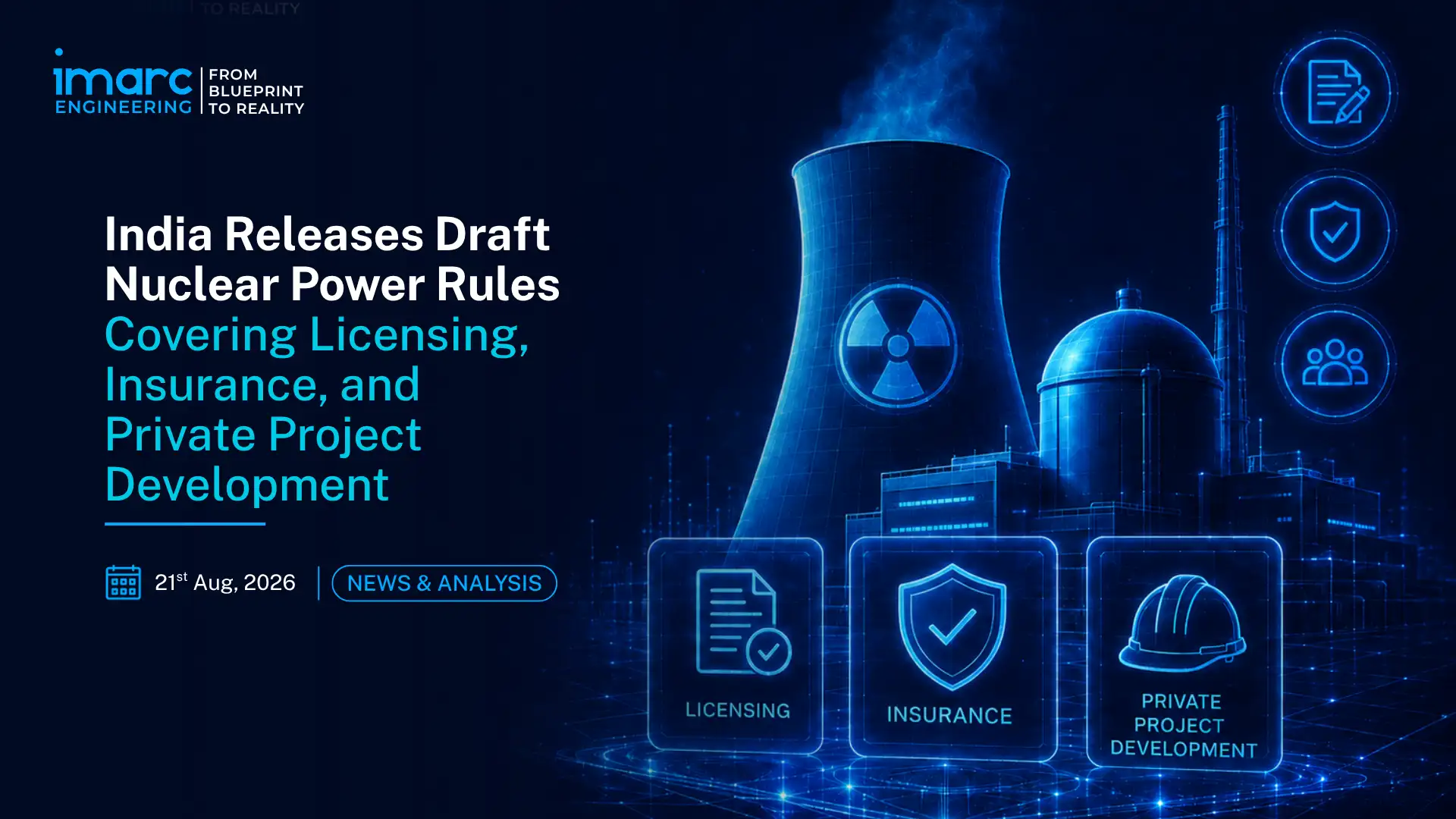
In August 2026, the Department of Atomic Energy released the draft SHANTI Rules, 2026, proposing the licensing, liability, financial-security, and procedural framework intended to support implementation of the Sustainable Harnessing and Advancement of Nuclear Energy for Transforming India (SHANTI) Act, 2025.
The draft rules arrived a day before Prime Minister Narendra Modi's Independence Day address, in which he announced that India aims to start five new nuclear reactors within this decade and reiterated the government's target of 100 GW of nuclear power capacity by 2047, up from roughly 8.78 GW today.
The SHANTI Act, which received presidential assent in December 2025, establishes a new legal framework for India's civil nuclear sector, replacing the earlier framework under the Atomic Energy Act, 1962 and the Civil Liability for Nuclear Damage Act, 2010. The Act creates a statutory pathway for private companies and joint ventures to build, own, operate, and decommission nuclear power plants under government licensing and regulatory oversight, marking a significant shift from India's historically state-led civil nuclear model.
India's draft nuclear power rules, which remain subject to finalisation, propose the operational procedures for licensing, financial security, and implementation of the liability framework that could shape how this legal opening translates into new nuclear projects.
What are India's New Draft Nuclear Power Rules?
The draft SHANTI Rules, 2026 are proposed subordinate regulations issued by the DAE under the SHANTI Act, 2025, and remain in draft form pending finalisation. They set out proposed procedures for licensing nuclear installations, financial-security arrangements, and implementation of the operator-liability framework established under the SHANTI Act.
The underlying Act continues to reserve certain sensitive nuclear activities, including uranium and thorium mining, enrichment and isotopic separation, spent-fuel reprocessing, high-level radioactive waste management, and heavy-water production, for the central government or authorised government entities. The draft rules propose the licensing and operating procedures for activities permitted under the Act, within these statutory boundaries.
What Licensing Framework is Proposed for Nuclear Power Projects in India?
Two provisions in the draft rules stand out for project developers. First, the draft proposes that the licensing authority may grant an in-principle approval even before an applicant has finalised its site or reactor technology. Once granted, the applicant could begin negotiating with reactor technology vendors and proceed with land acquisition and other infrastructure development in parallel, rather than needing every element locked down before formal engagement can begin.
Second, the draft proposes a single composite licence covering construction, ownership, operation, and decommissioning of a nuclear power plant or reactor, rather than requiring separate approvals at each project stage.
If finalised as proposed, the composite-licence model could change how statutory licensing is structured across the nuclear project lifecycle, although applicable safety authorisations, technical reviews, and regulatory requirements would still need to be satisfied.
What Insurance or Financial-Security Requirements Are Proposed for Nuclear Plant Operators?
The SHANTI Act establishes strict and no-fault operator liability for nuclear damage, including liability associated with the carriage of nuclear material, while the draft rules propose how operators would demonstrate the required financial protection. Draft Rule 77 proposes that operators maintain an insurance policy, financial security, or a combination of both, in accordance with the Act. The draft further proposes that this financial protection remain in place until all spent fuel has been removed from the relevant storage pool, extending the financial-security obligation beyond normal plant operations.
A separate provision in the draft would exempt nuclear installations owned by the central government from this insurance or financial-security requirement in specified cases, with the central government instead assuming liability for damages attributable to that operator. The draft rules also propose that the central government would constitute an expert group — including specialists in nuclear science and engineering, actuarial science, insurance, and law, alongside public-interest representatives — every five years to review the maximum limits of civil liability for nuclear damage and recommend amendments where warranted.
How Could the Draft Rules Affect Private-Sector Participation in India's Nuclear Power Industry?
The SHANTI Act establishes a defined operator-liability framework, while the draft rules propose greater procedural clarity on how operators would meet associated insurance and financial-security obligations. If finalised substantially as proposed, this could help private developers, lenders, and insurers assess liability exposure, long-term financial-security requirements, and project risk more clearly when evaluating private nuclear power projects in India.
At the same time, the strict no-fault liability framework under the Act, together with the financial-security obligations proposed in the draft rules, would need to be incorporated into project economics and long-term financial planning. The framework could therefore create a clearer pathway for private-sector participation in India's nuclear power industry without necessarily reducing the technical, financial, regulatory, and risk-management requirements associated with developing nuclear projects.
What Do the Draft Rules Mean for Foreign Reactor Technology and Nuclear Project Development?
The draft rules propose specific conditions for foreign reactor technology in India. For reactors based on a foreign design, the design would need to meet the applicable regulatory approval or certification requirements specified under the proposed framework, including requirements relating to its country of origin and deployment history.
If finalised, these provisions could influence which international reactor technologies and vendors are eligible for future nuclear project development in India. Developers considering foreign reactor technology would therefore need to evaluate the design's regulatory status, operating track record, technical suitability, supply-chain support, and compatibility with India's nuclear regulatory requirements.
Alongside this, the government's Nuclear Energy Mission, announced in Union Budget 2025-26, has allocated INR 20,000 crore toward the design, development, and deployment of Small Modular Reactors (SMRs), with a stated target of at least five indigenously designed SMRs operational by 2033. This indicates that domestic reactor technology development is progressing in parallel with the potential pathway for foreign reactor technologies contemplated under the draft rules.
What Should Developers Evaluate When Planning New Nuclear Power Projects in India?
A more defined licensing and liability framework changes the regulatory starting conditions for nuclear project development in India, but it does not reduce the underlying technical complexity of a nuclear power plant. Site selection remains a rigorous, multi-factor process involving seismic assessment, water availability for cooling, population density and evacuation planning, and grid connectivity, factors that an in-principle approval, even if the draft rules permit it ahead of site finalisation, does not resolve on the developer's behalf.
Technology evaluation, particularly for a developer considering a foreign-designed reactor, needs to confirm the design and its country-of-origin regulatory approval meet the qualification standard the draft rules propose, before major vendor or project commitments are made. Regulatory planning also needs to account for the fact that these rules remain in draft form, meaning the finalised version could differ from what is currently proposed, and any project timeline built around the draft needs to account for that regulatory uncertainty.
Financing structures need to model the insurance and financial-security obligations the draft proposes, including their extension through the spent-fuel removal period, as a long-duration cost rather than a one-time compliance item. And safety engineering, infrastructure planning, and construction sequencing for a nuclear facility remain as demanding as they have always been, a composite licence structure changes how approvals are bundled, not the engineering standard a plant must meet to be licensed and operated safely.
India's SHANTI Act establishes a new liability and private-participation framework, while the draft SHANTI Rules propose a composite licensing structure, financial-security procedures, and conditions for foreign reactor technology. Whether these reforms translate into 100 GW of operating capacity by 2047 will depend on project-specific site, technology, financing, safety, engineering, and execution decisions.
IMARC Engineering’s Perspective
India's draft nuclear power rules represent a genuinely significant step toward defining how private capital, foreign reactor technology, and a modernised liability framework could combine to support the country's 100 GW by 2047 ambition, but as a draft, the framework is still subject to change, and even once finalised, it addresses regulatory structure rather than project engineering.
At IMARC Engineering, we see this as the moment where developers evaluating nuclear power plant development need to pair regulatory awareness with rigorous, independent engineering assessment: site feasibility studies that test seismic, water, and grid conditions against a specific candidate location; technology evaluation that verifies a reactor design's country-of-origin approval status against the qualification standard the draft rules propose; and infrastructure and safety engineering planning that begins well before a licence, in-principle or composite, is granted.
As India works to move from 8.78 GW toward its 2047 target, and as these draft rules move toward finalisation, the developers that undertake rigorous site, technology, infrastructure, regulatory, and feasibility work early may be better positioned to translate an emerging regulatory framework into bankable and executable nuclear projects.
Latest News
-
IEX Subsidiary Applies for Coal Exchange Registration Under India’s New Coal Exchange Rules 2026
September 30, 2026
-
India Pushes Domestic Shipping Container Manufacturing with INR 10,000 Crore Assistance Scheme
September 25, 2026
-
India’s Growing GCC Sector Brings Greenfield Setup and Regulatory Compliance into Focus
September 24, 2026
-
Uttar Pradesh Approves INR 200+ Crore Ethanol Plant at Chhata Sugar Mill in Mathura
September 23, 2026
-
Escorts Kubota Breaks Ground on INR 2,000 Crore Greenfield Manufacturing Plant in Uttar Pradesh
September 22, 2026
Trusted by Industry Leaders
We partner with global enterprises and ambitious businesses across sectors to deliver operational excellence, strategic insights, and sustainable growth through integrated solutions.











Success in Their Words
Real feedback from clients across industries. Discover how our solutions delivered measurable impact and operational excellence.

I wanted to express my sincere appreciation for your efforts in handling this matter. Your dedication and commitment have been truly commendable, and it is evident that you have put in tremendous hard work and expertise into resolving the issues at hand. We are greatly interested in continuing our collaboration with you in the future, as your professionalism and reliability have made you a trusted partner. Thank you once again for your invaluable contribution. We look forward to strengthening our partnership ahead.

It has been a pleasure working with the IMARC team. The insights provided were structured, clear, and highly valuable, helping us strengthen both our technical and financial planning with confidence. We deeply appreciate the team’s professionalism, responsiveness, and attention to detail throughout the engagement. Every requirement was well understood and effectively incorporated, resulting in a comprehensive and actionable output. Overall, our experience has been excellent, and I would gladly recommend IMARC to organizations seeking a reliable research partner.

Your service is truly exceptional. Working with the IMARC team has been a seamless and professional experience. The clarity of communication, responsiveness to queries, and consistent support at every stage made the entire engagement highly efficient. The insights shared were well-structured, practical, and perfectly aligned with our requirements, helping us make informed decisions with confidence. Overall, the dedication and professionalism demonstrated by your team stand out, and I would be glad to recommend IMARC as a reliable and trustworthy research partner.

IMARC did an outstanding job in preparing our study. They were punctual, precise, and consistently responsive throughout the entire process. The team delivered all the data we required in a clear, well-organized, and highly professional format. Their strong attention to detail, combined with their ability to meet every deadline without compromising quality, truly set them apart. Overall, their reliability and commitment made them an exceptional partner for our project, and we would gladly work with them again in the future.

IMARC made the whole process incredibly easy from start to finish. Everyone I interacted with via email was polite, professional, and straightforward to deal with, always keeping their promises regarding delivery timelines and remaining consistently solutions-focused. From my very first contact, I appreciated the professionalism and support shown by the entire IMARC team. I highly recommend IMARC to anyone seeking timely, affordable, and reliable information or advice. My experience with IMARC was excellent, and I truly cannot fault any aspect of it.

I’d like to express my sincere gratitude for the excellent work you accomplished with the study. Your ability to quickly understand our requirements and deliver high-quality results under tight timelines truly reflects your expertise, exceptional work ethic, and unwavering commitment to your customer’s success. The professionalism and responsiveness you demonstrated throughout the process made a significant difference. Our entire team and company are incredibly thankful for your dedication, reliability, and support. Once again, thank you for your outstanding contribution.
Ready to Experience the IMARC Advantage?
Whether you're planning a new facility, expanding operations, optimizing performance, or facing complex challenges—IMARC Engineering brings the expertise, experience, and commitment needed for success.